Proceedings of the 55th Annual Meeting of the Association for Computational Linguistics (Short Papers), pages 635–640 Proceedings of the 55th Annual Meeting of the Association for Computational Linguistics (Short Papers), pages 635–640
Improving Semantic Relevance for Sequence-to-Sequence Learning of
Chinese Social Media Text Summarization
Shuming Ma1,2, Xu Sun1,2, Jingjing Xu1,2, Houfeng Wang1,2, Wenjie Li3, Qi Su4
1MOE Key Laboratory of Computational Linguistics, Peking University 2School of Electronics Engineering and Computer Science, Peking University
3Department of Computing, The Hong Kong Polytechnic University 4School of Foreign Languages, Peking University
{shumingma, xusun, jingjingxu, wanghf, sukia}@pku.edu.cn [email protected]
Abstract
Current Chinese social media text summa-rization models are based on an encoder-decoder framework. Although its gener-ated summaries are similar to source texts literally, they have low semantic relevance. In this work, our goal is to improve se-mantic relevance between source texts and summaries for Chinese social media sum-marization. We introduce a Semantic Rel-evance Based neural model to encourage high semantic similarity between texts and summaries. In our model, the source tex-t is representex-ted by a gatex-ted atex-ttex-tentex-tion en-coder, while the summary representation is produced by a decoder. Besides, the similarity score between the representa-tions is maximized during training. Our experiments show that the proposed mod-el outperforms basmod-eline systems on a so-cial media corpus.
1 Introduction
Text summarization is to produce a brief sum-mary of the main ideas of the text. For long and normal documents, extractive summarization achieves satisfying performance by selecting a few sentences from source texts (Radev et al., 2004;
Woodsend and Lapata, 2010; Cheng and Lapata,
2016). However, it does not apply to Chinese social media text summarization, where texts are comparatively short and often full of noise. There-fore, abstractive text summarization, which is based on encoder-decoder framework, is a better choice (Rush et al.,2015;Hu et al.,2015).
For extractive summarization, the selected sen-tences often have high semantic relevance to the text. However, for abstractive text summariza-tion, current models tend to produce grammatical
Text:昨晚,中联航空成都飞北京一架航班 被发现有多人吸烟。后因天气原因,飞机 备降太原机场。有乘客要求重新安检,机 长决定继续飞行,引起机组人员与未吸烟 乘客冲突。
Last night, several people were caught to smo-ke on a flight of China United Airlines from Chendu to Beijing. Later the flight temporari-ly landed on Taiyuan Airport. Some passeng-ers asked for a security check but were denied by the captain, which led to a collision betwe-en crew and passbetwe-engers.
RNN:中联航空机场发生爆炸致多人死亡。
China United Airlines exploded in the airport, leaving several people dead.
Gold:航班多人吸烟机组人员与乘客冲突。
Several people smoked on a flight which led to a collision between crew and passengers.
Figure 1: An example of RNN generated summa-ry. It has high similarity to the text literally, but low semantic relevance.
and coherent summaries regardless of its semantic relevance with source texts. Figure 1 shows that the summary generated by a current model (RNN encoder-decoder) is similar to the source text liter-ally, but it has low semantic relevance.
In this work, our goal is to improve the seman-tic relevance between source texts and generat-ed summaries for Chinese social mgenerat-edia text sum-marization. To achieve this goal, we propose a Semantic Relevance Based neural model. In our model, a similarity evaluation component is intro-duced to measure the relevance of source texts and generated summaries. During training, it maxi-mizes the similarity score to encourage high se-mantic relevance between source texts and
maries. The representation of source texts is pro-duced by an encoder, while that of summaries is computed by a decoder. We introduce a gated at-tention encoder to better represent the source tex-t. Besides, our decoder generates summaries and provide the summary representation. Experiments show that our proposed model has better perfor-mance than baseline systems on the social media corpus.
2 Background: Chinese Abstractive Text Summarization
Current Chinese social media text summarization model is based on encoder-decoder framework. Encoder-decoder model is able to compress source texts x = {x1, x2, ..., xN} into continuous
vec-tor representation with an encoder, and then gen-erate the summaryy={y1, y2, ..., yM}with a
de-coder. In the previous work (Hu et al.,2015), the encoder is a bi-directional gated recurrent neural network, which maps source texts into sentence vector {h1, h2, ..., hN}. The decoder is a
uni-directional recurrent neural network, which pro-duces the distribution of output wordsytwith
pre-vious hidden statest−1 and wordyt−1:
p(yt|x) =sof tmaxf(st−1, yt−1) (1)
wheref is recurrent neural network output
func-tion, ands0is the last hidden state of encoderhN.
Attention mechanism is introduced to bet-ter capture context information of source texts (Bahdanau et al.,2014). Attention vectorct
is represented by the weighted sum of encoder hidden states:
ct= N ∑
i=1
αtihi (2)
αti=
eg(st,hi)
∑N
j=1eg(st,hj)
(3)
where g(st, hi) is a relevant score between
de-coder hidden state st and encoder hidden state
hi. When predicting an output word, the decoder
takes account of attention vector, which contain-s the alignment information between contain-source textcontain-s and summaries.
3 Proposed Model
Our assumption is that source texts and sum-maries have high semantic relevance, so our pro-posed model encourages high similarity between
A
B
C
X
Y
Y
Z
݄
ଵ݄
ଶ݄
ଷݏ
ଵݏ
ଶAttention
[image:2.595.321.519.62.280.2]Cos
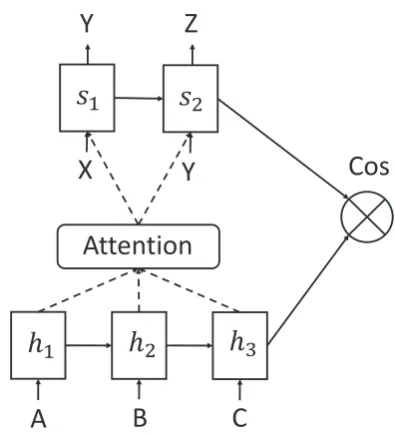
Figure 2: Our Semantic Relevance Based neural model. It consists of decoder (above), encoder (below) and cosine similarity function.
their representations. Figure 2 shows our pro-posed model. The model consists of three compo-nents: encoder, decoder and a similarity function. The encoder compresses source texts into seman-tic vectors, and the decoder generates summaries and produces semantic vectors of the generated summaries. Finally, the similarity function eval-uates the relevance between the sematic vectors of source texts and generated summaries. Our train-ing objective is to maximize the similarity score so that the generated summaries have high semantic relevance with source texts.
3.1 Text Representation
There are several methods to represent a text or a sentence, such as mean pooling of RNN output or reserving the last state of RNN. In our model, source text is represented by a gated attention en-coder (Hahn and Keller, 2016). Every upcoming word is fed into a gated attention network, which measures its importance. The gated attention net-work outputs the important score with a feedfor-ward network. At each time step, it inputs a word vectoretand its previous context vector ht, then
outputs the scoreβt. Then the word vector et is
multiplied by the scoreβt, and fed into RNN
en-coder. We select the last outputhN of RNN
en-coder as the semantic vector of the source textVt.
we encode the same sentence twice. Actually, the last outputsM contains information of both source
text and generated summaries. We simply com-pute the semantic vector of the summary by sub-tractinghN fromsM:
Vs=sM −hN (4)
Previous work has proved that it is effective to represent a span of words without encoding them once more (Wang and Chang,2016).
3.2 Semantic Relevance
Our goal is to compute the semantic relevance of source text and generated summary given seman-tic vector Vt and Vs. Here, we use cosine
simi-larity to measure the semantic relevance, which is represented with a dot product and magnitude:
cos(Vs, Vt) =
Vs·Vt
∥Vs∥∥Vt∥ (5)
Source text and summary share the same language, so it is reasonable to assume that their semantic vectors are distributed in the same space. Cosine similarity is a good way to measure the distance between two vectors in the same space.
3.3 Training
Given the model parameterθand input textx, the model produces corresponding summaryyand
se-mantic vectorVsandVt. The objective is to
mini-mize the loss function:
L=−p(y|x;θ)−λcos(Vs, Vt) (6)
where p(y|x;θ) is the conditional probability of
summaries given source texts, and is computed by the encoder-decoder model. cos(Vs, Vt) is cosine
similarity of semantic vectorsVsandVt. This term
tries to maximize the semantic relevance between source input and target output.
4 Experiments
In this section, we present the evaluation of our model and show its performance on a popular so-cial media corpus. Besides, we use a case to ex-plain the semantic relevance between generated summary and source text.
4.1 Dataset
Our dataset is Large Scale Chinese Short Tex-t SummarizaTex-tion DaTex-taseTex-t (LCSTS), which is con-structed by Hu et al. (2015). The dataset consists
of more than 2.4 million text-summary pairs, con-structed from a famous Chinese social media web-site called Sina Weibo1. It is split into three parts,
with 2,400,591 pairs in PART I, 10,666 pairs in PART II and 1,106 pairs in PART III. All the text-summary pairs in PART II and PART III are man-ually annotated with relevant scores ranged from 1 to 5, and we only reserve pairs with scores no less than 3. Following the previous work, we use PART I as training set, PART II as development set, and PART III as test set.
4.2 Experiment Setting
To alleviate the risk of word segmentation mis-takes (Xu and Sun,2016), we use Chinese charac-ter sequences as both source inputs and target out-puts. We limit the model vocabulary size to 4000, which covers most of the common characters. Each character is represented by a random initial-ized word embedding. We tune our parameter on the development set. In our model, the embed-ding size is 400, the hidden state size of encoder-decoder is 500, and the size of gated attention net-work is 1000. We use Adam optimizer to learn the model parameters, and the batch size is set as 32. The parameterλis 0.0001. Both the encoder
and decoder are based on LSTM unit. Follow-ing the previous work (Hu et al.,2015), our eval-uation metric is F-score of ROUGE: ROUGE-1, ROUGE-2 and ROUGE-L (Lin and Hovy,2003).
4.3 Baseline Systems
RNN. We denote RNN as the basic sequence-to-sequence model with bi-directional GRU encoder and uni-directional GRU decoder. It is a widely used language generated framework, so it is an im-portant baseline.
RNN context. RNN context is a sequence-to-sequence framework with neural attention. Atten-tion mechanism helps capture the context informa-tion of source texts. This model is a stronger base-line system.
4.4 Results and Discussions
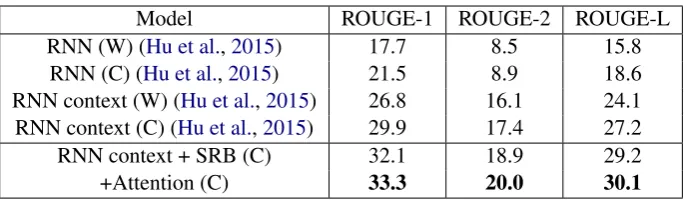
We compare our model with above baseline sys-tems, including RNN and RNN context. We refer to our proposed Semantic Relevance Based neural model asSRB. Besides, SRB with a gated atten-tion encoder is denoted as +Attention. Table 1
Model ROUGE-1 ROUGE-2 ROUGE-L RNN (W) (Hu et al.,2015) 17.7 8.5 15.8
[image:4.595.128.472.60.160.2]RNN (C) (Hu et al.,2015) 21.5 8.9 18.6 RNN context (W) (Hu et al.,2015) 26.8 16.1 24.1 RNN context (C) (Hu et al.,2015) 29.9 17.4 27.2 RNN context + SRB (C) 32.1 18.9 29.2 +Attention (C) 33.3 20.0 30.1
Table 1: Results of our model and baseline systems. Our models achieve substantial improvement of all ROUGE scores over baseline systems. (W: Word level; C: Character level).
Text:仔细一算,上海的互联网公司不乏成功
案例,但最终成为BAT一类巨头的几乎没有,
这也能解释为何纳税百强的榜单中鲜少互联 网公司的身影。有一类是被并购,比如:易
趣、土豆网、PPS、PPTV、一号店等;有一
类是数年偏安于细分市场。
With careful calculation, there are many succe-ssful Internet companies in Shanghai, but few of them becomes giant company like BAT. Th-is Th-is also the reason why few Internet compan-ies are listed in top hundred compancompan-ies of pay-ing tax. Some of them are merged, such as Eb-ay, Tudou, PPS, PPTV, Yihaodian and so on. Others are satisfied with segment market for years.
Gold:为什么上海出不了互联网巨头?
Why Shanghai comes out no giant company?
RNN context:上海的互联网巨头。
Shanghai’s giant company.
SRB:上海鲜少互联网巨头的身影。
Shanghai has few giant companies.
Figure 3: An Example of RNN generated summa-ry on LCSTS corpus.
shows the results of our models and baseline sys-tems. We can see SRB outperforms both RN-N and RRN-NRN-N context in the F-score of ROUGE-1, ROUGE-2 and ROUGE-L. It concludes that SR-B generates more key words and phrases. With a gated attention encoder, SRB achieves a bet-ter performance with 33.3 F-score of ROUGE-1, 20.0 ROUGE-2 and 30.1 ROUGE-L. It shows that the gated attention reduces noisy and unimportan-t informaunimportan-tion, so unimportan-thaunimportan-t unimportan-the remaining informaunimportan-tion represents a clear idea of source text. The bet-ter representation of encoder leads to a betbet-ter
se-Model level R-1 R-2 R-L RNN context Word 26.8 16.1 24.1 (Hu et al.,2015) Char 29.9 17.4 27.2 COPYNET Word 35.0 22.3 32.0 (Gu et al.,2016) Char 34.4 21.6 31.3 this work Char 33.3 20.0 30.1
Table 2: Results of our model and state-of-the-art systems. COPYNET incorporates copying mech-anism to solve out-of-vocabulary problem, so its has higher ROUGE scores. Our model does not incorporate this mechanism currently. In the fu-ture work, we will implement this technic to fur-ther improve the performance. (Word: Word level; Char: Character level; R-1: F-score of ROUGE-1; R-2: F-score of ROUGE-2; R-L: F-score of ROUGE-L)
mantic relevance evaluation by the similarity func-tion. Therefore, SRB with gated attention encoder is able to generate summaries with high semantic relevance to source text.
Figure3is an example to show the semantic rel-evance between the source text and the summary. It shows that the main idea of the source text is about the reason why Shanghai has few giant com-pany. RNN context produces “Shanghai’s giant companies” which is literally similar to the source text, while SRB generates “Shanghai has few giant companies”, which is closer to the main idea in semantics. It concludes that SRB produces sum-maries with higher semantic similarity to texts.
5 Related Work
Abstractive text summarization has achieved suc-cessful performance thanks to the sequence-to-sequence model (Sutskever et al., 2014) and at-tention mechanism (Bahdanau et al.,2014). Rush et al. (2015) first used an attention-based en-coder to compress texts and a neural network lan-guage decoder to generate summaries. Follow-ing this work, recurrent encoder was introduced to text summarization, and gained better perfor-mance (Lopyrev, 2015;Chopra et al.,2016). To-wards Chinese texts, Hu et al. (2015) built a large corpus of Chinese short text summarization. To deal with unknown word problem, Nallapati et al. (2016) proposed a generator-pointer model so that the decoder is able to generate words in source texts. Gu et al. (2016) also solved this issue by in-corporating copying mechanism.
Our work is also related to neural attention model. Neural attention model is first proposed by Bahdanau et al. (2014). There are many other methods to improve neural attention mod-el (Jean et al.,2015;Luong et al.,2015) and accel-erate the training process (Sun,2016).
6 Conclusion
Our work aims at improving semantic relevance of generated summaries and source texts for Chi-nese social media text summarization. Our model is able to transform the text and the summary in-to a dense vecin-tor, and encourage high similarity of their representation. Experiments show that our model outperforms baseline systems, and the gen-erated summary has higher semantic relevance.
Acknowledgements
This work was supported in part by National High Technology Research and Development Program of China (863 Program, No. 2015AA015404), and National Natural Science Foundation of Chi-na (No. 61673028). Xu Sun is the corresponding author of this paper.
References
Dzmitry Bahdanau, Kyunghyun Cho, and Yoshua Ben-gio. 2014. Neural machine translation by
joint-ly learning to align and translate. CoRR
ab-s/1409.0473.
Jianpeng Cheng and Mirella Lapata. 2016. Neural summarization by extracting sentences and
word-s. In Proceedings of the 54th Annual Meeting of
the Association for Computational Linguistics, ACL 2016, August 7-12, 2016, Berlin, Germany, Volume 1: Long Papers.
Sumit Chopra, Michael Auli, and Alexander M. Rush. 2016. Abstractive sentence summarization with
at-tentive recurrent neural networks. InNAACL HLT
2016, The 2016 Conference of the North American Chapter of the Association for Computational Lin-guistics: Human Language Technologies, San Diego California, USA, June 12-17, 2016. pages 93–98.
Jiatao Gu, Zhengdong Lu, Hang Li, and Victor O. K.
Li. 2016. Incorporating copying mechanism in
sequence-to-sequence learning. In Proceedings of
the 54th Annual Meeting of the Association for Computational Linguistics, ACL 2016, August 7-12, 2016, Berlin, Germany, Volume 1: Long Papers.
Michael Hahn and Frank Keller. 2016. Modeling
hu-man reading with neural attention. In
Proceed-ings of the 2016 Conference on Empirical Method-s in Natural Language ProceMethod-sMethod-sing, EMNLP 2016, Austin, Texas, USA, November 1-4, 2016. pages 85– 95.
Baotian Hu, Qingcai Chen, and Fangze Zhu. 2015. LC-STS: A large scale chinese short text summarization
dataset. InProceedings of the 2015 Conference on
Empirical Methods in Natural Language Process-ing, EMNLP 2015, Lisbon, Portugal, September 17-21, 2015. pages 1967–1972.
S´ebastien Jean, KyungHyun Cho, Roland Memisevic, and Yoshua Bengio. 2015. On using very large target vocabulary for neural machine translation. In Proceedings of the 53rd Annual Meeting of the Association for Computational Linguistics and the 7th International Joint Conference on Natural Lan-guage Processing of the Asian Federation of Natural Language Processing, ACL 2015, July 26-31, 2015, Beijing, China, Volume 1: Long Papers. pages 1–10.
Chin-Yew Lin and Eduard H. Hovy. 2003. Auto-matic evaluation of summaries using n-gram
co-occurrence statistics. InHuman Language
Technol-ogy Conference of the North American Chapter of the Association for Computational Linguistics, HLT-NAACL 2003, Edmonton, Canada, May 27 - June 1, 2003.
Konstantin Lopyrev. 2015. Generating news
head-lines with recurrent neural networks. CoRR
ab-s/1512.01712.
Thang Luong, Hieu Pham, and Christopher D. Man-ning. 2015. Effective approaches to attention-based
neural machine translation. In Proceedings of the
2015 Conference on Empirical Methods in Natural Language Processing, EMNLP 2015, Lisbon, Portu-gal, September 17-21, 2015. pages 1412–1421.
Abstractive text summarization using
sequence-to-sequence rnns and beyond. In Proceedings of the
20th SIGNLL Conference on Computational Natural Language Learning, CoNLL 2016, Berlin, Germany, August 11-12, 2016. pages 280–290.
Dragomir R. Radev, Timothy Allison, Sasha Blair-Goldensohn, John Blitzer, Arda C¸elebi, Stanko Dimitrov, Elliott Dr´abek, Ali Hakim, Wai Lam, Danyu Liu, Jahna Otterbacher, Hong Qi, Horacio Saggion, Simone Teufel, Michael Topper, Adam Winkel, and Zhu Zhang. 2004. MEAD - A platform for multidocument multilingual text summarization. In Proceedings of the Fourth International Confer-ence on Language Resources and Evaluation, LREC 2004, May 26-28, 2004, Lisbon, Portugal.
Alexander M. Rush, Sumit Chopra, and Jason Weston. 2015. A neural attention model for abstractive
sen-tence summarization. In Proceedings of the 2015
Conference on Empirical Methods in Natural Lan-guage Processing, EMNLP 2015, Lisbon, Portugal, September 17-21, 2015. pages 379–389.
Xu Sun. 2016. Asynchronous parallel learning for neu-ral networks and structured models with dense
fea-tures. InCOLING 2016, 26th International
Confer-ence on Computational Linguistics, Proceedings of the Conference: Technical Papers, December 11-16, 2016, Osaka, Japan. pages 192–202.
Ilya Sutskever, Oriol Vinyals, and Quoc V. Le. 2014. Sequence to sequence learning with neural
network-s. In Advances in Neural Information Processing
Systems 27: Annual Conference on Neural Informa-tion Processing Systems 2014, December 8-13 2014, Montreal, Quebec, Canada. pages 3104–3112.
Wenhui Wang and Baobao Chang. 2016. Graph-based dependency parsing with bidirectional LSTM. In
Proceedings of the 54th Annual Meeting of the As-sociation for Computational Linguistics, ACL 2016, August 7-12, 2016, Berlin, Germany, Volume 1: Long Papers.
Kristian Woodsend and Mirella Lapata. 2010.
Auto-matic generation of story highlights. InACL 2010,
Proceedings of the 48th Annual Meeting of the As-sociation for Computational Linguistics, July 11-16, 2010, Uppsala, Sweden. pages 565–574.
Jingjing Xu and Xu Sun. 2016. Dependency-based gat-ed recursive neural network for chinese word
seg-mentation. InMeeting of the Association for