2058
Unsupervised Neural Text Simplification
Sai Surya† Abhijit Mishra‡ Anirban Laha‡ Parag Jain‡ Karthik Sankaranarayanan‡
†IIT Kharagpur, India ‡IBM Research
{abhijimi,anirlaha,pajain34,kartsank}@in.ibm.com
Abstract
The paper presents a first attempt towards un-supervised neural text simplification that re-lies only on unlabeled text corpora. The core framework is composed of a shared encoder and a pair of attentional-decoders, crucially as-sisted bydiscrimination-based lossesand de-noising. The framework is trained using unla-beled text collected fromen-Wikipediadump. Our analysis (both quantitative and qualita-tive involving human evaluators) on public test data shows that the proposed model can perform text-simplification at both lexical and syntactic levels, competitive to existing super-vised methods. It also outperforms viable un-supervised baselines. Adding a few labeled pairs helps improve the performance further.
1 Introduction
Text Simplification (TS) deals with transforming the original text into simplified variants to increase its readability and understandability. TS is an im-portant task in computational linguistics, and has numerous use-cases in fields of education technol-ogy, targeted content creation, language learning, where producing variants of the text with vary-ing degree of simplicity is desired. TS systems are typically designed to simplify from two differ-ent linguistic aspects: (a) Lexical aspect, by re-placing complex words in the input with simpler synonyms (Devlin,1998;Candido Jr et al.,2009; Yatskar et al., 2010; Biran et al., 2011; Glavaˇs and ˇStajner, 2015), and (b)Syntactic aspect, by altering the inherent hierarchical structure of the sentences (Chandrasekar and Srinivas,1997; Can-ning and Tait,1999;Siddharthan,2006;Filippova and Strube, 2008; Brouwers et al., 2014). From the perspective of sentence construction, sentence simplification can be thought to be a form of text-transformationthat involves three major types of operations such as (a) splitting (Siddharthan, 2006;Petersen and Ostendorf,2007;Narayan and
Gardent,2014) (b) deletion/compression (Knight and Marcu, 2002; Clarke and Lapata, 2006; Fil-ippova and Strube,2008;Rush et al.,2015; Filip-pova et al.,2015), and (c)paraphrasing(Specia, 2010;Coster and Kauchak,2011;Wubben et al., 2012;Wang et al.,2016;Nisioi et al.,2017).
Most of the current TS systems require large-scale parallel corpora for training (except for sys-tems likeGlavaˇs and ˇStajner(2015) that performs only lexical-simplification), which is a major im-pediment in scaling to newer languages, use-cases, domains and output styles for which such large-scale parallel data do not exist. In fact, one of the popular corpus for TS in English language,i.e.,the Wikipedia-SimpleWikipedia aligned dataset has been prone to noise (mis-aligned instances) and inadequacy (i.e., instances having non-simplified targets) (Xu et al.,2015;ˇStajner et al.,2015), lead-ing to noisy supervised models (Wubben et al., 2012). While creation of better datasets (such as, NewselabyXu et al.(2015)) can always help, we explore the unsupervised learning paradigm which can potentially work with unlabeled datasets that are cheaper and easier to obtain.
At the heart of the TS problem is the need for preservation of language semantics with the goal of improving readability. From a neural-learning perspective, this entails a specially designed auto-encoder, which not only is capable of reconstruct-ing the original input but also can additionally in-troduce variations so that the auto-encoded out-put is a simplified version of the inout-put. Intu-itively, both of these can be learned by looking at the structure and language patterns of a large amount of non-aligned complex and simple sen-tences (which are much cheaper to obtain com-pared to aligned parallel data). These motivations form the basis of our work.
The crux of the (unsupervised) auto-encoding framework is a shared encoder and a pair of attention-based decoders (one for each type of cor-pus). The encoder attempts to produce semantics-preserving representations which can be acted upon by the respective decoders (simple or com-plex) to generate the appropriate text output they are designed for. The framework is crucially sup-ported by two kinds of losses: (1)adversarial loss
- to distinguish between the real or fake attention context vectors for the simple decoder, and (2) di-versification loss - to distinguish between atten-tion context vectors of the simple decoder and the complex decoder. The first loss ensures that only the aspects of semantics that are necessary for sim-plification are passed to the simple decoder in the form of the attention context vectors. The second loss, on the other hand, facilitates passing different semantic aspects to the different decoders through their respective context vectors. Also we employ
denoisingin the auto-encoding setup for enabling syntactic transformations.
The framework is trained using unlabeled text collected from Wikipedia (complex) and Simple Wikipedia (simple). It attempts to perform sim-plification both lexically and syntactically unlike prevalent systems which mostly target them sep-arately. We demonstrate the competitiveness of our unsupervised framework alongside supervised skylines through both automatic evaluation met-rics and human evaluation studies. We also outper-form another unsupervised baseline (Artetxe et al., 2018b), first proposed for neural machine transla-tion. Further, we demonstrate that by leveraging a small amount of labeled parallel data, perfor-mance can be improved further. Our code and a new dataset containing partitioned unlabeled sets of simple and complex sentences is publicly avail-able1.
2 Related Work
Text Simplification has often been discussed from psychological and linguistic standpoints (L’Allier, 1980;McNamara et al., 1996;Linderholm et al., 2000). A heuristic-based system was first intro-duced byChandrasekar and Srinivas(1997) which induces rules for simplification automatically ex-tracted from annotated corpora. Canning and Tait (1999) proposed a modular system that uses NLP tools such as morphological analyzer, POS tagger
1https://github.com/subramanyamdvss/UnsupNTS
plus heuristics to simplify the text both lexically and syntactically. Most of these systems (Sid-dharthan, 2014) are separately targeted towards lexical and syntactic simplification and are lim-ited to splitting and/or truncating sentences. For paraphrasing based simplification, data-driven ap-proaches were proposed like phrase-based SMT (Specia, 2010; ˇStajner et al., 2015) or their vari-ants (Coster and Kauchak,2011;Xu et al.,2016), that combine heuristic and optimization strategies for better TS. Recently proposed TS systems are based on neural seq2seq architecture (Bahdanau et al.,2014) which is modified for TS specific op-erations (Wang et al., 2016; Nisioi et al., 2017). While these systems produce state of the art re-sults on the popular Wikipedia dataset (Coster and Kauchak,2011), they may not be generalizable be-cause of the noise and bias in the dataset (Xu et al., 2015) and overfitting. Towards this, ˇStajner and Nisioi(2018) showed that improved datasets and minor model changes (such as using reduced vo-cabulary and enabling copy mechanism) help ob-tain reasonable performance for both in-domain and cross-domain TS.
In the unsupervised paradigm, Paetzold and Specia (2016) proposed an unsupervised lexi-cal simplification technique that replaces complex words in the input with simpler synonyms, which are extracted and disambiguated using word em-beddings. However, this work, unlike ours only addresses lexical simplification and cannot be triv-ially extended for other forms of simplification such as splitting and rephrasing. Other works re-lated to style transfer (Zhang et al., 2018; Shen et al., 2017; Xu et al., 2018) typically look into the problem of sentiment transformation and are not motivated by the linguistic aspects of TS, and hence not comparable to our work. As far as we know, ours is a first of its kind end-to-end solution for unsupervised TS. At this point, though super-vised solutions perform better than unsupersuper-vised ones, we believe unsupervised techniques should be further explored since they hold greater poten-tial with regards to scalability to various tasks.
3 Model Description
(ob-𝐴"# 𝐴"$ 𝐴"% 𝐴"&
𝑦# 𝑦$ 𝑦% 𝑦&
𝐴(# 𝐴($ 𝐴(% 𝐴(&
𝑦# 𝑦$ 𝑦% 𝑦&
𝑥# 𝑥$ 𝑥% 𝑥*
𝑬
𝑮𝒅 𝑮𝒔
Decoder Decoder
Encoder Discriminator
Classifier
𝓛𝒓𝒆𝒄(𝜽𝑮𝒅, 𝜽𝑬), 𝓛𝒅𝒆𝒏𝒐𝒊(𝜽𝑮𝒅, 𝜽𝑬)
𝓛𝒂𝒅𝒗,𝑫(𝜽𝑫)
𝓛𝒅𝒊𝒗,𝑪(𝜽𝑪)
𝓛𝒓𝒆𝒄(𝜽𝑮𝒔, 𝜽𝑬), 𝓛𝒅𝒆𝒏𝒐𝒊(𝜽𝑮𝒔, 𝜽𝑬)
[image:3.595.162.439.66.217.2]𝓛𝒅𝒊𝒗,𝑮𝒔(𝜽𝑬, 𝜽𝑮𝒔) 𝓛𝒂𝒅𝒗,𝑮𝒔(𝜽𝑬, 𝜽𝑮𝒔)
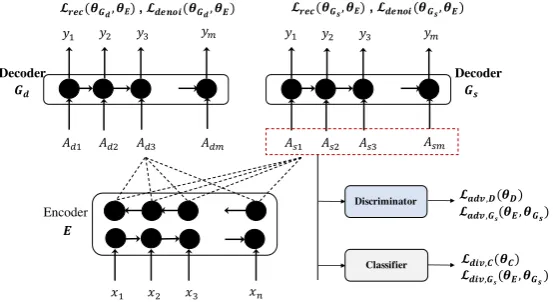
Figure 1: System Architecture. Input sentences of any domain is encoded byE, and decoded byGs,Gd.
Dis-criminatorDand classifierCtune the attention vectors for simplification.Lrepresents loss functions. The figure only reveals one layer inE,GsandGdfor simplicity. However, the model uses two layers of GRUs (Section3).
tained after a standard look up operation on the embedding matrix), is passed through a shared en-coder (E), the output representation from which is fed to two decoders (Gs, Gd) with attention mechanism.Gsis meant to generate a simple sen-tence from the encoded representation, whereas
Gd generates a complex sentence. A discrimi-nator (D) and a classifier (C) are also employed adversarially to distinguish between the attention context vectors computed with respect to the two decoders. Figure 1 is illustrates our system. We describe the components below.
3.1 Encode-Attend-Decode Model
EncoderEuses two layers of bi-directional GRUs (Cho et al., 2014b), and decoders Gs, Gd have two layers of GRUs each. E extracts the hidden representations from an input sentence. The de-coders output sentences, sequentially one word at a time. Each decoder-step involves using global attentionto create a context-vector (hidden repre-sentations weighted by attention weights) as an in-put for the next decoder-step. The attention mech-anism enables the decoders to focus on different parts of the input sentence. For the input sentence
X with nwords, the encoder produces nhidden representations,H = {h1, h2, . . . , hn}. The
con-text vector extracted fromX by a decoder Gfor time-steptis represented as,
At(X) = n
X
i=1
aithi (1)
where, ait denotes attention weight for the
hid-den representation at theithinput position with re-spect to decoder-stept. As there are two decoders,
Ast(X) and Adt(X) denote the context vectors
computed from decodersGsandGdrespectively for time-stepst∈ {1. . . m},mdenoting the total number of decoding steps performed2. The matri-cesAs(X)andAd(X)represent the sequence of
respective context vectors from all time-steps.
3.2 Discriminator and Classifier
A discriminator D is employed to influence the way the decoderGswill attend to the hidden rep-resentations, which has to be different for different types of inputs to the shared encoderE(simple vs complex). The input to D is the context vector sequence matrixAs pertaining toGs, and it
pro-duces a binary output,{1,0},1indicating the fact that the context vector sequence is close to a typi-cal context vector sequence extracted from simple sentences seen in the dataset. Gs andD are in-dulged in an adversarial interplay through an ad-versarial loss function (see Section4.2), analogous to GANs (Goodfellow et al., 2014), where the generator and discriminators, converge to a point where the distribution of the generations eventu-ally resembles the distribution of the genuine sam-ples. In our case, adversarial loss tunes the context vector sequence from a complex sentence byGs to ultimately resemble the context vector sequence of simple sentences in the corpora. This ensures that the resultant context vector for Gs captures only the necessary language signals to decode a simple sentence.
A classifier (C) is introduced for diversifica-tion to ensure that the way decoderGs attends to the hidden representations remains different from
Gd. It helps distinguish between simple and com-plex context vector sequences with respect toGs andGdrespectively. The classifier diversifies the context vectors given as input to the different de-coders. Intuitively, different linguistic signals are needed to decode a complex sentence vis-´a-vis a simple one. Refer Section4.3for more details.
BothDandCuse a CNN-based classifier anal-ogous to Kim (2014). All layers are shared be-tweenD andC except the fully-connected layer preceeding the softmax function.
3.3 Special Purpose Word-Embeddings
Pre-trained word embeddings are often seen to have positive impact on sequence-to-sequence frameworks (Cho et al., 2014a; Qi et al., 2018). However, traditional embeddings are not good at capturing relations like synonymy (Tissier et al., 2017), which are essential for simplification. For this, our word-embeddings are trained using the Dict2Vec framework3. Dict2Vec fine-tunes the
embeddings through the help of an external lex-icon containing weak and strong synonymy rela-tions. The system is trained on our whole un-labeled datasets and with seed synonymy dictio-naries provided by Tissier et al.(2017). Our en-coder and deen-coders share the same word embed-dings. Moreover, the embeddings at the input side are kept static but the decoder embeddings are up-dated as training progresses. Details about hyper-parameters are given in Section5.2.
4 Training Procedure
Let S and D be sets of simple and complex sentences respectively from large scale unlabeled repositories of simple and complex sentences. Let
Xsdenote a sentence sampled from the set of
sim-ple sentences S and Xd be a sentence sampled
from the set of complex sentences D. Let θE denote the parameters of E and θGs ,θGd
de-note the parameters of Gs and Gd respectively. Also,θC andθD are the parameters of the dis-criminator and the classifier modules. Training the model involves optimization of the above param-eters with respect to the following losses and de-noising, which are explained below.
4.1 Reconstruction Loss
Reconstruction Loss is imposed on bothE −Gs andE −Gdpaths. E−Gsis trained to
recon-3https://github.com/tca19/dict2vec
struct sentences from S and E −Gd is trained to reconstruct sentences fromD. LetPE−Gs(X)
andPE−Gd(X)denote the reconstruction
proba-bilities of an input sentence X estimated by the
E−Gs andE−Gd models respectively. Re-construction loss forE−GsandE −Gd, de-noted byLrecis computed as follows.
Lrec(θE,θGs,θGd) =−EXs∼S[logPE−Gs(Xs)]−
EXd∼D[logPE−Gd(Xd)]
(2)
4.2 Adversarial Loss
Adversarial Loss is imposed upon the context vec-tors forGs. The idea is that, context vectors ex-tracted even for a complex input sentence byGs should resemble the context vectors from a sim-ple input sentence. The discriminatorDis trained to distinguish thefake (complex) context vectors from thereal(simple) context vectors.E−Gsis trained to perplex the discriminatorD, and even-tually, at convergence, learns to produce real-like (simple) context vectors from complex input sen-tences. In practice, we observe that adversarial loss indeed assists E−Gs in simplification by encouraging sentence shortening. Let As(.) be
a sequence of context vectors as defined in Sec-tion3.1. Adversarial losses forE−Gs, denoted by Ladv,Gs and for discriminator D, denoted by
Ladv,Dare as follows.
Ladv,D(θD) =−EXs∼S[log (D(As(Xs)))]−
EXd∼D[log (1−D(As(Xd))] (3) Ladv,Gs(θE,θGs) =−EXd∼D[log (D(As(Xd)))] (4)
4.3 Diversification Loss
Diversification Loss is imposed by the classifierC
on context vectors extracted byGdfrom complex input sentences in contrast with context vectors ex-tracted byGsfrom simple input sentences. This helpsE−Gsto learn to generate simple context vectors distinguishable from complex context vec-tors. LetAs(.) andAd(.)be sequence of context
vectors as defined in Section3.1. Losses for clas-sifier C, denoted byLdiv,Cand for modelE −Gs denoted byLdiv,Gs are computed as follows.
Ldiv,C(θC) =−EXs∼S[log (C(As(Xs)))]−
Algorithm 1 Unsupervised simplification algo-rithm using denoising, reconstruction, adversarial and diversification losses.
Input:simple datasetS, complex datasetD.
Initialization phase: repeat
UpdateθE,θGs,θGd usingLdenoi
UpdateθE,θGs,θGd usingLrec
UpdateθD,θC usingLadv,DLdiv,C
untilspecified number of steps are completed
Adversarial phase: repeat
UpdateθE,θGs,θGd usingLdenoi
Update θE,θGs,θGd using Ladv,Gs, Ldiv,Gs,Lrec
UpdateθD,θC usingLadv,D,Ldiv,C
untilspecified number of steps are completed
4.4 Denoising
Denoising has proven to be helpful to learn syn-tactic / structural transformation from the source side to the target side (Artetxe et al., 2018b). Syntactic transformation often requires reorder-ing the input, which the denoisreorder-ing procedure aims to capture. Denoising involves arbitrarily re-ordering the inputs and reconstructing the origi-nal (unperturbed) input from such reordered in-puts. In our implementation, the source sen-tence is reordered by swapping bigrams in the in-put sentences. The following loss function are used in denoising. Let PE−Gs(X|noise(X))
and PE−Gd(X|noise(X)) denote the
probabili-ties that a perturbed inputXcan be reconstructed byE−GsandE−Gdrespectively. Denoising loss for modelsE −Gs andE−Gd , denoted byLdenoi(θE,θGs,θGd)is computed as follows.
Ldenoi=−EXs∼S[logPE−Gs(Xs|noise(Xs))]−
EXd∼D[logPE−Gd(Xd|noise(Xd))] (7)
Figure1depicts the overall architecture and the losses described above; the training procedure is described in Algorithm1. Theinitialization phase involves training theE−Gs,E−Gd using the reconstruction and denoising losses only. Next, training of D and C happens using the respec-tive adversarial or diversification losses. These losses are not used to update the decoders at this point. This gives the discriminator, classifier and decoders time to learn independent of each other.
In theadversarial phase, adversarial and diversifi-cation losses are introduced alongside denoising and reconstruction losses for fine-tuning the en-coder and deen-coders. Algorithm 1 is intended to produce the following results: i)E−Gs should simplify its input (irrespective of whether it is simple or complex), and ii) E −Gd should act as an auto-encoder in complex sentence domain. The discriminator and classifier enables preserv-ing the appropriate aspects of semantics necessary for each of these pathways through proper modu-lation of the attention context vectors.
A key requirement for a model like ours is that the dataset used has to be partitioned into two sets, containing relatively simple and complex sentences. The rationale behind having two de-coders is that whileGs will try to introduce sim-plified constructs (may be at the expense of loss of semantics), Gd will help preserve the semantics. The idea behind using the discriminator and clas-sifier is to retain signals related to language sim-plicity from which Gs will construct simplified sentences. Finally, denoising will help tackle nu-ances related to syntactic transfer from complex to simple direction. We remind the readers that, TS, unlike machine translation, needs complex syntac-tic operations such as sentence splitting, rephras-ing and paraphrasrephras-ing, which can not be tackled by the losses and denoising alone. Employing addi-tional explicit mechanisms to handle these in the pipeline is out of the scope of this paper since we seek aprima-facie judgement of our architecture based on how much simplification knowledge can be gained just from the data.
4.5 Training with Minimal Supervision
Our system, by design, is highly data-driven, and like any other sequence-to-sequence learning based system, can also leverage labeled data. We propose a semi-supervised variant of our system that could gain additional knowledge of simplifi-cation through the help of a small amount of la-beled data (in the order of a few thousands). The system undergoes training following steps similar to Algorithm 1, except that it adds another step of optimizing the cross entropy loss for both the
E−GsandE−Gdpathways by using the ref-erence texts available in the labeled dataset. This step is carried out in the adversarial phase along with other steps (See Algorithm2).
E−GsandE −Gdpaths using parallel dataset (details mentioned in Section 5.1) denoted by
∆ = (Sp,Dp). For a given parallel simplifica-tion sentence pair (Xs, Xd), letPE−Gs(Xs|Xd)
andPE−Gd(Xd|Xs)denote the probabilities that
Xsis produced fromXdby theE−Gsand the reverse is produced by theE−Gd respectively. Cross-Entropy loss forE−GsandE −Gd de-noted by Lcross(θE,θGs,θGd) is computed as
follows:
Lcross=−E(Xs,Xd)∼∆[logPE−Gs(Xs|Xd)]−
E(Xs,Xd)∼∆[logPE−Gd(Xd|Xs)] (8)
Algorithm 2Semi-supervised simplification algo-rithm using denoising, reconstruction, adversar-ial and diversification losses followed by cross-entropy loss using parallel data.
Input:simple datasetS, complex datasetD, par-allel dataset∆ = (Sp,Dp)
Initialization phase: repeat
UpdateθE,θGs,θGd usingLdenoi
UpdateθE,θGs,θGd usingLrec
UpdateθD,θC usingLadv,DLdiv,C
untilspecified number of steps are completed
Adversarial phase: repeat
UpdateθE,θGs,θGd usingLdenoi
Update θE,θGs,θGd using Ladv,Gs, Ldiv,Gs,Lrec
UpdateθD,θC usingLadv,D,Ldiv,C
UpdateθE,θGsusingLcross
UpdateθE,θGdusingLcross
untilspecified number of steps are completed
5 Experiment Setup
In this section we describe the dataset, architec-tural choices, and model hyperparameters. The implementation of the experimental setup is pub-licly available4.
5.1 Dataset
For training our system, we created an unlabeled dataset of simple and complex sentences by par-titioning the standard en-wikipediadump. Since partitioning requires a metric for measuring text simpleness we categorize sentences based on their
4https://github.com/subramanyamdvss/UnsupNTS
Category #Sents Avg. Avg. FE-Words FE Range
Simple 720k 18.23 76.67 74.9-79.16
Complex 720k 35.03 7.26 5.66-9.93
Table 1: Statistics showing number of sentences, av-erage words per sentence, and avav-erage FE score, FE score limits for complex and simple datasets used for training.
readability scores. For this we use the Flesch Readability Ease (henceforth abbreviated as FE) (Flesch, 1948). Sentences with lower FE values (up to 10) are categorized as complex and sen-tences with FE values greater than 70 are cate-gorized as simple5. The FE bounds are decided through trial and error through manual inspec-tion of the categorized sentences. Table1 shows dataset statistics. Even though the dataset was created with some level of human mediation, the manual effort is insignificant compared to that needed to create a parallel corpus.
To train the system with minimal supervision (Section 4.5), we extract 10,000 pairs of sen-tences from various datasets such as Wikipedia-SimpleWikipedia dataset introduced in Hwang et al. (2015) and the Split-Rephrase dataset by Narayan et al. (2017)6. The Wikipedia-SimpleWikipedia was filtered following Nisioi et al. (2017) and 4000 examples were randomly picked from the filtered set. From the Split-Rephrase dataset, examples containing one com-pound/complex sentence at the source side and two simple sentences at the target side were se-lected and6000 examples were randomly picked from the selected set. The Split-Rephrase dataset is used to promote sentence splitting in the pro-posed system.
To select and evaluate our models, we use the test and development sets7 released by (Xu et al., 2016). The test set (359sentences) and develop-ment set (2000sentences) have 8 simplified refer-ence sentrefer-ences for each source sentrefer-ence.
5.2 Hyperparameter Settings
For all the variants, we use a hidden state of size 600 and word-embedding size of 300. ClassifierC
5
FE has its shortcomings to fully judge simpleness, but we nevertheless employ it in the absence of stronger metrics
and discriminatorDuse convolutional layers with filters sizes from1 to 5. 128 filters of each size are used in the CNN-layers. Other training related hyper parameters include learning rate of 0.00012 forθE, θGs, θGd , 0.0005 forθD, θC and batch
size of 36. For learning the word-embedding us-ing Dict2Vec training, the window size is set to 5. Our experiments used at most 13 GB of GPU memory. The Initialization phase and Adversarial phase took 6000 and 8000 steps in batches respec-tively for both UNTS and UNTS+10K systems.
5.3 Evaluation Metrics
For automatic evaluation of our system on the test data, we used four metrics, (a) SARI (b) BLEU (c) FE Difference (d) Word Difference, which are briefly explained below.
SARI (Xu et al.,2016) is an automatic evalua-tion metric designed to measure the simpleness of the generated sentences. SARI requires access to source, predictions and references for evaluation. Computing SARI involves penalizing the n-gram additions to source which are inconsistent with the references. Similarly, deletions and keep opera-tions are penalized. The overall score is a balanced sum of all the penalties. BLEU (Papineni et al., 2002), a popular metric to evaluate generations and translations is used to measure the correctness of the generations by measuring overlaps between the generated sentences and (multiple) references. We also compute the average FE score dif-ference between predictions and source in our evaluations. FE-difference measures whether the changes made by the model increase the readabil-ity ease of the generated sentence. Word Differ-enceis the average difference between number of words in the source sentence and generation. It is a simple and approximate metric proposed to detect if sentence shortening is occurring or not. Genera-tions with lesser number of changes can still have high SARI and BLEU. Models with such genera-tions can be ruled out by imposing a threshold on the word-diff metric.
Models with high word-diff, SARI and BLEU are picked during model-selection (with validation data). Model selection also involved manually ex-amining the quality and relevance of generations.
We carry out a qualitative analysis of our sys-tem through human evaluation. For this the first 50 test samples were selected from the test data. Out-put of the seven systems reported in Table2along
with the sources are presented to two native En-glish speakers who would provide two ratings for each output: (a) Simpleness, a binary score [0-1] indicating whether the output is a simplified ver-sion of the input or not, (b)Grammaticalityof the output in the range of [1-5], in the increasing order of fluency (c)Relatednessscore in the range of [1-5] showing if the overall semantics of the input is preserved in the output or not.
5.4 Model Variants
Using our design, we propose two different vari-ants for evaluation: (i) Unsupervised Neural TS (UNTS) with SARI as the criteria for model se-lection, (ii) UNTS with minimal supervision us-ing10000labelled examples (UNTS+10K). Mod-els selected using other selection criteria such as BLEU resulted in similar and/or reduced perfor-mance (details skipped for brevity).
We carried out the following basic post-processing steps on the generated outputs. The OOV(out of vocabulary) words in the generations are replaced by the source words with high atten-tion weights. Words repeated consecutively in the generated sentences are merged.
5.5 Systems for Comparison
In the absence of any other direct baseline for end-to-end TS, we consider the following unsu-pervised baselines. We consider the unsuper-vised NMT framework proposed by (Artetxe et al., 2018b) as a baseline. It uses techniques such as backtranslationand denoisingtechniques to syn-thesize more training examples. To use this frame-work, we treated the set of simple and complex sentences as two different languages. Same model configuration as reported byArtetxe et al.(2018b) is used. We use the term UNMT for this system.
Similar to the UNMT system, we also con-sider unsupervised statistical machine translation (termed as USMT) proposed by Artetxe et al. (2018a), with default parameter setting. Another system, based on the cross alignment technique proposed by Shen et al. (2017) is also used for comparison. The system is originally proposed for the task of sentiment translation. We term this sys-tem as ST.
System FE-diff SARI BLEU Word-diff
UNTS+10K 10.45 35.29 76.13 2.38
UNTS 11.15 33.8 74.24 3.55
UNMT 6.60 33.72 70.84 0.74
USMT 13.84 32.11 87.36 -0.01
ST 54.38 14.97 0.73 5.61
NTS 5.37 36.1 79.38 2.73
SBMT 17.68 38.59 73.62 -0.84
PBSMT 9.14 34.07 67.79 2.26
[image:8.595.73.285.275.381.2]LIGHTLS 3.01 34.96 83.54 -0.02
Table 2: Comparison of evaluation metrics for proposed systems (UNTS), unsupervised baseline (UNMT,USMT, and ST) and existing supervised and the unsupervised lexical simplification system LIGHTLS.
System Simpleness Fluency Relatedness
UNTS+10K 57% 4.13 3.93
UNTS 47% 3.86 3.73
UNMT 40% 3.8 4.06
NTS 49% 4.13 3.26
SBMT 53% 4.26 4.06
PBSMT 53% 3.8 3.93
LIGHTLS 6% 4.2 3.33
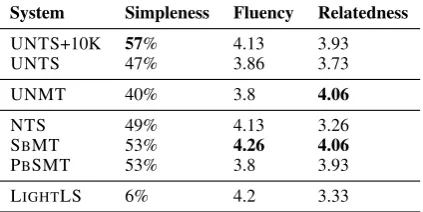
Table 3: Average human evaluation scores for simple-ness and grammatical correctsimple-ness (fluency) and seman-tic relatedness between the output and input.
et al.,2016), and Phrase-based SMT simplification or PBSMT (Wubben et al.,2012). All the systems are trained using the Wikipedia-SimpleWikipedia dataset (Hwang et al.,2015). The test set is same for all of these and our models.
6 Results
Table2 shows evaluation results of our proposed approaches along with existing supervised and un-supervised alternatives. We observe that unsu-pervised baselines such as UNMT and USMT often, after attaining convergence, recreates sen-tences similar to the inputs. This explains why they achieve higher BLEU and reduced word-difference scores. The ST system did not converge for our dataset after significant number of epochs which affected the performance metrics. The sys-tem often produces short sentences which are sim-ple but do not retain important phrases.
Other supervised systems such as SBMT and NTS achieve better content reduction as shown through SARI, BLEU and FE-diff scores; this is expected. However, it is still a good sign that
the scores for the unsupervised system UNTS are not far from the supervised skylines. The higher word-diff scores for the unsupervised system also indicate that it is able to perform content reduc-tion (a form of syntactic simplificareduc-tion), which is crucial to TS. This is unlike the existing unsu-pervised LIGHTLS system which often replaces nouns with related non-synonymous nouns; some-times increasing the complexity and affecting the meaning. Finally, it is worth noting that aiding the system with a very small amount of labeled data can also benefit our unsupervised pipeline, as sug-gested by the scores for the UNTS+10K system.
In Table3, the first column represents what per-centage of output form is a simplified version of the input. The second and third columns present the average fluency (grammaticality) scores given by human evaluators and semantic relatedness with input scored through automatic means. Al-most all systems are able to produce sentences that are somewhat grammatically correct and re-tain phrases from input. Supervised systems like PBSMT, as expected, simplify the sentences to the maximum extent. However, our unsupervised variants have scores competitive to the supervised skylines, which is a positive sign.
Table4shows an anecdotal example, containing outputs from the seven systems. As can be seen, the quality of output from our unsupervised vari-ants, is far from that of the reference output. How-ever, the attempts towards performing lexical sim-plification (by replacing the word “Neverthless” with “However”) and simplification of multi-word phrases (“Tagore emulated numerous styles” get-ting translated to “Tagore replaced many styles”) are quite visible and encouraging. Table5presents a few examples demonstrating the capabilities of our system in performing simplifications at lexical and syntactic level. We do observe that such op-erations are carried out only for a few instances in our test data. Also, our analysis in AppendixB in-dicate that the system can improve over time with addition of more data. Results for ablations on ad-versarial and diversification loss are also included in AppendixA.
7 Conclusion
System Output
Input Nevertheless , Tagore emulated numerous styles , including craftwork from northern New Ireland , Haida carvings from the west coast of Canada ( British Columbia ) , and woodcuts by Max Pechstein .
Reference Nevertheless , Tagore copied many styles , such as crafts from northern New Ireland , Haida carvings from the west coast of Canada and wood carvings by Max Pechstein .
UNTS+10K Nevertheless , Tagore replaced many styles , including craftwork from northern New Ireland , Haida carved from the west coast of Canada ( British Columbia ) .
UNTS However , Tagore notably numerous styles , including craftwork from northern New Ireland , Haida carved from the west coast of Canada ( British ) .
UNMT However , Tagore featured numerous styles including craftwork from northern New Ireland , Haida from the west coast of Canada ( British Columbia ) max by Max Pechstein .
USMT Nevertheless , Mgr emulated numerous styles , including craftwork from northern New Ireland , Haida carvings from the west coast of Canada (British Columbia) , and etchings by Max Pechstein .
NTS However , Tagore wrote many styles , including craftwork from northern New Ireland , Haida carvings from the west coast of Canada ( British Columbia ) .
SBMT However , Tagore emulated many styles , such as craftwork in north New Ireland , Haida prints from the west coast of Canada ( British Columbia ) , and woodcuts by Max Pechstein .
PBSMT Nevertheless , he copied many styles , from new craftwork , Haida carvings from the west coast of Canada in British Columbia and woodcuts by Max Pechstein .
[image:9.595.72.523.68.261.2]LIGHTLS However , Tagore imitated numerous styles , including craftwork from northern New Ireland , Haida sculptures from the west coast of Canada ( British Columbia ) , and engravings by Max Pechstein .
Table 4: Example predictions from different systems.
Type of Simplification Source Prediction
Splitting Calvin Baker is an American novelist . Calvin Baker is an American . American Baker is a birthplace . Sentence Shortening During an interview , Edward Gorey mentioned that Bawden
was one of his favorite artists ,lamenting the fact that not many people remembered or knew about this fine artist .
During an interview , Edward Gorey mentioned that Bawden was one of his favorite artists .
Lexical Replacement Inarchitecturaldecoration Small pieces of colored and iri-descentshell have been used to createmosaicsand inlays , which have been used to decorate walls , furniture and boxes .
Inimpressivedecoration Small pieces of colored andreddish
shell have been used to createstatuesand inlays , which have been used to decorate walls , furniture and boxes .
Table 5: Examples showing different types of simplifications performed by the best model UNTS+10K.
based on a shared encoder and two decoders. A novel training scheme is proposed which allows the model to perform content reduction and lexi-cal simplification simultaneously through our pro-posed losses and denoising. Experiments were conducted for multiple variants of our system as well as known unsupervised baselines and super-vised systems. Qualitative and quantitative anal-ysis of the outputs for a publicly available test data demonstrate that our models, though unsu-pervised, can perform better than or competitive to these baselines. In future, we would like to improve the system further by incorporating bet-ter architectural designs and training schemes to tackle complex simplification operations.
8 Acknowledgements
We thank researchers at IBM IRL, IIT Kharagpur, Vishal Gupta and Dr. Sudeshna Sarkar for helpful discussions in this project.
References
Mikel Artetxe, Gorka Labaka, and Eneko Agirre. 2018a. Unsupervised statistical machine translation.
In Proceedings of the 2018 Conference on Empiri-cal Methods in Natural Language Processing, pages 3632–3642.
Mikel Artetxe, Gorka Labaka, Eneko Agirre, and Kyunghyun Cho. 2018b. Unsupervised neural ma-chine translation. InProceedings of the Sixth Inter-national Conference on Learning Representations.
Dzmitry Bahdanau, Kyunghyun Cho, and Yoshua Ben-gio. 2014. Neural machine translation by jointly learning to align and translate. arXiv:1409.0473.
Or Biran, Samuel Brody, and No´emie Elhadad. 2011. Putting it simply: a context-aware approach to lexi-cal simplification. InACL, pages 496–501. Associ-ation for ComputAssoci-ational Linguistics.
Laetitia Brouwers, Delphine Bernhard, Anne-Laure Ligozat, and Thomas Franc¸ois. 2014. Syntactic sen-tence simplification for french. In Proceedings of the 3rd Workshop on Predicting and Improving Text Readability for Target Reader Populations (PITR)@ EACL 2014, pages 47–56.
[image:9.595.73.522.299.385.2]Yvonne Canning and John Tait. 1999. Syntactic sim-plification of newspaper text for aphasic readers. In
Customised Information Delivery, pages 6–11.
Raman Chandrasekar and Bangalore Srinivas. 1997. Automatic induction of rules for text simplifica-tion1. Knowledge-Based Systems, 10(3):183–190.
Kyunghyun Cho, Bart van Merrienboer, Dzmitry Bah-danau, and Yoshua Bengio. 2014a. On the proper-ties of neural machine translation: Encoder–decoder approaches. InProceedings of SSST-8, Eighth Work-shop on Syntax, Semantics and Structure in Statisti-cal Translation, pages 103–111.
Kyunghyun Cho, Bart van Merrienboer, Caglar Gul-cehre, Dzmitry Bahdanau, Fethi Bougares, Holger Schwenk, and Yoshua Bengio. 2014b. Learning phrase representations using rnn encoder–decoder for statistical machine translation. InProceedings of the 2014 Conference on Empirical Methods in Nat-ural Language Processing (EMNLP), pages 1724– 1734.
James Clarke and Mirella Lapata. 2006. Models for sentence compression: A comparison across do-mains, training requirements and evaluation mea-sures. InCOLING, pages 377–384. Association for Computational Linguistics.
William Coster and David Kauchak. 2011. Simple english wikipedia: a new text simplification task. In ACL, pages 665–669. Association for Computa-tional Linguistics.
Siobhan Devlin. 1998. The use of a psycholinguis-tic database in the simplification of text for aphasic readers. Linguistic databases.
Katja Filippova, Enrique Alfonseca, Carlos A Col-menares, Lukasz Kaiser, and Oriol Vinyals. 2015. Sentence compression by deletion with lstms. In
Proceedings of the 2015 Conference on Empirical Methods in Natural Language Processing, pages 360–368.
Katja Filippova and Michael Strube. 2008. Depen-dency tree based sentence compression. In INLG, pages 25–32. Association for Computational Lin-guistics.
Rudolph Flesch. 1948. A new readability yardstick.
Journal of applied psychology, 32(3):221.
Goran Glavaˇs and Sanja ˇStajner. 2015. Simplifying lexical simplification: do we need simplified cor-pora? InACL, volume 2, pages 63–68.
Ian Goodfellow, Jean Pouget-Abadie, Mehdi Mirza, Bing Xu, David Warde-Farley, Sherjil Ozair, Aaron Courville, and Yoshua Bengio. 2014. Generative ad-versarial nets. In Advances in neural information processing systems, pages 2672–2680.
William Hwang, Hannaneh Hajishirzi, Mari Ostendorf, and Wei Wu. 2015. Aligning sentences from stan-dard wikipedia to simple wikipedia. In NAACL-HLT, pages 211–217.
Yoon Kim. 2014. Convolutional neural networks for sentence classification. arXiv:1408.5882.
Kevin Knight and Daniel Marcu. 2002. Summariza-tion beyond sentence extracSummariza-tion: A probabilistic ap-proach to sentence compression. Artificial Intelli-gence, 139(1):91–107.
J. L’Allier. 1980. An evaluation study of a computer-based lesson that adjusts read- ing level by monitor-ing on task reader characteristics.Ph.D. Thesis.
Tracy Linderholm, Michelle Gaddy Everson, Paul Van Den Broek, Maureen Mischinski, Alex Crittenden, and Jay Samuels. 2000. Effects of causal text revi-sions on more-and less-skilled readers’ comprehen-sion of easy and difficult texts. Cognition and In-struction, 18(4):525–556.
Danielle S McNamara, Eileen Kintsch, Nancy But-ler Songer, and Walter Kintsch. 1996. Are good texts always better? interactions of text coherence, background knowledge, and levels of understanding in learning from text. Cognition and instruction, 14(1):1–43.
Shashi Narayan and Claire Gardent. 2014. Hybrid sim-plification using deep semantics and machine trans-lation. InACL, volume 1, pages 435–445.
Shashi Narayan, Claire Gardent, Shay Cohen, and Anastasia Shimorina. 2017. Split and rephrase. In
EMNLP 2017: Conference on Empirical Methods in Natural Language Processing, pages 617–627.
Sergiu Nisioi, Sanja ˇStajner, Simone Paolo Ponzetto, and Liviu P Dinu. 2017. Exploring neural text sim-plification models. InACL, volume 2, pages 85–91.
Gustavo H Paetzold and Lucia Specia. 2016. Unsuper-vised lexical simplification for non-native speakers. InAAAI, pages 3761–3767.
Kishore Papineni, Salim Roukos, Todd Ward, and Wei-Jing Zhu. 2002. Bleu: a method for automatic eval-uation of machine translation. InACL, pages 311– 318. Association for Computational Linguistics.
Sarah E Petersen and Mari Ostendorf. 2007. Text sim-plification for language learners: a corpus analysis. In Workshop on Speech and Language Technology in Education.
Alexander M Rush, Sumit Chopra, and Jason Weston. 2015. A neural attention model for abstractive sen-tence summarization. In Proceedings of the 2015 Conference on Empirical Methods in Natural Lan-guage Processing, pages 379–389.
Tianxiao Shen, Tao Lei, Regina Barzilay, and Tommi Jaakkola. 2017. Style transfer from non-parallel text by cross-alignment. InAdvances in neural informa-tion processing systems, pages 6830–6841.
Advaith Siddharthan. 2006. Syntactic simplification and text cohesion. Research on Language and Com-putation, 4(1):77–109.
Advaith Siddharthan. 2014. A survey of research on text simplification. ITL-International Journal of Ap-plied Linguistics, 165(2):259–298.
Lucia Specia. 2010. Translating from complex to sim-plified sentences. In Computational Processing of the Portuguese Language, pages 30–39. Springer.
Sanja ˇStajner, Hannah Bechara, and Horacio Saggion. 2015. A deeper exploration of the standard pb-smt approach to text simplification and its evaluation. In
ACL-IJCNLP, volume 2, pages 823–828.
Sanja ˇStajner and Sergiu Nisioi. 2018. A Detailed Evaluation of Neural Sequence-to-Sequence Mod-els for In-domain and Cross-domain Text Simplifi-cation. InProceedings of the Eleventh International Conference on Language Resources and Evaluation (LREC 2018), Miyazaki, Japan. European Language Resources Association (ELRA).
Julien Tissier, Christophe Gravier, and Amaury Habrard. 2017. Dict2vec : Learning word embed-dings using lexical dictionaries. In EMNLP, pages 254–263.
Tong Wang, Ping Chen, John Rochford, and Jipeng Qiang. 2016. Text simplification using neural ma-chine translation. InAAAI.
Sander Wubben, Antal Van Den Bosch, and Emiel Krahmer. 2012. Sentence simplification by mono-lingual machine translation. InProceedings of the 50th Annual Meeting of the Association for Compu-tational Linguistics: Long Papers-Volume 1, pages 1015–1024. Association for Computational Linguis-tics.
Jingjing Xu, SUN Xu, Qi Zeng, Xiaodong Zhang, Xu-ancheng Ren, Houfeng Wang, and Wenjie Li. 2018. Unpaired sentiment-to-sentiment translation: A cy-cled reinforcement learning approach. In Proceed-ings of the 56th Annual Meeting of the Association for Computational Linguistics (Volume 1: Long Pa-pers), pages 979–988.
Wei Xu, Chris Callison-Burch, and Courtney Napoles. 2015. Problems in current text simplification re-search: New data can help. Transactions of the Association of Computational Linguistics, 3(1):283– 297.
Wei Xu, Courtney Napoles, Ellie Pavlick, Quanze Chen, and Chris Callison-Burch. 2016. Optimizing statistical machine translation for text simplification.
TACL, 4:401–415.
Mark Yatskar, Bo Pang, Cristian Danescu-Niculescu-Mizil, and Lillian Lee. 2010. For the sake of sim-plicity: Unsupervised extraction of lexical simpli-fications from wikipedia. In NAACL-HLT, pages 365–368. Association for Computational Linguis-tics.
Zhirui Zhang, Shuo Ren, Shujie Liu, Jianyong Wang, Peng Chen, Mu Li, Ming Zhou, and Enhong Chen. 2018. Style transfer as unsupervised machine trans-lation.arXiv preprint arXiv:1808.07894.
A Ablation Studies
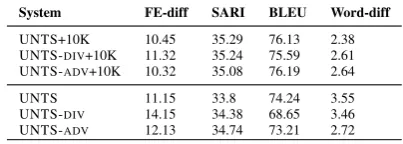
The following table shows results of the proposed system with ablations on adversarial loss (UNTS-ADV) and diversification loss (UNTS-DIV).
System FE-diff SARI BLEU Word-diff
[image:11.595.314.516.322.394.2]UNTS+10K 10.45 35.29 76.13 2.38 UNTS-DIV+10K 11.32 35.24 75.59 2.61 UNTS-ADV+10K 10.32 35.08 76.19 2.64 UNTS 11.15 33.8 74.24 3.55 UNTS-DIV 14.15 34.38 68.65 3.46 UNTS-ADV 12.13 34.74 73.21 2.72
Table 6: UNTS-ADVdoes not use the adversarial loss, UNTS-DIVdoes not use the diversification loss.
B Effects of Variation in Labeled Data Size
The following table shows the effect of labeled data size on the performance of the system. We supplied the system with 2K, 5K, and 10K pairs of complex and simple sentences. From the trained models, models with similar word-diff are chosen for fair comparison. Our observation is that, with increasing data, BLEU as well as SARI increases.
System FE-diff SARI BLEU Word-diff
UNTS+10K 11.65 35.14 75.71 3.05 UNTS+5K 11.69 34.39 70.96 3.01 UNTS+2K 11.64 34.17 72.63 3.26 UNTS 11.15 33.8 74.24 3.55