3595
Multi-grained Attention with Object-level Grounding
for Visual Question Answering
Pingping Huang, Jianhui Huang, Yuqing Guo, Min Qiao and Yong Zhu
Baidu Inc., Beijing, China
{huangpingping,huangjianhui,guoyuqing,qiaomin,zhuyong}@baidu.com
Abstract
Attention mechanisms are widely used in Vi-sual Question Answering (VQA) to search for visual clues related to the question. Most ap-proaches train attention models from a coarse-grained association between sentences and im-ages, which tends to fail on small objects
or uncommon concepts. To address this
problem, this paper proposes a multi-grained
attention method. It learns explicit
object correspondence by two types of word-level attention complementary to the
sentence-image association. Evaluated on the VQA
benchmark, the multi-grained attention model achieves competitive performance with state-of-the-art models. And the visualized atten-tion maps demonstrate that addiatten-tion of object-level groundings leads to a better understand-ing of the images and locates the attended ob-jects more precisely.
1 Introduction
Visual Question Answering (Antol et al., 2015;
Goyal et al.,2017a) is a multi-modal task requir-ing to provide an answer to the question with ref-erence to a given image. Most current VQA sys-tems resort to deep neural networks and solve the problem by end-to-end learning. First the question and the image are encoded into semantic represen-tations independently. Then the multi-modal fea-tures are fused into one unified representation for which the answer is predicted (Malinowski et al.,
2015;Fukui et al.,2016;Anderson et al.,2018). A key point to a successful VQA system is to discover the most relevant image regions to the question. This is commonly resolved by attention mechanisms, where a spatial attention distribution highlighting the visual focus is computed accord-ing to the similarity between the whole question and image regions (Xu et al., 2015;Yang et al.,
2016; Lu et al., 2016). Although such coarse
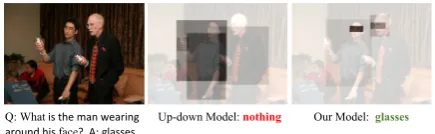
Q: Whatis the man wearing around his face? A: glasses
[image:1.595.309.527.221.288.2]Up-down Model: nothing Our Model: glasses
Figure 1: An example of VQA and the attention maps produced by a state-of-the-art model and our model.
sentence-image alignment reports promising re-sults in general, it sometimes fails to locate small objects or understand a complicated scenario. For the example in Figure1, the question is “What is the man wearing around his face”. Human has no difficulty in finding the visual clue on the people’s faces, and accordingly provide the correct answer “glasses”. However, by visualizing the attention map of a state-of-the-art VQA model, we find that the attention is mistakenly focused on the men’s body rather than their faces.
In order to identify related objects more pre-cisely, this paper proposes a multi-grained atten-tion mechanism that involves object-level ground-ing complementary to the sentence-image associ-ation. Specifically, a matching model is trained on an object-detection dataset to learn explicit corre-spondence between the content words in the ques-tion and their visual counterparts. And the la-bels of the detected objects are considered and their similarity with the questions are computed. Besides, a more sophisticated language model is adopted for better representation of the question. Finally the three types of word-object, word-label and sentence-image attention are accumulated to enhance the performance.
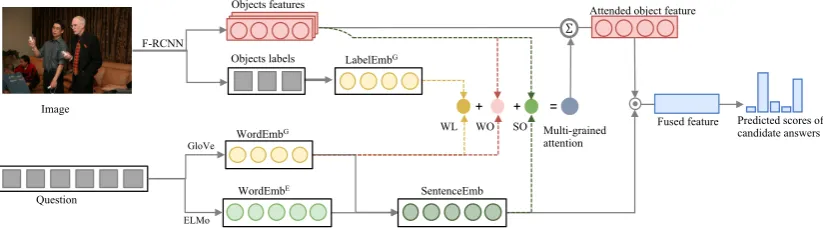
atten-F-RCNN
Image
ELMo GloVe
Predicted scores of candidate answers LabelEmbG
Objects labels Objects features
WordEmbG
WordEmbE SentenceEmb
Fused feature
Question
+ + =
∑
Attended object feature
[image:2.595.91.503.67.182.2]Multi-grained attention WL WO SO
Figure 2: The architecture of our proposed model. The enhanced modules are illustrated in dot lines.
tion approaches. Second, the deep contextualized word representation ELMo (Peters et al.,2018) is firstly adopted in the VQA task to facilitate a bet-ter question encoding.
2 Proposed Model
The flowchart of the proposed model is illustrated in Figure 2. We start from the bottom-up top-down (up-top-down) model (Teney et al., 2017; An-derson et al.,2018), which is the winning entry to the 2017 VQA challenge. Then this model is en-hanced with two types of object-level groundings to explore fine-grained information, and a more sophisticated language model for better question representation.
2.1 Image Features
We adopt the object-detection-based approach to represent the input image. Specifically, follow-ingAnderson et al.(2018), a state-of-the-art object detection model Faster R-CNN (Ren et al.,2015) with ResNet-101 (He et al.,2016) as its backbone is trained on the Visual Genome (VG) (Krishna et al., 2016) dataset. Then the trained model1 is applied to identify instances of objects with bounding boxes belonging to certain categories. The target categories of this detection model con-tain1600objects and400attributes.
For each input image, the top-K objects with the highest confidence scores are selected to rep-resent the image. For each object, the output of ResNet’s pool-flat-5 layer is used as its visual fea-ture, which is a2048-dimensional vectorvk.
Be-sides, the label of each object’s categoryckis also
kept as a visually grounded evidence. ck is aN
-dimensional one-hot vector, where N is the vo-cabulary size. Then the input image is represented
1The model is available at
https://github.com/peteanderson80/bottom-up-attention
by both its object featuresV = [v1,v2, ...,vK]∈
R2048×K and object labelsC = [c1,c2, ...,cK]∈
RN×K.
2.2 Text Features
In our model, text features include token fea-tures and sentence feafea-tures for the question, which are respectively used for fine-grained and coarse-grained attention computation.
Word Features LetQ = [q1, ...,qT] ∈ RN×T
denote the one-hot representation for the input question tokens, where T is the question length, andN is the vocabulary size. Then each tokenqt
is turned into two word embeddings: GloVe ( Pen-nington et al., 2014) xGt = qtEG ∈ RD1, and
ELMoxEt =ELM o(qt) ∈RD2. D
1andD2are the dimensions of GloVe embedding and ELMo embedding respectively. EG is the GloVe matrix pre-trained on the Wikipedia & Gigaword2. The ELMo embedding is dynamically computed by a
L-layer bi-LSTM language model (Hochreiter and Schmidhuber, 1997). We use the publicly avail-able pre-trained ELMo model3 to get the contex-tualized embeddings.
Sentence Features The above two sets of to-ken embeddings are then concatenated xt = [xG
t ;xEt ] ∈ RD1+D2, and fed into a GRU (Cho
et al.,2014) to encode the question sentence. The final hidden state of the GRU i.e., hT ∈ RD3 is
taken as sentence feature, whereD3 is the hidden state size for GRU.
2.3 Multi-grained Attentions
Word-Label Matching Attention (WL) Object category labels are high-level semantic representa-tion compared to visual pixels, and have proven to
2
http://nlp.stanford.edu/projects/glove/
be useful for both visual tasks like scene classifi-cation (Li et al.,2010) and multi-modal tasks like image caption and VQA (Wu et al.,2018).
For VQA task, we observed that the seman-tic similarity between the object category labels and the words in the question helps to locate the referred objects. For the input image in Fig-ure 1, Faster-RCNN detected objects with labels of “man”, “head”. Some labels are exactly the same as or are semantically close to the words in the question “What is the man wearing around his face?”. Therefore, we compute the WL attention vector, that indicates how much weight we should give to each of theKobjects in the image, in terms of the semantic similarity between the category la-bels of the objects and the words in the question. For thek-th object with labelckwe encode it into
GloVe embedding4 lGk = ckEG, and compute its
attention score by measuring its similarity to the question GloVe embedding as follows:
sW L(XG,lGk) = arg max t
cos(xGt ,l G k)
aW L(XG,LG) =sof tmaxsW L(XG,lGk)
(1)
where XG =
xG1, ...,xGT
∈ RD1×T is the
GloVe embeddings for the question tokens.LG =
lG1, ...,lGk
∈ RD1×K is the GloVe embeddings
for the objects labels.aW L ∈RKis the WL
atten-tion vector. In contrast toAnderson et al.(2018) that only use objects’ visual features without the labels, and unlike Wu et al.(2018) that discard the visual features once the labels are generated, we utilize both category labels and the visual features to enhance the fine-grained attention with object-level grounding.
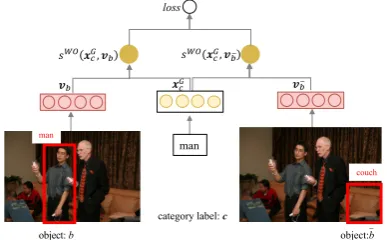
Word-Object Matching Attention (WO) A word-object matching module is exploited to directly evaluate how likely a question word matches a visual object. The pairwise training structure of the module is shown in Figure 3. The training set is constructed on the VG object detec-tion data. Let(c, b)be a positive sample consist-ing of the annotated object boundconsist-ing-box b with category label c, then a negative sample (c,¯b)is constructed by randomly replacingbwith the ob-ject¯bin the same image, if¯bis not labelled with
4The reason why GloVe embedding alone is used instead
of ELMo for object labels, is that object labels have no con-text sentence to derive the concon-text-sensitive ELMo embed-dings.
object: b
category label: c
man man
𝒙"# 𝒗%
object:b_ couch
loss
𝑠'(𝒙"#, 𝒗% 𝑠'(𝒙 " #, 𝒗
%_
[image:3.595.318.512.65.185.2]𝒗%_
Figure 3: Label-object matching module trained on VG object annotation data.
c. Then, each sample(c, b)is represented as fea-ture vectors(xGc,vb), wherexGcis the GloVe
em-bedding of c, and vb is extracted with the same
Faster R-CNN model as described in section2.1. At last, a margin-based pairwise ranking loss is used to train the model:
sW O(xGc,vb) =σ
Ws
h
f(WcxGc)◦f(Wvvb)
i
loss= maxn0, λ−sW O(xGc,vb) +sW O(xGc,v¯b)
o (2)
where f is ReLU and σ is sigmoid activation function, ◦ means element wise multiplication.
Wc,Wv,Ws are weight parameters5. And the
margin is setλ= 0.5.
AftersW Ois pre-trained, we forwardly select at mostB noun tokens in the question and compute the WO attentionaW O(X,V)over theKobjects as follows:
aW O(XG,V) =sof tmax
B
X
b=1
sW O(xGb,vk)
!
(3)
where the parameters of sW O are fine-tuned in
down-streaming VQA task.
Sentence-Object Attention (SO) Following previous methods of sentence-level question guided visual attention, we also use the global semantic of the whole sentence to guide the focus on relevant objects. Taking sentence featurehT
and objects features V as input, SO attention vectoraSOis computed as follows:
sSO(hT,vk) =σ(Wj[f(Wvvk)◦f(WthT)])
aSO(hT,V) =sof tmax
sSO(hT,vk)
(4)
wheref is ReLU,σ is sigmoid activation func-tion, andWj,Wv,Wtare weight parameters.
Method test-dev
All Yes/no Numbers Other
Up-down 65.32 81.82 44.21 56.05
Our Model 67.41 83.60 47.02 58.24
Method test-std
All Yes/no Numbers Other
Prior 25.98 61.20 0.36 1.17
Language-only 44.26 67.01 31.55 27.37
d-LSTM-n-I 54.22 73.46 35.18 41.83
MCB 62.27 78.82 38.28 53.36
Up-down 65.67 82.20 43.90 56.26
Our Model 67.73 83.88 46.60 58.50
Table 1: Result comparison on VQA v2 dataset. Re-sults of Prior, Language-only, d-SLTM-n-I, MCB are
reported in Goyal et al. (2017a). Result of up-down
model is reported inTeney et al.(2017).
2.4 Multi-modal Fusion and Answer Prediction
The above three attentions are summed together for the final attention vector. Then we get the weighted visual feature vectorva∈
R2048 for the
image:
a=aW L+aW O+aSO
va=
K
X
k=1
akvk
(5)
Then the question feature hTand the attended
visual feature va are transformed into the same dimension and fused together with element-wise multiplication, to get the joint representation vec-torr∈RD4.
r=f(WrthT)◦f(Wrvva) (6)
wheref is ReLU,Wrt,Wrvare weight
parame-ters. FollowingTeney et al.(2017), we treat VQA task as a classification problem, and use the bi-nary cross-entropy loss to take multiple marked answers into consideration:
ˆ
s=σ(f(War))
loss=
A
X
a=1
salog( ˆsa)−(1−sa)log(ˆsa) (7)
whereˆs∈RAis the predicted score over allA
an-swer candidates, sais the target accuracy score6.
3 Experiments and Analysis
3.1 Settings
Experiments are conducted on VQA v2 dataset (Goyal et al., 2017b). Questions are trimmed to a maximum ofT = 14words. We set
6accuracy =min(#humans that provided that answer
3 ,1), i.e. an
an-swer is accurate if at least 3 markers provided the anan-swer.
Model All Yes/no Numbers Other
Up-down 63.15 80.07 42.87 55.81
+ WL 64.29 81.75 44.34 56.29
+ WO 64.24 82.00 43.69 56.18
[image:4.595.318.514.62.114.2]+ ELMO 64.15 81.86 44.11 55.98
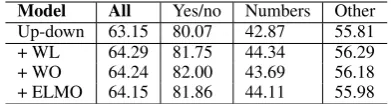
Table 2: Model analysis results. Models were trained ontrainand evaluated onvalset.
the number of detected boxes toK = 36, and set the dimension of GloVe embeddings and ELMo embeddings toD1= 300andD2= 1024, respec-tively. The GRU hidden size for question sentence
is D3 = 1024, and the joint representation r is
of dimension D4 = 2048. Noun tokens count is set as fixed B = 3 with padding7. Candidate answers are restricted to the correct answers in the training set that appear more than a threshold, which results in a number of A = 3129 answer candidates. Adamax optimizer (Kingma and Ba,
2014) is used with initial learning rate of 0.002, and we use a learning rate decay schedule that reduces the learning rate by a factor of 0.1 every 3 epochs after 8 epochs. The batch size is 512.
3.2 Comparisons with the State-of-the-arts
Table1shows the result comparison with the base-line up-down and other methods in single model setting. Our model outperforms these previous re-sults, improving the up-down model from 65.32 to 67.41 ontest-dev, and from 65.67 to 67.73 on test-std. This superior performance can be seen in all the answer types, especially for the most difficult onesNumbers, where our model gains significant +2.81/+2.70 improvement on thetest-dev/test-std.
3.3 Model Analysis
To understand the effects of different components, the performance by adding one certain proposed component to the baseline is reported in Table2. Adding our proposed two branches of fine-grained WL and WO attentions significantly improves the baseline performance. The result also verifies that ELMo embeddings combined with GloVe embed-dings provide more sophisticated text representa-tions, thus improves the overall performance.
3.4 Study on Attention Maps
To validate the effectiveness of the enhanced atten-tion mechanism, we visualize the attenatten-tions and
7ThoughB is set as a fixed value during the whole
[image:4.595.75.290.62.187.2]Q: How many dog ears are shown?
A: 2 Q: Is there a hat on the bench? A: yes Q:Are the stop signs facing normal? A: yes Q: Does his bow tie match his pants? A: yes
Baseline:
no Baseline: no
Baseline: 4
Baseline:no Baseline: no Baseline: no Baseline: no
Our : 2
Our: yes Our : yes Our : yes Our : no
Q: Can you see its paws? A: yes
[image:5.595.93.507.60.327.2](a) (b) (c) (d) (e)
Figure 4: Attention map examples (only top-5 salient regions are shown here).
compare them versus those of the up-down model. As Figure 4 shows, the addition of object-level groundings leads to a better understanding of the images and locates the attended objects more pre-cisely. For example, in Figure 4(a), for question “Can you see its paws?”, the attention generated by our method is focused on the “paws”, while the baseline does not focus on the key regions as accu-rate as we do. In Figure4(b), for theNumberstype question “How many dog ears are shown?”, our model gives the strongest attention on the “ear” part of the dog, while the baseline model attends to the whole dog body. For small object clues, our model shows more advantage. As shown in the examples in Figure4(c), Figure4(d).
We also notice cases where though the final an-swer is wrong, our model generates appropriate at-tention maps. As shown in Figure4(e), forYes/no
question “Does his bow tie match his pants?”, our model correctly finds “tie” and “pants” object re-gions, but we suspect that the model does not un-derstand the meaning of “match”.
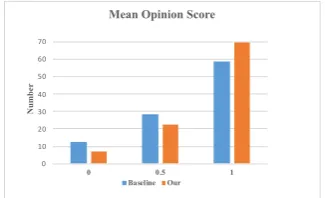
A mean opinion score (MOS) test to quantita-tively compare our attention mechanism with the baseline model is also performed. Specifically, we randomly select 100 cases and generate their attention maps. Then, we asked subjects to rate a score from 0 (bad quality), 0.5 (medium qual-ity) and 1 (excellent qualqual-ity) to these attention
maps. The distribution of MOS ratings are sum-marized in Figure 5. The mean scores of our model 0.8125 wins a large margin over the base-line model 0.7315, indicating that the attention maps generated by our attention mechanism are preferred by human.
0 10 20 30 40 50 60 70
0 0.5 1
Number
Mean Opinion Score
Baseline Our
Figure 5: The distribution of Mean Opinion Score.
4 Conclusion
[image:5.595.335.498.465.564.2]References
Peter Anderson, Xiaodong He, Chris Buehler, Damien Teney, Mark Johnson, Stephen Gould, and Lei Zhang. 2018. Bottom-up and top-down attention for image captioning and visual question answering. In Proceedings of the IEEE Conference on Computer Vision and Pattern Recognition, pages 6077–6086.
Stanislaw Antol, Aishwarya Agrawal, Jiasen Lu, Mar-garet Mitchell, Dhruv Batra, C. Lawrence Zitnick, and Devi Parikh. 2015. VQA: Visual Question
An-swering. InInternational Conference on Computer
Vision (ICCV).
Kyunghyun Cho, Dzmitry Bahdanau, Fethi Bougares, Holger Schwenk, and Yoshua Bengio. 2014. Learn-ing phrase representations usLearn-ing rnn encoderdecoder for statistical machine translation. InarXiv preprint arXiv:1406.1078.
Akira Fukui, Huk Park Dong, Daylen Yang, Anna Rohrbach, Trevor Darrell, and Marcus Rohrbach. 2016. Multimodal compact bilinear pooling for vi-sual question answering and vivi-sual grounding.
Yash Goyal, Tejas Khot, Douglas Summers-Stay, Dhruv Batra, and Devi Parikh. 2017a. Making the v in vqa matter: Elevating the role of image
under-standing in visual question answering. In CVPR,
volume 1, page 3.
Yash Goyal, Tejas Khot, Douglas Summers-Stay, Dhruv Batra, and Devi Parikh. 2017b. Making the V in VQA matter: Elevating the role of image
under-standing in Visual Question Answering. In
Confer-ence on Computer Vision and Pattern Recognition (CVPR).
Kaiming He, Xiangyu Zhang, Shaoqing Ren, and Jian Sun. 2016. Deep residual learning for image
recog-nition. In Proceedings of the IEEE conference on
computer vision and pattern recognition, pages 770– 778.
Sepp Hochreiter and J¨urgen Schmidhuber. 1997.
Long short-term memory. Neural computation,
9(8):1735–1780.
Diederik P Kingma and Jimmy Ba. 2014. Adam: A
method for stochastic optimization. arXiv preprint
arXiv:1412.6980.
Ranjay Krishna, Yuke Zhu, Oliver Groth, Justin John-son, Kenji Hata, Joshua Kravitz, Stephanie Chen, Yannis Kalantidis, Li-Jia Li, David A Shamma,
Michael Bernstein, and Li Fei-Fei. 2016. Visual
genome: Connecting language and vision using
crowdsourced dense image annotations.
Li-Jia Li, Hao Su, Yongwhan Lim, and Li Fei-Fei. 2010. Objects as attributes for scene classification. InEuropean Conference on Computer Vision, pages 57–69. Springer.
Jiasen Lu, Jianwei Yang, Dhruv Batra, and Devi
Parikh. 2016. Hierarchical question-image
co-attention for visual question answering. CoRR,
abs/1606.00061.
Mateusz Malinowski, Marcus Rohrbach, and Mario Fritz. 2015. Ask your neurons: A neural-based
ap-proach to answering questions about images. InIn
Proceedings of the IEEE International Conference on Computer Vision, pages 1–9.
Jeffrey Pennington, Richard Socher, and Christopher Manning. 2014. Glove: Global vectors for word
representation. InProceedings of the 2014
confer-ence on empirical methods in natural language pro-cessing (EMNLP), pages 1532–1543.
Matthew E. Peters, Mark Neumann, Mohit Iyyer, Matt Gardner, Christopher Clark, Kenton Lee, and Luke Zettlemoyer. 2018. Deep contextualized word rep-resentations.
Shaoqing Ren, Kaiming He, Ross Girshick, and Jian
Sun. 2015. Faster r-cnn: Towards real-time
ob-ject detection with region proposal networks. In
Advances in neural information processing systems, pages 91–99.
Damien Teney, Peter Anderson, Xiaodong He, and An-ton van den Hengel. 2017. Tips and tricks for visual question answering: Learnings from the 2017
chal-lenge. arXiv preprint arXiv:1708.02711.
Qi Wu, Chunhua Shen, Peng Wang, Anthony Dick, and Anton van den Hengel. 2018. Image captioning and visual question answering based on attributes
and external knowledge. IEEE transactions on
pat-tern analysis and machine intelligence, 40(6):1367– 1381.
Kelvin Xu, Jimmy Ba, Ryan Kiros, Kyunghyun Cho, Aaron Courville, Ruslan Salakhudinov, Rich Zemel, and Yoshua Bengio. 2015. Show, attend and tell: Neural image caption generation with visual
atten-tion. InInternational conference on machine
learn-ing, pages 2048–2057.
Zichao Yang, Xiaodong He, Jianfeng Gao, Li Deng, and Alex Smola. 2016. Stacked attention networks
for image question answering. InProceedings of the