Multi-grained Attention Network for Aspect-Level
Sentiment Classification
Feifan Fan1 Yansong Feng12∗ Dongyan Zhao13
1Institute of Computer Science and Technology, Peking University, China 2MOE Key Laboratory of Computational Linguistics, Peking University, China
3Beijing Institute of Big Data Research, China {fanff, fengyansong, zhaody}@pku.edu.cn
Abstract
We propose a novel multi-grained attention network (MGAN) model for aspect level sen-timent classification. Existing approaches mostly adopt coarse-grained attention mecha-nism, which may bring information loss if the aspect has multiple words or larger context. We propose a fine-grained attention mecha-nism, which can capture the word-level in-teraction between aspect and context. And then we leverage the fine-grained and coarse-grained attention mechanisms to compose the MGAN framework. Moreover, unlike previ-ous works which train each aspect with its context separately, we design an aspect align-ment loss to depict the aspect-level interac-tions among the aspects that have the same context. We evaluate the proposed approach on three datasets: laptop and restaurant are from SemEval 2014, and the last one is a twit-ter dataset. Experimental results show that the multi-grained attention network consistently outperforms the state-of-the-art methods on all three datasets. We also conduct experiments to evaluate the effectiveness of aspect alignment loss, which indicates the aspect-level interac-tions can bring extra useful information and further improve the performance.
1 Introduction
Aspect level sentiment classification is a funda-mental task in sentiment analysis (Pang et al.,
2008;Liu, 2012), which aims to infer the senti-ment polarity (e.g. positive, neutral, negative) of sentence with respect to the aspects. For exam-ple, in sentence “I like coming back to Mac OS but this laptop is lacking in speaker quality com-pared to my$400 old HP laptop”, the polarity of the sentence towards the aspect “Mac OS” is pos-itive while the polarity is negative in terms of as-pect “speaker quality”.
∗
corresponding author.
Many statistical methods, such as support vec-tor machine (SVM) (Wagner et al., 2014; Kir-itchenko et al., 2014), are employed with well-designed handcrafted features. In recent years, neural network models (Socher et al.,2011;Dong et al., 2014;Nguyen and Shirai, 2015) are stud-ied to automatically learn low-dimensional repre-sentations for aspects and their context. Attention mechanism (Wang et al., 2016; Li et al., 2017;
Ma et al., 2017) is also be studied to character-ize the effect of aspect on enforcing the model to pay more attention on the important words of the context. Previous works (Tang et al., 2016b;
Chen et al.,2017) mainly employed the simple av-eraged aspect vector to learn the attention weights on the context words. Ma et al. [2017] further proposed the bidirectional attention mechanism, which interactively learns the attention weights on context/aspect words, with respect to the averaged vector of aspect/context, respectively.
the instances that have the same context words. The aspect-level interactions among the instances with same context might bring extra useful formation. Considering the above example, in-tuitively, the aspect“speaker quality”should pay more attention on“lacking”and less attention on
“like”, compared with aspect “Mac OS”, since
they have different sentiment polarities.
In this paper, we propose a multi-grained at-tention network to address the above two is-sues in aspect level sentiment classification. Specifically, we propose a fine-grained atten-tion mechanism (i.e. F-Aspect2Context and F-Context2Aspect), which is employed to character-ize the word-level interactions between aspect and context words, and relieve the information loss occurred in coarse-grained attention mechanism. In addition, we utilize the bidirectional coarse-grained attention (i.e. C-Aspect2Context and
C-Context2Aspect) and combine them with
fine-grained attention vectors to compose the multi-grained attention network for the final sentiment polarity prediction, which can leverage the advan-tages of them. More importantly, in order to make use of the valuable aspect-level interaction infor-mation, we design an aspect alignment loss in the objective function to enhance the difference of the attention weights towards the aspects which have the same context and different sentiment polari-ties. As far as we know, we are the first to explore the interactions among the aspects with the same context.
To evaluate the proposed approach, we conduct experiments on three datasets: laptop and restau-rant are from the SemEval 2014 Task 4 and the third one is a tweet collection. Experimental re-sults show that our method achieves the best per-formance on all three datasets.
2 Related Work
Aspect-level sentiment analysis is a branch of sen-timent classification, which requires considering both the sentence and aspect information.
Traditional approaches (Jiang et al.,2011; Kir-itchenko et al.,2014;Vo and Zhang,2015) regard this task as the text classification problem and de-sign effective features, which are utilized in sta-tistical learning algorithms for training a classi-fier. Kiritchenko et al. [2014] proposed to use SVM based on n-gram features, parse features and lexicon features, which achieved the best
perfor-mance in SemEval 2014. Vo and Zhang [2015] designed sentiment-specific word embedding and sentiment lexicons as rich features for prediction. These methods highly depend on the effectiveness of the laborious feature engineering work and eas-ily reach the performance bottleneck.
In recent works, there are growing studies on neural network based methods due to their ca-pability of encoding original features as continu-ous and low-dimensional vectors without feature engineering. Recursive Neural Network (Socher et al.,2011;Dong et al.,2014;Nguyen and Shirai,
2015) are studied to conduct semantic composi-tions on tree structures, and generate representa-tions for prediction. Methods on LSTM ( Hochre-iter and Schmidhuber, 1997) were proposed to model the context information and use an ag-gregated vector for prediction. TD-LSTM (Tang et al., 2016a) adopted LSTM to model the left context and right context of the aspect, and con-catenate them as the representation for prediction. However, these works only focused on model-ing the contexts without considermodel-ing the aspects, which performed an important role in estimate the sentiment polarity.
Attention mechanisms (Wang et al., 2016; Lei et al.,2016;Li et al.,2017) are studied to enhance the influence of aspects on the final representa-tion for predicrepresenta-tion. Many approaches (Tang et al.,
2016b;Chen et al.,2017) adopted the averaged as-pect vector to learn the attention weights on the hidden vectors of context words. Ma et al. [2017] further proposed bidirectional attention mecha-nism, which also learns the attention weights on aspect words towards the averaged vector of text words. These attention methods only con-sider the coarse-grained level attention, through using the simple averaged aspect/context vector to steer the attention weights learning on the con-text/aspect words, which might cause some infor-mation loss on the long aspect or context case.
In contrast, motivated by the bidirectional atten-tion flow approaches (Seo et al.,2017;Pan et al.,
observe that the interactions among the aspects, which have the same context words, could bring extra useful information. Thus we design the as-pect alignment loss in the objective function to de-pict such kind of relationship, which is the first work to explore the aspect-level interactions.
3 Our Approach
3.1 Task Definition
Given a sentence s = {w1, w2,· · ·, wN}
con-sisting of N words, and an aspect list A =
{a1,· · ·, ak}, where the aspect list size is k and
each aspect ai = {wi1,· · ·, wiM} is a
subse-quence of sentences, which containsM ∈[1, N)
words. Aspect-level sentiment classification eval-uates sentiment polarity of the sentenceswith re-spect to each are-spectai.
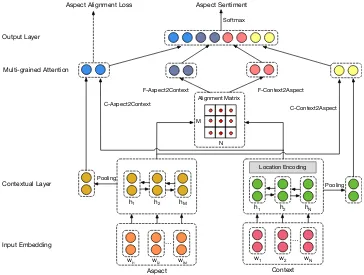
We present the overall architecture of the pro-posed Multi-grained Attention Network (MGAN) model in Figure 1. It consists of the Input Em-bedding layer, the Contextual Layer, the Multi-grained Attention Layer and the Output Layer.
3.2 Input Embedding Layer
Input Embedding Layer maps each word to a high dimensional vector space. We employ the pre-trained word vector, GloVe (Pennington et al.,
2014), to obtain the fixed word embedding of each word. Specifically, we denote the embedding lookup matrix as L ∈ Rdv×|V|, wheredv is the
word vector dimension and |V|is the vocabulary size.
3.3 Contextual Layer
We employ a bidirectional Long Short-Term Memory Network (BiLSTM) on top of the em-bedding layer to capture the temporal interactions among words. Specifically, at time stept, given the input word embedding x, the update process of forward LSTM network can be formalized as follows:
it=σ(
−→
Wi·[
− →
ht−1,−→xt] +
− →
bi) (1)
ft=σ(
−→
Wf ·[
− →
ht−1,−→xt] +
− →
bf) (2)
ot=σ(
−→
Wo·[
− →
ht−1,−→xt] +
− →
bo) (3)
gt=tanh(
−→
Wg·[
− →
ht−1,−→xt] +
− →
bg) (4)
− →c
t=ft∗ −→ct−1+it∗gt (5)
− →
ht=ot∗tanh(−→ct) (6)
Whereσis the sigmoid activation function,it,ft,
otare the input gate, forget gate and output gate,
respectively. −W→i,
−→
Wf,
−→
Wo,
−→
Wg ∈ Rd∗(d+dv),
− →
bi,
− →
bf,
− →
bo,
− →
bg ∈ Rd, and d is the hidden di-mension size. The backward LSTM does the simi-lar process and we can get the concatenated output
ht = [
− →
ht,
←−
ht] ∈ R2d. Given the word embed-dings of a context sentencesand a corresponding aspectaj, we will employ the BiLSTM separately
and get the sentence contextual outputH ∈R2d∗N
and aspect contextual outputQ∈R2d∗M.
In addition, considering that the context words with closer distance to an aspect may have higher influence to the aspect, we utilize the position encoding mechanism to simulate the observation. Formally, the weight for a context wordwj, which
haslword-level distance from the aspect (here we treat the aspect phrase as a single unit), is defined as follows:
wt= 1−
l
N−M+ 1 (7)
Specifically, we treat the weights of words within the aspect as 0 in order to focus on the context words in the sentence. Then we can obtain the final contextual outputs of context words H = [H1∗w1,· · ·, HN ∗wN].
3.4 Multi-grained Attention Layer
at-hN
h1 h2
…
wi1 wi2 wiM
…
wN
w1 w2
hM
h1 h2
Location Encoding M
N Alignment Matrix
Pooling
Pooling
Aspect Context
Aspect Sentiment
Softmax
Input Embedding Contextual Layer Multi-grained Attention Output Layer
C-Aspect2Context
F-Aspect2Context
[image:4.595.118.482.64.339.2]C-Context2Aspect F-Context2Aspect Aspect Alignment Loss
Figure 1: The architecture of the proposed multi-grained attention network.
tention difference among aspects with same con-text and different sentiment polarities.
Coarse-grained Attention
Coarse-grained attention is a widely used mech-anism to capture the interactions between aspect and context, which utilizes an averaged aspect vector to steer the attention weights on the con-text words. Follow the work in (Ma et al.,2017), we employ the bidirectional attention mechanism, namelyC-Aspect2ContextandC-Context2Aspect. (1) C-Aspect2Context learns to assign atten-tion scores to the context words with respect to the averaged aspect vector. Here we employ an aver-age pooling layer above aspect contextual output
Qto generate the averaged aspect vectorQavg ∈
R2d. For each word vector Hi in context, we can
compute the attention scoreacai as follows:
sca(Qavg, Hi) =Qavg∗Wca∗Hi (8)
acai = PNexp(sca(Qavg, Hi))
k=1exp(sca(Qavg, Hk))
(9)
Where the score functionscacomputes the weight
which indicates the importance of a context word towards aspect sentiment. Wca ∈ R2d∗2d is the attention weight matrix. Then the weighted com-bination of the context outputmca ∈R2dis
calcu-lated as follows:
mca =
N
X
i=1
acai ·Hi (10)
(2) C-Context2Aspect learns to assign atten-tion weights on aspects words, which follows the similar learning process with C-Aspect2Context. We utilize the average pooling mechanism to ob-tain the averaged context vector Havg, and
com-pute the weights for each word wi in the aspect
phrase. We compute the final weighted combina-tion of aspect vectormcc ∈R2das follows:
scc(Havg, Qi) =Havg∗Wcc∗Qi (11)
acci = exp(scc(Havg, Qi))
PM
k=1exp(scc(Havg, Qk))
(12)
mcc=
M
X
i=1
acci ·Qi (13)
whereWcc ∈ R2d∗2dis the attention weight ma-trix.
Fine-grained Attention
word affect each context/aspect word. Consider-ing the previous example “I like coming back to Mac OS but this laptop is lacking in speaker qual-ity compared to my$400 old HP laptop”, the word “quality”in aspect“speaker quality”should have more effect on the context words compared with
word “speaker”. Accordingly, the context words
should pay more attention on“quality”instead of “speaker”.
Formally, we define an alignment matrix U ∈
RN∗M, between the contextual output of and the contextH and the aspect Q, whereUij indicates
the similarity betweeni-th context word and j-th aspect word. The similarity matrixU is computed by
Uij =Wu([Hi;Qj;Hi∗Qj]) (14)
WhereWu ∈R1∗6dis the weight matrix,[; ]is the vector concatenation across row, ∗is the elemen-twise multiplication. Then we useU to calculate the attention vectors in both directions.
(1) F-Aspect2Contextestimates which context word has the closest similarity to one of the aspect word and are hence critical for determining the sentiment. We can compute the attention weights
af aon context words by
sf ai =max(Ui,:) (15)
af ai = exp(s
f a i )
PN
k=1exp(s f a k )
(16)
wheresf ai obtains the maximum similarity across column. And then we can get the attended vector
mf a ∈R2das follows:
mf a =
N
X
i=1
af ai ·Hi (17)
(2) F-Context2Aspect measures which aspect words are most relevant to each context word. Let
af ci ∈ RM be the attention weights on aspect
contextual output Qwith respect to thei-th con-text word vectorHi. The attended aspect vector
qf c∈R2d∗N is defined as follows:
af cij = PMexp(Uij)
k=1exp(Uik)
(18)
qif c=
M
X
j=1
af cij ·Qj (19)
Then we use an average pooling layer onqf cto get the attended vectormf c∈R2d:
mf c=P ooling([q1f c,· · ·, qNf c]) (20)
3.5 Output Layer
At last, we concatenate both the coarse-grained and fine-grained attention vectors as the final rep-resentationm ∈ R8d, which will be fed to a soft-max layer for determining the aspect sentiment po-larity.
m= [mca;mcc;mf a;mf c] (21)
p=sof tmax(Wp∗m+bp) (22)
where p ∈ RC is the probability distribution for
the polarity of aspect sentiment,Wp ∈RC∗8dand bp ∈ RC are the weight matrix and bias, respec-tively. Here we setC= 3, which is the number of aspect sentiment classes.
3.6 Model Training
Aspect Alignment Loss
Existing approaches train each aspect with its con-text separately, without considering the relation-ship among the aspects. However, we observe the aspect-level interactions can bring extra valuable information. In order to enhance the attention dif-ferences of aspects, which have the same context and different sentiment polarities, we design the aspect alignment loss on the C-Aspect2Context at-tention weights. C-Aspect2Context is employed to find the important context words in terms of a spe-cific aspect. With the constraint of aspect align-ment loss, each aspect will pay more attention on the important words through the comparisons with other related aspects. In terms of the previous ex-ample, the aspect “speaker quality” should pay more attention on“lacking”and less attention on
“like”, compared with aspect“Mac OS” due to
their different sentiment polarities.
Specifically, for each aspect pair ai and aj in
aspect list A, we compute the square loss on the coarse-grained attention vector acai and acaj , and also estimate the distancedij ∈ [0,1]betweenai
andaj as the loss weight.
dij =σ(Wd([Qi;Qj;Qi∗Qj]) (23)
Lalign =− M−1
X
i=1 M
X
j=i+1,yi6=yj N
X
k=1
dij ·(acaik−acajk)2
(24) Whereσ is the sigmoid function,Wd ∈ R1∗6dis weight matrix for computing the distance,yi and
yj are the true labels of the aspectai andaj, acaik
For training the multi-grained attention network (MGAN), we should optimize all
the parameters Θ from the LSTM networks:
[Wi, Wo, Wf, Wg, bi, bo, bf, bg], the attention and
alignment loss parameters: [Wca, Wcc, Wu, Wd]
and softmax parameters: [Wp, bp]. The final loss
function is consisting of the cross-entropy loss, aspect alignment loss and regularization item as follows:
L=−
C
X
i=1
yilog(pi) +βLalign+λkΘk2 (25)
Whereβ ≥ 0 andλ ≥ 0 controls the influence of the aspect alignment loss and theL2
regulariza-tion item, respectively. We employ the stochastic gradient descent (SGD) optimizer to compute and update the training parameters. In addition, we uti-lize dropout strategy to avoid overfitting.
4 Experiments
In this section, we conduct experiments to eval-uate our two hypotheses: (1) whether the word-level interaction between aspect and context can help relieve the information loss and improve the performance. (2) whether the relationship among the aspects, which have the same context and dif-ferent sentiment polarities, can bring extra useful information.
4.1 Experiment Setting
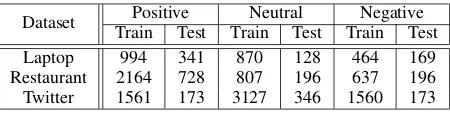
We conduct experiments on three datasets, as shown in Table 1. The first two are from the Se-mEval 2014 Task 41(Pontiki et al.,2014), which contains the reviews in laptop and restaurants, re-spectively. The third one is a tweet collection, which are gathered by (Dong et al., 2014). Each aspect with the context is labeled by three senti-ment polarities, namelyPositive,Neutraland Neg-ative. In addition, we adoptAccuracyand Macro-F1 as the metrics to evaluate the performance of aspect-level sentiment classification, which is widely used in previous works (Tang et al.,2016b;
Ma et al., 2017; Chen et al., 2017; Wang et al.,
2016).
In our experiments, word embeddings for both context and aspect words are initialized by Glove (Pennington et al., 2014). The dimension of word embedding dv and hidden state d are
1The detailed task introduction can be found in
http://alt.qcri.org/semeval2014/task4/.
Dataset Positive Neutral Negative
Train Test Train Test Train Test
Laptop 994 341 870 128 464 169
Restaurant 2164 728 807 196 637 196
[image:6.595.308.533.62.119.2]Twitter 1561 173 3127 346 1560 173
Table 1: The statistics of the datasets.
set to 300. The weight matrix and bias are ini-tialized by sampling from a uniform distribution
U(0.01,0.01). The coefficientλofL2
regulariza-tion item is10−5, the parameterβ of aspect align-ment loss and drop out rate are set to0.5.
4.2 Compared Methods
To evaluate the performance of proposed ap-proach, we compared with the following methods: Majorityis the basic baseline, which chooses the largest sentiment polarity in the training set to each instance in the test set.
Feature+SVM(Kiritchenko et al.,2014) uses n-gram features, parse features and lexicon features based on SVM, which achieves the state-of-the-art performance in SemEval 2014.
LSTM(Wang et al.,2016) utilizes one LSTM net-work to learn the hidden states and obtain the av-eraged vector to predict the sentiment polarity. ATAE-LSTM(Wang et al.,2016) learns attention embeddings and combine them with the LSTM hidden states to predict the polarity.
TD-LSTM(Tang et al., 2016a) employs two di-rectional LSTM networks, which estimate the left context and right context of the target aspect, re-spectively. Finally it takes the last hidden states of LSTM networks for prediction.
MemNet(Tang et al.,2016b) applys multi-hop at-tentions on the word embeddings, learns the atten-tion weights on context word vectors with respect to the averaged query vector.
IAN (Ma et al., 2017) interactively learns the coarse-grained attentions between the context and aspect, and concatenate the vectors for prediction. BILSTM-ATT-G (Liu and Zhang, 2017) mod-els left and right context with two attention-based LSTMs and utilizes gates to control the impor-tance of left context, right context and the entire sentence for prediction.
atten-tion weights on context words are steered by the simple averaged aspect vector.
We also list the variants of MGAN model, which are used to analyze the effects of coarse-grained attention, fine-coarse-grained attention and aspect alignment loss, respectively.
MGAN-Conly employs the coarse-grained atten-tions for prediction, which is similar withIAN. MGAN-Fonly utilizes the proposed fine-grained attentions for prediction.
MGAN-CF adopts both the coarse-grained and fine-grained attentions, while without applying the aspect alignment loss.
MGAN is the complete multi-grained attention network model.
4.3 Overall Performance Comparison
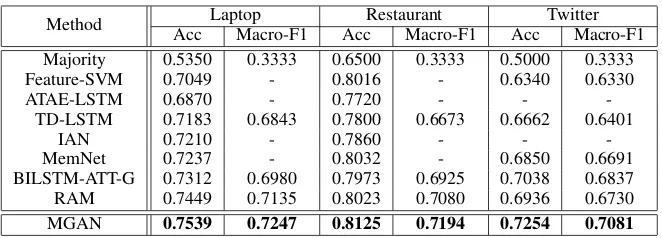
Table2shows the performance comparison results of MGAN with other baseline methods. We can have the following observations.
(1) Majorityperforms worst since it only uti-lizes the data distribution information. Fea-ture+SVMcan achieve much better performance on all the datasets, with the well-designed feature
engineering. Our method MGAN outperforms
MajorityandFeature+SVMsinceMGANcould learn the high quality representation for predic-tion.
(2)ATAE-LSTMis better thanLSTMsince it employs attention mechanism on the hidden states and combines with attention embedding to gener-ate the final representation. TD-LSTMperforms slightly better thanATAE-LSTM, and it employs two LSTM networks to capture the left and right context of the aspect. TD-LSTMperforms worse than our methodMGANsince it could not prop-erly pay more attentions on the important parts of the context.
(3)IANachieves slightly better results with the previous LSTM-based methods, which interac-tively learns the attended aspect and context vector as final representation. Our method consistently performs better thanIANsince we utilize the fine-grained attention vectors to relieve the informa-tion loss in IAN. MemNet continuously learns the attended vector on the context word embed-ding memory, and updates the query vector at each hop. BILSTM-ATT-G models left context and right context using attention-based LSTMs, which achieves better performance thanMemNet.RAM performs better than other baselines. It employs
bidirectional LSTM network to generate contex-tual memory, and learns the multiple attended vec-tor on the memory. Similar withMemNet, it uti-lizes the averaged aspect vector to learn the atten-tion weights on context words.
Our proposed MGAN consistently performs
better thanMemNet,BILSTM-ATT-GandRAM
on all three datasets. On one hand, they only consider to learn the attention weights on context towards the aspect, and do not consider to learn the weights on aspect words towards the context. On the other hand, they just use the averaged as-pect vector to guide the attention, which will lose some information, especially on the aspects with multiple words. From another perspective, our method employs the aspect alignment loss, which can bring extra useful information from the aspect-level interactions.
4.4 Analysis of MGAN model
Table3shows the performance comparison among the variants of MGAN model. We can have the following observations.
(1) the proposed fine-grained attention mech-anism MGAN-F, which is responsible for link-ing and fuslink-ing the information between the con-text and aspect word, achieves competitive per-formance compared withMGAN-C, especially on laptop dataset. To investigate this case, we col-lect the percentage of aspects with different word lengths in Table4. We can find that laptop dataset has the highest percentage on the aspects with more than two words, and the second-highest per-centage on two words. It demonstrates MGAN-F has better performance on aspects with more words, and make use of the word-level interactions to relieve the information loss occurred in coarse-grained attention mechanism.
(2) MGAN-CF is better than both MGAN-C and MGAN-F, which demonstrates the coarse-grained attentions and fine-coarse-grained attentions could improve the performance from different per-spectives. Compared withMGAN-CF, the
com-plete MGAN model gains further improvement
Method Laptop Restaurant Twitter
Acc Macro-F1 Acc Macro-F1 Acc Macro-F1
Majority 0.5350 0.3333 0.6500 0.3333 0.5000 0.3333
Feature-SVM 0.7049 - 0.8016 - 0.6340 0.6330
ATAE-LSTM 0.6870 - 0.7720 - -
-TD-LSTM 0.7183 0.6843 0.7800 0.6673 0.6662 0.6401
IAN 0.7210 - 0.7860 - -
-MemNet 0.7237 - 0.8032 - 0.6850 0.6691
BILSTM-ATT-G 0.7312 0.6980 0.7973 0.6925 0.7038 0.6837
RAM 0.7449 0.7135 0.8023 0.7080 0.6936 0.6730
[image:8.595.134.465.60.179.2]MGAN 0.7539 0.7247 0.8125 0.7194 0.7254 0.7081
Table 2: The performance comparisons of different methods on the three datasets, where the results of baseline methods are retrieved from published papers. The best performances are marked in bold.
Method Laptop Restaurant Twitter
Acc Macro-F1 Acc Macro-F1 Acc Macro-F1
MGAN-C 0.7273 0.6933 0.8054 0.7099 0.7153 0.6952
MGAN-F 0.7398 0.7082 0.8000 0.7092 0.7110 0.6918
MGAN-CF 0.7445 0.7121 0.8089 0.7135 0.7254∗ 0.7081∗
[image:8.595.80.284.344.388.2]MGAN 0.7539 0.7247 0.8125 0.7194 0.7254 0.7081
Table 3: The performance comparisons of MGAN variants.∗means MGAN-CF and MGAN can be regarded as the same method on twitter dataset.
Dataset #words=1 #words=2 #words>2
Laptop 61.60% 29.16% 9.24%
Restaurant 74.47% 17.32% 8.21%
Twitter 29.99% 69.91% 0.10%
Table 4: The percentage of aspects with different word length on three datasets. Here we give the overall statis-tic of each dataset.
The improved performance on the two datasets shows the importance of capturing the aspect-level interactions. In terms of twitter dataset, almost all of the sentences only has one aspect. In this case,
the method MGANcan be regarded as
MGAN-CF.
Dataset #aspects=1 #aspects=2 #aspects>2
Laptop 63.94% 23.32% 12.74%
Restaurant 50.89% 28.60% 20.51%
Twitter 99.91% 0.09% 0.00%
Table 5: The percentage of sentences with different as-pect numbers on three datasets. Asas-pects with the same context are regarded as the same sentence.
4.5 Case Study
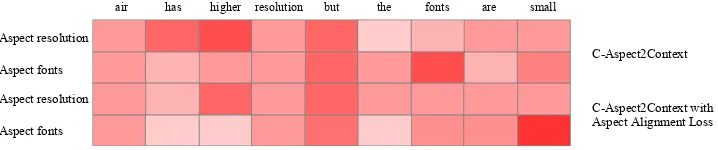
In order to demonstrate the effect of aspect align-ment loss, we visualize the attention weights of the C-Aspect2Context mechanism. Figure 2
shows the attention weights of two aspects “res-olution” and “fonts”, whose sentiment polarities are positive and negative, respectively. From
the above two bars, we can observe that the C-Aspect2Context can enforce the model to pay more attentions on the important words with re-spect to the are-spect. For example, in terms of the aspect“resolution”, the words “has”, “higher” and “but” have higher attention weights compared with other words. In contrast, aspect “fonts” pays more attentions on words “but”, “fonts” and “small”. In addition, we evaluate the effect of as-pect alignment loss, which enhances the attention difference between the aspect “resolution” and “fonts”. For the two bars at bottom, we can find that aspect “fonts” has more attention on “small” and less attention on “higher”, compared with the aspect “resolution”. This phenomenon shows that with the constraint of aspect alignment loss, C-Aspect2Context can not only learn the important context words for each aspect, but also can make the attention gaps on the important words be as large as possible for aspects with different polari-ties.
5 Conclusion
atten-air has higher resolution but the fonts are small
Aspect resolution
Aspect fonts
Aspect resolution
Aspect fonts
C-Aspect2Context
[image:9.595.120.479.65.140.2]C-Aspect2Context with Aspect Alignment Loss
Figure 2: The attention visualizations on aspect “resolution” and “fonts”. The above two bars are from the C-Aspect2Context attention mechanism, and the two bars at bottom are from the C-C-Aspect2Context attention mech-anism with the constraint of aspect alignment loss.
tion mechanism to compose the MGAN model. In addition, we design an aspect alignment loss to characterize the aspect-level interactions among aspects, which have the same context and dif-ferent sentiment polarities, to explore extra valu-able information. Experimental results demon-strate the effectiveness of our approach on three public datasets.
Acknowledgments
This work is supported by the National Nat-ural Science Foundation of China (61672057,
61672058); KLSTSPI Key Lab. of Intelligent
Press Media Technology. For any correspondence, please contact Yansong Feng.
References
Peng Chen, Zhongqian Sun, Lidong Bing, and Wei Yang. 2017. Recurrent attention network on mem-ory for aspect sentiment analysis. InProceedings of the 2017 Conference on Empirical Methods in Nat-ural Language Processing, pages 452–461.
Li Dong, Furu Wei, Chuanqi Tan, Duyu Tang, Ming Zhou, and Ke Xu. 2014. Adaptive recursive neural network for target-dependent twitter sentiment clas-sification. InProceedings of the 52nd Annual Meet-ing of the Association for Computational LMeet-inguistics (Volume 2: Short Papers), volume 2, pages 49–54.
Sepp Hochreiter and J¨urgen Schmidhuber. 1997. Long short-term memory. Neural computation, 9(8):1735–1780.
Long Jiang, Mo Yu, Ming Zhou, Xiaohua Liu, and Tiejun Zhao. 2011. Target-dependent twitter senti-ment classification. InProceedings of the 49th An-nual Meeting of the Association for Computational Linguistics: Human Language Technologies-Volume 1, pages 151–160. Association for Computational Linguistics.
Svetlana Kiritchenko, Xiaodan Zhu, Colin Cherry, and Saif Mohammad. 2014. Nrc-canada-2014: Detect-ing aspects and sentiment in customer reviews. In
Proceedings of the 8th International Workshop on
Semantic Evaluation (SemEval 2014), pages 437– 442.
Tao Lei, Regina Barzilay, and Tommi Jaakkola. 2016. Rationalizing neural predictions. InProceedings of the 2016 Conference on Empirical Methods in Nat-ural Language Processing, pages 107–117.
Cheng Li, Xiaoxiao Guo, and Qiaozhu Mei. 2017. Deep memory networks for attitude identification. InProceedings of the Tenth ACM International Con-ference on Web Search and Data Mining, pages 671– 680. ACM.
Bing Liu. 2012. Sentiment analysis and opinion min-ing. Synthesis lectures on human language tech-nologies, 5(1):1–167.
Jiangming Liu and Yue Zhang. 2017. Attention mod-eling for targeted sentiment. InProceedings of the 15th Conference of the European Chapter of the As-sociation for Computational Linguistics: Volume 2, Short Papers, volume 2, pages 572–577.
Dehong Ma, Sujian Li, Xiaodong Zhang, and Houfeng Wang. 2017. Interactive attention networks for aspect-level sentiment classification. InIJCAI.
Thien Hai Nguyen and Kiyoaki Shirai. 2015. Phrasernn: Phrase recursive neural network for aspect-based sentiment analysis. InProceedings of the 2015 Conference on Empirical Methods in Nat-ural Language Processing, pages 2509–2514.
Boyuan Pan, Hao Li, Zhou Zhao, Bin Cao, Deng Cai, and Xiaofei He. 2017. Memen: Multi-layer embed-ding with memory networks for machine compre-hension. arXiv preprint arXiv:1707.09098.
Bo Pang, Lillian Lee, et al. 2008. Opinion mining and sentiment analysis. Foundations and TrendsR in
In-formation Retrieval, 2(1–2):1–135.
Jeffrey Pennington, Richard Socher, and Christopher Manning. 2014. Glove: Global vectors for word representation. InProceedings of the 2014 confer-ence on empirical methods in natural language pro-cessing (EMNLP), pages 1532–1543.
8th International Workshop on Semantic Evaluation (SemEval 2014), pages 27–35.
Minjoon Seo, Aniruddha Kembhavi, Ali Farhadi, and Hannaneh Hajishirzi. 2017. Bidirectional attention flow for machine comprehension. InProceedings of ICLR.
Richard Socher, Jeffrey Pennington, Eric H Huang, Andrew Y Ng, and Christopher D Manning. 2011. Semi-supervised recursive autoencoders for predict-ing sentiment distributions. In Proceedings of the conference on empirical methods in natural lan-guage processing, pages 151–161. Association for Computational Linguistics.
Duyu Tang, Bing Qin, Xiaocheng Feng, and Ting Liu. 2016a. Effective lstms for target-dependent senti-ment classification. pages 3298–3307.
Duyu Tang, Bing Qin, and Ting Liu. 2016b. Aspect level sentiment classification with deep memory net-work. pages 214–224.
Duy-Tin Vo and Yue Zhang. 2015. Target-dependent twitter sentiment classification with rich automatic features. InIJCAI, pages 1347–1353.
Joachim Wagner, Piyush Arora, Santiago Cortes, Utsab Barman, Dasha Bogdanova, Jennifer Foster, and Lamia Tounsi. 2014. Dcu: Aspect-based polarity classification for semeval task 4. InProceedings of the 8th International Workshop on Semantic Evalu-ation (SemEval 2014), pages 223–229.