53
Tagged Back-Translation
Isaac Caswell, Ciprian Chelba, David Grangier Google Research
{icaswell, ciprianchelba, grangier}@google.com
Abstract
Recent work in Neural Machine Translation (NMT) has shown significant quality gains from noised-beam decoding during back-translation, a method to generate synthetic par-allel data. We show that the main role of such synthetic noise is not to diversify the source side, as previously suggested, but simply to indicate to the model that the given source is synthetic. We propose a simpler alternative to noising techniques, consisting of tagging back-translated source sentences with an ex-tra token. Our results on WMT outperform noised back-translation in English-Romanian and match performance on English-German, re-defining state-of-the-art in the former.
1 Introduction
Neural Machine Translation (NMT) has made considerable progress in recent years (Bahdanau et al., 2015;Gehring et al., 2017;Vaswani et al.,
2017). Traditional NMT has relied solely on par-allel sentence pairs for training data, which can be an expensive and scarce resource. This moti-vates the use of monolingual data, usually more abundant (Lambert et al., 2011). Approaches using monolingual data for machine translation include language model fusion for both phrase-based (Brants et al., 2007; Koehn, 2009) and neural MT (G¨ulc¸ehre et al., 2015, 2017), back-translation (Sennrich et al.,2016;Poncelas et al.,
2018), unsupervised machine translation (Lample et al., 2018a; Artetxe et al.,2018), dual learning (Cheng et al., 2016; Di He and Ma, 2016; Xia et al.,2017), and multi-task learning (Domhan and Hieber,2017).
We focus on back-translation (BT), which, de-spite its simplicity, has thus far been the most effective technique (Sennrich et al., 2017; Ha et al.,2017;Garc´ıa-Mart´ınez et al.,2017). Back-translation entails training an intermediate
target-to-source model on genuine bitext, and using this model to translate a large monolingual corpus from the target into the source language. This al-lows training a source-to-target model on a mix-ture of genuine parallel data and synthetic pairs from back-translation.
We build upon Edunov et al. (2018) and Ima-mura et al. (2018), who investigate BT at the scale of hundreds of millions of sentences. Their work studies different decoding/generation meth-ods for back-translation: in addition to regular beam search, they consider sampling and adding noise to the one-best hypothesis produced by beam search. They show that sampled BT and noised-beam BT significantly outperform standard BT, and attribute this success to increased source-side diversity (sections 5.2 and 4.4).
Our work investigates noised-beam BT (NoisedBT) and questions the role noise is play-ing. Rather than increasing source diversity, our work instead suggests that the performance gains come simply from signaling to the model that the source side is back-translated, allowing it to treat the synthetic parallel data differently than the natural bitext. We hypothesize that BT introduces both helpful signal (strong target-language signal and weak cross-lingual signal) and harmful signal (amplifying the biases of machine translation). Indicating to the model whether a given training sentence is back-translated should allow the model to separate the helpful and harmful signal.
noise, and instead explicitly tag the synthetic data with a reserved token. We call this technique “Tagged Back-Translation” (TaggedBT). These models achieve equal to slightly higher perfor-mance than the noised variants. We repeat these experiments with WMT English-Romanian (EnRo), where NoisedBT underperforms standard BT and TaggedBT improves over both techniques. We demonstrate that TaggedBT also allows for effective iterative back-translation with EnRo, a technique which saw quality losses when applied with standard back-translation.
To further our understanding of TaggedBT, we investigate the biases encoded in models by com-paring the entropy of their attention matrices, and look at the attention weight on the tag. We con-clude by investigating the effects of the back-translation tag at decoding time.
2 Related Work
This section describes prior work exploiting target-side monolingual data and discusses related work tagging NMT training data.
2.1 Leveraging Monolingual Data for NMT
Monolingual data can provide valuable informa-tion to improve translainforma-tion quality. Various meth-ods for using target-side LMs have proven effec-tive for NMT (He et al., 2016; G¨ulc¸ehre et al.,
2017), but have tended to be less successful than back-translation – for example, G¨ulc¸ehre et al.
(2017) report under +0.5 BLEU over their
base-line on EnDe newstest14, whereasEdunov et al.
(2018) report over +4.0 BLEU on the same test set. Furthermore, there is no straighforward way to incorporate source-side monolingual data into a neural system with a LM.
Back-translation was originally introduced for phrase-based systems (Bertoldi and Federico,
2009;Bojar and Tamchyna,2011), but flourished in NMT after work bySennrich et al.(2016). Sev-eral approaches have looked into iterative forward-and BT experiments (using source-side mono-lingual data), including Cotterell and Kreutzer
(2018), Vu Cong Duy Hoang and Cohn (2018), and Niu et al. (2018). Recently, iterative back-translation in both directions has been devised has a way to address unsupervised machine transla-tion (Lample et al.,2018b;Artetxe et al.,2018).
Recent work has focused on the importance of diversity and complexity in synthetic training
data. Fadaee and Monz(2018) find that BT ben-efits difficult-to-translate words the most, and se-lect from the back-translated corpus by oversam-pling words with high prediction loss. Imamura et al. (2018) argue that in order for BT to en-hance the encoder, it must have a more diverse source side, and sample several back-translated source sentences for each monolingual target sen-tence. Our work follows most closely Edunov et al.(2018), who investigate alternative decoding schemes for BT. LikeImamura et al.(2018), they argue that BT through beam or greedy decoding leads to an overly regular domain on the source side, which poorly represents the diverse distribu-tion of natural text.
Beyond the scope of this work, we briefly men-tion alternative techniques leveraging monolin-gual data, like forward translation (Ueffing et al.,
2007; Kim and Rush, 2016), or source copy-ing (Currey et al.,2017).
2.2 Training Data Tagging for NMT
Tags have been used for various purposes in NMT. Tags on the source sentence can indicate the target language in multi-lingual models (Johnson et al.,
2016). Yamagishi et al.(2016) use tags in a sim-ilar fashion to control the formality of a transla-tion from English to Japanese. Kuczmarski and Johnson(2018) use tags to control gender in trans-lation. Most relevant to our work, Kobus et al.
(2016) use tags to mark source sentence domain in a multi-domain setting.
3 Experimental Setup
This section presents our datasets, evaluation pro-tocols and model architectures. It also describes our back-translation procedure, as well as noising and tagging strategies.
3.1 Data
For monolingual data, we deduplicate and filter sentences with more than 70 tokens or 500 char-acters. Furthermore, after back-translation, we re-move any sentence pairs where the back-translated source is longer than 75 tokens or 550 characters. This results in 216.5M sentences for EnDe, 2.2M for EnRo, 149.9M for RoEn, and 39M for EnFr. For monolingual data, all tokens are defined by whitespace tokenization, not wordpieces.
The DeEn model used to generate BT data has 28.6 SacreBLEU on newstest12, the RoEn model used for BT has a test SacreBLEUof 31.9 (see Ta-ble4.b), and the FrEn model used to generate the BT data has 39.2 SacreBLEUon newstest14.
3.2 Evaluation
We rely on BLEUscore (Papineni et al.,2002) as
our evaluation metric.
While well established, any slight difference in post-processing and BLEUcomputation can have a dramatic impact on output values (Post,2018). For example,Lample and Conneau(2019) report 33.3 BLEU on EnRo using unsupervised NMT, which at first seems comparable to our reported 33.4 SacreBLEU from iterative TaggedBT. However, when we use their preprocessing scripts and eval-uation protocol, our system achieves 39.2 BLEU
on the same data, which is close to 6 points higher than the same model evaluated by SacreBLEU.
We therefore report strictly SacreBLEU1, using
the reference implementation from Post (2018), which aims to standardize BLEUevaluation.
3.3 Architecture
We use the transformer-base and transformer-big architectures (Vaswani et al.,2017) implemented in lingvo (Shen et al., 2019). Transformer-base is used for the bitext noising experiments and the EnRo experiments, whereas the transformer-big is used for the EnDe tasks with BT. Both use a vo-cabulary of 32k subword units. As an alterna-tive to the checkpoint averaging used in Edunov et al.(2018), we train with exponentially weighted moving average (EMA) decay with weight decay parameter α = 0.999 (Buduma and Locascio,
2017).
Transformer-base models are trained on 16 GPUs with synchronous gradient updates and per-gpu-batch-size of 4,096 tokens, for an effective
1BLEU + case.mixed + lang.LANGUAGE PAIR + num-refs.1 + smooth.exp + test.SET + tok.13a + version.1.2.15
batch size of 64k tokens/step. Training lasts 400k steps, passing over 24B tokens. For the final EnDe TaggedBT model, we train transformer-big simi-larly but on 128 GPUs, for an effective batch size of 512k tokens/step. A training run of 300M steps therefore sees about 150B tokens. We pick check-points with newstest2012 for EnDe and news-dev2016 for EnRo.
3.4 Noising
We focused on noised beam BT, the most effec-tive noising approach according to Edunov et al.
(2018). Before training, we noised the decoded data (Lample et al.,2018a) by applying 10% word-dropout, 10% word blanking, and a 3-constrained permutation (a permutation such that no token moves further than 3 tokens from its original position). We refer to data generated this way as NoisedBT. Additionally, we experiment using only the 3-constrained permutation and no word dropout/blanking, which we abbreviate as P3BT.
3.5 Tagging
We tag our BT training data by prepending a reserved token to the input sequence, which is then treated in the same way as any other to-ken. We also experiment with both noising and tagging together, which we call Tagged Noised Back-Translation, or TaggedNoisedBT. This con-sists simply of prepending the<BT>tag to each noised training example.
An example training sentence for each of these set-ups can be seen in Table 1. We do not tag the bitext, and always train on a mix of back-translated data and (untagged) bitext unless explic-itly stated otherwise.
Noise type Example sentence
[no noise] Raise the child, love the child. P3BT child Raise the, love child the. NoisedBT Raise child love child, the. TaggedBT <BT>Raise the child, love the child. TaggedNoisedBT <BT>Raise, the child the love.
Table 1: Examples of the five noising settings exam-ined in this paper
4 Results
4.1 Noising Parallel Bitext
We first show that noising EnDe bitext sources does not seriously impact the translation quality of the transformer-base baseline. For each sen-tence pair in the corpus, we flip a coin and noise the source sentence with probability p. We then train a model from scratch on this partially noised dataset. Table2 shows results for various values ofp. Specifically, it presents the somewhat unex-pected finding that even when noising 100% of the source bitext (so the model has never seen well-formed English), BLEU on well-formed test data only drops by 2.5.
This result prompts the following line of rea-soning about the role of noise in BT: (i) By itself, noising does not add meaningful signal (or else it would improve performance); (ii) It also does not damage the signal much; (iii) In the context of back-translation, the noise could therefore signal whether a sentence were back-translated, without significantly degrading performance.
SacreBLEU
% noised Newstest ’12 Newstest ’17
0% 22.4 28.1
20% 22.4 27.9
80% 21.5 27.0
[image:4.595.103.261.361.425.2]100% 21.2 25.6
Table 2: SacreBLEU degradation as a function of the proportion of bitext data that is noised.
4.2 Tagged Back-Translation for EnDe
We compare the results of training on a mix-ture of bitext and a random sample of 24M back-translated sentences in Table 3.a, for the various set-ups of BT described in sections 3.4 and 3.5. Like Edunov et al. (2018), we confirm that BT improves over bitext alone, and noised BT im-proves over standard BT by about the same mar-gin. All methods of marking the source text as back-translated (NoisedBT, P3BT, TaggedBT, and TaggedNoisedBT) perform about equally, with TaggedBT having the highest average BLEU by
a small margin. Tagging and noising together (TaggedNoisedBT) does not improve over either tagging or noising alone, supporting the conclu-sion that tagging and noising are not orthogonal signals but rather different means to the same end. Table 3.b verifies our result at scale applying TaggedBT on the full BT dataset (216.5M sen-tences), upsampling the bitext so that each batch contains an expected 20% of bitext. As in the
smaller scenario, TaggedBT matches or slightly out-performs NoisedBT, with an advantage on seven test-sets and a disadvantage on one. We also compare our results to the best-performing model from Edunov et al. (2018). Our model is on par with or slightly superior to their re-sult2, out-performing it on four test sets and under-performing it on two, with the largest advantage on Newstest2018 (+1.4 BLEU).
As a supplementary experiment, we consider training only on BT data, with no bitext. We compare this to training only on NoisedBT data. If noising in fact increases the quality or diver-sity of the data, one would expect the NoisedBT data to yield higher performance than training on unaltered BT data, when in fact it has about 1 BLEU lower performance (Table3.a, “BT alone” and “NoisedBT alone”).
We also compare NoisedBT versus Tagged-NoisedBT in a set-up where the bitext itself is noised. In this scenario, the noise can no longer be used by the model as an implicit tag to dif-ferentiate between bitext and synthetic BT data, so we expect the TaggedNoisedBT variant to per-form better than NoisedBT by a similar mar-gin to NoisedBT’s improvement over BT in the unnoised-bitext setting. The last sub-section of Ta-ble3.a confirms this.
4.3 Tagged Back-Translation for EnRo
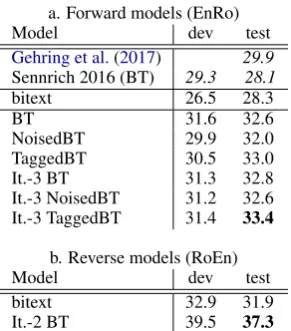
We repeat these experiments for WMT EnRo (Ta-ble 4). This is a much lower-resource task than EnDe, and thus can benefit more from mono-lingual data. In this case, NoisedBT is actu-ally harmful, lagging standard BT by -0.6 BLEU. TaggedBT closes this gap and passes standard BT by +0.4 BLEU, for a total gain of +1.0 BLEUover
NoisedBT.
4.4 Tagged Back-Translation for EnFr
We performed a minimal set of experiments on WMT EnFr, which are summarized in Table 5. This is a much higher-resource language pair than either EnRo or EnDe, but Edunov et al. (2018) demonstrate that noised BT (using sampling) can still help in this set-up. In this case, we see that BT alone hurts performance compared to the strong bitext baseline, but NoisedBT indeed surpasses the bitext model. TaggedBT out-performs all other
2SacreB
a. Results on 24M BT Set
Model AVG 13-18 2010 2011 2012 2013 2014 2015 2016 2017 2018 Bitext 32.05 24.8 22.6 23.2 26.8 28.5 31.1 34.7 29.1 42.1 BT 33.12 24.7 22.6 23.5 26.8 30.8 30.9 36.1 30.6 43.5 NoisedBT 34.70 26.2 23.7 24.7 28.5 31.3 33.1 37.7 31.7 45.9
P3BT 34.57 26.1 23.6 24.5 28.1 31.8 33.0 37.4 31.5 45.6 TaggedBT 34.83 26.4 23.6 24.5 28.1 32.1 33.4 37.8 31.7 45.9
TaggedNoisedBT 34.52 26.3 23.4 24.6 27.9 31.4 33.1 37.4 31.7 45.6 BT alone 31.20 23.5 21.2 22.7 25.2 29.3 29.4 33.7 29.1 40.5 NoisedBT alone 30.28 23.2 21.0 22.1 24.6 28.4 28.2 33.0 28.1 39.4 Noised(BT + Bitext) 32.07 24.2 22.1 23.5 26.2 29.7 30.1 35.1 29.4 41.9 + Tag on BT 33.53 25.5 22.8 24.5 27.6 30.3 31.9 36.9 30.4 44.1
b. Results on 216M BT Set
Model AVG 13-18 2010 2011 2012 2013 2014 2015 2016 2017 2018
Edunov et al.(2018) 35.28 25.0 29.0 33.8 34.4 37.5 32.4 44.6
[image:5.595.94.506.65.248.2]NoisedBT 35.17 26.7 24.0 25.2 28.6 32.6 33.9 38.0 32.2 45.7 TaggedBT 35.42 26.5 24.2 25.2 28.7 32.8 34.5 38.1 32.4 46.0
Table 3: SacreBLEUon Newstest EnDe for different types of noise, with back-translated data either sampled down to 24M or using the full set of 216M sentence pairs.
a. Forward models (EnRo)
Model dev test
Gehring et al.(2017) 29.9
Sennrich 2016 (BT) 29.3 28.1
bitext 26.5 28.3
BT 31.6 32.6
NoisedBT 29.9 32.0 TaggedBT 30.5 33.0 It.-3 BT 31.3 32.8 It.-3 NoisedBT 31.2 32.6 It.-3 TaggedBT 31.4 33.4
b. Reverse models (RoEn)
Model dev test
bitext 32.9 31.9
It.-2 BT 39.5 37.3
Table 4: Comparing SacreBLEU scores for differ-ent flavors of BT for WMT16 EnRo. Previous works’ scores are reported in italics as they use detok.multi-bleuinstead of SacreBLEU, so are not guaranteed to be comparable. In this case, how-ever, we do see identical BLEUon our systems when we score them withdetok.multi-bleu, so we be-lieve it to be a fair comparison.
methods, beating NoisedBT by an average of +0.3 BLEUover all test sets.
It is worth noting that our numbers are lower than those reported byEdunov et al.(2018) on the years they report (36.1, 43.8, and 40.9 on 2013, 2014, and 2015 respectively). We did not inves-tigate this result. We suspect that this is an er-ror/inoptimlaity in our set-up, as we did not op-timize these models, and ran only one experiment for each of the four set-ups. Alternately, sampling could outperform noising in the large-data regime.
4.5 Iterative Tagged Back-Translation
We further investigate the effects of TaggedBT by performing one round of iterative back-translation (Cotterell and Kreutzer,2018;Vu Cong Duy Hoang and Cohn, 2018; Niu et al., 2018), and find another difference between the different varieties of BT: NoisedBT and TaggedBT allow the model to bootstrap improvements from an im-proved reverse model, whereas standard BT does not. This is consistent with our argument that data tagging allows the model to extract information out of each data set more effectively.
For the purposes of this paper we call a model trained with standard back-translation an Iteration-1 BT model, where the back-translations were generated by a model trained only on bitext. We inductively de-fine the Iteration-k BT model as that model which is trained on BT data generated by an
Iteration-(k-1) BT model, for k > 1. Unless otherwise specified, any BT model mentioned in this paper is an Iteration-1 BT model.
[image:5.595.109.255.300.466.2]Model Avg 2008 2009 2010 2011 2012 2013 2014 2015 Bitext 32.8 26.3 28.8 32.0 32.9 30.1 33.5 40.6 38.4 BT 29.2 22.2 27.3 28.8 29.3 27.9 30.7 32.6 34.8 NoisedBT 33.8 26.8 29.9 33.4 33.9 31.3 34.3 42.3 38.8 TaggedBT 34.1 27.0 30.0 33.6 33.9 31.2 34.4 42.7 39.8
Table 5: Results on WMT15 EnFr, with bitext, BT, NoisedBT, and TaggedBT.
We find that the iteration-3 BT models im-prove over their Iteration-1 counterparts only for NoisedBT (+1.0 BLEU, dev+test avg) and TaggedBT (+0.7 BLEU, dev+test avg), whereas the Iteration-3 BT model shows no improve-ment over its Iteration-1 counterpart (-0.1 BLEU, dev+test avg). In other words, both techniques that (explicitly or implicitly) tag synthetic data bene-fit from iterative BT. We speculate that this sep-aration of the synthetic and natural domains al-lows the model to bootstrap more effectively from the increasing quality of the back-translated data while not being damaged by its quality issues, whereas the simple BT model cannot make this distinction, and is equally “confused” by the bi-ases in higher or lower-quality BT data.
An identical experiment with EnDe did not see either gains or losses in BLEU from iteration-3 TaggedBT. This is likely because there is less room to bootstrap with the larger-capacity model. This said, we do not wish to read too deeply into these results, as the effect size is not large, and nei-ther is the number of experiments. A more thor-ough suite of experiments is warranted before any strong conclusions can be made on the implica-tions of tagging on iterative BT.
5 Analysis
In an attempt to gain further insight into TaggedBT as it compares with standard BT or NoisedBT, we examine attention matrices in the presence of the back translation tag and measure the impact of the tag at decoding time.
5.1 Attention Entropy and Sink-Ratio
To understand how the model treats the tag and what biases it learns from the data, we investigate the entropy of the attention probability distribu-tion, as well as the attention captured by the tag.
We examine decoder attention (at the top layer) on the first source token. We define Attention Sink Ratio for indexj(ASRj) as the averaged attention
over thejth token, normalized by uniform
atten-tion, i.e.
ASRj(x,yˆ) =
1
|yˆ| |ˆy|
X
i=1
αij
˜
α
whereαijis the attention value for target tokeniin
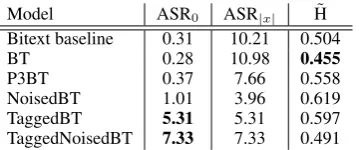
hypothesisyˆover source tokenjandα˜ = |1x| cor-responds to uniform attention. We examine ASR on text that has been noised and/or tagged (de-pending on the model), to understand how BT sen-tences are treated during training. For the tagged variants, there is heavy attention on the tag when it is present (Table 6), indicating that the model relies on the information signalled by the tag.
Our second analysis probes word-for-word translation bias through the average source-token entropy of the attention probability model when decoding natural text. Table6reports the average length-normalized Shannon entropy:
˜
H(x,yˆ) =− 1 |yˆ|
|yˆ|
X
i=1
1 log|x|
|x|
X
j=1
αijlog(αij)
sur-(a) EnDe BT
(b) EnDe NoisedBT
(c) EnDe TaggedBT
(d) EnRo BT
(e) EnRo NoisedBT
[image:7.595.94.503.66.393.2](f) EnRo TaggedBT
Figure 1: Comparison of attention maps at the first encoder layer for a random training example for BT (row 1), NoisedBT (row 2), and TaggedBT (row 3), for both EnDe (col 1) and EnRo (col 2). Note the heavy attention on the tag (position 0 in row 3), and the diffuse attention map learned by the NoiseBT models. These are the models from Table3.a
prising entry on this table is probably the low en-tropy of the TaggedNoisedBT. Our best explana-tion is that TaggedNoisedBT puts disproporexplana-tion- disproportion-ately high attention on the sentence-end token, with 1.4x the ASR|x|that TaggedBT has, naturally leading to lower entropy.
Model ASR0 ASR|x| H˜
Bitext baseline 0.31 10.21 0.504
BT 0.28 10.98 0.455
P3BT 0.37 7.66 0.558
NoisedBT 1.01 3.96 0.619 TaggedBT 5.31 5.31 0.597 TaggedNoisedBT 7.33 7.33 0.491
Table 6: Attention sink ratio on the first and last to-ken and entropy (at decoder layer 5) for the models in Table3.a, averaged over all sentences in newstest14. For ASR, data is treated as if it were BT (noised and/or tagged, resp.), whereas for entropy the natural text is used. Outliers discussed in the text are bolded.
5.2 Decoding with and without a tag
In this section we look at what happens when we decode with a model on newstest data as if it were back-translated. This means that for the TaggedBT model we tag the true source, and for the NoisedBT model, we noise the true source. These “as-if-BT” decodings contrast with “stan-dard decode”, or decoding with the true source. An example sentence from newstest2015 is shown in Table 8, decoded by both models both in the standard fashion and in the “as-if-BT” fashion. The BLEU scores of each decoding method are
presented in Table 7.
[image:7.595.94.274.583.658.2]qual-Model Decode type AVG 13-17 2010 2011 2012 2013 2014 2015 2016 2017 TaggedBT standard 33.24 26.5 24.2 25.2 28.7 32.8 34.5 38.1 32.4
as BT (tagged) 30.30 24.3 22.2 23.4 26.6 30.0 30.5 34.2 30.2 NoisedBT standard 33.06 26.7 24.0 25.2 28.6 32.6 33.9 38.0 32.2 as BT (noised) 10.66 8.1 6.5 7.5 8.2 11.1 10.0 12.7 11.3
Table 7: Comparing standard decoding with decoding as if the input were back-translated data, meaning that it is tagged (for the TaggedBT model) or noised (for the NoisedBT model) .
Model Decode type Example
TaggedBT standard Wie der Reverend Martin Luther King Jr. vor f¨unfzig Jahren sagte: as-if-BT (tagged) Wie sagte der Reverend Martin Luther King jr. Vor f¨unfzig Jahren: NoisedBT standard Wie der Reverend Martin Luther King Jr. vor f¨unfzig Jahren sagte:
as-if-BT (noised) Als Luther King Reverend Jr. vor f¨unfzig Jahren: Source As the Reverend Martin Luther King Jr. said fifty years ago: Reference Wie Pastor Martin Luther King Jr. vor f¨unfzig Jahren sagte:
Table 8: Example decodes from newstest2015 for decoding in standard and “as-if-BT” varieties. Here, NoisedBT and TaggedBT produce equivalent outputs with standard decoding; TaggedBT produces less natural output with tagged input; and NoisedBT produces a low-quality output with noised input.
ity drop – the model correctly omits the tag in the outputs, but simply produces slightly lower qual-ity hypotheses. The only noticeable difference in decoding outputs between the two systems is that the tagged decoding produces about double the quantity of English outputs (2.7% vs. 1.2%, over newstest2010-newstest2017, using a language ID classifier).
That the tagged-decode BLEU is still quite reasonable tells us that the model has not sim-ply learned to ignore the source sentence when it encounters the input tag, suggesting that the p(y|BT(x)) signal is still useful to the model, as
Sennrich et al.(2016) also demonstrated. The tag might then be functioning as a domain tag, causing the model to emulate the domain of the BT data – including both the desirable target-side news do-main and the MT biases inherent in BT data.
To poke at the intuition that the quality drop comes in part from emulating the NMT biases in the synthetic training data, we probe a particu-lar shortcoming of NMT: copy rate. We quantify the copy rate with the unigram overlap between source and target as a percentage of tokens in the target side, and compare those statistics to the bi-text and the back-translated data (Table 9). We notice that the increase in unigram overlap with the tagged decode corresponds to the increased copy rate for the back-translated data (reaching the same value of 11%), supporting the hypothesis that the tag helps the model separate the domain of the parallel versus the back-translated data. Under this lens, quality gains from TaggedBT/NoisedBT could be re-framed as transfer learning from a
multi-task set-up, where one task is to translate simpler “translationese” (Gellerstam, 1986; Fre-itag et al., 2019) source text, and the other is to translate true bitext.
Data src-tgt unigram overlap TaggedBT (standard decode) 8.9% TaggedBT (tagged decode) 10.7%
Bitext 5.9%
[image:8.595.96.507.60.116.2]BT Data 11.4 %
Table 9: Source-target overlap for both back-translated data with decoding newstest as if it were bitext or BT data. Model decodes are averaged over newstest2010-newstest2017.
6 Negative Results
In addition to tagged back-translation, we tried several tagging-related experiments that did not work as well. We experimented with tagged forward-translation (TaggedFT), and found that the tag made no substantial difference, often lag-ging behind untagged forward-translation (FT) by a small margin (∼ 0.2 BLEU). For EnDe, (Tagged)FT underperformed the bitext baseline; for EnRo, (Tagged)FT performed about the same as BT. Combining BT and FT had additive effects, yielding results slightly higher than iteration-3 TaggedBT (Table4), at 33.9 SacreBLEU on test;
repli-cated the “as-if-bt” experiments from Table8 us-ing year-specific tags, and although there was a slight correlation between year tag and that year’s dataset, the standard-decode still resulted in the highest BLEU.
7 Conclusion
In this work we develop TaggedBT, a novel tech-nique for using back-translation in the context of NMT, which improves over the current state-of-the-art method of Noised Back-Translation, while also being simpler and more robust. We demon-strate that while Noised Back-Translation and standard Back-Translation are more or less effec-tive depending on the task (low-resource, mid-resource, iterative BT), TaggedBT performs well on all tasks.
On WMT16 EnRo, TaggedBT improves on vanilla BT by 0.4 BLEU. Our best BLEU score of 33.4 BLEU, obtained using Iterative TaggedBT, shows a gain of +3.5 BLEUover the highest previ-ously published result on this test-set that we are aware of. We furthermore match or out-perform the highest published results we are aware of on WMT EnDe that use only back-translation, with higher or equal BLEUon five of seven test sets.
In addition, we conclude that noising in the con-text of back-translation acts merely as an indicator to the model that the source is back-translated, al-lowing the model to treat it as a different domain and separate the helpful signal from the harmful signal. We support this hypothesis with experi-mental results showing that heuristic noising tech-niques like those discussed here, although they produce text that may seem like a nigh unintelli-gible mangling to humans, have a relatively small impact on the cross-lingual signal. Our analysis of attention and tagged decoding provides further supporting evidence for these conclusions.
8 Future Work
A natural extension of this work is to investi-gate a more fine-grained application of tags to both natural and synthetic data, for both back-translation and forward-back-translation, using quality and domain tags as well as synth-data tags. Sim-ilarly, tagging could be investigated as an alter-native to data selection, as in van der Wees et al.
(2017);Axelrod et al.(2011), or curriculum learn-ing approaches like fine-tunlearn-ing on in-domain data (Thompson et al.,2018;Hassan Sajjad and Nadir
Durrani and Fahim Dalvi and Yonatan Belinkov and Stephan Vogel,2017;Freitag and Al-Onaizan,
2016). Finally, the token-tagging method should be contrasted with more sophisticated versions of tagging, like concatenating a trainable domain em-bedding with all token emem-beddings, as inKobus et al.(2016).
9 Acknowledgements
Thank you to Markus Freitag, Melvin Johnson and Wei Wang for advising and discussions about these ideas; thank you to Keith Stevens, Mia Chen, and Wei Wang for technical help and bug fixing; thank you to Sergey Edunov for a fast and thor-ough answer to our question about his paper; and of course to the various people who have given comments and suggestions throughout the pro-cess, including Bowen Liang, Naveen Arivazha-gan, Macduff Hughes, and George Foster.
References
Mikel Artetxe, Gorka Labaka, and Eneko Agirre. 2018.
Unsupervised Statistical Machine Translation. In
Proceedings of the 2018 Conference on Empirical Methods in Natural Language Processing, pages 3632–3642.
Amittai Axelrod, Xiaodong He, and Jianfeng Gao. 2011. Domain adaptation via pseudo in-domain data selection. InProceedings of the 2011 Conference on Empirical Methods in Natural Language Process-ing, pages 355–362.
Dzmitry Bahdanau, Kyunghyun Cho, and Yoshua Ben-gio. 2015. Neural Machine Translation by Jointly
Learning to Align and Translate. In 3rd
Inter-national Conference on Learning Representations, ICLR 2015.
Nicola Bertoldi and Marcello Federico. 2009. Do-main adaptation for statistical machine translation with monolingual resources. InProceedings of the fourth workshop on statistical machine translation, pages 182–189. Association for Computational Lin-guistics.
Ondˇrej Bojar and Aleˇs Tamchyna. 2011. Improving translation model by monolingual data. In Proceed-ings of the Sixth Workshop on Statistical Machine Translation, pages 330–336. Association for Com-putational Linguistics.
Thorsten Brants, Ashok C Popat, Peng Xu, Franz J Och, and Jeffrey Dean. 2007.Large Language
Mod-els in Machine Translation. In Proceedings of the
Nikhil Buduma and Nicholas Locascio. 2017.
Fundamentals of deep learning: Designing
next-generation machine intelligence algorithms. “O’Reilly Media, Inc.”.
Yong Cheng, Wei Xu, Zhongjun He, Wei He, Hua Wu, Maosong Sun, and Yang Liu. 2016. Semi-Supervised Learning for Neural Machine Transla-tion. InProceedings of the 54th Annual Meeting of the Association for Computational Linguistics, vol-ume 1, pages 1965–1974.
Ryan Cotterell and Julia Kreutzer. 2018. Explain-ing and GeneralizExplain-ing Back-Translation through
Wakesleep.arXiv preprint arXiv:1806.04402.
Anna Currey, Antonio Valerio Miceli Barone, and Ken-neth Heafield. 2017. Copied monolingual data im-proves low-resource neural machine translation. In Proceedings of the Second Conference on Machine Translation, pages 148–156.
Tao Qin Liwei Wang Nenghai Yu Tieyan Liu Di He, Yingce Xia and Wei-Ying Ma. 2016. Dual
Learn-ing for Machine Translation. InConference on
Ad-vances in Neural Information Processing Systems (NeurIPS).
Tobias Domhan and Felix Hieber. 2017.Using Target-side Monolingual Data for Neural Machine Transla-tion through Multi-task Learning. InProceedings of the 2017 Conference on Empirical Methods in Nat-ural Language Processing, pages 1500–1505.
Sergey Edunov, Myle Ott, Michael Auli, and David Grangier. 2018. Understanding Back-Translation at
Scale. InProceedings of the 2018 Conference on
Empirical Methods in Natural Language Processing (EMNLP), pages 489–500.
Marzieh Fadaee and Christof Monz. 2018.
Back-Translation Sampling by Targeting Difficult
Words in Neural Machine Translation. CoRR,
abs/1808.09006.
Markus Freitag and Yaser Al-Onaizan. 2016. Fast
Do-main Adaptation for Neural Machine Translation.
CoRR, abs/1612.06897.
Markus Freitag, Isaac Caswell, and Scott Roy. 2019.
Text Repair Model for Neural Machine Translation.
CoRR, abs/1904.04790.
Mercedes Garc´ıa-Mart´ınez, Ozan C¨ ¸ a˘glayan, Walid Aransa, Adrien Bardet, Fethi Bougares, and Lo¨ıc Barrault. 2017. LIUM Machine Translation
Sys-tems for WMT17 News Translation Task. CoRR,
abs/1707.04499.
Jonas Gehring, Michael Auli, David Grangier, Denis Yarats, and Yann N. Dauphin. 2017. Convolutional
Sequence to Sequence Learning. In Proceedings
of the 34th International Conference on Machine Learning - Volume 70, pages 1243–1252.
Martin Gellerstam. 1986. Translationese in Swedish novels translated from English. Translation Studies in Scandinavia, pages 88–95.
C¸ a˘glar G¨ulc¸ehre, Orhan Firat, Kelvin Xu, Kyunghyun Cho, Loic Barrault, Huei-Chi Lin, Fethi Bougares, Holger Schwenk, and Yoshua Bengio. 2015. On us-ing Monolus-ingual Corpora in Neural Machine Trans-lation.arXiv preprint arXiv:1503.03535.
C¸ a˘glar G¨ulc¸ehre, Orhan Firat, Kelvin Xu, Kyunghyun Cho, and Yoshua Bengio. 2017. On Integrating a
Language Model into Neural Machine Translation.
Comput. Speech Lang., pages 137–148.
Thanh-Le Ha, Jan Niehues, and Alexander H. Waibel. 2017. Effective Strategies in Zero-Shot Neural Ma-chine Translation.CoRR, abs/1711.07893.
Hassan Sajjad and Nadir Durrani and Fahim Dalvi and Yonatan Belinkov and Stephan Vogel. 2017. Neural machine translation training in a multi-domain sce-nario. arXiv preprint arXiv:1708.08712v2.
Wei He, Zhongjun He, Hua Wu, and Haifeng Wang. 2016. Improved neural machine translation with SMT features. InThirtieth AAAI conference on ar-tificial intelligence.
Kenji Imamura, Atsushi Fujita, and Eiichiro Sumita. 2018. Enhancement of Encoder and Attention Us-ing Target MonolUs-ingual Corpora in Neural Machine Translation. InProceedings of the 2nd Workshop on Neural Machine Translation and Generation, vol-ume 1, pages 55–63.
Melvin Johnson, Mike Schuster, Quoc V. Le, Maxim Krikun, Yonghui Wu, Zhifeng Chen, Nikhil Tho-rat, Fernanda B. Vi’egas, Martin Wattenberg, Greg Corrado, Macduff Hughes, and Jeffrey Dean. 2016.
Google’s Multilingual Neural Machine Translation
System: Enabling Zero-Shot Translation. CoRR,
abs/1611.04558.
Yoon Kim and Alexander M. Rush. 2016.
Sequence-Level Knowledge Distillation. In Proceedings of
the 2016 Conference on Empirical Methods in Natu-ral Language Processing, pages 1317–1327, Austin, Texas. Association for Computational Linguistics.
Catherine Kobus, Josep Maria Crego, and Jean Senel-lart. 2016. Domain Control for Neural Machine
Translation.CoRR, abs/1612.06140.
Philipp Koehn. 2009. Statistical machine translation. Cambridge University Press.
James Kuczmarski and Melvin Johnson. 2018.
Gender-aware natural language translation. Techni-cal Disclosure Commons.
Guillaume Lample and Alexis Conneau. 2019. Cross-lingual Language Model Pretraining. arXiv preprint arXiv:1901.07291.
Guillaume Lample, Alexis Conneau, Ludovic Denoyer, and Marc’Aurelio Ranzato. 2018a. Unsupervised Machine Translation Using Monolingual Corpora Only. InInternational Conference on Learning Rep-resentations.
Guillaume Lample, Myle Ott, Alexis Conneau, Lu-dovic Denoyer, and Marc’Aurelio Ranzato. 2018b.
Phrase-Based & Neural Unsupervised Machine Translation. InProceedings of the 2018 Conference on Empirical Methods in Natural Language Pro-cessing (EMNLP).
Xing Niu, Michael Denkowski, and Marine Carpuat. 2018. Bi-Directional Neural Machine Translation with Synthetic Parallel Data.ACL 2018, page 84.
Kishore Papineni, Salim Roukos, Todd Ward, and Wei-Jing Zhu. 2002. BLEU: a Method for Automatic
Evaluation of Machine Translation. InProceedings
of the 40th annual meeting on association for com-putational linguistics, pages 311–318. Association for Computational Linguistics.
Alberto Poncelas, Dimitar Shterionov, Andy Way, Gideon Maillette de Buy Wenniger, and Peyman Passban. 2018. Investigating Backtranslation in
Neural Machine Translation. InProceedings of the
21st Annual Conference of the European Associa-tion for Machine TranslaAssocia-tion, pages 249–258.
Matt Post. 2018. A Call for Clarity in Reporting Bleu Scores.arXiv preprint arXiv:1804.08771.
Rico Sennrich, Alexandra Birch, Anna Currey, Ulrich Germann, Barry Haddow, Kenneth Heafield, An-tonio Valerio Miceli Barone, and Philip Williams. 2017. The University of Edinburgh’s Neural MT
Systems for WMT17.CoRR, abs/1708.00726.
Rico Sennrich, Barry Haddow, and Alexandra Birch. 2016. Improving Neural Machine Translation
Mod-els with Monolingual Data. InProceedings of the
54th Annual Meeting of the Association for Compu-tational Linguistics (Volume 1: Long Papers), pages 86–96.
Jonathan Shen, Patrick Nguyen, Yonghui Wu, Zhifeng Chen, Mia X. Chen, Ye Jia, Anjuli Kannan, Tara N. Sainath, and Yuan Cao et al. 2019. Lingvo: a Modular and Scalable Framework for
Sequence-to-Sequence Modeling. CoRR, abs/1902.08295.
Brian Thompson, Huda Khayrallah, Antonios Anasta-sopoulos, Arya D. McCarthy, Kevin Duh, Rebecca Marvin, Paul McNamee, Jeremy Gwinnup, Tim An-derson, and Philipp Koehn. 2018. Freezing Subnet-works to Analyze Domain Adaptation in Neural Ma-chine Translation. InProceedings of the Third Con-ference on Machine Translation: Research Papers, pages 124–132. Association for Computational Lin-guistics.
Nicola Ueffing, Gholamreza Haffari, and Anoop Sarkar. 2007. Semi-supervised model adaptation for statistical machine translation. Machine Transla-tion, 21(2):77–94.
Ashish Vaswani, Noam Shazeer, Niki Parmar, Jakob Uszkoreit, Llion Jones, Aidan N Gomez, Łukasz Kaiser, and Illia Polosukhin. 2017. Attention Is All
You Need. InAdvances in Neural Information
Pro-cessing Systems, pages 5998–6008.
Gholamreza Haffari Vu Cong Duy Hoang,
Philipp Koehn and Trevor Cohn. 2018. Iterative
Backtranslation for Neural Machine Translation.
In Proceedings of the 2nd Workshop on Neural Machine Translation and Generation, volume 1, pages 18–24.
Marlies van der Wees, Arianna Bisazza, and Christof Monz. 2017. Dynamic Data Selection for Neural Machine Transaltion. In Proceedings of the 2017 Conference on Empirical Methods in Natural Lan-guage Processing, pages 1400–1410.
Yingce Xia, Tao Qin, Wei Chen, Jiang Bian, Nenghai Yu, and Tie-Yan Liu. 2017. Dual Supervised Learn-ing. InInternational Conference on Machine Learn-ing (ICML).