A Computationally Efficient Algorithm for Learning Topical Collocation
Models
Zhendong Zhao1, Lan Du1, Benjamin B¨orschinger1,2, John K Pate1, Massimiliano Ciaramita2, Mark Steedman3 and Mark Johnson1
1 Department of Computing, Macquarie University, Australia 2 Google, Zurich, Switzerland
3School of Informatics, University of Edinburgh, Scotland
Abstract
Most existing topic models make the bag-of-wordsassumption that words are gener-ated independently, and so ignore poten-tially useful information about word or-der. Previous attempts to usecollocations (short sequences of adjacent words) in topic models have either relied on a pipe-line approach, restricted attention to bi-grams, or resulted in models whose infer-ence does not scale to large corpora. This paper studies how to simultaneously learn both collocations and their topic assign-ments. We present an efficient reformula-tion of the Adaptor Grammar-based topi-cal collocation model (AG-colloc) (John-son, 2010), and develop a point-wise sam-pling algorithm for posterior inference in this new formulation. We further improve the efficiency of the sampling algorithm by exploiting sparsity and parallelising in-ference. Experimental results derived in text classification, information retrieval and human evaluation tasks across a range of datasets show that this reformulation scales to hundreds of thousands of docu-ments while maintaining the good perfor-mance of the AG-colloc model.
1 Introduction
Probabilistic topic models like Latent Dirichlet Allocation (LDA) (Blei et al., 2003) are com-monly used to study the meaning of text by iden-tifying a set of latent topics from a collection of documents and assigning each word in these doc-uments to one of the latent topics. A document is modelled as a mixture of latent topics, and each topic is a distribution over a finite vocabulary of words. It is common for topic models to treat documents as bags-of-words, ignoring any
inter-nal structure. While this simplifies posterior infer-ence, it also ignores the information encoded in, for example, syntactic relationships (Boyd-Graber and Blei, 2009), word order (Wallach, 2006) and the topic structure of documents (Du et al., 2013). Here we are interested in topic models that capture dependencies between adjacent words in a topic dependent way. For example, the phrase “white house” can be interpreted compositionally in a real-estate context, but not in a political context.
Several extensions of LDA have been proposed that assign topics not only to individual words but also to multi-word phrases, which we calltopical collocations. However, as we will discuss in sec-tion 2, most of those extensions either rely on a pre-processing step to identify potential colloca-tions (e.g., bigrams and trigrams) or limit attention to bigram dependencies. We want a model that can jointly learn collocations of arbitrary length and their corresponding topic assignments from a large collection of documents. The AG-colloc model (Johnson, 2010) does exactly this. However, be-cause the model is formulated within the Adaptor Grammar framework (Johnson et al., 2007), the time complexity of its inference algorithm is cu-bic in the length of each text fragment, and so it is not feasible to apply the AG-colloc model to large collections of text documents.
In this paper we show how to reformulate the AG-colloc model so it is no longer relies on a general Adaptor Grammar inference proce-dure. The new formulation facilitates more ef-ficient inference by extending ideas developed for Bayesian word segmentation (Goldwater et al., 2009). We adapt a point-wise sampling algo-rithm from Bayesian word segmentation, which has also been used in Du et al. (2013), to simul-taneously sample collocation boundaries and col-location topic assignments. This algorithm retains the good performance of the AG-colloc model in document classification and information retrieval
tasks. By exploiting the sparse structure of both collocation and topic distributions, using tech-niques inspired by Yao et al. (2009), our new in-ference algorithm produces a remarkable speedup in running time and allows our reformulation to scale to a large number of documents. This algo-rithm can also be easily parallelised to take advan-tage of multiple cores by combining the ideas of the distributed LDA model (Newman et al., 2009). Thus, the contribution of this paper is three-fold: 1) a novel reformulation of the AG-colloc model, 2) an easily parallelisable and fast point-wise sam-pling algorithm exploiting sparsity and 3) system-atic experiments with both qualitative and quanti-tative analysis.
The structure of the paper is as follows. In Sec-tion 2 we briefly discuss prior work on learning topical collocations. We then present our reformu-lation of the AG-colloc model in Section 3. Sec-tion 4 derives a point-wise Gibbs sampler for the model and shows how this sampler can take advan-tage of sparsity and be parallelised across multiple cores. Experimental results are reported in Section 5. Section 6 concludes this paper and discusses fu-ture work.
2 Related Work
There are two main approaches to incorporat-ing topical collocations in LDA: 1) pipeline ap-proaches that use a pre-processing step prior to LDA, and 2) extensions to LDA, which modify the generative process. In this section we discuss prior work that falls into these two categories and their limitations.
Pipeline Approaches (Lau et al., 2013), denoted here by PA, involve two steps. The first step iden-tifies a set of bigrams that are potentially rele-vant collocations from documents by using sim-ple heuristics for learning collocations, e.g., the Student’s t-test method of Banerjee and Peder-sen (2003). For each identified bigram “w1 w2”,
a new pseudo word “w1 w2” is added to the
vo-cabulary and the documents are re-tokenised to treat every instance of this bigram as a new to-ken. LDA is then applied directly to the mod-ified corpus without any changes to the model. While Lau et al. demonstrated that this two-step approach improves performance on a document classification task, it is limited in two ways. First, it can identify only collocations of a fixed length (i.e., bigrams). Second, the pre-processing step
that identifies collocation candidates has no access to contextual cues (e.g. the topic of the context in which a bigram occurs),
A variety of extensions to the LDA model have been proposed to address this second shortcom-ing. Most extensions add some ability to capture word-to-word dependencies directly into the un-derlying generative process. For example, Wal-lach (2006) incorporates a hierarchical Dirichlet language model (MacKay and Peto, 1995), en-abling her model to automatically cluster function words together. The model proposed by Griffiths et al. (2004) combines a hidden Markov model with LDA, using the former to model syntax and the latter to model semantics.
The LDA collocation model (LDACOL) (Grif-fiths et al., 2007) infers both the per-topic word distribution in the standard LDA model and, for each word in the vocabulary, a distribution over the words that follow it. The generative process of the LDACOL model allows words in a document to be generated in two ways. A word is generated either by drawing it directly from a per-topic word distri-bution corresponding to its topic as in LDA, or by drawing it from the word distribution associated with its preceding word w. The two alternatives are controlled by a set of Bernoulli random vari-ables associated with individual words. Sequences of words generated from their predecessors consti-tute topical collocations.
Wang et al. (2007) extended the LDACOL model to generate the second word of a colloca-tion from a distribucolloca-tion that condicolloca-tions on not only the first word but also the first word’s topic assign-ment, proposing the topical N-gram (TNG) model. In other words, whereas LDACOL only adds a dis-tribution for every word-type to LDA, TNG adds a distribution for every possible word-topic pair. Wang et al. found that this modification allowed TNG to outperform LDACOL on a standard in-formation retrieval task. However, both LDACOL and TNG do not require words within a sequence to share the same topic, which can result in seman-tically incoherent collocations.
ex-tension of TNG inspired by Bayesian N-gram models Teh (2006) that incorporate a Pitman-Yor Process prior. The n-gram HDP is a nonparametric extension of LDA-colloc, putting an HDP prior on the per-document topic distribution. Both of these non-parametric extensions use the Chinese Fran-chise representation for posterior inference.
Our work here is based on the AG-colloc model proposed by Johnson (2010). He showed how Adaptor Grammars can generalise LDA to learn topical collocations of unbounded length while jointly identifying the topics that occur in each document. Unfortunately, because the Adaptor Grammar inference algorithm uses Probabilistic Context-Free Grammar (PCFG) parsing as a sub-routine, the time complexity of inference is cu-bic in the length of individual text fragments. In order to improve the efficiency of the AG-colloc model, we re-express it using ideas from Bayesian word segmentation models. This allows us to de-velop an efficient inference algorithm for the AG-colloc model that scales to large corpora. Finally, we evaluate our model in terms of classification, information retrieval, and topic intrusion detection tasks; to our knowledge, we are the first to evalu-ate topical collocation models along all the three dimensions.
3 Topical Collocation Model
In this section we present our reformulation of the AG-colloc model, which we call the Topical Col-location Model (TCM) to emphasise that we are not using a grammar-based formulation. We start with the Unigram word segmentation model and Adaptor Grammar model of topical collocations, and then present our reformulation.
Goldwater et al. (2009) introduced a Bayesian model for word segmentation known as the Uni-gram model. This model is based on the Dirichet Process (DP) and assumes the following genera-tive process for a sequence of words.
G∼DP(α0, P0), wi |G∼G
Here, P0 is some distribution over the countably
infinite set of all possible word forms (which are in turn sequences of a finite number of charac-ters), and G is a draw from a Dirichlet Process. Inference is usually performed under a collapsed model in which G is integrated out, giving rise to a Chinese Restaurant Process (CRP) represen-tation. The CRP is defined by the following
pre-dictive probability ofwigivenw1:i−1:
p(wi =l|w1:i−1) = i−1 +nl α 0 +
α0P0(l)
i−1 +α0 ,
wherenl is the number of times word forml
ap-pears in the firstn−1words.
During inference, the words are not known, and the model observes only a sequence of charac-ters. Goldwater et al. (2009) derived a linear time Gibbs sampler that samples from the posterior dis-tribution over possible segmentations of a given corpus according to the model. Their key insight is that sampling can be performed over a vector of Boolean boundary indicator variables – not in-cluded in the original description of the model – that indicates which adjacent characters are sepa-rated by a word boundary. We will show how this idea can be generalised to yield an inference algo-rithm for the AG-colloc model.
Adaptor Grammars (Johnson et al., 2007) are a generalisation of PCFGs. In a PCFG, a non-terminalAis expanded by selecting a ruleA→β with probabilityP(β|A), whereβis a sequence of terminal and non-terminal node labels. Because the rules are selected independently, PCFGs in-troduce strong conditional independence assump-tions. In an Adaptor Grammar, some of the non-terminal labels areadapted. These nodes can be expanded either by selecting a rule, as in PCFGs, or by retrieving an entire subtree from a Dirichlet Process cache specific to that node’s non-terminal label,1 breaking the conditional independence
as-sumptions and capturing longer-range statistical relationships.
The AG-colloc model can be concisely ex-pressed using context free grammar rule schemata, where adapted non-terminals are underlined:
Top→Docm
Docm→−m| Docm Topici
Topici→Word+
Herem ranges over the documents,iranges over topics, “|” separates possible expansions, and “+”
means “one or more”. As in LDA, each document is defined as a mixture ofK topics with the mix-ture probabilities corresponding to the
probabili-1Strictly speaking, Adaptor Grammars are defined using
ties of the different expansions of Docm.
How-ever, the topic distributions are modelled using an adapted non-terminal Topici. This means that
there is an infinite number of rules expanding Topici, one for every possible sequence over the
finite vocabulary of words. Topici non-terminals
cache sequences of words, just as G caches se-quences of characters in the Unigram model.
The base distribution of the AG-colloc model is a geometric distribution over sequences of a finite vocabulary of words: P0(c = (w1, . . . , wM)) =
p#(1−p#)M−1QMj=1Pw(wj),wherePw(·)is the
uniform distribution over the finite set of words. This is the same base distribution used by Gold-water et al. (2009), except characters have been replaced by words.p#is the probability of seeing
the end of a collocation, and so controls the length of collocations. With this, we can re-express the AG-colloc model as a slight modification of the Unigram model:
1. For each topick,1≤k≤K,φk∼DP(α0, P0)
2. For each documentd,1≤d≤D
(a) Draw a topic distributionθd|α∼DirichletK(α) (b) For each collocationcd,nin documentd,1 ≤ n ≤
Nd
i. Draw a topic assignment: zd,n|θd∼Discrete(θd) ii. Draw a collocation:
cd,n|zd,n,φ1, . . . ,φK ∼φz d,n
where the length of a collocation cd,n is greater
than or equal to 1, i.e.,|cd,n| ≥1. Unlike previous
models, the TCM associates each topic with a Un-igram model over topical collocations. Therefore, the TCM learns different vocabularies for different topics.2
4 Posterior Inference
We develop an efficient point-wise sampling al-gorithm that can jointly sample collocations and their topics. The observed data consists of a se-quence of word tokens which are grouped intoD documents. We sample from the posterior distri-bution over segmentations of documents into col-locations, and assignments of topics to colloca-tions. Let each documentdbe a sequence ofNd
wordswd,1, . . . , wd,Nd. We introduce a set of
aux-iliary random variablesbd,1, . . . , bd,Nd. The value
2In the TCM, the vocabulary differs from topic to topic.
Given a sequence of adjacent words, it is hard to tell if it is a collocation without knowing the topic of its context. There-fore, the Pointwise Mutual Information (PMI) (Newman et al., 2010) and its variant (Lau et al., 2014) are not applicable to our TCM in evaluation.
of bd,j indicates whether there is a collocation
boundary betweenwd,j and wd,j+1, and, if there
is, the topic of the collocation to the left of the boundary. If there is no boundary thenbd,j = 0.
Otherwise, there is a collocation to the left of the boundary consisting of the wordswd,l+1, . . . , wd,j
where l = max{i|1≤i≤j−1∧bd,i 6= 0},
andbd,j =k(1≤k≤K) is the topic of the
col-location. Note thatbd,Nd must not be0as the end
of a document is always a collocation boundary. For example, consider the document consisting of the words “the white house.” We use theK+1 -valued variablesb1, b2(after ‘the’ and ‘white’) and
the K-valued variable b3 (after ‘house’) to
de-scribe every possible segmentation of this docu-ment into topical collocations.3 If there areK
top-ics andNwords, there are(K+1)N−1Kpossible
topical segmentations. To illustrate, see how each of the following triples(b1, b2, b3)encodes a
dif-ferent analysis of “the white house” into bracketed collocations and subscripted topic numbers:
• (0,0,1): (the white house)1 • (1,0,2): (the)1 (white house)2 • (2,1,1): (the)2 (white)1(house)1
The next section elaborates the Gibbs sampler over theseK+1boundary variables.
4.1 A Point-wise Gibbs Sampler for the TCM We consider a collapsed version of the TCM in which the document-specific topic mixturesθ1:D
and theKnon-parametric topic distributionsφ1:K
are integrated out. We introduce the sampling equations using a concrete example, considering again the toy document, “the white house.”
Let the sampler start in stateb1 =b2 = 0,b3 =
z0,1≤z0≤K. This corresponds to the analysis
(the| 0 white{z0 housez0}
c0
).
This analysis consists of a single collocation c0
which spans the entire document and is assigned to topicz0. For simplicity, we will not show how
to model document boundaries.
If we resampleb1, we have to consider two
dif-ferent hypotheses, i.e., putting or not putting a col-location boundary atb1. The analysis
correspond-ing to not puttcorrespond-ing a boundary is the one we just
3A similar strategy of using K-valued rather than
saw. Putting a boundary corresponds to a new seg-mentation,
(thez1)
| {z }
c1
(white| 0{zhousez}2
c2
).
We need to consider theKpossible topics forc1,
for each of which we calculate the probability as follows. If b1 = 0 (i.e., there is no collocation
boundary after “the”) we have
p(z0, c0|µ) =p(z0|α)p(c0|α0, P0, z0), (1)
where µ = {α, α0, P0}. p(c0|α0, P0, z0) is the
probability of generating collocationc0from topic
z0with a CRP, i.e.,
p(c0|α0, P0, z0) = n −c0
z0 +α0P0(c0)
N−c0
z0 +α0
, (2)
where n−c0
z0 is the number of times that
colloca-tion c0 was assigned to topic z0 andNz−c0 0 is the
total number of collocations assigned toz0. Both
counts exclude the parts of the analysis that are af-fected by the boundaryc0. As in LDA,
p(z0 =k|α) = nˆ −c0
k +α
PK
k=1nˆ−ck 0 +Kα
, (3)
wherenˆ−c0
k is the total number of collocations
as-signed to topickin a document, again excluding the count for the parts of the document that are af-fected by the current boundary. For the hypothesis thatb1 = z1 (with1 ≤ z1 ≤ K), the full
condi-tional to generate two adjacent collocations is
p(z1, z2, c1, c2|µ)∝ (4)
p(z1|α)p(c1|α0, P0, z1)
p(z2|α, z1)p(c2|α0, P0, c1, z1, z2),
where p(z1|α) and p(c1|α0, P0, z1) can be
com-puted with Eqs (3) and (2), respectively. The re-maining probabilities are computed as
p(z2 =k|α, z1) =
ˆ
n−c1,c2
k +α+Iz2=z1
PK
k=1nˆ−ck 1,c2+Kα+ 1
, (5)
p(c2|α0, P0, c1, z1, z2) =
n−c1,c2
z2 +Iz1=z2Ic1=c2+α0P0(c2)
α0+Nz−c2 1,c2+Iz1=z2
(6)
where Ix=y is an indicator function that is equal to 1 if x = y and 0 otherwise, n−c1,c2
z2 is the
number of collocations c2 assigned to topic z2,
andN−c1,c2
z2 is the total number of collocations
as-signed to topicz2. Both counts exclude the current
c2, and also excludec1ifz1 =z2andc1 =c2. Our
sampler does random sweeps over all the bound-ary positions, and calculates the joint probability of the corresponding collocations and their topic assignment using Eqs (1) and (4) at each position.
4.2 Parallelised Sparse Sampling Algorithm The word distributions and topic distributions in LDA are typically sparse, and Yao et al. (2009) proposed a ‘sparseLDA’ Gibbs sampler that takes advantage of this sparsity to substantially reduce running time. These two distributions are even sparser for the TCM than LDA, because collo-cations are less frequent than unigrams. Here we show how to modify our sampler to take advan-tage of sparsity. Sampling boundaries according the two probabilities shown Eqs (1) and (4) re-quires the generation of a random numberxfrom a uniform distribution,U(0,P), where
P =p(z0, c0) + K
X
z1=1
p(z1, c1)p(z2, c2|c1, z1). (7)
Here the first term corresponds to the case that there is no collocation boundary, and the summa-tion corresponds to the case that there is a collo-cation boundary. Thus, ifxis less thanP(z0, c0),
there will be no boundary. Otherwise, we need to samplez1according to Eq (4).
The sampling algorithm requires calculation of Eq (7), even though the probability mass may be concentrated on just a few topics. We have ob-served in our experiments that the denominators of Eqs (5) and (6) are often quite large and the indica-tor functions usually turn out to be zero, so we ap-proximate the two equations by removing the in-dicator functions. This approximation not only fa-cilitates the computation of Eq (7), but also means thatp(z2, c2|c1, z1) no longer depends onz1 and
c1. Thus, Eq (7) can be approximated as
P ≈p(z0, c0) +p(z2, c2) K
X
z1=1
p(z1, c1). (8)
Now thatp(z0, c0)andp(z2, c2)are both out of the
method (Yao et al., 2009). We divide the summa-tion term inp(z1, c1) into three parts as follows,
each of which corresponds to a bucket: p(z1=k, c1)
= PKnˆ−ck 1,c2 +α
k=1nˆ−ck 1,c2 +Kα
n−c1,c2
k +α0P0(c1)
N−c1,c2
k +α0 ∝ α0P0(c1)α
N−c1,c2
k +α0
+nˆ−ck 1,c2α0P0(c1)
N−c1,c2
k +α0
+(ˆn−ck 1,c2+α)n−ck 1,c2
N−c1,c2
k +α0
(9)
Then, the summation in Eq (8) is proportional to the sum of the following three equations:
s = XK
k=1
α0P0(c1)α
N−c1,c2
k +α0
(10)
r = XK
k=1
ˆ
n−c1,c2
k α0P0(c1)
N−c1,c2
k +α0
(11)
q = XK
k=1
(ˆn−c1,c2
k +α)n−ck 1,c2
N−c1,c2
k +α0
(12)
We can now use the sampling techniques used in the sparse-LDA model to sample z1. Firstly,
sample U ∼ U(0, s + r + q). If U < s we have hit buckets. In this case, we need to com-pute the probability for each possible topic. If s < x < (s+r)we have hit the second bucket r. In this case, we compute probabilities only for topics such thatnˆ−c1,c2
k 6= 0. Ifx > (s+r)we
have hit bucketq, which is the “topic collection” bucket, and we need only consider topics such that n−c1,c2
k 6= 0. Although we use an approximation
in computing the full conditionals, experimental results have shown that our TCM is as accurate as the original AG-colloc model, see Section 5.
Our sparse sampling algorithm can be easily parallelised with the same multi-threading strat-egy used by Newman et al. (2009) in their dis-tributed LDA (AD-LDA). In AD-LDA, documents are distributed evenly acrossP processors, each of which also has a copy of the word-topic count ma-trix. Gibbs updates are performed simultaneously on each of the P processors. At the end of each Gibbs iteration, the P copies of the word-topic count matrices are collected and summed into the global word-topic count matrix.
In the TCM, collocations in each topic are gen-erated from a CRP. Hence, distributing the word-topic count matrix in AD-LDA now corresponds
to distributing a set of Chinese restaurants in the parallelised TCM. The challenge is how to merge the Chinese Restaurant copies from theP proces-sors into a single global restaurant for each topic, similar to the merging problem in Du et al. (2013). However, Eqs (2) and (6) show that the statistics that need to be collected are the number of col-locations generated for each topic. The number of tables in a restaurant does not matter.4
There-fore, we can adapt the summation technique used in AD-LDA.
We further observed that if P is large, using a single processor to perform the summation oper-ation could result in a large overhead. The sum-mation step could be even costlier in TCM than in LDA, since the number of distinct collocations is much larger than the number of distinct words. Thus we also parallelise the summation step using all the processors that are free in this step.
5 Experimental Results
In this section we evaluate the effectiveness and efficiency of our Topical Collocation Model (TCM) on different tasks, i.e., a document clas-sification task, an information retrieval task and a topic intrusion detection task. All the empirical re-sults show that our TCM performs as well as the AG-colloc model and outperforms other colloca-tion models (i.e., LDACOL (Griffiths et al., 2007), TNG (Wang et al., 2007), PA (Lau et al., 2013)). The TCM also runs much faster than the other models. We also compared the TCM with the Mal-let implementation of AD-LDA (Newman et al., 2009), denoted by Mallet-LDA, for completeness. Following Griffiths et al. (2007), we used punc-tuation and Mallet’s stop words to split the docu-ments into subsequences of word tokens, then re-moved those punctuation and stop words from the input. All experiments were run on a cluster with 80 Xeon E7-4850 processors (2.0GHz) and 96 GB memory.
5.1 Classification Evaluation
In the classification task, we used three datasets: the movie review dataset (Pang and Lee, 2012) (MReviews), the 20 Newsgroups dataset, and the Reuters-21578 dataset. The movie review dataset includes 1,000 positive and 1,000 negative re-views. The 20 Newsgroups dataset is organised
4The number of tables is used only when sampling the
Task Classification IR
Dataset MReview SJMN-2k
Mallet-LDA 71.30 18.85
LDACOL 71.75 19.03
TNG 71.40 19.06
PA 72.74 19.16
AG-colloc 73.15 19.37
Non-sparse TCM 73.14 19.30
[image:7.595.73.291.60.192.2]Sparse TCM 73.13 19.31
Table 1: Comparison of all models in the classi-fication task (accuracy in %) and the information retrieval task (MAP scores in %) on small corpora. Bold face indicates scores not significantly differ-ent from the best score (in italics) according to a Wilcoxon signed rank test (p <0.05).
Mallet-LDA PA TCM
Politics 89.1 89.2 89.2
Comp 86.3 87.4 87.9
Sci 92.0 93.2 93.4
Sports 91.6 91.7 92.6
[image:7.595.327.508.61.106.2]Reuter-21578 97.3 97.5 97.6
Table 2: Classification accuracy (%) on larger datasets. Bold face indicates scores not signifi-cantly different from the best score (in italics) ac-cording to a Wilcoxon signed rank test (p <0.05).
into 20 different categories according to different topics. We further partitioned the 20 newsgroups dataset into four subsets, denoted byComp,Sci, Sport, and Politics. They have 4,891, 3,952,
1,993, and2,625documents respectively. We ap-plied document classification to each subset. The Reuters-21578 dataset has 21,578 Reuters news articles which are split into 10 categories.
The classification evaluation was carried out as follows. First, we ran each model on each dataset to derive point estimates of documents’ topic dis-tributions (θ), which were used as the only fea-tures in classification. We then randomly selected from each dataset 80% documents for training and 20% for testing. A Support Vector Machine (SVM) with a linear-kernel was used. We ran all models for 10,000 iterations with 50 topics on the movie review dataset and 100 on the other two. We setα = 1/K andβ = 0.02for Mallet-LDA, LDACOL, TNG and PA. We used the reported set-tings in Johnson (2010) for the AG-colloc model. For the TCM, we usedα = 1/K. The
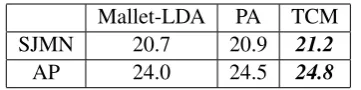
concentra-Mallet-LDA PA TCM
SJMN 20.7 20.9 21.2
AP 24.0 24.5 24.8
Table 3: Mean average Precision (MAP in %) scores in the information retrieval task. Scores in bold and italics are the significantly best MAP scores according to a Wilcoxon signed rank test (p <0.05).
tion parameterα0 was initially set to 100 and
re-sampled using approximated table counts (Blun-som et al., 2009).
Since efficient inference is unavailable for LDACOL, TNG and AG-colloc, making it imprac-tical to evaluate them on the large corpora, we compared our TCM with them only on the MRe-viewsdataset. The first column of Table 1 shows the classification accuracy of those models. All the collocation models outperform Mallet-LDA. The AG-colloc model yields the highest classification accuracy, and our TCM with/without sparsity per-forms as well as the AG-colloc model according to the Wilcoxon signed rank test. The Pipeline Ap-proach (PA) is always better than LDACOL and TNG. Therefore, in the following experiments we will focus on the comparison among our TCM, Mallet-LDA and PA.
Table 2 shows the classification accuracy of those three models on the larger datasets, i.e., the 20 Newsgroups dataset, and the Reuters-21578 dataset. The TCM outperforms both Mallet-LDA and PA on 3 out of 5 datasets, and performs equally well as PA on the Politics and Reuter-21578 datasets according to a Wilcoxon signed rank test (p <0.05).
5.2 Information Retrieval Evaluation
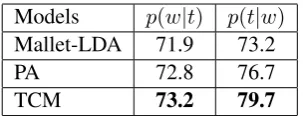
[image:7.595.75.286.294.380.2]Models p(w|t) p(t|w)
Mallet-LDA 71.9 73.2
PA 72.8 76.7
[image:8.595.106.258.61.119.2]TCM 73.2 79.7
Table 4: The model precision (%) derived from the intrusion detection experiments.
On a small subset of the SJMN data, which contains 2,000 documents (SJMN-2k), we find again that TCM and AG-colloc perform equally well and outperform all other models (LDACOL, TNG, PA), as shown in the second column of Ta-ble 1. We further compare the TCM, Mallet-LDA and PA on the fullSJMNdataset and theAPnews dataset, as these models can run on large scale. Ta-ble 3 shows the mean average precision (MAP) scores. The TCM significantly outperforms both Mallet-LDA and the PA approach, and yields the highest MAP score.
5.3 Topic Coherence Evaluation
We ran a set of topic intrusion detection experi-ments (Chang et al., 2009) that provide a human evaluation of the coherence of the topics learnt by Mallet-LDA, PA and TCM on theSJMNdataset. This set of experiments was use to measure how well the inferred topics match human concepts. Each subject recruited from Amazon Mechanical Turk was presented with a randomly ordered list of 10 tokens (either words or collocations). The task of the subject was to identify the token which is semantically different from the others.
To generate the 10-token lists, we experimented with two different methods for selecting tokens (either words or collocations) most strongly asso-ciated with a topict. The standard method chooses the tokenswthat maximisep(w|t). This method is biased toward high frequency tokens, since low-frequency tokens are unlikely to have a large p(w|t). We also tried choosing words and colloca-tionswthat maximisep(t|w). This method findsw that are unlikely to appear in any other topic except t, and is biased towards low frequencyw. We re-duce this low-frequency bias by using a smoothed estimate forp(t|w)with a Dirichlet pseudo-count α= 5.
An intruder token was randomly selected from a set of tokens that had low probability in the cur-rent topic but high probability in some other topic. We then randomly selected one of the 10 tokens
Dataset MReview SJMN-2k
#Topic 100 800 100 800
AG-colloc 84.9 1305 37.5 692
Non-sparse TCM 13.8 233 6.6 85.7
[image:8.595.308.526.61.135.2]Sparse TCM 0.28 0.35 0.14 0.2
Table 5: The average running time (in seconds) per iteration.
Figure 1: Plot of speedup in running time for the Mallet-LDA and our TCM.
to be replaced by the intruder token. We expect collocations to be more useful in lists that are con-structed using p(t|w)than lists constructed using p(w|t). This is because p(w|t)can be dominated by the frequency ofw, but individual collocations are rare.
The performance was measured by model pre-cision (Chang et al., 2009), which measures the fraction of subjects that agreed with the model. Table 4 shows that our TCM outperforms both PA and Mallet-LDA under both ways of constructing the intrusion lists. As expected, the collocation models PA and TCM perform better with lists con-structed according top(t|w)than lists constructed according top(w|t).
5.4 Efficiency of the TCM
[image:8.595.309.523.180.341.2]and takes less than a second per iteration. There-fore, Tables 1 and 5 jointly show that our refor-mulation runs an order of magnitude faster than AG-colloc without losing performance, thereby making the AG-colloc model inference feasible at large scales.
We further studied the scalability of our sam-pling algorithm after parallelisation on theSJMN dataset and the AP news dataset. We fixed the number of topics to 100, and varied the number of processors from 1 to 24 for the SJMN dataset and from 1 to 80 for the AP dataset. The plots in Fig-ure 1 show that our parallelised sampler achieved a remarkable speedup. We have also observed that there is a point at which using additional proces-sors actually slows running time. This is com-mon in parallel algorithms when communication and synchronisation take more time than the time saved by parallelisation. This slowdown occurs in the highly-optimized Mallet implementation of LDA with fewer cores than it does in our imple-mentation. The speedup achieved by our TCM also shows the benefit of parallelising the summa-tion step mensumma-tioned in Secsumma-tion 4.2.
6 Conclusion
In this paper we showed how to represent the AG-colloc model without using Adaptor Gram-mars, and how to adapt Gibbs sampling tech-niques from Bayesian word segmentation to per-form posterior inference under the new represen-tation. We further accelerated the sampling algo-rithm by taking advantage of the sparsity in the collocation count matrix. Experimental results de-rived in different tasks showed that 1) our new representation performs as well as the AG-colloc model and outperforms the other collocation mod-els, 2) our point-wise sampling algorithm scales well to large corpora. There are several ways in which our model can be extended. For example, our algorithm could be further sped up by using the sampling techniques presented by Smola and Narayanamurthy (2010), Li et al. (2014) and Bun-tine and Mishra (2014). One can also consider us-ing a hybrid of MCMC and variational inference as in Ke et al. (2014).
Acknowledgments
This research was supported by a Google award through the Natural Language Understanding Focused Program, and under the Australian
Research Council’s Discovery Projects fund-ing scheme (project numbers DP110102506 and DP110102593).
References
Satanjeev Banerjee and Ted Pedersen. 2003. The de-sign, implementation, and use of the ngram statistics package. InComputational Linguistics and Intelli-gent Text Processing, volume 2588, pages 370–381. D.M. Blei, A.Y. Ng, and M.I. Jordan. 2003. Latent Dirichlet allocation. Journal of Machine Learning Research, 3:993–1022.
Phil Blunsom, Trevor Cohn, Sharon Goldwater, and Mark Johnson. 2009. A note on the implementation of hierarchical dirichlet processes. InProceedings of the ACL-IJCNLP 2009 Conference Short Papers, pages 337–340.
Benjamin B¨orschinger, Mark Johnson, and Katherine Demuth. 2013. A joint model of word segmentation and phonological variation for english word-final /t/-deletion. InProceedings of the 51st Annual Meet-ing of the Association for Computational LMeet-inguistics (Volume 1: Long Papers), pages 1508–1516, Sofia, Bulgaria.
Jordan L Boyd-Graber and David Blei. 2009. Syntac-tic topic models. InAdvances in Neural Information Processing Systems 21, pages 185–192.
Wray L Buntine and Swapnil Mishra. 2014. Exper-iments with non-parametric topic models. In Pro-ceedings of the 20th ACM SIGKDD international conference on Knowledge discovery and data min-ing, pages 881–890.
Jonathan Chang, Sean Gerrish, Chong Wang, Jordan L. Boyd-graber, and David M. Blei. 2009. Reading tea leaves: How humans interpret topic models. In
Advances in Neural Information Processing Systems 22, pages 288–296.
Lan Du, Wray Buntine, and Mark Johnson. 2013. Topic segmentation with a structured topic model. InProceedings of the 2013 Conference of the North American Chapter of the Association for Computa-tional Linguistics: Human Language Technologies, pages 190–200.
Lan Du, John Pate, and Mark Johnson. 2014. Topic models with topic ordering regularities for topic seg-mentation. InProceedings of the IEEE International Conference on Data Mining, pages 803–808. Sharon Goldwater, Thomas L. Griffiths, and Mark
Johnson. 2009. A Bayesian framework for word segmentation: Exploring the effects of context.
Cognition, 112(1):21–53.
syntax. InAdvances in neural information process-ing systems, pages 537–544.
Thomas L. Griffiths, Mark Steyvers, and Joshua B. Tenenbaum. 2007. Topics in semantic representa-tion. Psychological Review, 114(2):211–244. Shoaib Jameel and Wai Lam. 2013a. An n-gram topic
model for time-stamped documents. InProceedings of the 35th European Conference on Advances in In-formation Retrieval, pages 292–304.
Shoaib Jameel and Wai Lam. 2013b. A nonparametric n-gram topic model with interpretable latent topics. InInformation Retrieval Technology, pages 74–85. M. Johnson, T.L. Griffiths, and S. Goldwater. 2007.
Adaptor grammars: A framework for specifying compositional nonparametric Bayesian models. In
Advances in Neural Information Processing Systems 19, pages 641–648.
Mark Johnson. 2010. Pcfgs, topic models, adaptor grammars and learning topical collocations and the structure of proper names. In Proceedings of the 48th Annual Meeting of the Association for Compu-tational Linguistics, pages 1148–1157.
Zhai Ke, Boyd-Graber Jordan, and Cohen Shay B. 2014. Online adaptor grammars with hybrid infer-ence. Transactions of the Association of Computa-tional Linguistics, 2:465–476.
Jey Han Lau, Timothy Baldwin, and David Newman. 2013. On collocations and topic models. ACM Transactions on Speech and Language Processing (TSLP), 10(3):10.
Jey Han Lau, David Newman, and Timothy Baldwin. 2014. Machine reading tea leaves: Automatically evaluating topic coherence and topic model quality. InProceedings of the 14th Conference of the Euro-pean Chapter of the Association for Computational Linguistics, pages 530–539.
Aaron Q Li, Amr Ahmed, Sujith Ravi, and Alexan-der J Smola. 2014. Reducing the sampling com-plexity of topic models. InProceedings of the 20th ACM SIGKDD international conference on Knowl-edge discovery and data mining, pages 891–900. Robert Lindsey, William Headden, and Michael
Stipicevic. 2012. A phrase-discovering topic model using hierarchical Pitman-Yor processes. In Pro-ceedings of the 2012 Joint Conference on Empirical Methods in Natural Language Processing and Com-putational Natural Language Learning, pages 214– 222.
David JC MacKay and Linda C Bauman Peto. 1995. A hierarchical Dirichlet language model. Natural language engineering, 1(3):289–308.
David Newman, Arthur Asuncion, Padhraic Smyth, and Max Welling. 2009. Distributed algorithms for topic models. Journal of Machine Learning Re-search, 10:1801–1828.
David Newman, Youn Noh, Edmund Talley, Sarvnaz Karimi, and Timothy Baldwin. 2010. Evaluating topic models for digital libraries. In Proceedings of the 10th Annual Joint Conference on Digital Li-braries, pages 215–224.
Bo Pang and Lillian Lee. 2012. Cornell Movie Review Data.
Alexander Smola and Shravan Narayanamurthy. 2010. An architecture for parallel topic models. Proc. VLDB Endow., 3(1-2):703–710.
Y. W. Teh. 2006. A hierarchical Bayesian language model based on Pitman-Yor processes. In Proceed-ings of the 21st International Conference on Com-putational Linguistics and the 44th annual meeting of the Association for Computational Linguistics, pages 985–992.
Hanna M. Wallach. 2006. Topic modeling: beyond bag-of-words. InProceedings of the 23rd interna-tional conference on Machine learning, pages 977– 984.
Xuerui Wang, Andrew McCallum, and Xing Wei. 2007. Topical n-grams: Phrase and topic discov-ery, with an application to information retrieval. In
Proceedings of the 2007 Seventh IEEE International Conference on Data Mining, pages 697–702. Xing Wei and W. Bruce Croft. 2006. LDA-based
doc-ument models for ad-hoc retrieval. InProceedings of the 29th annual international ACM SIGIR confer-ence on Research and development in information retrieval, pages 178–185.