229
Automatic Generation of Personalized Comment Based on User Profile
Wenhuan Zeng1∗, Abulikemu Abuduweili2∗, Lei Li3, Pengcheng Yang4 1School of Mathematical Sciences, Peking University
2State Key Lab of Advanced Optical Communication System and Networks,
School of EECS, Peking University
3School of Computer Science and Technology, Xidian University
4MOE Key Lab of Computational Linguistics, School of EECS, Peking University
{zengwenhuan, abduwali}@pku.edu.cn
[email protected], yang [email protected]
Abstract
Comments on social media are very diverse, in terms of content, style and vocabulary, which make generating comments much more chal-lenging than other existing natural language generation (NLG) tasks. Besides, since dif-ferent user has difdif-ferent expression habits, it is necessary to take the user’s profile into con-sideration when generating comments. In this paper, we introduce the task of automatic gen-eration of personalized comment (AGPC) for social media. Based on tens of thousands of users’ real comments and corresponding user profiles on weibo, we propose Personalized Comment Generation Network (PCGN) for AGPC. The model utilizes user feature embed-ding with a gated memory and attends to user description to model personality of users. In addition, external user representation is taken into consideration during the decoding to en-hance the comments generation. Experimental results show that our model can generate natu-ral, human-like and personalized comments.1
1 Introduction
Nowadays, social media is gradually becoming a mainstream communication tool. People tend to share their ideas with others by commenting, re-posting or clickinglike on posts in social media. Among these behaviors, comment plays a signif-icant role in the communication between posters and readers. Automatically generate personalized comments (AGPC) can be useful due to the fol-lowing reasons. First, AGPC helps readers express their ideas more easily, thus make them engage more actively in the platform. Second, bloggers can capture different attitudes to the event from multiple users with diverse backgrounds. Lastly,
∗
Equal Contribution.
1Source codes of this paper are available at
https://github.com/Walleclipse/AGPC
the platform can also benefit from the increasing interactive rate.
Despite its great applicability, the AGPC task faces two important problems: whether can we achieve it and how to implement it? TheSocial Differentiation Theoryproposed byRiley and Ri-ley(1959) proved the feasibility of building a uni-versal model to automatically generate personal-ized comments based on part of users’ data. The Individual Differences Theorypointed byHovland et al. (1953) answers the second question by in-troducing the significance of users’ background, which inspires us to incorporating user profile into comments generation process. More specifi-cally, the user profile consists of demographic fea-tures (for example, where does the user live), in-dividual description and the common word dic-tionary extracted from user’s comment history. There are few works exploring the comments gen-eration problem. Zheng et al. (2017) first paid attention to generating comments for news arti-cles by proposing a gated attention neural net-work model (GANN) to address the contextual rel-evance and the diversity of comments. Similarly,
Qin et al.(2018) introduced the task of automatic news article commenting and released a large scale Chinese corpus. Nevertheless, AGPC is a more challenging task, since it not only requires gener-ating relevant comments given the blog text, but also needs the consideration of the diverse users’ background.
the model attends to user description to enhance the comments generation process. In addition, the vocabulary distribution of generated word is adapted by considering the external user represen-tation.
Our main contributions are as follows:
• We propose the task of automatic generating personalized comment with exploiting user profile.
• We design a novel model to incorporate the personalized style in large-scale comment generation. The model has three novel mech-anisms: user feature embedding with gated memory, blog-user co-attention, and an ex-ternal personality expression.
• Experimental results show that the pro-posed method outperforms various competi-tive baselines by a large margin. With novel mechanisms to exploit user information, the generated comments are more diverse and in-formative. We believe that our work can ben-efit future work on developing personalized and human-like NLG model.
2 Personalized Comments Dataset
We introduce the dataset as follows:
Data Preparation We collect short text posts from Weibo, one of the most popular social me-dia platform in China, which has hundreds of mil-lions of active users. Each instance in the dataset has province, city, gender, age, marital status, in-dividual description of user’s, comment added by user and homologous blog content. Figure 1 vi-sually shows a sample instance. We tokenized all text like individual description, comment and blog content into words, using a popular python library Jieba2. To facilitate the model to learn valid information from the dataset, we removed @, url, expressions in the text, and unified Chinese into simplified characters. Discrete variables such as province, city, gender and marital status were treated uniformly by one-hot coding. To ensure the quality of text, we filtered out samples with less than two words in the variable of comment and blog content. Besides, in order to learn user-specific expression habits, we retain users with 50 or more records. The resulting dataset contains
2https://github.com/fxsjy/jieba
UID:
215803 Age:24 Birthday:1994-01-21
Gender:
Female Province:Shanghai City: NULL
Individual Description:
Practice makes prefect
Blog:
The doctor prescribed the new medicine which let my stomach uncomfortable. If only everything were a dream.
Comment:
Everything will be ok.
Figure 1: A data example in personalized comment dataset. Corresponding English translation is provided.
Statistic User Comment Microblog
Train 32,719 2,659,870 1,450,948
Dev 24,739 69,659 27,822
Test 20,157 43,866 17,052
Total 32,719 4,463,767 1,495,822
Table 1: Sample size of three datasets
4,463,767 comments on 1,495,822 blog posts by 32,719 users.
Data Statistics We split the corpus into train-ing, validation and testing set according to the mi-croblog. To avoid overfitting, the records of the same microblog will not appear in the above three sets simultaneously. Table 1 displays the detail sample size of user, comment and blog about train-ing set, validation set and testtrain-ing set. Each user in the resulting dataset has an average of 56 sam-ples. The average lengths of blog post, comment and individual description are 50, 11 and 9 words, respectively. The particular statistics of each ex-perimental dataset are shown in Table2.
Average length Train Dev Test Total
ID 8.84 9.04 8.83 8.85
Comment 11.28 11.32 11.86 11.28
[image:2.595.306.526.60.259.2]Microblog 49.67 47.95 50.30 49.65
User Numeric Feature
Embedding
:; Blog
Content Encoder
LSTM%&'(
ℎ*( ℎ+( ℎ&(
, -* , -+ ⋯ , -& ⋯ ⋯
Attentive Read
/0( /01
User Description Encoder
LSTM%&'1
ℎ*1 ℎ+1 ℎ&1
⋯ ⋯ ⋯
Attentive Read
, 2* , 2+ ⋯ , 2&
Gated Memory Module
304 506* 50 ⋯
⋯
, 706+ , 706* 706*
LSTM8%'
⨁ External Personality
Expression
[image:3.595.83.517.57.216.2]Word Distribution 70
Figure 2: Personalized comment generation network
3 Personalized Comment Generation Network
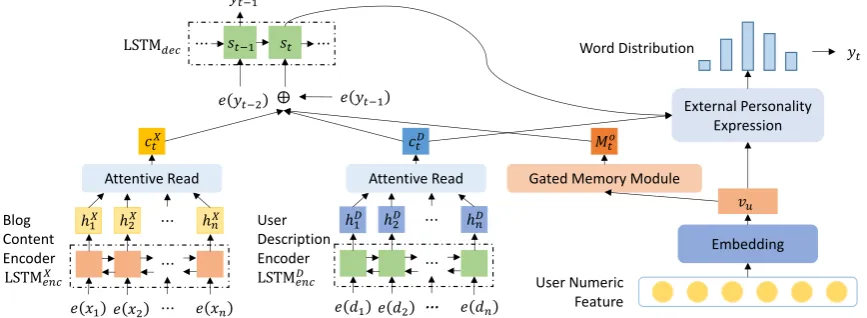
Given a blog X = (x1, x2,· · ·, xn) and a user profileU = {F, D}, whereF = (f1, f2,· · ·, fk) denotes the user’s numeric feature (for example, age, city, gender) and D = (d1, d2,· · ·, dl) de-notes the user’s individual description, the AGPC aims at generating commentY = (y1, y2,· · ·, ym) that is coherent with blog X and user U. Fig-ure2presents an overview of our proposed model, which is elaborated on in detail as follows.
3.1 Encoder-Decoder Framework
Our model is based on the encoder-decoder framework of the general sequence-to-sequence (Seq2Seq) model (Sutskever et al., 2014). The encoder converts the blog sequence X = (x1, x2,· · ·, xn) to hidden representationshX = (hX1 , hX2 ,· · ·, hXn)by a bi-directional Long Short-Term Memory (LSTM) cell (Hochreiter and Schmidhuber,1997):
hXt = LSTMXenc(hXt−1, xt) (1)
The decoder takes the embedding of a previously decoded word e(yt−1) and a blog context vector cXt as input to update its statest:
st= LSTMdec(st−1,[cXt ;e(yt−1)]) (2)
where[·;·]denotes vector concatenation. The con-text vectorcXt is a weighted sum of encoder’s hid-den states, which carries key information of the input post (Bahdanau et al., 2014). Finally, the decoder samples a wordytfrom the output proba-bility distribution as follows
yt∼softmax(Wost) (3)
whereWo is a weight matrix to be learned. The
model is trained via maximizing the log-likelihood of ground-truthY∗ = (y∗1,· · ·, y∗n)and the objec-tive function is defined as
L=−
n
X
t=1
logp(yt∗|y∗<t, X, U) (4)
3.2 User Feature Embedding with Gated Memory
To encode the information in user profile, we map user’s numeric feature F to a dense vector vu through a fully-connected layer. Intuitively,vucan be treated as a user feature embedding denotes the character of the user. However, if the user feature embedding is static during decoding, the gram-matical correctness of sentences generated may be sacrificed as argued in Ghosh et al. (2017). To tackle this problem, we design an gated memory module to dynamically express personality during decoding, inspired byZhou et al.(2018). Specifi-cally, we maintain a internal personality state dur-ing the generation process. At each time step, the personality state decays by a certain amount. Once the decoding process is completed, the personality state is supposed to decay to zero, which indicates that the personality is completely expressed. For-mally, at each time stept, the model computes an update gate gut according to the current state of the decoderst. The initial personality stateM0is set as user feature embeddingvu. Hence, the per-sonality stateMtis erased by a certain amount (by gu
t ) at each step. This process is described as
gtu = sigmoid(Wugst) (5)
M0 = vu (6)
Mt = gtu⊗Mt−1, t >0 (7)
atten-tion should be paid to the personality state at each time step. Thus, output gate gto is introduced to control the information flow by considering the previous decoder statest−1, previous target word e(yt−1)and the current context vectorcXt
got = sigmoid(Wgo[st−1;e(yt−1);cXt ]). (8)
By an element-wise multiplication ofgot andMt, we can obtain adequate personality information Mtofor current decoding step
Mto=gto⊗Mt. (9)
3.3 Blog-User Co-Attention
Individual description is another important infor-mation source when generating personalized com-ments. For example, a user with individual de-scription “只爱朱一龙” (I only love Yilong Zhu3), tends to writes a positive and adoring comments on the microblog related to Zhu. Motivated by this, we propose Blog-user co-attention to model the interactions between user description and blog content. More specifically, we encode the user’s individual descriptionD= (d1, d2,· · ·, dl)to hid-den states(hD1, hD2 ,· · ·, hDl )via another LSTM
hDt = LSTMDenc(hDt−1, dt) (10)
We can obtain a description context vectorcDt by attentively reading the hidden states of user de-scription,
cDt = X j
αtjhDj (11)
αtj = softmax(etj) (12)
etj = st−1WahDj (13)
where etj is a alignment score (Bahdanau et al.,
2014). Similarly, we can get the blog content vec-torcXt . Finally, the context vectorctis a concate-nation ofcXt andcDt , in order provide more com-prehensive information of user’s personality
ct= [cXt ;cDt ] (14)
Therefore, the state update mechanism in Eq.(2) is modified to
st= LSTMdec(st−1,[ct;e(yt−1);Mto]) (15)
3A famous Chinese star.
3.4 External Personality Expression
In the gated memory module, the correlation be-tween the change of the internal personality state and selection of a word is implicit. To fully ex-ploit the user information when selecting words for generation, we first compute a user representa-tionrut with user feature embedding and user de-scription context.
rtu =Wr[vu;cDt ] (16)
whereWr is a weight matrix to align user repre-sentation dimention.
The final word is then sampled from output dis-tribution based on the concatenation of decoder statestandrtuas
˜
yt∼softmax(Wo˜t[st; r
u
t]) (17)
whereWo˜tis a learnable weight matrix.
4 Experiments
4.1 Implementation
The blog content encoder and comment decoder are both 2-layer bi-LSTM with 512 hidden units for each layer. The user’s personality description encoder is a single layer bi-LSTM with 200 hidden units. The word embedding size is set to 300 and vocabulary size is set to 40,000. The embedding size of user’s numeric feature is set to 100.
We adopted beam search and set beam size to 10 to promote diversity of generated comments. We used SGD optimizer with batch size set to 128 and the learning rate is 0.001.
To further enrich the information provided by user description, we collected most common k words in user historical comments (k = 20in our experiment). We concatenate the common words with the user individual description. Therefore, we can obtain more information about users’ ex-pression style. The model using concatenated user description is named PCGN with common words (PCGN+ComWord).
4.2 Baseline
We implemented a general Seq2Seq model (Sutskever et al., 2014) and a user embedding model (Seq2Seq+Emb) proposed by Li et al.
Method PPL B-2 METEOR
Seq2Seq 32.47 0.071 0.070
Seq2Seq+Emb 31.13 0.084 0.079
PCGN 27.94 0.162 0.132
PCGN+ComWord 24.48 0.193 0.151
Table 3: Automatic evaluation results of different methods. PPL denotes perplexity and B-2 denotes BLEU-2. Best results are shown in bold.
Method PPL B-2
Seq2Seq 32.47 0.071
+ Mem 30.73 (-1.74) 0.099 (+0.028) + CoAtt 27.12 (-3.61) 0.147 (+0.078) + External 27.94 (+0.82) 0.162 (+0.015)
Table 4: Incremental experiment results of proposed model. Performance on METEOR is similar to B-2.
Memdenotes gated memory,CoAttdenotes blog-user co-attention andExternaldenotes external personality expression
4.3 Evaluation Result
Metrics: We use BLEU-2 (Papineni et al.,
2002) and METEOR (Banerjee and Lavie,2005) to evaluate overlap between outputs and refer-ences. Besides, perplexity is also provided.
Results: The results are shown in Table 3. As can be seen, PCGN model with common words obtains the best performance on perplex-ity, BLEU-2 and METEOR. Note that the per-formance of Seq2Seq is extremely low, since the user profile is not taken into consideration during the generation, resulting repetitive responses. In contrast, with the help of three proposed mecha-nism (gated memory, blog-user co-attention and external personality expression), our model can utilize user information effectively, thus is capable of generating diverse and relevant comments for the same blog. Further, we conducted incremental experiments to study the effect of proposed mech-anisms by adding them incrementally, as shown in Table4. It can be found that all three mechanism help generate more diverse comments, while blog-user co-attention mechanism contributes most im-provements. An interesting finding is that external personality expression mechanism causes the de-cay on perplexity. We speculate that the modifica-tion on word distribumodifica-tion by personality influence the fluency of generated comments.
5 Related Work
This paper focuses on comments generation task, which can be further divided into generating a comment according to the structure data (Mei et al., 2015), text data (Qin et al., 2018), im-age (Vinyal et al., 2015) and video (Ma et al.,
2018a), separately.
There are many works exploring the problem of text-based comment generation. Qin et al.
(2018) contributed a high-quality corpus for ar-ticle comment generation problem. Zheng et al.
(2017) proposed a gated attention neural network model (GANN) to generate comments for news article, which addressed the contextual relevance and the diversity of comments. To alleviate the dependence on large parallel corpus, Ma et al.
(2018b) designed an unsupervised neural topic model based on retrieval technique. However, these works focus on generating comments on news text, while comments on social media are much more diverse and personal-specific.
In terms of the technique for modeling user character, the existing works on machine com-menting only utilized part of users’ information.
Ni and McAuley(2018) proposed to learn a latent representation of users by utilizing history infor-mation. Lin et al. (2018) acquired readers’ gen-eral attitude to event mentioned by article through its upvote count. Compared to the indirection in-formation obtained from history or indicator, user features in user profile, like demographic factors, can provide more comprehensive and specific in-formation, and thus should be paid more attention to when generating comments. Sharing the same idea that user personality counts,Luo et al.(2018) proposed personalized MemN2N to explore per-sonalized goal-oriented dialog systems. Equipped with a profile model to learn user representation and a preference model learning user preferences, the model is capable of generating high quality re-sponses. In this paper, we focus on modeling per-sonality in a different scenario, where the gener-ated comments is supposed to be general and di-verse.
6 Conclusion
gated memory for user feature embedding, blog-user co-attention, and external personality repre-sentation to generate comments in personalized style. Evaluation results show that PCGN outpe-forms baseline models by a large margin. With the help of three proposed mechanisms, the generated comments are more fluent and diverse.
References
Dzmitry Bahdanau, Kyunghyun Cho, and Yoshua Ben-gio. 2014. Neural machine translation by jointly learning to align and translate. arXiv preprint arXiv:1409.0473.
Satanjeev Banerjee and Alon Lavie. 2005. Meteor: An automatic metric for mt evaluation with improved correlation with human judgments. InProceedings of the acl workshop on intrinsic and extrinsic evalu-ation measures for machine translevalu-ation and/or sum-marization, pages 65–72.
Sayan Ghosh, Mathieu Chollet, Eugene Laksana, Louis-Philippe Morency, and Stefan Scherer. 2017. Affect-lm: A neural language model for customiz-able affective text generation. arXiv preprint arXiv:1704.06851.
Sepp Hochreiter and J¨urgen Schmidhuber. 1997. Long short-term memory. Neural computation, 9(8):1735–1780.
Carl I. Hovland, Irving L. Janis, and Harold H. Kelley. 1953. Communication and Persua-sion:Psychological Studies of Opinion Change. Yale University Press.
Jiwei Li, Michel Galley, Chris Brockett, Georgios P Spithourakis, Jianfeng Gao, and Bill Dolan. 2016. A persona-based neural conversation model. arXiv preprint arXiv:1603.06155.
Zhaojiang Lin, Genta Indra Winata, and Pascale Fung. 2018. Learning comment generation by leveraging user-generated data. CoRR, abs/1810.12264.
Liangchen Luo, Wenhao Huang, Qi Zeng, Zaiqing Nie, and Xu Sun. 2018. Learning personalized end-to-end goal-oriented dialog.
Shuming Ma, Lei Cui, Damai Dai, Furu Wei, and Xu Sun. 2018a. Livebot: Generating live video comments based on visual and textual contexts.
CoRR, abs/1809.04938.
Shuming Ma, Lei Cui, Furu Wei, and Xu Sun. 2018b. Unsupervised machine commenting with neural variational topic model. arXiv preprint arXiv:1809.04960.
Hongyuan Mei, Mohit Bansal, and Matthew R. Walter. 2015. What to talk about and how? selective gen-eration using lstms with coarse-to-fine alignment.
arXiv preprint arXiv:1509.00838.
Jianmo Ni and Julian McAuley. 2018. Personalized re-view generation by expanding phrases and attending on aspect-aware representations. InIn Proceedings of the 56th Annual Meeting of the Association for Computational Linguistics, pages 706–711.
Kishore Papineni, Salim Roukos, Todd Ward, and Wei-Jing Zhu. 2002. Bleu: a method for automatic eval-uation of machine translation. In Proceedings of the 40th annual meeting on association for compu-tational linguistics, pages 311–318. Association for Computational Linguistics.
Lianhui Qin, Lemao Liu, Wei Bi, Yan Wang, Xiaojiang Liu, Zhiting Hu, Hai Zhao, and Shuming Shi. 2018. Automatic article commenting: the task and dataset. InProceedings of the 56th Annual Meeting of the As-sociation for Computational Linguistics, ACL 2018, Melbourne, Australia, July 15-20, 2018, Volume 2: Short Papers, pages 151–156.
J. W. Riley and Matilda White Riley. 1959. Mass com-munication and the social system.
Ilya Sutskever, Oriol Vinyals, and Quoc V Le. 2014. Sequence to sequence learning with neural net-works. InAdvances in neural information process-ing systems, pages 3104–3112.
Oriol Vinyal, Alexander Toshev, Samy Bengio, and Dumitru Erhan. 2015. Show and tell: A neural im-age caption generator. InProceedings of the IEEE conference on computer vision and pattern recogni-tion, pages 3156–3164.
Hai-Tao Zheng, Wei Wang, Wang Chen, and Arun Ku-mar Sangaiah. 2017. Automatic generation of news comments based on gated attention neural networks. 6.
Hao Zhou, Minlie Huang, Tianyang Zhang, Xiaoyan Zhu, and Bing Liu. 2018. Emotional chatting ma-chine: Emotional conversation generation with in-ternal and exin-ternal memory. InThirty-Second AAAI Conference on Artificial Intelligence.
A Case Study
User
Age
Gender
Province
City
Individual Description
U1
24
女
Female
Others
其他
NULL
I only love Yilong Zhu
只爱朱一龙
U2
23
女
Female
Heilong Jiang
黑龙江
NULL
努力成为更好的自己
Become a better me
U3
20
女
Female
Zhejiang
浙江
Ningbo
宁波
NULL
Figure 3: Part of user profile of case study users. In order to protect user privacy, the birthday variable is not shown here.
Blog
# [ ] # [ ] # #
Yilong Zhu Gentle power [super topic]# walking side by side with Yilong Zhu#The moment I met you seems like the wind of the wilderness, breaking into my heart. The moment I met you seems like the snow between the eyebrows, blending into the eyes. I want to share everything with you, the warm sun in the morning, the vast night sky, the beauty of the past and the companion in the future.
Comments Seq2Seq:
# [ ] # # #
#Yilong Zhu Gentle power [super topic]# #Yilong Zhu, move forward together# PCGN U1:
100 99
There is one hunderd ways of sweetness, have a candy and miss you 99 times a day. PCGN U2:
# #
#Yilong Zhu Gentle power [super topic]# #Yilong Zhu, move forward together# Yilong Zhu| ZYL PCGN U3:
I hope that you are always young, with a clean and pure heart, always believing something beautiful
Figure 4: Generated comments based on blog of different users. Since Seq2Seq model does not take user profile into consideration, it generates same comments for the same blog.
Blog
# #
! Angelababy / Angelababy / / /
#My true friend # Using the lens of Japanese TV dramas and comics, Bazaar specially plans to create visual blockbusters, and present the relationship among the three main characters in the photo, which will give you a sneak of the movie before its showing! Angelababy Hairstyle / Liu Xueliang Angelababy Makeup / Chun Nan Lun Deng makeup hair / Jiancheng Li Yilong Zhu makeup hair / Pengkun Li
Comments Seq2Seq:
# angelababy [ ] # # angelababy [super topic] # PCGN U1:
# [ ] # # #
Yilong Zhu[super topic]# # # Looking forward to Jingan brother PCGN U2:
looking forward to PCGN U3:
looking forward to Lun Deng