ISSN Online: 2153-1242 ISSN Print: 2153-1234
DOI: 10.4236/jis.2018.91001 Nov. 22, 2017 1 Journal of Information Security
Robust Digital Audio Watermarking Based on
SVD and Modified Firefly Algorithm
Sayed Afzal Mortaza Rizvi
1, Sanjay Pratap Singh Chauhan
21Department of Computer Science, Jamia Millia Islamia, Central University, New Delhi, India
2School of Computing Science and Engineering, Galgotias University, Uttar Pradesh, India
Abstract
Digital Watermarking is a technology, to facilitate the authentication, copy-right protection and Security of digital media. The objective of developing a robust watermarking technique is to incorporate the maximum possible ro-bustness without compromising with the transparency. Singular Value De-composition (SVD) using Firefly Algorithm provides this objective of an op-timal robust watermarking technique. Multiple scaling factors are used to embed the watermark image into the host by multiplying these scaling factors with the Singular Values (SV) of the host audio. Firefly Algorithm is used to optimise the modified host audio to achieve the highest possible robustness and transparency. This approach can significantly increase the quality of wa-termarked audio and provide more robustness to the embedded watermark against various attacks such as noise, resampling, filtering attacks etc.
Keywords
Firefly Algorithm (FA), Multiple Scaling Factors (MSF), Singular Values, Robustness, PSNR
1. Introduction
The term digital watermarking [1], first came into existence in 1993 when Tirkel presented watermarking techniques to hide the watermark data in the image. Due to the rapid growth in computer and communication industry, cost effec-tive and popular digital recording and storage devices made it possible to copy, and have unauthorised access of the original digital multimedia contents. Digital watermarking has evolved as a solution to these problems of copyright protec-tion, authorizaprotec-tion, illegal modifications and distributes the data in an effortless ways without having legal permission of the author. Digital watermarking pro-How to cite this paper: Rizvi, S.A.M. and
Chauhan, S.P.S. (2018) Robust Digital Au-dio Watermarking Based on SVD and Mod-ified Firefly Algorithm. Journal of Informa-tion Security, 9, 1-11.
https://doi.org/10.4236/jis.2018.91001
Received: October 15, 2017 Accepted: November 19, 2017 Published: November 22, 2017
Copyright © 2018 by authors and Scientific Research Publishing Inc. This work is licensed under the Creative Commons Attribution International License (CC BY 4.0).
http://creativecommons.org/licenses/by/4.0/
DOI: 10.4236/jis.2018.91001 2 Journal of Information Security vides a way to imperceptibly embed digital signal or information into the digital multimedia content. The watermarking is done by embedding a watermark sig-nal into the host data for the purpose of copyright protection, access control. Broadcast monitoring etc. A watermark can be a signal, a tag or a label. The em-bedding process should be in such a way that the watermark image can be ex-tracted from the watermarked audio without any perceptible loss of quality of the host audio. Watermarking techniques can be classified according to domain, visibility and transparency.
According to domain, watermarking is classified as spatial domain and trans-form domain [2]. In spatial domain, watermark is embedded directly into the original audio. In transform domain, the watermark is embedded by modulating the coefficients in a transform such as discrete cosine transforms (DCT), discrete Fourier transform (DFT), discrete wavelet transform (DWT). The transform domain provides more robust and secure watermarking which has attracted many researchers to work in this domain. The main advantage of working in the transform domain is that when the audio is inverse transformed the watermark is distributed irregularly over the host audio which makes the attacker hard to modify and copy the host audio.
The singular value decomposition (SVD) [3] is a kind of transform domain technique. SVD divides a N × N matrix into three matrices:
T
A USV=
where S is an N × N diagonal matrix. U and VT are N × N orthogonal matrices,
whose column vectors are ui’s and vi’s, respectively. The important property of
the singular values is that any modifications done on these values do not show any change in the respective matrix. Based on this property, the singular values are modified with the singular values of the watermark image. An N × N image can have N singular values that reveal various tolerances to modifications [4]. As there is no idea of the sensitivity of the image to various scaling factors. There-fore, an optimization algorithm [5] is needed to obtain optimum scaling factors
DOI: 10.4236/jis.2018.91001 3 Journal of Information Security the modified singular values (SV) by the watermark values will be more robust and secure. Also it will enhance the overall watermarking scheme and decrease the trade-off between robustness and transparency and less vulnerable to various attacks. The paper is organised in the following manner: Section II elaborates the description of Singular Value Decomposition (SVD); Section III is for Modified Firefly algorithm. The proposed model is being given in Section IV. Section V gives the conclusion of the paper and the proposed model.
2. Singular Value Decomposition (SVD)
Singular value decomposition (SVD) comes under the category of transform domain technique of digital audio watermarking, which is akin theory of diago-nalizing of symmetric matrix in linear algebra. SVD decomposes a matrix into three sub-parts: U, S and V. U and V are the orthogonal matrices while S is the diagonal matrix. These diagonal elements are called the singular values of the corresponding matrix. This decomposition can be illustrated as:
T
A USV= (1)
where A is a matrix of dimension m × n. U is made up of the eigen vectors of AAT and is called left singular vector. V is formed by the orthogonal vectors of
ATA and is called right singular vector. S contains the square roots of either U or
V in descending order in its diagonal being a diagonal matrix. Let the rank of the matrix A be r (r < n), then the diagonal elements of S will follow the following relation:
1 2 r r1 r 2 n
α α≥ ≥≥α ≥α+ ≥α+ ≥≥α (2)
Now A can be derived as:
1
r i i i i
A=
∑
=αu v (3)where αi is the diagonal element of matrix S at i
th position.
The singular values give the luminance of the audio at each ith position,
whereas singular vectors give the geometrical property. The most important property of SVD is that if any changes are applied to the singular values then will be no significant changes seen on the given matrix. Using this property the wa-termark image is modified by applying change in its singular values and embed-ded into the singular values of the host audio without getting any distortions and any perpetual change.
Properties of SVD:
1) Singular values preserve the energy as well as prevent the image from at-tacks.
2) The matrix in SVD can be variable. It need not be always scalar. 3) The singular values αi are unique in the matrix S.
4) The rank of the matrix is given by the non-zero elements in the diagonal matrix, S.
3. Modified Firefly Algorithm
DOI: 10.4236/jis.2018.91001 4 Journal of Information Security The algorithm is based upon the flashing behaviour of fireflies. Randomly gen-erated solutions are treated as fireflies. It has two basic components-brightness and attractiveness. Attractiveness is directly proportional to the brightness but decreases with distance. Brightness is computed on the basis of an objective function. Thus the basic rule is that the brighter firefly will attract the more fire-flies and if no such brighter firefly is present then the firefly will move in ran-dom direction [9].
In firefly algorithm, the brightest firefly is a firefly with current global best so-lution and it will move in random direction if no brighter firefly is found. This random movement may decrease the brightness depending on direction. As a consequence the overall performance of the algorithm is decreased in that par-ticular iteration.
It is proved in elementary physics that intensity of light is inversely propor-tional to the square of the distance from the source to the object. Therefore we can formulate the light intensity, I in terms of distance, r as follows:
( )
0er
I r =I −λ (4)
where λ is the light absorption coefficient and I0 is the light intensity at the
source point.
For the sake of simplicity this can be written as:
( )
02 1
I I r
r
λ
=
+ (5) Likewise, attractiveness can also be derived:
( )
02 1
A A r
r
λ
=
+ (6) where A0 is the attractiveness at r = 0.
Steps of implementation of firefly are as follows: 1) Generate a solution set randomly.
2) Find the intensity for each of the generated firefly.
3) The movement of the firefly will be done in the direction of brighter firefly and if no such direction is found then the firefly will move in random direction.
4) Now, solution is updated.
5) End the process if termination condition holds true; else go back to step 2. The main drawback of the FA is that if there is no such direction in which the brightness increases, it moves the firefly randomly, and this random movement may sometimes cause degradation in the performance of FA because brightness may reduce in some random direction. Now if we change this property of ran-dom movement by moving in a particular direction in which its brightness in-creases then it will not degrade the performance in that iteration. If such direc-tion does not exist then the firefly will remain at its current posidirec-tion. This is the Modified Firefly algorithm.
The movement of the firefly will be according to the following relation: :
DOI: 10.4236/jis.2018.91001 5 Journal of Information Security where, d is the location of the firefly, µ is the chosen direction in which move-ment is to be done and α is the step length selected randomly.
Attractiveness of a firefly can be calculated as:
0 0 0 I A I ′
= (8)
where A0 is the attractiveness of a firefly say, i at r = 0, I0′ is the intensity of firefly i and I0 is the intensity of firefly j.
4. Proposed Watermarking Model
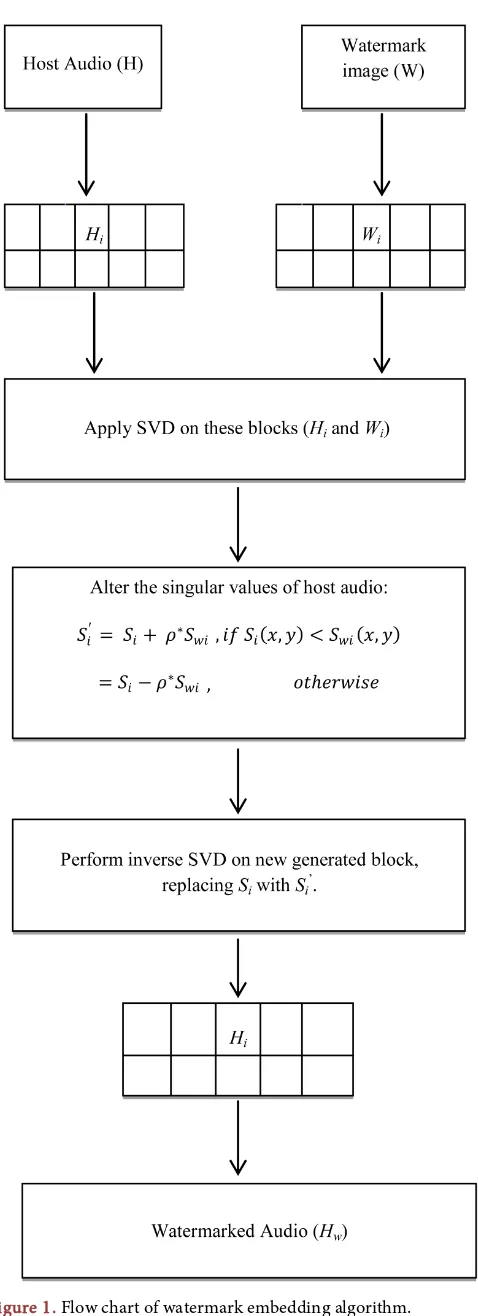
This paper proposes a SVD [11] based watermarking technique which uses mul-tiple scaling factors (MSF) to embed the watermark image into host audio. These MSFs are generated using the optimization algorithm, Modified Firefly Algo-rithm (MFA) [12]. The embedding and extraction process by applying block by block SVD and combining it with the MFA is described in the following sections in the form of flow charts and then the conclusion is derived with the help of experimental results.
1) Steps of embedding watermark:
The steps of embedding the watermark image into the host audio are shown in Figure 1.
Step1: Divide the host audio (H) and watermark image (W) into n non over-lapping frames of size m × m.
Step 2: Apply SVD on these blocks of host audio (Hi) and watermark image
(Wi) simultaneously.
[
U S Vi i i]
=SVD( )
Hi (9)[
U S Vwi wi wi]
=SVD( )
Wi (10) Step 3: Embed the singular values of the watermark image (Swi) into thesin-gular values of host audio (Si) using the following formula:
( )
( )
*
*
, if , ,
, otherwise
i wi i wi
i wi
i
S S S x y S x y
S
S S
ρ ρ
+ <
′ =
−
(11)
Step 4: Do inverse SVD on the sub-blocks to regain the Hi:
i i i i
H =US′V (12)
Step 5: Recombination of the blocks is performed to get the watermarked im-age with size equal to the host imim-age.
2) Extraction process of watermark
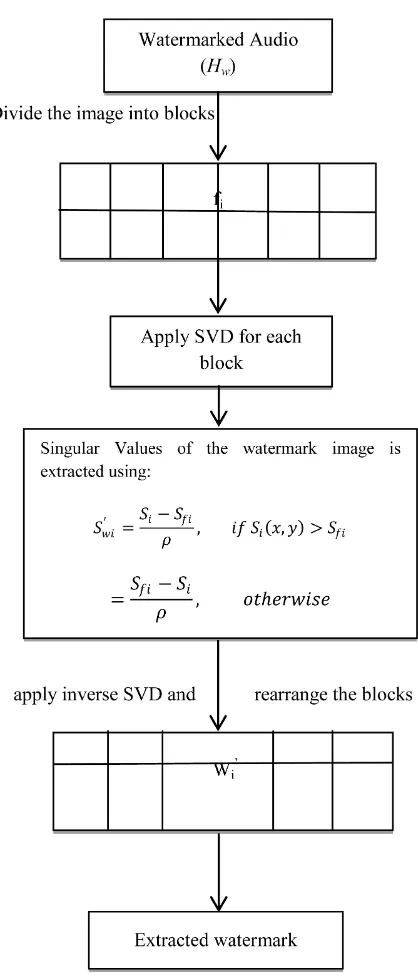
In the extraction process watermark image is being extracted from the water-marked audio (Hw), which is produced as a result of the embedding process.
This extraction procedure is described below in Figure 2 with the help of flow chart.
Step 1: Divide the produced watermarked image (Hw) into n non overlapping
DOI: 10.4236/jis.2018.91001 7 Journal of Information Security Figure 2. Extraction process.
Step 2: Perform SVD on each sub-block:
( )
SVDfi fi fi
U S V fi
=
(13) Step 3: Singular Values of the watermark image is extracted using:
( )
, if ,
, otherwise
i fi
i fi
wi
fi i
S S
S x y S
S
S S
ρ
ρ −
>
′ = −
(14)
DOI: 10.4236/jis.2018.91001 8 Journal of Information Security * * T
i wi wi wi
W′=U S V (15)
Step 5: To get the original size and dimension of the watermark image, the recovered blocks are recombined.
5. Proposed Algorithm
Let the host audio be H and watermark image be W of size N × N, then the fol-lowing are the steps of the algorithm by which this model works:
Step 1: n no. of fireflies are generated randomly using MFA. Where n=
[
ρ ρ ρ
1, 2, 3,,ρ
n]
Step 2: for each generated firefly, ρ, perform the following operations:
1) Apply embedding process discussed in the previous section on the host au-dio and watermark image.
2) Induce r number of attacks on the watermarked audio (Hw); hence at-tacked audio (Hw') are generated.
3) Extract the watermark from the host audio and attacked images using ex-traction algorithm described above.
4) Compute the PSNR values of the host audio (H), watermarked audio (Hw) and attacked audio (Hw').
5) Compute the objective function (O) of the firefly (ρ) using the objective function below:
(
)
(
)
1(
)
PSNR , PSNR , r PSNR , Wi
i
O= H Hw + W Hw′ +
∑
= W H′ (16)where PSNR
(
W Hw′,)
is the peak signal to noise ratio between watermark au-dio and the watermark extracted from the attacked auau-dio.Step 3: Now take the maximum value of the objective function to choose the multiple scaling factor which in turn optimizes the trade-off between the imper-ceptibility and robustness of the watermarking procedure.
6. Implementation Results
To verify the results of above-mentioned technique, we implemented the algo-rithm in the MATLAB 7.0. The audio file named “in” (Figure 3(a)) used in the experiment is audio signal in the wave format sampled at a rate of 44,100 Hz. Plots of in (host signal) audio signal and its watermarked version are shown in
Figure 3(b). The original and extracted watermark without any attack has been
shown in Figure 4(a) and Figure 4(b). This value provides good tradeoffs be-tween imperceptibility of watermark and robustness against different attacks
[13].
7. Robustness Test
DOI: 10.4236/jis.2018.91001 9 Journal of Information Security (a)
[image:9.595.284.462.68.290.2](b)
Figure 3. (a) Host audio signal; (b) Watermarked audio signal.
[image:9.595.308.440.323.380.2]
(a) (b)
Figure 4. (a) Binary watermark; (b) Recovered watermark.
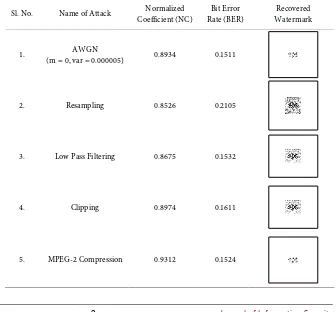
Table 1. Effect of different attacks.
Sl. No. Name of Attack Coefficient (NC) Normalized Rate (BER) Bit Error Watermark Recovered
1. (m = 0, var = 0.000005) AWGN 0.8934 0.1511
2. Resampling 0.8526 0.2105
3. Low Pass Filtering 0.8675 0.1532
4. Clipping 0.8974 0.1611
[image:9.595.204.540.433.745.2]DOI: 10.4236/jis.2018.91001 10 Journal of Information Security 1) Additive white Gaussian noise (AWGN):
White Gaussian noise [7] is added to the watermarked audio signal so that the resulting signal has a SNR of above40db.
2) Re-sampling:
The Watermarked signal originally sampled at 44.1 kHz is re-sampled at 22.05 kHz, and then restored by sampling again at 44.1 kHz. Correlation [15] is a measure of similarity of two signals as it depicts the amount by which the signal is deviated from the other signal. Normalized correlation is defined as follows:
(
)
( )
( )
( )
( )
1 1
2 2
1 1 1 1
, ,
,
, ,
M M
i j
M M M M
i j i j
W i j wm i j NC wm wm
wm i j wm i j
= =
= = = =
′ =
∑ ∑
∑ ∑
∑ ∑
The bit error rate (BER) is used to measure the robustness of our scheme:
(
)
Error bitsBER ,
Total Bits
wm wm =
3) Low-pass Filtering:
The low-pass filter [7] [8] used is a second-order Butterworth filter with cut-off frequency 11,025 Hz.
8. Conclusion
Robust watermarking scheme can provide better authentication and security of the digital audio. In this rapid growing era of technology there are many tools available which can easily modify or extract the watermark from an audio, hence it is a necessary thing to have more robust watermarking scheme which can withheld these attacks and forgeries. This is a new method of robust audio wa-termarking based on SVD using Modified Firefly Algorithm. Modified Firefly Algorithm is used to employ optimise function that was defined by two con-flicting requirements of watermarking i.e. transparency and robustness. The wa-termark image is embedded into the host audio by modifying the singular values of the host audio. To achieve maximum robustness without losing transparency, modifications are to be done using multiple scaling factors obtained by Modified Firefly Algorithm.
References
[1] Hartung, F. and Kutter, M. (1999) Multimedia Watermarking Techniques. Pro-ceeding of IEEE, 87, 1079-1107.
[2] Liu, F. and Liu, Y. (2008) A Watermarking Algorithm for Digital Image Based on DCT and SVD. In IEEE Congress on Image and Signal Processing, Sanya, Hainan, China, Vol. 1, 380-383.
[3] Lai, C.-C. (2011) A Digital Watermarking Scheme Based on Singular Value De-composition and Tiny Genetic Algorithm. Digital Signal Processing, 21, 522-527.
https://doi.org/10.1016/j.dsp.2011.01.017
DOI: 10.4236/jis.2018.91001 11 Journal of Information Security 2007, 1-9.https://doi.org/10.1109/NRSC.2007.371376
[5] Vijaya Durga, K., Mamatha, G. and Hima Bindu, Ch. (2015) SVD Based Image Wa-termarking with Firefly Algorithm. In International Conference on Computer Communication and Informatics, Coimbatore, India,8-10 Jan. 2015.
[6] Aslantas, V. (2009) An Optimal Robust Image Watermarking Based on SVD Using Differential Evolution Algorithm. In Optics Communications, 282, 769-777. [7] Jain, C., Arora, S. and Panigrahi, P.K. (2008) A Reliable SVD Based Watermarking
Scheme. adsabs.harvad.edu/abs/2008arXiv 0808.0309J.
[8] Yang, X.-S. and He, X. (2013) Firefly Algorithm: Recent Advances and Applications. International Journal of Swarm Intelligence, 1, 36-50.
https://doi.org/10.1504/IJSI.2013.055801
[9] Chandra, D. (2002) Digital Image Watermarking Using Singular Value Decomposi-tion. In Proceedings of the IEEE 45th Midwest Symposium on Circuits and Systems, Oklahoma State University, USA, Vol. 3, 264-267.
[10] Agarwal C., Mishra A., Sharma A. and Chetty, G. (2014) A Novel Image Water-marking Scheme Using Firefly Algorithm. International Conference on Artificial Intelligence and software Engineering, 430-436.
[11] Lee S., Jang, D. and Yoo, C.D. (2005) AN SVD-Based Watermarking Method for Image Content Authentication with Improved Security. In: Proc. ICASSP05, 525-528.
[12] SurafelLulesegedTilahun and Hong ChoonOng.,(2012) Modified Firefly Algorithm. In Hindawi Publishing Corporation. Journal of Applied Mathematics, 2012, Article ID 467631.
[13] Surekha, P. and Sumathi (2011) Implementation of Genetic Algorithm for a DWT Based Image Watermarking Scheme. ICTACT Journal on Soft Computing: Special Issue on Fuzzy in Industry and Process Automation, 2.
[14] Yuan, Q., Li, C. and Zhong, Y. (2007) Adaptive DWT-SVD Domain Image Water-marking Using a Human Visual Model. Proceedings of the 9th Advanced Commu-nication Technology Conference, 3, 1947-1951.
[15] Kim, B., Choi, J.G. and Min, D. (2003) Robust Digital Water-Marking Method against Geometric Attacks. Real Time Imaging Processing, 9, 139-149.