Proceedings of the 6th Workshop on Argument Mining, pages 83–91 83
Argument Component Classification by Relation Identification by Neural
Network and TextRank
Mamoru Deguchi University of Tokyo
Kazunori Yamaguchi University of Tokyo [email protected]
Abstract
In recent years, argumentation mining, which automatically extracts the structure of argu-mentation from unstructured documents such as essays and debates, is gaining attention. For argumentation mining applications, argument-component classification is an important sub-task.
The existing methods can be classified into su-pervised methods and unsusu-pervised methods. Many existing supervised methods use a clas-sifier to identify the roles of argument compo-nents, such as“claim”or“premise”, but many of them use information of a single sen-tence without relying on the whole document. On the other hand, existing unsupervised doc-ument classification has the advantage of be-ing able to use the whole document, but accu-racy of these methods is not so high.
In this paper, we propose a method for argument-component classification that com-bines relation identification by neural net-works and TextRank to integrate relation infor-mations (i.e. the strength of the relation). This method can use argumentation-specific knowl-edge by employing supervised learning on a corpus while maintaining the advantage of us-ing the whole document.
Experiments on two corpora, one consisting of student essays and the other of Wikipedia arti-cles, show the effectiveness of this method.
1 Introduction
In recent years, argumentation mining, which au-tomatically extracts the structure of argumentation from unstructured documents such as essays and debates, is gaining attention.
Argumentation mining consists of the following four subtasks (Potash et al.,2017).
1. Extracting the argument component (AC for short) from a given document (component idenfication).
2. Assigning a label such as claim or premise to each AC (component classification).
3. Determining whether each pair of ACs is re-lated or not (relation identification).
4. Assigning a label such as attack or support to the related pairs of ACs (relation classifica-tion).
We focus on component classification. Gener-ally, an AC is classified as a claim or a premise. A claim is the conclusion of an argument, and a premise is an assumption or reason to induce the conclusion.
In this paper, we propose a method that can be applied to new domains of argumentation with lit-tle cost.
Previous methods of component classification can be classified as supervised document classi-fication and unsupervised document classiclassi-fication using topic models or TextRank, a ranking algo-rithm. Many existing methods of supervised docu-ment classication perform classication using a sin-gle sentence without relying on the whole docu-ment. Existing unsupervised document classifi-cation has the advantage of being able to use the whole document, but it can not use argumentation specific knowledge, such as the fact that “there-fore” relates a conclusion with its reason.
In this paper, we propose a framework for component classification using the argumentation-specific knowledge by employing supervised learning on a corpus while maintaining the advan-tage of using the whole document.
context-free and context-dependent features such as the cosine similarity between the topic of the article and the sentence. (Lippi and Torroni,2015) pro-posed a method to extract a CDC from a sentence using a support-vector machine (SVM) with Tree Kernels on the phrase structure of the sentence. As for student essays, (Stab and Gurevych,2014) proposed a method to classify a sentence as a ma-jor claim, claim, or premise using an SVM on the basis of features such as the position of the AC in a paragraph and a clue expression. However, these methods have a disadvantage in that new features must be developed in order to apply said methods to a new domain of argumentation.
(Daxenberger et al., 2017) proposed a method to extract claims in various domains of argumen-tation using a recurrent neural network (RNN) and convolutional neural network (CNN). These are methods for classifying a sentence, so they cannot use information outside of the sentence. This is a significant disadvantage for these methods in com-ponent classification because the role of an AC is determined relatively to those of other ACs in the document. For example, the probability that an AC is a claim is higher if the AC is supported by some premises. Thus, using the relation of an AC to other ACs is important when classifying the AC.
Some researchers have tried to improve the per-formance of component classification by employ-ing the relation information between ACs. In (Stab and Gurevych,2017), the results of compo-nent classification and relation identification are combined to improve both of their performances using integer programming. In this method, the cost to apply a new domain of argumentation is high because hand-crafted features are highly de-pendent on the domain of argumentation such as the position of AC in the argumentation or a clue expression.
In (Potash et al., 2017), component classifica-tion and relaclassifica-tion identificaclassifica-tion between ACs are performed simultaneously using a PointerNet neu-ral network. This improves the classification per-formance. In this research, the dependency rela-tion is limited to within a paragraph, and the whole document cannot be used.
There is also research on component classifica-tion using unsupervised learning. (Ferrara et al.,
2017) proposed a method to extract a sentence including AC, extract a major claim (the stand-point of the author for the topic of an
es-say), and classify ACs using a topic model. In (Petasis and Karkaletsis, 2016), sentences in-cluding a major claim and a claim are ex-tracted by ranking the sentences using the Tex-tRank (Mihalcea and Tarau,2004) on the basis of the similarity of sentences. These studies use rela-tions among ACs in a document and are not depen-dent on the domain of argumentation. However, these methods are not highly accurate.
In this paper, we propose a neural network to evaluate the probability of there being a relation between ACs and to rank ACs using TextRank on the basis of probability.
Our method uses argumentation-specific knowl-edge for relation identification between ACs, and the results are used for component classifica-tion. The argumentation-specific knowledge is ex-tracted by a neural network from a small corpus. Thus, this method can be applied to various do-mains of argumentation with little cost. We ap-plied the proposed method to two domains of ar-gumentation and had positive results.
2 Previous Methods
2.1 Component Classification using TextRank
In this section, we explain what TextRank is and discuss previous methods of component classifi-cation using TextRank.
TextRank is a PageRank-based ranking algo-rithm applied to natural language processing. It has been used for keyword extraction and extra-neous document summarization. In TextRank, a document is represented by a weighted directed graph with a fragment of a text such as a sentence, phrase, or word as a node; a metric between two nodes are used as a weight on the edge between the nodes. From this directed graph, a recurrent equation is generated and its solution is used to determine the rank of the nodes.
For example, suppose that a weighted direct graph G = (S, E) is obtained from a document D = {S1, ..., Sn}. Here, E ⊆ S ×S andEij
(1≤ i, j ≤ n) are a directed edge from sentence Sito sentenceSj. For a directed edgeEij, a metric
w(Si, Sj) from a sentenceSi toSi is used as the
weight of the edge. Then,W S(Si)determined by
Eq.2is used as the score of the sentenceSi.
W(Si, Sj) = ∑ w(Si, Sj)
Sk∈Out(Si)w(Si, Sk)
W S(Si) = (1−d)+d∗ ∑
Sj∈In(Si)
W(Sj, Si)·W S(Sj) (2)
In(Si) is the set of sentences that have an
outgoing edge to the sentence Si, and Out(Sj)
is the set of sentences that have an incoming edge from Sj. d is a hyperparameter (random
surfer rate) taking a value between 0 and 1. In the previous work (Petasis and Karkaletsis,2016;
Ferrara et al., 2017), the term frequency inverse document frequency (TFIDF) cosine similarity be-tween sentencesSiandSiwas used asw(Si, Sj).
In (Petasis and Karkaletsis, 2016), the score was determined for each sentence, and the method was evaluated correct if the top one or two sentences according to the score includes the target major claim or claim.
2.2 Relation Identification between Argument Components
In this section, we give an overview of re-search on relation identification between ACs. (Stab and Gurevych, 2017) performed a binary classification of whether or not there is a relation between two ACs using SVM on the basis of fea-tures extracted from ACs in the domain of student essays. (Nguyen and Litman, 2016) performed a classification of the relation between ACs us-ing features obtained from the information around the AC as well as the features obtained from the AC itself. (Rinott et al.,2015) classified evidence (claim dependent evidence: CDE) into Study, Ex-pert, and Anecdotal in accordance with their prop-erties in Wikipedia articles of a random topic, and then extracted CDE of each Claim using a com-bination of logistic regression (LR) classifiers. In these studies, features used for classification have to be prepared by hand, so these methods have the disadvantage of a high cost to develop the features. (Cocarascu and Toni, 2017) classified the rela-tion between ACs with neural networks using a corpus they developed.
In this paper, we propose a method that can be applied to various domains of argumentation with little cost. We think that preparing a small corpus with labels is acceptable for better accuracy, but developing new features is too costly because for developing new features, skills on feature enginer-ing as well as knowledge on the domaim of argu-ment are required. For these reasons, we employ a novel neural network to determine the probability that an AC is related to other ACs as in the
ap-proach of (Cocarascu and Toni,2017), use proba-bility as the weight for TextRank, and use the score of the AC as the likelihood that the AC is major claim or claim.
3 Proposed Method
In this section, we explain our approach. Section
3.1explains the neural network we use to identify the relations between ACs. Section3.2explains a method for extracting claims by applying the Tex-tRank algorithm to the identified relation.
3.1 Relation Identification
We use a neural network for identifying the rela-tions between ACs. The neural network is used to convert an AC into a single sentence vector and to output the probability that there exists a rela-tion between a pair of ACs using the vectors of the ACs. The neural network consists of
1. a neural network to convert an AC into a sin-gle sentence vector, and
2. a neural network to assess the relatedness of the vectors of two ACs.
We tested long short-term memory (LSTM) and a CNN for Step1. In Step2, we tested the following two methods to combine the vectors of two docu-ments obtained in Step1. In the first method, we concatenated the two vectors and fed them to the fully connected layer. In the second method, we fed the two vectors as a sequence to LSTM, and the hidden units of LSTM were concatenated and sent to the fully connected layer.
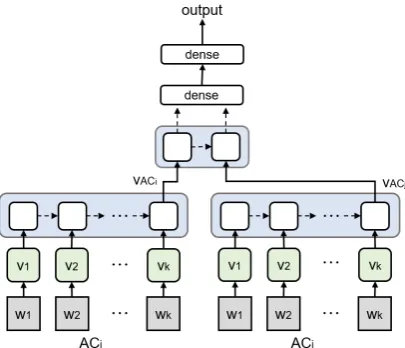
We evaluated the neural networks on the basis of their performance when combined with Tex-tRank. Figure1shows the neural network that ob-tained the best performance.
The input to the neural network is a pair con-sisting of ACi = (w1, w2, ...wk) and ACj =
(w′1, w2′, ...w′k′), where wl is a word in an AC
andk and k′ is the length of the ACi and ACj.
ACi and ACj are converted into word vectors
Vi = (v1, v2, ...vk)andVj = (v′1, v′2, ...v′k′)in the
embedding layer.vlis a word vector for a wordwl.
Figure 1: Proposed neural network for relation identi-fication: LSTM and dense network
If there is a relation betweenACi andACj, we
denote the pair aslink, and otherwise asnolink.
3.2 TextRank for Argument Mining
The relation identifier in Section 3.1 yields the probabilityP(link|Si, Sj)fromACi toACj. We
use this estimated probability P(link|Si, Sj) as
w(Si, Sj)in Eq. 1. Because there is no ground to
determinew(Si, Si), we empirically setw(Si, Si)
to1.
4 Experiment
In this section, we explain the corpus we use, ex-perimental setting, and results.
4.1 Data
We used two copora in this experiment, one consisting of student essays and the other of Wikipedia articles.
4.1.1 Student Essay
(Stab and Gurevych, 2017) distributed an-notated student essays in English extracted from the online forum essayforum.com at https://www.informatik.tu-darmstadt.de/
(Argument Annotated Essays (version 2)). The annotation consists of classification labels of the ACs and the relations among the ACs. We call this corpus “Student Essay.” The basic figures of Student Essay are shown in Table1.
As for the classification, ACs are classified as major claims, claims, and premises. A major claim shows the standpoint of the author on the topic of the essay. A claim supports or attacks the
major claim. A premise is an assumption or a rea-son in an argument and supports or attacks a claim or another premise.
Regarding relations between ACs, the relation between claims is generally marked as for or against and that between premises as support or attack. In this paper, however, we do not use these types of relation (i.e. for, against, support, or at-tack). Rather, if there exists a relation of any type between a pair of ACs, we consider the pair as a positive example. Other pairs of ACs could serve as negative examples. However, the number of such negative examples is much larger than that of positive examples. In addition, most of the neg-ative example AC pairs are irrelevant to learning. Thus, we used only the reverse pairs (i.e. major claim and claim, major claim and premise, and claim and premise) as negative examples.
4.1.2 Wikipedia Article
(Aharoni et al., 2014) distributed annotated Wikipedia articles1 with the topic labels, claim (CDC), and context dependent evidence (CDE). A topic is a short statement of the subject of an article. CDC is a statement supporting or attacking the topic that is directly related to a main claim of the article. CDE is a text fragment directly supporting some CDC under the topic of the article. We call this corpus “Wikipedia Article.” The basic figures of Wikipedia Article are shown in Table2.
CDE can be classified as Study, Expert, and Anecdotal according to the type of evidence. Study is CDE backed by quantitative analysis. Ex-pert is CDE backed by an exEx-pert (person or orga-nization). Anecdotal is CDE backed by an event or example. In this experiment, if CDC and CDE in an article were related, we used the pair as a positive example. Otherwise, they were used as a negative example. We did not use the different types of CDE.
Table 1: Student Essay
essay Type of AC Relation MajorClaim Claim Premise link nolink 402 751 1506 3832 6673 91798
4.2 Proposed Method
In this section, we explain the experimen-tal details of the proposed method. For
Table 2: Wikipedia Article
essay Type of AC Relation CDC CDE link nolink 102 350 795 1291 31634
word vectors, we used pretrained word
vectors with 300 dimensions available at https://code.google.com/archive/p/word2vec/.
The neural network was implemented in Keras2. For Student Essay, we used the following set-tings. LSTM had 64 units. The fully connected layer had 64 units with a dropout rate of 0.5. A sig-moid function was used in the output layer. Binary cross-entropy was used as the loss function. The batch size was 128. Early stopping was employed using validation loss. The longest AC consisted of 67 words with 7238 words in vocabulary. We em-ployed five-fold cross validation for testing. Ten percent of the training data was used as validation data.
For Wikipedia Article, we used the following settings. LSTM had 32 units. The fully connected layer had 64 units with a dropout rate of 0.3. A sigmoid function was used in the output layer. Bi-nary cross-entropy was used as the loss function. The batch size was 128. Early stopping was em-ployed using validation loss. The longest AC was 254 words with 6412 words in vocabulary. We employed ten-fold cross validation for testing be-cause the data size of Wikipedia Article is smaller than that of Student Essay. Ten percent of the training data was used as validation data.
The hyperparameterdof TextRank was set 0.85 throughtout the experiments.
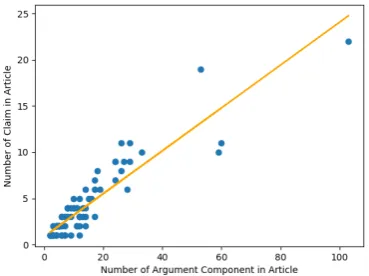
Figure 2: The Number of ACs vs. That of Claims in Wikipedia Article
2https://keras.io/
4.3 Previous Work: TextRank-TFIDF and TextRank-W2V
Here, we explain the similarities used in Tex-tRank for comparison. For the similarity of TFIDF, we used the TFIDF vectors as used in (Petasis and Karkaletsis, 2016). We call this TextRank with the TFIDF cosine similarity “TextRank-TFIDF”.
For the similarity of word2vec, we used the vec-tor obtained by averaging the vecvec-tors of words in a sentence. For the word vectors, we used pre-trained Word2Vec with 300 dimensions at https://code.google.com/archive/p/word2vec/. We call TextRank with the word2vec consine similar-ity “TextRank-W2V”.
4.4 Previous Work: Supervised Component Classification
Here, we explain the detail of supervised compo-nent classification for comparison. Because Stu-dent Essay has major claims and claims, we con-structed two classifiers: the one which detects only major claims and another which detects all claims (including the major claims). For the classifier, we used a neural network classifier. As for the neural networks, we tested LSTM, bidirectional LSTM (biLSTM), and CNN. The input to the network was a sequence of AC word vectors. The output was whether the input AC is major claim (claim) or not. We used the following settings. LSTM and biLSTM had 64 units. The fully connected layer had 64 units with dropout rate 0.5. A sigmoid function was used in the output layer. The binary crossentropy was used as the loss function. The CNN had the kernel sizes 3, 4, and 5. The num-ber of filters was 64. The max pooling had pool-size 2. The fully connected layer had 64 units with dropout rate 0.5. A sigmoid function was used in the output layer. Binary crossentropy was used as the loss function.
To discriminate major claims, claims, and premises, we used three-way classification. For three-way classification, we employed the softmax function. For the loss, we used categorical cross entropy.
We employed five-fold cross validation for test-ing. Ten percent of the training data was used as validation data for early stopping.
[image:5.595.84.269.565.703.2]Table 3: Results of Claim Detection using TextRank in Student Essay
TextRank-TFIDF TextRank-W2V Our Model
evaluation metrics total correct essay accuracy correct essay accuracy correct essay accuracy MajorClaim@1 402 116 0.289 79 0.197 218 0.542
MajorClaim@2 402 173 0.430 128 0.318 282 0.701
MajorClaim@3 402 215 0.535 176 0.438 326 0.811
Claim@1 402 252 0.627 198 0.493 319 0.794
Claim@2 402 330 0.821 291 0.724 372 0.925
Claim@3 402 361 0.898 337 0.838 392 0.975
Table 4: Results of Claim detection using TextRank in Wikipedia Article
TextRank-TFIDF TextRank-W2V Our Model
evaluation metrics total correct essay accuracy correct essay accuracy correct essay accuracy
Claim@1 104 13 0.125 2 0.019 101 0.971
Claim@2 104 44 0.423 30 0.288 103 0.990
Table 5: Averaged Rank of Major Claim, Claim, and Premise in Student Essay
Component Type TextRank-TFIDF TextRank-W2V Our Model MajorClaim 6.397 7.071 3.883
Claim 7.609 8.050 6.664
[image:6.595.346.488.297.376.2]Premise 9.399 9.093 10.263
Table 6: Average Rank of Claim and Premise in Wikipedia Article
Component Type TextRank-TFIDF TextRank-W2V Our Model
Claim 17.162 17.780 4.747
Premise 14.368 14.089 19.959
4.5 Evaluation Method
For the comparison between our method and
TextRank-TFIDF/TextRank-W2V, we used
Claim@k and MajorClaim@k as evaluation met-rics. In MajorClaim@k, the result is considered correct if the top k according to the ranking includes the target major claim. In Claim@k, the result is considered correct if the topkaccording to the ranking includes the target claim and major claim. In Student Essay, MajorClaim@k and Claim@k were evalueted for k = 1,2,3. Wikipedia Article does not include major claim, so the evaluation was done only for Claim@k. The number of ACs varies significantly, and the minimum is 2, so we report Claim@k fork= 2to evaluate all the ACs. The number of articles that had two ACs was 24 out of 102. This means that these 24 articles are considered correct regardless of the output of the classifier when evaluating at Claim@2. So we should be careful that there is possibility of overestimation.
For component classification, we employed the precision, recall, and F-score as evaluation
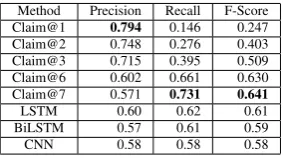
met-Table 7: Precision and Recall detecting Claim in Stu-dent Essay
Method Precision Recall F-Score Claim@1 0.794 0.146 0.247 Claim@2 0.748 0.276 0.403 Claim@3 0.715 0.395 0.509 Claim@6 0.602 0.661 0.630 Claim@7 0.571 0.731 0.641
[image:6.595.336.499.431.494.2]LSTM 0.60 0.62 0.61 BiLSTM 0.57 0.61 0.59 CNN 0.58 0.58 0.58
Table 8: Precision and Recall detecting Major Claim in Student Essay
Method Precision Recall F-Score MajorClaim@1 0.542 0.298 0.384 MajorClaim@2 0.437 0.472 0.454 MajorClaim@3 0.371 0.602 0.458
LSTM 0.44 0.39 0.41 BiLSTM 0.49 0.35 0.41 CNN 0.49 0.31 0.38
rics that are often used in text classification. Our method obtains a rank of the ACs. For compari-son, we set a threshold; if the rank was higher than the threshold, we considered the AC to be a major claim or claim. We used 1-3 as the threshold for Student Essay.
Table 9: Precision and Recall detecting Claim in Wikipedia Corpus
Method Precision Recall F-Score Claim@adaptive 0.832 0.875 0.853 Claim@1 0.971 0.554 0.706 Claim@2 0.788 0.734 0.760 LSTM 0.89 0.97 0.93
BiLSTM 0.92 0.86 0.90 CNN 0.94 0.91 0.93
in Fig.2.
For Student Essay, we evaluated a case wherein only major claims is considered and one wherein both major claims and claims are considered.
4.6 Experimental Result and Discussion
Tables3and4show the results using our method and TextRank-TFIDF/TextRank-W2V to Student Essay and Wikipedia Article.
For Student Essay, our proposed method outper-formed the previous TextRank-TFIDF/TextRank-W2V. In particular, our method achieved 0.542, which is significantly better than the 0.289 of TextRank-TFIDF, for major claims.
Simply employing word vectors alone did not improve the performance; MajorClaim@1 was 0.197 for TextRank-W2V while it was 0.289 for TextRank-TFIDF.
Table 5 shows the averaged rank of major claims, claims and premises. For TextRank-TFIDF/TextRank-W2V, the difference in the av-eraged ranks for major claims, claims, premises is small, and they are not well separated. In our proposed method, the averaged ranks of ma-jor claims, claims, and premises are 3.883, 6.664, and 10.263, respectively, and they are well articu-lated. For Wikipedia Article, our method correctly assigns a higher rank to claims while TextRank-TFIDF/TextRank-W2V incorrectly assign a higher rank to premises.
Tables 7, 8, and 9 show the result of compar-ison of our method to the neural network classi-fiers. Our method ranks ACs into specified types of AC: major claim, claim, or premise for Stu-dent Essay. Because the neural network classifiers are classifiers, in order to make a comparison, we set a threshold on the rank to make classification. For Wikipedia Article, because the number of ACs varies, we use an adaptive threshold explained in Section4.5.
For Student Essay, our method was the best in F-Score for major claim with 3 as the threshold,
Table 10: F-Score of three-way Classification of Ma-jorClaim, Claim, and Premise of Student Essay
[image:7.595.342.488.101.137.2]Method MajorClaim Claim Premise LSTM 0.37 0.34 0.75 BiLSTM 0.27 0.22 0.76 CNN 0.33 0.30 0.75
Table 11: Confusion Matrix of three-way Classifica-tion of MajorClaim, Claim, and Premise using LSTM of Student Essay for 20% test set of Table1
MajorClaim Claim Premise MajorClaim 44 44 71
Claim 18 96 201
Premise 19 113 612
and also for claim with 7 as seen in Tables7 and
8. This shows the effectiveness of our method for classifying AC into major claim and claim.
For Student Essay, our method is better than the neural network classifier. Table 10 shows the F-score for three-way classifier. In this table, LSTM and biLSTM are slightly better than CNN, but the difference is small. It is notable that the score is high for premise, but it is low for major claim and claim. Table 11 shows the confusion matrix for LSTM. The table shows this more clearly. Our method is effective for discriminating major claim and claim because major claim and claim are sep-arated by ranking,
For Wikipedia Article, the neural network clas-sifier marked better F-Scores. This can be understood that the argumentation structure of Wikipedia Article is more controlled and can be extracted just by the neural network classifier. We show the confusion matrix for LSTM of Wikipedia Article at Table12.
However our method is better than the neural network classifier in the precision of @1 in Table
9. If one want to find out not all the claim but main claim, our method can serve better.
In summary, our method outperformed the pre-vious methods for Student Essay. For Wikipedia Article, our method was slightly worse than the neural network classifiers.
5 Conclusion and Future Work
[image:7.595.337.495.204.241.2]Table 12: Confusion Matrix of Classification of Claim, and Premise using LSTM of Wikipedia Article for 20% test set of Table2
Claim Premise
Claim 70 2
Premise 9 151
experiments on Student Essay and Wikipedia Arti-cle show that the proposed method performed bet-ter in major claim and claim classification com-pared with TextRank with unsupervised similar-ity measure. This shows the effectiveness of uti-lizing the relation between ACs. Compared with the neural network classifier, the proposed method performed better for Student Essay, and not better in F-Score but better in precision for Wikipedia Article. Thus, if we need more precision such as the case that we want to find out only claim, the proposed method has an advantage. In addition, the proposed method performed well for a rather complex argument structure such as major claim, claim, and premise utilizing the ranking produced by the method. In summary, the proposed method performed well for multiple corpora with different argument structures and varying number of ACs.
We are going to use word vectors using the con-textual information to improve the relation iden-tification and also test other ranking algorithms such as RankNet (Burges et al.,2005) and ListNet (Cao et al.,2007).
References
Ehud Aharoni, Anatoly Polnarov, Tamar Lavee, Daniel Hershcovich, Ran Levy, Ruty Rinott, Dan Gutfre-und, and Noam Slonim. 2014. A benchmark dataset for automatic detection of claims and evidence in the context of controversial topics. In Proceedings of the First Workshop on Argumentation Mining, pages 64–68, Baltimore, Maryland. Association for Com-putational Linguistics.
Chris Burges, Tal Shaked, Erin Renshaw, Ari Lazier, Matt Deeds, Nicole Hamilton, and Greg Hullender. 2005. Learning to rank using gradient descent. In
Proceedings of the 22Nd International Conference on Machine Learning, ICML ’05, pages 89–96, New York, NY, USA. ACM.
Zhe Cao, Tao Qin, Tie-Yan Liu, Ming-Feng Tsai, and Hang Li. 2007. Learning to rank: From pairwise ap-proach to listwise apap-proach. InProceedings of the 24th International Conference on Machine Learn-ing, ICML ’07, pages 129–136, New York, NY, USA. ACM.
Oana Cocarascu and Francesca Toni. 2017. Identify-ing attack and support argumentative relations us-ing deep learnus-ing. InProceedings of the 2017 Con-ference on Empirical Methods in Natural Language Processing, pages 1374–1379, Copenhagen, Den-mark. Association for Computational Linguistics.
Johannes Daxenberger, Steffen Eger, Ivan Habernal, Christian Stab, and Iryna Gurevych. 2017. What is the essence of a claim? cross-domain claim identifi-cation. InProceedings of the 2017 Conference on Empirical Methods in Natural Language Process-ing, pages 2055–2066, Copenhagen, Denmark. As-sociation for Computational Linguistics.
Alfio Ferrara, Stefano Montanelli, and Georgios Peta-sis. 2017. Unsupervised detection of argumentative units though topic modeling techniques. In Pro-ceedings of the 4th Workshop on Argument Mining, pages 97–107, Copenhagen, Denmark. Association for Computational Linguistics.
Ran Levy, Yonatan Bilu, Daniel Hershcovich, Ehud Aharoni, and Noam Slonim. 2014. Context depen-dent claim detection. In Proceedings of COLING 2014, the 25th International Conference on Compu-tational Linguistics: Technical Papers, pages 1489– 1500, Dublin, Ireland. Dublin City University and Association for Computational Linguistics.
Marco Lippi and Paolo Torroni. 2015. Context-independent claim detection for argument mining. InProceedings of the 24th International Conference on Artificial Intelligence, IJCAI’15, pages 185–191. AAAI Press.
Rada Mihalcea and Paul Tarau. 2004.
Textrank: Bringing order into text. In Proceed-ings of EMNLP 2004, pages 404–411, Barcelona, Spain. Association for Computational Linguistics.
Huy Nguyen and Diane Litman. 2016.
Context-aware argumentative relation mining. In Proceedings of the 54th Annual Meeting of the Association for Computational Linguistics (Volume 1: Long Papers), pages 1127–1137, Berlin, Germany. Association for Computational Linguistics.
Georgios Petasis and Vangelis Karkaletsis. 2016.
Identifying argument components through textrank. In Proceedings of the Third Workshop on Argu-ment Mining (ArgMining2016), pages 94–102, Berlin, Germany. Association for Computational Linguistics.
Ruty Rinott, Lena Dankin, Carlos Alzate Perez, Mitesh M. Khapra, Ehud Aharoni, and Noam Slonim. 2015. Show me your evidence - an auto-matic method for context dependent evidence de-tection. In Proceedings of the 2015 Conference on Empirical Methods in Natural Language Process-ing, pages 440–450, Lisbon, Portugal. Association for Computational Linguistics.
Christian Stab and Iryna Gurevych. 2014. Identifying argumentative discourse structures in persuasive es-says. InEMNLP, pages 46–56.
Christian Stab and Iryna Gurevych. 2017.
Parsing argumentation structures in persuasive essays.