ISSN 2348 – 7968
357
Mining Algorithm of Opinion Leaders Based on Analysis of User
Attention Behavior
Ying Xia, Miaomiao Cao, Xu Zhang and Hae Young Bae
Research Center of Spatial Information System, Chongqing University of Posts and Telecommunications, Chongqing, China
Abstract
Mining opinion leaders is of great significance to the dissemination of information in social network. This paper put forward a mining algorithm of opinion leaders in social network. First, the algorithm defined the concept of attention degree based on the analysis of user attention behaviors including forward, comment, point praise and other concerns. Then it adopted the ideas of voting in the PageRank algorithm to calculate user's influence. Experimental analysis based on data set from Sina Microblogging shows that the algorithm can identify the influential users more effective and accurate.
Keywords: social network, opinion leaders, attention behavior, attention degree, PageRank.
1. Introduction
Opinion leaders, known as the leaders of public opinion and view communicator,refer to "active elements" that not only provide information, advice, comments, also have a certain impact on others in the interpersonal communication network [1]. Social network is an online community that provides a platform for people with the same background to share their interests and hobbies. In the process of information dissemination in social network, opinion leaders playing a more and more important role, are widely used in public opinion monitoring, information promotion, e-commerce and other fields.
With the rapid development of Internet technology and social network, users can share information anytime and anywhere on the network. Especially FaceBook, Twitter, Sina Microblogging and other large-scale online social network have become important mediums of communication, playing important roles in information communication between network users. How to find a set of users with a certain influence accurately in a large amount of data from the large-scale social network has been the research target of opinion leaders mining.
2. Related Work
Scholars have carried out a wide range of research on the mining of opinion leaders in social network. These studies can be broadly divided into the following three kinds of methods.
Mining methods of opinion leaders based on topology analysis of network, such as Larry Page [2] reflected the relevance and importance of web pages by using PageRank algorithm, Jon Kleinberg [3] evaluated the degree of user's authority by using HITS algorithm, Zhai [4] mined opinion leaders through classifying the data set according to the theme and adopting PageRank algorithm, Song [5] proposed InfluenceRank algorithm on the basis of considering the novelty of the blog itself and the links between blogs, Yu Xiao [6] proposed LeaderRank algorithm through increasing analysis of content and emotional of posts.
Mining methods of opinion leaders based on information interaction, mainly through the analysis on the impact of user's information and the dissemination of information to reflect the users’ influence. For example, Agarwal [7] evaluated the impact of posts through the degree of novel and the length of content of posts. Li [8] found opinion leaders from the product evaluation according to the quantity and quality of blogs. Xinghua Fan [9] calculated influence value and filtered opinion leaders by the way of conveying views basing on text interaction.
ISSN 2348 – 7968
358
Currently, due to the increasingly rich social networking platform, users’ attention behaviors are also more diverse. This paper, not only taking network topology and user attributes into consideration, also adopting ideas of PageRank algorithm, analyze the behavior of users and find opinion leaders effectively.
3. Calculation Model of User Influence
3.1 Data Structure of Social Network
A user in social network is used as a node, a link between two users is used as a side, then the whole social network can constitute a graph. The network structure of users with concern relationship can be expressed by network G= (N, E, W) with weight. Among them, N is a set of nodes that represents all users. E is a collection of edges that indicates the relationship between users. W is a set of edges’ weight to describe the degree of attention among users.
3.2 Introduction of PageRank
In social networks, If user p follows user q, then p will give his degree of attention to q, if q gets high degree of attention that means he has a large influence on others, then q has a relatively large influence on the p. This idea is similar to the basic ideas of PageRank algorithm [2].
PageRank algorithm is a classical algorithm used to measure the importance of pages in network. The structures of links between pages are used to determine the importance of pages. If page p links to page q, that is to say, p votes to q. Ranking system will assess importance of pages based on the number of votes received between pages. The expression of the algorithm for the importance of page q calculated by the importance of pages voted to q. For the PR value of page q, namely PageRank (q), as shown in formula (1):
PageRank(q) = (1−C) + C∑p∈APageRank(p)|p| (1)
Thus, the PR value of page q can be attained by adding all results calculated by PR value of all the pages linked into q divided by the number of every page linked out. A refers to a set of pages linked into page q, |p| refers to the number of every page linked out. In the formula, the damping factor C (0<C≤1), refers to the probability keeping to browse the pages linked out.
Thus, in the process of calculating PR value of every page in iteration, the main step is to calculate the PageRank (p) /|p|, which means, the PR value of page p average
distribution to pages linked out. However, there is no consideration of the differences among pages.
3.3 Definition of Attention Behaviors and Attention
Degree
In social network, a user can be followed by more than one user. Attention behaviors occurred in two users mainly includes one user forwards, comments, points praise and other acts on another user’s information. A user’s information can’t get the same attention degree from others, because they don’t have same friendship and hobby. So the degree of attention user p pays to user q, reflected by the attention behaviors occurred between p and q’s information.
The degree of attention is reflected by attention occurred among nodes. In social networks, whether nodes can get attention or not reflected by the probability of attention behaviors occurrence. The definition of attention degree among nodes is:
W(p,q)=NN(p(,q)
q) (2)
In formula (2), N(p,q) indicates the number of q’s information given attention by p, it can be expressed as formula (3). 1~n, which indicates that p owns the number of properties on behavior to q, such as forward, comment, point praise and collection; N1~Nn represents the number of attribute; α1~αn represents the weight of every attribute and they add up to 1. N(q) refers to the total number of information of user q.
N(p,q)=α1N1+ … +αiNi+ … + αnNn
(3)
In the above formula, the number of attributes that are related to and the weight value of attribute can be set up according to the specific application.
3.4 Calculation Method of User Influence
In PageRank algorithm, the PR value of a page is uniformly transmitted to other pages link out, however it does not consider the importance of the page itself. In order to calculate user influence well, this paper proposes a mining algorithm of opinion leaders in social network (Social Network User Rank, SNURank), considering the characteristics of users' attention behaviors.
ISSN 2348 – 7968
359
contrary, a user who gets lower degree of attention will get a lower influence value. The problem of uniform transmission can be solved by this way and the problem of simply relying on the link among users to rank also can be overcome, so the model can reflect the actual situation more objectively. Similar to the PageRank algorithm, users in social network correspond to pages, the relationship between users is corresponding to the link between pages, thus calculation expressions of Network User Rank Social (SNURank) algorithm is as follows:
SNUR(q) = (1−C) + C ×∑p∈EA��������������p,qSNUR(p) (4)
The C, the damping coefficients are often used in the reference PageRank algorithm, is set 0.85. E represents a collection of all the users who attention about q.
In addition, as shown in the formula (5), Ap,q refers to the proportion of p allocate attention to q, That is because user p concerned about many users, so the user q get user p’s influence is relative proportion of p. F represents a set of users who are concerned by p.
Ap,q =∑ W(Wp,q()
p,q)
q∈F (5)
4. Experiment and Analysis
4.1 Experimental Data Set
Experiment selected the data set of Sina Microblogging
which from Datatang platform
(35TUhttp://www.datatang.com/data/46758)U35T, including
information belongs to 63641 users, friendship among 1391718 users, forwarding relationship in 27759 micro blogs. The data set collected are stored in the following format:
1) table of users’ information: user ID, number of fans, number of attention, number of micro blogs
2) table of micro blogs’ information: micro blog ID, the time published, number of forwarding, number of comments, number of points, user ID who publish
3) table of users’ relationship: user ID, fans ID
4) table of micro blogs relationships: micro blog ID, original micro blog ID
4.2 Evaluation Factors
Influence coverage rate of nodes put forward in [12] will be used as evaluation factor in this paper, which means the proportion of the number of nodes affected by influential nodes directly or indirectly to the number of total nodes. The formula is shown as (6):
p(k) =∑Nk=1L(k)
N (6)
As shown in the above formula, p(k) indicates the influence coverage rate of the former k users, N represents the number of users to be studied, L (k) indicates that the number of users is affected by user number k.
In general, the greater impact coverage rate of the previous users, the greater influence users are.
4.3 Influence Coverage Analysis
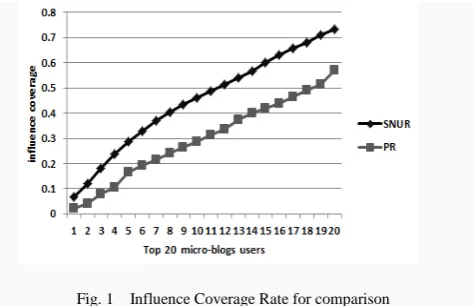
In order to evaluate the effectiveness of SNURank algorithm (SNUR), compared with mining algorithm of opinion leaders based on PageRank algorithm (PR), considering the influence coverage rate of top 20 users in two algorithms.
In experiment, we main comprehensive the number of forwards, comments and points as attributes to calculate degree of attention of users. Taking into account user p transmits user q’s information can help the q’s information be further spread. That is, it may help q get a higher degree of attention. So the weight of this three attributes can be set to 0.4, 0.3 and 0.3. The results of experiment are shown in figure 1. It can be seen that the influence coverage rate of SNURank algorithm is significantly higher than the PageRank algorithm’s.
Fig. 1 Influence Coverage Rate for comparison
4.4 Case Analysis
ISSN 2348 – 7968
360 Table 1: Influence Ranking of PageRank
Rank userid fans follows micro-blogs PR
1 1618051664 33787450 88798 88798 0.002152728
2 1191258123 37607791 951 204 0.002105834
3 2656274875 18249317 172 31901 0.001809606
4 1496852380 4534645 184 483 0.001779502
5 2803301701 19977043 272 28677 0.001429315
6 1197161814 51287110 517 13828 0.001398102
7 1761179351 7834504 178 1247 0.001167495
8 1182389073 20287367 161 69177 0.001156822
9 1705586121 11640156 295 3097 0.001038854
Table 2: Influence Ranking of SNURank
Rank userid fans follows micro-blogs SNUR
1 1216766752 1250609 1640 3397 0.003442212
2 1974808274 1541472 321 13826 0.003056597
3 2834256503 2521620 198 7409 0.003039269
4 1904769205 2023180 1261 13564 0.002968050
5 1496852380 4534645 184 483 0.002776082
6 1850988623 1898923 1962 23000 0.002755934
7 1235457821 2126566 164 731 0.002280324
8 1649159940 2813741 614 73914 0.002049567
9 1197362373 3589483 719 817 0.001414612
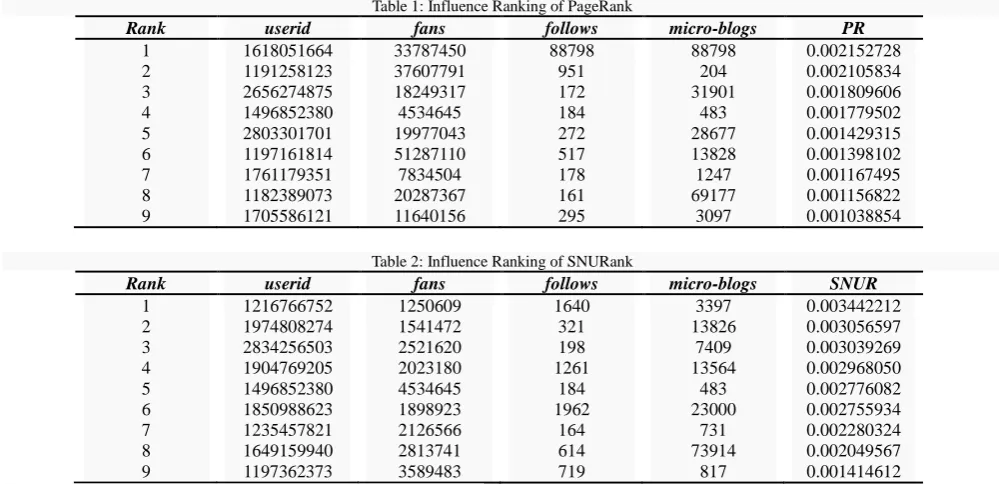
Compared with the results of user ranking obtained by two algorithm can be found that the ranking of top 9 users’ influence is different. Because PageRank algorithm only considers link between two nodes, that is to say influence value is mainly determined by the sum of out degree and in degree. Here, the number of fans and attention a user owned refers to the node’s out degree and in degree. For example, the user whose ID is“1496852380” owns the number of fans is far greater than the top 2 users’ in table 2. The reason for this is because of many of his fans not pay attention to him. So the algorithm proposed in this paper to calculate the influence value, the ranking of this user is lower than the ranking of PageRank algorithm attained.
Known from analysis, SNURank algorithm considers attention behaviors like forwards, comments, point praise and other concerns between two users. The influence value of user can be calculated by the degree of attention. It is more accurate to identify the opinion leaders in social networks.
5. Conclusions
Mining opinion leaders for information dissemination in social network is of great significance. This paper proposes SNURank algorithm, a mining algorithm of opinion leaders in social network. It can be used to calculate user's influence and select opinion leaders by defining degree of attention based on analysis of user's attention behaviors and the ideas of PageRank algorithm. Through experimental analysis of data set from Sina Microblogging,
the algorithm can identify the influential users more effective and accurate.
Acknowledgments
This work is funded by Chongqing Natural Science Foundation (cstc2014kjrc-qnrc40002), Scientific and Technological Research Program of Chongqing Municipal Education Commission (KJ1500431), and WenFeng Creative Foundation of CQUPT (WF2014-05).
References
[1] Paul F.Lazarsfield. The People’s Choice: How the Voter Makes Up His Mind in a Presidential Campaign[M] New York: Duell,Sloan & Pierce, 1944
[2] Brin S, Page L. The anatomy of a large-scale hypertextual web search engine. Computer Networks and ISDN Systems, 1998, 30(1): 107-117
[3] Kleinberg J M. Authoritative sources in a hyperlinked environment. Journal of the ACM, 1999, 46(5): 604-632 [4] Zhongwu Zhai, Hua Xu, Peifa Jia. Identifying Opinion
Leaders in BBS[C]. 2008 IEEE/WIC/ACM International Conference on Web Intelligence and Intelligent AgentTechnology, Sydeny, NSW, Australia, 2008:398-401 [5] Xiaodan Song, Yun Chi, Koji Hino, et al. Identifying opinion
leaders in the blogsphere[C]. Proceedings of the 16th ACM Conference on Information and Knowledge Management, Lisboa, Portugal, 2007: 971-974
[6] Yu Xiao, Wei Xu, Lin Xia. Networking Groups Opinion Leader Identification Algorithms Based on Sentiment Analysis. Computer Science, 2012, 39(2): 34-37+46
ISSN 2348 – 7968
361 on Web Search and Web Data Mining. New York: ACM
Press,2008: 207_218
[8] Li Feng, Du T C. Who is talking? An ontology-based opinion leader identification framework for word-of-mouth marketing in online social blogs[J]. Decision Support Systems, 2011, 51(1): 190-197
[9] Xinghua Fan, Jing Zhao, Binxing Fang, Yuxiao Li. Influence Diffusion Probability Model and Utilizing It to Identify Network Opinion Leader. Chinese Journal of Computers, 2013,36(2):360-367
[10] Xuefeng Ding,Feng Hu,Wen Zhao. Research on the characteristics of network opinion leaders. Journal of Sichuan University: Engineering Science Edition, 2010,42(2): 145-149 [11] Shuai Zhu,Xiaolin Zheng,Deren Chen. Research of
algorithm for automatic opinion leader Detection in BBS. System Engineering-theory & Practice, 2011, 31(S2): 7-12 [12] Yu Wu, Lulu Ma, Mao Lin, HongTao liu. Discovery
Algorithm of Opinion leaders Based on User Influence. Journal of Chinese Computer Systems,2015,36(3):561-565
Ying Xia is a professor of Chongqing University of Posts and Telecommunications. Her research area mainly includes database and data mining, spatial information processing, etc.
Miaomiao Cao is a graduate student at the College of Computer Science and Technology, Chongqing University of Posts and Telecommunications. Her research area mainly is social network data mining.
Xu Zhang is an associate professor of Chongqing University of Posts and Telecommunications. His research area mainly includes cloud computing and big data processing.