2384
hyperdoc2vec
: Distributed Representations of Hypertext Documents
Jialong Han♠, Yan Song♠, Wayne Xin Zhao, Shuming Shi♠, Haisong Zhang♠ ♠Tencent AI Lab
School of Information, Renmin University of China
{jialonghan,batmanfly}@gmail.com,{clksong,shumingshi,hansonzhang}@tencent.com
Abstract
Hypertext documents, such as web pages and academic papers, are of great impor-tance in delivering information in our daily
life. Although being effective on plain
documents, conventional text embedding methods suffer from information loss if di-rectly adapted to hyper-documents. In this paper, we propose a general embedding approach for hyper-documents, namely,
hyperdoc2vec, along with four crite-ria characterizing necessary information that hyper-document embedding models should preserve. Systematic comparisons
are conducted betweenhyperdoc2vec
and several competitors on two tasks,i.e.,
paper classification and citation recom-mendation, in the academic paper do-main. Analyses and experiments both
val-idate the superiority ofhyperdoc2vec
to other models w.r.t. the four criteria.
1 Introduction
The ubiquitous World Wide Web has boosted
re-search interests on hypertext documents,e.g.,
per-sonal webpages (Lu and Getoor,2003), Wikipedia
pages (Gabrilovich and Markovitch,2007), as well
as academic papers (Sugiyama and Kan, 2010).
Unlike independent plain documents, a hypertext document (hyper-doc for short) links to another hyper-doc by a hyperlink or citation mark in its textual content. Given this essential distinction, hyperlinks or citations are worth specific model-ing in many tasks such as link-based
classifica-tion (Lu and Getoor, 2003), web retrieval (Page
et al.,1999), entity linking (Cucerzan,2007), and
citation recommendation (He et al.,2010).
To model hypertext documents, various
ef-forts (Cohn and Hofmann, 2000; Kataria et al.,
2010; Perozzi et al., 2014; Zwicklbauer et al.,
2016;Wang et al., 2016) have been made to
de-pict networks of hyper-docs as well as their con-tent. Among potential techniques, distributed
rep-resentation (Mikolov et al.,2013;Le and Mikolov,
2014) tends to be promising since its validity and
effectiveness are proven for plain documents on many natural language processing (NLP) tasks.
Conventional attempts on utilizing embedding techniques in hyper-doc-related tasks generally
fall into two types. The first type (Berger et al.,
2017;Zwicklbauer et al.,2016) simply downcasts
hyper-docs to plain documents and feeds them into
word2vec(Mikolov et al.,2013) (w2vfor short) or doc2vec (Le and Mikolov, 2014) (d2v for
short). These approaches involve downgrading
hyperlinks and inevitably omit certain information in hyper-docs. However, no previous work inves-tigates the information loss, and how it affects the performance of such downcasting-based adapta-tions. The second type designs sophisticated
em-bedding models to fulfill certain tasks, e.g.,
cita-tion recommendacita-tion (Huang et al., 2015b),
pa-per classification (Wang et al., 2016), and entity
linking (Yamada et al.,2016),etc. These models
are limited to specific tasks, and it is yet unknown whether embeddings learned for those particular tasks can generalize to others. Based on the above facts, we are interested in two questions:
• What information should hyper-doc
embed-ding models preserve, and what nice property should they possess?
• Is there a general approach to learning
task-independent embeddings of hyper-docs?
To answer the two questions, we formalize the hyper-doc embedding task, and propose four
cri-teria, i.e., content awareness, context awareness,
aware-ness, to assess different models. Then we discuss simple downcasting-based adaptations of existing approaches w.r.t. the above criteria, and demon-strate that none of them satisfy all four. To this
end, we propose hyperdoc2vec (h-d2v for
short), a general embedding approach for hyper-docs. Different from most existing approaches,
h-d2v learns two vectors for each hyper-doc to characterize its roles of citing others and being
cited. Owning to this, h-d2v is able to directly
model hyperlinks or citations without downgrad-ing them. To evaluate the learned embedddowngrad-ings, we
employ two tasks in the academic paper domain1,
i.e.,paper classification and citation
recommenda-tion. Experimental results demonstrate the
supe-riority of h-d2v. Comparative studies and
con-trolled experiments also confirm thath-d2v
ben-efits from satisfying the above four criteria. We summarize our contributions as follows:
• We propose four criteria to assess different
hyper-document embedding models.
• We proposehyperdoc2vec, a general
em-bedding approach for hyper-documents.
• We systematically conduct comparisons with
competing approaches, validating the
superi-ority ofh-d2vin terms of the four criteria.
2 Related Work
Network representation learning is a related topic to ours since a collection of hyper-docs re-semble a network. To embed nodes in a network,
Perozzi et al. (2014) propose DeepWalk, where
nodes and random walks are treated as pseudo
words and texts, and fed tow2vfor node vectors.
Tang et al.(2015b) explicitly embed second-order
proximity via the number of common neighbors of
nodes. Grover and Leskovec(2016) extend
Deep-Walk with second-order Markovian walks. To
im-prove classification tasks,Tu et al.(2016) explore
a semi-supervised setting that accesses partial
la-bels. Compared with these models,h-d2vlearns
from both documents’ connections and contents while they mainly focus on network structures.
Document embedding for classification is an-other focused area to apply document embeddings.
1Although limited in tasks and domains, we expect that
our embedding approach can be potentially generalized to, or serve as basis to more sophisticated methods for, similar tasks in the entity domain,e.g.,Wikipedia page classification and entity linking. We leave them for future work.
Le and Mikolov(2014) employ learnedd2v
vec-tors to build different text classifiers. Tang et al.
(2015a) apply the method in (Tang et al.,2015b)
on word co-occurrence graphs for word embed-dings, and average them for document vectors. For
hyper-docs, Ganguly and Pudi(2017) and Wang
et al.(2016) target paper classification in
unsuper-vised and semi-superunsuper-vised settings, respectively.
However, unlike h-d2v, they do not explicitly
model citation contexts. Yang et al. (2015)’s
ap-proach also addresses embedding hyper-docs, but involves matrix factorization and does not scale.
Citation recommendationis a direct downstream task to evaluate embeddings learned for a
cer-tain kind of hyper-docs,i.e.,academic papers. In
this paper we concentrate on context-aware
cita-tion recommendacita-tion (He et al.,2010). Some
pre-vious studies adopt neural models for this task.
Huang et al.(2015b) propose Neural Probabilistic
Model (NPM) to tackle this problem with embed-dings. Their model outperforms non-embedding
ones (Kataria et al.,2010;Tang and Zhang,2009;
Huang et al., 2012). Ebesu and Fang(2017) also
exploit neural networks for citation recommenda-tion, but require author information as additional
input. Compared with h-d2v, these models are
limited in a task-specific setting.
Embedding-based entity linkingis another topic that exploits embeddings to model certain
hyper-docs,i.e.,Wikipedia (Huang et al.,2015a;Yamada
et al.,2016;Sun et al.,2015;Fang et al.,2016;He
et al., 2013;Zwicklbauer et al., 2016), for entity
linking (Shen et al., 2015). It resembles citation
recommendation in the sense that linked entities highly depend on the contexts. Meanwhile, it re-quires extra steps like candidate generation, and can benefit from sophisticated techniques such as
collective linking (Cucerzan,2007).
3 Preliminaries
We introduce notations and definitions, then for-mally define the embedding problem. We also pro-pose four criteria for hyper-doc embedding models w.r.t their appropriateness and informativeness.
3.1 Notations and Definitions
Letw ∈W be a word from a vocabularyW, and
d∈Dbe adocument id(e.g.,web page URLs and
paper DOIs) from an id collectionD. After
filter-ing out non-textual content, ahyper-documentH
(Koehn et al., 2007)
(Zhao and Gildea, 2010)
(Papineni et al., 2002)
Original Source doc ݀௦
Context words ܥ
Target doc ݀௧
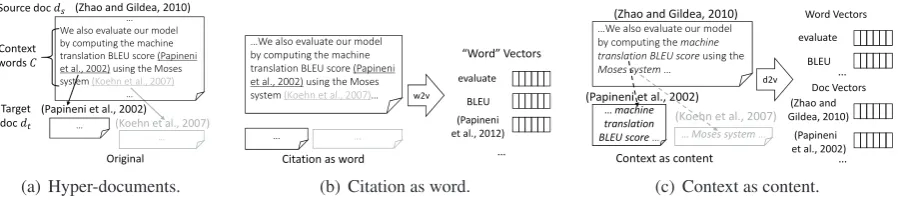
… We also evaluate our model by computing the machine translation BLEU score (Papineni et al., 2002) using the Moses system (Koehn et al., 2007)
…
…
…
(a) Hyper-documents.
Citation as word
BLEU evaluate
(Papineni et al., 2012)
“Word” Vectors
…
w2v
…We also evaluate our model by computing the machine translation BLEU score (Papineni et al., 2002) using the Moses system (Koehn et al., 2007)…
… …
(b) Citation as word.
Context as content
BLEU evaluate
(Zhao and Gildea, 2010)
…
…
Word Vectors
Doc Vectors
(Papineni et al., 2002)
d2v (Koehn et al., 2007) (Zhao and Gildea, 2010)
(Papineni et al., 2002) …We also evaluate our model by computing the machine translation BLEU score using the
Moses system …
… machine translation
BLEU score … … Moses system …
[image:3.595.77.527.64.164.2](c) Context as content.
Figure 1: An example ofZhao and Gildea(2010) citingPapineni et al.(2002) and existing approaches.
i.e.,W∪D. For example, web pages could be
sim-plified as streams of words and URLs, and papers are actually sequences of words and cited DOIs.
If a document id dt with some surrounding
wordsC appear in the hyper-doc ofds,i.e.,Hds,
we stipulate that ahyper-linkds, C, dtis formed.
Hereinds, dt ∈ D are ids of the sourceand
tar-getdocuments, respectively; C ⊆ W arecontext
words. Figure1(a)exemplifies a hyperlink.
3.2 Problem Statement
Given a corpus of hyper-docs {Hd}d∈D with D
andW, we want to learn document and word
em-bedding matricesD ∈ Rk×|D|andW ∈Rk×|W|
simultaneously. Thei-th columndi ofDis a k
-dimensional embedding vector for thei-th
hyper-doc with id di. Similarly, wj, the j-th column
of W, is the vector for word wj. Once
embed-dings for hyper-docs and words are learned, they can facilitate applications like hyper-doc classifi-cation and citation recommendation.
3.3 Criteria for Embedding Models
A reasonable model should learn how contents and
hyperlinks in hyper-docs impact both D andW.
We propose the following criteria for models:
• Content aware. Content words of a hyper-doc play the main role in describing it, so the document representation should depend on its own content. For example, the words
inZhao and Gildea(2010) should affect and
contribute to its embedding.
• Context aware. Hyperlink contexts usu-ally provide a summary for the target docu-ment. Therefore, the target document’s vec-tor should be impacted by words that others
use to summarize it,e.g.,paperPapineni et al.
(2002) and the word “BLEU” in Figure1(a).
• Newcomer friendly. In a hyper-document network, it is inevitable that some documents
are not referred to by any hyperlink in other
hyper-docs. If such “newcomers” do not
get embedded properly, downstream tasks in-volving them are infeasible or deteriorated.
• Context intent aware. Words around a
hy-perlink,e.g.,“evaluate . . . by” in Figure1(a),
normally indicate why the source hyper-doc
makes the reference, e.g., for general
refer-ence or to follow/oppose the target hyper-doc’s opinion or practice. Vectors of those context words should be influenced by both documents to characterize such semantics or intents between the two documents.
We note that the first three criteria are for hyper-docs, while the last one is desired for word vectors.
4 Representing Hypertext Documents
In this section, we first give the background of two
prevailing techniques,word2vecanddoc2vec.
Then we present two conversion approaches for
hyper-documents so thatw2vandd2vcan be
ap-plied. Finally, we address their weaknesses w.r.t. the aforementioned four criteria, and propose our
hyperdoc2vecmodel. In the remainder of this paper, when the context is clear, we mix the use of terms hyper-doc/hyperlink with paper/citation.
4.1 word2vecanddoc2vec
w2v (Mikolov et al., 2013) has proven effective
for many NLP tasks. It integrates two models,i.e.,
cbowandskip-gram, both of which learn two
types of word vectors, i.e., IN and OUT vectors.
cbow sums up IN vectors of context words and
make it predictive of the current word’s OUT vec-tor.skip-gramuses the IN vector of the current word to predict its context words’ OUT vectors.
As a straightforward extension to w2v, d2v
also has two variants: pv-dm and pv-dbow.
Desired Property
Impacts Task? Addressed by Approach?
Classification Citation
Rec-ommendation w2v d2v-nc d2v-cac h-d2v
Context aware ×
Content aware ×
Newcomer friendly ×
Context intent aware × × × ×
Table 1: Analysis of tasks and approaches w.r.t. desired properties.
Model Output
DI DO WI WO
w2v
d2v (pv-dm) ×
d2v (pv-dbow) × ×
[image:4.595.75.525.64.155.2]h-d2v
Table 2: Output of models.
is regarded as a special context vector to average.
Analogously, pv-dbow uses IN document
vec-tor to predict its words’ OUT vecvec-tors, following
the same structure ofskip-gram. Therefore in
pv-dbow, words’ IN vectors are omitted.
4.2 Adaptation of Existing Approaches
To represent hyper-docs, a straightforward strat-egy is to convert them into plain documents in a
certain way and applyw2vandd2v. Two
conver-sions following this strategy are illustrated below.
Citation as word. This approach is adopted by
Berger et al.(2017).2 As Figure1(b)shows,
doc-ument ids D are treated as a collection of
spe-cial words. Each citation is regarded as an oc-currence of the target document’s special word. After applying standard word embedding
meth-ods, e.g., w2v, we obtain embeddings for both
ordinary words and special “words”, i.e.,
docu-ments. In doing so, this approach allows target documents interacting with context words, thus produces context-aware embeddings for them.
Context as content. It is often observed in aca-demic papers when citing others’ work, an author briefly summarizes the cited paper in its citation context. Inspired by this, we propose a
context-as-content approach as in Figure1(c). To start, we
remove all citations. Then all citation contexts of a
target documentdtare copied intodtas additional
contents to make up for the lost information.
Fi-nally,d2vis applied to the augmented documents
to generate document embeddings. With this ap-proach, the generated document embeddings are both context- and content-aware.
4.3 hyperdoc2vec
Besides citation-as-word with w2v and
context-as-content with d2v (denoted by d2v-cac for
short), there is also an alternative using d2v on
documents with citations removed (d2v-nc for
2
It is designed for document visualization purposes.
short). We made a comparison of these approaches
in Table1in terms of the four criteria stated in
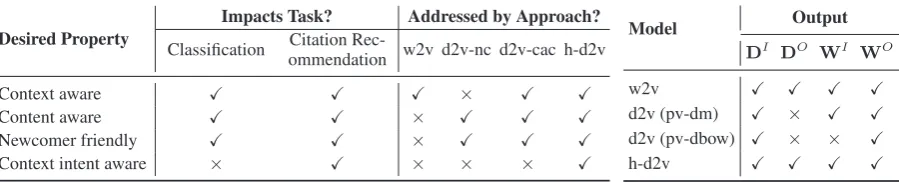
Sec-tion3.3. It is observed that none of them satisfy all
criteria, where the reasons are as follows.
First,w2v is not content aware. Following our
examples in the academic paper domain, consider
the paper (hyper-doc) Zhao and Gildea (2010)
in Figure 1(a), from w2v’s perspective in
Fig-ure 1(b), “. . . computing the machine translation
BLEU . . . ” and other text no longer have
as-sociation with Zhao and Gildea (2010), thus not
contributing to its embedding. In addition, for papers being just published and having not ob-tained citations yet, they will not appear as special
“words” in any text. This makesw2v
newcomer-unfriendly,i.e.,unable to produce embeddings for
them. Second, being trained on a corpus without
citations,d2v-ncis obviously not context aware.
Finally, in bothw2vandd2v-cac, context words
interact with the target documents without treat-ing the source documents as backgrounds, which forces IN vectors of words with context intents,
e.g.,“evaluate” and “by” in Figure1(a), to simply
remember the target documents, rather than cap-ture the semantics of the citations.
The above limitations are caused by the conver-sions of hyper-docs where certain information in
citations is lost. For a citationds, C, dt,
citation-as-word only keeps the co-occurrence information
between C and dt. Context-as-content, on the
other hand, mixesC with the original content of
dt. Both approaches implicitly downgrade
cita-tionsds, C, dttoC, dtfor adaptation purposes.
To learn hyper-doc embeddings without such
limitations, we proposehyperdoc2vec. In this
model, two vectors of a hyper-docd,i.e.,IN and
OUT vectors, are adopted to represent the
docu-ment of its two roles. The IN vectordI
character-izesdbeing a source document. The OUT vector
dOencodes its role as a target document. We note
con-(Zhaoand Gildea,2010)
DI
also evaluate … (Papineni etal.,2002) Classifier
Average
Document Matrix
BLEU
WI WI WI
DO
[image:5.595.72.287.61.165.2](ZhaoandGildea,2010) “…alsoevaluate…BLEU…” (Papineni etal.,2002) Acitationۦ݀௦ǡ ܥǡ ݀௧ۧ
Figure 2: Thehyperdoc2vecmodel.
tents simultaneously without sacrificing informa-tion on either side. Next, we describe the details ofh-d2vin modeling citations and contents.
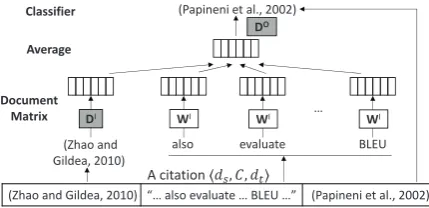
To model citations, we adopt the architecture in
Figure2. It is similar topv-dm, except that
docu-ments rather than words are predicted at the output
layer. For a citationds, C, dt, to allow context
wordsCinteracting with both vectors, we average
dIs ofdswith word vectors ofC, and make the
re-sulted vector predictive ofdO
t ofdt. Formally, for
all citationsC={ds, C, dt}, we aim to optimize
the following average log probability objective:
max DI,DO,WI
1
|C|
ds,C,dt∈C
logP(dt|ds, C) (1)
To model the probabilityP(dt|ds, C)wheredtis
cited indswithC, we average their IN vectors
x= 1
1 +|C|
dIs+
w∈C
wI
(2)
and usexto compose a multi-class softmax
clas-sifier on all OUT document vectors
P(dt|ds, C) =
exp(xdOt )
d∈Dexp(xdO)
(3)
To model contents’ impact on document vec-tors, we simply consider an additional objective
function that is identical topv-dm, i.e.,
enumer-ate words and contexts, and use the same input
ar-chitecture as Figure 2 to predict the OUT vector
of the current word. Such convenience owes to the fact that using two vectors makes the model
pa-rameters compatible with those ofpv-dm. Note
that combining the citation and content objectives leads to a joint learning framework. To facilitate easier and faster training, we adopt an
alterna-tive pre-training/fine-tuning orretrofitting
frame-work (Faruqui et al., 2015). We initialize with a
predefined number ofpv-dmiterations, and then
optimize Eq.1based on the initialization.
Dataset Docs Citations Years
NIPS
Train 1,590 512 Up to 1998
Test 150 89 1999
Total 1,740 601 Up to 1999
ACL
Train 18,845 91,792 Up to 2012
Test 1,563 16,937 2013
Total 20,408 108,729 Up to 2013
DBLP
Train 593,378 2,565,625 Up to 2009
Test 55,736 308,678 From 2010
[image:5.595.310.522.63.185.2]Total 649,114 2,874,303 All years
Table 3: The statistics of three datasets.
Finally, similar to w2v (Mikolov et al., 2013)
andd2v(Le and Mikolov,2014), to make training
efficient, we adopt negative sampling:
logσ(xdOt ) +
n
i=1
Edi∼PN(d)logσ(−xdOi )
(4)
and use it to replace every logP(dt|ds, C).
Fol-lowingHuang et al.(2015b), we adopt a uniform
distribution onDas the distributionPN(d).
Unlike the other models in Table1,h-d2v
sat-isfies all four criteria. We refer to the example in
Figure2to make the points clear. First, when
op-timizing Eq.1 with the instance in Figure 2, the
update to dO of Papineni et al. (2002) depends
on wI of context words such as “BLEU”.
Sec-ond, we pre-traindI with contents, which makes
the document embeddings content aware. Third,
newcomers can depend on their contents for dI,
and update their OUT vectors when they are
sam-pled3 in Eq.4. Finally, the optimization of Eq.1
enables mutual enhancement between vectors of
hyper-docs and context intent words,e.g.,
“evalu-ate by”. Under the background of a machine
trans-lation paper Zhao and Gildea (2010), the above
two words help point the citation to the BLEU
pa-per (Papineni et al.,2002), thus updating its OUT
vector. The intent “adopting tools/algorithms” of “evaluate by” is also better captured by iterating over many document pairs with them in between.
5 Experiments
In this section, we first introduce datasets and ba-sic settings used to learn embeddings. We then discuss additional settings and present
experimen-tal results of the two tasks,i.e.,document
classifi-cation and citation recommendation, respectively.
3
Model Original w/ DeepWalk
Macro Micro Macro Micro
DeepWalk 61.67 69.89 61.67 69.89
w2v (I) 10.83 41.84 31.06 50.93
w2v (I+O) 9.36 41.26 25.92 49.56
d2v-nc 70.62 77.86 70.64 78.06
d2v-cac 71.83 78.09 71.57 78.59
h-d2v (I) 68.81 76.33 73.96 79.93
h-d2v (I+O) 72.89 78.99 73.24 79.55
Table 4: F1scores on DBLP.
Model Content Aware/ Original w/ DeepWalk Newcomer Friendly Macro Micro Macro Micro
DeepWalk - 66.57 76.56 66.57 76.56
w2v (I) ×/× 19.77 47.32 59.80 72.90
w2v (I+O) ×/× 15.97 45.66 50.77 70.08
d2v-nc / 61.54 73.73 69.37 78.22
d2v-cac / 65.23 75.93 70.43 78.75
h-d2v (I) / 58.59 69.79 66.99 75.63
h-d2v (I+O) / 66.64 75.19 68.96 76.61
Table 5: F1on DBLP when newcomers are discarded.
5.1 Datasets and Experimental Settings
We use three datasets from the academic paper
do-main, i.e., NIPS4, ACL anthology5 and DBLP6,
as shown in Table3. They all contain full text of
papers, and are of small, medium, and large size,
respectively. We apply ParsCit7 (Councill et al.,
2008) to parse the citations and bibliography
sec-tions. Each identified citation string referring to a
paper in the same dataset,e.g.,[1] or (Author et al.,
2018), is replaced by a global paper id. Consecu-tive citations like [1, 2] are regarded as multiple ground truths occupying one position. Following
He et al.(2010), we take 50 words before and after
a citation as the citation context.
Gensim (Reh˚uˇrek and Sojkaˇ , 2010) is used to
implement allw2v andd2v baselines as well as
h-d2v. We usecbowforw2vandpv-dbowfor
d2v, unless otherwise noted. For all three
base-lines, we set the (half) context window length to
50. For w2v, d2v, and the pv-dm-based
ini-tialization of h-d2v, we run 5 epochs following
Gensim’s default setting. Forh-d2v, its iteration
is set to 100 epochs with 1000 negative samples.
The dimension sizekof all approaches is 100. All
other parameters in Gensim are kept as default.
5.2 Document Classification
In this task, we classify the research fields of pa-pers given their vectors learned on DBLP. To
ob-tain labels, we use Cora8, a small dataset of
Com-puter Science papers and their field categories. We keep the first levels of the original categories,
4https://cs.nyu.edu/ roweis/data.html
5http://clair.eecs.umich.edu/aan/index.php (2013 release) 6
http://zhou142.myweb.cs.uwindsor.ca/academicpaper.html This page has been unavailable recently. They provide a larger CiteSeer dataset and a collection of DBLP paper ids. To better interpret results from the Computer Science perspective, we intersect them and obtain the DBLP dataset.
7
https://github.com/knmnyn/ParsCit
8
http://people.cs.umass.edu/˜mccallum/data.html
e.g., “Artificial Intelligence” of “Artificial
Intelli-gence - Natural Language Processing”, leading to 10 unique classes. We then intersect the dataset with DBLP, and obtain 5,975 labeled papers.
For w2v and h-d2v outputing both IN and OUT document vectors, we use IN vectors or con-catenations of both vectors as features. For
new-comer papers without w2v vectors, we use zero
vectors instead. To enrich the features with net-work structure information, we also try
concate-nating them with the output of DeepWalk (Perozzi
et al.,2014), a representative network embedding
model. The model is trained on the citation
net-work of DBLP with an existing implementation9
and default parameters. An SVM classifier with RBF kernel is used. We perform 5-fold cross
vali-dation, and report Macro- and Micro-F1scores.
5.2.1 Classification Performance
In Table 4, we demonstrate the classification
re-sults. We have the following observations. First, adding DeepWalk information almost al-ways leads to better classification performance,
except for Macro-F1of thed2v-cacapproach.
Second, owning to different context awareness,
d2v-cac consistently outperforms d2v-nc in terms of all metrics and settings.
Third,w2vhas the worst performance. The
rea-son may be thatw2vis neither content aware nor
newcomer friendly. We will elaborate more on the
impacts of the two properties in Section5.2.2.
Finally, no matter whether DeepWalk vectors
are used, h-d2v achieves the best F1 scores.
However, when OUT vectors are involved,h-d2v
with DeepWalk has slightly worse performance.
A possible explanation is that, when h-d2v IN
and DeepWalk vectors have enough information to train the SVM classifiers, adding another 100 fea-tures (OUT vectors) only increase the parameter
9
Model NIPS ACL Anthology DBLP
Rec MAP MRR nDCG Rec MAP MRR nDCG Rec MAP MRR nDCG
w2v (cbow, I4I) 5.06 1.29 1.29 2.07 12.28 5.35 5.35 6.96 3.01 1.00 1.00 1.44
w2v (cbow, I4O) 12.92 6.97 6.97 8.34 15.68 8.54 8.55 10.23 13.26 7.29 7.33 8.58
d2v-nc (pv-dbow, cosine) 14.04 3.39 3.39 5.82 21.09 9.65 9.67 12.29 7.66 3.25 3.25 4.23
d2v-cac (same as d2v-nc) 14.61 4.94 4.94 7.14 28.01 11.82 11.84 15.59 15.67 7.34 7.36 9.16
NPM (Huang et al.,2015b) 7.87 2.73 3.13 4.03 12.86 5.98 5.98 7.59 6.87 3.28 3.28 4.07
h-d2v (random init, I4O) 3.93 0.78 0.78 1.49 30.98 16.76 16.77 20.12 17.22 8.82 8.87 10.65
h-d2v (pv-dm retrofitting, I4O) 15.73 6.68 6.68 8.80 31.93 17.33 17.34 20.76 21.32 10.83 10.88 13.14
Table 6: Top-10 citation recommendation results (dimension sizek= 100).
space of the classifiers and the training variance.
Forw2v with or without DeepWalk, it is also the
case. This may be because information inw2v’s
IN and OUT vectors is fairly redundant.
5.2.2 Impacts of Content Awareness and Newcomer Friendliness
Because content awareness and newcomer
friend-liness are highly correlated in Table 1, to isolate
and study their impacts, we decouple them as fol-lows. In the 5,975 labeled papers, we keep 2,052 with at least one citation, and redo experiments in
Table 4. By carrying out such controlled
exper-iments, we expect to remove the impact of new-comers, and compare all approaches only with
re-spect to different content awareness. In Table 5,
we provide the new scores obtained.
By comparing Tables4and5, we observe that
w2vbenefits from removing newcomers with zero
vectors, while all newcomer friendly approaches get lower scores because of fewer training
exam-ples. Even though the change, w2v still cannot
outperform the other approaches, which reflects the positive impact of content awareness on the classification task. It is also interesting that Deep-Walk becomes very competitive. This implies that structure-based methods favor networks with
bet-ter connectivity. Finally, we note that Table 5is
based on controlled experiments with intentionally skewed data. The results are not intended for com-parison among approaches in practical scenarios.
5.3 Citation Recommendation
When writing papers, it is desirable to recommend proper citations for a given context. This could be achieved by comparing the vectors of the context and previous papers. We use all three datasets for this task. Embeddings are trained on papers before 1998, 2012, and 2009, respectively. The remain-ing papers in each dataset are used for testremain-ing.
We compareh-d2vwith all approaches in
Sec-tion 4.2, as well as NPM10 (Huang et al.,2015b)
mentioned in Section2, the first embedding-based
approach for the citation recommendation task. Note that the inference stage involves interactions between word and document vectors and is non-trivial. We describe our choices as below.
First, for w2v vectors, Nalisnick et al. (2016)
suggest that the IN-IN similarity favors word pairs
with similar functions (e.g., “red” and “blue”),
while the IN-OUT similarity characterizes word
co-occurrence or compatibility (e.g., “red” and
“bull”). For citation recommendation that relies on the compatibility between context words and cited papers, we hypothesize that the IN-for-OUT (or I4O for short) approach will achieve better results.
Therefore, forw2v-based approaches, we average
IN vectors of context words, then score and and rank OUT document vectors by dot product.
Second, ford2v-based approaches, we use the
learned model to infer a document vector d for
the context words, and usedto rank IN document
vectors by cosine similarity. Among multiple at-tempts, we find this choice to be optimal.
Third, for h-d2v, we adopt the same scoring
and ranking configurations as forw2v.
Finally, for NPM, we adopt the same ranking
strategy as in Huang et al. (2015b). Following
them, we focus on top-10 results and report the Recall, MAP, MRR, and nDCG scores.
5.3.1 Recommendation Performance
In Table6, we report the citation recommendation
results. Our observations are as follows.
First, among all datasets, all methods perform relatively well on the medium-sized ACL dataset. This is because the smallest NIPS dataset provides
10Note that the authors usedn = 1000for negative
100 200 300 400 500 Dimension
5 10 15 20 25 30
Rec@10 (%)
[image:8.595.95.267.60.187.2]w2v (I4O) d2v-nc d2v-cac NPM h-d2v
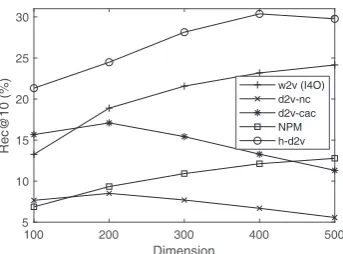
Figure 3: Varyingkon DBLP. The scores ofw2v
keeps increasing to 26.63 atk = 1000, and then
begins to drop. Although at the cost of a larger model and longer training/inference time, it still
cannot outperformh-d2vof 30.37 atk= 400.
too few citation contexts to train a good model. Moreover, DBLP requires a larger dimension size
kto store more information in the embedding
vec-tors. We increasekand report the Rec@10 scores
in Figure3. We see that all approaches have
bet-ter performance whenkincreases to 200, though
d2v-based ones start to drop beyond this point.
Second, the I4I variant of w2v has the worst
performance among all approaches. This
obser-vation validates our hypothesis in Section5.3.
Third, the d2v-cacapproach outperforms its
variantd2v-ncin terms of all datasets and
met-rics. This indicates that context awareness matters in the citation recommendation task.
Fourth, the performance of NPM is sandwiched
between those of w2v’s two variants. We have
tried our best to reproduce it. Our explanation is that NPM is citation-as-word-based, and only de-pends on citation contexts for training. Therefore, it is only context aware but neither content aware
nor newcomer friendly, and behaves likew2v.
Finally, when retrofittingpv-dm,h-d2v
gen-erally has the best performance. When we substi-tutepv-dmwith random initialization, the perfor-mance is deteriorated by varying degrees on differ-ent datasets. This implies that contdiffer-ent awareness is also important, if not so important than context awareness, on the citation recommendation task.
5.3.2 Impact of Newcomer Friendliness
Table7analyzes the impact of newcomer
friendli-ness. Opposite from what is done in Section5.2.2,
we only evaluate on testing examples where at least a ground-truth paper is a newcomer. Please note that newcomer unfriendly approaches do not
Model Newcomer
Friendly Rec MAP MRR nDCG
w2v (I4O) × 3.64 3.23 3.41 2.73
NPM × 1.37 1.13 1.15 0.92
d2v-nc 6.48 3.52 3.54 3.96
d2v-cac 8.16 5.13 5.24 5.21
h-d2v 6.41 4.95 5.21 4.49
Table 7: DBLP results evaluated on 63,342 cita-tion contexts with newcomer ground-truth.
Category Description
Weak Weakness of cited approach
CoCoGM Contrast/Comparison in Goals/Methods (neutral)
CoCo- Work stated to be superior to cited work
CoCoR0 Contrast/Comparison in Results (neutral) CoCoXY Contrast between 2 cited methods
PBas Author uses cited work as basis or starting point
PUse Author uses tools/algorithms/data/definitions
PModi Author adapts or modifies tools/algorithms/data
PMot This citation is positive about approach used or
problem addressed (used to motivate work in cur-rent paper)
PSim Author’s work and cited work are similar
PSup Author’s work and cited work are
compati-ble/provide support for each other
Neut Neutral description of cited work, or not enough
textual evidence for above categories, or unlisted citation function
Table 8: Annotation scheme of citation functions
inTeufel et al.(2006).
necessarily get zero scores. The table shows that newcomer friendly approaches are superior to
un-friendly ones. Note that, like Table5, this table is
also based on controlled experiments and not in-tended for comparing approaches.
5.3.3 Impact of Context Intent Awareness
In this section, we analyze the impact of context
intent awareness. We use Teufel et al. (2006)’s
2,824 citation contexts11 with annotated citation
functions, e.g., emphasizing weakness (Weak) or
using tools/algorithms (PBas) of the cited papers.
Table8fromTeufel et al.(2006) describes the full
annotating scheme. Teufel et al.(2006) also use
manual features to evaluate citation function clas-sification. To test all models on capturing con-text intents, we average all concon-text words’ IN vec-tors (trained on DBLP) as features. Noticing that
pv-dbowdoes not output IN word vectors, and OUT vectors do not provide reasonable results, we usepv-dmhere instead. We use SVM with RBF
11The number is 2,829 in the original paper. The
[image:8.595.309.523.65.151.2] [image:8.595.307.527.205.401.2]Query and Ground Truth Result Ranking ofw2v Result Ranking ofd2v-cac Result Ranking ofh-d2v
. . . We also evaluate our model by computing the machine trans-lation BLEU score (Papineni et al., 2002) using the Moses system (Koehn et al.,2007). . .
(Papineni et al.,2002)BLEU: a Method for Automatic Evalua-tion of Machine TranslaEvalua-tion (Koehn et al., 2007) Moses: Open Source Toolkit for Sta-tistical Machine Translation
1. HMM-Based Word Alignment in Statistical Translation
2. Indirect-HMM-based Hypothe-sis Alignment for Combining Outputs from Machine Translation Systems 3. The Alignment Template Approach to Statistical Machine Translation
. . .
9. Moses: Open Source Toolkit for Statistical Machine Translation 57.BLEU: a Method for Automatic Evaluation of Machine Translation
1. Discriminative Reranking for Ma-chine Translation
2. Learning Phrase-Based Head Trans-duction Models for Translation of Spo-ken Utterances
3. Cognates Can Improve Statistical Translation Models
. . .
6. BLEU: a Method for Automatic Evaluation of Machine Translation 29. Moses: Open Source Toolkit for Statistical Machine Translation
1. BLEU: a Method for Au-tomatic Evaluation of Machine Translation
2. Statistical Phrase-Based Translation
3. Improved Statistical Align-ment Models
[image:9.595.79.524.63.178.2]4. HMM-Based Word Align-ment in Statistical Translation 5.Moses: Open Source Toolkit for Statistical Machine Trans-lation
Table 9: Papers recommended by different approaches for a citation context inZhao and Gildea(2010).
Weak
CoCoGMCoCoR0CoCo-CoCoXY PBas PUse PModi PMot PSim PSup Neut
0 20 40 60 80 100
F1
(%)
[image:9.595.312.520.219.318.2]EMNLP'06 (Macro: 57.00 Micro: 77.00) w2v (Macro: 44.86 Micro: 74.43) d2v-cac (Macro: 24.19 Micro: 70.64) h-d2v (Macro: 54.37 Micro: 75.39)
Figure 4: F1of citation function classification.
kernels and default parameters. FollowingTeufel
et al.(2006), we use 10-fold cross validation.
Figure4depicts the F1scores. Scores ofTeufel
et al.(2006)’s approach are from the original
pa-per. We omitd2v-ncbecause it is very inferior to
d2v-cac. We have the following observations.
First,Teufel et al.(2006)’s
feature-engineering-based approach has the best performance. Note that we cannot obtain their original cross valida-tion split, so the comparison may not be fair and is only for consideration in terms of numbers.
Second, among all embedding-based methods,
h-d2vhas the best citation function classification
results, which is close toTeufel et al.(2006)’s.
Finally, thed2v-cacvectors are only good at
Neutral, the largest class. On the other classes and
global F1, they are outperformed byw2vvectors.
To study how citation function affects citation recommendation, we combine the 2,824 labeled citation contexts and another 1,075 labeled con-texts the authors published later to train an SVM, and apply it to the DBLP testing set to get cita-tion funccita-tions. We evaluate citacita-tion
recommenda-tion performance of w2v (I4O), d2v-cac, and
h-d2v on a per-citation-function basis. In
Fig-ure5, we break down Rec@10 scores on citation
functions. On the six largest classes (marked by
solid dots),h-d2voutperforms all competitors.
100 102 104 106
Count
Weak
CoCoGMCoCoR0CoCo-CoCoXY PBas PUse PModi PMot PSim PSup Neut
10 20 30 40
Rec@10 (%)
[image:9.595.85.282.221.329.2]w2v d2v-cac h-d2v Category Size
Figure 5: Rec@10 w.r.t. citation functions.
To better investigate the impact of context intent
awareness, Table9shows recommended papers of
the running example of this paper. Here,Zhao and
Gildea (2010) cited the BLEU metric (Papineni
et al.,2002) and Moses tools (Koehn et al.,2007)
of machine translation. However, the additional
words “machine translation” lead both w2v and
d2v-cacto recommend many machine
transla-tion papers. Only ourh-d2vmanages to
recog-nize the citation function “using tools/algorithms (PBas)”, and concentrates on the citation intent to return the right papers in top-5 results.
6 Conclusion
We focus on the hyper-doc embedding problem. We propose that hyper-doc embedding algorithms should be content aware, context aware, new-comer friendly, and context intent aware. To meet all four criteria, we propose a general approach,
hyperdoc2vec, which assigns two vectors to each hyper-doc and models citations in a straight-forward manner. In doing so, the learned embed-dings satisfy all criteria, which no existing model is able to. For evaluation, paper classification and citation recommendation are conducted on three academic paper datasets. Results confirm the ef-fectiveness of our approach. Further analyses also demonstrate that possessing the four properties
References
Matthew Berger, Katherine McDonough, and Lee M. Seversky. 2017. cite2vec: Citation-driven document exploration via word embeddings. IEEE Trans. Vis. Comput. Graph.23(1):691–700.
David A. Cohn and Thomas Hofmann. 2000. The missing link - A probabilistic model of document content and hypertext connectivity. InAdvances in Neural Information Processing Systems 13, Papers from Neural Information Processing Systems (NIPS) 2000. pages 430–436.
Isaac G. Councill, C. Lee Giles, and Min-Yen Kan. 2008. Parscit: an open-source CRF reference string parsing package. In Proceedings of the Interna-tional Conference on Language Resources and Eval-uation, LREC 2008.
Silviu Cucerzan. 2007. Large-scale named entity dis-ambiguation based on wikipedia data. In EMNLP-CoNLL 2007, Proceedings of the 2007 Joint Con-ference on Empirical Methods in Natural Language Processing and Computational Natural Language Learning. pages 708–716.
Travis Ebesu and Yi Fang. 2017. Neural citation net-work for context-aware citation recommendation. In Proceedings of the 40th International ACM SIGIR Conference on Research and Development in Infor-mation Retrieval. pages 1093–1096.
Wei Fang, Jianwen Zhang, Dilin Wang, Zheng Chen, and Ming Li. 2016. Entity disambiguation by knowledge and text jointly embedding. In Proceed-ings of the 20th SIGNLL Conference on Computa-tional Natural Language Learning, CoNLL 2016. pages 260–269.
Manaal Faruqui, Jesse Dodge, Sujay Kumar Jauhar, Chris Dyer, Eduard H. Hovy, and Noah A. Smith. 2015. Retrofitting word vectors to semantic lexi-cons. InNAACL HLT 2015, The 2015 Conference of the North American Chapter of the Association for Computational Linguistics: Human Language Tech-nologies. pages 1606–1615.
Evgeniy Gabrilovich and Shaul Markovitch. 2007. Computing semantic relatedness using wikipedia-based explicit semantic analysis. In IJCAI 2007, Proceedings of the 20th International Joint Confer-ence on Artificial IntelligConfer-ence. pages 1606–1611.
Soumyajit Ganguly and Vikram Pudi. 2017. Pa-per2vec: Combining graph and text information for scientific paper representation. In Advances in In-formation Retrieval - 39th European Conference on IR Research, ECIR 2017. pages 383–395.
Aditya Grover and Jure Leskovec. 2016. node2vec: Scalable feature learning for networks. In Proceed-ings of the 22nd ACM SIGKDD International Con-ference on Knowledge Discovery and Data Mining. pages 855–864.
Qi He, Jian Pei, Daniel Kifer, Prasenjit Mitra, and C. Lee Giles. 2010. Context-aware citation recom-mendation. InProceedings of the 19th International Conference on World Wide Web, WWW 2010. pages 421–430.
Zhengyan He, Shujie Liu, Mu Li, Ming Zhou, Longkai Zhang, and Houfeng Wang. 2013. Learning entity representation for entity disambiguation. In Pro-ceedings of the 51st Annual Meeting of the Associa-tion for ComputaAssocia-tional Linguistics, ACL 2013, Vol-ume 2: Short Papers. pages 30–34.
Hongzhao Huang, Larry P. Heck, and Heng Ji. 2015a. Leveraging deep neural networks and knowledge graphs for entity disambiguation. CoRR abs/1504.07678.
Wenyi Huang, Saurabh Kataria, Cornelia Caragea, Prasenjit Mitra, C. Lee Giles, and Lior Rokach. 2012. Recommending citations: translating papers into references. In21st ACM International Confer-ence on Information and Knowledge Management, CIKM’12. pages 1910–1914.
Wenyi Huang, Zhaohui Wu, Liang Chen, Prasenjit Mi-tra, and C. Lee Giles. 2015b. A neural probabilistic model for context based citation recommendation. In Proceedings of the Twenty-Ninth AAAI Confer-ence on Artificial IntelligConfer-ence. pages 2404–2410.
Saurabh Kataria, Prasenjit Mitra, and Sumit Bhatia. 2010. Utilizing context in generative bayesian mod-els for linked corpus. InProceedings of the Twenty-Fourth AAAI Conference on Artificial Intelligence, AAAI 2010.
Philipp Koehn, Hieu Hoang, Alexandra Birch, Chris Callison-Burch, Marcello Federico, Nicola Bertoldi, Brooke Cowan, Wade Shen, Christine Moran, Richard Zens, Chris Dyer, Ondrej Bojar, Alexandra Constantin, and Evan Herbst. 2007. Moses: Open source toolkit for statistical machine translation. In ACL 2007, Proceedings of the 45th Annual Meeting of the Association for Computational Linguistics.
Quoc V. Le and Tomas Mikolov. 2014. Distributed rep-resentations of sentences and documents. In Pro-ceedings of the 31th International Conference on Machine Learning, ICML 2014. pages 1188–1196.
Qing Lu and Lise Getoor. 2003. Link-based classifi-cation. In Machine Learning, Proceedings of the Twentieth International Conference (ICML 2003). pages 496–503.
Eric T. Nalisnick, Bhaskar Mitra, Nick Craswell, and Rich Caruana. 2016. Improving document ranking with dual word embeddings. InProceedings of the 25th International Conference on World Wide Web, WWW 2016, Companion Volume. pages 83–84.
Lawrence Page, Sergey Brin, Rajeev Motwani, and Terry Winograd. 1999. The pagerank citation rank-ing: Bringing order to the web. .
Kishore Papineni, Salim Roukos, Todd Ward, and Wei-Jing Zhu. 2002. Bleu: a method for automatic eval-uation of machine translation. InProceedings of the 40th Annual Meeting of the Association for Compu-tational Linguistics. pages 311–318.
Bryan Perozzi, Rami Al-Rfou, and Steven Skiena. 2014. Deepwalk: online learning of social repre-sentations. InThe 20th ACM SIGKDD International Conference on Knowledge Discovery and Data Min-ing, KDD ’14. pages 701–710.
Radim ˇReh˚uˇrek and Petr Sojka. 2010. Software Frame-work for Topic Modelling with Large Corpora. In Proceedings of the LREC 2010 Workshop on New Challenges for NLP Frameworks. ELRA, Valletta,
Malta, pages 45–50. http://is.muni.cz/
publication/884893/en.
Wei Shen, Jianyong Wang, and Jiawei Han. 2015. En-tity linking with a knowledge base: Issues, tech-niques, and solutions. IEEE Trans. Knowl. Data Eng.27(2):443–460.
Kazunari Sugiyama and Min-Yen Kan. 2010. Schol-arly paper recommendation via user’s recent re-search interests. InProceedings of the 2010 Joint In-ternational Conference on Digital Libraries, JCDL 2010. pages 29–38.
Yaming Sun, Lei Lin, Duyu Tang, Nan Yang, Zhen-zhou Ji, and Xiaolong Wang. 2015. Modeling mtion, context and entity with neural networks for en-tity disambiguation. InProceedings of the Twenty-Fourth International Joint Conference on Artificial Intelligence, IJCAI 2015. pages 1333–1339.
Jian Tang, Meng Qu, and Qiaozhu Mei. 2015a. PTE: predictive text embedding through large-scale het-erogeneous text networks. In Proceedings of the 21th ACM SIGKDD International Conference on Knowledge Discovery and Data Mining. pages 1165–1174.
Jian Tang, Meng Qu, Mingzhe Wang, Ming Zhang, Jun Yan, and Qiaozhu Mei. 2015b. LINE: large-scale information network embedding. InProceedings of the 24th International Conference on World Wide Web, WWW 2015. pages 1067–1077.
Jie Tang and Jing Zhang. 2009. A discriminative ap-proach to topic-based citation recommendation. In Advances in Knowledge Discovery and Data Min-ing, 13th Pacific-Asia Conference, PAKDD 2009. pages 572–579.
Simone Teufel, Advaith Siddharthan, and Dan Tidhar. 2006. Automatic classification of citation function. In EMNLP 2007, Proceedings of the 2006 Confer-ence on Empirical Methods in Natural Language Processing. pages 103–110.
Cunchao Tu, Weicheng Zhang, Zhiyuan Liu, and Maosong Sun. 2016. Max-margin deepwalk: Dis-criminative learning of network representation. In Proceedings of the Twenty-Fifth International Joint Conference on Artificial Intelligence, IJCAI 2016. pages 3889–3895.
Suhang Wang, Jiliang Tang, Charu C. Aggarwal, and Huan Liu. 2016. Linked document embedding for classification. InProceedings of the 25th ACM In-ternational Conference on Information and Knowl-edge Management, CIKM 2016. pages 115–124.
Ikuya Yamada, Hiroyuki Shindo, Hideaki Takeda, and Yoshiyasu Takefuji. 2016. Joint learning of the em-bedding of words and entities for named entity dis-ambiguation. In Proceedings of the 20th SIGNLL Conference on Computational Natural Language Learning, CoNLL 2016. pages 250–259.
Cheng Yang, Zhiyuan Liu, Deli Zhao, Maosong Sun, and Edward Y. Chang. 2015. Network representa-tion learning with rich text informarepresenta-tion. In Proceed-ings of the Twenty-Fourth International Joint Con-ference on Artificial Intelligence, IJCAI 2015. pages 2111–2117.
Shaojun Zhao and Daniel Gildea. 2010. A fast fertil-ity hidden markov model for word alignment using MCMC. InProceedings of the 2010 Conference on Empirical Methods in Natural Language Process-ing, EMNLP 2010. pages 596–605.