201
Task-oriented Dialogue System for Automatic Diagnosis
Qianlong Liu1, Zhongyu Wei1*, Baolin Peng2, Xiangying Dai3, Huaixiao Tou1, Ting Chen1, Xuanjing Huang4, Kam-fai Wong2,5
1School of Data Science, Fudan University, China 2The Chinese University of Hong Kong, Hong Kong
3Baidu Inc., China
4School of Computer Science, Fudan University, China 5MoE Key Lab of High Confidence Software Technologies, China
{17210980040,zywei,17210980013,17210980029}@fudan.edu.cn {blpeng, kfwong}@se.cuhk.edu.hk
[email protected] [email protected]
Abstract
In this paper, we make a move to build a dialogue system for automatic diagno-sis. We first build a dataset collected from an online medical forum by extracting symptoms from both patients’ self-reports and conversational data between patients and doctors. Then we propose a task-oriented dialogue system framework to make the diagnosis for patients automat-ically, which can converse with patients to collect additional symptoms beyond their self-reports. Experimental results on our dataset show that additional symptoms ex-tracted from conversation can greatly im-prove the accuracy for disease identifica-tion and our dialogue system is able to collect these symptoms automatically and make a better diagnosis.
1 Introduction
Automatic phenotype identification using elec-tronic health records (EHRs) has been a rising topic in recent years (Shivade et al., 2013). Re-searchers explore with various machine learning approaches to identify symptoms and diseases for patients given multiple types of information (both numerical data and pure texts). Experimental re-sults prove the effectiveness of the identification of heart failure (Jonnalagadda et al., 2017; Choi et al.,2016), type 2 diabetes (Li et al.,2015;Zheng et al., 2017), autism spectrum disorders ( Doshi-Velez et al.,2014), infection detection (Tou et al.,
2018) etc. Currently, most attempts focus on some *Corresponding author
specific types of diseases and it is difficult to trans-fer models from one disease to another.
In general, each EHR contains multiple types of data, including personal information, admission note, diagnose tests, vital signs and medical im-age. And it is collected accumulatively following a diagnostic procedure in clinic, which involves in-teractions between patients and doctors and some complicated medical tests. Therefore, it is very expensive to collect EHRs for different diseases. How to collect the information from patient auto-matically remains the challenge for automatic di-agnosis.
Recently, due to its promising potentials and alluring commercial values, research about task-oriented dialogue system (DS) has attracted in-creasing attention in different domains, including ticket booking (Li et al.,2017;Peng et al.,2017a), online shopping (Yan et al.,2017) and restaurant searching (Wen et al.,2017). We believe that ap-plying DS in the medical domain has great poten-tial to reduce the cost of collecting data from pa-tients.
However, there is a gap to fill for applying DS in disease identification. There are basically two ma-jor challenges. First, the lack of annotated med-ical dialogue dataset. Second, no available DS framework for disease identification. By address-ing these two problems, we make the first move to build a dialogue system facilitating automatic information collection and diagnosis making for medical domain. Contributions are two-fold:
doctors.
• We propose a reinforcement learning based framework for medical DS. Experiment re-sults on our dataset show that our dialogue system is able to collect symptoms from pa-tients via conversation and improve the accu-racy for automatic diagnosis.
2 Dataset for Medical DS
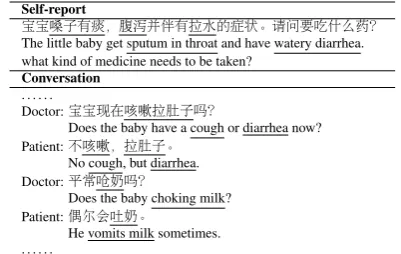
Our dataset is collected from the pediatric depart-ment in a Chinese online healthcare community1. It is a popular website for users to inquire with doctors online. Usually, a patient would provide a piece of self-report presenting his/her basic condi-tions. Then a doctor will initialize a conversation to collect more information and make a diagno-sis based on both the self-report and the conversa-tional data. An example is shown in Table1. As we can see, the doctor can obtain additional symp-toms during conversation beyond the self-report. For each patient, we can also obtain the final di-agnosis from doctors as the label. For clarity, we term symptoms from self-reports asexplicit symp-tomswhile those from conversational data as im-plicit symptoms.
We choose four types of diseases for annota-tion, including upper respiratory infecannota-tion, chil-dren functional dyspepsia, infantile diarrhea and children’s bronchitis. We invite three annotators (one with medical background) to label all the symptom phrases in both self-reports and conver-sational data. The annotation is performed in two steps, namely symptom extraction and symptom normalization.
Symptom Extraction We follow the BIO (begin-in-out) schema for symptom identification (Figure 1). Each Chinese character is assigned a label of ”B”, ”I” or ”O”. Also, each extracted symptom expression is tagged withTrueorFalse
indicating whether the patient suffers from this symptom or not. In order to improve the anno-tation agreement between annotators, we create two guidelines for the self-report and the conver-sational data respectively. Each record is anno-tated by at least two annotators. Any inconsis-tency would be further judged by the third one. The Cohen’s kappa coefficient between two anno-tators are 71%and67%for self-reports and con-versations respectively.
1http://muzhi.baidu.com
Self-report
宝宝嗓子有痰,腹泻并伴有拉水的症状。请问要吃什么药? The little baby get sputum in throat and have watery diarrhea. what kind of medicine needs to be taken?
Conversation
. . . .
Doctor:宝宝现在咳嗽拉肚子吗?
Doctor:Does the baby have a cough or diarrhea now? Patient:不咳嗽,拉肚子。
Patient:No cough, but diarrhea. Doctor:平常呛奶吗?
Doctor:Does the baby choking milk? Patient:偶尔会吐奶。
Patient:He vomits milk sometimes. . . . .
Table 1: An example of a user record. Each record consists of two parts: self-report from the patient and the conversation between the doctor and the patient. Underlined phrases are symptom expres-sions.
Extracted symptom expression Related concept in SNOMED CT
咳嗽(cough) 咳嗽(cough)
喷嚏(sneez) 打喷嚏(sneezing)
鼻涕(cnot) 鼻流涕(cnot) 拉肚子(have loose bowels) 腹泻(diarrhea)
温度37.5-37.7之间(body tempera-ture between 37.5-37.7)
[image:2.595.315.516.62.189.2]低热(low-grade fever)
Table 2: Examples of extracted symptom expres-sions and the related concepts in SNOMED CT.
Symptom Normalization After symptom ex-pression identification, medical experts manually link each symptom expression to the most rele-vant concept on SNOMED CT 2 for normaliza-tion. Table 2 shows some phrases that describe symptoms in the example and some related con-cepts in SNOMED CT. The overview of dataset is presented in Table3.
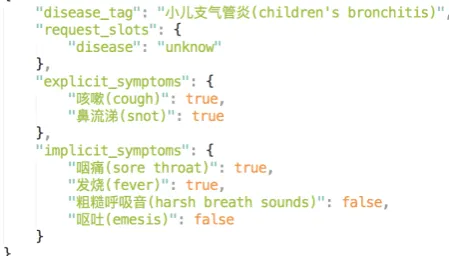
After symptom extraction and normalization, there are144unique symptoms identified. In or-der to reduce the size of action space of the DS, only 67 symptoms with a frequency greater than or equal to10 are kept. Samples are then gener-ated, calleduser goal. As we know, each user goal (see Figure2) is derived from one real world pa-tient record3.
3 Proposed Framework
A task-oriented DS typically contains three com-ponents, namely Natural Language Understanding (NLU), Dialogue Manager (DM) and Natural Lan-guage Generation (NLG). NLU detects the user intent and slots with values from utterances; DM
2
https://www.snomed.org/snomed-ct 3The dataset is available at:
Figure 1: An example utterance with annotations of symptoms in BIO format.
Disease ] of
user goal
Ave]of ex-plicit symp-toms
Ave]of im-plicit symp-toms
infantile diarrhea 200 2.15 2.71 children functional dyspepsia 150 1.70 3.20 upper respiratory infection 160 2.56 3.55 children’s bronchitis 200 2.87 3.64
Table 3: Overview of the dataset. ]of user goal is the number of dialogue sessions of each disease, Ave]of explicit symptoms and Ave] of implicit symptoms are the average number of explicit and implicit symptoms among user goals respectively.
tracks the dialogue states and takes system actions; NLG generates natural language given the system actions. In this work, we focus on the DM for au-tomatic diagnosis consisting of two sub-modules, namely, dialogue state tracker (DST) and policy learning. Both NLU and NLG are implemented with template-based models. Typically, a user simulator is designed to interact with the dialogue system (Liu et al., 2017; Peng et al., 2017b; Su et al.,2016;Schatzmann et al.,2006). We follow the same setting as Li et al. (2017) to design our medical DS. At the beginning of a dialogue ses-sion, the user simulator samples a user goal (see Figure2), while the agent attempts to make a di-agnosis for the user. The system will learn to se-lect the best response action at each time step by maximizing a long term reward.
3.1 User Simulator
At the beginning of each dialogue session, a user simulator samples a user goal from the experiment dataset. At each turn t, the user takes an action
au,taccording to the current user statesu,tand the previous agent action at−1, and transits into the
next user statesu,t+1. In practice, the user statesu
is factored into an agenda A (Schatzmann et al.,
2007) and a goalG, noted assu = (A, G).
Dur-ing the course of the dialogue, the goalGensures that the user behaves in a consistent, goal-oriented manner. And the agenda contains a list of symp-toms and their status (whether or not they are re-quested) to track the progress of the conversation. Every dialogue session is initiated by the user
Figure 2: An example of user goal. Each user goal consists of four parts,disease tagis the dis-ease that the user suffers; explicit symptoms are symptoms extracted from the user self-report; im-plicit symptomsare symptoms extracted from the conversational data between the patient and the doctor; request slots is the disease slot that the user would request.
via the user actionau,1 which consists of the
re-quested disease slot and all explicit symptoms. In terms of the symptom requested by the agent during the course of the dialogue, the user will take one of the three actions including True (if the symptom is positive), False (if the symptom is negative), and not sure (if the symptom is not mentioned in the user goal). If the agent informs correct disease, the dialogue session will be termi-nated as successful by the user. Otherwise, the di-alogue session will be recognized as failed if the agent makes incorrect diagnosis or the dialogue turn reaches the maximum dialogue turnT.
3.2 Dialogue Policy Learning
Markov Decision Process Formulation for Au-tomatic Diagnosis We cast DS as Markov De-cision Process (MDP) (Young et al., 2013) and train the dialogue policy via reinforcement learn-ing (Cuayahuitl et al., 2015). An MDP is com-posed of states, actions, rewards, policy, and tran-sitions.
symp-toms are 0. Each states∈Sis the concatenation of these four vectors.
Actions A. An action a ∈ A is composed of a dialogue act (e.g., inform, request, denyand
confirm) and a slot (i.e., normalized symptoms or a special slot disease). In addition, thanks and
close dialogueare also two actions.
Transition T. The transition from st to st+1
is the updating of state st based on the agent ac-tionat, the previous user actionau,t−1and the step
timet.
RewardR. The rewardrt+1 =R(st, at)is the
immediate reward at step time t after taking the actionat, also known as reinforcement.
Policy π. The policy describes the behaviors of an agent, which takes the state st as input
and outputs the probability distribution over all possible actionsπ(at|st).
Learning with DQN In this paper, the pol-icy is parameterized with a deep Q-network (DQN) (Mnih et al.,2015), which takes the state
stas input and outputs Q(st, a;θ) for all actions
a. A Q-network can be trained by updating the parameters θi at iteration i to reduce the
mean squared error between the Q-value com-puted from the current network Q(s, a|θi) and the Q-value obtained from the Bellman equation
yi =r+γmaxa0Q(s0, a0|θ−
i ), whereQ(s0, a0|θ − i )
is the target network with parameters θ−i from some previous iteration. In practice, the behavior distribution is often selected by an-greedy policy that takes an action a = arg maxa0Q(st, a0;θ)
with probability 1 − and selects a random action with probability , which can improve the efficiency of exploration. When training the policy, we use a technique known as experience replay. We store the agent’s experiences at each time-step, et = (st, at, rt, st+1) in a fixed size, queue-like bufferD.
In a simulation epoch, the current DQN network is updated multiple times (depending on the batch size and the current size of replay buffer) with dif-ferent batches drawn randomly from the buffer, while the target DQN network is fixed during the updating of current DQN network. At the end of each epoch, the target network is replaced by the current network and the current network is evalu-ated on training set. The buffer will be flushed if the current network performs better than all previ-ous versions.
4 Experiments and Results
4.1 Experimental Setup
The max dialogue turnT is22. A positive reward of+44 is given to the agent at the end of a suc-cess dialogue, and a−22reward is given to a fail-ure one. We apply a step penalty of−1for each turn to encourage shorter dialogues. The dataset is divided into two parts: 80%for training with568
user goals and20%for testing with142user goals. The of-greedy strategy is set to 0.1for effec-tive action space exploration and theγin Bellman equation is0.9. The size of bufferDis10000and the batch size is 30. And the neural network of DQN is a single layer network. The learning rate is 0.001. Each simulation epoch consists of 100
dialogue sessions and the current network is eval-uated on500dialogue sessions at the end of each epoch. Before training, the buffer is pre-filled with the experiences of the rule-based agent (see below) to warm start our dialogue system.
To evaluate the performance of the proposed framework, we compare our model with baselines in terms of three evaluation metrics following Li et al. (2017) and Peng at al. (2017a;2017b), namely, success rate, average reward and the average num-ber of turns per dialogue session. As for classifi-cation models, we use accuracy as the metric.
The baselines include: (1) SVM: This model treats the automatic diagnosis as a multi-class clas-sification problem. It takes one-hot representation of symptoms in the user goal as input, and predicts the disease. There are two configurations: one takes both explicit and implicit symptoms as in-put (denoted as SVM-ex&im), and the other takes only explicit symptoms to predict the disease (de-noted as SVM-ex). (2) Random Agent: At each turn, the random agent takes an action randomly from the action space as the response to the user’s action. (3) Rule-based Agent: The rule-based agent takes an action based on handcrafted rules. Conditioned on the current dialogue state st, the agent will inform disease if all the known symp-toms related are detected. If no disease can be identified, the agent will select one of the left symptoms randomly to inform. The relations be-tween diseases and symptoms are extracted from the annotated corpus in advance. In this work, only the first T /2.5 4 symptoms with high fre-quency are kept for each disease so that the
based agent could inform a disease within the max dialogue turnT.
Disease SVM-ex&im SVM-ex
Infantile diarrhea 0.91 0.89 Children functional dyspepsia 0.34 0.28 Upper respiratory infection 0.52 0.44 Children’s bronchitis 0.93 0.71
Overall 0.71 0.59
[image:5.595.82.282.229.380.2]Table 4: Accuracy of classification models
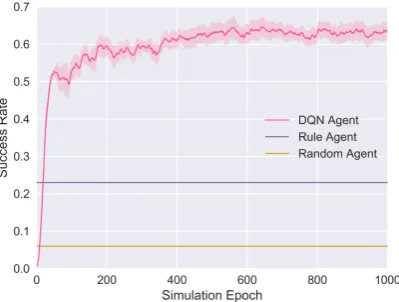
Figure 3: Learning curve of policy learning
Model Success Reward Turn
[image:5.595.87.273.429.471.2]Random Agent 0.06 -24.36 17.51 Rule Agent 0.23 -13.78 17.00 DQN Agent 0.65 20.51 5.11
Table 5: Performance of three dialogue systems on 5K simulated dialogues
4.2 Results
Table 4 shows the accuracy of two SVM-based models. The result shows that the implicit symp-toms can greatly improve the accuracy of dis-ease identification for all the four disdis-eases, which demonstrates the contribution of implicit symp-toms when making diagnosis for patients. Figure
3 shows the learning curve of all the three dia-logue systems and Table5shows the performance of these agents on testing set. Due to the large ac-tion space, the random agent performs badly. The rule-based agent outperforms the random agent in a large margin. This indicates that the rule-based agent is well designed. We can also see that the RL-based DQN agent outperforms rule-based agent significantly. Moreover, DQN agent outper-forms SVM-ex by collecting additional implicit
symptoms via conversing with patients. However, there is still a gap between the performance of
DQN agentandSVM-ex&imin terms of accuracy, which indicates that there is still rooms for the im-provement of the dialogue system.
5 Related Works
In 2003, an ontology-based dialogue system that supports electronic referrals for breast cancer is proposed (Milward and Beveridge, 2003), which can deal with the informative response of users based on the medical domain ontologies. In ad-dition, there are two works where deep reinforce-ment learning is applied for automatic diagnosis (Tang et al., 2016; Kao et al., 2018). However, their models need extra human resources to cat-egorize the diseases into different groups and the data used is simulated that can not reflect the situ-ation of the real patients.
6 Conclusions and Future Works
In this paper, we propose a reinforcement learning based framework of dialogue system for automatic diagnosis and build a dataset for training DS which is derived from the dialogue text between real pa-tients and doctors. Experiment results on a self-constructed dataset show that our dialogue system is able to collect additional symptoms via conver-sation with patients and improve the accuracy for automatic diagnosis.
The relationship between diseases and symp-toms is an external knowledge which is thought to be useful for the automatic diagnosis. One of our future directions is to explore models that can incorporate external knowledge for better policy learning.
Acknowledgments
References
Edward Choi, Andy Schuetz, Walter F Stewart, and Ji-meng Sun. 2016. Using recurrent neural network models for early detection of heart failure onset. Journal of the American Medical Informatics Asso-ciation24(2):361–370.
Heriberto Cuayahuitl, Simon Keizer, Oliver Lemon, et al. 2015. Strategic dialogue management via deep reinforcement learning. CoRR.
Finale Doshi-Velez, Yaorong Ge, and Isaac Kohane. 2014. Comorbidity clusters in autism spectrum dis-orders: an electronic health record time-series anal-ysis. Pediatrics133(1):e54–e63.
Siddhartha R Jonnalagadda, Abhishek K Adupa, Ravi P Garg, Jessica Corona-Cox, and Sanjiv J Shah. 2017. Text mining of the electronic health record: An information extraction approach for automated identification and subphenotyping of hfpef patients for clinical trials. Journal of cardiovascular trans-lational research10(3):313–321.
Hao-Cheng Kao, Kai-Fu Tang, and Edward Y Chang. 2018. Context-aware symptom checking for disease diagnosis using hierarchical reinforcement learning .
Li Li, Wei-Yi Cheng, Benjamin S Glicksberg, Omri Gottesman, Ronald Tamler, Rong Chen, Erwin P Bottinger, and Joel T Dudley. 2015. Identification of type 2 diabetes subgroups through topological analysis of patient similarity. Science translational medicine7(311):311ra174–311ra174.
Xiujun Li, Yun-Nung Chen, Lihong Li, Jianfeng Gao, and Asli Celikyilmaz. 2017. End-to-end task-completion neural dialogue systems. InProceedings of the Eighth International Joint Conference on Nat-ural Language Processing (Volume 1: Long Papers). volume 1, pages 733–743.
Bing Liu, Gokhan Tur, Dilek Hakkani-Tur, Pararth Shah, and Larry Heck. 2017. End-to-end optimization of task-oriented dia-logue model with deep reinforcement learning https://arxiv.org/abs/1711.10712.
David Milward and Martin Beveridge. 2003. Ontology-based dialogue systems. In Proc. 3rd Workshop on Knowledge and reasoning in practical dialogue systems (IJCAI03). pages 9–18.
Volodymyr Mnih, Koray Kavukcuoglu, David Silver, Andrei A Rusu, Joel Veness, Marc G Bellemare, Alex Graves, Martin Riedmiller, Andreas K Fidje-land, Georg Ostrovski, et al. 2015. Human-level control through deep reinforcement learning. Na-ture518(7540):529–533.
Baolin Peng, Xiujun Li, Jianfeng Gao, Jingjing Liu, Yun-Nung Chen, and Kam-Fai Wong. 2017a. Adversarial advantage actor-critic model for task-completion dialogue policy learning https://arxiv.org/abs/1710.11277.
Baolin Peng, Xiujun Li, Lihong Li, Jianfeng Gao, Asli Celikyilmaz, Sungjin Lee, and Kam-Fai Wong. 2017b. Composite task-completion dialogue policy learning via hierarchical deep reinforcement learn-ing. InProceedings of the 2017 Conference on Em-pirical Methods in Natural Language Processing. pages 2231–2240.
Jost Schatzmann, Blaise Thomson, Karl Weilhammer, Hui Ye, and Steve Young. 2007. Agenda-based user simulation for bootstrapping a pomdp dialogue sys-tem. InHuman Language Technologies 2007: The Conference of the North American Chapter of the Association for Computational Linguistics; panion Volume, Short Papers. Association for Com-putational Linguistics, pages 149–152.
Jost Schatzmann, Karl Weilhammer, Matt Stuttle, and Steve Young. 2006. A survey of statistical user sim-ulation techniques for reinforcement-learning of di-alogue management strategies. The knowledge en-gineering review21(2):97–126.
Chaitanya Shivade, Preethi Raghavan, Eric Fosler-Lussier, Peter J Embi, Noemie Elhadad, Stephen B Johnson, and Albert M Lai. 2013. A review of approaches to identifying patient phenotype co-horts using electronic health records. Journal of the American Medical Informatics Association 21(2):221–230.
Pei-Hao Su, Milica Gasic, Nikola Mrksic, Lina Rojas-Barahona, Stefan Ultes, David Vandyke, Tsung-Hsien Wen, and Steve Young. 2016. Con-tinuously learning neural dialogue management https://arxiv.org/abs/1606.02689.
Kai-Fu Tang, Hao-Cheng Kao, Chun-Nan Chou, and Edward Y Chang. 2016. Inquire and diagnose: Neu-ral symptom checking ensemble using deep rein-forcement learning. InProceedings of NIPS Work-shop on Deep Reinforcement Learning.
Huaixiao Tou, Lu Yao, Zhongyu Wei, Xiahai Zhuang, and Bo Zhang. 2018. Automatic infection detection based on electronic medical records.BMC bioinfor-matics19(5):117.
TH Wen, D Vandyke, N Mrkˇs´ıc, M Gaˇs´ıc, LM Rojas-Barahona, PH Su, S Ultes, and S Young. 2017. A network-based end-to-end trainable task-oriented di-alogue system. In 15th Conference of the Euro-pean Chapter of the Association for Computational Linguistics, EACL 2017-Proceedings of Conference. volume 1, pages 438–449.
Zhao Yan, Nan Duan, Peng Chen, Ming Zhou, Jian-she Zhou, and Zhoujun Li. 2017. Building task-oriented dialogue systems for online shopping. In AAAI. pages 4618–4626.