Proceedings of the 56th Annual Meeting of the Association for Computational Linguistics (Long Papers), pages 1616–1626 1616
A Graph-to-Sequence Model for AMR-to-Text Generation
Linfeng Song1, Yue Zhang3, Zhiguo Wang2 and Daniel Gildea1
1Department of Computer Science, University of Rochester, Rochester, NY 14627
2IBM T.J. Watson Research Center, Yorktown Heights, NY 10598
3Singapore University of Technology and Design
Abstract
The problem of AMR-to-text generation is to recover a text representing the same meaning as an input AMR graph. The current state-of-the-art method uses a sequence-to-sequence model, leverag-ing LSTM for encodleverag-ing a linearized AMR structure. Although it is able to model non-local semantic information, a se-quence LSTM can lose information from the AMR graph structure, and thus faces challenges with large graphs, which re-sult in long sequences. We introduce a neural graph-to-sequence model, using a novel LSTM structure for directly encod-ing graph-level semantics. On a standard benchmark, our model shows superior re-sults to existing methods in the literature.
1 Introduction
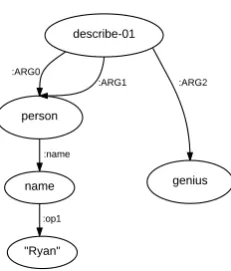
Abstract Meaning Representation (AMR) ( Ba-narescu et al.,2013) is a semantic formalism that encodes the meaning of a sentence as a rooted, directed graph. Figure 1 shows an AMR graph in which the nodes (such as “describe-01” and “person”) represent the concepts, and edges (such as “:ARG0” and “:name”) represent the relations between concepts they connect. AMR has been proven helpful on other NLP tasks, such as ma-chine translation (Jones et al., 2012; Tamchyna et al.,2015), question answering (Mitra and Baral,
2015), summarization (Takase et al., 2016) and event detection (Li et al.,2015).
The task of AMR-to-text generation is to pro-duce a text with the same meaning as a given in-put AMR graph. The task is challenging as word tenses and function words are abstracted away when constructing AMR graphs from texts. The translation from AMR nodes to text phrases can
:name :ARG0
describe-01
name person
"Ryan" :op1
:ARG1
[image:1.595.359.475.221.357.2]genius :ARG2
Figure 1: An example of AMR graph meaning “Ryan’s description of himself: a genius.”
be far from literal. For example, shown in Figure
1, “Ryan” is represented as “(p / person :name (n / name :op1 “Ryan”))”, and “description of” is rep-resented as “(d / describe-01 :ARG1 )”.
While initial work used statistical approaches (Flanigan et al.,2016b;Pourdamghani et al.,2016;
Song et al.,2017;Lampouras and Vlachos,2017;
Mille et al.,2017;Gruzitis et al.,2017), recent re-search has demonstrated the success of deep learn-ing, and in particular the sequence-to-sequence model (Sutskever et al.,2014), which has achieved the state-of-the-art results on AMR-to-text gen-eration (Konstas et al., 2017). One limitation of sequence-to-sequence models, however, is that they require serialization of input AMR graphs, which adds to the challenge of representing graph structure information, especially when the graph is large. In particular, closely-related nodes, such as parents, children and siblings can be far away after serialization. It can be difficult for a linear recur-rent neural network to automatically induce their original connections from bracketed string forms.
To capture non-local information, the encoder per-forms graph state transition by information ex-change between connected nodes, with a graph state consisting of all node states. Multiple recur-rent transition steps are taken so that information can propagate non-locally, and LSTM (Hochreiter and Schmidhuber,1997) is used to avoid gradient diminishing and bursting in the recurrent process. The decoder is an attention-based LSTM model with a copy mechanism (Gu et al.,2016;Gulcehre et al.,2016), which helps copy sparse tokens (such as numbers and named entities) from the input.
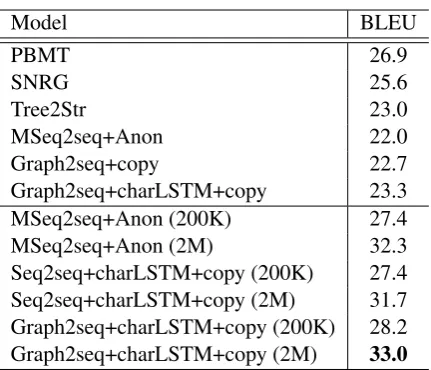
Trained on a standard dataset (LDC2015E86), our model surpasses a strong sequence-to-sequence baseline by 2.3 BLEU points, demon-strating the advantage of graph-to-sequence mod-els for AMR-to-text generation compared to sequence-to-sequence models. Our final model achieves a BLEU score of 23.3 on the test set, which is 1.3 points higher than the existing state of the art (Konstas et al.,2017) trained on the same dataset. When using gigaword sentences as ad-ditional training data, our model is consistently better than Konstas et al. (2017) using the same amount of gigaword data, showing the effective-ness of our model on large-scale training set.
We release our code and models at https: //github.com/freesunshine0316/
neural-graph-to-seq-mp.
2 Baseline: a seq-to-seq model
Our baseline is a sequence-to-sequence model, which follows the encoder-decoder framework of
Konstas et al.(2017).
2.1 Input representation
Given an AMR graphG = (V, E), where V and Edenote the sets of nodes and edges, respectively, we use the depth-first traversal of Konstas et al.
(2017) to linearize it to obtain a sequence of to-kensv1, . . . , vN, whereNis the number of tokens.
For example, the AMR graph in Figure 1 is seri-alized as “describe :arg0 ( person :name ( name :op1 ryan ) ) :arg1 person :arg2 genius”. We can see that the distance between “describe” and “ge-nius”, which are directly connected in the original AMR, becomes 14 in the serialization result.
A simple way to calculate the representation for each tokenvj is using its word embeddingej:
xj =W1ej+b1, (1)
whereW1 andb1 are model parameters for
com-pressing the input vector size.
To alleviate the data sparsity problem and ob-tain better word representation as the input, we also adopt a forward LSTM over the characters of the token, and concatenate the last hidden statehcj with the word embedding:
xj =W1
[ej;hcj]
+b1 (2)
2.2 Encoder
The encoder is a bi-directional LSTM applied on the linearized graph by depth-first traversal, as in
Konstas et al.(2017). At each step j, the current states←hj and
→
hj are generated given the previous
states←hj+1and
→
hj 1and the current inputxj:
←
hj =LSTM(
← hj+1, xj)
→
hj =LSTM(
→ hj 1, xj)
2.3 Decoder
We use an attention-based LSTM decoder ( Bah-danau et al., 2015), where the attention memory (A) is the concatenation of the attention vectors among all input words. Each attention vectorajis
the concatenation of the encoder states of an input token in both directions (←hj and
→
hj) and its input
vector (xj):
aj = [
← hj;
→
hj;xj] (3)
A= [a1;a2;. . .;aN] (4)
whereN is the number of input tokens.
The decoder yields an output sequence
w1, w2, . . . , wM by calculating a sequence of
hidden states s1, s2. . . , sM recurrently. While
generating the t-th word, the decoder considers five factors: (1) the attention memory A; (2) the previous hidden state of the LSTM model st 1;
(3) the embedding of the current input (previously generated word) et; (4) the previous context
vector µt 1, which is calculated with attention
from A; and (5) the previous coverage vector γt 1, which is the accumulation of all attention
distributions so far (Tu et al.,2016). Whent= 1, we initializeµ0 andγ0 as zero vectors, set e1 to
the embedding of the start token “<s>”, and s0
as the average of all encoder states.
Time
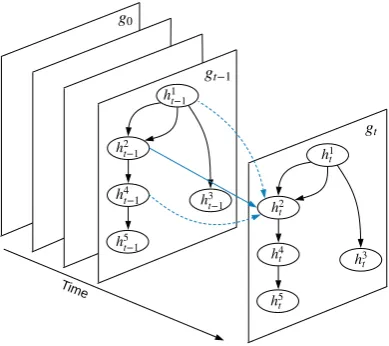
Figure 2: Graph state LSTM.
LSTM model to update its hidden state. Then the attention probability αt,i on the attention vector
ai∈Afor the time-step is calculated as:
t,i =v2T tanh(Waai+Wsst+Wγγt 1+b2)
αt,i =
exp(t,i)
PN
j=1exp(t,j)
where Wa, Ws, Wγ, v2 and b2 are model
pa-rameters. The coverage vector γt is updated by
γt =γt 1+αt, and the new context vectorµtis
calculated viaµt=PNi=1αt,iai.
The output probability distribution over a vo-cabulary at the current state is calculated by:
Pvocab =softmax(V3[st, µt] +b3), (5)
whereV3andb3are learnable parameters, and the
number of rows in V3 represents the number of
words in the vocabulary.
3 The graph-to-sequence model
Unlike the baseline sequence-to-sequence model, we leverage a recurrent graph encoder to represent each input AMR, which directly models the graph structure without serialization.
3.1 The graph encoder
Figure2shows the overall structure of our graph encoder. Formally, given a graph G = (V, E), we use a hidden state vectorhj to represent each
nodevj ∈ V. The state of the graph can thus be
represented as:
g={hj}|vj∈V
In order to capture non-local interaction between nodes, we allow information exchange between nodes through a sequence of state transitions, leading to a sequence of statesg0, g1, . . . , gt, . . .,
wheregt = {hjt}|vj∈V. The initial state g0
con-sists of a set of initial node stateshj0 =h0, where
h0 is a hyperparameter of the model.
State transition A recurrent neural network is used to model the state transition process. In particular, the transition fromgt 1togtconsists of
a hidden state transition for each node, as shown in Figure 2. At each state transition step t, we allow direct communication between a node and all nodes that are directly connected to the node. To avoid gradient diminishing or bursting, LSTM (Hochreiter and Schmidhuber, 1997) is adopted, where a cellcjt is taken to record memory forhjt. We use an input gateijt, an output gateojt and a forget gateftjto control information flow from the inputs and to the outputhjt.
The inputs include representations of edges that are connected to vj, where vj can be either the
source or the target of the edge. We define each edge as a triple(i, j, l), whereiandjare indices of the source and target nodes, respectively, andl is the edge label.xli,j is the representation of edge
(i, j, l), detailed in Section3.3. The inputs forvj
are distinguished by incoming and outgoing edges, before being summed up:
xij = X
(i,j,l)∈Ein(j)
xli,j
xoj = X
(j,k,l)∈Eout(j)
xlj,k,
where Ein(j) andEout(j) denote the sets of
in-coming and outgoing edges ofvj, respectively.
In addition to edge inputs, a cell also takes the hidden states of its incoming nodes and outgoing nodes during a state transition. In particular, the states of all incoming nodes and outgoing nodes are summed up before being passed to the cell and gate nodes:
hij = X
(i,j,l)∈Ein(j)
hit 1
hoj = X
(j,k,l)∈Eout(j)
hkt 1,
[image:3.595.366.466.476.538.2]repre-sented byhjt, can be defined as:
ijt =σ(Wixij+ ˆWixoj +Uihij+ ˆUihoj +bi),
ojt =σ(Woxij+ ˆWoxoj+Uohij+ ˆUohoj +bo),
ftj =σ(Wfxij+ ˆWfxoj +Ufhij+ ˆUfhoj +bf),
ujt =σ(Wuxij+ ˆWuxoj +Uuhij+ ˆUuhoj +bu),
cjt =ftj ctj 1+ijtujt,
hjt =ojttanh(cjt),
whereijt,ojt andftj are the input, output and for-get gates mentioned earlier. Wx,Wˆx,Ux,Uˆx,bx,
wherex∈ {i, o, f, u}, are model parameters.
3.2 Recurrent steps
Using the above state transition mechanism, infor-mation from each node propagates to all its neigh-boring nodes after each step. Therefore, for the worst case where the input graph is a chain of nodes, the maximum number of steps necessary for information from one arbitrary node to reach another is equal to the size of the graph. We exper-iment with different transition steps to study the effectiveness of global encoding.
Note that unlike the sequence LSTM encoder, our graph encoder allows parallelization in node-state updates, and thus can be highly efficient us-ing a GPU. It is general and can be potentially ap-plied to other tasks, including sequences, syntactic trees and cyclic structures.
3.3 Input Representation
Different from sequences, the edges of an AMR graph contain labels, which represent relations be-tween the nodes they connect, and are thus impor-tant for modeling the graphs. Similar with Section
2, we adopt two different ways for calculating the representation for each edge(i, j, l):
xli,j =W4
[el;ei]
+b4 (6)
xli,j =W4
[el;ei;hci]
+b4, (7)
whereelandeiare the embeddings of edge labell
and source nodevi,hcidenotes the last hidden state
of the character LSTM overvi, andW4 andb4are
trainable parameters. The equations correspond to Equations1and2in Section2.1, respectively.
3.4 Decoder
We adopt the attention-based LSTM decoder as described in Section2.3. Since our graph encoder
generates a sequence of graph states, only the last graph state is adopted in the decoder. In partic-ular, we make the following changes to the de-coder. First, each attention vector becomesaj =
[hjT;xj], where hjT is the last state for node vj.
Second, the decoder initial states 1is the average
of the last states of all nodes.
3.5 Integrating the copy mechanism
Open-class tokens, such as dates, numbers and named entities, account for a large portion in the AMR corpus. Most appear only a few times, re-sulting in a data sparsity problem. To address this issue, Konstas et al.(2017) adopt anonymization for dealing with the data sparsity problem. In par-ticular, they first replace the subgraphs that repre-sent dates, numbers and named entities (such as “(q / quantity :quant 3)” and “(p / person :name (n / name :op1 “Ryan”))”) with predefined place-holders (such as “num 0” and “person name 0”) before decoding, and then recover the correspond-ing surface tokens (such as “3” and “Ryan”) af-ter decoding. This method involves hand-crafted rules, which can be costly.
Copy We find that most of the open-class to-kens in a graph also appear in the correspond-ing sentence, and thus adopt the copy mechanism (Gulcehre et al., 2016; Gu et al., 2016) to solve this problem. The mechanism works on top of an attention-based RNN decoder by integrating the attention distribution into the final vocabulary dis-tribution. The final probability distribution is de-fined as the interpolation between two probability distributions:
Pf inal=θtPvocab+ (1 θt)Pattn, (8)
where θt is a switch for controlling generating a
word from the vocabulary or directly copying it from the input graph. Pvocab is the probability
distribution of directly generating the word, as de-fined in Equation5, andPattnis calculated based
on the attention distribution αt by summing the
probabilities of the graph nodes that contain iden-tical concept. Intuitively,θtis relevant to the
cur-rent decoder inputetand statest, and the context
vectorµt. Therefore, we define it as:
θt=σ(wTµµt+wsTst+weTet+b5), (9)
where vectorswµ,ws,weand scalarb5are model
gener-ating words that appear in the input. For AMR-to-text generation, it facilitates the generation of dates, numbers, and named entities that appear in AMR graphs.
Copying vs anonymization Both copying and anonymization alleviate the data sparsity problem by handling the open-class tokens. How-ever, the copy mechanism has the following ad-vantages over anonymization: (1) anonymization requires significant manual work to define the placeholders and heuristic rules both from sub-graphs to placeholders and from placeholders to the surface tokens, (2) the copy mechanism auto-matically learns what to copy, while anonymiza-tion relies on hard rules to cover all types of the open-class tokens, and (3) the copy mechanism is easier to adapt to new domains and languages than anonymization.
4 Training and decoding
We train our models using the cross-entropy loss over each gold-standard output sequence W∗ =
w∗1, . . . , wt∗, . . . , w∗M:
l=
M
X
t=1
logp(wt∗|w∗t 1, . . . , w∗1, X;θ), (10)
where X is the input graph, and θ is the model parameters. Adam (Kingma and Ba,2014) with a learning rate of 0.001 is used as the optimizer, and the model that yields the best devset performance is selected to evaluate on the test set. Dropout with rate 0.1 is used during training. Beam search with beam size to 5 is used for decoding. Both training and decoding use Tesla K80 GPUs.
5 Experiments
5.1 Data
We use a standard AMR corpus (LDC2015E86) as our experimental dataset, which contains 16,833 instances for training, 1368 for development and 1371 for test. Each instance contains a sentence and an AMR graph.
Following Konstas et al. (2017), we supple-ment the gold data with large-scale automatic data. We take Gigaword as the external data to sam-ple raw sentences, and train our model on both the sampled data and LDC2015E86. We adopt
Konstas et al.(2017)’s strategy for sampling sen-tences from Gigaword, and choose JAMR ( Flani-gan et al.,2016a) to parse selected sentences into
Model BLEU Time
Seq2seq 18.8 35.4s
Seq2seq+copy 19.9 37.4s
Seq2seq+charLSTM+copy 20.6 39.7s
Graph2seq 20.4 11.2s
Graph2seq+copy 22.2 11.1s
Graph2seq+Anon 22.1 9.2s
[image:5.595.308.525.61.176.2]Graph2seq+charLSTM+copy 22.8 16.3s
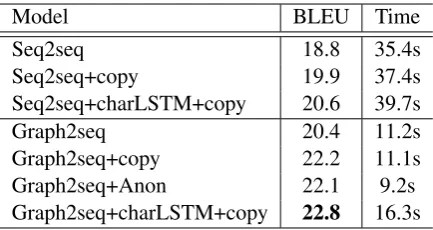
Table 1: DEVBLEU scores and decoding times.
AMRs, as the AMR parser ofKonstas et al.(2017) only works on the anonymized data. For training on both sampled data and LDC2015E86, we also follow the method ofKonstas et al.(2017), which is fine-tuning the model on the AMR corpus after every epoch of pretraining on the gigaword data.
5.2 Settings
We extract a vocabulary from the training set, which is shared by both the encoder and the de-coder. The word embeddings are initialized from Glove pretrained word embeddings (Pennington et al., 2014) on Common Crawl, and are not up-dated during training. Following existing work, we evaluate the results with the BLEU metric ( Pa-pineni et al.,2002).
For model hyperparameters, we set the graph state transition number as 9 according to devel-opment experiments. Each node takes informa-tion from at most 10 neighbors. The hidden vector sizes for both encoder and decoder are set to 300 (They are set to 600 for experiments using large-scale automatic data). Both character embeddings and hidden layer sizes for character LSTMs are set 100, and at most 20 characters are taken for each graph node or linearized token.
5.3 Development experiments
As shown in Table1, we compare our model with a set of baselines on the AMR devset to demon-strate how the graph encoder and the copy mecha-nism can be useful when training instances are not sufficient. Seq2seq is the sequence-to-sequence baseline described in Section 2. Seq2seq+copy
extends Seq2seq with the copy mechanism,
and Seq2seq+charLSTM+copy further extends
Seq2seq+copywith character LSTM. Graph2seq
is our graph-to-sequence model,Graph2seq+copy
extends Graph2seq with the copy mechanism,
Graph2seq+copy with the character LSTM. We also try Graph2seq+Anon, which applies our graph-to-sequence model on the anonymized data fromKonstas et al.(2017).
The graph encoder As can be seen from Ta-ble1, the performance ofGraph2seqis 1.6 BLEU points higher thanSeq2seq, which shows that our graph encoder is effective when applied alone. Adding the copy mechanism (Graph2seq+copyvs
Seq2seq+copy), the gap becomes 2.3. This shows
that the graph encoder learns better node represen-tations compared to the sequence encoder, which allows attention and copying to function better.
Applying the graph encoder together with the copy mechanism gives a gain of 3.4 BLEU points over the baseline (Graph2seq+copy vsSeq2seq). The graph encoder is consistently better than the sequence encoder no matter whether character LSTMs are used.
We also list the encoding part of decoding times on the devset, as the decoders of the seq2seq and the graph2seq models are similar, so the time dif-ferences reflect efficiencies of the encoders. Our graph encoder gives consistently better efficiency compared with the sequence encoder, showing the advantage of parallelization.
The copy mechanism Table 1 shows that the copy mechanism is effective on both the graph-to-sequence and the sequence-to-sequence models. Anonymization gives comparable over-all performance gains on our graph-to-sequence model as the copy mechanism (comparing
Graph2seq+Anonwith Graph2seq+copy).
How-ever, the copy mechanism has several advantages over anonymization as discussed in Section3.5.
Character LSTM Character LSTM helps to increase the performances of both systems by roughly 0.6 BLEU points. This is largely because it further alleviates the data sparsity problem by handling unseen words, which may share common substrings with in-vocabulary words.
5.4 Effectiveness on graph state transitions
We report a set of development experiments for understanding the graph LSTM encoder.
Number of iterations We analyze the influ-ence of the number of state transitions to the model performance on the devset. Figure 3 shows the BLEU scores of different state transition numbers,
1 2 3 4 5 6 7 8 9
10.0 12.0 14.0 16.0 18.0 20.0 22.0 24.0
[image:6.595.314.520.64.165.2]only-incoming only-outgoing both
Figure 3: DEV BLEU scores against transition
steps for the graph encoder.
0 5 10 15 20
0 20 40 60 80 100
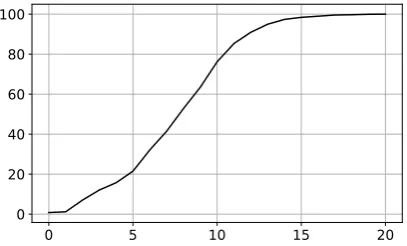
Figure 4: Percentage of DEVAMRs with different
diameters.
when both incoming and outgoing edges are taken for calculating the next state (as shown in Figure
2). The system is Graph2seq+charLSTM+copy. Executing only 1 iteration results in a poor BLEU score of 14.1. In this case the state for each node only contains information about immediately adja-cent nodes. The performance goes up dramatically to 21.5 when increasing the iteration number to 5. In this case, the state for each node contains infor-mation of all nodes within a distance of 5. The per-formance further goes up to 22.8 when increasing the iteration number from 5 to 9, where all nodes with a distance of less than 10 are incorporated in the state for each node.
Graph diameter We analyze the percentage of the AMR graphs in the devset with different graph diameters and show the cumulative distribu-tion in Figure4. The diameter of an AMR graph is defined as the longest distance between two AMR nodes.1 Even though the diameters for less than 80% of the AMR graphs are less or equal than 10, our development experiments show that it is not necessary to incorporate the whole-graph informa-tion for each node. Further increasing state transi-tion number may lead to additransi-tional improvement.
[image:6.595.314.518.217.340.2]Model BLEU
PBMT 26.9
SNRG 25.6
Tree2Str 23.0
MSeq2seq+Anon 22.0
Graph2seq+copy 22.7
Graph2seq+charLSTM+copy 23.3
MSeq2seq+Anon (200K) 27.4
MSeq2seq+Anon (2M) 32.3
Seq2seq+charLSTM+copy (200K) 27.4
Seq2seq+charLSTM+copy (2M) 31.7
Graph2seq+charLSTM+copy (200K) 28.2
[image:7.595.74.290.58.243.2]Graph2seq+charLSTM+copy (2M) 33.0
Table 2: TEST results. “(200K)”, “(2M)” and “(20M)” represent training with the corresponding number of additional sentences from Gigaword.
We do not perform exhaustive search for finding the optimal state transition number.
Incoming and outgoing edges As shown in Figure3, we analyze the efficiency of state tran-sition when only incoming or outgoing edges are used. From the results, we can see that there is a huge drop when state transition is performed only with incoming or outgoing edges. Using edges of one direction, the node states only contain infor-mation of ancestors or descendants. On the other hand, node states contain information of ancestors, descendants, and siblings if edges of both direc-tions are used. From the results, we can conclude that not only the ancestors and descendants, but also the siblings are important for modeling the AMR graphs. This is similar to observations on syntactic parsing tasks (McDonald et al., 2005), where sibling features are adopted.
We perform a similar experiment for the
Seq2seq+copybaseline by only executing
single-directional LSTM for the encoder. We observe BLEU scores of 11.8 and 12.7 using only forward or backward LSTM, respectively. This is consis-tent with our graph model in that execution using only one direction leads to a huge performance drop. The contrast is also reminiscent of using the normal input versus the reversed input in neural machine translation (Sutskever et al.,2014).
5.5 Results
Table 2 compares our final results with existing work. MSeq2seq+Anon (Konstas et al., 2017) is an attentional multi-layer sequence-to-sequence
model trained with the anonymized data. PBMT
(Pourdamghani et al.,2016) adopts a phrase-based model for machine translation (Koehn et al.,2003) on the input of linearized AMR graph, SNRG
(Song et al.,2017) uses synchronous node replace-ment grammar for parsing the AMR graph while generating the text, andTree2Str(Flanigan et al.,
2016b) converts AMR graphs into trees by split-ting the re-entrances before using a tree transducer to generate the results.
Graph2seq+charLSTM+copyachieves a BLEU
score of 23.3, which is 1.3 points better than
MSeq2seq+Anon trained on the same AMR
cor-pus. In addition, our model without charac-ter LSTM is still 0.7 BLEU points higher than
MSeq2seq+Anon. Note thatMSeq2seq+Anon
re-lies on anonymization, which requires additional manual work for defining mapping rules, thus lim-iting its usability on other languages and domains. The neural models tend to underperform statistical models when trained on limited (16K) gold data, but performs better with scaled silver data ( Kon-stas et al.,2017).
Following Konstas et al. (2017), we also evaluate our model using both the AMR cor-pus and sampled sentences from Gigaword. Using additional 200K or 2M gigaword
sen-tences, Graph2seq+charLSTM+copy achieves
BLEU scores of 28.2 and 33.0, respectively, which are 0.8 and 0.7 BLEU points better than
MSeq2seq+Anonusing the same amount of data,
respectively. The BLEU scores are 5.3 and 10.1 points better than the result when it is only trained with the AMR corpus, respectively. This shows that our model can benefit from scaled data with automatically generated AMR graphs, and it is more effective than MSeq2seq+Anon using the same amount of data. Using 2M gigaword data, our model is better than all existing methods. Kon-stas et al.(2017) also experimented with 20M ex-ternal data, obtaining a BLEU of 33.8. We did not try this setting due to hardware limitations. The
Seq2seq+charLSTM+copybaseline trained on the
large-scale data is close to MSeq2seq+Anon us-ing the same amount of trainus-ing data, yet is much worse than our model.
5.6 Case study
graph-to-sequence (G2S) and graph-to-sequence with copy mechanism (G2S+CP).Ref denotes the reference output sentence, and Lin shows the serialization results of input AMRs. The best hyperparameter configuration is chosen for each model.
For the first example,S2Sfails to recognize the concept “a / account” as a noun and loses the con-cept “o / old” (both are underlined). The fact that “a / account” is a noun is implied by “a / ac-count :mod (o / old)” in the original AMR graph. Though directly connected in the original graph, their distance in the serialization result (the input ofS2S) is 26, which may be whyS2Smakes these mistakes. In contrast, G2Shandles “a / account” and “o / old” correctly. In addition, the copy mech-anism helps to copy “look-over” from the input, which rarely appears in the training set. In this case, G2S+CP is incorrect only on hyphens and literal reference to “anti-japanese war”, although the meaning is fully understandable.
For the second case, both G2S and G2S+CP
correctly generate the noun “agreement” for “a / agree” in the input AMR, whileS2Sfails to. The fact that “a / agree” represents a noun can be de-termined by the original graph segment “p / pro-vide :ARG0 (a / agree)”, which indicates that “a / agree” is the subject of “p / provide”. In the se-rialization output, the two nodes are close to each other. Nevertheless,S2Sstill failed to capture this structural relation, which reflects the fact that a se-quence encoder is not designed to explicitly model hierarchical information encoded in the serialized graph. In the training instances, serialized nodes that are close to each other can originate from neighboring graph nodes, or distant graph nodes, which prevents the decoder from confidently de-ciding the correct relation between them. In con-trast, G2S sends the node “p / provide” simulta-neously with relation “ARG0” when calculating hidden states for “a / agree”, which facilitates the yielding of “the agreement provides”.
6 Related work
Among early statistical methods for AMR-to-text generation, Flanigan et al. (2016b) convert input graphs to trees by splitting re-entrances, and then translate the trees into sentences with a tree-to-string transducer. Song et al. (2017) use a syn-chronous node replacement grammar to parse in-put AMRs and generate sentences at the same time. Pourdamghani et al. (2016) linearize input
(p / possible01 :polarity -:ARG1 (l / look-over-06
:ARG0 (w / we) :ARG1 (a / account-01
:ARG1 (w2 / war-01
:ARG1 (c2 / country :wiki “Japan” :name (n2 / name :op1 “Japan”)) :time (p2 / previous)
:ARG1-of (c / call-01 :mod (s / so))) :mod (o / old))))
Lin: possible :polarity - :arg1 ( look-over :arg0 we :arg1 ( account :arg1 ( war :arg1 ( country :wiki japan :name ( name :op1 japan ) ) :time previous :arg1-of ( call :mod so ) ) :mod old ) )
Ref: we can n’t look over the old accounts of the previous so-called anti-japanese war .
S2S: we can n’t be able to account the past drawn out of japan ’s entire war .
G2S: we can n’t be able to do old accounts of the previous and so called japan war.
G2S+CP: we can n’t look-over the old accounts of the pre-vious so called war on japan .
(p / provide-01 :ARG0 (a / agree-01) :ARG1 (a2 / and
:op1 (s / staff :prep-for (c / center
:mod (r / research-01))) :op2 (f / fund-01
:prep-for c)))
Lin: provide :arg0 agree :arg1 ( and :op1 ( staff :prep-for ( center :mod research ) ) :op2 ( fund :prep-for center ) )
Ref: the agreement will provide staff and funding for the research center .
S2S: agreed to provide research and institutes in the center .
G2S: the agreement provides the staff of research centers and funding .
G2S+CP: the agreement provides the staff of the research center and the funding .
Table 3: Example system outputs.
graphs by breadth-first traversal, and then use a phrase-based machine translation system2 to gen-erate results by translating linearized sequences.
Prior work using graph neural networks for NLP include the use graph convolutional net-works (GCN) (Kipf and Welling,2017) for seman-tic role labeling (Marcheggiani and Titov, 2017) and neural machine translation (Bastings et al.,
2017). Both GCN and the graph LSTM update node states by exchanging information between neighboring nodes within each iteration. However, our graph state LSTM adopts gated operations for making updates, while GCN uses a linear transfor-mation. Intuitively, the former has better learning power than the later. Another major difference is that our graph state LSTM keeps a cell vector for each node to remember all history. The contrast
between our model with GCN is reminiscent of the contrast between RNN and CNN. We leave em-pirical comparison of their effectiveness to future work. In this work our main goal is to show that graph LSTM encoding of AMR is superior com-pared with sequence LSTM.
Closest to our work, Peng et al. (2017) mod-eled syntactic and discourse structures using DAG LSTM, which can be viewed as extensions to tree LSTMs (Tai et al.,2015). The state update follows the sentence order for each node, and has sequen-tial nature. Our state update is in parallel. In addi-tion,Peng et al.(2017) split input graphs into sep-arate DAGs before their method can be used. To our knowledge, we are the first to apply an LSTM structure to encode AMR graphs.
The recurrent information exchange mechanism in our state transition process is remotely related to the idea of loopy belief propagation (LBP) ( Mur-phy et al., 1999). However, there are two major differences. First, messages between LSTM states are gated neural node values, rather than probabil-ities in LBP. Second, while the goal of LBP is to estimate marginal probabilities, the goal of in-formation exchange between graph states in our LSTM is to find neural representation features, which are directly optimized by a task objective.
In addition to NMT (Gulcehre et al., 2016), the copy mechanism has been shown effective on tasks such as dialogue (Gu et al., 2016), summa-rization (See et al.,2017) and question generation (Song et al.,2018). We investigate the copy mech-anism on AMR-to-text generation.
7 Conclusion
We introduced a novel graph-to-sequence model
for AMR-to-text generation. Compared to
sequence-to-sequence models, which require lin-earization of AMR before decoding, a graph LSTM is leveraged to directly model full AMR structure. Allowing high parallelization, the graph encoder is more efficient than the sequence en-coder. In our experiments, the graph model out-performs a strong sequence-to-sequence model, achieving the best performance.
Acknowledgments We thank the anonymized reviewers for the insightful comments, and the Center for Integrated Research Computing (CIRC) of University of Rochester for providing computa-tion resources.
References
Dzmitry Bahdanau, Kyunghyun Cho, and Yoshua
Ben-gio. 2015. Neural machine translation by jointly
learning to align and translate. InInternational Con-ference on Learning Representations (ICLR).
Laura Banarescu, Claire Bonial, Shu Cai, Madalina Georgescu, Kira Griffitt, Ulf Hermjakob, Kevin Knight, Philipp Koehn, Martha Palmer, and Nathan Schneider. 2013. Abstract meaning representation
for sembanking. InProceedings of the 7th
Linguis-tic Annotation Workshop and Interoperability with Discourse, pages 178–186.
Joost Bastings, Ivan Titov, Wilker Aziz, Diego
Marcheggiani, and Khalil Simaan. 2017. Graph
convolutional encoders for syntax-aware neural ma-chine translation. InConference on Empirical Meth-ods in Natural Language Processing (EMNLP-17), pages 1957–1967, Copenhagen, Denmark.
Jeffrey Flanigan, Chris Dyer, Noah A. Smith, and
Jaime Carbonell. 2016a. CMU at semeval-2016
task 8: Graph-based AMR parsing with infinite ramp loss. InProceedings of the 10th International Workshop on Semantic Evaluation (SemEval-2016), pages 1202–1206, San Diego, California.
Jeffrey Flanigan, Chris Dyer, Noah A. Smith, and Jaime Carbonell. 2016b. Generation from abstract meaning representation using tree transducers. In
Proceedings of the 2016 Meeting of the North Amer-ican chapter of the Association for Computational Linguistics (NAACL-16), pages 731–739.
Normunds Gruzitis, Didzis Gosko, and Guntis
Barzdins. 2017. RIGOTRIO at SemEval-2017 Task 9: Combining Machine Learning and Grammar
En-gineering for AMR Parsing and Generation. In
Pro-ceedings of the 11th International Workshop on Se-mantic Evaluation (SemEval-2017), pages 924–928, Vancouver, Canada.
Jiatao Gu, Zhengdong Lu, Hang Li, and Victor O.K.
Li. 2016. Incorporating copying mechanism in
sequence-to-sequence learning. In Proceedings of
the 54th Annual Meeting of the Association for Com-putational Linguistics (ACL-16), pages 1631–1640, Berlin, Germany.
Caglar Gulcehre, Sungjin Ahn, Ramesh Nallapati, Bowen Zhou, and Yoshua Bengio. 2016. Pointing
the unknown words. InProceedings of the 54th
An-nual Meeting of the Association for Computational Linguistics (ACL-16), pages 140–149, Berlin, Ger-many.
Sepp Hochreiter and J¨urgen Schmidhuber. 1997.
Long short-term memory. Neural computation,
9(8):1735–1780.
Bevan Jones, Jacob Andreas, Daniel Bauer,
Karl Moritz Hermann, and Kevin Knight. 2012. Semantics-based machine translation with
the International Conference on Computational Linguistics (COLING-12), pages 1359–1376.
Diederik Kingma and Jimmy Ba. 2014. Adam: A
method for stochastic optimization. arXiv preprint
arXiv:1412.6980.
Thomas N. Kipf and Max Welling. 2017.
Semi-supervised classification with graph convolutional
networks. InInternational Conference on Learning
Representations (ICLR).
Philipp Koehn, Franz Josef Och, and Daniel Marcu. 2003. Statistical phrase-based translation. In Pro-ceedings of the 2003 Meeting of the North American chapter of the Association for Computational Lin-guistics (NAACL-03), pages 48–54.
Ioannis Konstas, Srinivasan Iyer, Mark Yatskar, Yejin Choi, and Luke Zettlemoyer. 2017. Neural AMR: Sequence-to-sequence models for parsing and
gen-eration. In Proceedings of the 55th Annual
Meet-ing of the Association for Computational LMeet-inguistics (ACL-17), pages 146–157, Vancouver, Canada.
Gerasimos Lampouras and Andreas Vlachos. 2017. Sheffield at semeval-2017 task 9: Transition-based
language generation from amr. In Proceedings of
the 11th International Workshop on Semantic Eval-uation (SemEval-2017), pages 586–591, Vancouver, Canada.
Xiang Li, Thien Huu Nguyen, Kai Cao, and Ralph Gr-ishman. 2015. Improving event detection with
ab-stract meaning representation. In Proceedings of
the First Workshop on Computing News Storylines, pages 11–15, Beijing, China.
Diego Marcheggiani and Ivan Titov. 2017. Encoding sentences with graph convolutional networks for
se-mantic role labeling. In Conference on Empirical
Methods in Natural Language Processing
(EMNLP-17), pages 1506–1515, Copenhagen, Denmark.
Ryan McDonald, Koby Crammer, and Fernando Pereira. 2005. Online large-margin training of
de-pendency parsers. In Proceedings of the 43rd
An-nual Meeting of the Association for Computational Linguistics (ACL-05), pages 91–98, Ann Arbor, Michigan.
Simon Mille, Roberto Carlini, Alicia Burga, and Leo Wanner. 2017. Forge at semeval-2017 task 9: Deep sentence generation based on a sequence of graph
transducers. In Proceedings of the 11th
Interna-tional Workshop on Semantic Evaluation (SemEval-2017), pages 920–923, Vancouver, Canada.
Arindam Mitra and Chitta Baral. 2015. Addressing a question answering challenge by combining statisti-cal methods with inductive rule learning and
reason-ing. InProceedings of the National Conference on
Artificial Intelligence (AAAI-16).
Kevin P Murphy, Yair Weiss, and Michael I Jordan. 1999. Loopy belief propagation for approximate
in-ference: An empirical study. InProceedings of the
Fifteenth conference on Uncertainty in artificial in-telligence, pages 467–475. Morgan Kaufmann Pub-lishers Inc.
Kishore Papineni, Salim Roukos, Todd Ward, and
Wei-Jing Zhu. 2002. BLEU: a method for automatic
evaluation of machine translation. InProceedings of the 40th Annual Meeting of the Association for Com-putational Linguistics (ACL-02), pages 311–318.
Nanyun Peng, Hoifung Poon, Chris Quirk, Kristina Toutanova, and Wen-tau Yih. 2017. Cross-sentence
n-ary relation extraction with graph LSTMs.
Trans-actions of the Association for Computational Lin-guistics, 5:101–115.
Jeffrey Pennington, Richard Socher, and Christo-pher D. Manning. 2014. GloVe: Global vectors for
word representation. In Conference on Empirical
Methods in Natural Language Processing
(EMNLP-14), pages 1532–1543.
Nima Pourdamghani, Kevin Knight, and Ulf
Herm-jakob. 2016. Generating English from abstract
meaning representations. In International
Confer-ence on Natural Language Generation (INLG-16), pages 21–25, Edinburgh, UK.
Abigail See, Peter J. Liu, and Christopher D. Manning. 2017. Get to the point: Summarization with
pointer-generator networks. InProceedings of the 55th
An-nual Meeting of the Association for Computational Linguistics (ACL-17), pages 1073–1083, Vancouver, Canada.
Linfeng Song, Xiaochang Peng, Yue Zhang, Zhiguo Wang, and Daniel Gildea. 2017. AMR-to-text gen-eration with synchronous node replacement gram-mar. In Proceedings of the 55th Annual Meet-ing of the Association for Computational LMeet-inguistics (ACL-17), pages 7–13, Vancouver, Canada.
Linfeng Song, Zhiguo Wang, Wael Hamza, Yue Zhang,
and Daniel Gildea. 2018. Leveraging context
in-formation for natural question generation. In
Pro-ceedings of the 2018 Meeting of the North American chapter of the Association for Computational Lin-guistics (NAACL-18), New Orleans.
Ilya Sutskever, Oriol Vinyals, and Quoc V Le. 2014. Sequence to sequence learning with neural
net-works. InAdvances in neural information
process-ing systems, pages 3104–3112.
Kai Sheng Tai, Richard Socher, and Christopher D. Manning. 2015. Improved semantic representations from tree-structured long short-term memory
net-works. In Proceedings of the 53rd Annual
Sho Takase, Jun Suzuki, Naoaki Okazaki, Tsutomu Hi-rao, and Masaaki Nagata. 2016. Neural headline generation on abstract meaning representation. In
Conference on Empirical Methods in Natural Lan-guage Processing (EMNLP-16), pages 1054–1059, Austin, Texas.
Aleˇs Tamchyna, Chris Quirk, and Michel Galley.
2015. A discriminative model for
semantics-to-string translation. In Proceedings of the 1st
Workshop on Semantics-Driven Statistical Machine Translation (S2MT 2015), pages 30–36, Beijing, China.
Zhaopeng Tu, Zhengdong Lu, Yang Liu, Xiaohua Liu,
and Hang Li. 2016. Modeling coverage for