766
Sequence-to-Action: End-to-End Semantic Graph Generation for
Semantic Parsing
Bo Chen†‡, Le Sun†, Xianpei Han† †State Key Laboratory of Computer Science
Institute of Software, Chinese Academy of Sciences, Beijing, China
‡University of Chinese Academy of Sciences, Beijing, China
{chenbo,sunle,xianpei}@iscas.ac.cn
Abstract
This paper proposes a neural semantic parsing approach – Sequence-to-Action, which models semantic parsing as an end-to-end semantic graph generation process. Our method simultaneously leverages the advantages from two recent promising di-rections of semantic parsing. Firstly, our model uses a semantic graph to represent the meaning of a sentence, which has a tight-coupling with knowledge bases. Sec-ondly, by leveraging the powerful repre-sentation learning and prediction ability of neural network models, we propose a RNN model which can effectively map sentences to action sequences for seman-tic graph generation. Experiments show that our method achieves state-of-the-art performance on OVERNIGHT dataset and gets competitive performance on GEOand
ATISdatasets.
1 Introduction
Semantic parsing aims to map natural lan-guage sentences to logical forms (Zelle and Mooney, 1996; Zettlemoyer and Collins, 2005; Wong and Mooney, 2007; Lu et al., 2008; Kwiatkowski et al., 2013). For example, the sentence “Which states border Texas?” will be mapped to answer (A, (state (A), next to (A, stateid ( texas )))).
A semantic parser needs two functions, one for structure prediction and the other for seman-tic grounding. Traditional semanseman-tic parsers are usually based on compositional grammar, such as CCG (Zettlemoyer and Collins,2005,2007), DCS (Liang et al., 2011), etc. These parsers compose structure using manually designed grammars, use lexicons for semantic grounding, and exploit
fea-Sequence-to-Action RNN Model
Sentence
Action Sequence
Semantic Graph
Generate
Construct Constraints
KB
Which states border Texas?
add_variable: A add_type: state arg_node: A add_entity: texas:st add_edge: next_to arg_node: A arg_node: texas:st return: A
A next_to
type state return
[image:1.595.312.534.221.385.2]texas:st
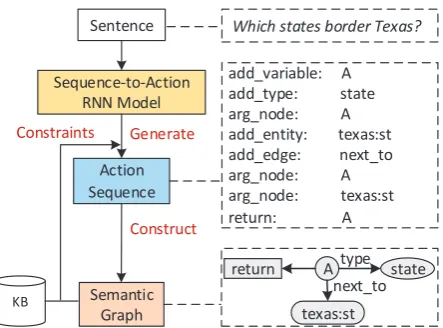
Figure 1: Overview of our method, with a demon-stration example.
tures for candidate logical forms ranking. Un-fortunately, it is challenging to design grammars and learn accurate lexicons, especially in wide-open domains. Moreover, it is often hard to design effective features, and its learning process is not end-to-end. To resolve the above problems, two promising lines of work have been proposed: Se-mantic graph-based methods and Seq2Seq meth-ods.
are either constructed by matching with patterns (Bast and Haussmann, 2015), transforming from dependency tree (Reddy et al., 2014, 2016), or via a staged heuristic search algorithm (Yih et al., 2015). These methods are all based on manually-designed, heuristic construction processes, mak-ing them hard to handle open/complex situations.
In recent years, RNN models have achieved success in sequence-to-sequence problems due to its strong ability on both representation learning and prediction, e.g., in machine translation (Cho et al., 2014). A lot of Seq2Seq models have also been employed for semantic parsing (Xiao et al., 2016; Dong and Lapata, 2016; Jia and Liang,2016), where a sentence is parsed by trans-lating it to linearized logical form using RNN models. There is no need for high-quality lexi-cons, manually-built grammars, and hand-crafted features. These models are trained end-to-end, and can leverage attention mechanism (Bahdanau et al.,2014;Luong et al.,2015) to learn soft align-ments between sentences and logical forms.
In this paper, we propose a new neural semantic parsing framework – Sequence-to-Action, which can simultaneously leverage the advantages of se-mantic graph representation and the strong predic-tion ability of Seq2Seq models. Specifically, we model semantic parsing as an end-to-end semantic graph generation process. For example in Figure 1, our model will parse the sentence “Which states border Texas” by generating a sequence of ac-tions [add variable:A, add type:state, ...]. To achieve the above goal, we first design an action set which can encode the generation process of semantic graph (including node actions such as add variable, add entity, add type, edge actions such asadd edge, and operation ac-tions such as argmin, argmax, count, sum, etc.). And then we design a RNN model which can generate the action sequence for constructing the semantic graph of a sentence. Finally we fur-ther enhance parsing by incorporating both struc-ture and semantic constraints during decoding.
Compared with the manually-designed, heuris-tic generation algorithms used in traditional se-mantic graph-based methods, our sequence-to-action method generates semantic graphs using a RNN model, which is learned end-to-end from training data. Such a learnable, end-to-end gener-ation makes our approach more effective and can fit to different situations.
Compared with the previous Seq2Seq seman-tic parsing methods, our sequence-to-action model predicts a sequence of semantic graph generation actions, rather than linearized logical forms. We find that the action sequence encoding can better capture structure and semantic information, and is more compact. And the parsing can be en-hanced by exploiting structure and semantic con-straints. For example, in GEO dataset, the action
add edge:next tomust subject to the seman-tic constraint that its arguments must be of type
state and state, and the structure constraint that the edgenext tomust connect two nodes to form a valid graph.
We evaluate our approach on three standard datasets: GEO (Zelle and Mooney, 1996), ATIS
(He and Young, 2005) and OVERNIGHT (Wang
et al., 2015b). The results show that our method achieves state-of-the-art performance on OVERNIGHTdataset and gets competitive
perfor-mance on GEOand ATISdatasets.
The main contributions of this paper are sum-marized as follows:
• We propose a new semantic parsing frame-work – Sequence-to-Action, which models semantic parsing as an end-to-end semantic graph generation process. This new frame-work can synthesize the advantages of se-mantic graph representation and the predic-tion ability of Seq2Seq models.
• We design a sequence-to-action model, in-cluding an action set encoding for semantic graph generation and a Seq2Seq RNN model for action sequence prediction. We further enhance the parsing by exploiting structure and semantic constraints during decoding. Experiments validate the effectiveness of our method.
2 Sequence-to-Action Model for End-to-End Semantic Graph Generation
Sentence:Which river runs through the most states?
Semantic Graph:
Action Sequence:
most
arg_for_1 arg_for_2
A B
state traverse
type type
river return
Structure Semantic Arg
add_operation most add_variable A
add_type river A
add_variable B
add_type state B
add_edge traverse A, B
end_operation most A, B
[image:3.595.74.294.68.322.2]return A
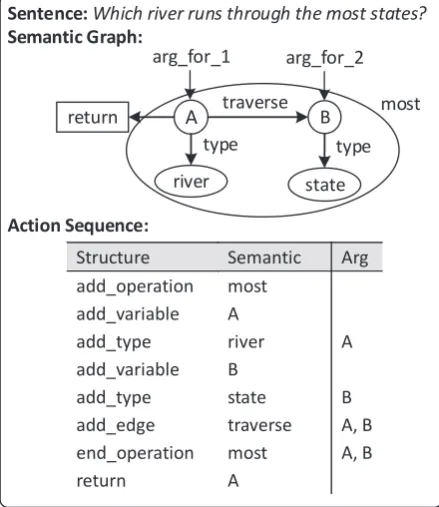
Figure 2: An example of a sentence paired with its semantic graph, together with the action sequence for semantic graph generation.
model is decomposed as follows:
P(Y|X) =
|Y| Y
t=1
P(yt|y<t, X) (1)
wherey<t =y1, ..., yt−1.
To achieve the above goal, we need: 1) an ac-tion set which can encode semantic graph genera-tion process; 2) an encoder which encodes natural language inputXinto a vector representation, and a decoder which generatesy1, ..., y|Y|conditioned on the encoding vector. In following we describe them in detail.
2.1 Actions for Semantic Graph Generation
Generally, a semantic graph consists of nodes (including variables, entities, types) and edges (semantic relations), with some universal opera-tions (e.g.,argmax,argmin,count,sum, and
not). To generate a semantic graph, we define six types of actions as follows:
Add Variable Node: This kind of actions
de-notes adding a variable node to semantic graph. In most cases a variable node is a return node (e.g., which,what), but can also be an intermediate vari-able node. We represent this kind of action as
add variable:A, where A is the identifier of the variable node.
Add Entity Node:This kind of actions denotes
adding an entity node (e.g.,Texas,New York) and is represented as add entity node:texas. An entity node corresponds to an entity in knowl-edge bases.
Add Type Node: This kind of actions denotes
adding a type node (e.g.,state,city). We represent them asadd type node:state.
Add Edge:This kind of actions denotes adding
an edge between two nodes. An edge is a binary relation in knowledge bases. This kind of actions is represented asadd edge:next to.
Operation Action: This kind of actions
de-notes adding an operation. An operation can be
argmax,argmin,count,sum,not, et al. Be-cause each operation has a scope, we define two actions for an operation, one is operation start ac-tion, represented asstart operation:most, and the other is operation end action, repre-sented as end operation:most. The sub-graph within the start and end operation actions is its scope.
Argument Action: Some above actions need
argument information. For example, which nodes the add edge:next to action should connect to. In this paper, we design argument actions foradd type,add edgeandoperation ac-tions, and the argument actions should be put di-rectly after its main action.
Foradd typeactions, we put an argument ac-tion to indicate which node this type node should constrain. The argument can be a variable node or an entity node. An argument action for a type node is represented asarg:A.
For add edge action, we use two argu-ment actions: arg1 node and arg2 node, and they are represented as arg1 node:A and
arg2 node:B.
We design argument actions for different op-erations. For operation:sum, there are three arguments: arg-for, arg-in and
arg-return. For operation:count, they arearg-forandarg-return. There are two
b1 b2 bm
x1 x2 xm
attentio n
s1 s2 sn
y1 yn-1 softmax controller
y1 y2 yn
... ...
[image:4.595.74.297.64.140.2]...
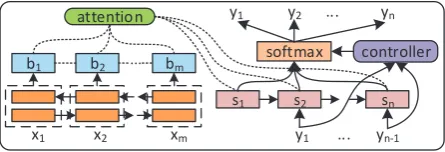
Figure 3: Our attention-based Sequence-to-Action RNN model, with a controller for incorporating constraints.
2.2 Neural Sequence-to-Action Model
Based on the above action encoding mechanism, this section describes our encoder-decoder model for mapping sentence to action sequence. Specif-ically, similar to the RNN model in Jia and Liang (2016), this paper employs the attention-based sequence-to-sequence RNN model. Figure 3presents the overall structure.
Encoder: The encoder converts the input
se-quence x1, ..., xm to a sequence of
context-sensitive vectors b1, ..., bm using a bidirectional
RNN (Bahdanau et al.,2014). Firstly each wordxi
is mapped to its embedding vector, then these vec-tors are fed into a forward RNN and a backward RNN. The sequence of hidden statesh1, ..., hmare
generated by recurrently applying the recurrence:
hi =LST M(φ(x)(xi), hi−1). (2)
The recurrence takes the form of LSTM ( Hochre-iter and Schmidhuber,1997). Finally, for each in-put positioni, we define its context-sensitive em-bedding asbi= [hFi , hBi ].
Decoder: This paper uses the classical attention-based decoder (Bahdanau et al.,2014), which gen-erates action sequence y1, ..., yn, one action at a
time. At each time step j, it writes yj based on
the current hidden state sj, then updates the
hid-den state tosj+1 based onsj andyj. The decoder
is formally defined by the following equations:
s1 = tanh(W(s)[hFm, hB1]) (3) eji =sTjW(a)bi (4)
aji =
exp(eji)
Pm
i0=1exp(eji0)
(5)
cj = m
X
i=1
ajibi (6)
P(yj =w|x, y1:j−1)∝exp(Uw[sj, cj]) (7)
sj+1 =LST M([φ(y)(yj), cj], sj) (8)
where the normalized attention scoresaji defines
the probability distribution over input words, in-dicating the attention probability on input wordi at timej;ejiis un-normalized attention score. To
incorporate constraints during decoding, an extra controller component is added and its details will be described in Section3.3.
Action Embedding. The above decoder needs
the embedding of each action. As described above, each action has two parts, one for struc-ture (e.g., add edge), and the other for se-mantic (e.g., next to). As a result, ac-tions may share the same structure or se-mantic part, e.g., add edge:next to and
add edge:loc have the same structure part, and add node:A and arg node:A have the same semantic part. To make parameters more compact, we first embed the structure part and the semantic part independently, then concate-nate them to get the final embedding. For in-stance, φ(y)(add edge:next to ) = [φ(struty) (
add edge), φ(semy) (next to)]. The action
em-beddingsφ(y)are learned during training.
3 Constrained Semantic Parsing using Sequence-to-Action Model
In this section, we describe how to build a neural semantic parser using sequence-to-action model. We first describe the training and the inference of our model, and then introduce how to incorporate structure and semantic constraints during decod-ing.
3.1 Training
Parameter Estimation. The parameters of our
model include RNN parametersW(s),W(a),Uw,
word embeddings φ(x), and action embeddings φ(y). We estimate these parameters from training data. Given a training example with a sentenceX and its action sequenceY, we maximize the like-lihood of the generated sequence of actions given X. The objective function is:
n
X
i=1
logP(Yi|Xi) (9)
Standard stochastic gradient descent algorithm is employed to update parameters.
Logical Form to Action Sequence. Currently,
compiler generator
compiler generator
Action Sequence Semantic
Graph Logical
[image:5.595.71.299.62.113.2]Form
Figure 4: The procedure of converting between logical form and action sequence.
convert logical forms to action sequences using semantic graph as an intermediate representation (See Figure 4 for an overview). Concretely, we transform logical forms into semantic graphs us-ing a depth-first-search algorithm from root, and then generate the action sequence using the same order. Specifically, entities, variables and types are nodes; relations are edges. Conversely we can convert action sequence to logical form similarly. Based on the above algorithm, action sequences can be transformed into logical forms in a deter-ministic way, and the same for logical forms to action sequences.
Mechanisms for Handling Entities.Entities play
an important role in semantic parsing (Yih et al., 2015). In Dong and Lapata (2016), entities are replaced with their types and unique IDs. In Jia and Liang (2016), entities are generated via attention-based copying mechanism helped with a lexicon. This paper implements both mechanisms and compares them in experiments.
3.2 Inference
Given a new sentence X, we predict action se-quence by:
Y∗ = argmax
Y
P(Y|X) (10)
whereY represents action sequence, andP(Y|X)
is computed using Formula (1). Beam search is used for best action sequence decoding. Semantic graph and logical form can be derived fromY∗ as described in above.
3.3 Incorporating Constraints in Decoding
For decoding, we generate action sequentially. It is obviously that the next action has a strong cor-relation with the partial semantic graph generated to current, and illegal actions can be filtered us-ing structure and semantic constraints. Specifi-cally, we incorporate constraints in decoding using a controller. This procedure has two steps: 1) the controller constructs partial semantic graph using the actions generated to current; 2) the controller checks whether a new generated action can meet
Sentence:Which states border Texas?
Partial Semantic Graph:
A next_to
type state
texas:st
Structure Semantic Arg Validity
Generated Actions
add_variable A
add_type state A add_entity texas:st
Candidate Next Action
add_type city texas:st O add_edge loc A, texas:st O add_edge next_to A, A O add_edge next_to A, texas:st P
… … … …
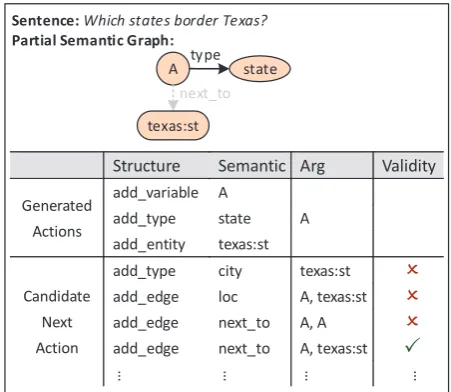
Figure 5: A demonstration of illegal action filter-ing usfilter-ing constraints. The graph in color is the constructed semantic graph to current.
all structure/semantic constraints using the partial semantic graph.
Structure Constraints. The structure constraints
ensure action sequence will form a connected acyclic graph. For example, there must be two ar-gument nodes for an edge, and the two arar-gument nodes should be different (The third candidate next action in Figure 5 violates this constraint). This kind of constraints are domain-independent. The controller encodes structure constraints as a set of rules.
Semantic Constraints. The semantic constraints
ensure the constructed graph must follow the schema of knowledge bases. Specifically, we model two types of semantic constraints. One is selectional preference constraints where the argu-ment types of a relation should follow knowledge base schemas. For example, in GEOdataset, rela-tionnext to’sarg1 andarg2 should both be astate. The second is type conflict constraints, i.e., an entity/variable node’s type must be consis-tent, i.e., a node cannot be both of typecityand
state. Semantic constraints are domain-specific and are automatically extracted from knowledge base schemas. The controller encodes semantic constraints as a set of rules.
4 Experiments
[image:5.595.307.533.63.259.2]4.1 Datasets
We conduct experiments on three standard datasets: GEO, ATISand OVERNIGHT.
GEO contains natural language questions about US geography paired with corresponding Pro-log database queries. FollowingZettlemoyer and Collins (2005), we use the standard 600/280 in-stance splits for training/test.
ATIS contains natural language questions of a flight database, with each question is annotated with a lambda calculus query. Following Zettle-moyer and Collins (2007), we use the standard 4473/448 instance splits for training/test.
OVERNIGHT contains natural language
para-phrases paired with logical forms across eight do-mains. We evaluate on the standard train/test splits asWang et al.(2015b).
4.2 Experimental Settings
Following the experimental setup ofJia and Liang (2016): we use 200 hidden units and 100-dimensional word vectors for sentence encoding. The dimensions of action embedding are tuned on validation datasets for each corpus. We initialize all parameters by uniformly sampling within the interval [-0.1, 0.1]. We train our model for a to-tal of 30 epochs with an initial learning rate of 0.1, and halve the learning rate every 5 epochs af-ter epoch 15. We replace word vectors for words occurring only once with an universal word vec-tor. The beam size is set as 5. Our model is implemented in Theano (Bergstra et al., 2010), and the codes and settings are released on Github: https://github.com/dongpobeyond/Seq2Act.
We evaluate different systems using the stan-dard accuracy metric, and the accuracies on differ-ent datasets are obtained as same asJia and Liang (2016).
4.3 Overall Results
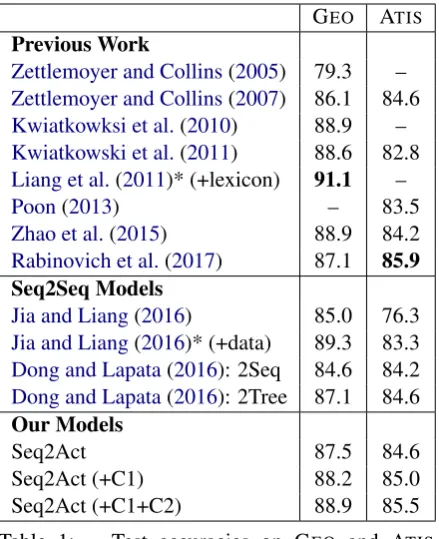
We compare our method with state-of-the-art sys-tems on all three datasets. Because all syssys-tems us-ing the same trainus-ing/test splits, we directly use the reported best performances from their original papers for fair comparison.
For our method, we train our model with three settings: the first one is the basic sequence-to-action model without constraints – Seq2Act; the second one adds structure constraints in decod-ing – Seq2Act (+C1); the third one is the full model which adds both structure and semantic
GEO ATIS
Previous Work
Zettlemoyer and Collins(2005) 79.3 – Zettlemoyer and Collins(2007) 86.1 84.6 Kwiatkowksi et al.(2010) 88.9 – Kwiatkowski et al.(2011) 88.6 82.8 Liang et al.(2011)* (+lexicon) 91.1 –
Poon(2013) – 83.5
Zhao et al.(2015) 88.9 84.2 Rabinovich et al.(2017) 87.1 85.9 Seq2Seq Models
Jia and Liang(2016) 85.0 76.3 Jia and Liang(2016)* (+data) 89.3 83.3 Dong and Lapata(2016): 2Seq 84.6 84.2 Dong and Lapata(2016): 2Tree 87.1 84.6
Our Models
Seq2Act 87.5 84.6
Seq2Act (+C1) 88.2 85.0
[image:6.595.308.528.62.332.2]Seq2Act (+C1+C2) 88.9 85.5
Table 1: Test accuracies on GEO and ATIS
datasets, where * indicates systems with extra-resources are used.
constraints – Seq2Act (+C1+C2). Semantic con-straints (C2) are stricter than structure concon-straints (C1). Therefore we set that C1 should be first met for C2 to be met. So in our experiments we add constraints incrementally. The overall results are shown in Table1-2. From the overall results, we can see that:
1) By synthetizing the advantages of seman-tic graph representation and the prediction abil-ity of Seq2Seq model, our method achieves state-of-the-art performance on OVERNIGHT dataset,
and gets competitive performance on GEO and ATIS dataset. In fact, on GEO our full model (Seq2Act+C1+C2) also gets the best test accuracy of 88.9 if under the same settings, which only falls behindLiang et al.(2011)* which uses extra hand-crafted lexicons andJia and Liang(2016)* which uses extra augmented training data. On ATIS our full model gets the second best test accuracy of 85.5, which only falls behind Rabinovich et al. (2017) which uses a supervised attention strategy. On OVERNIGHT, our full model gets state-of-the-art accuracy of 79.0, which even outperformsJia and Liang(2016)* with extra augmented training data.
Soc. Blo. Bas. Res. Cal. Hou. Pub. Rec. Avg.
Previous Work
Wang et al.(2015b) 48.2 41.9 46.3 75.9 74.4 54.0 59.0 70.8 58.8
Seq2Seq Models
Xiao et al.(2016) 80.0 55.6 80.5 80.1 75.0 61.9 75.8 – 72.7 Jia and Liang(2016) 81.4 58.1 85.2 76.2 78.0 71.4 76.4 79.6 75.8 Jia and Liang(2016)* (+data) 79.6 60.2 87.5 79.5 81.0 72.5 78.3 81.0 77.5
Our Models
Seq2Act 81.4 60.4 87.5 79.8 81.0 73.0 79.5 81.5 78.0 Seq2Act (+C1) 81.8 60.9 88.0 80.1 81.0 73.5 80.1 82.0 78.4 Seq2Act (+C1+C2) 82.1 61.4 88.2 80.7 81.5 74.1 80.7 82.9 79.0
Table 2: Test accuracies on OVERNIGHTdataset, which includes eight domains: Social, Blocks, Bas-ketball, Restaurants, Calendar, Housing, Publications, and Recipes.
our basic Seq2Act model gets better results than all Seq2Seq baselines. On GEO, the Seq2Act model achieve test accuracy of 87.5, better than the best accuracy 87.1 of Seq2Seq baseline. On ATIS, the Seq2Act model obtains a test accuracy of 84.6, the same as the best Seq2Seq baseline. On OVERNGIHT, the Seq2Act model gets a test accu-racy of 78.0, better than the best Seq2Seq baseline gets 77.5. We argue that this is because our ac-tion sequence encoding is more compact and can capture more information.
3) Structure constraints can enhance semantic parsing by ensuring the validity of graph using the generated action sequence. In all three datasets, Seq2Act (+C1) outperforms the basic Seq2Act model. This is because a part of illegal actions will be filtered during decoding.
4) By leveraging knowledge base schemas dur-ing decoddur-ing, semantic constraints are effective for semantic parsing. Compared to Seq2Act and Seq2Act (+C1), the Seq2Act (+C1+C2) gets the best performance on all three datasets. This is because semantic constraints can further filter se-mantic illegal actions using selectional preference and consistency between types.
4.4 Detailed Analysis
Effect of Entity Handling Mechanisms.This
pa-per implements two entity handling mechanisms – Replacing(Dong and Lapata,2016) which identi-fies entities and then replaces them with their types and IDs, and attention-based Copying (Jia and Liang, 2016). To compare the above two mech-anisms, we train and test with our full model and the results are shown in Table3. We can see that, Replacingmechanism outperformsCopyingin all three datasets. This is becauseReplacing is done
Replacing Copying
GEO 88.9 88.2
ATIS 85.5 84.0
[image:7.595.82.518.61.214.2]OVERNIGHT 79.0 77.9
Table 3: Test accuracies of Seq2Act (+C1+C2) on GEO, ATIS, and OVERNIGHT of two entity han-dling mechanisms.
Logical Form Action Sequence
GEO 28.2 18.2
ATIS 28.4 25.8
OVERNIGHT 46.6 33.3
Table 4: Average length of logical forms and ac-tion sequences on three datasets. On OVERNIGHT, we average across all eight domains.
in preprocessing, while attention-based Copying is done during parsing and needs additional copy mechanism.
Linearized Logical Form vs. Action Sequence.
Table4shows the average length of linearized log-ical forms used in previous Seq2Seq models and the action sequences of our model on all three datasets. As we can see, action sequence en-coding is more compact than linearized logical form encoding: action sequence is shorter on all three datasets, 35.5%, 9.2% and 28.5% reduction in length respectively. The main advantage of a shorter/compact encoding is that it will reduce the influence of long distance dependency problem.
4.5 Error Analysis
We perform error analysis on results and find there are mainly two types of errors.
Unseen/Informal Sentence Structure.Some test
[image:7.595.325.512.260.317.2]Error Types Examples
Un-covered Sentence Structure
Sentence:Iowa borders how many states?(Formal Form:How many states does Iowa border?)
Gold Parse: answer(A, count(B, (const (C, stateid(iowa)), next to(C, B),
state (B)), A))
Predicted Parse:answer (A, count(B, state(B), A))
Under-Mapping
Sentence:Please show mefirst classflights from indianapolis to memphis one way leaving before 10am
Gold Parse: (lambda x (and (flight x) (oneway x) (class type x first:cl)
(< (departure time x) 1000:ti) (from x indianapolis:ci) (to x memphis:ci)))
[image:8.595.77.524.61.176.2]Predicted Parse: (lambda x (and (flight x) (oneway x) (< (departure time x) 1000:ti) (from x indianapolis:ci) (to x memphis:ci)))
Table 5: Some examples for error analysis. Each example includes the sentence for parsing, with gold parse and predicted parse from our model.
and informal structure, where entity word “Iowa” and relation word “borders” appear ahead of the question words “how many”. For this problem, we can employ sentence rewriting or paraphrasing techniques (Chen et al.,2016;Dong et al.,2017) to transform unseen sentence structures into normal ones.
Under-Mapping. As Dong and Lapata (2016)
discussed, the attention model does not take the alignment history into consideration, makes some words are ignored during parsing. For example in the second case in Table5, “first class” is ignored during the decoding process. This problem can be further solved using explicit word coverage mod-els used in neural machine translation (Tu et al., 2016;Cohn et al.,2016)
5 Related Work
Semantic parsing has received significant attention for a long time (Kate and Mooney,2006;Clarke et al., 2010; Krishnamurthy and Mitchell, 2012; Artzi and Zettlemoyer, 2013; Berant and Liang, 2014;Quirk et al.,2015;Artzi et al.,2015;Reddy et al., 2017). Traditional methods are mostly based on the principle of compositional seman-tics, which first trigger predicates using lexicons and then compose them using grammars. The prominent grammars include SCFG (Wong and Mooney,2007;Li et al.,2015), CCG (Zettlemoyer and Collins,2005;Kwiatkowski et al.,2011;Cai and Yates, 2013), DCS (Liang et al., 2011; Be-rant et al., 2013), etc. As discussed above, the main drawback of grammar-based methods is that they rely on high-quality lexicons, manually-built grammars, and hand-crafted features.
In recent years, one promising direction of se-mantic parsing is to use sese-mantic graph as rep-resentation. Thus semantic parsing is modeled as a semantic graph generation process. Ge and Mooney (2009) build semantic graph by
trans-forming syntactic tree. Bast and Haussmann (2015) identify the structure of a semantic query using three pre-defined patterns. Reddy et al. (2014, 2016) use Freebase-based semantic graph representation, and convert sentences to semantic graphs using CCG or dependency tree. Yih et al. (2015) generate semantic graphs using a staged heuristic search algorithm. These methods are all based on manually-designed, heuristic generation process, which may suffer from syntactic parse er-rors (Ge and Mooney, 2009;Reddy et al.,2014, 2016), structure mismatch (Chen et al.,2016), and are hard to deal with complex sentences (Yih et al., 2015).
One other direction is to employ neural Seq2Seq models, which models semantic parsing as an end-to-end, sentence to logical form machine translation problem. Dong and Lapata(2016),Jia and Liang(2016) andXiao et al.(2016) transform word sequence to linearized logical forms. One main drawback of these methods is that it is hard to capture and exploit structure and semantic con-straints using linearized logical forms. Dong and Lapata(2016) propose a Seq2Tree model to cap-ture the hierarchical struccap-ture of logical forms.
It has been shown that structure and tic constraints are effective for enhancing seman-tic parsing. Krishnamurthy et al.(2017) use type constraints to filter illegal tokens. Liang et al. (2017) adopt a Lisp interpreter with pre-defined functions to produce valid tokens. Iyyer et al. (2017) adopt type constraints to generate valid ac-tions. Inspired by these approaches, we also in-corporate both structure and semantic constraints in our neural sequence-to-action model.
con-straints can be exploited for more accurate decod-ing. We believe this can also be used to enhance previous transition based methods and may also be used in other parsing tasks, e.g., AMR parsing.
6 Conclusions
This paper proposes Sequence-to-Action, a method which models semantic parsing as an end-to-end semantic graph generation process. By leveraging the advantages of semantic graph representation and exploiting the representation learning and prediction ability of Seq2Seq models, our method achieved significant performance im-provements on three datasets. Furthermore, struc-ture and semantic constraints can be easily incor-porated in decoding to enhance semantic parsing.
For future work, to solve the problem of the lack of training data, we want to design weakly super-vised learning algorithm using denotations (QA pairs) as supervision. Furthermore, we want to collect labeled data by designing an interactive UI for annotation assist like (Yih et al.,2016), which uses semantic graphs to annotate the meaning of sentences, since semantic graph is more natural and can be easily annotated without the need of expert knowledge.
Acknowledgments
This research work is supported by the National Key Research and Development Program of China under Grant No.2017YFB1002104; and the Na-tional Natural Science Foundation of China under Grants no. 61572477 and 61772505. Moreover, we sincerely thank the reviewers for their valuable comments.
References
Yoav Artzi, Kenton Lee, and Luke Zettlemoyer.
2015. Broad-coverage ccg semantic parsing
with amr. In Proceedings of the 2015 Con-ference on Empirical Methods in Natural Lan-guage Processing. Association for Computational Linguistics, Lisbon, Portugal, pages 1699–1710.
http://aclweb.org/anthology/D15-1198.
Yoav Artzi and Luke Zettlemoyer. 2013. Weakly su-pervised learning of semantic parsers for mapping
instructions to actions. Transactions of the
Associa-tion for ComputaAssocia-tional Linguistics1(1):49–62.
Dzmitry Bahdanau, Kyunghyun Cho, and Yoshua
Bengio. 2014. Neural machine translation by
jointly learning to align and translate. CoRR
abs/1409.0473. http://arxiv.org/abs/1409.0473.
Hannah Bast and Elmar Haussmann. 2015. More
accurate question answering on freebase. In Proceedings of the 24th ACM International on Conference on Information and Knowledge Man-agement, CIKM 2015, Melbourne, VIC, Aus-tralia, October 19 - 23, 2015. pages 1431–1440.
https://doi.org/10.1145/2806416.2806472.
Jonathan Berant, Andrew Chou, Roy Frostig, and Percy
Liang. 2013. Semantic parsing on Freebase from
question-answer pairs. In Proceedings of the 2013 Conference on Empirical Methods in Natural Lan-guage Processing. Association for Computational Linguistics, Seattle, Washington, USA, pages 1533–
1544.http://www.aclweb.org/anthology/D13-1160.
Jonathan Berant and Percy Liang. 2014.
Se-mantic parsing via paraphrasing. In Proceed-ings of the 52nd Annual Meeting of the Asso-ciation for Computational Linguistics (Volume 1: Long Papers). Association for Computational Lin-guistics, Baltimore, Maryland, pages 1415–1425.
http://www.aclweb.org/anthology/P14-1133.
James Bergstra, Olivier Breuleux, Fr´ed´eric Bastien, Pascal Lamblin, Razvan Pascanu, Guillaume Des-jardins, Joseph Turian, David Warde-Farley, and Yoshua Bengio. 2010. Theano: A cpu and gpu math
compiler in python. InProc. 9th Python in Science
Conf. pages 1–7.
Qingqing Cai and Alexander Yates. 2013. Large-scale
semantic parsing via schema matching and lexicon extension. InProceedings of the 51st Annual Meet-ing of the Association for Computational LMeet-inguistics (Volume 1: Long Papers). Association for Computa-tional Linguistics, Sofia, Bulgaria, pages 423–433.
http://www.aclweb.org/anthology/P13-1042.
Bo Chen, Le Sun, Xianpei Han, and Bo An. 2016.
Sentence rewriting for semantic parsing. In Proceedings of the 54th Annual Meeting of the Association for Computational Linguistics (Vol-ume 1: Long Papers). Association for Computa-tional Linguistics, Berlin, Germany, pages 766–777.
http://www.aclweb.org/anthology/P16-1073.
Kyunghyun Cho, Bart van Merrienboer, Caglar Gul-cehre, Dzmitry Bahdanau, Fethi Bougares, Holger
Schwenk, and Yoshua Bengio. 2014. Learning
phrase representations using rnn encoder–decoder for statistical machine translation. InProceedings of the 2014 Conference on Empirical Methods in Nat-ural Language Processing (EMNLP). Association for Computational Linguistics, Doha, Qatar, pages
1724–1734.
http://www.aclweb.org/anthology/D14-1179.
James Clarke, Dan Goldwasser, Ming-Wei Chang,
and Dan Roth. 2010. Driving semantic parsing
from the world’s response. In Proceedings of the Fourteenth Conference on Computational Nat-ural Language Learning. Association for Computa-tional Linguistics, Uppsala, Sweden, pages 18–27.
Trevor Cohn, Cong Duy Vu Hoang, Ekaterina Vy-molova, Kaisheng Yao, Chris Dyer, and
Gholam-reza Haffari. 2016. Incorporating structural
align-ment biases into an attentional neural translation model. In Proceedings of the 2016 Conference of the North American Chapter of the Associa-tion for ComputaAssocia-tional Linguistics: Human Lan-guage Technologies. Association for Computational Linguistics, San Diego, California, pages 876–885.
http://www.aclweb.org/anthology/N16-1102.
Li Dong and Mirella Lapata. 2016. Language
to logical form with neural attention. In Pro-ceedings of the 54th Annual Meeting of the Association for Computational Linguistics (Vol-ume 1: Long Papers). Association for Computa-tional Linguistics, Berlin, Germany, pages 33–43.
http://www.aclweb.org/anthology/P16-1004.
Li Dong, Jonathan Mallinson, Siva Reddy, and Mirella
Lapata. 2017. Learning to paraphrase for
ques-tion answering. In Proceedings of the 2017 Con-ference on Empirical Methods in Natural Lan-guage Processing. Association for Computational Linguistics, Copenhagen, Denmark, pages 875–886.
https://www.aclweb.org/anthology/D17-1091.
Ruifang Ge and Raymond Mooney. 2009.
Learn-ing a compositional semantic parser usLearn-ing an existing syntactic parser. In Proceedings of the Joint Conference of the 47th Annual Meet-ing of the ACL and the 4th International Joint Conference on Natural Language Processing of the AFNLP. Association for Computational Linguistics, Suntec, Singapore, pages 611–619.
http://www.aclweb.org/anthology/P/P09/P09-1069.
Yulan He and Steve Young. 2005. Semantic
pro-cessing using the hidden vector state model. Computer Speech Language 19(1):85 – 106.
https://doi.org/https://doi.org/10.1016/j.csl.2004.03.001.
James Henderson, Paola Merlo, Ivan Titov, and
Gabriele Musillo. 2013. Multilingual joint parsing
of syntactic and semantic dependencies with a latent variable model. Comput. Linguist.39(4):949–998.
http://dx.doi.org/10.1162/COLIa00158.
Sepp Hochreiter and J¨urgen Schmidhuber. 1997. Long
short-term memory. Neural Comput. 9(8):1735–
1780.https://doi.org/10.1162/neco.1997.9.8.1735.
Mohit Iyyer, Wen-tau Yih, and Ming-Wei Chang.
2017. Search-based neural structured learning
for sequential question answering. In Proceed-ings of the 55th Annual Meeting of the Asso-ciation for Computational Linguistics (Volume 1: Long Papers). Association for Computational Lin-guistics, Vancouver, Canada, pages 1821–1831.
http://aclweb.org/anthology/P17-1167.
Robin Jia and Percy Liang. 2016. Data
recom-bination for neural semantic parsing. In Pro-ceedings of the 54th Annual Meeting of the
Association for Computational Linguistics (Vol-ume 1: Long Papers). Association for Computa-tional Linguistics, Berlin, Germany, pages 12–22.
http://www.aclweb.org/anthology/P16-1002.
Rohit J. Kate and Raymond J. Mooney. 2006.
Us-ing strUs-ing-kernels for learnUs-ing semantic parsers. In Proceedings of the 21st International Confer-ence on Computational Linguistics and 44th An-nual Meeting of the Association for Computa-tional Linguistics. Association for Computational Linguistics, Sydney, Australia, pages 913–920.
https://doi.org/10.3115/1220175.1220290.
Jayant Krishnamurthy, Pradeep Dasigi, and Matt
Gardner. 2017. Neural semantic parsing with
type constraints for semi-structured tables. In Proceedings of the 2017 Conference on Em-pirical Methods in Natural Language
Process-ing. Association for Computational
Linguis-tics, Copenhagen, Denmark, pages 1516–1526.
https://www.aclweb.org/anthology/D17-1160.
Jayant Krishnamurthy and Tom Mitchell. 2012.
Weakly supervised training of semantic parsers. In Proceedings of the 2012 Joint Conference on Empirical Methods in Natural Language Pro-cessing and Computational Natural Language Learning. Association for Computational
Lin-guistics, Jeju Island, Korea, pages 754–765.
http://www.aclweb.org/anthology/D12-1069.
Tom Kwiatkowksi, Luke Zettlemoyer, Sharon
Gold-water, and Mark Steedman. 2010. Inducing
prob-abilistic CCG grammars from logical form with higher-order unification. In Proceedings of the 2010 Conference on Empirical Methods in Natu-ral Language Processing. Association for Compu-tational Linguistics, Cambridge, MA, pages 1223–
1233.http://www.aclweb.org/anthology/D10-1119.
Tom Kwiatkowski, Eunsol Choi, Yoav Artzi, and Luke
Zettlemoyer. 2013. Scaling semantic parsers with
on-the-fly ontology matching. In Proceedings of the 2013 Conference on Empirical Methods in Natu-ral Language Processing. Association for Computa-tional Linguistics, Seattle, Washington, USA, pages
1545–1556.
http://www.aclweb.org/anthology/D13-1161.
Tom Kwiatkowski, Luke Zettlemoyer, Sharon
Gold-water, and Mark Steedman. 2011. Lexical
gen-eralization in ccg grammar induction for seman-tic parsing. In Proceedings of the 2011 Confer-ence on Empirical Methods in Natural Language Processing. Association for Computational Linguis-tics, Edinburgh, Scotland, UK., pages 1512–1523.
http://www.aclweb.org/anthology/D11-1140.
Junhui Li, Muhua Zhu, Wei Lu, and Guodong Zhou.
2015. Improving semantic parsing with enriched
synchronous context-free grammar. In Proceed-ings of the 2015 Conference on Empirical Methods in Natural Language Processing. Association for Computational Linguistics, Lisbon, Portugal, pages
Chen Liang, Jonathan Berant, Quoc Le, Kenneth D.
Forbus, and Ni Lao. 2017. Neural symbolic
ma-chines: Learning semantic parsers on freebase with weak supervision. InProceedings of the 55th An-nual Meeting of the Association for Computational Linguistics (Volume 1: Long Papers). Association for Computational Linguistics, Vancouver, Canada,
pages 23–33.
http://aclweb.org/anthology/P17-1003.
Percy Liang, Michael Jordan, and Dan Klein.
2011. Learning dependency-based
composi-tional semantics. In Proceedings of the 49th Annual Meeting of the Association for Com-putational Linguistics: Human Language Tech-nologies. Association for Computational Linguis-tics, Portland, Oregon, USA, pages 590–599.
http://www.aclweb.org/anthology/P11-1060.
Wei Lu, Hwee Tou Ng, Wee Sun Lee, and
Luke S. Zettlemoyer. 2008. A generative model
for parsing natural language to meaning repre-sentations. In Proceedings of the 2008 Con-ference on Empirical Methods in Natural Lan-guage Processing. Association for Computational Linguistics, Honolulu, Hawaii, pages 783–792.
http://www.aclweb.org/anthology/D08-1082.
Thang Luong, Hieu Pham, and Christopher D.
Man-ning. 2015. Effective approaches to attention-based
neural machine translation. InProceedings of the 2015 Conference on Empirical Methods in Natu-ral Language Processing. Association for Compu-tational Linguistics, Lisbon, Portugal, pages 1412–
1421.http://aclweb.org/anthology/D15-1166.
Joakim Nivre. 2008. Algorithms for deterministic
in-cremental dependency parsing. Comput. Linguist.
34(4):513–553.
http://dx.doi.org/10.1162/coli.07-056-R1-07-027.
Hoifung Poon. 2013. Grounded unsupervised
seman-tic parsing. InProceedings of the 51st Annual Meet-ing of the Association for Computational LMeet-inguistics (Volume 1: Long Papers). Association for Computa-tional Linguistics, Sofia, Bulgaria, pages 933–943.
http://www.aclweb.org/anthology/P13-1092.
Chris Quirk, Raymond Mooney, and Michel Galley.
2015.Language to code: Learning semantic parsers
for if-this-then-that recipes. InProceedings of the 53rd Annual Meeting of the Association for Compu-tational Linguistics and the 7th International Joint Conference on Natural Language Processing (Vol-ume 1: Long Papers). Association for Computa-tional Linguistics, Beijing, China, pages 878–888.
http://www.aclweb.org/anthology/P15-1085.
Maxim Rabinovich, Mitchell Stern, and Dan Klein.
2017. Abstract syntax networks for code
gen-eration and semantic parsing. In Proceed-ings of the 55th Annual Meeting of the Asso-ciation for Computational Linguistics (Volume 1: Long Papers). Association for Computational Lin-guistics, Vancouver, Canada, pages 1139–1149.
http://aclweb.org/anthology/P17-1105.
Siva Reddy, Mirella Lapata, and Mark Steedman.
2014. Large-scale semantic parsing without
question-answer pairs. Transactions of the Asso-ciation for Computational Linguistics 2:377–392.
http://aclweb.org/anthology/Q14-1030.
Siva Reddy, Oscar T¨ackstr¨om, Michael Collins,
Tom Kwiatkowski, Dipanjan Das, Mark
Steed-man, and Mirella Lapata. 2016. Transforming
Dependency Structures to Logical Forms for Semantic Parsing. Transactions of the Associ-ation for ComputAssoci-ational Linguistics 4:127–140.
http://sivareddy.in/papers/reddy2016transforming.pdf.
Siva Reddy, Oscar T¨ackstr¨om, Slav Petrov, Mark
Steedman, and Mirella Lapata. 2017. Universal
semantic parsing. In Proceedings of the 2017 Conference on Empirical Methods in Natural Lan-guage Processing. Association for Computational Linguistics, Copenhagen, Denmark, pages 89–101.
https://www.aclweb.org/anthology/D17-1009.
Zhaopeng Tu, Zhengdong Lu, Yang Liu,
Xiao-hua Liu, and Hang Li. 2016. Modeling
cov-erage for neural machine translation. In Pro-ceedings of the 54th Annual Meeting of the Association for Computational Linguistics (Vol-ume 1: Long Papers). Association for Computa-tional Linguistics, Berlin, Germany, pages 76–85.
http://www.aclweb.org/anthology/P16-1008.
Chuan Wang, Nianwen Xue, and Sameer Pradhan.
2015a. A transition-based algorithm for amr
parsing. In Proceedings of the 2015 Confer-ence of the North American Chapter of the As-sociation for Computational Linguistics: Human Language Technologies. Association for Computa-tional Linguistics, Denver, Colorado, pages 366– 375. http://www.aclweb.org/anthology/N15-1040.
Yushi Wang, Jonathan Berant, and Percy Liang. 2015b.
Building a semantic parser overnight. In Proceed-ings of the 53rd Annual Meeting of the Association for Computational Linguistics and the 7th Interna-tional Joint Conference on Natural Language Pro-cessing (Volume 1: Long Papers). Association for Computational Linguistics, Beijing, China, pages
1332–1342.
http://www.aclweb.org/anthology/P15-1129.
Yuk Wah Wong and Raymond Mooney. 2007.
Learn-ing synchronous grammars for semantic parsLearn-ing with lambda calculus. In Proceedings of the 45th Annual Meeting of the Association of Computa-tional Linguistics. Association for Computational Linguistics, Prague, Czech Republic, pages 960– 967. http://www.aclweb.org/anthology/P07-1121.
Chunyang Xiao, Marc Dymetman, and Claire Gardent.
2016. Sequence-based structured prediction for
se-mantic parsing. InProceedings of the 54th Annual Meeting of the Association for Computational Lin-guistics (Volume 1: Long Papers). Association for Computational Linguistics, Berlin, Germany, pages
1341–1350.
Wen-tau Yih, Ming-Wei Chang, Xiaodong He, and
Jianfeng Gao. 2015. Semantic parsing via staged
query graph generation: Question answering with knowledge base. In Proceedings of the 53rd Annual Meeting of the Association for Computa-tional Linguistics and the 7th InternaComputa-tional Joint Conference on Natural Language Processing (Vol-ume 1: Long Papers). Association for Compu-tational Linguistics, Beijing, China, pages 1321–
1331.http://www.aclweb.org/anthology/P15-1128.
Wen-tau Yih, Matthew Richardson, Chris Meek,
Ming-Wei Chang, and Jina Suh. 2016. The value of
se-mantic parse labeling for knowledge base question answering. InProceedings of the 54th Annual Meet-ing of the Association for Computational LMeet-inguistics (Volume 2: Short Papers). Association for Computa-tional Linguistics, Berlin, Germany, pages 201–206.
http://anthology.aclweb.org/P16-2033.
John M. Zelle and Raymond J. Mooney. 1996.
Learning to parse database queries using induc-tive logic programming. In AAAI/IAAI. AAAI Press/MIT Press, Portland, OR, pages 1050–1055.
http://www.cs.utexas.edu/users/ai-lab/?zelle:aaai96.
Luke Zettlemoyer and Michael Collins. 2007.
On-line learning of relaxed CCG grammars for parsing to logical form. In Proceedings of the 2007 Joint Conference on Empirical Methods in Natural Language Processing and Compu-tational Natural Language Learning (EMNLP-CoNLL). Association for Computational Linguis-tics, Prague, Czech Republic, pages 678–687.
http://www.aclweb.org/anthology/D/D07/D07-1071.
Luke S. Zettlemoyer and Michael Collins. 2005. Learning to map sentences to logical form: Struc-tured classification with probabilistic categorial
grammars. InUAI ’05, Proceedings of the 21st
Con-ference in Uncertainty in Artificial Intelligence, Ed-inburgh, Scotland, July 26-29, 2005. pages 658–666.
Kai Zhao, Hany Hassan, and Michael Auli. 2015.
Learning translation models from monolingual con-tinuous representations. InProceedings of the 2015 Conference of the North American Chapter of the Association for Computational Linguistics: Human Language Technologies. Association for Computa-tional Linguistics, Denver, Colorado, pages 1527–