A system for fine-grained aspect-based sentiment analysis of Chinese
Janna Lipenkova Anacode
Abstract
This paper presents a pipeline for aspect-based sentiment analysis of Chinese texts in the automotive domain. The input to the pipeline is a string of Chinese characters; the output is a set of relationships between evaluations and their targets. The main goal is to demonstrate how knowledge about sen-tence structure can increase the precision, insight value and granularity of the output. We formulate the task of sentiment analysis in two steps, namely unit identification and relation extraction. In unit identification, we identify fairly well-delimited linguistic units which describe features, emotions and evaluations. In relation extraction, we dis-cover the relations between evaluations and their “target” features.
1 Introduction
Whereas most work on sentiment analysis, and es-pecially on less covered languages such as Chi-nese, is based on probabilistic models and the use of general sentiment lexica, we believe that a holistic approach should also take into ac-count general linguistic knowledge. On the one hand, this allows to leverage the results of several decades of research in theoretical linguistics. On the other hand, the hard-coding of general prin-ciples of language structure allows us to create a linguistically adequate training space for further application of probabilistic models.
In the following, we present the “bottom-up” component of our sentiment system which builds opinion representations by a progression along three levels - the lexical, the phrasal and the sen-tence level. The system has been conceptualized manually and bootstrapped on a corpus of about 1 mio. automotive reviews with an average length of 135 Chinese characters.1 We use a prebuilt
lex-1The reviews were crawled from popular
automo-icon with ca. 2000 entries which contains opin-ion words, their modifiers, car features as well as a large number of functional categories relevant for the syntactic analysis of phrases and sentences. The performance of the system is evaluated on a testset of 800 annotated sentences. In practice, the presented model is complemented by a probabilis-tic model which performs topic and polarity clas-sification on the sentence and the document levels; this component will not be described below due to space limitations.
The basic assumption on which the model builds is that language follows rules. Many of these rules have been extensively studied in the linguistic literature and have been taken to a level of abstraction which allows for a straightforward encoding. Incorporating these rules spares us the construction of probabilistic models for the dis-covery of already established general knowledge about linguistic structure. For example, it has long been observed that Chinese phrase struc-ture is largely head-final (Huang 1982, Li 1990, i. a.): nominal modifiers precede their head nouns, whereas degree and negation adverbs normally precede the adjectives or verbs they modify. Due to the relative rigidity of word order in Chinese on the phrasal level, a small set of correspond-ing phrase-level rules achieves a high coverage on our dataset. Rules do not perform as well on sen-tence level; nevertheless, some general observa-tions are possible: for example, AP targets precede their APs. These high-level observations form the basis of a sequence classifier which determines whether a sequence of words between two syntac-tic phrases establishes or disrupts one of the target relations between these phrases.
The paper is structured as follows: after a very brief review of research on aspect-based senti-ment analysis (henceforth ABSA), we formulate tive sites:http://www.autohome.com.cn,http:// auto.16888.com,http://auto.qq.com.
our task and, specifically, present the output for-mat of the system (Section 3). In the second step, we briefly describe the categories used in our lex-ical resources (Section 4). In the third step, we describe the three levels of processing (Section 5). Finally, we present the evaluation of our system (Section 6).
2 Previous work
ABSA has been exploited as a refined alternative to sentiment analysis on the sentence and the doc-ument level: whereas the latter targets the general sentiment or polarity of a piece of text, ABSA out-puts a mapping from specific aspects of the dis-cussed topic to their evaluations. Different ABSA approaches have been exploited; thus, Popescu and Etzioni (2005) and Kim and Hovy (2006) present unsupervised algorithms for extracting as-pects and determining sentiment in review text. Ding et al. (2008) and Liu (2012) describe ap-proaches based on rules of semantic composition and distance metrics for the identification of rela-tions between aspects and their opinions. Due to the relatively fine granularity of the task, parsing-based approaches have been proposed to capture the aspect/sentiment relations based on sentence structure (Jiang et al. 2011, Boiy and Moens 2009, i. a.). Further, the SemEval-2014 task on ABSA (Pontiki et al., 2014) has been addressed with a number of promising approaches and also signif-icantly contributed to a unified understanding of ABSA.
Still, most research is focussed on the English language; for Chinese, most approaches to senti-ment analysis are targeted on lexicon construction (e. g. Liu et al. 2013) or sentence/document-level sentiment classification.2 Only few contributions
aim at a finer-grained analysis at the aspect level (Ku et al. (2009), Su et al. (2008)).
3 Task
The goal of aspect-based sentiment analysis is to derive the opinions of a speaker about an entity and its features (Liu, 2012, p. 58). In our frame-work, opinions can be subclassified into evalua-tions and emoevalua-tions. Evaluaevalua-tions express how the author evaluates a specific feature (e. g. good, ex-pensive), whereas emotions express how the au-2Cf. Proceedings of the evaluation task on polarity
anal-ysis organized by the Professional Committee of Information Retrieval (中文倾向性分析评测委员会) 2008 - 2014.
thor feels about a specific feature (e. g. to please, angry).
We formulate the task in two stages - the iden-tification of syntactic units and the extraction of relations between the syntactic units. Thus, given an opinion statement on a specific product, we “translate” the statement into a set of (feature, < evaluation|emotion >) pairs in two processing steps:
1. Build three sets of syntactic units F (fea-tures), EV (evaluations) and EM (emo-tions). For convenience, we will use E = EM ∪ EV in cases where the evalua-tion/emotion distinction is not relevant. 2. For eache∈E, find whether it has an
opin-ion targetf ∈F.
A word is in place about the semantic orga-nization of evaluations and emotions in our sys-tem. It has long been observed that many evalu-ation words come with implicit features; for ex-ample, the evaluationbeautifulimplicitly contains the feature VisualAppearance. In order to preserve this meaning, we adopt a scalar representation of evaluations (cf. Kennedy and McNally (2005) for a linguistic analysis of scalar expressions): eval-uations are represented as pairs of a feature and a numerical value which “maps” the evaluation to some point on the feature scale [-3, 3]. Thus, beautiful gets the representation (VisualAppear-ance, 2), whereasuglygets the representation (Vi-sualAppearance, -2). Similarly, emotions are also represented as pairs of the emotion concept and a numerical value representing the intensity of the emotion (e. g.angry: (Anger, 2)).
The final mapping goes from sequences of fea-tures to numerical evaluations. In a feature se-quence[f1, f2. . . fn], features are ordered by the subfeature relation, such thatfi (withi > 0) is a subfeature offi−1. Consider the following feature expression:
(1) 方向盘
steering.wheel的DE 指针 indicator the indicator of the steering wheel
Our representation is [SteeringWheel, Indica-tor], whereby Indicator is interpreted as a subfea-ture of SteeringWheel.
(2) 方向盘
steering.wheel的DE 指针 indicator
很 very精
准。 precise The indicator of the steering wheel is very precise.
This sentence contains the evaluation ‘precise’. According to the above description, it is decom-posed into a feature (Precision) and a positive eval-uation. The feature is moved into the feature se-quence. The resulting mapping is as follows:
(3) [SteeringWheel, Indicator, Precision] → +2
Thus, instead of limiting ourselves to entities and restricted sets of their immediate features, we adapt a “higher-order” view and allow a hierarchi-cal feature sequence of arbitrary depth. This struc-ture seamlessly integrates implicit feastruc-tures and flexibly captures any granularity that is intended by the author of the text. At the same time, the value of the evaluation is reduced to a single nu-merical value, which allows for a straightforward aggregation of the final results.
4 Lexical basis
Out lexical resources contain functional and se-mantic categories. Members of “functional” cat-egories (e. g. conjunctions, phrase-final markers) are only relevant for the syntactic analysis. Se-mantic categories are relevant for the interpreta-tion of opinions. The top-level semantic categories are:
• Features, e. g. 外观 (‘look’), 座椅 (‘seat’),
颜色(‘color’)
• Evaluations:
– with implicit features, e. g. 好看 (‘beautiful’ → VisualAppearance), 便 宜(‘cheap’→Price)
– without implicit features, e. g. 不错 (‘not bad’), 一般 (‘ordinary’), 还可以 (‘OK’)
• Emotions, e. g. 赞美(‘admire’), 烦人 (‘an-noying’)
• Degree adverbs and negation words, e. g. 非 常(‘very’),稍微(‘a little bit’),不(‘not’) Each of these categories is in turn subclassified into more fine-grained classes which capture in-formation about the linguistic use of the subclass members.
5 Processing steps
Figure illustrates the in- and output, the three processing steps as well as the resources involved in these steps.
5.1 Preprocessing
We use the third-party tool jieba3 for word
seg-mentation and POS tagging; both steps are cus-tomized in order to achieve a better performance on domain- and task-specific data. Specifically, the dictionary provided by the tool is inter-sected with a specified dictionary. This user-specified dictionary contains all words from our lexical resources. The user-added words are anno-tated with customized POS tags, such as ‘F’ for feature, ‘EV’ for evaluation etc. The following two examples depict the same sentence as output by jieba without and with customization:
(4) a. original jieba output without cus-tomization:
后排/vn rear.row
空间/n
space 已经already/d 做make/v 得/ud DE 很/d
very不错not.bad/a 了PFV/ul 。/x
The rear space is already quite not bad.
b. after customization:
后排空间/F
rear.space 已经already/d 做make/v 得/ud DE 很/D
very 不错not.bad/EV了PFV/ul 。/x
The rear space is already quite not bad.
Thus, we see that the two words 后排 (‘rear row’) and空间(‘space’) are merged into one word in the customized output since this combination occurs frequently in automotive texts and has a quasi-lexicalized meaning; the resulting word gets our custom POS tag ‘F’ (feature). Further, the POS tag of不错is changed from the original jieba tag ‘a’ to the custom tag ‘EV’ (evaluation).
5.2 Unit identification
In the next step, we identify phrasal units corre-sponding to features, evaluations, emotions. We use a phrase rule grammar which is based on reg-ular expressions involving the POS tags of the
Figure 1: Overall architecture of the system
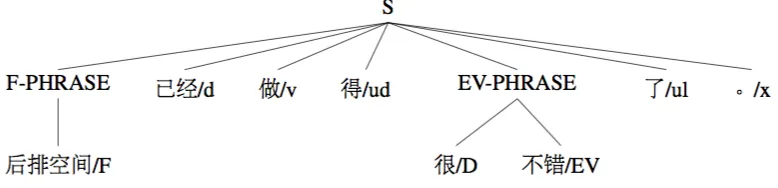
Figure 2: Phrasal analysis of the sentence后排空间已经做得 很不错了。
words. Figure 2 shows the parsed version of ex-ample (4b).
In the following, we present some of the most common phrase structures for features and evalu-ations/emotions that are used in our system. Feature phrases Besides simple NPs consisting only of one feature word, the most frequent types of feature phrases are phrases with nominal mod-ifiers, coordinated NPs and NPs with pronominal modifiers:
(5) NP modifier:
座椅
seat 的DE 材料 material the material of the seats (6) 它
it 的DE 设计 design its design (7) 前排
front.row((and)跟/和)后rear.row排 the front and the rear row
Evaluation and emotion chunks The class of evaluations consists of adjectives, whereas the class of emotions consists both of adjectives and
verbs. However, evaluations and emotions get a unified treatment at the unit level, since Chinese stative verbs behave similarly to adjectives: they can also be modified by degree adverbs, used in comparative constructions etc.
Besides simple lexical units, the following are the most frequent phrase types for the E class:
(8) a. Verb or adjective preceded by nega-tion or degree adverb:
很
very难difficult.to.bear受 very difficult to bear
b. Adjective followed by degree adverb: 小
small了PFV 点 a.bit a bit small
Evaluations can be coordinated in various ways; for example, coordination can be expressed by simple juxtaposition, with a comma or in the 又 E1又E2 construction:
(9) a. juxtaposition / punctuation: 精准
[image:4.595.101.490.267.361.2]b. 又E1又E2: 又
CONJ 精准
precise又CONJ 灵活 flexible both precise and flexible
Besides, evaluations are often expressed by so-called “possessed features”: the evaluation value is derived from the “amount” to which a feature is possessed by the discussed entity:
(10) 没 NEG
有
have活力vigor not vigorous 5.3 Relation extraction
After identifying the syntactic units of interest, we proceed with identifying sentence-level relations between these units. In the literature, there are two major approaches to the identification of rela-tions between evaluarela-tions and their targets. On the one hand, some authors recur to parsing and iden-tify evaluation targets based on dependency rela-tions (Wu et al. 2009, Jiang et al. 2011,i. a.). On the other hand, distance metrics can be used (Ding et al., 2008; Liu, 2012). Since we want to avoid the overhead of full-fledged syntactic parsing, but also want to improve the accuracy of simple distance metrics, we develop a sequence classifier which determines whether a given sequence of words be-tween a feature and an evaluation/emotion phrase indicates a target relation.
The two semantic relations of interest are the causer and thetheme relation. Additionally, the system analyzes a third non-semantic relation – the topic – which provides relevant discourse-structural information on the overall aspect dis-cussed in a sentence.
The causer relation The causer relation is a fairly well-delimited relation which describes the causer of some state of event. In our model, it is applied to emotions caused by specific features. In the most basic cases, the causer is expressed as subject of one of the causative verbs (让,令etc.):
(11) 动力 power让CAUS
我 me非very常
失望。 desperate The power really makes me desperate. The theme relation The theme relation is ex-pressed differently for evaluations and emotions. In the case of evaluations, it can be realized as the single argument of an AP or the nominal head of an adjectival modifier:
(12) a. Single argument of an AP: 设计
design 特别
particularly时 尚。 fashionable The design is particularly fashionable. b. Nominal head of an adjectival
modi-fier: 特别
particularly时 尚
fashionable的DE 设计 design a particularly fashionable design With respect to emotions, thethemerelation is only relevant for verbs; the feature targets of ad-jectives are covered by the causer relation. Thus, themes can be expressed as (possibly topicalized) objects of emotion verbs:
(13) a. Object in canonical postverbal posi-tion:
我 me
很 very喜
欢
like 它it 的DE
设计。 design I like its design a lot. b. Topicalized object:
设计 design
很 very喜
欢
like ,, ... The design, I like it a lot, ...
5.4 Relation extraction
In the above examples, relations hold between ad-joined constituents and can thus be easily recog-nized. However, in many cases, several words oc-cur between the evaluation/emotion and its target:
(14) 后排空间
rear.row 已经space做already 得 make
很 DE
不错 very 了。
not.badPFV
The rear space is already quite not bad. From our corpus, we bootstrap the most fre-quent sequences that occur between themes and emotions/evaluations, emotions and themes as well as causers and emotions. We then apply a simple classifier for the classification of unseen se-quences.
6 Evaluation
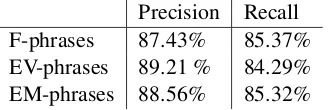
Precision Recall F-phrases 87.43% 85.37% EV-phrases 89.21 % 84.29% EM-phrases 88.56% 85.32%
Table 1: Results of unit identification
Precision Recall F-EV relations - theme 89.2% 87.33% F-EM relations - theme 84.01% 83.10% F-EM relations - causer 86.49% 87.90%
Table 2: Results of relation extraction
two independent annotators - a native Chinese stu-dent without specialized linguistic knowledge and a non-native linguist with very good mastery of the Chinese language. They proceeded in three steps: at the phrase level, the total F-score of inter-annotator agreement was 91.3%. The diverging items were discussed with a third team member to create a unified phrase-level annotation. The re-viewed corpus was then annotated for relations be-tween opinion and their targets; in this step, inter-annotator agreement reached 93.4%.
Table 1 shows the results achieved in unit iden-tification; table 2 shows the results achieved for relation extraction on the test set with finalized an-notation of F/EV/EM phrases.
7 Outlook
We have shown that the use of a prebuilt lexicon together with the application of general language rules allows to achieve a considerable accuracy in ABSA for Chinese. Currently, the presented sys-tem is being extended with a number of more com-plex sentence-level relations, specifically compar-ative structures and modal operators. Further,
References
Boiy, Erik and Moens, Marie-Francine. 2009. A machine learning approach to sentiment analy-sis in multilingual Web texts. Inf. Retr. 12(5), 526–558.
Ding, Xiaowen, Liu, Bing and Yu, Philip S. 2008. A Holistic Lexicon-based Approach to Opinion Mining. In Proceedings of WSDM’08, WSDM ’08, pages 231–240.
Huang, James C.-T. 1982. Logical relations in Chinese and the theory of grammar. Ph. D.thesis, MIT, Massachusetts.
Jiang, Long, Yu, Mo, Zhou, Ming, Liu, Xiaohua and Zhao, Tiejun. 2011. Target-dependent Twit-ter Sentiment Classification. In Proceedings of ACL’11 - Volume 1, pages 151–160.
Kennedy, Christopher and McNally, Louise. 2005. Scale structure, degree modification, and the se-mantics of gradable predicates. Language 81, 345 – 381.
Kim, Soo-Min and Hovy, Eduard. 2006. Extract-ing Opinions, Opinion Holders, and Topics Ex-pressed in Online News Media Text. In Pro-ceedings of the Workshop on Sentiment and Subjectivity in Text, SST ’06, pages 1–8. Ku, Lunwei, Huang, Tinghao and Chen, Hsinhsi.
2009. Using Morphological and Syntactic Structures for Chinese Opinion Analysis. In Proceedings of EMNLP’09, pages 1260–1269. Li, Audrey Yen-Hui. 1990. Order and
Con-stituency in Mandarin Chinese. Studies in Natu-ral Language and Linguistic Theory, Dordrecht: Kluwer Academic Publishers.
Liu, Bing. 2012. Sentiment Analysis and Opinion Mining.
Liu, Lizhen, Lei, Mengyun and Wang, Hanshi. 2013. Combining Domain-Specific Sentiment Lexicon with Hownet for Chinese Sentiment Analysis.Journal of Computers8(4).
Pontiki, Maria, Galanis, Dimitris, Pavlopoulos, John, Papageorgiou, Harris, Androutsopoulos, Ion and Manandhar, Suresh. 2014. SemEval-2014 Task 4: Aspect Based Sentiment Analy-sis. In Proceedings of the SemEval’14, pages 27–35, Dublin, Ireland: ACL and Dublin City University.
Popescu, Ana Maria and Etzioni, Oren. 2005. Ex-tracting Product Features and Opinions from Reviews. InProceedings of HLT & EMNLP’05, pages 339–346, Stroudsburg, USA.
Su, Qi, Xu, Xinying, Guo, Honglei, Guo, Zhili, Wu, Xian, Zhang, Xiaoxun, Swen, Bin and Su, Zhong. 2008. Hidden Sentiment Association in Chinese Web Opinion Mining. In Proceedings of WWW’08.