ISSN Online: 2379-1551 ISSN Print: 2379-1543
DOI: 10.4236/jtst.2018.44009 Nov. 22, 2018 129 Journal of Textile Science and Technology
Analysis of Using Ultraviolet Light to Test Color
Mothball
Shen-Kung Liao
1*, Chung-Tse Wu
1, Chia-Chi Yang
1, Wen-Chang Chen
2, Tien-Yuan Liang
21Department of Fiber and Composite Materials, Feng Chia University, Taiwan
2Environmental Bioengineering & Chemical Analysis Section, China Steel Corporation, Taiwan
Abstract
Color mothball is a daily necessity in Southeast Asia. Mothball contained nearly 100% naphthalene or 100% p-dichlorobenzene. It was used to resist insects, mothproof and mildew with a special odor. In other words, the odor was thought unpleasant enough to drive animals away in repellent products. This research analyzed color mothball which was manufactured by C and N companies. The mothball was dyed with eight dyes and three essences of fra-grance, respectively. The experiment of color fastness with UV-light test is to determine how much the color will fade, when it exposed to a known ultra-violet light source. In the last analysis, the experimental data from the spec-trum of GC/MS described all kinds of structure on color mothball after 80 hours phototherapy treatment as shown in the content. This research reveals that color mothball can have better appearance and greater performance, to meet the requirements for customs and various applications.
Keywords
Naphthalene, Quinoline, Color, Fade, Whiteness
1. Background
Color Mothball is used to prevent insect and mothproof with a special odor and it is a daily necessity. It was sold to advanced and developed countries world-wide. However, color mothball is sold to Southeast Asia such like Malaysia, Sin-gapore, and Indonesia in recent years. The reason is that Southeast Asia has more insect and mildew than occident. Thus, color mothball has wide market in Southeast Asia.
White mothball is very common in daily life of Europe and America. In the United States, there are nine insect repellent products containing naphthalene
How to cite this paper: Liao, S.-K., Wu, C.-T., Yang, C.-C., Chen, W.-C. and Liang, T.-Y. (2018) Analysis of Using Ultraviolet Light to Test Color Mothball. Journal of Textile Science and Technology, 4, 129-140.
https://doi.org/10.4236/jtst.2018.44009
Received: October 11, 2018 Accepted: November 18, 2018 Published: November 22, 2018
Copyright © 2018 by authors and Scientific Research Publishing Inc. This work is licensed under the Creative Commons Attribution International License (CC BY 4.0).
http://creativecommons.org/licenses/by/4.0/
DOI: 10.4236/jtst.2018.44009 130 Journal of Textile Science and Technology
that have been registered for use by the US Environmental Protection Agency. These include products intended to kill moths in airtight spaces, and to repel vertebrate pests in attics and wall void spaces, even though it is not so popular in Southeast Asia [1] [2]. Because the people in Southeast Asia prefer to use the mothball with various color and strong fragrance, the dyeing technology of mothball have been researched in these years.
This research analyzed the color mothball which was manufactured by China Steel Corporation and Japan Corporation. Let the color mothball with dyed of eight dyes (Four yellow, two red and two green) and fragrance of three essences (sunflower, ginger lily and lavender of essences) respectively. The experiment of color fastness with light test is to determine how much the color will fade when exposed to a known ultraviolet light source. In the research, we try to find a good dyestuff which owned the highest level of light fastness with Kubel-ka-Munk equation and color spaces of CIE Lab & CIE LCH. In the last analysis, the experiment determined of fragrance structure from Fourier transformed infrared spectroscopy (FT-IR). In addition, we researched into composition of color mothball with different company from gas chromatography—mass spec-trometry (GC/MS) and described kinds of structure after 80 hours light test phototherapy treatment [3].
The mothball had the better of color fastness by FT-IR and GC/MS analyzed. That’s just what we expected. In other word, this research reveals the mothball with various colors, better appearance and greater performance in order to sa-tisfy the requirements for market and various applications [4].
2. Experimental Measurement
2.1. Kubelka-Munk Theory (K/S)
We should use K/S where K is the absorption coefficient, S is the scattering coef-ficient of light in the visible region (400 - 700 nm) and R∞ is reflectance value in
maximum absorption wave length (nm) to evaluate the color strength for dye samples. In 1948, Kubelka developed numerous formulas for correlating reflec-tance with concentration by making scattering and surface difference correc-tions. It was found that the ratio of light absorption to light scattering at a given wavelength is proportional to the concentration of the dye in the sample. The relationship shown here is derived from the Kubelka-Munk equation [5] [6]:
(
1)
22
R K
S R
∞
∞ −
= (1)
Figure 1 shows the light of incident is I, thickness of dx of scattering is I * S *
dx and parts of transmission is I * (1 − S − K) * dx.
2.2. Color Spaces of CIE LAB & CIE LCH
DOI: 10.4236/jtst.2018.44009 131 Journal of Textile Science and Technology
Figure 1. The relation of physical absorption and scattering.
colors visible to the human eye and was created to serve as a device independent model to be used as a reference. Figure 2 and Table 1 shows the three coordi-nates of CIE LAB represent the lightness of the color (L* = 0 yields black and L* = 100 indicates diffuse white; specular white may be higher), its position be-tween red/magenta and green (a*, negative values indicate green while positive values indicate magenta) and its position between yellow and blue (b*, negative values indicate blue and positive values indicate yellow).
Another CIE L*C*H* (CIE LCH) is L* axis represents Lightness. It ranges from L* = 0 yields black and L* = 100 indicates diffuse white. The C* axis represents Chroma or “saturation”. This ranges from 0 at the centre of the circle, which is completely unsaturated (i.e. a neutral grey, black or white) to 100 or more at the edge of the circle for very high Chroma (saturation) or “color puri-ty”. H* describes the hue angle. It ranges from 0 to 360 and H* = 0° = red/H* =
90° = yellow/H* =180° = green/H* = 270° = blue.
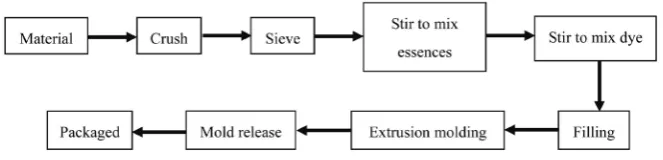
2.3. Production Process of Color Mothball
As below figure.3. Results and Discussion
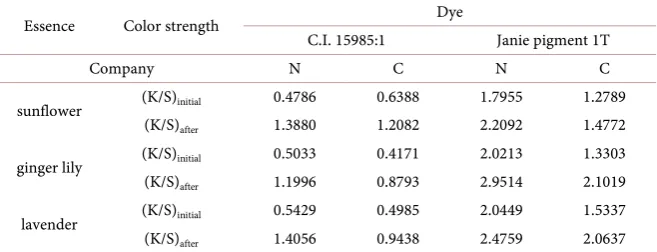
Tables 2-4 show the K/S data of color mothball for initial and after UV-light test
DOI: 10.4236/jtst.2018.44009 132 Journal of Textile Science and Technology
Figure 2. The CIE L*a*b* &CIE L*C*H* color model [7].
(a)
(b)
(c)
DOI: 10.4236/jtst.2018.44009 133 Journal of Textile Science and Technology
Table 1. Explanation of L*, a*, b*, C*, H*.
L* Represents a standard or sample’s position on the lightness axis in either CIELAB or CIELCH color space.
a* Represents a standard or sample’s position on the green/red axis in CIELAB color space, green being in the negative direction and red being in the positive direction.
b* Represents a standard or sample’s position on the blue/yellow axis in CIELAB color space, blue being in the negative direction and yellow being in the positive direction.
[image:5.595.210.539.249.375.2]C* Represents a standard or sample’s chroma value in CIELCH color space. H* Represents a standard or sample’s hue value in CIELCH color space.
Table 2. The K/S data of color mothball for initial and after UV-light test from yellow se-ries dye.
Essence Color strength Dye
C.I. 15985:1 Janie pigment 1T
Company N C N C
sunflower (K/S)initial 0.4786 0.6388 1.7955 1.2789
(K/S)after 1.3880 1.2082 2.2092 1.4772
ginger lily (K/S)initial 0.5033 0.4171 2.0213 1.3303
(K/S)after 1.1996 0.8793 2.9514 2.1019
lavender (K/S)initial 0.5429 0.4985 2.0449 1.5337
[image:5.595.212.539.420.548.2](K/S)after 1.4056 0.9438 2.4759 2.0637
Table 3. The K/S data of color mothball for initial and after UV-light test from green se-ries dye.
Essence Color strength Dye
C.I. 42090:1 Janie pigment 187
Company N C N C
sunflower (K/S)initial 0.6511 0.5705 0.9479 0.7159
(K/S)after 2.1928 2.3083 2.8471 1.7404
ginger lily (K/S)initial 0.4653 0.4101 1.1214 1.0618
(K/S)after 1.9078 1.6916 2.2313 1.6828
lavender (K/S)initial 0.3454 0.3601 1.324 0.8127
[image:5.595.212.540.595.725.2](K/S)after 2.2023 1.8409 2.3691 1.4884
Table 4. The K/S data of color mothball for initial and after UV-light test from red series dye.
Essence Color strength Dye
C.I. 16035:1 C.I. 45430:1
Company N C N C
sunflower (K/S)initial 0.5916 0.565 0.733 0.4622
(K/S)after 1.9008 1.9687 1.3869 1.4033
ginger lily (K/S)initial 0.3362 0.3485 0.6961 0.5956
(K/S)after 1.4121 1.1147 1.0141 0.8896
lavender (K/S)initial 0.3976 0.4598 0.4244 0.4244
DOI: 10.4236/jtst.2018.44009 134 Journal of Textile Science and Technology
words, unit volume of dye in color mothball is increased. Thus K/S value is in-creased after UV-light test.
In Figure 3, we can find color mothball have regularities at K/S value in dyes
and essences, no matter what N or C company product. We need to rely on K/S to evaluate the color strength for dye samples. Such as color mothball use yellow dye of Janie pigment 1T with sunflower essences, green dye of Janie pigment 187 with lavender essences have better color fastness and red dye of C.I. 45430:1 with ginger lily essences have better color fastness.
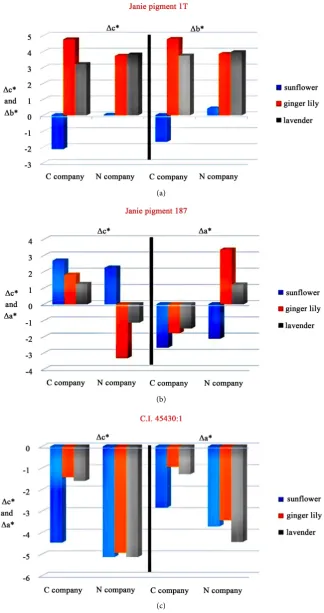
From the above results, we select color mothball dyed with Janie pigment 1T of yellow series, C.I. 45430:1 of red series and Janie pigment 187 of green series.
Figure 4 shows the color mothball difference in L*, a*, b* and c* value between
initial and after UV-light test. The research mainly discusses lightness (L*), red/green values (a*), yellow/blue values (b*) and Chroma (C*). As shown in
Figure 5, we can find color mothball that have regularities at L*, a*, b* and C*
value in the same dyes and essences, no matter what C or N company product. Mothball used dye of Janie pigment 1T with sunflower essences, C.I. 45430:1 with ginger lily essences and Janie pigment 187 with lavender essences have the better color fastness.
Figures 5-7 showed the fragrance of three essences (sunflower, ginger lily and
lavender of essences) analyzed by using FT-IR. We could find the three essences have carboxyl structure from vibration of O-H bond at wavelength range from 3400 to 3200 cm−1 [8], the rotation of C=O bond at wavelength range from 1685
to 1660 cm−1 [9] and rotation of C-O bond at wavelength range from 1410 to
1310 cm−1[10]. In addition, essences have long alkyl group and vibration of C-F
bond at wavelength range from 1350 to 1140 cm−1[11] [12]. Table 5 showed
va-riety of vibration and rotation group from Fourier transform infrared spectros-copy.
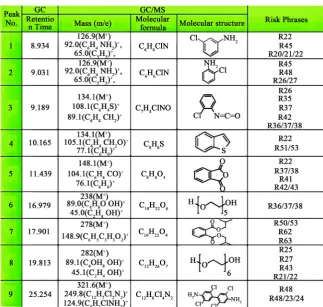
From gas chromatography–mass spectrometry (GC/MS) for N and C compa-ny product. The initial compositions of color mothball from C and N compacompa-ny product, as shown in Table 6. Because the composition of the mothballs pro-duced by each company is different, we must discuss whether the different in-gredients have an effect on the final result. In the GC/MS analyze, we could get minor constituents of 8 ppm indene, 48 ppm indole, 23 ppm quinoline and 20 ppm iso-quinoline in company C product, but those could not be found almost in N-company product. Mothball of product from N company have more thia-naphthene than its in C company product. The retention time of 7.438 min. and 8.841 min. are represent as indene and indole, respectively. Color mothball of C company product have more indene and indole than N company product.
DOI: 10.4236/jtst.2018.44009 135 Journal of Textile Science and Technology (a)
(b)
[image:7.595.211.536.71.685.2](c)
DOI: 10.4236/jtst.2018.44009 136 Journal of Textile Science and Technology
[image:8.595.84.512.282.477.2]Figure 5. The fragrance of sunflower essences analyzed from Fourier transform infrared spectroscopy.
Figure 6. The fragrance of ginger lily essences analyzed from Fourier transform infrared spectroscopy.
Figure 7. The fragrance of lavender essences analyzed from Fourier transform infrared spectroscopy.
3418
2954 2929 2870 1723 1677
1614 1487 1454 1364 1300 1270 1249 1214 1099 1070 937 885 833 756 713 699 3
3800 3600 3400 3200 3000 2800 2600 2400 2200 2000 1800 1600 1400 1200 1000 800 0.16 0.14 0.12 0.10 0.08 0.06 0.04 0.02 0.00 Wavenumber Abs or banc e 3374 3063 3028 2968 2928 2872 2729 1737 1680 1623 1454 1411 1376
1334 1299 1249
1208 1147 1089 1047 1008 923 860 837 746 699 1
3800 3600 3400 3200 3000 2800 2600 2400 2200 2000 1800 1600 1400 1200 1000 800 0.16 0.14 0.12 0.10 0.08 0.06 0.04 0.02 0.00 Wavenumber A bs or banc e 3369 2969 2929 2881 1736 1643 1607 1543 1453 1375 1332 1246 1146 1090 1050 1008 990 931 860 835 755 2
[image:8.595.85.514.510.705.2]DOI: 10.4236/jtst.2018.44009 137 Journal of Textile Science and Technology
[image:9.595.56.528.410.565.2]Figure 8. GC/MS chromatogram of dark solid formed on the surface of color mothball after UV-light test.
Table 5. The variety of vibration and rotation group from Fourier transform infrared spectroscopy.
Classification Group Bond Rang cm−1
Alkanes
R-CH3 C-H 2972 - 2952, 2882 - 2662, 1475 - 1435, 1380 - 1375
C-(CH3)2 C-C 1175 - 1165, 1160 - 1135
C-(CH3)3 C-C 1255 - 1245, 1250 - 1200
R-C-(CH2)4-O C-C 742 - 734
Alkenes CH=CH Cis C-H, C=C 3040 - 3010, 730 - 650, 1662 - 1631
Alcohols (R)3-C-O-H O-H, C-O 3400 - 3200, 1410 - 1310, 1210 - 1110, 1075 - 1000
Ketones C=C-COR C=O 1685 - 1665
Quinones C=O 1690 - 1660
Halogens Ring CF2 C-F 1350 - 1140
Silicons Si-O-Si, Si-O-C Si-O-Si, Si-O-C 1100 - 1000
Sulfur C-SO2-O-C S=O, S-O, S-C 1375 - 1335, 1195 - 1165, 1020 - 850, 830 - 690, 700 - 600
Table 6. The original compositions of mothball from N company and C company.
No. Component N Company C Company
1 Naphthalene, % 99.4 99.6
2 Thianaphthene, % 0.5 0.3
3 Phenol, ppm 5.0 1.0
4 Indole, ppm 9.0 48.0
5 Quinoline, ppm Nil. 23.0
6 Iso-quinoline, ppm Nil. 20.0
7 Indene, ppm Nil. 8.0
8 β-MN, ppm Nil. 2.0
[image:9.595.58.537.597.741.2]DOI: 10.4236/jtst.2018.44009 138 Journal of Textile Science and Technology
Figure 9 shows the structure and properties of dark solid in mothball after
UV-light test. It is possible to have environmental pollution as well as adverse human health. Therefore, the volatility gas of mothball is unpleasant and wor-ried in commercial manufacturing. [13]
4. Conclusion
[image:10.595.211.535.399.706.2]Naphthalene is a polycyclic aromatic hydrocarbon that is commonly encoun-tered in indoor and outdoor environments. It is a component of crude oil, and it is also a product of natural combustion. A significant source of non-occupational exposures in residential settings is thought to be from the use of naphtha-lene-based products, particularly mothballs. Naphthalene mothballs contain above 99.4% naphthalene and else product including in thianaphthene. From the experimental studies, the mothball after UV-light test the color was darker than original. This is due to the volatility matter of color mothball. In other words, the unit volume of dye in color mothball is increased. Thus K/S value is in-creased after UV-light test. From the retention time of GC/MS, we can get orig-inal composition of mothball from N and C company product, and the product from C company have more indene, indole, iso-quinoline and quinoline than N company due to minor constituents .The dark solid formed on the surface of color mothball after UV-light test were found. We can estimate the appearance of mothball structure by adding dye and essences, and then observe the appearance
DOI: 10.4236/jtst.2018.44009 139 Journal of Textile Science and Technology
change by high energy of UV light. In FT-IR analysis, fragrance of three essences (sunflower, ginger lily and lavender of essences) has carboxyl structure, long al-kyl group, and C-F bond. From the above experimental results, we think color mothball using dye of Janie pigment 1T with sunflower essences, C.I. 45430:1 with ginger lily essences and Janie pigment 187 with lavender essences have the better color fastness.
Conflicts of Interest
There is no conflict of interest regarding the publication of this paper.
Funding
The research was not written as a project, so no research funding was requested. There is no funding statement of this paper.
Statement
Data sharing not applicable to this article as no datasets were generated or ana-lysed during the current study.
References
[1] Geriego, F.Y., Bogen, K.T., Price, P.S. and Weed, D.L. (2008) Exposure Epidemiol-ogy and Human Cancer Incidence of Naphthalene. Regulatory Toxicology and Pharmacology, 51, 22-26.
https://sciencedirect.com/science/article/pii/S0273230008000263
https://doi.org/10.1016/j.yrtph.2008.02.003
[2] Sudakin, D.L., Stone, D.L. and Power, L. (2011) Naphthalene Mothballs: Emerging and Recurring Issues and Their Relevance to Environmental Health. Current Opi-nion in Toxicology, 7, 13-19. https://ncbi.nlm.nih.gov/pmc/articles/PMC3850774/ [3] Kusch, P. (2017) Application of Gas Chromatography/Mass Spectrometry (GC/MS)
and Pyrolysis-Gas Chromatography/Mass Spectrometry (Py-GC/MS) in Failure Analysis in the Automotive Industry. Engineering Failure Analysis, 82, 726-732.
https://sciencedirect.com/science/article/pii/S1350630716308469
https://doi.org/10.1016/j.engfailanal.2017.06.033
[4] Preuss, R., Angerer, J. and Drexler, H. (2003) Naphthalene—An Environmental and Occupational Toxicant. International Archives of Occupational and Environmental Health, 76, 556-576.
https://researchgate.net/publication/10611129_Naphthalene_-_An_environmental_
and_occupational_toxicant
https://doi.org/10.1007/s00420-003-0458-1
[5] International Color Consortium, Specification ICC.1:2004-10 Image 4. Technology colour Management—Architecture, Profile Format, 2006.
http://color.org/icc1v42_2006-05.pdf
[6] Great Britain, COLOR INDEX, The Society of Dyes and Colourists American Asso-ciation of Textile Chemists and Colorists, 1969, 3494.
[7] Hunter, R.S. (1948) Proceedings of the Thirty-Third Annual Meeting of the Optical Society of America. Journal of the Optical Society of America, 38, 1092-1106.
DOI: 10.4236/jtst.2018.44009 140 Journal of Textile Science and Technology https://doi.org/10.1364/JOSA.38.001092
[8] Parab, R.H., Patel, K.D., Desai, D.J. and Dixit, B.C. (2016) Synthesis and Dyeing Performance of Bisazo Disperse Dyes Based on 3-[4-(4-amino-2-chlorophe- noxy)anilino]phenol. Journal of Saudi Chemical Society, 20, 523-529.
https://sciencedirect.com/science/article/pii/S1319610312001214
https://doi.org/10.1016/j.jscs.2012.07.012
[9] Sayed, A.Z., Aboul-Fetouh, M.S. and Nassar, H.S. (2012) Synthesis Biological Activ-ity and Dyeing Performance of Some Novel Azo Disperse Dyes Incorporating Py-razolo[1,5-a]pyrimidines for Dyeing of Polyester Fabrics. Journal of Molecular Structure, 1010, 146-151.
https://sciencedirect.com/science/article/pii/S002228601100929X
https://doi.org/10.1016/j.molstruc.2011.11.046
[10] Sener, I., Karei, F. and Ertan, N. (2006) Synthesis and Investigations of the Absorp-tion Spectra of Hetarylazo Disperse Dyes Derived from 2,4-Quinolinediol. Dyes and Pigments, 70, 143-148.
https://sciencedirect.com/science/article/pii/S0143720805001592
https://doi.org/10.1016/j.dyepig.2005.05.003
[11] Ki, Y., Zhang, S., Yang, J., Jiang, S. and Li, Q. (2008) Synthesis and Application of Novel Crosslinking Polyamine Dyes with Good Dyeing Performance. Dyes and Pigments, 76, 508-514.
https://sciencedirect.com/science/article/pii/S014372080600413X
https://doi.org/10.1016/j.dyepig.2006.10.012
[12] Xu, H., Tang, B.T. and Zhang, S.F. (2011) Synthesis and Dyeing Performance of a Novel Polycarboxylic Acid Azo Dye. Chinese Chemical Letters, 22, 424-426.
https://sciencedirect.com/science/article/pii/S1001841710004638
https://doi.org/10.1016/j.cclet.2010.11.010
[13] Esparza, X., Moyano, E., Coxialls, J.R. and Galceran, M.T. (2013) Determination of naphthalene-Derived Compounds in Apples by Ultra-High Performance Liquid Chromatography-Tandem Mass Spectrometry. Analytica Chimica Acta, 782, 28-36.
https://sciencedirect.com/science/article/pii/S0003267013004984
![Figure 2. The CIE L*a*b* &CIE L*C*H* color model [7]. (a)](https://thumb-us.123doks.com/thumbv2/123dok_us/9249831.413170/4.595.268.484.249.690/figure-the-cie-l-cie-l-color-model.webp)