EVALUATION OF ANTIBACTERIAL EFFICACY OF OZONATED OLIVE OIL AND COLD PRESSED
NEEM OIL AGAINST ENTEROCOCCUS
*Dr. M.V. Pratyusha, Dr. Jayalakshmi
Dr. Arul Selvan
Department of Conservative Dentistry and Endodontics
ARTICLE INFO ABSTRACT
Background:
of root canal. Various medicaments are advised for disinfecting root canal, such as herbal and non herbal medicaments.
Aim: This in vitro study was done to evaluate the antibacterial effect of ozonated olive oil and cold pressed neem oil against
Materials and Method:
Group 1: Ozonated olive oil, Group 2: cold pressed neem oil, Group 3: 2% Chlorhexidine, Group 4: Calcium hydroxide and Group 5: Normal saline. The petri plate
48 hours. The inhibition zones against
using one way analysis of variance (ANOVA) and Post Hoc test (
Results:
followed by 2% CHX and then cold pressed neem oil. Least mean value for the zone of inhibition was obtained for calcium hydroxide. There was a statistically significant difference between the groups. (p<0.001)
Conclusion:
experimental groups and can be used as an alternative intracanal medicament.
Copyright©2017, Pratyusha et al. This is an open access article distributed
distribution, and reproduction in any medium, provided the original work is properly cited.
INTRODUCTION
Microorganisms and their by-products are considered to be the major etiologic agents in endodontic diseases. Failure, during and after endodontic treatment, are associatedwith the presence of bacteria in the root canal. Enterococcus faecalis
faecalis) is known to be important resistant species in infected
root canals, and they may cause treatment failures (Dubey
al., 2012). As it is a facultative anaerobe, it can endure high pH. In such cases, inter-appointment dressing with an intracanal medicament is essential. Calcium hydroxide [Ca(OH)2] has been the most commonly used intracanal
medicament. Nevertheless even Ca(OH)2 could
eradicate E. faecalis. The complete elimination of
essential from the root canal system for successful endodontic outcome (Reddy et al, 2015). At present, ozone therapy is gaining acceptance as a modern non-invasive method of treatment.
*Corresponding author: Dr. M. V. Pratyusha,
Department of Conservative Dentistry and Endodontics, Krishnadevaraya College of Dental Sciences, Bangalore, Karnataka, India
ISSN: 0975-833X
Article History:
Received 20th February, 2017
Received in revised form
10th March, 2017
Accepted 17th April, 2017
Published online 23rd May,2017
Key words:
Enterococcus faecalis, Ozonated olive oil, Cold pressed neem oil.
Citation: Dr. M. V. Pratyusha, Dr. Jayalakshmi, K. B., Dr. Prasannalatha Nadig, D
“Evaluation of antibacterial efficacy of ozonated olive oil and cold pressed neem oil against enterococcus Journal of Current Research, 9, (05), 50711-50715.
RESEARCH ARTICLE
EVALUATION OF ANTIBACTERIAL EFFICACY OF OZONATED OLIVE OIL AND COLD PRESSED
NEEM OIL AGAINST ENTEROCOCCUS FAECALIS: AN AGAR WELL DIFFUSION
Dr. Jayalakshmi, K.B., Dr. Prasannalatha Nadig
Dr. Arul Selvan K and Dr. Zaharunnissa
Conservative Dentistry and Endodontics, Krishnadevaraya College of Dental Sciences,
Bangalore, Karnataka, India
ABSTRACT
Background: Successful endodontic treatment depends on effective disinfection and complete sealing of root canal. Various medicaments are advised for disinfecting root canal, such as herbal and non herbal medicaments.
This in vitro study was done to evaluate the antibacterial effect of ozonated olive oil and cold pressed neem oil against Enterococcus faecalis (E. faecalis) (ATCC 29212)
Materials and Method: Agar well diffusion method was used to evaluate the antibacterial action of Group 1: Ozonated olive oil, Group 2: cold pressed neem oil, Group 3: 2% Chlorhexidine, Group 4: Calcium hydroxide and Group 5: Normal saline. The petri plates were incubated aerobically at 37 48 hours. The inhibition zones against E. faecalis were recorded. The data was statistically analyzed using one way analysis of variance (ANOVA) and Post Hoc test (p
Results: Ozonated olive oil showed the maximum mean value for the zone of inhibition after 48 hrs followed by 2% CHX and then cold pressed neem oil. Least mean value for the zone of inhibition was obtained for calcium hydroxide. There was a statistically significant difference between the groups. (p<0.001)
Conclusion: Ozonatedolive oil was most effective against E.faecalis
experimental groups and can be used as an alternative intracanal medicament.
is an open access article distributed under the Creative Commons Attribution License, which distribution, and reproduction in any medium, provided the original work is properly cited.
products are considered to be the major etiologic agents in endodontic diseases. Failure, during associatedwith the presence
Enterococcus faecalis (E.
) is known to be important resistant species in infected root canals, and they may cause treatment failures (Dubey et
As it is a facultative anaerobe, it can endure high appointment dressing with an intracanal medicament is essential. Calcium hydroxide ] has been the most commonly used intracanal could not entirely . The complete elimination of E. faecalisis essential from the root canal system for successful endodontic At present, ozone therapy is invasive method of
Department of Conservative Dentistry and Endodontics, Krishnadevaraya College of Dental Sciences, Bangalore, Karnataka, India.
Ozone is a gaseous, energized form of oxygen O unstable and dissociates back into oxygen (O
so-called singlet oxygen (O1), which is a strong oxidizing
agent. Thus ozone has a high antibacterialpower against oral pathogens, without resistance development for both gaseous state as well as aqueous state. It is used in various treatment modalities in field of medicine, dentistry, veterinary, food industry, and water treatment
inactivates bacteria and viruses by cell lysis. It disrupts theintegrity of the bacterial cell enve
phospholipids and lipoproteins (
furthermoreacts as a super-oxygenator, carrying oxygen to tissues and supporting the body in its natural healing process (Holland, 2010). Various forms of Ozone used for roo disinfection comprise- Ozone gas, aqueous solution, oil or ozonated water. These have been used as irrigant & intracanal medicament. Amongst these ozonated water is less cytotoxic than gaseous ozone and other irrigants like NaOCl, CHX and H2O2, but these forms lack residual effect (half
20ºc) and need to be freshly prepared (
Bhayya, 2015) (Mohammadi et al
International Journal of Current Research
Vol. 9, Issue, 05, pp.50711-50715, May, 2017
OF CURRENT RESEARCH
Dr. M. V. Pratyusha, Dr. Jayalakshmi, K. B., Dr. Prasannalatha Nadig, Dr. Sujatha, I., Dr. Arul Selvan and Dr. Zaharunnissa
Evaluation of antibacterial efficacy of ozonated olive oil and cold pressed neem oil against enterococcus faecalis: an agar well diffusion study
EVALUATION OF ANTIBACTERIAL EFFICACY OF OZONATED OLIVE OIL AND COLD PRESSED
: AN AGAR WELL DIFFUSION STUDY
Dr. Prasannalatha Nadig, Dr. Sujatha, I.,
Krishnadevaraya College of Dental Sciences,
Successful endodontic treatment depends on effective disinfection and complete sealing of root canal. Various medicaments are advised for disinfecting root canal, such as herbal and
non-This in vitro study was done to evaluate the antibacterial effect of ozonated olive oil and cold
Enterococcus faecalis (E. faecalis) (ATCC 29212).
Agar well diffusion method was used to evaluate the antibacterial action of Group 1: Ozonated olive oil, Group 2: cold pressed neem oil, Group 3: 2% Chlorhexidine, Group 4: s were incubated aerobically at 37o for were recorded. The data was statistically analyzed
p< 0.05).
imum mean value for the zone of inhibition after 48 hrs followed by 2% CHX and then cold pressed neem oil. Least mean value for the zone of inhibition was obtained for calcium hydroxide. There was a statistically significant difference between the groups.
E.faecalis when compared to other
experimental groups and can be used as an alternative intracanal medicament.
ribution License, which permits unrestricted use,
Ozone is a gaseous, energized form of oxygen O3, which is
dissociates back into oxygen (O2), thus liberating
), which is a strong oxidizing agent. Thus ozone has a high antibacterialpower against oral pathogens, without resistance development for both gaseous tate. It is used in various treatment modalities in field of medicine, dentistry, veterinary, food industry, and water treatment (Tiwari et al, 2017). Ozone inactivates bacteria and viruses by cell lysis. It disrupts theintegrity of the bacterial cell envelope by oxidation of phospholipids and lipoproteins (Nagayoshi et al, 2004). Ozone oxygenator, carrying oxygen to tissues and supporting the body in its natural healing process
Various forms of Ozone used for root canal Ozone gas, aqueous solution, oil or ozonated water. These have been used as irrigant & intracanal medicament. Amongst these ozonated water is less cytotoxic than gaseous ozone and other irrigants like NaOCl, CHX and these forms lack residual effect (half-life 40min, 20ºc) and need to be freshly prepared (Raiyani, Arora and
et al., 2013). Ozonated oil due to
OF CURRENT RESEARCH
Dr. Arul Selvan and Dr. Zaharunnissa, 2017.
its viscosity remains in the root canal for extended periods, thus facilitating its use as an intracanal medicament (Bocci et al., 2009). Ozonated oils are still not widely used in dentistry and very few studies have been done on its use.(Farac et al., 2013) Ozonated olive oilis a cold pressed olive oil that has undergone ozonization using a steady flow of ozone oxygen mixture in the ratio of 5:95% until olive oil transforms from the greenish-colored liquid status to the whitish gel status (Shoukheba et al., 2014). It is recognized that neem leaves have antibacterial, antifungal, antiviral, antioxidant, anti-inflammatory, antipyretic, and analgesic effects without any side effect. Neem extract has several active constituents which are responsible for its antibacterial action. The oil from the leaves, seeds and bark has a wide spectrum of antibacterial action against gram positive and gram negative bacteria. (Kumar et al., 2013) The present study was aimed to explore the antibacterial efficacy of commercially available ozonated olive oil (NaturO3, Lightning in a jar, AZ Healthcare, Bangalore) (Fig.1) and cold pressed neem oil (Allin exporters, Delhi) (Fig.1) against E. facaelis in comparison to 2% chlorhexidine.
Fig.1. Cold pressed neem oil(Allin exporters, Delhi) (Left), ozonated olive oil (NaturO3, Lightning in a jar, AZ Healthcare,
Bangalore)(right)
Methodology
This study was conducted in the Microbiology department of Krishnadevaraya College of dental sciences, Bangalore.
Preparation of Microbial Inocula
The antibacterial activity was carried out against standard strain of American Type Culture Collection (ATCC).
Enterococcus faecalis ATCC 29212 strain was used for the
study. E. faecalis was freshly sub-cultured in Brain Heart Infusion (BHI) (HI Media, Mumbai) broth incubated at 370 C for 24 hours. The culture turbidity was adjusted to McFarland opacity standard 0.5.
Determination of Antibacterial Susceptibility using Agar Well-Diffusion Method
BHI agar was freshly prepared and 30 ml was dispensed in conical flask and sterilized by autoclaving for 15 lbs for 15
mins. The medium was allowed to cool to 500 C and 30 microlitre of the adjusted E. faecalisculture was inoculated into the medium. It was mixed well and poured into a sterile petri plate (90mm diameter) (Tarson, Mumbai).The medium was allowed to set completely for 15 mins. Using sterile templates 5 wells of 6 mm diameter and 4 mm depth were made which were placed equally distributed in the petri plate. 50 microliter of the undiluted reagents was inoculated into the wells with the help of sterile microtips under aseptic conditions.
The reagents used:
Group 1: Ozonated olive oil Group 2: Cold pressed Neem oil Group 3: 2%Chlorhexidine (CHX) Group 4: Calcium hydroxide Group 5: Saline (negative control)
The plates were incubated at 370 for 48 hrs. The petri plates were observed for the zone of inhibition, which was measured in millimeters using Vernier Caliper. The experiment was conducted in 3 replicates to minimize the errors.
Statistical Analysis
The data was compiled using Microsoft excel and was subjected to statistical analysis using SPSS 20.1. Descriptive and analytical statistics was done. ANOVA with Tukey’s post hoc test was used to check the mean differences between groups where appropriate.
RESULTS
For E. faecalis, ozonated olive oil showed the maximum mean
value for the zone of inhibition after 48 hrs followed by 2% CHX and then cold pressed neem oil. Least mean value for the zone of inhibition was obtained for calcium hydroxide (Fig 2). There was a statistical difference between the groups. (p<0.001) (Table 1)
Fig.2. Petri plate with Brain heart infusion agar with 5 equally spaced wells depicting the zone of inhibiton for the experimental
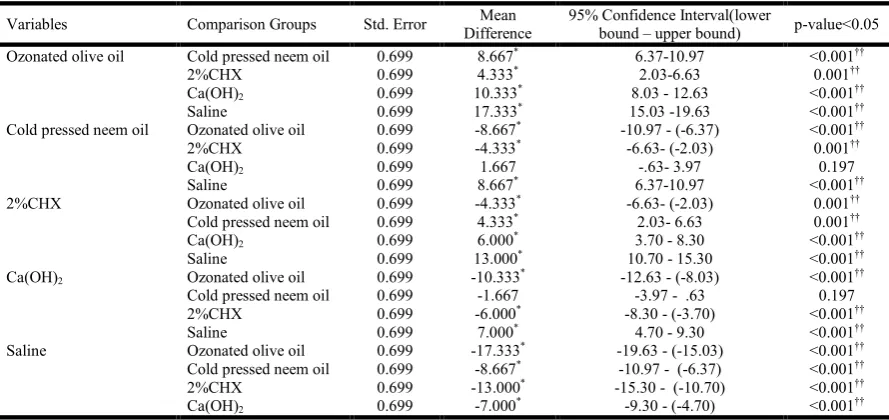
Post hoc test was performed to check the inter-group mean difference. Ozonated olive oil showed better antibacterial efficacy against E. faecalis than other groups. The difference with each group was statistically significant. (p<0.05) Similarly when cold pressed neem oil was compared it was observed that 2% CHX was better than cold pressed neem oil. The difference was statistically significant.But when cold pressed neem oil was compared to Ca(OH)2 the difference was
not significant (p=0.197). 2% CHX was better than Ca(OH)2
andthe difference was statistically significant (p<0.005). (Table 2)
DISCUSSION
E. faecalis was taken in the present study because it has been
identified as the most common species in root canal diseases and represents an organism that is commonly isolated from the root canals of teeth that have been previously root filled. E.
faecalis shows high bacterial resistance to several irrigation
solutions and medicaments used in endodontics, especially when a high pH is not maintained. Thus, E.faecalis can survive for a long time in the root canals (Adl, Shojaee, and
Motamedifar, 2012). Several studies have been focused
towards finding an effective way to eliminate and/or inhibit E.
faecalis from gaining entry to the root canal space. E. faecalis
can gainentry into the root canal system during the course of treatment, in between appointments, or even after the treatment has been completed (Rôças, Siqueira and Santos, 2004). Thus, it is essential to consider treatment proceduresdirected at eliminating or preventing the infection of E. faecalis during each of these phases.One of the new generations of the disinfectant agents is ozone; a powerfuloxidizing agentused to
eliminate bacteria in root canals. There are several ways of delivering ozone, when it dissolves in water, it becomes highly unstable and rapidly decomposes through a complex series of chain reactions, so it cannot be stored. In contrast, when it is dissolved in an oil base, it has a life span that could be measured in years. It chemically reacts with oil, and forms long complex molecules. Hence, in this study ozonated olive oil gel was selected over ozonated water because the application of gels was found to provide a long stay in the oral cavity, adequate drug penetration, high efficacy and acceptability. Ozone reacts with various chemical compounds in two different and coexisting modes, one involving direct reactions of molecular ozone and the other a free radical-mediated reaction. Both these mechanisms may be involved in the destruction ofbacteria by ozone (Shoukheba et al, 2014) (Nagayoshi, Kitamura, Fukuizumi, Nishihara, and Terashita, 2004) Extracting oil through cold-pressing technique involves the crushing of the seed or nut and forcing out the oil. The seeds are dropped into a cylinder that comprisesof a rotating screw, which grinds and crushes the seeds until the oil is extracted. Small holes in the bottom of the cylinder permit the oil to escape into a collection container. The amount of heat produced by friction, as the screw breaks down the seeds, isn’t enough heat to damage the extracted oil (Bachmann, 2001).
[image:3.595.84.507.86.148.2]Ozonization of olive oil is carried out by bubbling ozone through cold pressed olive oil in the presence of magnetic field for eight weeks which is a redox reaction. When olive oilis completely ozonated, it turns in to a clear, gel substance holding the ozone within. The smell of ozone being emitted from the olive oil is obvious. The final product must be refrigerated at all times. When refrigerated, this gel will hold
Table 1. Intergroup comparison of mean zone of inhibition
Groups N Mean zone size (mm) Std. Deviation F value p value*
Group 1 (Ozonated olive oil) 3 17.33 1.155
174.227 <0.001††
Group 2 (Cold pressed Neem oil) 3 8.67 .577
Group 3 (2% Chlorhexidine) 3 13.00 1.000
Group 4 (Calcium Hydroxide) 3 7.00 1.000
Group 5 (Saline) 3 0.00 0.000
*ANOVA was used, †Significant p<0.05; ††Significant p<0.01
Table 2. The inter group comparison of antibacterial efficacy (Zone of inhibition) of ozonated olive oil, Cold pressed neem oil, 2% CHX, Ca(OH)2 and saline
Variables Comparison Groups Std. Error Difference Mean 95% Confidence Interval(lower bound – upper bound) p-value<0.05
Ozonated olive oil Cold pressed neem oil 0.699 8.667* 6.37-10.97 <0.001††
2%CHX 0.699 4.333* 2.03-6.63 0.001††
Ca(OH)2 0.699 10.333* 8.03 - 12.63 <0.001††
Saline 0.699 17.333* 15.03 -19.63 <0.001††
Cold pressed neem oil Ozonated olive oil 0.699 -8.667* -10.97 - (-6.37) <0.001††
2%CHX 0.699 -4.333* -6.63- (-2.03) 0.001††
Ca(OH)2 0.699 1.667 -.63- 3.97 0.197
Saline 0.699 8.667* 6.37-10.97 <0.001††
2%CHX Ozonated olive oil 0.699 -4.333* -6.63- (-2.03) 0.001††
Cold pressed neem oil 0.699 4.333* 2.03- 6.63 0.001††
Ca(OH)2 0.699 6.000* 3.70 - 8.30 <0.001††
Saline 0.699 13.000* 10.70 - 15.30 <0.001††
Ca(OH)2 Ozonated olive oil 0.699 -10.333* -12.63 - (-8.03) <0.001††
Cold pressed neem oil 0.699 -1.667 -3.97 - .63 0.197
2%CHX 0.699 -6.000* -8.30 - (-3.70) <0.001††
Saline 0.699 7.000* 4.70 - 9.30 <0.001††
Saline Ozonated olive oil 0.699 -17.333* -19.63 - (-15.03) <0.001††
Cold pressed neem oil 0.699 -8.667* -10.97 - (-6.37) <0.001††
2%CHX 0.699 -13.000* -15.30 - (-10.70) <0.001††
Ca(OH)2 0.699 -7.000* -9.30 - (-4.70) <0.001††
[image:3.595.78.523.198.408.2]the ozone for years (Geweely, 2006). The reaction of ozone with olive oil occurs exclusively with the carbon-carbon double bonds present in the un-saturated fatty acids producing different toxic products such as several oxygenated compounds, hyperoxides, ozonides, aldehydes, peroxides, diperoxides and polyperoxides and these compounds could also be responsible for the wide antibacterial activity of ozonized olive oil (Shoukheba et al., 2014) (Geweely, 2006).
Azadirachta indica (Neem) is perhaps the most useful
traditional medicinal plant. Each part of the tree has been used as traditional medicine for household remedies against various human ailments. Most of the parts of the plant such as fruits, seeds, leaves, bark and roots contain compounds with proven antiseptic, antiviral, antipyretic, antiinflammatory, antiulcer and antifungal properties. Antibacterial effects of neem extract have been demonstrated against Streptococcus mutans (S.
mutans) and E. faecalis (Ambareen and Chinappa, 2014). In a
study by Nayak et al, they showed that aqueous and alcohol extract of neem leafhad significant inhibitory effect against S.
mutans, E. faecalis and Candida albicans (Nayak et al., 2013).
In a study by Datta et al, they showed that neem oil had no efficacy against E. faecalis (Dutta and Kundabala, 2013). The present study is the first of its kind wherein Cold pressed Neem oil is being tested for its antibacterial efficacy against E. faecalis.
The results of the current study shows maximum inhibitory effect against E. faecalis by ozonated olive oil followed by 2% chlorhexidine, cold pressed neem oil and Calcium hydroxide and no effect was seen with saline. Ozonated olive oil had the highest antibacterial effect with a mean zone of inhibition of 17.33mm which was statistically significant when compared to the other experimental groups (Table 1). The mean zone of inhibition for chlorhexidine was 13±1mm which was statistically significant when compared to calcium hydroxide which had a mean zone of inhibition of 7±1mm. This result was in agreement with results obtained by Bhandari et al. (2014) and Attia et al. (2015) who found that chlorhexidine had a better antibacterial efficacy when compared to calcium hydroxide. Since it is the first study using these novel herbal medicaments, the literature review is scarce to compare the results of theantibacterial efficacy of Ozonated Olive oil and cold pressed neem oil. However further research is required to brand the materials as safe and non-cytotoxic.
Conclusion
Ozonated Olive oil has shownsignificant inhibitory effect against E. faecalis when compared to cold pressed neem oil, 2% CHX and Ca(OH)2. Hence, it can be concluded that
Ozonated Olive oil can be consideredas an alternative endodontic intracanal medicament.
REFERENCES
Adl, A., Shojaee, N.S. and Motamedifar, M., 2012. A comparison between the antimicrobial effects of triple antibiotic paste and calcium hydroxide against Entrococcus faecalis. Iranian endodontic journal, 7(3), pp.149-155. Ambareen, Z. and Chinappa, A., 2014. Go Green-Keep the
Root Canal Clean!!!. International Journal of Dental
Sciences and Research, 2(6B), pp.21-25.
Attia, D.A., Farag, A.M., Afifi, I.K. and Darrag, A.M., 2015. Antimicrobial effect of different intracanal medications on
various microorganisms. Tanta Dental Journal, 12(1), pp.41-47.
Bachmann, J., 2001. Small-scale Oilseed
Processing. Small, 800, pp.346-9140.
Bhandari, S., Ashwini, T.S. and Patil, C.R., 2014. An in Vitro Evaluation of Antimicrobial Efficacy of 2% Chlorhexidine
Gel, Propolis and Calcium Hydroxide Against
Enterococcus faecalis in Human Root Dentin. Journal of clinical and diagnostic research: JCDR, 8(11), p.ZC60. Bocci, V., Borrelli, E., Travagli, V. and Zanardi, I., 2009. The
ozone paradox: ozone is a strong oxidant as well as a medical drug. Medicinal research reviews, 29(4), pp.646-682.
Dubey S, Chaodary T M, Gupta P., 2012. Comparative study of the antimicrobial efficiency of neem leaf extract, sodium
hypochlorite and biopure MTAD-An in vitro study. Indian
J Dent Adv, 4(1), pp.740-743.
Dutta, A. and Kundabala, M., 2013. Antimicrobial efficacy of endodontic irrigants from Azadirachta indica: An in vitro study. Acta Odontologica Scandinavica, 71(6), pp.1594-1598.
Farac, R.V., Pizzolitto, A.C., Tanomaru, J.M.G., Morgental, R.D., Lima, R.K.D.P. and Bonetti-Filho, I., 2013. Ex-vivo effect of intracanal medications based on ozone and calcium hydroxide in root canals contaminated with Enterococcus faecalis. Brazilian dental journal, 24(2), pp.103-106.
Geweely, N.S., 2006. Antifungal activity of ozonized olive oil (Oleozone). Int J Agri Biol, 8(5), pp.671-8.
Holland, A., 2010. Ozone in endodontics. Endod Pract, pp.6-10.
Kumar, V.G., Srinivas, N., Sravanthi, P. and Sravani, B., 2013. Comparision of potency of anti bacterial activity and anti inflammatory activity of 10 years and 100 years old bark extracts of azadirachta indica. Indian Journal of Research in Pharmacy and Biotechnology, 1(4), p.478.
Mohammadi, Z., Shalavi, S., Soltani, M.K. and Asgary, S., 2013. A review of the properties and applications of ozone
in endodontics: an update. Iranian endodontic
journal, 8(2), pp.40-43.
Nagayoshi, M., Fukuizumi, T., Kitamura, C., Yano, J., Terashita, M. and Nishihara, T., 2004. Efficacy of ozone on survival and permeability of oral microorganisms. Oral microbiology and immunology, 19(4), pp.240-246.
Nagayoshi, M., Kitamura, C., Fukuizumi, T., Nishihara, T. and Terashita, M., 2004. Antimicrobial effect of ozonated water
on bacteria invading dentinal tubules. Journal of
Endodontics, 30(11), pp.778-781.
Nayak, A., Nayak, R.N., Soumya, B., Bhat, K. and Kudalkar, M., 2011. Evaluation of antibacterial and anticandidial efficacy of aqueous and alcoholic extract of Neem (Azadirachta indica) an in vitro study. IJRAP, 2, pp.230-5. Raiyani, C.M., Arora, R. and Bhayya, D.P., 2015. Ozone
(Dentistry towards the greenery)–A Review. International Journal of Biomedical Research, 6(3), pp.155-159.
Reddy KS, Prasad SD, Sirisha PD, Prashanth V., 2015. Evaluation of Antimicrobial Efficacy of Ozonated Sesame Oil, Calcium Hydroxide and their Combination as Intracanal Medicament against Candida Albicans: An in-vitro study. Adv Hum Biol. 2015;5(2):78-87.
Shoukheba, M.Y.M. and Ali, S.A., 2014. The effects of subgingival application of ozonated olive oil gel in patient with localized aggressive periodontitis. A clinical and bacteriological study. Tanta Dental Journal, 11(1), pp.63-73.
Tiwari, S., Avinash, A., Katiyar, S., Iyer, A.A. and Jain, S., 2017. Dental applications of ozone therapy: A review of literature. The Saudi Journal for Dental Research, 8(1), pp.105-111.