ISSN Online: 2153-1188 ISSN Print: 2153-117X
DOI: 10.4236/msa.2018.911063 Oct. 26, 2018 873 Materials Sciences and Applications
Investigation of the Boriding Process of the
Ti-Al Intermetallic Alloy GE48-2-2 Taking into
Account the Probability of the Influence of the
Substrate Modification
Dimitrios I. Zagkliveris, Georgios K. Triantafyllidis
Department of Chemical Engineering, Aristotle University of Thessaloniki, Thessaloniki, Greece
Abstract
Boriding of the Ti-Al intermetallic GE48-2-2 at 1273 K for 10 hours was per-formed. In order to ensure that no any serious alteration occurred in the sub-strate, it was previously examined with X-Ray Diffractometry (XRD), after it has undergone an annealing process at the temperature of boronizing. Sub-sequently, we examined the coating with XRD and Scanning Electron Micro-scopy, in order to characterize its structure and morphology. A dense TiΒ2
layer, 10 - 15 μm thick,was formed, but also Cr2B3 and NbN, BN and some
Ti-Al phases were detected. Efforts were undertaken to focus on influence of the substrate modification, towards the quality of the coating.
Keywords
Titanium Aluminide, Boriding, Titanium Boride, Substrate Modification, Phase Analysis, X-Ray Diffraction
1. Introduction
The Ti-Al intermetallics are light, high-temperature oxidation resistant materials and can find application in automotive, aerospace and power industry [1]. They could replace Ni superalloys in these applications [1], as they have almost two times lower density. They are also more sufficient than pure titanium due to their higher elastic modulus and strength and better oxidation resistance at high temperatures [1]. These properties result from the dominant presence of the γ-TiAl phase. In such a way Ti-Al intermetallic is a promising group of light and high-temperature oxidation and creep resistant materials [1]. Moreover in order How to cite this paper: Zagkliveris, D.I.
and Triantafyllidis, G.K. (2018) Investigation of the Boriding Process of the Ti-Al Inter-metallic Alloy GE48-2-2 Taking into Ac-count the Probability of the Influence of the Substrate Modification. Materials Sciences and Applications, 9, 873-882.
https://doi.org/10.4236/msa.2018.911063
Received: September 14, 2018 Accepted: October 23, 2018 Published: October 26, 2018
Copyright © 2018 by authors and Scientific Research Publishing Inc. This work is licensed under the Creative Commons Attribution International License (CC BY 4.0).
DOI: 10.4236/msa.2018.911063 874 Materials Sciences and Applications to improve these interesting properties, some alloying elements could be added. For instance, Nb and Ta addition improves the oxidation and creep resistance at 1000 K [2][3]. In particular, Nb hinders dislocation slip resulting to the increase of creep resistance at high temperatures and, additionally, contributes to oxida-tion resistance by supporting the formaoxida-tion of an Al2O3 film, a kind of
passiva-tion [4].
In spite of their interesting properties, these materials show insufficient hard-ness values, so that makes them to be inappropriate for applications towards wear resistance requirements [2]. In order to encounter this weakness, a lot of surface treatments have been developed, included diffusion heat treatments such as aluminizing [5], nitriding [6], siliconizing [7] and other techniques as well. Boriding (or boronizing) method is not applied extensively on Ti-Al intermetal-lics, in spite of this method is widely used in similar applications, even on tita-nium alloys [8][9]. By this technique, a layer of metal borides is formed on the surface of the metal with diffusion of boron atoms through the metal lattice.
The most commonly used technique is conventional powder-pack boriding, which is characterized by its simplicity and cost-effectiveness [10]. It is often performed using a powder that contains the boron agent, an activator and a filler material at a high temperature, which causes the boron to be released from the agent by the activator. After the boron is released, it diffuses interstitially into the titanium aluminide lattice.
It is important to emphasize that there is not much data related to the borid-ing process especially on Ti-Al intermetallics. On this topic a rather new and sufficiently comprehensive work it is found at reference [11]. In our work, we investigated the role of the substrate modification, caused by the heat treatment, and the effect of the residual atmospheric gases in the structure and composition of the coating. Such an investigation on a borided Ti-Al intermetallic alloy, fo-cused on the influence of the substrate, is totally absent from literature.
2. Material and Methods
2.1. Preliminary Work
The alloy that used is the GE48-2-2 Ti-Al intermetallic with the chemical composi-tion, as provided by the manufacturer (GfE—Gesellschaft für Elektrometallurgie mbH), presented in Table 1.
Ti-Al GE48-2-2 ingots are manufactured by double or triple VAR melting with consumable electrodes. Consumable electrodes are made up of compacted Ti sponge, Aluminum and master alloys [12].
The material has been cut into cubic samples with 1 cm long edge. Before bo-riding process, the samples were ground on SiC papers and then washed and dried.
DOI: 10.4236/msa.2018.911063 875 Materials Sciences and Applications Table 1. Chemical composition of the intermetallic GE48-2-2.
Element Ti Al Nb Cr Fe Si
wt. % (precise) 59.7 33.2 4.4 2.5 0.03 0.004
at. % (nominal) 48 48 2 2 - -
Table 2. Chemical composition of the intermetallic GE48-2-2.
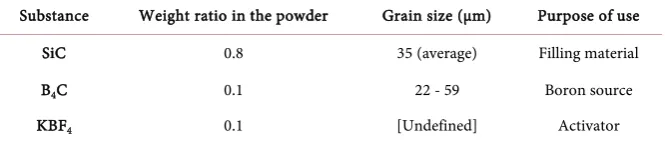
Substance Weight ratio in the powder Grain size (μm) Purpose of use
SiC 0.8 35 (average) Filling material
B4C 0.1 22 - 59 Boron source
KBF4 0.1 [Undefined] Activator
2.2. The Boriding Process
The sample was placed in a high-temperature resistant porcelain crucible full of the boriding powder. The crucible was sealed in a larger container with a conti-nuous Argon flow, in order to create an inert atmosphere to avoid oxidation.
The sample with the above described boriding experimental plant was put into a CARBOLITE™ CWF 1300 furnace. The boriding process was carried out for 10 hours at 1273 K. After the end of the cycle, the specimens were left to cool down slowly in the furnace. The boriding conditions selected after a literature research in boronizing studies on Ti-Al and Ti alloys [10][11][13][14].
2.3. XRD Analysis
XRD analysis method was selected to characterize the crystal structure of the substrate, with and without the thermal cycle. Also, Ti boride formation was ve-rified via this method.
The measurements were carried out with a Bruker D8 ADVANCE device. A Cu Ka tube with 1.54060 Å wave length was used. The measurements were taken within a 2θ angle range of 25 - 85 degrees with a step of 0.02 degrees and 1.0 sec time exposure for every measured angle.
We also carried out extra measurements within a sub-range of 2θ angle with the same step, but 5.000 sec time exposure. Thereby, we achieved to produce a high quality pattern at the sub-range that includes the majority of the informa-tion of the whole pattern.
The evaluation of the patterns was carried out via Bruker’s DIFFRAC.EVA V.4.2.0.31 suite, drawing data from Crystallographic Open Database (COD-2016).
2.4. SEM Analysis
[image:3.595.207.540.177.248.2]DOI: 10.4236/msa.2018.911063 876 Materials Sciences and Applications
3. Results and Discussion
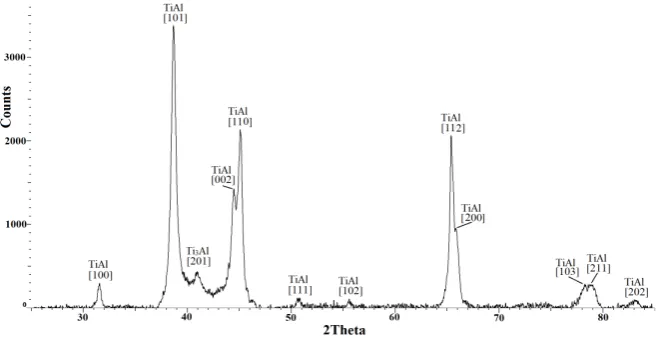
Figure 1 shows XRD pattern of the substrate material GE48-2-2 Titanium Alu-minide before any treatment.
In order to separate overlapping peaks, we proceeded to an additional mea-surement with five times larger exposure time (5.0 sec) within a 2θ range of 36 - 48 degrees, which is shown in Figure 2. It is clear that, in the pre-treatment sub-strate, the dominant phase is the γ-Titanium Aluminide (γ-TiAl), but there is a presence of another equilibrium Ti-Al phase consisted of α2-Ti3Al. These
pre-liminary measurements were carried out for two reasons: first, to detect the ini-tial phases of the raw material and, second, to have a reference to evaluate the possible modification of the substrate after the boronizing treatment.
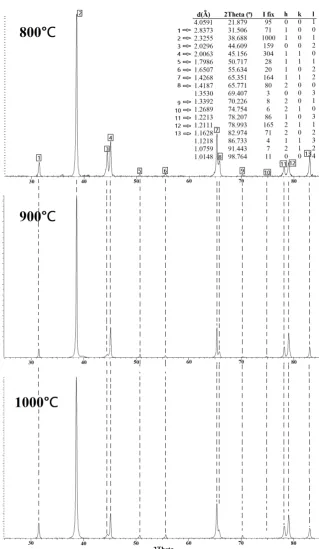
In Figure 3 the XRD spectrum of the substrate metal after 10 hours non-boriding annealing treatment at 1073 K, 1173 K and 1273 K is presented. The measurements, which were carried out at room temperature, showed that the substrate was modified and transformed into a pure γ-TiAl material, ensur-ing that durensur-ing boridensur-ing the substrate consists of just one sensur-ingle phase.
[image:4.595.209.536.528.704.2]Figure 1. Full XRD pattern of commercial GE48-2-2 alloy.
DOI: 10.4236/msa.2018.911063 877 Materials Sciences and Applications Figure 3. Full XRD pattern of the substrate after non-boriding treatment at 1073 K, 1173 K and 1273 K for 10 hours. In the table (up-right) the crystallographic data of γ-TiAl phase’s peaks are depicted.
DOI: 10.4236/msa.2018.911063 878 Materials Sciences and Applications Figure 4. Full XRD pattern of borided layer after boronizing treatment at 1273 K for 10 hours (red lines correspond to TiB phase peaks, in order the total absence of TiB phase to be clear).
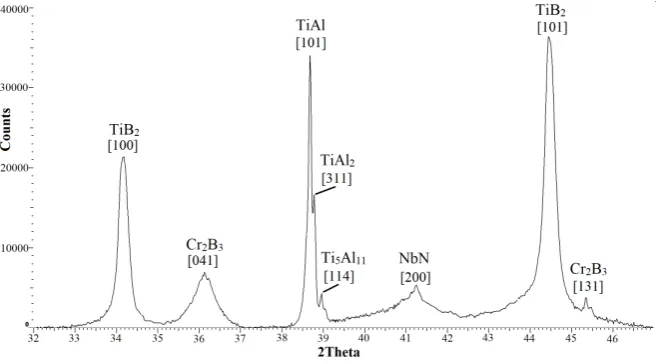
Figure 5. Remeasured part of the pattern of Figure 4 at 2θ 32 - 47 degrees sub-range.
Moreover, a variety of secondary phases was revealed such as TiAl2 and
Ti5Al11. During the boriding process, a diffusion mechanism seems to hold near
the surface, leading to an alteration of the local equilibrium composition, which in turn results in formation of the mentioned above Al-rich phases, appeared to be formed between the TiB2 needles. It is more probably that the Al-rich phases
were formed because of the fact that a part of the Ti atoms was consumed for the formation mainly of TiB2.
There is no evidence of TiB formation, in spite that elsewhere was referred to be observed [14] [15] [16]. Contrariwise, only TiB2 was formed as it is clearly
observable in Figure 4 and Figure 5. This is a very important detail that contri-butes to the evaluation of the quality of the coating, because the mechanical properties of TiB phase are inferior in comparison to TiB2[17]. The absence of
[image:6.595.210.539.305.487.2]DOI: 10.4236/msa.2018.911063 879 Materials Sciences and Applications Figure 6. Metallographic image of the coating layer (A: γ-TiAl substrate, B: boride coat-ing).
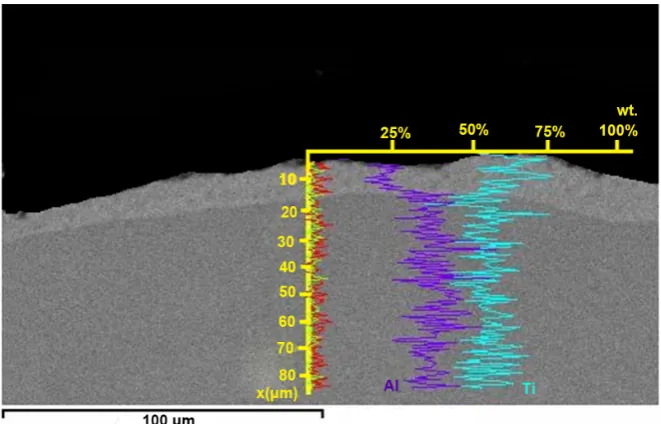
Figure 7. SEM image of coating layer after boronizing and chemical analysis profile for the elements Ti (light blue), Al (purple) Nb (red), Cr (green).
boride with Chromium, Cr2B3 (Figure 5). The Cr2B3 is a hard phase that
en-hances the quality of the coating [18]. Moreover, NbN (Figure 5) was probably formed, which contributes to the superficial strengthening of the material [19].
Finally, there is a strong evidence of the formation of a hexagonal (gra-phite-like) Boron Nitride, h-BN (Figure 4). Normally, the BN is formed in the case that an NH4Cl activator is used [10]. However, in our case is obvious that
the presence of BN in the coating is caused by the atmospheric Nitrogen traces, as we did not use a Nitrogen containing activator. The substrate is not suffi-ciently approachable from the X-ray beam, so the γ-TiAl phase peaks on XRD pattern (Figure 4 & Figure 5) are not enough intense [20][21].
[image:7.595.208.539.281.493.2]DOI: 10.4236/msa.2018.911063 880 Materials Sciences and Applications In Figure 7 a SEM image of the coating layer is presented.
The image (Figure 7) revealed a 10 - 15 μm thick TiB2 layer. Moreover, the
li-near chemical profile across the coating layer for the elements Ti (light blue), Al (purple), Nb (red), Cr (green) is presented. The coating layer, as shown clearly in Figure 6, seems to consist of two phases. The atomic ratio Al:Ti in the coating, as extracted from elemental analysis via SEM (Figure 7), is significantly dimi-nished. The majority of Ti atoms have being consumed in the formation of the TiB2 phase. Thus, a large amount of Al atoms were deliberated from the initial
γ-TiAl phase. Part of these Al atoms seemed to form the detected via XRD Al-rich phases TiAl2 and Ti5Al11. The rest of the Al atoms have been moved
to-wards the surface, following a reverse diffusion path. After that, an oxidation reaction of Al atoms took place and the oxide that was formed peeled off due to its weak adhesion with the coating layer.
4. Conclusions
From the above described results we deduce the following:
• The boronizing treatment leads to the formation of a coating layer, that in-cludes the desirable TiB2 phase with sufficient hardness (up to HV = 1400). • The TiB phase is totally absent from the spectrum.
• The substrate undergoes a modification during the boronizing process, being transformed into a pure γ-TiAl material.
• The same modification is present during non-boriding annealing of the pure substrate at the same time and temperature conditions. Consequently, this modification is independent of the presence of Boron.
Acknowledgements
The authors acknowledge Mrs. Dabou Xanthi for carrying out the XRD mea-surements and Assoc. Prof. Pavlidou Eleni for conducting the SEM measure-ments. This research has been financially supported by General Secretariat for Research and Technology (GSRT) and the Hellenic Foundation for Research and Innovation (HFRI) (Scholarship Code: 530).
Conflicts of Interest
The authors declare no conflicts of interest regarding the publication of this pa-per.
References
[1] Appel, F. and Oehring, M. (2003) γ-Titanium Aluminide Alloys: Alloy Design and Properties. In: Leyens, C. and Peters, M., Eds., Titanium and Titanium Alloys, WILEY-VCH Verlag GmbH & Co. KGaA, Weinheim, 89-152.
https://doi.org/10.1002/3527602119.ch4
DOI: 10.4236/msa.2018.911063 881 Materials Sciences and Applications https://doi.org/10.1016/j.msea.2011.07.070
[3] Popela, T., Kubásek, J., Maixner, J., Novák, P. and Vojtěch, D. (2011) Comparison of Nb- and Ta-Effectiveness for Improvement of the Cyclic Oxidation Resistance of TiAl-Based Intermetallics. Intermetallics, 19, 493-501.
https://doi.org/10.1016/j.intermet.2010.11.025
[4] Miura, K. and Yoshihara, M. (1995) Effects of Nb Addition on Oxidation. Interme-tallics, 3, 357-363. https://doi.org/10.1016/0966-9795(95)94254-C
[5] Swadzba, L., Moskal, G., Jarczyk, G., Aguilar, J. and Goral, M. (2011) Diffusion Aluminide Coatings for TiAl Intermetallic Turbine Blades. Intermetallics, 19, 744-747. https://doi.org/10.1016/j.intermet.2010.12.015
[6] Thongtem, T., McNallan, M., Thongtem, S. and Sopunna, K. (2004) Surface Mod-ification of the γ-TiAl Alloys by the Nitridation. Surface Science, 566-568, 810-815. https://doi.org/10.1016/j.susc.2004.06.113
[7] Ma, X.X., Zhao, X.G., Zhang, F., Shi, J.Y., Zhang, J. and Liang, W. (2007) Oxidation Kinetics of the Pack Siliconized TiAl-Based Alloy and Microstructure Evolution of the Coating. Intermetallics, 15, 1-8. https://doi.org/10.1016/j.intermet.2005.11.038 [8] Anthymidis, K.G., Stergioudis, G. and Tsipas, D.N. (2002) Boride Coatings on
Non-Ferrous Materials in a Fluidized Bed. Science and Technology of Advanced Materials, 3, 303-311. https://doi.org/10.1016/S1468-6996(02)00038-4
[9] Anthymidis, K.G., Tsipas, D.N. and Stergioudis, G. (2001) Boriding of Titanium Alloys in a Fluidized Bed Reactor. Journal of Materials Science Letters, 20, 2067-2069. https://doi.org/10.1023/A:1013510629005
[10] Vázquez-Alcázar, M.R., Ruiz Navas, E.M., Gordo, E. and Tsipas, S.A. (2010) Boride Coatings Obtained by Pack Cementation Deposited on Powder Metallurgy and Wrought Ti and Ti-6Al-4V. Surface & Coatings Technology, 205, 2340-2347. https://doi.org/10.1016/j.surfcoat.2010.09.026
[11] Vojtěch, D. and Popela, T. (2012) Characterization of Pack-Borided Last-Generation TiAl Intermetallics. Surface & Coatings Technology, 209, 90-96.
https://doi.org/10.1016/j.surfcoat.2012.08.034 [12] GfE (2010) Data Sheet for γ-TiAl 48-2-2 Ingots.
https://www.gfe.com/fileadmin/user_upload/pdfs/Produktspezifikationen_Titaniu m_Aluminides/PDB_gamma-TiAl_48-2-2-Ingot_V2.pdf
[13] Lei, M.K., Zhu, X.P., Han, S.Q., Wang, D.Y., Wang, F.G. and Wang, F. (2000) Effect of Borate Coating on Oxidation Resistance of γ-TiAl Intermetallic Compound. Ma-terials Chemistry and Physics, 65, 249-252.
https://doi.org/10.1016/S0254-0584(99)00263-1
[14] Aich, S. and Ravi Chandran, K.S. (2002) TiB Whisker Coating on Titanium Surfaces by Solid-State Diffusion: Synthesis, Microstructure, and Mechanical Properties. Metallurgical and Materials Transactions A, 33, 3489-3498.
https://doi.org/10.1007/s11661-002-0336-6
[15] Atar, E., Kayali, E.S. and Cimenoglu, H. (2008) Characteristics and Wear Perfor-mance of Borided Ti6Al4V Alloy. Surface & Coatings Technology, 202, 4583-4590. https://doi.org/10.1016/j.surfcoat.2008.03.011
[16] Li, F., Yi, X., Zhang, J., Fan, Z., Gong, D. and Xi, Z. (2010) Growth Kinetics of Tita-nium Boride Layers on the Surface of Ti6Al4V. Acta Metallurgica Sinica (English
Letters), 23, 293-300. https://doi.org/10.1016/S1006-7191(07)60042-8
DOI: 10.4236/msa.2018.911063 882 Materials Sciences and Applications Ceramic Society, 91, 1319-1321. https://doi.org/10.1111/j.1551-2916.2007.02246.x [18] Okada, S., Atoda, T. and Higashi, I. (1987) Structural Investigation of Cr2B3, Cr3B4,
and CrB by Single-Crystal Diffractometry. Journal of Solid State Chemistry, 68, 61-67. https://doi.org/10.1016/0022-4596(87)90285-4
[19] Borcz, C., Lepienski, C.M. and Brunatto, S.F. (2013) Surface Modification of Pure Niobium by Plasma Nitriding. Surface & Coatings Technology, 224, 114-119. https://doi.org/10.1016/j.surfcoat.2013.03.008
[20] Azaroff, L.V. (1968) Elements of X-Ray Crystallography. McGraw-Hill Inc., New York.