Dynamic Neural Network Based Nonlinear
Control of a Distillation Column
Feng Li1,2 1
Department of Mathematics and Statistics, University of Maryland, Baltimore, USA 2
Office of Biostatistics, Center for Drug Evaluation and Research, Food and Drug Administration, Silver Spring, USA
E-mail: [email protected]
Received July 27, 2011; revised August 19, 2011; accepted August 26, 2011
Abstract
Taking advantage of the knowledge of top and bottom compositions of a distillation column, a dynamic neu-ral network (DNN) is designed to identify the input-output relationship of the column. The weight-training
algorithm is derived from a Lyapunov function. Based on this empirical model, a nonlinear H controller is
synthesized. The effectiveness of the control strategy is demonstrated using simulation results.
Keywords:Distillation Column, Dynamic Neural Network, Nonlinear H Control
1. Introduction
A distillation column is a strongly nonlinear process with multivariate interactions among outputs and some uncer- tainty often exists in the system, which renders the analysis and control of a distillation column very difficult [1,2]. In practice, the single-point control is commonly used which is sample and easy to tune. However, the con- sumption of energy in single-point control is large and the product of the other end is not guaranteed. For high purity distillation column, the two-point control or other strate- gies have been investigated [1,2]. Considering the intrinsic nonlinearity of a distillation column, nonlinear controller has been designed based on the rigorous mathematical model [3,4]. Although a nonlinear controller may be effective in simulation, its implementation in practical plants is complex because of the lack of measurement of some key variables. Furthermore, a controller based on the accurate mathematical model may lead to poor perfor- mance in case of large perturbation. For this reason, most controllers for distillation columns are synthesized based on the input-output relations such as transfer function or a model obtained by system identification [1,5-8].
Because of its capability to approximate arbitrary non- linear mapping, neural network has been actively used in nonlinear system identification and control [9-12]. The multilayer feed-forward neural network (MFNN) is one of the most widely used neural networks as a system model in the design of a model-based controller. A dy-
namic neural network (DNN) is more suitable to ap-proximate a nonlinear dynamic process. Therefore, dy-namic recurrent neural network has been used to learn the input-output relationship of a column and a local optimal controller based on the neural network model was given in [8]. Non-linear adaptive controllers based on MFNN and RBFNN have also been studied [13,14]. A recent review [15] for the past 28 years showed that most of the implementations of advanced control like internal model control were based on linear models. Many recently published papers [16,17] on neural control for distillation columns are some extensions of previous research and supported by simulations. Although a neural network can be trained in simulation to approximate any nonlinear process, the control law must be designed to be robust for the modeling error. H control has been a very popular for
robust control of nonlinear system [18-20]. The applica- tion of H control to distillation columns has not been
widely discussed.
In this paper, a dynamic neural network is designed to identify the input-output relation of a distillation column online. The training algorithm of the network is derived from a Lyapunov function so that the convergence of weights and the finite bound of the identification error are guaranteed. To cope with model error, a nonlinear H
1 1 2 2 ( ) ( ) ( ) ( ) ( ) u tY f Y g Y g Y
u t 2 1 ( ), ( )
2. DNN Based On-Line Identifier of a Binary
Distillation Column
Assume the distillation column is with (L, V) control
structure where L and V are reflux flow in condenser and
boil up flow in reboiler (kmol/min) respectively. Then, let
u1, u2 be L, V respectively. The outputs are the light
compositions of the top and bottom products of a distilla-tion column.
In some set points, assume the nonlinear input-output relationship of the distillation column can be expressed approximately as below:
(1)
wheref Y g Yi R
( )
( ) ( )
Tg Y g Y g Y
0,
g
22 0
g i
1 2
1
1 2
( )
ˆ ˆ
( , g ) ( , g )
u t
g Y W g Y W
ˆ
, i 1i 2i , and
according to some mechanistic knowledge, 11
, 12 21 for any , = 1, 2. Assume the outputsY1, 2are known, a dynamic neu-
ral network based identifier is designed to approximate (1) as below:
0, 0
g g Yi[0,1]
Y
2( )
u t
ˆ Y ˆ
ˆ ˆ ( ,
YAY f Y Wf)AY
(2)
where A is any stable matrix. Y and are the output
vectors of the column and the identifier respectively.
f andgˆi (i = 1,2) are all MFNN, which are the
estimates of f and gi in (1) respectively. The active
function of the output-layer of MFNN fˆ is linear. The
active function of gˆ1 is a sigmoid function
(1 exp(
k x)), and the active function of gˆ2 is
(1 x k
exp( k k ))
, where is a tunable parameter sat-isfying 0. Wf and Wgi are the weight matrixes.
From [9], for 0 and any continuous function ( )
F x there exist a three-layer feedforward network
sat-isfing: ˆ F sup x ( )
F x ( ,x W)
W
( , )
where denotes the optimal weight matrix and ˆ
F x W denotes the outputs of the network.
Let Wf
and
i
g
W be the corresponding optimal
weight matrix, system (1) can be rewritten as:
2
1
ˆ( , ) ˆ( , ) ( ) ( ) i
f i g i
i
f Y W AY g Y W u t Y
)
YAY (3)
where ( Y is the modeling error of the optimal
identi-fer satisfing: sup ( )
Y
Y Y
, Y
Y 0Y Y1, 21
which can be made as small as possible by adjusting the neural network structure.
Let
be an extended column vector of all the
ele-ments of a weight matrix W. denotes the corre-
sponding extended vector of the optimal weight matrix. Then the extended column vector of Wfand Wgiare f and gi. Define identification error as
ˆ
Y
e Y and parameter estimation error as
j j j
,
i g
( j f ). From (2) and (3) we have 2
1
)
i i i
e Ae f g Y
u t( )( (4)
where
1
ˆ ˆ ) f Yˆ( ,
( ,Y f f) f f
f f
f
O
0 1
f f ,
, 1 ˆ ˆ ˆ i i g ( , ) ( , )
i i i i
i
i i g i g g g g
g
g g Y g Y O
Define 2 1 i f i O O
( ) g i( ) ( )
d t u t Y (5)
Assume:
sup ( )d t f gsupu (6)
where j ( j f g, ) is a finite constant.
The updating algorithms of the parameter vectors f
and giare as followings: ˆ
f f
f f
Pe k P e
f , ˆ ( ) i i i i i
i g g
g g
Peu t k P e
(7) g
0, ,
where j i, and P is the positive defined
solution of the following Lyapunov equation:
k j f g
T
PAA P Q
Q is a positive defined matrix and the minimal eigenvalue
of Q is0.
Theorem 1: If is bounded and the weight updat-ing alogrithm is (7), then the identification error and parameter estimation error
( )
u t
e
j
( are all
ulti-mately uniformly bounded (UUB) , )i
j f g
Proof: Consider the Lyapunov function candidate:
2
1 1
2 2 f f gi gi
V e e
1 i
P
.
Differentiating it along (4) and (5) yields
2 1 ˆ ( ) ( ) i i i 1 2 ˆ 1 2 i i
f i g
f f g g
i
u t
e Pd t
i
f g
g f
V e Qe e P e P
Substituting (10) into the above equation leads to 2 1 ( ) ( ( ) 2 ( )
i i i i
1
f f f f
g g g g
V e Qe e Pd t e P k
k i
2 2 02 2 2
1 1
( 2
)
i i i i i
f f
g g f f f g g g
i i
V e e P d e P k
k k k
We can further have:
2 2 2 * 0 2 2 2 * * 1 2 2 1 1 f
f f f
k
V e P e k
* 1 4 2 4
i i i i
f
g g g g
i
k d
Assuming is bounded and combining it with (6), we have u t( )
( ) f g m
d t u .
So m is bounded.
Define 2 2 2
1
1 1
4 f gi 4 gi m
i k k d f
.It is easy to verify that
if
0
2
e
P d
or: 1 2
f f d kf
,
or: 1
i 2
i i
g g d kg
0
V
then . For i
L
being bounded, when u ti , we have
d
( )L
. According to Barbalat’s theorem [21], it can be seen that:
, f, gi e L
eL
.
Considering (5), we further have .
3. Nonlinear H
Control of the Binary
Distillation Column
3.1. Nonlinear H Control
Consider an affine nonlinear controller system
1 2
( ) ( ) ( )
x f x g xg x u
( ) ( )
yh x k x u n
(8) where xR ,uRm, Rs,yRp; f x( ),g x1( ),
g2( )x , h(x) and k(x) are smooth functions; u is control
input is uncertainty noise and f(0) 0, (0) 0 h
0
. For system (8), the design objective of nonlinear H
control is to make the following conditions guaranteed [19,20].
1) The closed-loop system is asymptotically stable; and,
2) for a given , the following inequality holds
2
2 2
0 ( ) d 0 ( ) d
t
ty t 0.
According to [19], defining x V V x n
for x R
( ) T
R x k
and ( ) ( )x k x , we have: ( )
R x
Proposition: If is nonsingular, nonlinear H
control law is expressed as
1
2
( ) ( ) ( )
2 x
u R x g x x
1
( )
V k x h
(9)
where V(x) (V(0) = 0) satisfies
1
ˆ( ) ˆ ) ( )ˆ ˆ( ) 0 4
x x x
V f x h x( h x V R x V
where
1
ˆ ( ) ( ) 2( ) ( ) ( ) ( )
f x f x g x R x k x h x
1
ˆ( ) ( ( ) ( ) ( )) ( )
h x Ik x R x k x h x
1
1
ˆ( ) ( ) ( ) ( ) ( )
R x 2g x g1 1 x g x R2 x g2.
1 2
ˆ ˆ ˆ ( )
Y AY f AY g g u t 3.2. Nonlinear H Control of the Binary
Distillation Column
Considering the existence of the modeling error, system (3) can be rewritten as:
d d
Y AY s
(10)
where is the uncertainty variable denoting the mode- ling error.
Assuming the desired tracking trajectory is
s
is a reference variable.
, where
Define 1 1 1d .
d Y Y x Y Y Y Y x
2 2 2d
2
From (10), the tracking error equation can be derived as below:
1
( )
xa x AxGG u
( ) a x
(11) where
ˆ
f AY s
1 0 , 11 12
1 2 21 22 ˆ ˆ ˆ ˆ 0 1 g g
,G G
( ) G Y
u
1
2
For the binary distillation column, 2 is inver-
tible. If the penalty variables are chosen to be
2
( ) ( ) ( )
zh x k x ua x G . (12)
Substituting (9) into (12), we have:
2( ) ( ) ( )
( )
T T
x G x Px k x h x
x a x
1
( )
u R
G P
(13)
where P is the positive defined solution of the following
Riccati inequality:
2
1 1 0
T
PAA PP P . (14)
Remark: P can be obtained by solving a Riccati
equation as below:
2
1
1 0
T T
PA A P P P C C
where [A,C] is observable.
4. Simulation
After The binary distillation model used in the simula-tion is the same as the one developed by [2]. The nomi-nal values of outputs are Y100.98(mol%)
(mol%)
and
20 . The nominal values of reflux flow
and boil-up flow are L = 2.28625 (kmol/min) and V = 2.78625 (kmol/min). The feed flow and feed
compo-sition are F = 1 (kmol/min) and Zf = 0.5 (mol%).
0.02
Y
9 0
0 9
A
1 0
, 1.1
0 1
C
0.0555 0
0 0.0555
P
The distillation column is controlled using the control strategy (13) developed in this paper. The tacking prop-erty and the disturbance attenuation propprop-erty of the con-trol system are demonstrated through simulation. To make the transient response be more elegant, the dy-namic neural network based identifier is trained for some time offline.
In the simulation, we choose
,
and the positive definite P we obtained is
.
1) Servo properties
Let the setpoint of the top light component change from nominal value 0.98 to 0.995 and the bottom com-position remain nominal value 0.02. The augmentations of system output are demonstrated in Figure 1. The
curves of the control inputs are in Figure 2.
2) Robustness
[image:4.595.329.512.75.514.2]The responses of the closed-loop system are illus-
Figure 1. The augmentations of outputs.
[image:4.595.339.508.545.660.2]Figure 2. The curves of control inputs.
Figure 3. The augmentations of outputs (Feed increases 10%).
Figure 4. The augmentations of outputs (Feed composition increases 10%).
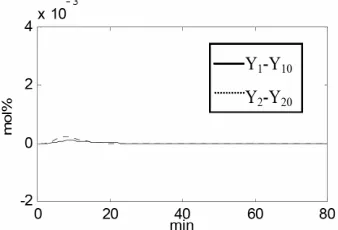
trated in Figures 3 and 4 when feed flow F and feed
5. Conclusions
A dynamic neural network based online nonlinear identi-fier for a binary distillation column is designed. The learning algorithm of the network weights is established in detail, which can guarantee the boundedness of the identification error. To deal with the modeling error, a nonlinear H∞ controller based on the identifier is given
by choosing the penalty variables for the column. The effectiveness of the proposed strategy is demonstrated in simulation results. The algorithm developed in this paper can be applied to other chemical processes as well.
6. Acknowledgements
The author thanks the reviewers for very helpful com-ments. Views expressed in this paper are the author’s professional opinions and do not necessarily represent the official position of the US Food and Drug Admini-stration.
7. References
[1] T. J. McAvoy and Y. H. Wang, “Survey of Recent Dis-tillation Control Results,” ISA Transactions, Vol. 25, No.
1, 1986, pp. 5-21.
[2] S. Skogestad and M. Morari, “Understanding the Dy-namic Behavior of Distillation Columns,” Industrial & Engineering Chemistry Research, Vol. 27, No. 10, 1988,
pp. 1848-1862. doi:10.1021/ie00082a018
[3] J. Lévine and P. Rouchon, “Quality Control of Binary Distillation Columns via Nonlinear Aggregated Models,”
Automatica, Vol. 27, No. 3, 1991, pp. 463-480. doi:10.1016/0005-1098(91)90104-A
[4] F. Viel, E. Busvelle and J. P. Gauthier. “A Stable Control Structure for Binary Distillation Columns,” International Journal of Control, Vol. 67, No. 4, 1997, pp. 475-505. doi:10.1080/002071797224036
[5] N. F. Jerome and W. H. Ray, “High-Performance Multi-variable Control Strategies for Systems Having Time Delays,” AIChE, Vol. 32, No. 6, 1986, pp. 914-931. doi:10.1002/aic.690320603
[6] S. Skogestad, M. Morari and J. C. Doyle, “Robust Con-trol of Ill-Conditioned Plants: High Purity Distillation,”
IEEE Transactions on Automatic Control, Vol. 33, No.
12, 1988, pp. 1092-1105. doi:10.1109/9.14431
[7] J. Savkovic, “Neural Net Controller by Inverse Modeling for a Distillation Plant,” Computers & Chemical Engi-neering, Vol. 20, No. S2, 1996, pp. S925-S930. doi:10.1016/0098-1354(96)00162-7
[8] W. Yu, S. Alexander and J. A. Poznykz, “Neuro Control for Multicomponent Distillation Column,” 1999 IFAC
World Congress,Beijing, 5-9 July 1999, pp. 379-383.
[9] G. Cybenko, “Approximation by Superpositions of Sig-moidal Function,” Mathematics of Control, Signals, and Systems, Vol. 5, No. 4, 1989, pp. 303-314.
doi:10.1007/BF02551274
[10] K. Hunt, J. D. Sbarbaro, R. Zbikowshi and P. J. Gaw-throp, “Neural Networks for Control Systems—A Sur-vey,” Automatica, Vol. 28, No. 6, 1992, pp. 1083-1112. doi:10.1016/0005-1098(92)90053-I
[11] M. J. Wills, G. A. Montague, C. Di Massimo, M. T. Tham and A. J. Morris, “Artificial Neural Networks in Process Esitmation and Control,” Automatica, Vol. 28,
No. 6, 1992, pp. 1181-1187.
doi:10.1016/0005-1098(92)90059-O
[12] P. Turner, G. Montagueand J. Morris, “Dynamic Neural Networks in Nonlinear Predictive Control,”Computers & Chemical Engineering, Vol. 20, No. S2, 1996, pp. S937-
S942. doi:10.1016/0098-1354(96)00164-0
[13] S. Li and F. Li, “Dynamic Neural Network Based Non- linear Adaptive Control for a Distillation Column,” Pro-ceedings of the 3rd World Congress on Intelligent Con-trol and Automation, Hefei, June 28-July 2 2000, pp.
3087-3091.
[14] S. R. Li, H. T. Shi and F. Li. “RBFNN Based Direct Adaptive Control of MIMO Nonlinear System and Its Application to a Distillation Column,” Proceedings of World Conference of Intelligent Control and Automation,
Shanghai, 10-14 June 2002, pp. 2896-2900.
[15] D. Muhammad, Z. Ahmad and N. Aziz, “Implementation of Internal Model Control (IMC) in Continuous Distilla-tion Column,” Proceedings of the 5th International Sym-posium on Design, Operation and Control of Chemical Processes, Singapore, 16February 2010, pp. 812-821. [16] H. E. Tonnang and A. Olatunbosun, “Neural Network
Controller for a Crude Oil Distillation Column,” Journal of Engineering and Applied Sciences, Vol. 5, No. 6, 2010,
pp. 74-82.
[17] M. Ławryńczuk, “Explicit Nonlinear Predictive Control of a Distillation Column Based on Neural Models,” Che- mical Engineering & Technology, Vol. 32, No. 10, 2011,
pp. 1578-1587.
[18] S. R. Li, “Nonlinear H Controller Design for a Class of
Nonlinear Control Systems,” Proceedings of 23rd IEEE Industrial Electronics, Control and Instrumentation, New Orleans, 9-14 November 1997, pp. 291-294.
[19] A. Isidori, “Nonlinear Control Systems,” 2nd Edition, Springer-Verlag, New York, 1989.
[20] A. Isidori and A. Astolfi, “Disturbance Attenuation and H Control via Measurement Feedback in Nonlinear
Systems,” IEEE Transactions on Automatic Control, Vol.
37, No. 9, 1992, pp. 1283-1293. doi:10.1109/9.159566