Solving the independent set problem by sticker based DNA
computers
Hassan Taghipour1*, Ahad Taghipour2, Mahdi Rezaei3, Heydar Ali Esmaili1
1Department of Pathology, Tabriz University of Medical Sciences, Tabriz, Iran
2Department of Computer Engineering, Faculty of Engineering, Isfahan University, Isfahan, Iran 3Department of Theoretical Physics and Astrophysics, Tabriz University, Tabriz, Iran
Email: *[email protected]
Received 29 December 2011; revised 12 January 2012; accepted 25 January 2012
ABSTRACT
In this paper, the sticker based DNA computing was used for solving the independent set problem. At first, solution space was constructed by using appropriate DNA memory complexes. We defined a new opera- tion called “divide” and applied it in construction of solution space. Then, by application of a sticker based parallel algorithm using biological operations, inde- pendent set problem was resolved in polynomial time.
Keywords:Parallel Computing; Sticker Based DNA
Computers; Independent Set Problem; NP-Complete Problem
1. INTRODUCTION
DNA encodes the genetic information of cellular organ- isms. The unique and specific structure of DNA makes it one of the favorite candidates for computing purposes. In comparison with conventional silicon-based computers, DNA computers have massive degrees of miniaturization and parallelism. By recent technology, about 1018 DNA molecules can be produced and placed in a test tube. Each of these DNA molecules could act as a small pro- cessor. Biological operations such as hybridization, sepa- ration, setting and clearing can be performed simultane- ously on all of these DNA strands. Thus, in an in vitro assay we could handle about 1018 DNA molecules or, we can say that 1018 data processors can be executed in par-allel.
DNA computing was initially developed by Leonard Adleman in 1994 [1]. Adleman succeeded in solving seven-point Hamiltonian path problem solely by mani- pulating DNA molecules and suggested that DNA could be used to solve complex mathematical problems.
In 1996, a new model of DNA computing (sticker model) was introduced by Roweis et al. [2]. This model
has a random access memory that requires no strand ex- tension, uses no enzymes, and its materials are reusable. Sticker based DNA computing has potential capability for being a universal method in DNA computing. Roweis
et al. also proposed specific machine architecture for implementing the sticker model as a microprocessor- controlled parallel robotic workstation [2]. Thus, the ope- rations used in sticker model can be performed on fully automated devices, which is helpful in reducing the error rates of operations.
In this paper, we applied sticker model for solving the independent set problem which is one of the NP-com- plete problems.
The paper is organized as follows. Section 2 intro- duces the DNA structure and various DNA computing models and discuss about Sticker based DNA computing and biological operations which are used in sticker mo- del. Section 3 introduces a DNA based algorithm for solving the independent set problem in sticker model.
2. BASICS OF DNA COMPUTING
2.1. Structure of DNA and DNA Computing Models
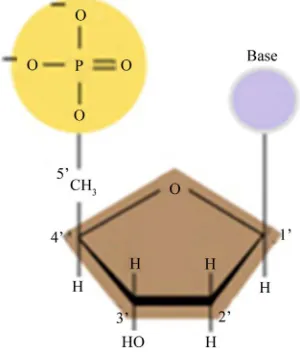
tides, and the neucleotides are simply represented as A, G, C, and T. The neucleotides are link together by phos- phodiester bonds and form single stranded DNA (ss- DNA). A ssDNA molecule can be likened to a string consisting of a combination of four different symbols, A, G, C, T. Mathematically, this means we have a four letter alphabet ∑ = {A, G, C, T} to encode information. Two ssDNA molecules join together to form double stranded DNA (DsDNA) based on complementary rule: “A” from one strand bond to “T” from opposite strand, and “C” bond to “G”. In Figure 1, a schematic picture of neu-
cleotide is shown.
DNA computing was initially developed by Leonard Adleman in 1994 [1]. Adleman resolved an instance of Hamiltonian path problem just by handling the DNA mo- lecules. In 1995, Lipton [3] presented a method for solv- ing the satisfiability (SAT) problem. Adleman-Lipton model can be used to solve different NP-complete prob- lems. In Adleman-Lipton model, DNA splints are used for construction of solution space. Adleman [4,5] also presented a molecular algorithm for solving the 3-color- ing problem. Chang and Guo [6-8] showed that the DNA operations in Adelman-Lipton model could be used for developing DNA algorithms to resolve the dominating set problem, the vertex cover problem, the maximal cli- que problem and independent set problem.
[image:2.595.97.247.543.721.2]In 1996, Roweis et al. [2] introduced the Sticker based DNA computing model and applied it in solving the Mi- nimal Set Cover problem. Perez-Jimenez and Sancho- caparrini [9] used Sticker based DNA computing to re- solve knapsack problem, and this model also were ap- plied for breaking the Data Encryption Standard (DES) [10,11]. DES encrypts 64 bit texts by using 56 bit key. Breaking DES means that given one (plain-text, cipher- text) pair, we can find a key which maps the plain-text to the cipher text. A conventional attack on DES would need to perform an exhaustive search through all of the
Figure 1. A neucleotide.
256 keys, which, at a rate of 100,000 operations per se- cond, would take 10,000 years. In contrast, it was esti- mated that DES could be broken by using sticker based DNA computing in about 4 months.
Other than Adleman-Lipton and Sticker based models, other various models are also proposed in DNA comput- ing by researchers. Quyang et al. [12] solved the maxi- mal clique problem using DNA molecules and Restric- tion endonuclease enzymes. Amos et al. [13,14] described a DNA computation model using restriction endonucle- ase enzymes instead of successive cycles of separation by DNA hybridization, which can reduce the error-rate of computation. Hagiya et al. [15] proposed a new me- thod of DNA computing that involves a self-acting DNA molecule containing both the input, program, and work- ing memory. In this method, a single-stranded DNA mo- lecule consists of an input segment on the 5’-end, fol- lowed by a formula (program) segment, followed by a spacer, and finally with a “head” on the 3’-end that moves and performs the computation. Another method for DNA computation is “computation by self-assembly”. Eric Winfree et al. [16-18] introduced a linear and 2-di- mentional self-assembly model.
The surface-based model was introduced by Liu et al. [19]. This model uses DNA molecules attached to a solid surface, instead of DNA molecules floating in a solution. The computing by blocking was introduced by Rozen- berg et al. [20,21]. This model uses a novel approach to filter the DNA molecules: Instead of separating the DNA strands to distinct tubes, or destroy and removing the DNA molecules that does not contribute to finding a so- lution, it blocks (inactivates) them in a way that the blocked strands can be considered as non-existent during the subsequent steps of computation.
2.2. Sticker Based DNA Computation
methods in which the presence or absence of a particular subsequence in a strand corresponded to a particular bit being on or off. In sticker model, each possible bit string is represented by a unique association of memory strands and stickers. This model has a random access memory that requires no strand extension and uses no enzymes [2].
[image:3.595.326.521.615.719.2]Another conception in sticker model is (K, L) library. Each (K, L) library contains memory complexes with K bit regions, the first L bit regions are either on or off, in all possible ways, whereas the remaining K-L bit regions are off. The last K-L bit regions can be used for inter- mediate data storage. In every (K, L) library there are at least 2L memory complexes. In
Figure 2, a memory
complex with 7 bit regions representing the binary num- ber 1100101 is shown.
2.3. Biological Operations in Sticker Model
There are four principal operations in sticker model: com-bination, separation, setting and clearing [2]. We also de- fined a new operation called “divide” which is used in con- struction of solution space. Here we briefly discuss about these operations.
1) Combine (T0, T1, T2): the memory complexes from the tubes T1 and T2 are combined to form a new tube T0, simply the contents of T1 and T2 are poured into tube T0. (T0 = T1 T2).
2) Separate (T0, i) (T1, T2), this operation creates two new tubes T1 and T2, T1 contains the memory com- plexes having the ith bit on (T1 = +(T0, i)) and T2 con- tains the memory complexes having the ith bit off (T2 = –(T0, i)).
3) Set (T0, i): the ith bit region on every memory com- plex in tube T0 set to 1 or turned on, or we can say the sticker for that bit is annealed to corresponded bit region on every memory complex.
4) Clear (T0, i): the ith bit region on every memory complex in tube T0 set to 0 or turned off, or we can say the stickers of that bit region must be removed (if present) from every memory complex in tube T0.
5) Divide (T0, T1, T2): by this operation, the contents of tube T0 is divided into two equal portions and poured into the tubes T1 and T2.
3. SOLVING THE INDEPENDENT SET
PROBLEM IN STICKER BASED DNA
COMPUTERS
3.1. Definition of the Independent Set Problem
In graph theory, an independent set of a graph G = (V, E),
Figure 2. A memory complex representing 1100101.
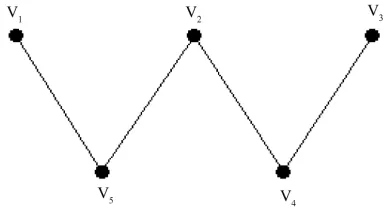
where V is the set of the vertices and E is the set of the edges, is a subset V1 V such that no two vertices in V1 are joined by an edge in E. On the other hand, the inde- pendent set is a set of vertices such that for every two vertices, there is no edge connecting the two. The size of an independent set is the number of vertices it contains. A maximum independent set is a largest independent set for a given graph G and the problem of finding such a set is called the maximum independent set problem. The ma- ximum independent set problem has been proved to be a NP-complete problem [22]. For example, the graph in
Figure 3 includes 5 vertices and 4 edges.
All of the independent sets for our graph are as fol- lows: {V1}, {V2}, {V3}, {V4}, {V5}, {V1, V2}, {V1, V3}, {V1, V4}, {V2, V3}, {V3, V5}, {V4, V5}, {V1, V2, V3}
It is clear that the independent set of the maximum size is {V1, V2, V3}, furthermore, the size of the inde- pendent set problem in our graph is 3.
3.2. Construction of Sticker Based DNA Solution Space for Independent Set Problem
First of all, it is essential to generate the sticker based DNA solution space of our problem. Then, basic bio- logical operations are used to select legal strands and remove illegal strands from the solution space. It is ob- vious that a graph with N vertices has 2N subset of verti- ces or 2N possible independent sets. Furthermore, each possible independent set can be represented by an N- digit binary number. If the ith bit in an N-digit binary number is set to 1, it represents that the ith vertex is in the independent set. If the ith bit in an N-digit binary number is set to 0, it represents that the ith vertex is not in the independent set.
Our graph has 5 vertices and 32 possible independent sets. All of these possible independent sets can be repre- sented by a 5-digit binary number. For example the bi- nary number 11100 represent the {V1, V2, V3} or the bi- nary number 11111 represent the {V1, V2, V3, V4, V5}.
To represent all possible independent sets by appro- priate DNA memory complexes, we introduce two me- thods for construction of solution space.
Method One:
In this method which is proposed by Roweis et al., [2]
first we provide enough amounts of memory strands with at least 5 bit regions. Then, the strands are split into two tubes A and B. To one tube (tube A) is added an excess amounts of all stickers and set all bits on. The unused stickers are then removed. The contents of tubes A and B are then mixed together and by rising temperature all annealed stickers dissociate from memory strands. Fi- nally the mixture is cooled again, causing the stickers to randomly anneal to the memory strands. By this method, it is expected that approximately 63% of memory com- plexes will be produced. Of course, this percentage can obviously be increased by starting with more memory strands. The advantage of this method is that the solution space is produced at single step, but its main disadvan- tage is that some memory complexes may not be pro- duced by above method.
Method Two:
1) Input (T0), where T0 contains large amounts of me- mory strands with at least N (number of vertices in graph) bit regions.
2) For i = 1 to N, where N is number of vertices in graph
a) Divide (T0, T1, T2) b) Set (T1, i)
c) Combine (T0, T1, T2) End for
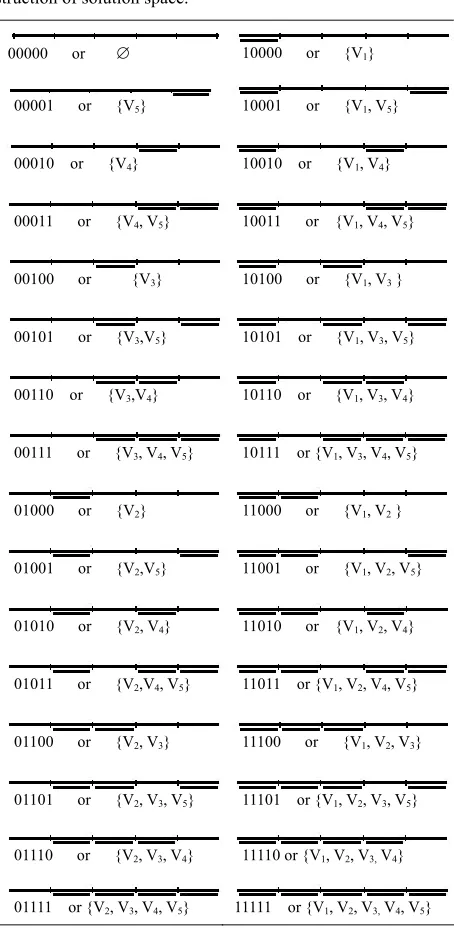
Note: Method two has N divide, N set and N combine operations. At the end of procedure, tube T0 contains all of the memory complexes which each of them represent one of the possible independent sets. The main advantage of this new method is that the memory complexes repre- senting all possible independent sets will be produced definitely. In our example, tube T0 contains 32 different memory complexes. The 32 memory complexes which are produced during construction of solution space are shown in Table 1.
3.3. DNA Algorithm for Solving the Independent Set Problem
The following algorithm is proposed for solving the in- dependent set problem:
1) For k = 1 to m, where m is the number of edges in the graph G
a) Let ek = (vi, vj), where ek is one edge and vi, vj are vertices which are connected to each other by ek
b) Bit regions i and j represents vi and vj, respectively. c) Separate (T0, i) → (T1, T2)
d) Separate (T1, j) → (T3, T4) e) Discard T3
f) Combine (T0, T2, T4) 2) For i = 0 to n – 1 For j = i down to 0
[image:4.595.311.538.102.571.2]Separate (Tj, I + 1) → (T(j+1)’, Tj)
Table 1. Memory complexes which are produced during con-struction of solution space.
00000 or 10000 or {V1}
00001 or {V5} 10001 or {V1, V5}
00010 or {V4} 10010 or {V1, V4}
00011 or {V4, V5} 10011 or {V1, V4, V5}
00100 or {V3} 10100 or {V1, V3 }
00101 or {V3,V5} 10101 or {V1, V3, V5}
00110 or {V3,V4} 10110 or {V1, V3, V4}
00111 or {V3, V4, V5} 10111 or {V1, V3, V4, V5}
01000 or {V2} 11000 or {V1, V2 }
01001 or {V2,V5} 11001 or {V1, V2, V5}
01010 or {V2, V4} 11010 or {V1, V2, V4}
01011 or {V2,V4, V5} 11011 or {V1, V2, V4, V5}
01100 or {V2, V3} 11100 or {V1, V2, V3}
01101 or {V2, V3, V5} 11101 or {V1, V2, V3, V5}
01110 or {V2, V3, V4} 11110 or {V1, V2, V3, V4}
01111 or {V2, V3, V4, V5} 11111 or {V1, V2, V3, V4, V5}
Combine (Tj+1, Tj+1, T(j+1)’)
3) Read Tn; else if it was empty then: Read Tn–1; else if it was empty then: Read Tn–2; else if it was empty then: Read T2; else if it was empty then: Read T1;
“1xxx1”, “x1xx1”, “x1x1x” and “xx11x” (x can be either 1 or 0) cannot be independent set and memory com- plexes representing them should be removed from solu- tion space.
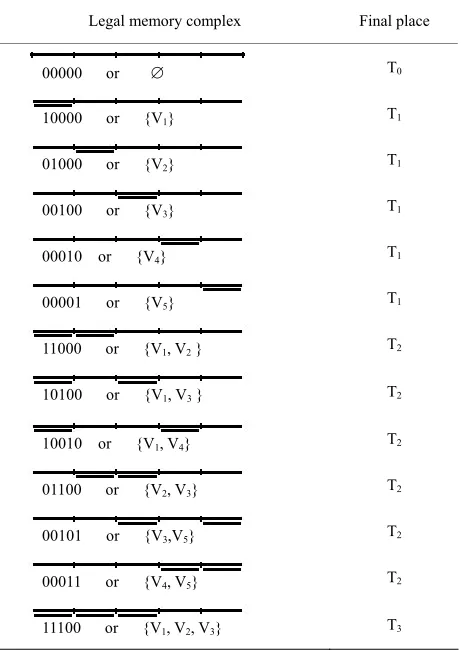
Step 1 of the algorithm is executed m times (m is 4 in our graph) and at each round of execution the memory complexes representing the subsets “1xxx1”, “x1xx1”, “x1x1x” and “xx11x” are removed from tube T0. At the end of step 1, illegal memory complexes are removed from solution space and tube T0 only contains the me- mory complexes which represent legal independent sets. ({V1}, {V2}, {V3}, {V4}, {V5}, {V1, V2}, {V1, V3}, {V1, V4}, {V2, V3}, {V3, V5}, {V4, V5}, {V1, V2, V3}).
By the execution of step 2, the memory complexes without any annealed stickers are placed in tube T0, the memory complexes with only one annealed sticker are placed in tube T1, the memory complexes with 2 an- nealed stickers are placed in tubes T2, the memory com- plexes with 3 annealed stickers are placed in tube T3, and so on. Note, that the numbers of annealed stickers in every memory complex represent the number of vertices in corresponding independent set. For example, in Graph of our problem, the legal independent sets with one ver- tex ({V1}, {V2}, {V3}, {V4}, {V5}) are placed in tube T1 , and those with 2 vertices ({V1,V2}, {V1,V3}, {V1,V4}, {V2,V3}, {V3,V5}, {V4,V5}) are placed in tube T2 and finally the independent set with 3 vertices ({V1,V2,V3}) is placed in tube T3.
The legal memory complexes which remain in tube T0 at the end of step 1 of the algorithm and their final places at the end of step 2 are shown in Table 2.
In step 3, all of the tubes (from Tn to T1) are evaluated for presence of memory complexes, and the first tube which is not empty and contains memory complexes represent maximum independent set. In our example, tubes T5 and T4 are empty and devoid of any memory complexes. The first tube which contains DNA mole- cules is tube T3. As mentioned before, the memory com- plexes in tube T3 have 3 annealed stickers; therefore, the maximum independent set in our graph is 3.
4. CONCLUSIONS
[image:5.595.309.540.124.449.2]In this paper, the sticker based DNA computing was used for solving the independent set problem. This method could be used for solving other NP-complete problems. There are four principal operations in sticker model: Combination, Separation, Setting and Clearing. We also defined a new operation called “divide” and applied it in construction of solution space. This new method of con- struction of solution space has some advantages over other methods. The main advantage of this new method is that the memory complexes representing all possible independent sets will be produced definitely.
Table 2. The legal memory complexes which remain in tube T0 at the end of step 1 of algorithm and their final places at the end of step 2.
Legal memory complex Final place
00000 or T0
10000 or {V1} T1
01000 or {V2} T1
00100 or {V3} T1
00010 or {V4} T1
00001 or {V5} T1
11000 or {V1, V2 } T2
10100 or {V1, V3 } T2
10010 or {V1, V4} T2
01100 or {V2, V3} T2
00101 or {V3,V5} T2
00011 or {V4, V5} T2
11100 or {V1, V2, V3} T3
Among the four principal operations in sticker model, “Clearing” operation is the most problematic and there are some difficulties and limitations in perfect execution of that. For this reason, we have not used this operation in our algorithm.
REFERENCES
[1] Adleman, L.M. (1994) Molecular computation of solu- tions to combinatorial problems. Science, 266, 1021-1024.
doi:10.1126/science.7973651
[2] Roweis, S., et al. (1999) A sticker based model for DNA computation. In: Landweber, L. and Baum, E., Eds., The 2nd Annual Workshop on DNA Computing, Princeton University, Series in Discrete Mathematics and Theoreti- cal Computer Science, DIMACS, American Mathemati- cal Society, 1-29.
[3] Lipton, R.J. (1995) DNA solution of hard computational problems. Science, 268, 542-545.
doi:10.1126/science.7725098
[4] Adleman, L.M. (1995) On constructing a molecular com- puter. University of Southern California, Los Angeles, 1995.
puter. In: Lipton, R.J. and Baum E.B., Eds., DNA Based Computers, American Mathematical Society, 1-22. [6] Chang, W.-L. and Guo, M. (2002) Solving the dominat-
ing-set problem in Adleman—Lipton’s model. The 3rd International Conference on Parallel and Distributed Computing, Applications and Technologies, Kanazawa, 4-6 September 2002, 167-172.
[7] Chang, W.-L. and Guo, M. (2002) Solving the clique problem and the vertex cover problem in Adleman— Lipton’s model. IASTED International Conference, Net- works, Parallel and Distributed Processing, and Applica- tions, Japan, 2-4 July 2003, 431-436.
[8] Chang, W.-L. and Guo, M. (2002) Solving NP-complete problem in the Adleman—Lipton model. The Proceed- ings of 2002 International Conference on Computer and Information Technology, Japan, 157-162.
[9] Perez-Jimenez, M.J. and Sancho-Caparrini, F. (2001) Solv- ing knapsack problems in a sticker based model. Series in Discrete Mathematics and Theoretical Computer Sci- ence, Seventh Annual Workshop on DNA Computing,Prince- ton University, Series in Discrete Mathematics and Theo- retical Computer Science, DIMACS, American Mathe- matical Society.
[10] Adleman, L., Rothemund, P., Roweis, S. and Winfree E. (1999) On applying molecular computation to the data encryption standard. The 2nd Annual Workshop on DNA Computing, Princeton University, Series in Discrete Ma- thematics and Theoretical Computer Science, DIMACS, American Mathematical Society, 31-44.
[11] Boneh, D., Dunworth, C. and Lipton, R. (1996) Breaking DES using a molecular computer. Technical Reports, TR- 489-95, Princeton University, Princeton.
[12] Quyang, Q., Kaplan, P.D., Liu, S. and Libchaber, A. (1997) DNA solution of the maximal clique problem. Science, 278, 446-449. doi:10.1126/science.278.5337.446
[13] Amos, M., Gibbons, A. and Hodgson, D. (1996) Er- ror-resistant implementation of DNA computations. Pro- ceedings of the 2nd DIMACS Workshop on DNA Based
Computers, 87-101.
[14] Amos, M., Gibbons, A. and Hodgson, D. (1996) A new model of DNA computation. 12th British Colloquium on Theoretical Computer Science.
[15] Hagiya, M., Arita, M., Kiga, D., Sakamoto, K. and Yoko- yama, S. (1999) Towards parallel evaluation and learning of boolean μ-formulas with molecules. DIMACS: Series in Discrete Mathematics and Theoretical Computer Sci- ence, Proceedings of 3rd Annual Meeting on DNA Based Computers, 48, 105-114.
[16] Winfree, E. (1998) Simulations of computing by self- assembly. In: Winfree, E. and Gifford, D.K., Eds., 4th In- ternational Meeting on DNA Based Computers, Massa- chusetts Institute of Technology, Cambridge, 213-239. [17] Winfree, E., Liu, F.L., Wenzler, L.A. and Seeman, N.C.
(1998) Design and self-assembly of two-dimensional DNA crystals. Nature, 394, 539-544. doi:10.1038/28998 [18] Winfree, E., Yang, X. and Seeman, N.C. (1996) Universal
computation via self-assembly of DNA: Some theory and experiments. Proceedings of the 2nd DIMACS Workshop on DNA Based Computers, 44, 191-213.
[19] Liu, Q., et al. (1996) A surface-based approach to DNA computation, Proceedings of the 2nd Annual Meeting on DNA Based Computers, Princeton University, Princeton, 10-12 June 1996.
[20] Rozenberg, G. and Spaink, H. (2003) DNA computing by blocking. Theoretical Computer Science, 292, 653-665.
doi:10.1016/S0304-3975(01)00194-3
[21] Schmidt, K., Henkel, C., Rozenberg, G. and Spaink, H. (2001) Experimental aspects of DNA computing by block- ing: Use of fluorescence techniques for detection. In: Kraayenhof, R., Visser, A.J.W.G. and Gerritsen, H.C., Eds., Fluorescence Spectroscopy, Imaging and Probes. Springer- Verlag, Berlin.