ISSN Online: 2327-5227 ISSN Print: 2327-5219
DOI: 10.4236/jcc.2019.76002 Jun. 28, 2019 6 Journal of Computer and Communications
Improved CoSaMP Reconstruction Algorithm
Based on Residual Update
Dongxue Lu, Guiling Sun
*, Zhouzhou Li, Shijie Wang
College of Electronic Information and Optical Engineering, Nankai University, Tianjin, China
Abstract
A large number of sparse signal reconstruction algorithms have been conti-nuously proposed, but almost all greedy algorithms add a fixed number of in-dices to the support set in each iteration. Although the mechanism of select-ing the fixed number of indexes improves the reconstruction efficiency, it also brings the problem of low index selection accuracy. Based on the full study of the theory of compressed sensing, we propose a dynamic indexes selection strategy based on residual update to improve the performance of the com-pressed sampling matching pursuit algorithm (CoSaMP). As an extension of CoSaMP algorithm, the proposed algorithm adopts a residual comparison strategy to improve the accuracy of backtracking selected indexes. This back-tracking strategy can efficiently select backback-tracking indexes. And without in-creasing the computational complexity, the proposed improvement algorithm has a higher exact reconstruction rate and peak signal to noise ratio (PSNR). Simulation results demonstrate the proposed algorithm significantly outper-forms the CoSaMP for image recovery and one-dimensional signal.
Keywords
Compressed Sensing, Residual Descent, Reconstruction Algorithm, Backtracking
1. Introduction
Compressed Sensing (CS) is a new theory of signal processing, proposed by [1] [2]. If the sampled signal has sparsity or compressibility, the original signal can be recovered well by sampling only a small number of data points and selecting the reconstruction algorithm reasonably. There are a variety of sparse signals in nature, which brings broad prospects for the use of compressed sensing [3] [4] [5]. In order to efficiently reconstruct the original signal, a lot of algorithms have How to cite this paper: Lu, D.X., Sun,
G.L., Li, Z.Z. and Wang, S.J. (2019) Im-proved CoSaMP Reconstruction Algorithm Based on Residual Update. Journal of Computer and Communications, 7, 6-14.
https://doi.org/10.4236/jcc.2019.76002
Received: March 20, 2019 Accepted: June 25, 2019 Published: June 28, 2019
Copyright © 2019 by author(s) and Scientific Research Publishing Inc. This work is licensed under the Creative Commons Attribution International License (CC BY 4.0).
http://creativecommons.org/licenses/by/4.0/
DOI: 10.4236/jcc.2019.76002 7 Journal of Computer and Communications been proposed to solve this problem. They are mainly divided into three catego-ries: greedy pursuit, convex optimization and combination algorithm. Greedy pursuit has been widely used owing to its low computing complexity and high reconstruction speed. Tropp and Gilbert propose Orthogonal Matching Pursuit (OMP) in 2006. Later, some modified algorithms are proposed, such as Stage-wise Orthogonal Matching Pursuit (StOMP) [6], StageStage-wise Weak Orthogonal Matching Pursuit (SWOMP) [7]; these algorithms have low reconstruction complexity but require more measurements to perfect reconstruction. Subspace Pursuit (SP) [8] [9] [10] [11] introduced the idea of backtracking which can offer better reconstruction quality and low reconstruction complexity, but it needs the sparsity level K as a prior information. Bayesian Group Matching Pursuit (GMP) [12] [13], whose group coefficients are modeled by a multivariate Gaussian dis-tribution, and solved by a maximum a posteriori probability estimate, has a bet-ter reconstruction in solving the reconstruction problem.
The reconstruction algorithm is the core of CS theory. How to efficiently re-cover low-dimensional signals to high-dimensional signals is the goal pursued by many researchers. The difficulty with this problem is that reconstruction of high-dimensional signals requires solving an underdetermined equation. So the problem can be solved by the l0 norm minimization, which is an NP-hard prob-lem [14] that requires exhaustively listing all possibilities of the original signal and is difficult to achieve by the traditional algorithm.
In this paper, the improved CoSaMP reconstruction algorithm based on resi-dual update was proposed, which is an improved algorithm in view of the Co-SaMP. We propose a dynamic indexes selection strategy based on residual up-date to improve the performance of the compressed sampling matching pursuit algorithm (CoSaMP). This backtracking strategy which is based on this residual descent can flexibly select backtracking indexes. And this improvement can im-prove the reconstruction performance. Different simulation results show that the improved algorithm has better reconstruction performance for both one-dimensional signals and two-dimensional signals compared with other clas-sical algorithms.
The rest of this paper is organized as follows. Section 2 introduces the back-ground and the improved algorithm. We discuss the performance of proposed algorithm in Section 3 and conclude the paper in Section 4.
2. Compressive Sensing Model and Greedy Algorithm
2.1. Compressive Sensing Model
We suppose that x is an N×1 sparse signal. CS suggests that one can recover certain signal from far fewer samplings or measurements than traditional me-thods via the following optimization problem:
0
min s.t. .
x x y= Φx (1)
DOI: 10.4236/jcc.2019.76002 8 Journal of Computer and Communications the random measurement matrix
(
Φ ∈RM N× ,M N)
. But, zero-norm mini-mization problem is NP-hard. The solution to the one-norm problem is convex relaxation of zero-norm. As the computational intractability, this problem could be replaced by one-norm optimization problem:1
min s.t. .
x x y= Φx (2)
where x1 represents the sum of absolute value of non-zeros components of x. And linear programming methods have shown to be effective in solving such problems (2) with high accuracy. Such as BP. Theoretically, Candes also proved that when the random measurement matrix satisfies the restricted isometry property (RIP) [15] [16], Equation (2) is equivalent to Equation (1). The follow-ing definition of restricted isometry property (RIP) of sensing matrix Φ plays an important role on the analysis of recovery algorithm in CS.
Definition 1. For the sensing matrix Φ, each integer s=1,2,, the Φ sa-tisfies the restricted isometry property of order s if
(
)
2 2(
)
22 2 2
1−δs x ≤ Φx ≤ +1 δs x (3)
holds for all s-sparse vectors x R∈ N and some 0 1 s
δ
≤ < . The restricted
iso-metry constant (RIC) δs is the smallest value.
But minimizing the l1 norm is very complicated and requires a lot of calcula-tions. However, the greedy reconstruction algorithm has a simple geometry and a very low computational complexity. So, greedy algorithm is widely used for sparse reconstruction.
2.2. Compressed Sampling Matching Pursuit Algorithm
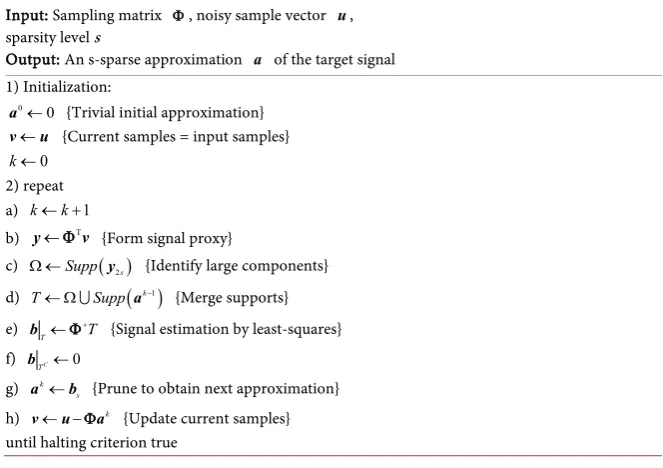
As we all know, the OMP algorithm first proposed the idea of orthogonality. Many subsequent algorithms follow this idea. OMP algorithm selects only one index which is corresponding to the largest magnitude. Through this method, index selection is inefficient. And OMP does not adopt backtracking mechan-ism. Once an error occurs in the support set selection process, it will result in poor reconstruction. For CoSaMP algorithm, it selects multi-indexes in each iteration, which can promote the reconstruction speed. However, if the selected indexes is not appropriate for signal reconstruction, it would remove fixed in-dexes from temporary support sets to get high reconstruction quality and accu-racy. The CoSaMP algorithm is summarized in Table 1.
2.3. The Proposed Algorithm
DOI: 10.4236/jcc.2019.76002 9 Journal of Computer and Communications
Table 1. CoSaMP algorithm.
Input: Sampling matrix Φ, noisy sample vector u, sparsity level s
Output: An s-sparse approximation a of the target signal 1) Initialization:
0←0
a {Trivial initial approximation} ←
v u {Current samples = input samples} 0
k← 2) repeat a) k← +k 1
b) y←ΦTv {Form signal proxy}
c) Ω ←Supp( )y2s {Identify large components}
d) T← Ω Supp
( )
ak−1 {Merge supports}
e) T T
+
←
b Φ {Signal estimation by least-squares} f) bTC←0
g) k s ←
a b {Prune to obtain next approximation} h) v← −u Φak {Update current samples}
[image:4.595.209.539.91.630.2]until halting criterion true
Table 2. The proposed algorithm.
Input: Sampling matrix Φ, noisy sample vector u, sparsity level s
Output: An s-sparse approximation a of the target signal 1) Initialization:
0←0
a {Trivial initial approximation} ←
v u {Current samples = input samples} 0
k← 2) repeat a) k← +k 1 b) y←ΦTv
{Form signal proxy}
c) Ω ←Supp( )y2s {Identify large components}
d) T← Ω Supp
( )
ak−1 {Merge supports}
e) T T
+
←
b Φ {Signal estimation by least-squares}
f) bTC←0
g) r←v
If 0.8 (norm(r)) < norm(v):
(0.8) k
floor s
←
a b
h) k s ←
a b {Prune to obtain next approximation} i) v← −u Φak {Update current samples}
until halting criterion true
3. Simulations and Analysis
DOI: 10.4236/jcc.2019.76002 10 Journal of Computer and Communications
3.1. One-Dimensional Signal
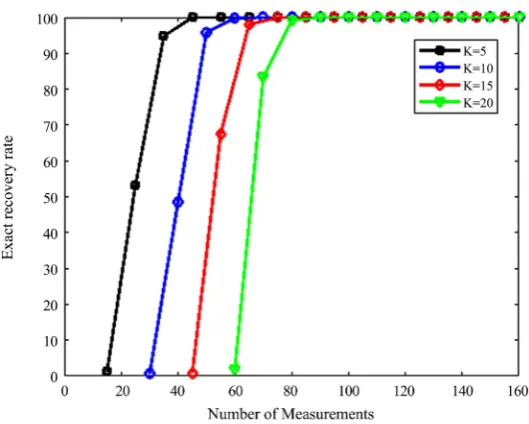
In this section, in order to demonstrate the superiority of the proposed rithm, we compare the proposed algorithm with other similar classical algo-rithms for signals with nonzero elements drawn from the Gaussian and uniform distributions. Gaussian sparse signals are used with length N = 256 and sparsity level K = (5, 20). The sensing matrix Φ, which is different for each test signal, is drawn from the Gaussian distribution with mean 0 and standard deviation 1/N. Then, we normalize each column norm to unity. Experimental platform was MATLAB R2013b.
As shown in Figure 1, we provide the rate of exact reconstruction perfor-mance as a function of the measurement number M. Figure 1 shows the curves of the probability of exact recovery signal with the proposed algorithm. 500s si-mulations were conducted for the different number of measurements M. The exact recovery rate of the proposed algorithm at M = 60 increases by 90%. And overall, the algorithm proposed in this paper is also superior to other classical algorithms in Figure 1.
Figure 2 shows the curves of the probability of exact recovery signal with the proposed algorithm. It shows the comparison of the exact reconstruction rate of the proposed algorithm and CoSaMP algorithm under different sparsity level (i.e., 5, 10, 15, 20 non-zero entries). 500 simulations were conducted for each pair of sparsity k and the number of measurements M. Figure 2 also shows the proposed algorithm has higher probability of exact recovery signal.
Figure 3 shows the curves of the probability of exact recovery signal with proposed algorithm. The number of measurements (M), given a fixed signal sparsity K. 500 simulations were conducted for each pair of sparsity K and the number of measurements M. Figure 3 shows that the proposed algorithm has higher stability and reliability in terms of exact recovery of the signal.
Figure 1. Rate of exact reconstruction performance as a function of
[image:5.595.241.506.485.692.2]DOI: 10.4236/jcc.2019.76002 11 Journal of Computer and Communications
Figure 2. Rate of exact reconstruction performance as a function of
measurement number.
Figure 3. Probability of exact recovery signal with proposed algorithm. The
original signal has length of N = 256 with K = 5, 10, 15, 20 non-zero entries.
3.2. Two-Dimensional Signal
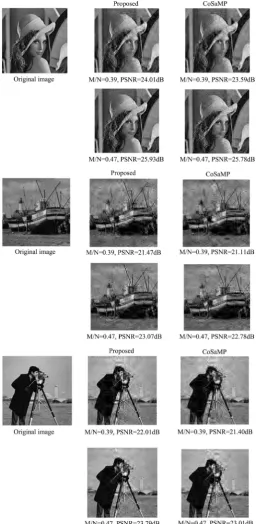
In the two-dimensional image experiment, the wavelet base is used as the sparse basis and the random Gauss matrix is used as the measurement matrix Φ. We use three international standard, i.e. Lena image, Camera image and Barche im-age, as the input to conduct the comparison analysis of different algorithms. And the peak signal-to-noise ratio (PSNR) is used to evaluate the performance of the improved algorithm and the original algorithm, which is defined as follows
2 10
2
255
PSNR 10log M N
x x × ×
=
−
[image:6.595.240.505.318.530.2]DOI: 10.4236/jcc.2019.76002 12 Journal of Computer and Communications where x is the original image, x is the reconstruction image. Sampling ratio is M/N. The size of each image is 256 × 256.
[image:7.595.245.503.175.701.2]From Figure 4, we can know that the proposed algorithm is superior to the original algorithms CoSaMP. And we can see that the proposed algorithm has a better visual effect for different types of images. The improved algorithm can accurately recover the original signal.
DOI: 10.4236/jcc.2019.76002 13 Journal of Computer and Communications
4. Conclusion
Based on a comprehensive study of the sparse signal reconstruction algorithm, we find that CoSaMP cannot dynamically select the support set to efficiently re-construct the original signal. To solve this problem, we use the residual update strategy to improve the backtracking index selection. Thereby the number of backtracking indexes is adjusted according to the direction in which the residual is decreasing. The proposed algorithm can significantly improve the perfor-mance of CoSaMP by adjusting dynamically the number of indexes which are added to the support set in each iteration. Different simulation results show that the improved algorithm has better reconstruction performance for both one-dimensional signals and two-dimensional signals compared with other clas-sical algorithms.
Acknowledgements
This research has been supported by National Natural Science Foundation of China under Grant No. 61771262, and Science and Technology Major Project and Engineering of Tianjin China under Grant No. 2017ZXHLNC00100.
Conflicts of Interest
The authors declare no conflicts of interest regarding the publication of this pa-per.
References
[1] Donoho, D.L. (2006) Compressed Sensing. IEEE Transactions on Information Theory, 52, 1289-1306.https://doi.org/10.1109/TIT.2006.871582
[2] Candes, E.J. and Wakin, M.B. (2008) An Introduction to Compressive Sampling. IEEE Signal Processing, 25, 21-30.https://doi.org/10.1109/MSP.2007.914731
[3] Ghahremani, M. and Ghassemian, H. (2015) Remote Sensing Image Fusion Using Ripplet Transform and Compressed Sensing. IEEE Geoscience and Remote Sensing Letters, 12, 502-506.https://doi.org/10.1109/LGRS.2014.2347955
[4] Wei, J., Huang, Y., Lu, K., et al. (2016) Nonlocal Low-Rank-Based Compressed Sensing for Remote Sensing Image Reconstruction. IEEE Geoscience and Remote Sensing Letters, 13, 1557-1561.https://doi.org/10.1109/LGRS.2016.2595863
[5] Zheng, H., Yang, F., Tian, X., et al. (2015) Data Gathering with Compressive Sens-ing in Wireless Sensor Networks: A Random Walk Based Approach. IEEE Transac-tions on Parallel and Distributed Systems, 26, 35-44.
https://doi.org/10.1109/TPDS.2014.2308212
[6] Ning, K. (2014) Compressed Sensing Image Processing Based on Stagewise Ortho-gonal Matching Pursuit. Sensors & Transducers, 181, 134.
[7] Shi, M., Li, L. and Xu, J. (2018) Backtracking Stagewise Weak Orthogonal Matching Pursuit Algorithm Based on Fuzzy Threshold. Video Engineering, No. 2, 2.
[8] Goyal, P. and Singh, B. (2018) Subspace Pursuit for Sparse Signal Reconstruction in Wireless Sensor Networks. Procedia Computer Science, 125, 228-233.
DOI: 10.4236/jcc.2019.76002 14 Journal of Computer and Communications [9] Kim, K.S. and Chung, S.Y. (2019) Greedy Subspace Pursuit for Joint Sparse
Recov-ery. Journal of Computational and Applied Mathematics, 352, 308-327.
https://doi.org/10.1016/j.cam.2018.11.027
[10] Becerra, J.A., Herrera, D., Madero-Ayora, M.J., et al. (2018) Sparse Model Selection of Digital Predistorters Using Subspace Pursuit. 13th European Microwave Inte-grated Circuits Conference, Madrid, 24-26 September 2018, 190-193.
https://doi.org/10.23919/EuMIC.2018.8539910
[11] Dai, W. and Milenkovic, O. (2009) Subspace Pursuit for Compressive Sensing Sig-nal Reconstruction. IEEE Transactions on Information Theory, 55, 2230-2249.
https://doi.org/10.1109/TIT.2009.2016006
[12] Han, N. and Song, Z. (2018) Bayesian Multiple Measurement Vector Problem with Spatial Structured Sparsity Patterns. Digital Signal Processing, 75, 184-201.
https://doi.org/10.1016/j.dsp.2018.01.015
[13] Li, W., Liu, F., Jiao, L., Hao, H. and Yang, S. (2016) A Group Matching Pursuit for Image Reconstruction. Image Communication, 49, 47-62.
https://doi.org/10.1016/j.image.2016.10.002
[14] Peng, J., Wu, A. and Zhu, L. (2018) A New Quadratic Optimization Approach to Beam Angle Optimization for Fixed-Field Intensity Modulated Radiation Therapy Using Compressed Sensing.
[15] Dirksen, S., Lecué, G. and Rauhut, H. (2018) On the Gap between Restricted Isome-try Properties and Sparse Recovery Conditions. IEEE Transactions on Information Theory, 64, 5478-5487.https://doi.org/10.1109/TIT.2016.2570244
[16] Cohen, A., Dahmen, W. and DeVore, R. (2017) Orthogonal Matching Pursuit under the Restricted Isometry Property. Constructive Approximation, 45, 113-127.