Access Grid Environments as Spaces of
Mixed Spatial Interaction
The Third International Conference on e-Social Science
October 7-9, 2007, Ann Arbor, Michigan, US
Mary Allan
1, David Thorns
21
School of Sociology and Anthropology University of Canterbury New Zealand
2
School of Sociology and Anthropology University of Canterbury New Zealand
[email protected]
[email protected]
Abstract. Using Actor Network Theory, the paper investigates the relationships between people and technology and the way these relationships construct social spaces in Access Grid (AG) environments. This investigation challenges prevalent perceptions about the dominance of technology in driving innovative research practices, and proposes a cyclic relationship between people, the technology and other artefacts used in the course of AG sessions. The paper highlights the various elements comprising AG communications, and finds that these generate a unique setting of mixed spatial environments in which the physical and the virtual coincide as if residing in the same space to create an almost seamless flow of interactions and exchanges. However, the paper -shows that the seamlessness is occasionally disrupted by a ‘virtual divide’ generated sometimes by technology, the people, or the interactions between people and artefacts such as cameras, microphones, or furniture. The paper outlines a process which identifies assemblages of factors conducive to the creation of mediated collaborative research environments and the construction of globally accessible spaces of collaborative knowledge creation.
Introduction
colleagues, and compete as equal partners in the global knowledge economy. Successive New Zealand governments acknowledge that for the country to resume its position in the top half of the OECD (Lewis & Thorns, 2005; NZGovt, 2005; Oxley & Thorns, 2007), it needs to enhance its ICT infrastructure and implement powerful technologies such as Advanced Network and the Access Grid to support its scientific research activities. The recently1 launched high-speed internet connection KAREN2 links all of the country’s universities and Crown Research Institutes enabling international connections to academic and research institutions across the US and Europe offering a more robust infrastructure for interactions. The paper recognises the potential of virtual collaboration to trigger changes in the current research arena; however, it proposes to challenge a common assertion (Castells, 1996; Hine, 2003; Jarvie, 2004, 2005; Machlup, 1962) which argues for the dominance of the technology in driving research innovation and changes in practice. Adopting a Latourian (Latour, 1999, 2005) approach the paper suggests that if indeed changes are occurring they are made possible through constant cyclic movement among researchers, between them and technology, and the interdependent assemblages these cyclic movements create. The paper investigates virtual interactions facilitated by Access Grid (AG) infrastructure and outlines a process which identifies assemblages conducive to the creation of collaborative globally accessible mediated knowledge creation spaces
Collaboration is about ‘working together’, sharing a mutual space in which people and associated technologies are present and in the presence of others, all of which requires an ability to communicate. Prevalent perceptions about face-to-face (F2F) interactions suggest that they provide the richest and most effective medium for communication, providing verbal and non verbal cues (Billinghurst & Kato, 1999; Daft & Lengel, 1986; Daft & Wiginton, 1979),while at the same time creating a sense of ‘being there’ in each other presence, sharing a space (Goffman, 1963; Heeter, 1992; Schroeder, 2006). The paper attempts to establish whether the interdependencies of assemblages interrelating in cyclic movement among researchers interacting with, and through the AG infrastructure provide circumstances similar to F2F communication and hence hold the potential to facilitate collaboration, in a way that will go beyond fast and robust transfer of data, to facilitate the creation of new knowledge. As social scientists investigating the emergence of collaborative practices conducted in technologically mediated environment, we choose to engage in reiterative discursive analysis of processes emerging in the constantly evolving assembling and disassembling cycles of socio- technical interactions comprising our data.
Our data consists of the deconstructed elements of AG spaces, through which we search and investigate similarities between F2F and technologically mediated contexts. The investigation is formed around three key criteria. The first is the richness of communicative features relayed throughout the AG medium. The second is the sense of presence, co-presence created through interactions between human participants and interdependencies between humans, technology, and other artefacts in AG environments. The third is the sense of shared social space in the mixed spatial AG environment where physical and virtual are blurred.
Scope of Study
The paper summarises a pilot study of 17 AG sessions conducted between the second half of 2006 and the first half of 2007, and also provides a preliminary look at the first phase of a
1 February 2007
2
two-year project funded by the BRCSS3 Network, and REANZ4 Capability Building Fund. The data comprising the studies described here consists of observations conducted during Access Grid sessions. The participants of the study included staff and postgraduate students attending virtual seminars broadcast via Access Grid across NZ universities, BRCSS network management meetings, collaborative teaching across two universities and a collaborative project debate involving various community representatives.
Method of Study
The method of study is ethnographic in the sense that the researchers collected data through participation and observation of Access Grid meetings. The data consists of manual annotation of Access Grid (AG) sessions, seminars and cross- site teaching sessions. Note taking, was the only option for recording and documenting due to two major technical set backs. First, the bandwidth available to us prior to the implementation of KAREN in February 2007 could not support any type of recording, archiving, or the operation of computer based annotating middleware. Only when KAREN’s robust bandwidth became available, were we able to begin exploring recording and annotating tools. Having evaluated a number of options we have discovered a gap between the tools available, and our research needs. We are currently attempting to develop our own set of tools with the help of our project partners form HIT Lab NZ. The technical restraints limited the amount of information we were able to obtain. The manual note taking consisting of text alone could not capture or fully represent aspects such as body language and facial cues. Therefore, the study primarily focuses on aspects that could be noted down manually in real time observation.
Relationships - People and Technology
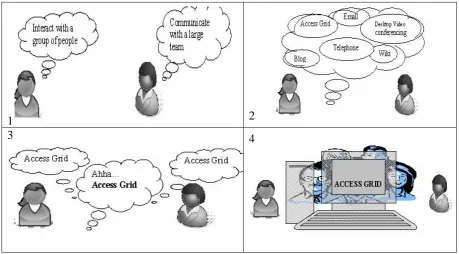
Geographically dispersed interlocutors need technological mediators that enable communication. However, the presence of the technology itself does not insure communication, it is up to the human agent to utilise the technology and initiate communication and interaction with another human. This creates a relation of interdependency between human and non-human. Establishing a communication link facilitates interactions, the nature of which will be determined through the interdependency between the human agent and the technology, as well as through the purposes, intentions, motivation, and goals the human participants aim to achieve by choosing to use a certain technology. The storyboard in Figure1 illustrates some of the processes that occur in the interaction between people, their intentions and their choice of technology as they seek to communicate across distance using an AG as the connecting medium.
3
Building Research Capabilities in the Social Sciences 4
1 2
[image:4.595.68.528.69.323.2]3 4
Figure 1. Media Selection
While this choice facilitated the goal of linking a large group, it also contributed to the nature of the communication resulting from the features and structure of the technology. This interdependent relationship highlights a cyclic movement between the actors and systems or structures surrounding them, creating a reciprocal rather than dichotomous or hierarchical relation in which one party is perceived as dictating the roles and interplays among communicating human and non-human members (Latour, 1999). Latour’s Actor Network Theory (ANT) enables a systematic recording of the world-building abilities, and procedures which render actors, (human and non-human) the ability to negotiate their ways through one another’s activity. This approach allows us to investigate the practices applied in the Access Grid environment without the constraints of fixed roles allocated to either the technology or the participants, and opens the way for us to establish how, and in what ways collaborating through technology may be changing practices of human interaction, perception of, and relationships with the technology. In this approach the participants in the relationship, human and non human alike are called actants. These according to Latour (1987) are not simply characters in a story, but an integral structural element upon which the narrative revolves.
Collaborating at a Distance
Communication between people is an essential prerequisite for facilitating any form of sharing and collaborative activities. Physical proximity allows people to engage in
Access Grid (AG) is a collection of resources put together for the purpose of supporting human collaboration across the Grid5. Because the Access Grid is based on the Grid infrastructure it has the potential to allow for sharing dimensions that were not available using internet technology. Furthermore, AG technology is presumed to overcomes the lack of presence, and co-presence associated with other virtual communication modes, (Fielding & Macintyre, 2006), and so contributes to providing a near real face-to-face experience, in which people can experience ‘being there’ in a shared space. In this paper we examine the ways in which interactions in AG environments explore the potential embedded in the technology, and the ways in which the various actants interact and construct socio technical, communicative narratives.
Mediated Shared Spaces
A project called “Dancing beyond Boundaries”(Oliverio, Quay, & Walz, 2001) used Access Grid to connect dancers, choreographers, musicians, and engineers across North and South America, and collaboratively create a dance piece while being separated by thousands of miles. The artists from different spaces created original music and dance as though they were sharing the same physical space. Video captures of music and dance were simultaneously transmitted to all four collaborating locations. One could argue that the collaborative piece was created in the interconnection between the four physical locations and that this connectivity created a ‘fifth place’, a virtual space (Oliverio et al., 2001). Mediated spaces challenge our perception of space as being a physical entity. “Dancing Beyond Boundaries” created a fluent continuum between physical spaces to create something that is beyond them, reflecting the physical, yet residing in the interconnection between them.
Blurred boundaries between the physical and the virtual is referred to as mixed reality (Florins, Trevisan, & J., 2005), where the ‘real’ may include video display of physical objects, whereas the ‘virtual’ has no existence in the physical world, and is computer generated (Milgram & Kishino, 1994). ‘Dancing Beyond Boundaries’ created a sense of “same space flow”, between the physical spaces and their representations by creating a virtual space in the interconnections between the physical spaces. We suggest that the Access Grid calls for a redefinition of the ‘virtual’ to include the video displays representing the physical world, and refer to AG environments as ‘mixed spatial environments’. The creation of ‘space’ in the interconnections denotes ‘space’ as a socially constructed entity (McGregor, 2004), with social processes influencing the structure of space (Castells, 1996; Francke & Ham, 2006). Allan (2005) argues that ‘space’ is not only created through interactions, but that their dynamics define the nature of the ‘space’. Using visualisation technologies Allan was able to study visual representations of the dynamics of interactions. Her study found that chain like interactions illustrated negotiations and mutual meaning making processes implying collaborative activities.
Findings and Analysis
Simulating Face to Face Interactions- The Media Richness of Access Grid
In our observations we attempted to investigate whether the social spaces created through the Access Grid convey the media richness entailed in face-to-face (F2F) interactions. In order to
5
The Grid – a computing and data management infrastructure that provides electronic underpinning for a global
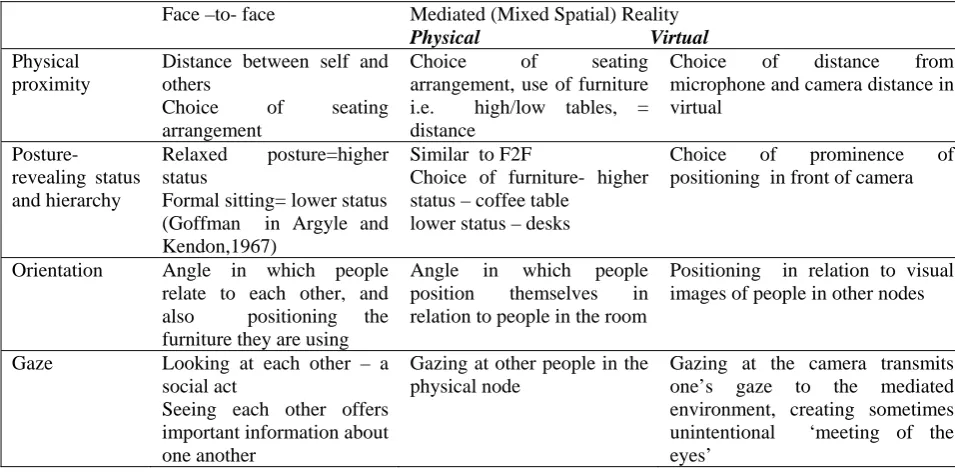
do so we listed the features involved in F2F as well as those comprising mediated interactions. The F2F features included: physical proximity, posture, orientation, language and speech, patterns of looking at the other (Gaze) bodily movement; facial expression(Argyle & Kendon, 1967).Access grid mediated interactions included: images of F2F interactions; camera movement; microphone/s, furniture in the AG/VC facility, room décor, and group size. Table I illustrates how features of face-to-face were translated to the mediated environment. The table notes the interaction between people, the technology, and various artefacts present in AG environments, and the ways in which the use of these indicated the construction of social status and roles.
Table I-from physical to virtual
Face –to- face Mediated (Mixed Spatial) Reality
Physical Virtual
Physical proximity
Distance between self and others
Choice of seating arrangement
Choice of seating arrangement, use of furniture i.e. high/low tables, = distance
Choice of distance from microphone and camera distance in virtual Posture- revealing status and hierarchy Relaxed posture=higher status
Formal sitting= lower status (Goffman in Argyle and Kendon,1967)
Similar to F2F
Choice of furniture- higher status – coffee table
lower status – desks
Choice of prominence of positioning in front of camera
Orientation Angle in which people relate to each other, and also positioning the furniture they are using
Angle in which people position themselves in relation to people in the room
Positioning in relation to visual images of people in other nodes
Gaze Looking at each other – a social act
Seeing each other offers important information about one another
Gazing at other people in the physical node
Gazing at the camera transmits one’s gaze to the mediated environment, creating sometimes unintentional ‘meeting of the eyes’
Because of the inability to record, we are only referring to these aspects and have left out the features of language and speech, bodily movement, and facial expressions.
Communication in the virtual, as in the physical is reliant on the ability to see and hear each other. The means of achieving this differs between the physical and virtual, the former requiring an assemblage made of only the F2F features, whereas the latter requires a double layered assemblage of both F2F and mediated features. We propose that the physical assemblage reflects social interactions, whereas the virtual assemblage reflects socio-technical interactions.
Access Grid technology for creating a sense of presence, co-presence
Table II presence
Type of Presence Presence in AG Sessions
Personal presence- the extent to which a person feels part of the environment
Visual image of self - when local node’s image was projected people felt part of the environment. When image was not projected participants noted that they feltexcluded
Social presence the extent to which others (human and non- human) exist in the environment. Sometimes referred to as co-presence, a situation in which participants experience a mutual awareness of each other through interaction. Both social presence, and co-presence describe a situation of being present, in an environment which includes another, as ‘being there together’(Rettie, 2005; Schroeder, 2006). -
1)When microphones were muted people perceived the social presence to be that of their physical /local space
1a) Muting of microphones was perceived by participants as a way of becoming ‘invisible’ and became unaware of the effect their body language and facial expressions may have on people sitting in other nodes
2) Some presenters used the muting of microphones for creating a local social presence, working in local groups
3) when self image was not available, some very informal behaviour appeared, i.e. yawning, or leaving the room with no reference to the projected nodes, frequent attention to person present in the room but invisible to the camera for example participator talking to node operator sitting off range of camera
Environmental presence – the extent to which the environment acknowledges and interacts with the participants
1) The introduction of the participants of each node to the other nodes created an environmental presence.
Example: On occasions where one node was active and the rest were invited to listen in, no introductions were made, as if obscuring the environment surrounding the active node.
2)Control over camera
when given to chair person – camera movement acknowledged changes in the session and was made to respond accordingly
Social spaces created in Access Grid
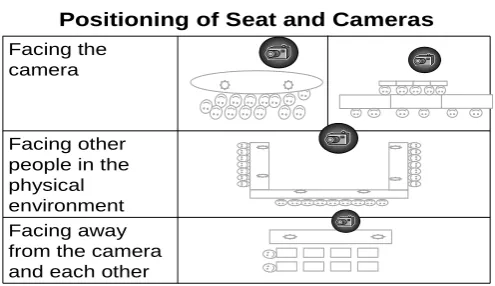
Our observations revealed that the interactions among people and between human and non- human artefacts created spaces in which physical entities such as furniture and cameras, became actants in the communicative activities among people, and so contributed to the creation of social spaces embedded in the physical. The positioning of furniture, as showing in Figure2 created and narrated the forms for interaction among the people sitting in the physical node, those located at remote nodes represented through video images on the screens, and the interactions between the physical nodes and their video representations. Constructing the physical
Positioning of Seat and Cameras
[image:7.595.72.320.571.714.2]Facing away from the camera and each other Facing other people in the physical environment Facing the camera
Figure 2. positioning
allocation also affected the way rooms were organised. Some institutions allocated an exclusive space for the use of Access Grid, whereas others opted for a multipurpose space that was used when required. These different physical features seem to have contributed to the ways in which participants through their interactions constructed social spaces. These findings corroborate Hall’s(1963) findings, suggesting that the distance between people, their Proxemic Behaviour, reveals how people unconsciously structure micro spaces and construct hierarchies and levels of involvement. We argue that in mediated spaces, proxemic behaviour should be extended to the use of non human artefacts, and suggest that proximity to camera and microphones- reveal high level of hierarchy and involvement – for example, choosing to sit at the low table, positioned closer to the camera and microphones, and exposing full body rather than showing head and shoulder. These tables were chosen by people who expressed confidence throughout their interactions. They talked mostly addressing the screens (which include their own image), sometimes turning to the back to respond to people in the physical room. They were relaxed and exhibited informal, sometimes humoristic behaviour. In F2F situation this is interpreted as expressions of higher status. Having a large table at the AG room meant that only a single facet of it could be used without blocking the camera. When larger groups participated in nodes with a single large table, participants sat in multiple rows of chairs stacked one behind the other aligned with the single table facet facing the camera. This resulted in the exclusion of back rows from access to microphones and diminished their visual presence, hence diminishing their social presence.The horse shoe model created a wide exposed space in which even a large group could enjoy access to microphones and the cameras, and good visual connection with others in the physical space
Low levels of involvement were apparent in the proxemic behaviour of people who chose to shy away from the camera or the microphones, and sat far away from the microphones and out of the cameras range.
Constructing the Virtual
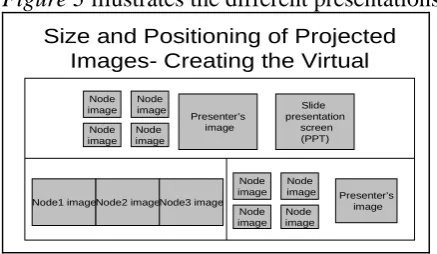
[image:8.595.70.289.594.721.2]Projecting different size images as showing in Figure 3 narrated the direction of gaze and attention of the participants, and contributed to the structuring of the ‘virtual’ and the discourses it spawned. In some cases the presenter’s image was enlarged, in other cases the presentation screen was enlarged alongside that of the presenter’s. However, in other cases all screens representing each of the nodes were projected as adjacent one size screens. This created a feeling of standardisation of all the different nodes, merging them into an equalised single rather than fragmented virtual space, and creating a “same space flow” merging the different nodes. However, this model did not allow for distinguishing the current active speakers.
Figure 3 illustrates the different presentations.
Size and Positioning of Projected Images- Creating the Virtual
Node image Node image
Node image Node image
Slide presentation
screen (PPT) Presenter’s
image
Node image Node image
Node image Node image
Presenter’s image Node1 imageNode2 imageNode3 image
Constructing Mixed Spatial Environments
The screen images not only construct the virtual, but also affect the interactions in the physical spaces, by focusing attention on different spaces and elements in the virtual. This cyclic momentum reiterates the construction of a mixed spatial environment, in which the virtual and the physical interrelate affecting the structures and dynamics of each other. This blurring of the boundaries created a need for people to feel co-presence in the virtual as well as in the physical. Seeing one’s self is not something required in a F2F situation, however, to be included in this mixed and constantly flowing spatial environment, people expressed a need for a visual projection of themselves so as to experience embodied inclusion in the cyclic construction of the mixed spaces. In cases where no self image was projected, participants tended to lean towards the microphone as though funnelling their intention to the ‘other reality’. Muting the microphones resulted in segregation of the different physical localities and disrupted the flow spaces. Furthermore the lack of self image diminished the feeling of co-presence, and participants expressed feelings of exclusion.
Mixed Spatial Environments- Beyond the Technology
Our findings show, that the positioning of an interaction in the virtual or the local was not solely created by technology or geographic location, but was at times constructed through social dynamics. When people knew each other prior to the mediated encounter, a sense of mutual locality was created in the interconnection between spaces, to create something which is not embodied in any physical or virtual node, but in the minds of the participants. These instances occurred in events:
• When a group at one node spotted a colleague sitting at another node. This prior acquaintance formed a short informal hearty alliance. This alliance generated an atmosphere different to the one expressed by the rest of the participants
• When a physical meeting of participants from different geographical locations occurred the night previous to the Access Grid session. This prior meeting consolidated an inter- nodal group comprised of members from multiple physical locations which formed an alliance situated temporarily in a single physical location. The overnight links seem to have shadowed the connection with the originating geographical nodes. However, a note of caution should be made here. The inter nodal group was the largest in relation to other nodes, this in itself may have created a critical mass
• Locality was also created through the interactions with non human artefacts. Using printed hard copies of emails circulated prior to the Access Grid meeting created localities in the sense that people referred to their hard copy paper held in their hands, however, at the same time the local hard copy is an embodiment of a virtual communication through the email further virtualised by the discussions it triggers around the various AG nodes
The creation of collaborative spaces of knowledge – a social dynamic process
Allan’s(2005) study discovered a way of investigating the nature of Web Based interactions by identifying archetypes of visual patterns charted through communication exchanges. The study found that Chain like patterns of interactions indicate the existence of negotiation and mutual meaning making processes, Star shaped interactions indicated the exchange of structured or distinctly defined body of information, such as for example, the scheduled time of a meeting, or an exact location of an event. Identifying such dynamics would prove valuable in this current project, however, we needed a tool which will enable o annotation and visualisation of interactions in AG environments. Our initial search for such a tool led us to the Memetic project developed by NCeSS in the UK. The UK team collaborated with us in an attempt to solve the problems encountered when attempting to install the UK configurated software to our NZ system. After long weeks of international collaboration and mutual attempts to solve the configuration problems we were able to install the Memetic software, only to find that it will not serve our purposes. In consultation with our project partners from HIT Lab NZ we have now decided to develop a suit of tools that will answer our investigative needs. The suit will include video streaming, capturing, annotating, and visualising tools, which will operate in seamless synchronisation. We are now in the process of developing the necessary tools.
Conclusions
In this paper we set out to find whether Access Grid (AG) technologies facilitate a communicative environment that will simulate the richness of information conveyed in F2F interactions, and provide participants with not only verbal and non verbal cues but also with the experience of presence and co presence in a mutual space. Our findings outline the ability of the AG technology to provide information richness and support an almost true to life F2F experience in which participants use the microphones and cameras as ears and eyes. However, we would argue that this use of the technology is not a mere extension of human’s physical abilities the way McLuhan(1964) may have concluded, but has created a complex system of interactions not only between humans, but between humans, artefacts and technology. These interactions create social structures which operate in blurred realities of physical and virtual spaces. Furthermore, these interactions create spaces which are not physical or virtual but exist in the interconnections between the real, the virtual, and the experienced. Furthermore, the interactions between human and non human actants created interdependencies. Whenever these were compromised, the system broke down. However, we would like to suggest that these breakdowns were not confined to the technology but that within the different spaces and the blurred mixed spatial reality lurks a ‘virtual divide’, obstructing the seamless flow between the physical and the projected virtual. This virtual divide is a product of technological problems which are yet to be solved, but also emanate from our present limited perception of the possibilities and practices enabled by the new technological environment, and the collaborative potential these mixed spatial spaces offer. We anticipate that the new suit of tools we are currently developing will provide us with better understanding of the practices conducive for collaboration, and so enable us to facilitate the building of such capabilities in the research community in NZ and aboard.
at the use of technology in this way heralds a new horizon for social science research, which looks beyond the study of the use of technology, to explore socio-technical interactions and the creation of socio- technical structures located at the interconnections between human and non human agency, and between physical and the virtual.
References
Allan, M. (2005). Conceptualising Social Space in Cyberspace:A Study of the Interactions in Online Discussion forums. Unpublished PhD, University of Canterbury, Christchurch. Argyle, M., & Kendon, A. (1967). The Experimental Analysis of Social Performance. In J.
Laver & S. Hutcheson (Eds.), Communication in Face-to-Face Interaction (pp. 19-64). Middlesex: Penguin.
Berman, F., Fox, G. C., & Hey, A. J. G. (Eds.). (2003). Grid Computing Making the Global Infrastructure a Reality. Chichester: John Wiley and Sons Ltd.
Billinghurst, M., & Kato, H. (1999). Collaborative Mixed Reality- Mergin Realk and Virtual Worlds. Paper presented at the First International Symposium on Mixed Reality (ISMR 99), Berlin.
Castells, M. (1996). The Rise of the Network Society (Vol. 1). Cambridge MA: Blackwell Publishers.
Daft, R. L., & Lengel, R. H. (1986). Organisational Information Requirements, Media Richenss and Structural Design. Management Science, 32(5), 554-571.
Daft, R. L., & Wiginton, J. (1979). Language and Organisation. Academy of Management Review, 4(2), 171-191.
Fielding, N., & Macintyre, M. (2006, 28-30 June ). Engaging with the Access Grid as a New Data Collection Tool. Paper presented at the Second International Conference on e-Social Science, Manchester, UK.
Florins, M., Trevisan, D. G., & J., V. (2005). The Continuity Property in Mixed Reality and Multiplatform Systems: A Comparative Study. In Computer-Aided Design of User Interfaces IV (Vol. 8 ch.26, pp. 323-334): Springer Netherlands.
Francke, M., & Ham, E. (2006). Space of Flows Manuel Castells. Geographical Approaches, 26/1/2006.
Goffman, E. (1963). Behaviour in Public Places: Notes on the Social Organisation of Gatherings. London: The Free Press of Glenco.
Hall, E. T. (1963). A system for the Notation of Proxemic Behaviour. American Anthropologist, New Series, 65(5), 1003-1026.
Heeter, C., 1(2), pp. . (1992). Being There: The subjective experience of presence. Presence: Teleoperators and Virtual Environments, 1(2), 262-271.
Hine, C. (2003). Systematics as Cyberscience: the role of ICTs in the working practices of taxonomy. Paper presented at the Oxford Internet Institute Information, Communication and Society Symposium, Oxford.
Jarvie, C. (2004). An advanced Network Architecture for New Zealand. Wellington: Ministry of Research, Science, and technology (MoRST).
Jarvie, C. (2005). Advanced Network Backgrounder: Ministry of research, Science, and Technology.
Latour, B. (1987). Science in Action. Cambridge MA: Harvard University Press.
Latour, B. (1999). On Recalling ANT. In J. Law & J. Hassard (Eds.), Actor Network Theory and After (pp. 15-26). Oxford: Blackwell Publishers.
Lewis, N., & Thorns, D. (2005). BRCSS: Building a network and a Knowledge Space Critical Conditions: BRCSS.
Machlup, F. (1962). The Production and Distribution of Knowledge in the United States. New Jersey: Princeton University Press.
McGregor, J. (2004). Space, Power and the Classroom. Forum: for promoting 3-19 comprehensive education, 46(1), 13-18.
McLuhan, M. (1964). Understanding Media: The Extensions of Man. London: Routledge. Mehrabian, A. (1971). Silent messages. Belmont, California.: Wadsworth.
Milgram, P., & Kishino, F. (1994). A Taxonomy of Mixed Reality Visual Displays. IEICE Transactions on Information Systems, E77-D(12).
NZGovt. (2005). The Digital Strategy: Creating Our Digital Future (strategy). Wellington: NZ Government.
Oliverio, J., Quay, A., & Walz, J. (2001). Facilitating Real-Time Intercontinental Collaboration with Emergent Grid Technologies: Dancing Beyond Boundaries: Digital World Institute.
Oxley, L., & Thorns, D. (2007, 2-5 April). Exploring the Knowledge Economy / Society. Paper presented at the Social Policy Research and Evaluation (SPRE), Wellington.
Rettie. (2005). Social Presence as Presentation of Self. Paper presented at the PRESENCE 2005: The 8th Annual International Workshop on Presence, London.
Rogers E. H., & Geisler, C. (1997). A Collaborative Learning Environment for Intellectual Teamwork Across the Curriculum. Paper presented at the ASEE/IEEE Frontiers in Education Conference, Pittsburgh Pennsylvania.
Schroeder, R. (2006). Being There Together and the Future of Connected Presence. Presence, 15(4), 438-454.
Toffler, A. (1990). Power Shift. New York: Bantam Books.