doi:10.4236/am.2011.25077 Published Online May 2011 (http://www.SciRP.org/journal/am)
Stability Loss of Rotating Elastoplastic Discs of the
Specific Form
Dmitrii Makarovich Lila1, Anatolii Andreevich Martynyuk2
1Cherkasy National Bohdan Khmelnytsky University, Cherkasy, Ukraine
2Stability of Processes Department, S. P. Timoshenko Institute of Mechanicsof the National Academy of Sciences of
Ukraine, Kyiv, Ukraine E-mail: [email protected]
Received February 17, 2011; revised March 25, 2011; accepted March 28, 2011
Abstract
A method of calculating a possible stability loss by a rotating circular annular disc of variable thickness is suggested within the theory of perfect plasticity with the help of small parameter method. A characteristic equation for a critical radius of a plastic zone is obtained as a first approximation. The formula for the critical angular velocity, determining the stability loss of the disc according to the self-balanced form, is derived. The method using which we can take into account the disc’s geometry and loading parameters is also speci-fied. The efficiency of the proposed method is shown in Section 5 while considering an illustrative example. The values of critical angular velocity of rotating are found numerically for different parameters of the disc.
Keywords:Axisymmetric Elastoplastic Problem, Boundary Shape Perturbation Method, Rotating Circular
Annular Disc, Stepped Disc, Stability Loss, Critical Angular Velocity
1. Introduction
The analytical methods of studying the stability loss [1-6] at radial tension are known to be applied to plane discs (with constant thickness) in elastoplastic state. In [7] a method of calculation of possible stability loss was pro-posed for the case of the simplest non-planar rotating circular disc, namely, the stepped disc, loaded by radial stress on the boundary. This method underlies the present approach to approximate calculation of critical radius of the plastic zone and critical angular velocity of the rotat-ing annular disc of variable thickness. Besides, the real profile is roughly replaced by a step-like one, so that the disc is considered to be composed of partial annular discs of constant thickness. The applicability of the algorithm to the analysis of the small perturbations dynamics in case of the discs with arbitrary profiles is discussed.
2. Problem Statement
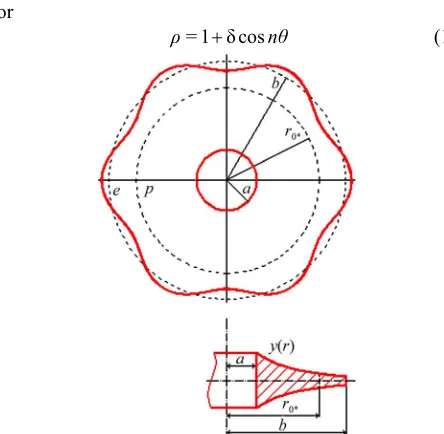
Consider a stability loss of the rotating annular disc with an arbitrary smooth profile y r
(Figure 1) as a result of its attaining an equilibrium form, different from a cir-cular one, in the plane of rotation. We will assume the disc to be almost circular, and present the equation ofexternal boundary in its middle plane y =0
const,
, being a plane of symmetry of the disc, with the accuracy to the first-order infinitesimals, in the following form
= cos , 2,
r b d nθ n d
or
= 1 δcos
[image:1.595.310.532.472.689.2]ρ nθ (1)
where b is the external radius of the unperturbed disc (the radius of circumference profile), = r b is the non-dimensional current radius, is a small parameter,
,
n is a polar angle. Let a be the internal radius of the disc, s be the yield strength of the material, be the modulus of elasticity,
E
be the density, v be Poisson’s coefficient, be the angular velocity of ro-tation and 0 be the current radius of the plastic zone for the unperturbed disc.
r
Let’s assume that the maximal thickness of the disc is small as compared to its other dimensions. Based on this assumption, the stresses located on the internal and ex-ternal boundaries of the disc will be considered as re-sulted from certain efforts 0 i and
[7,8], acting on the disc in its middle plane.
=
i i p p p
0
=
e e
p p pe
For the boundary form, described by (1), we need to obtain (as a first approximation) the characteristic equation for the critical radius of the plastic zone 0 and to find the corresponding critical angular rotation velocity
r
.
3. The Unperturbed Elastoplastic State of
the Rotating Disc
Consider the equation of quasi-static equilibrium [9]
21 d
= d
rr rry
y r r b
r,
(2)
where
2 2
= b .
Basing on yield condition (of maximum shear theory) and taking into account that the problem statement gives
= ,rr a pi
in the plastic region r
a r, 0
, we present the solution of linear differential Equation (2)2
d 1 1 d =
d d
rr
rr
y r
r r y r r b
in general form
= ; ,
rr x r a pi .
(3)
Moreover,
= s.
(4) Taking into account the condition on the external boundary
=rr b pe
and yield condition (constant stress intensity), suppose that in the disc elastic region r
r b0, the stress com-ponents are
= , ; ,
rr z r C b pe
, (5)
=w r C b p, ; , e
Here the constant C is to be found.
Having in mind that non-dimensional values will be used in further calculations we refer the values with the dimension of pressure to the yield strength s. The values with the dimension of length will be referred to the characteristic length b. Introducing the notations
0:=r b0 , :=a b,
we use the continuity condition for the stress components at transition through the boundary = 0. Equating the right-hand sides of (3) and (5), and those of (4) and (6) at
0 =
, we get the system of equations
0; , i s
=
0, ;1, e s
,x p z C p
0
1 =w , ;1,C pe s . Its solution
0
0= , s =
C
fully describes the stress state (3)-(6) and determines the dependence of the angular velocity of disc rotation on the radius of plastic region.
4. Principal Result
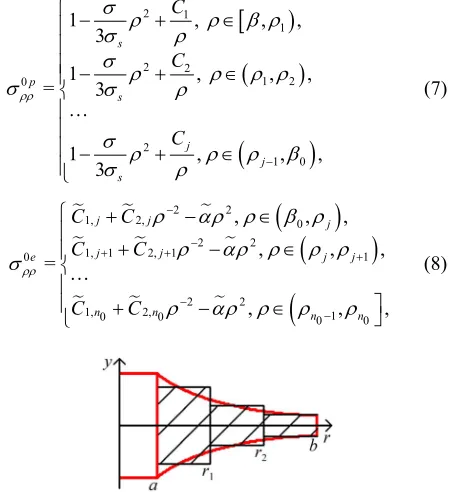
Along with relations (3), (5), (6), consider an approxi-mated stress state, obtained at dividing the given disc of an arbitrary profile into partial discs of constant thick-ness 1 0 (Figure 2). In [7] it has been shown that the dependences corresponding to (3), (5), (6) for the stepped annular disc are
2 , , 2h hn
2 1
1 2 2
1 2 0
2
1 0
1 , ,
3
1 , ,
= 3
1 ,
3 s
p
s
j
j s
C
C
C
,
,
, ,
(7)
2 2
1, 2, 0
2 2
1, 1 2, 1 1
0
2 2
1,0 2,0 1
0 0
, , ,
, ,
=
, ,
j j j
j j j j
e
n n n n
C C
C C
C C
,
[image:2.595.315.541.447.693.2], (8)
Figure 2. The disc of arbitrary profile divided into partial discs of constant thicknesses.
, ,
2 21, 2, 0
2 2
1, 1 2, 1 1
0
2 2
1,0 2,0 1
0 0
, , ,
, ,
=
, ,
j j j
j j j j
e
n n n n
C C C C C C
(9)
where 1=r b1 ,,n01=rn01 b, n0 = 1,
=
3
8
s
, =
3 1
8s
, and the constants C1, , Cj and C1,j,C2,j,,C1,n0,C2,n0 are found as solutions of the systems2 1
= 1 ,
3 i
s s
p C
2 1 2
1 1 2 1
1 1
2 2 2 3
2 2 3 2
2 2
1
2 2
1 1 1
1 1
1 = 1 ,
3 3
1 = 1
3 3
1 = 1
3 3
s s
s s
j j
j j j j
s j s j
C C h h C C h h C C h h 2 , and 1, 2, 1, 2,
1, 1 2, 1 1 1
1, 1 2, 1 1 1
1,0 2,0 0
1,0 2,0 0 = , = , = , = , = , =
j j j j
j j j j
j j j j
j j j j
n n n
n n n
C C x s
C C x t
C C x s
C C x t
C C s
C C t
respectively. Here 2 2
1 0
0
= 1 , , = 1
j j n n
x x 1,
2 2
0 0 0 0
0 0 0
2 1 2
0 2 0 0
0 0 = ( ) 8 = , 3 1 1 = ,
3 1 24δ 3 1
= ,
3 3 3
s
e i
n n n n
s s
n n n
s
q
p RA R B p SA S B
QA Q B D
q b
Q d f
1 0 1 0
1 0 3 0
= δ ,
= δ 1,
R d S d
2 10 2 0 0
0 0
1 0 1 0
1 0 3 0
0 0
0 0 0 2
0 0 0
3 1
1 2 1 1
=1
3 1 1 0 0
=1
3 1 24δ 3 1
= ,
3 3 3
= δ ,
= δ 1,
1
= , = , = ,
2 2
1
δ = ,δ = ( ) ,
3 1
δ = ( ) , = 0, = ,
j j
j
k k k
k
j j
j
k k k
k j
Q f d
R f
S f
x x x x
d f x
x x
h
h h
h h
h h h
h 2
whereas s tj, , ,j sn0 1,tn0 1,sn0,tn0 and An0, Bn0, Dn0, are found from the recurrence relations
1 1 1 1
1 1 1 1
2 2 2 2
2 2 2 2
0 0 0 0 0 0
= , = , = , = , = , = , = , = i i j j s s
j j j j j j
j j j j j j
j j j j j j
j j j j j j
n n j n j n n n
p p
s Q R S t Q R S
s A s B t C
t A s B t C
s A s B t C
t A s B t C
s A s B t C t A s
0 0,
j B tn j Cn
where
1 1 1 1 1 12 1 1 1 1 1 1 1
2 1 1 1 1 1 1 1
2 1 1 1 1
1 1 = , = , = , = = , = , = , = , =
j j j j j j j
j j j j j j j j j j
j j j j j j j
j j j j j j j j
j j j j j j j j
j j j j j
j j j
A d a f c B f
C d b f b A f a d c
B d C f b d b
A d a A f c A A
B d a B f c B B
C d a C b
f c C
,
1 1 1
2 1 1 1 1 1 1
2 1 1 1 1 1 1
2 1 1 1 1
1 1 1 1 1
1 0 0 , = , = , = , = j j
j j j j j j j j
j j j j j j j j
j j j j j
j j j j j
n n
C b
A f a A d c A A
B f a B d c B B
C f a C b
d c C C b
A d a
1 1 0 01 1 1 1
0 0 0 0
1 1 1
0 0 0 0
1 1 1 1
0 0 0 0
, =
,
n n
n n n n
n n n n
n n n n
A
f c A A
B d a B
f c B B
1 1 1 1
0 0 0 0 0
1 1 1 1 1
0 0 0 0 0
1 1 1 1 1 1 1
0 0 0 0 0 0 0 0
1 1 1 1 1 1 1
0 0 0 0 0 0 0 0
1 1 1 1
0 0 0 0 0
1 1 1
0 0 0
=
,
= ,
= ,
=
n n n n n
n n n n n
n n n n n n n n
n n n n n n n n
n n n n n
n n n n
C d a C b
f c C C b
A f a A d c A A
B f a B d c B B
C f a C b
d c C C
1 1 0 0 0 11 1 1 1
1 1 1 1 1
0 1 1 1 1 1 1 1 ,
= , = 1, , ,
= ,
=
,
= 2, , ,
= , = , = , = , 2 = , 2 n k k
j j j j
j j j j j
j j j j j
k k k
k k
k k k
k k k k
k k k k k k k k k b
C D k j n
D g d f
D d a D g
f c D D g
j j n
h h h
a b
h h x
h h x x
c d h x x x f g x 1 1 0 1 = ,
= , , 1.
k k
k k
h h
h x
k j n
Dependences (7-9) with account of the relation provide a zeroth approximation to the solution of the problem on plastic equilibrium, determining the position of elastoplastic boundary. In addition,
0p = 1
0 10 0 0 0
0 0 0
0 0 2 1 d 1 = d = 3 ,
= 1 1 = 3 ,
e
i e
n n n n
s s
n n n
e e
A
p p
A Q B Q A R B R
A S B S C
A A where
0 1 2 0 0 1 2 0 0 3 1 20 0 0
0 = 8 3 = , 8 3 0 < 1, 0 < 1,
1
= , 0, > 0, > 1,
= 1,
= i
s
i
i e i n
i n n i e e e i
n n n
e s e i
p
SA S B
RA R B
QA Q B D
p n
for i 0, and
3 10 0 0 0
0 3 1 0 0 1 0 8 1 3 = = 8 1 1 3 = e
e i e n n n
e
s e
n n
i s i e
RA R B SA S B
p
RA R B
p , n
4
0
, =1
ij i j
a ,
for e 0. is the determinant of the matrix
The number of sections n0 of the stepped profile, which approximately substitutes a real one, still remains unknown, and constant half-thicknesses of partial annu-lar discs can be introduced by the average theorem:
0 1 0 0= d ,
= , 1, ,
rj
j
rj
j
n
h y r r
b a b a
r a j j n
n
. (11) where (10) where
0 0 0 0 0 0 0 011= 1A d1 I n 1,1s E,
12 1 1
13 1 1
14 1 1
21 2 1
22 2 1
23 2 1
24 2 1
31 1, 1 32 2, 1
= ,1 ,
= ,1 ,
= ,1 ,
= ,1 ,
= ,1 ,
= 1 ,1 ,
= ,1 ,
= , = ,
II n s
III n s
IV n s
I n s
II n s
III n s
IV n s
j j
a
a A d E
a A d E
a A d E
a nA d E
a nA d E
a nA d E
a nA d E
a q a q
First assume that 0 equals to a certain fixed small natural number. Then, with regard to (10), one has a characteristic equation [2-4,7]
n
0 = 0,
, , ,
are the known functions of two vari-33 3, 1 34 4, 1
41 5, 1 42 6, 1
43 7, 1 44 8, 1
= , =
= , =
= , =
j j
j j
j j
a q a q
a q a q
a q a q
, ,
I IV
d d
ables, and 0
n
A , , and
0
n
B
0
n
C
1,j1, , 8,j1
q q
oreover, the critical are tions. M
found from angular velocity
recurrence rela
, co 0
rresponding to the critical radius of the plastic zone , 0
,1nding ins to be seen
depe a
, is obtained fr on the type of c whether
om on-the known form
tour load pi, p ulae [7]
. It rem ,
e 0
and are exac values for the di
t appr with g
oxima ven pr
tions o ofile
f the correspon
dingsc i y r .
Let be an arbitrary positive number. Let it be con-nected with the absolute error of the stress state, ap-peared due to transition to a stepped disc, by the condi-tion
0 0
, ,1
0
max sup x p e e
,1
0 0 0
, sup , sup
,
z w
(12) where the functions (3 nd (7)-(9) are taken for 0= 0
), (5), (6) a
. If for 0 being the solution of charac-teristic equ ion 11), inequality (12) fails, one should take 0:=n01, redetermine
at
n
(
j
h , and also (7)-(9) ac-cording to (10) and solve Equation (11) on again. The ce fulfillment of condition (12) with new 0 allows to complet solution of the problem on the stability loss of the disc with given profile, with the accuracy of . If equality (12)
peated with
fails, the descri 1
d so onbed
procedure u
an .
5. Example
Let’s calculate the stability loss for the disc of a hy m st be
re-0 0
n :=n
per-bolic profile
= s, , > 0.
y k k s (13) Many real profiles can be approximately expressed by Equation (13). For such discs, as well as for those of constant thickness ( = 0s in (13)), the stress-strain state can be obtained in a closed form [9].
From Equality (4), Equation (2) in the plastic region is presented as
r
2
d 1
= s rr
. d
rr s r
r r r b
(14)
f the corresponding initial problem is of Solution (3) o
the following form
2
= 2 1 1
2 2
1 3 1 3
s s s
rr i
a
r a p
s s b s
or
s
r
s b
2
1 1
; , =
1 3
i
s s
p x
s s
1 2 1.
1 3
s i s
s s
s s
1 p 1
(15) In the elastic region the stress components of the un-perturbed annular disc with a hyperbolic profile can be sought as [9]
2
1 2
1 2 2
1 2
1 2
1 2
2 2
= ,
= 1 1
,
rr C r C r r
b
s C r s C r
r b
(16)
where C1, C2, 1, 2, , ndi
are yet to be speci-fied. Substitution ng expressions (16) for
of the correspo
rr
and in equilibrium Equation (14) gives
1
= .
3 s
(17)
After substitution of expressions (16) into
1d d
1 = 0, =
d d
rr
rr
r mr m m
r r
,
obtained by exclusion of radial displacement
coupling equations for deformations and stresses, based on (17), we get
from the
3 1 3
= , = .
8m s m3 1 8m s m3 1
m m
(18)
Besides, using the method of undetermined coeffi -cients, find the indices 1, 2:
2 1,2 =2 1 1 4.
s s s
m
(19)
The condition on the external boundary leads to the relations
1 2
1= e , 2= .
C b p Cb C C
Taking them into account in (16), from the system of stress continuity equations at transition through the elas-toplastic boundary, we get
1
2
0 1 0
1 1
=
e s
p s
C
2 1
2 0 1 0
,
1 1
s s
s s
11 1 2
2 1
1 1
0 1 0
2
1 0 1 2 0
1
3 1
0 2 0 1 0
=
1
1 1
4
1 1 1
3
s
s
s i s
s s p s s s s s
1 2 1 2
1 2
0 0 ( 2 1) 0
1 1
e
p
s s
2 2 2
2 1 0 2 4 0
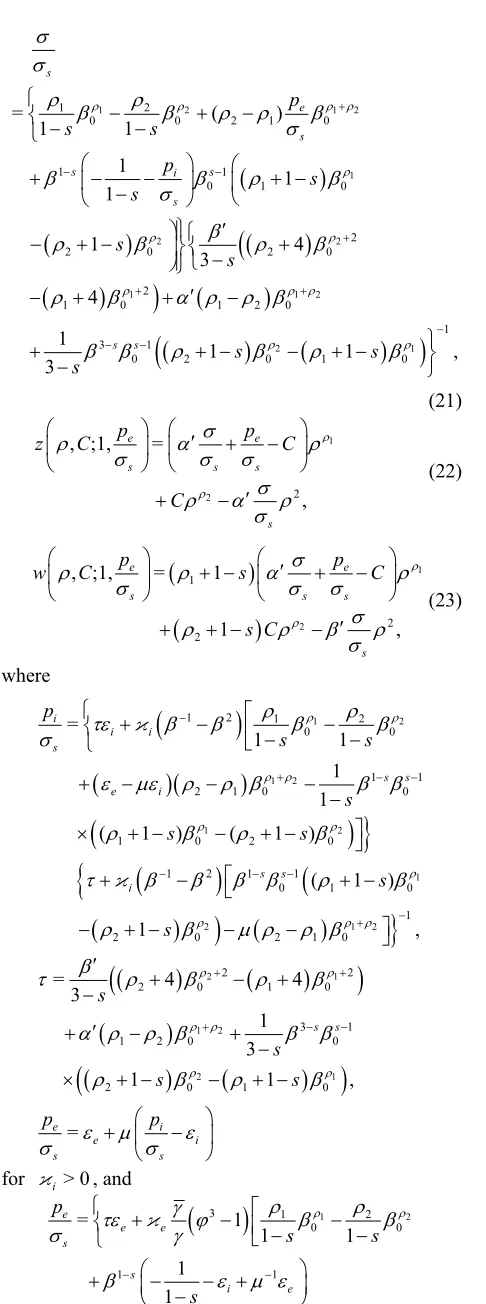
3 s s s , (21) 1 2 2
, ;1, =
,
e e
s s s
s
p p
z C C
C (22)
1 2 1 2 2, ;1, = 1
1 ,
e e
s s s
s
p p
w C s C
s C (23) where
1 2 1 2 1 12 1 2
2 1
1 2 1 2
0 0
1 1
2 1 0 0
1 0 2 0
1 2 1 1
0 1 0
1
2 0 2 1 0
2 2
2 0 1 0
1
=
1 1
1 1
( 1 ) ( 1 )
( 1 )
1 ,
= 4 4
3 i i i s 2 s s e i s s i p s s s s s s s s
1 2 2 1 3 12 0 0
2 0 1 0
1 3
1 1 ,
= s s e i e i s s s s s p p
for i> 0, and
3
1 1 2 20 0 1 1 = 1 1 1 1 1 e e e s s i e p s s s
1 2 12 1 2
1
0 1 0 2 0
3 1 1 1
0 1 0
1
2 0 2 1 0
1 1 1 1 1 1 , = s s s e i e i e s s s s s s p p for
ze the dynamics of small perturbations let’s first calculate half-thicknesses
> 0
e
.
To analy
j
h . In terms of (10), we have:
1 1 0 0 0 01 1 1
= ,
1 1
1, , .
s s
j s
kn j j
n n h b s j n (24)
hen w rmine dependences (7)-(9) (for as yet unknown
T e dete
0
) and characteristic Equation (11) itself. Its solution 0 allows proceeding to the verification of
estimation (12) with previously given . In some ases the exact upper limits in inequality (12) can be found utions of th obal extremum problem for continuously differentiable functions (at discontin points
c
analytically as the sol
uity
e gl
0
1, , n 1
he values of
it is necessary to use one-sided li ts as t function: the right-side limit at
mi 1 j
and the left-side one at j of each seg- ment j1,j
,1 )thod appears to be easier and
. However, the numerical m - more versatile tool to verify condition (12). It is reduced to finding the maximum of the set of limited nonnegative piece-wise continuous functions, given at
e
0= 0
), in the poi
by using relations (15), , (23) a (7)-(9 nts of quite dense discre-tiz
olic disc with and depending upon . Here
(22) nd
ation of the corresponding segment.
Table 1 gives the results of problem solution for a
hyperb k= 0.005
, b= 1,
= 2
s
0
n n= 2 =a b= 0.2, = 0.3, = 0.01
s E , i= 0, e= 0, = 1 3, e
i
6. Concluding Remarks
The proposed scheme allows determining the critical
[image:6.595.56.299.67.719.2] = 0.
Table 1. Critical radius and squared relative critical veloc-ity.
n0 3 10 20 25 30
β0* 0.7331 0.8399 0.9199 0.9359 0.9466
2 q2
me tudying the discs,
s
c annular a is rbitr prof [11].
Russian, Vyshcha shk, Kiev, 1989.
ing Discs, Close to Circular Ones,” Izvestiya Akademii Nauk SSSR, Otdelenie Tekhnicheskikh Nauk, in
Rus-,No. 1, 7, pp. 141-144.
[3] D. Ivl . sh tu M n
Theor c Bo in Rus an, Nauka
Mo ow,
lastoviscoplastic Ro-
.07.008
t II—Burst of a Superalloy Turbine
On the Instability of Rotating Elastoplastic
lastic Annular Disc,” In-.
irger, “Stress Calculation stroyeniye, Mos-
ickness,” Applied Mathematics, Vol. 1, No. 5, [5] M. Mazière, J. Besson, S. Forest, B. Tanguy, H. Chalons
and F. Vogel, “Overspeed Burst of E
radius and critical angular velocity of rotating disc with the given profile for known load para ters. This
en-tating Disks—Part I: Analytical and Numerical Stability Analyses,” European Journal of Mechanics—A/Solids, Vol. 28, No. 1, 2009, pp. 36-44.
doi:10.1016/j.euromechsol.2008
ables s whose unperturbed elastoplastic state can be obtained in a closed form [10]. Except the discs of constant thickness and the hyperbolic discs, conical, exponential and equal resistance discs [9], as well as compound di cs of the mentioned profiles are referred to this type. Besides, neglecting the procedure of verification of condition (12) due to sufficient increase of th
[6] M. Mazière, J. Besson, S. Forest, B. Tanguy, H. Chalons and F. Vogel, “Overspeed Burst of Elastoviscoplastic Ro- tating Disks: Par
Disk,” European Journal of Mechanics—A/Solids, Vol. 28, No. 3, 2009, pp. 428-432.
doi:10.1016/j.euromechsol.2008.10.002 [7] D. M. Lila, “
e number of stepped disc sections n0, we get a method of calculating the possible stability loss (including the eccentric case) for fast rotating elastoplasti nd
solid d cs of an a ary ile Stepped Annular Disc, Loaded over the Boundary in the Middle Plane,” International Applied Mechanics (in Press).
[8] D. M. Lila and А. A. Martynyuk, “On the Development of Instability of Rotating Elastop
ternational Applied Mechanics (in Press)
7. References
[1] А. N. Guz and Yu. N. Nemish, “Method of Boundary Form Perturbation in the Mechanics of Continua,” in
[2] D. D. Ivlev, “On the Loss of Bearing Capacity of Rotat-[9]
sian 195 D.
the
ev and L y of Elas
V. Yer toplasti
ov, “Per dy,”
rbation si
ethod i
, co
K. B. Bitseno and R. Grammel, “Technical Dynamics,” Gosudarstvennoe Izdatelstvo Tekhniko-Teoreti- cheskoy Literatury, in Russian, Vol. 2, Moscow and Leningrad, 1952.
[10] I. V. Demianushko and I. A. B of Rotating Discs,” in Russian, Mashino
w, 1978.
[11] A. M. Zenkour and D. S. Mashat, “Analytical and Nu-merical Solutions for a Rotating Annular Disk of Vari-able Th
sc 1978.
[4] L. V. Yershov and D. D. Ivlev, “On the Stability Loss of Rotating Discs,” Izvestiya Akademii Nauk SSSR, Otdele-nie Tekhnicheskikh Nauk, in Russian, No. 1, 1958, pp. 124-125.