MUTABLE DATA IN A DISTRIBUTED ENVIRONMENT
Simone Ivan Conte
A Thesis Submitted for the Degree of PhD
at the
University of St Andrews
2018
Full metadata for this thesis is available in
St Andrews Research Repository
at:
http://research-repository.st-andrews.ac.uk/
Please use this identifier to cite or link to this thesis:
http://hdl.handle.net/10023/16827
This item is protected by original copyright
This item is licensed under a
Creative Commons Licence
The Sea of Stuff: a Model to Manage
Shared Mutable Data in a Distributed
Environment
Simone Ivan
Conte
This thesis is submitted in partial fulfilment for the degree of
Doctor of Philosophy (PhD)
at the University of St Andrews
Abstract
Managing data is one of the main challenges in distributed systems and computer
science in general. Data is created, shared, and managed across heterogeneous distributed
systems of users, services, applications, and devices without a clear and comprehensive data
model. This technological fragmentation and lack of a common data model result in a poor
understanding of what data is, how it evolves over time, how it should be managed in a
distributed system, and how it should be protected and shared. From a user perspective,
for example, backing up data over multiple devices is a hard and error-prone process, or
synchronising data with a cloud storage service can result in conflicts and unpredictable
behaviours.
This thesis identifies three challenges in data management: (1) how to extend the
current data abstractions so that content, for example, is accessible irrespective of its
location, versionable, and easy to distribute; (2) how to enable transparent data storage
relative to locations, users, applications, and services; and (3) how to allow data owners to
protect data against malicious users and automatically control content over a distributed
system. These challenges are studied in detail in relation to the current state of the art
and addressed throughout the rest of the thesis.
The artefact of this work is the Sea of Stuff (SOS), a generic data model of immutable
self-describing location-independent entities that allow the construction of a distributed
system where data is accessible and organised irrespective of its location, easy to protect,
and can be automatically managed according to a set of user-defined rules.
The evaluation of this thesis demonstrates the viability of the SOS model for managing
data in a distributed system and using user-defined rules to automatically manage data
across multiple nodes.
The code for this work can be found online at the following URL:
Declaration
Candidate’s Declaration
I, Simone Ivan Conte, do hereby certify that this thesis, submitted for the degree of
PhD, which is approximately 66,400 words in length, has been written by me, and that
it is the record of work carried out by me, or principally by myself in collaboration with
others as acknowledged, and that it has not been submitted in any previous application
for any degree.
I was admitted as a research student at the University of St Andrews in September
2014.
I received funding from an organisation or institution and have acknowledged the
fun-der(s) in the full text of my thesis.
Date Signature of candidate
Supervisor’s Declaration
I hereby certify that the candidate has fulfilled the conditions of the Resolution and
Regulations appropriate for the degree of PhD in the University of St Andrews and that
the candidate is qualified to submit this thesis in application for that degree.
In submitting this thesis to the University of St Andrews we understand that we are
giving permission for it to be made available for use in accordance with the regulations of
the University Library for the time being in force, subject to any copyright vested in the
work not being affected thereby. We also understand, unless exempt by an award of an
embargo as requested below, that the title and the abstract will be published, and that a
copy of the work may be made and supplied to any bona fide library or research worker,
that this thesis will be electronically accessible for personal or research use and that the
library has the right to migrate this thesis into new electronic forms as required to ensure
continued access to the thesis.
I, Simone Ivan Conte, confirm that my thesis does not contain any third-party material
that requires copyright clearance.
The following is an agreed request by candidate and supervisor regarding the
publica-tion of this thesis:
• No embargo on print copy.
• No embargo on electronic copy.
Date Signature of candidate
Underpinning Research Data or Digital Outputs
Candidate’s declaration
I, Simone Ivan Conte, hereby certify that no requirements to deposit original research
data or digital outputs apply to this thesis and that, where appropriate, secondary data
used have been referenced in the full text of my thesis.
Acknowledgments
I would like to thank my supervisors, Alan Dearle and Graham Kirby, for their guidance
and endless patience throughout my doctoral studies.
Thanks goes to Adrian O’Lenskie and Ian Paterson, from Adobe Systems Inc., for their
precious advice and support.
I would like to acknowledge the School of Computer Science, which has made my
stay in St Andrews, over the last eight years, enjoyable academically and has given me the
opportunity to meet people that have been a true inspiration to me. Thanks goes to Stuart
Norcross and the Fixit team who have helped me with the provision and management of
the testbed used for the experiments.
Thanks to my office mates Masih, Tom, Ward, and Ryo who have provided me with
challenging, interesting, and fun discussions on a daily basis.
I would like to thank my aunt Giusy for inspiring me, when I was ten, to pursue a
career in science.
I am forever grateful to my parents and my brother for their immense and invaluable
love and support, which helped me arrive where I am today.
Finally, the biggest thanks goes to Giulia, who makes me smile everyday.
Funding
Contents
Abstract . . . iii
Declaration . . . v
Permission for Electronic Publication . . . vi
Underpinning Research Data or Digital Outputs . . . vii
Acknowledgments . . . ix
1 Introduction 1 1.1 Introduction . . . 1
1.2 The Three Challenges . . . 2
1.2.1 Limitation of the Current Data Storage Abstractions . . . 3
1.2.2 Transparent Data Storage . . . 5
1.2.3 Data Ownership, Protection and Control . . . 7
1.3 Hypothesis . . . 8
1.4 Thesis Contributions . . . 10
1.5 Thesis Structure . . . 11
2 Background 13 2.1 Data Storage Concepts . . . 13
2.1.1 Data . . . 13
2.1.2 Location and Naming . . . 14
2.1.3 Metadata . . . 17
2.1.4 Caching . . . 19
2.1.5 CAP Theorem . . . 20
2.1.7 Scalability . . . 24
2.1.8 Security . . . 25
2.2 Data Management Systems . . . 32
2.2.1 File Systems . . . 33
2.2.2 Database Systems . . . 41
2.2.3 Versioning in Storage Systems . . . 46
2.2.4 Networked File Systems . . . 49
2.2.5 Cloud Storage . . . 54
2.2.6 Object Storage . . . 55
3 Literature Review 57 3.1 File Systems . . . 57
3.1.1 Extended Attributes Support . . . 58
3.1.2 Tagged Files . . . 59
3.2 Networked File Systems . . . 59
3.2.1 The Hadoop File System and Google File System . . . 60
3.2.2 GlusterFS . . . 63
3.3 Versioning in Storage Systems . . . 64
3.3.1 Manual Data Versioning . . . 64
3.3.2 Versioning in Backup Applications . . . 65
3.3.3 Version Control Systems . . . 67
3.4 Cloud Storage . . . 77
3.4.1 Infrastructure as a Service Storage . . . 77
3.4.2 Software as a Service Storage . . . 80
3.4.3 Multi-Cloud Storage . . . 86
3.5 P2P . . . 87
3.5.1 Overlay Networks . . . 87
3.5.2 P2P Storage Systems . . . 88
Contents
3.6.1 The Semantic File System . . . 101
3.6.2 The quFile . . . 101
3.7 Conclusions . . . 102
4 Design Requirements 105 4.1 End-User Requirements . . . 105
4.2 Model Requirements . . . 106
4.3 Architecture Requirements . . . 107
5 The Sea of Stuff 109 5.1 The Sea of Stuff Model . . . 109
5.1.1 The Sea of Stuff GUID . . . 109
5.1.2 A Manifest-based Model . . . 110
5.1.3 The Node Model . . . 111
5.1.4 The Data Model . . . 112
5.1.5 The Metadata Model . . . 127
5.1.6 The User-Role Model . . . 130
5.1.7 The Context Model . . . 138
5.1.8 Summary of the Sea of Stuff Model . . . 152
5.2 The Sea of Stuff Architecture . . . 153
5.2.1 The Node . . . 154
5.2.2 Services . . . 155
5.2.3 Considerations . . . 166
6 Reference Implementation 167 6.1 Services . . . 167
6.1.1 Storage Management Service . . . 167
6.1.2 Manifest-Data Management Service . . . 171
6.1.3 Metadata Management Service . . . 173
6.1.5 User-Role Management Service . . . 173
6.1.6 Context Management Service . . . 173
6.1.7 Node Maintenance . . . 174
6.1.8 REST API . . . 174
6.1.9 Instrumentation . . . 174
6.2 Node Storage . . . 176
6.3 Node Configuration . . . 178
6.4 Example Applications . . . 178
6.4.1 WebApp . . . 178
6.4.2 SOS-WebDAV Server . . . 180
6.5 Overall Prototype Limitations . . . 182
7 Comparative Evaluation 183 7.1 Evaluation of Requirements . . . 184
7.1.1 End-User Requirements . . . 184
7.1.2 Model Requirements . . . 185
7.1.3 Architecture Requirements . . . 186
7.2 File Systems . . . 188
7.2.1 The File Metaphor . . . 188
7.2.2 The Directory Metaphor . . . 189
7.3 Networked File Systems . . . 190
7.3.1 Client-Server File Systems . . . 190
7.3.2 Clustered File Systems . . . 191
7.3.3 Shared-Nothing File Systems . . . 191
7.4 Versioning in Storage Systems . . . 192
7.4.1 Backup Applications . . . 192
7.4.2 Version Control Systems . . . 194
7.5 Cloud Storage . . . 200
Contents
7.5.2 Software as a Service Storage . . . 204
7.5.3 Multi-Cloud Storage . . . 207
7.6 P2P . . . 207
7.6.1 OceanStore and Pond . . . 207
7.6.2 InterPlanetary File System . . . 208
7.6.3 Perkeep . . . 211
7.6.4 Tahoe-LAFS . . . 212
7.7 Context-Aware Storage . . . 213
7.7.1 The Semantic File System . . . 214
7.7.2 The quFile . . . 215
7.8 Conclusions . . . 216
8 Experimental Evaluation 219 8.1 Experiments Outline . . . 219
8.2 Experimental Methodology . . . 221
8.3 Experimental Setup . . . 221
8.4 The Experimental Framework . . . 223
8.4.1 Extension of the Sea of Stuff Node . . . 223
8.4.2 The Experimental Framework Utility . . . 223
8.4.3 The Datasets . . . 225
8.5 Reference Implementation Benchmarks . . . 226
8.5.1 Input/Output Benchmark . . . 226
8.5.2 Network Latency and Throughput . . . 230
8.5.3 Atoms and Manifests Replication . . . 231
8.6 Context Experiments . . . 232
8.6.1 The Nature of the Predicates . . . 233
8.6.2 Predicates and the Domain . . . 238
8.6.3 The Nature of the Policies . . . 243
8.6.5 Contexts under Failure . . . 247
8.7 Conclusions . . . 260
9 Conclusions and Future Work 263 9.1 Thesis Summary . . . 263
9.2 Review of Contributions . . . 264
9.3 Limitations of Evaluations . . . 265
9.4 Future Work . . . 266
9.4.1 The Sea of Stuff Model and Architecture . . . 266
9.4.2 Security . . . 267
9.4.3 Sea of Stuff Integration with Existing Technology . . . 268
9.5 Concluding Remarks . . . 268
Bibliography 269 Image Credits 295 List of Abbreviations 297 Glossary of Terms 301 Appendices 303 A Settings 305 A.1 SOS Node Settings . . . 305
B Experiment Settings 309 B.1 Butts Wynd Cluster . . . 309
B.2 Experiment Configuration . . . 310
C Libraries used by the SOS prototype 313 C.1 Castore . . . 313
Contents
C.3 St Andrews Utilities . . . 314
C.4 Apache Tika . . . 314
C.5 Unirest . . . 314
C.6 WebDAV-server . . . 314
C.7 fs-sta . . . 314
Introduction
1.1
Introduction
Among historians, history is defined as “the study of past events” and is commonly
known to have started when humans have invented writing [1]. Any event prior to the
invention of writing, instead, is known to have happened in the prehistoric era. With the
invention of writing, humans have started to record facts, events, trading exchanges, stories,
thoughts, and anything else we could possibly imagine. With the ability to write, humans
started not only to produce information, but also to store it: inside caves, on stones, papyri,
wood, and, later, paper. Humans did not just produce and store information, but they did
so in ever growing amounts. Throughout history, the invention of papyrus, paper, and the
printing press has allowed information to be stored and replicated more easily, faster and
at a lower cost than before. However, none of these technologies has had the same impact
on information storage as the invention of the digital computer.
The two main building stones of computing are: data and algorithms [2]. Data and
algorithms are so important in computing that sometimes computer science itself is defined
as the science of processing data [3, 4, 5, 6]. In this work we are going to focus mainly on
data and the algorithms used to manage data. Looking at the history of computing from
a data-centric perspective, it is interesting to note how the digital computing revolution
has allowed us to generate and store data at an ever-growing pace. It has been estimated
that the size of the “digital universe” has grown by approximately 16 zettabytes1 in 2016
only and the trend is exponential [7, 8]. Together with the internet, we are now able
not only to create and accumulate data, but also to do so while sharing it across the
globe. The computing revolution has not slowed down ever since the invention of the
internet, with the number of devices and amount of data constantly increasing. The result
of the increase of connectivity is data flowing in all directions and users constantly sharing
photos, videos, documents,etc. In addition, most people own multiple computing devices,
which often synchronise data with cloud services and send it to other devices and users.
However, how the internet and its web services work is much more complex than sending
and receiving data from a user’s device to another. For example, a cloud-based backup
application replicates data to multiple locations hidden to the user and synchronises it to
the user’s devices, but the actual behaviour is hard to predict and understand. The model
controlling the data, in fact, is complex and bound to the specific service. Given this
complexity, it is necessary to study how data management can be improved and simplified,
and create processes and algorithms built around data concepts that are not bound to a
specific service, application, or user, and that are easy to understand for the user, easy to
implement, efficient to execute, and complete enough to capture the needs of today and
adapted to the needs of tomorrow.
To summarise, even though data has become pervasive and the difficulty in using
dig-ital devices has decreased drastically, data management is still challenging. This thesis
identifies three challenges that users face: (1) how to extend the current data
abstrac-tions, which have been around for decades but have not adapted to the needs of today’s
applications and users, so that content, for example, is versionable, easy to distribute, and
accessible irrespective of its location; (2) how to enable transparent data storage relative
to locations, applications, and services; and (3) how to allow data owners to properly and
effectively protect data and automatically control it over a distributed system.
1.2
The Three Challenges
The Background and Literature Review chapters discuss the problems highlighted by
1.2. The Three Challenges
1.2.1 Limitation of the Current Data Storage Abstractions
The family of persistent data storage systems can be logically subdivided in two main
branches: file systems and databases. As the name suggests, file systems are designed
and built around the concept of the file; whereas databases are designed around the idea
of storing data, possibly related to each other, in an organised and efficient manner. File
systems are also commonly associated with the hierarchical structure of files and directories,
a concept any computer user is familiar and comfortable using. Hierarchical file systems,
however, have been around for almost half-century and have not evolved rapidly enough
to cope with the user needs and the new technologies [9, 10, 11, 12].
In [13], Jim Gray states that “everything builds from files as a base”, from composite
data formats to databases (i.e., tables are usually stored as files), but some file systems
have actually slowly become database systems themselves.2 Gray is not suggesting that
all file systems have become databases, but rather that the file system abstraction is
outdated and must be re-thought. Take, for instance, the growing trend for end-users
to use application-centric systems over data-centric systems. Application-centric systems,
like Android3, iOS4, or the Windows 8’s metro5, tend to hide the hierarchical structure
of the underlying file system while enhancing it with the help of a better user-interface
and other services. Application-centric systems also hide the file metaphor as much as
possible and simply present data via applications. An application, for example, may use
a metadata database to provide additional information about the data displayed or it can
interact with an external data storage service for better data reliability and data sharing.
These are only two of many examples of how applications and services are being created
around data-centric systems, such as file systems, to facilitate complex actions, such as
sharing or data replication, and to hide complexities, such as a complex hierarchical file
system structure. However, actual storage system implementations are not forced to fall
within one category: file systems or databases. In fact, it is quite common for a storage
2
It should be noted that some databases run on raw partitions and not file systems.
3Android. https://android.com/[last accessed on 11/10/2017]. 4
iOS.https://apple.com/ios/[last accessed on 11/10/2017].
system to have traits from both branches, as suggested in [13].
When new software is released, users can benefit not only from new features, but also
from new ‘mental models’ about data. As a result, users interact with data in new ways
and both the users and the systems acquire new behaviours. One of the side effects of this
is a misalignment and lack of correspondence between the ‘real model’ and the ‘mental
model’ of how files are understood [14]. The most basic data operations: create, read,
update, delete (CRUD) [15] are well understood by most users and it is easy to associate
these operations with files when working locally. The standard file metaphor, however,
is overloaded and much more complex and hard to define [16, 17]. In fact, the number
of operations on files is larger than the simple CRUD operations. Users want to move,
rename, duplicate, share, synchronise, protect, associate, tag, replicate, version, sign files.6
Each of these operations makes the original file definition, based on CRUD, more complex
and harder to understand. Let’s take, for example, the ‘synchronise’ operation. When
taking a photo with a smartphone, this is saved to the local storage of the device and
a backup application (or applications) will start synchronising it to an external service,
which itself will replicate the photo to multiple data servers transparently to the user.
Na¨ıvely, users understand the ‘synchronise’ operation as a simple ‘copy’ operation, even
though there are more underlying processes happening, which can also lead to behaviours
difficult to predict. For example, a synchronisation process might involve two nodes that
act on the same data, stored locally, independently of each other so that conflicts may
arise. In this scenario, one node attempts to propagate a data change while the other a
data deletion. The resulting state of the system, whether the data is deleted on the first
node or copied back on the second node, does not always reflect the user’s intentions.
In particular, this thesis claims that storage abstractions should address the following:
• Data abstraction over locations. Data should be accessible irrespective of where
it is stored and from where it is accessed.
6
1.2. The Three Challenges
• Versioning. It should be possible to version data, at arbitrary granularities, so
that users can see how data has changed and revert to previous changes if needed.
Versioning models also favour collaboration over data.
• Rich metadata support. Metadata is used to improve retrieval, usage, and
man-agement of data. Therefore, richer metadata results in better data storage services.
Data storage abstractions should also be designed and built taking into account the
following non-functional requirements:
• Implementation independence. The abstractions should be described as concepts
independent from their actual implementation.
• Scalability. These abstractions should be usable in a system that scales globally.
• Data integrity. Users and/or services operating on such abstractions should be
able to verify whether a data/metadata has changed or not.
• Security. Users and/or services should be able to protect data/metadata from being
accessed from unwanted parties.
1.2.2 Transparent Data Storage
The aim of a data storage solution providing transparent properties is to hide any
complexities from its users. Transparency can be applied over many aspects of a system,
but often only location transparency is addressed. Location transparency ensures that the
name associated with the data is related to the actual data rather than to its locations.
This work, however, suggests that data storage systems should also address transparency
over applications and services.
A feature that makes cloud storage applications and services very useful, and popular,
is their ability to abstract the stored content from locations. Whether data is stored in
a cloud storage application, like Dropbox [18] or OneDrive [19], or in a cloud storage
is transparent to users or applications. Users do not have to remember all the locations of
the different replicas of the stored data. As a benefit, the data stored will comply with the
servicelevel agreement of the service, meaning that data is stored with highreliability,
-availability and -durability at a reasonable, and often little, cost. Relying on cloud storage,
means also less maintenance, relying on the work of hundreds of thousands of engineers
hours, and good scalability. Storing data in the ‘cloud’, however, can also present some
issues:
• Services can go down, even if they promise 99.9999+%7
availability/reliability/dura-bility.
• Data is locked-in: users have little or no control over the data stored in the cloud.8
• The company providing the service can go bankrupt.
• Data might not be stored safely and securely [22, 23, 24, 25].
Moreover, even though cloud services abstract data over their locations, data is still not
abstracted over location-services. For example, imagine having a version control repository
in your local file system, which is also synchronised with a remote version control service
and backed-up to a cloud storage service. The file system, the remote version control
service, and the cloud storage service each provide location abstraction, but each of them
also represents a location-service, which is not abstracted to the user.
A common solution to have transparency over cloud services is to build a ‘cloud of
clouds’ (CoC), where a generic data management solution provides abstraction over
mul-tiple cloud services [26, 27, 28, 29, 30]. CoC, however, have the following limitations:
7
For a time-based property, a six-nine probability (99.9999%) is equivalent to 2.6 seconds downtime per month, or 31.2 seconds downtime per year.
8
For example, most cloud storage solutions allow users and/or applications to choose the geographical regions where data is stored. However, while advantageous, this level of abstraction is still limiting, as one is often not able to describe precisely where data should be stored. Plus, it is usually the case that extending this level of control over multiple cloud solutions is not possible.
1.2. The Three Challenges
• Their generic abstraction provides a smaller subset of functionalities, so as to adapt
to many cloud services (or it provides many features, but not all of them for all
services).
• Moving content across the underlying cloud services is still challenging.
• Moving content while preserving its provenance, metadata and integrity is still hard.
• Data is still locked-in, but in multiple cloud services rather than one.
1.2.3 Data Ownership, Protection and Control
The third challenge is related to how to allow users to explicitly state ownership over
data, how to effectively protect data and how to automatically control it over a distributed
system. These three sub-challenges are linked together as they question what users can do
with their own data.
1.2.3.1 Ownership
Data ownership is the relationship between a user and some arbitrary data that he/she
‘possesses’. In digital systems data ownership is implemented by mapping the concept of
user to data. However, the concept of user, as well as the type of mapping of the data,
is strictly related to the system in question. In most systems, the concepts of users and
ownership are not built in the data model of the system, but are rather built on top of
it. Having the concepts of users and ownerships separated from the data model results in
a non-uniform behaviour and management when the system is distributed and/or has to
interact with other systems.
1.2.3.2 Protection
Related to ownership is protection. Protection is the ability to stop unwanted users
to freely access data. With data sharing being central to distributed storage, protection
is a fundamental aspect to provide a proper service. In most traditional storage systems,
for example, data is protected by simply assigning password protected users to it (i.e.,
instead, protect users’ data via encryption, but users have no control over the actual
protection mechanism since this is not part of the data model, but part of the cloud
service architecture.
1.2.3.3 Control
Finally, the third sub-challenge is related to how to allow users to control their data in
a distributed environment and how to let the system perform control automatically. This
works defines control over data as the ability to decide and act upon the data, such as
copying, encrypting, or deleting it. Controlling data in a distributed system is challenging
and even more so when the task has to be run autonomously. The current commercial
solutions that allow control over content aread-hoc tools, such as Syncthing9 and Resilio
Sync10. Large distributed storage systems and cloud storage services adopt automatic
data control mechanisms, but they require specialised technical knowledge that the typical
end-user does not have.
1.3
Hypothesis
The ability to correctly and easily store and control data is hard to achieve. Ideally,
one would wish to have a system that satisfies the following properties:
1. Storage space is infinite.
2. The system minimises the latency of access to data.
3. Data is always available regardless of its location and the locations of users.
4. The system abstracts the physical location of data and metadata.
5. Access to data and metadata can be controlled.
6. Data and metadata may be shared between globally distributed users.
7. Arbitrary levels of resilience may be defined and automatically enforced.
9
Syncthing. https://syncthing.net/[last accessed on 03/11/2017].
1.3. Hypothesis
8. All data and metadata may be versioned.
The above properties are hard to achieve due to theoretical and physical limits. This
thesis attempts to approximate to these properties at two distinct levels: (1) at a level that
is visible to users and (2) at the system level — as realised by a computational model.
This thesis hypothesises that:
H1:
A data model based on immutable, self-describing, re-computable, and
content-addressable entities can be used to build a distributed data management system
which approximates to the properties 1–2 and satisfy the properties 3–8 above
in a manner that provides advantages over existing storage systems.
H2:
A data model based on immutable, self-describing, re-computable, and
content-addressable entities can be used to build a personal distributed data management
system where data is automatically managed based on user-defined rules in a
manner which provides advantages over existing solutions and approaches.
The distributed storage model and the prototype developed in this work attempt to
provide the following properties:
1. Location abstraction. Users can perform data operations irrespective of where the
data is stored and from where it is accessed.
2. Copying, Moving and Sharing. Data and metadata can be copied, moved, and
shared across locations, users, and services at different granularities while retaining
3. Data Protection. Data and metadata can be protected independently of locations
and of each other. The result is the ability to protect data once and replicate it
many times. It is also possible to protect data, while leaving metadata readable to
everyone — if one wishes to increase the data’s discoverability — without necessarily
giving access to the actual content.
4. Versioning. Content can be versioned at different granularities.
5. Autonomic Data Management. Users can automatically organise and enforce
actions on data using well-defined rules.
6. Resiliency. Resiliency over data is supported by the ability of the model to abstract
entities over their locations. Entities are not trapped by a single system and can be
replicated across multiple nodes or services without any loss of information, thus
increasing the level of availability in the face of faults.
7. Users and Roles. Users can play multiple roles and access different data views
based on the role played.
8. Absence of Central Authority. Entities can be exchanged across individual nodes
without the need for a central authority.
To test the hypothesesH1and H2, a proposed data model was designed, prototyped,
and later evaluated (see Chapter 5 for the design of the SOS and Chapters 7 and 8 for its
evaluation).
1.4
Thesis Contributions
The contributions of this work are:
1. The design of a generic model — the Sea of Stuff — for managing data in a
heterogeneous distributed system.
1.5. Thesis Structure
3. A comprehensive literature review on data management.
4. An implementation of the model and architecture proposed.
5. An evaluation of the Sea of Stuff model.
6. The identification of a set of future research directions.
1.5
Thesis Structure
This chapter — Introduction — introduced the problems, challenges, and the
re-search hypothesis of this thesis and listed the contributions of this work.
Chapter 2 — Background — presents a summary of data management concepts
nec-essary to read the rest of the thesis. This chapter also provides an overview of different
storage systems and their properties.
Chapter 3 — Literature Review — presents the state of the art in data management
along with the dimensions identified by the hypotheses, as outlined in this chapter.
Chapter 4 —Design Requirements— outlines the needed requirements from the
end-user perspective, as well as the requirements need to design and implement the proposed
model.
Chapter 5 — The Sea of Stuff — presents the design of the Sea of Stuff model,
rea-soning about the design decisions made along the way and how it compares to the related
work. Furthermore, this chapter briefly described the prototype developed with its features
and limitations.
Chapter 7 — Comparative Evaluation — evaluates the Sea of Stuff model
Chapter 8 — Experimental Evaluation — evaluates the Sea of Stuff model
quanti-tatively through experimentations on the prototype developed.
Chapter 9 — Conclusions and Future Work — concludes this thesis and presents
Background
This chapter introduces the basic concepts about data storage systems and provides
an introduction to the different classes of storage solutions.
Data storage is the study ofrecordingandreadingdata into storage media (e.g., volatile
memory, hard disk, recording tape), and consists of (a) designing and implementing the
actual physical storage media and (b) designing and developing the software to allow the
operating system and/or the applications to use the storage media. This thesis will ignore
(a), as those are tasks and challenges belonging to the study of electronics, and will focus
on how storage is abstracted and managed via software. In particular, this thesis will focus
on the high-level techniques11, systems, and solutions to store persistent data locally and
in a distributed setting.
2.1
Data Storage Concepts
2.1.1 Data
Data12, in informatics, is defined as a sequence of bits — which can be created, read,
processed, saved, and stored digitally — and constitutes the basic building block for any
data storage system.
The way data is organised and stored — such as a file, a database entry, or a composition
of independent data elements — affects also the data ‘metaphor’ perceived by users and the
set of operations associated with it (e.g., create, read, update, delete, share, copy, move,
11Techniques and methods on how to read, write, and process data on physical disks and manage IO in
general are not the focus of this work and will not be taken into account.
etc.). The most relevant data abstractions are discussed in more detail in the relevant
sections about the different types of data storage systems (see Section 2.2) and in the
Literature Reviewchapter.
2.1.2 Location and Naming
2.1.2.1 Location
Location is the “the place” where data is stored and from which it can be fetched.
However, this definition is ambiguous, since it is not always clear what and where this
place is and what the relationship with the logical data is. So we must distinguish location
into two types: the physical location and the logical location of the data.
Thephysical locationof data indicates the place where it is stored on physical storage
media, such as a disk or a recording tape. However, understanding how data is managed
in different physical locations is beyond the scope of this work and will not be discussed
further in this thesis.
The logical location of data is the place where it is stored in relation to other data
or other abstractions, such as directories for file systems, from a user/application level
perspective. In a flat file system, which has only the root directory, the logical location
of the files and their names are one and the same. In hierarchical file systems, the logical
location of a file is related to its name and the structure of directories that contain it.
Directories are the abstractions that allow files to be organised in hierarchies. The textual
representation of logical locations is thepath. The following, for example, is a path for
a file contained under the desktop directory, which itself is contained under the home
directory: home/desktop/a file
The path of a file consists of the definition of the name of the file and the description
of the logical location of the file in relation to directories and other files. Paths can
be absolute or relative. Absolute paths locate a file regardless of the current working
directory the user is in, while a relative path — as the name suggests — is a path that is
2.1. Data Storage Concepts
2.1.2.2 Naming
“Naming is a mapping between logical and physical objects” [31, p. 707] and allows
users to refer to files and directories using human-readable names even though these are
physically stored in a storage media and accessed by using physical “hard-to-read”
ad-dresses.13 The resolution of the naming mappings, such as the one below, is performed
by thename service of a system. A typical name service for a local file system resolves
the user-level name to its physical address, which corresponds to its actual location, as
following:
user level textual name → system level identifier→ physical address
Naming is also very important in distributed systems, where data is distributed across
multiple nodes (see Glossary of Terms for the definition of node). In distributed systems,
naming and location are related one another and the following two properties must be
taken into account when looking at naming in a system [31, 32]:
• Location Transparency. The name associated with the data is not related to its
physical storage location.
• Location Independence. The name associated with the data does not need to
be changed when its physical storage location changes. A name service providing
location independence dynamically maps names to locations.
Finally, the collection of all the names allowed in a system defines the namespace.
There are two types of namespaces: local and global. Names in a local namespace are
unique only within a given node or set of machines. Systems using a local namespace can
concatenate the host name with the data name to provide a wider access to such data.
The web is an example of a system where file names are concatenated to a host name (i.e.,
http://〈domain〉/〈filename〉) in the form of a URI (Uniform Resource Identifier). This
technique, however, conflicts with the location transparency and location independence
13
properties described above, since the URI is related to the location of the data and needs
to be changed if the data is moved somewhere else. On the other hand, names within a
global namespace are unique over all the nodes of a system.
The remainder of this section briefly describes the URI, the globally unique
identi-fier (GUID), and content-addressable naming schemes, necessary to understand the next
chapters.
Uniform Resource Identifier
A URI is a string of characters that identifies a resource and follows the general scheme:
protocol:[[user[ password]@]host[ port]][path][?query][#fragment]
which is described in detail in the RFCs 2396 [33] and 3986 [34].
There are two main types of URIs: locator identifiers, or URL (Uniform Resource
Locator), and name identifiers, or URN (Uniform Resource Name). URLs define the
location of the resources, with the protocol describing how resources should be accessed.
Examples of URLs are:
• http://www.ietf.org/rfc/rfc2396.txt
• mailto:[email protected]
• https://doi.org/10.1109/JPROC.2010.2096170
URNs, unlike URLs, do not contain any hint about the location of the content.
Exam-ples of URNs are:
• urn:ietf:rfc:2648
• urn:guid:7A7B95D784007B930599D491366E0C272D119EB0
2.1. Data Storage Concepts
Globally Unique Identifier
A GUID (Globally Unique Identifier) is a number, of any length, used to uniquely
identify a resource in a system. That means that two resources cannot have the same GUID,
unless they are actually representing the same entity (i.e., they are the same sequence of
bytes). The RFC 4122 [35] defines a GUID as a 128-bit number that can be generated in
multiple ways (e.g., using a hash function) and that describes a resource uniquely within
the system adopting it. GUIDs shorter or longer than 128-bit can also exist. The following
is an example of GUID in hexadecimal format (32 digits, 4 bits each):
123e4567-e89b-12d3-a456-426655440000
Content-Addressable Naming Schemes
A content-addressable naming scheme allows storage systems to bind data to names
that are related to its actual sequence of bytes, such that a different sequence of bytes must
be bound to another name. In such schemes, the name of some content is usually generated
by applying a cryptographically secure hash function on the content (see Section 2.1.8.2),
so that a change to the content results also in a change in the name.
The purpose of content-addressable naming schemes is to abstract data from locations,
so that the users of such storage system are able to access data irrespective of where it is
stored or where it is accessed from.
2.1.3 Metadata
Metadata is “data about data” and it is used to facilitate retrieval, usage, and
man-agement of content. Metadata is usually structured data defined by well known
stan-dards [36, 37, 38], but it can take any arbitrary form. Jenn Riley defines metadata as
“key to the functionality of the systems holding the content, enabling users to find items
of interest, record essential information about them, and share that information with
oth-ers” [38]. Windows- and Unix-based file systems, for example, support a limited set of
metadata attributes (e.g., name, creation/modification/last access date, owner) that are
systems — such as Google Photo14, Amazon Kindle15, or social networks like Facebook16
or Twitter17 — support richer metadata linkage with data. This, however, usually comes
at the cost of binding the data within the application ecosystem.
Metadata can also be generated by a system to enable certain features. For example,
distributed storage systems, such as the Google File System and GlusterFS, uselocation
metadata to map data with its storage locations. Likewise, desktop search applications,
such as Spotlight18 and Alfred19, index and enrich local data to provide better search
functions (e.g., find all the files authored by the user Simone, all the pdf files opened last
week, or all the images tagged asholiday).
For the purpose of this work, metadata is classified based on the relationship it has
with the data it describes:
Intrinsic metadata
Intrinsic metadata is metadata inherent to the data and embedded within it. We
dis-tinguish two types of intrinsic metadata: explicit andimplicit. Explicit intrinsic metadata
(EIM) is structured metadata stored within the data, and thus easy to extract using
meta-data extractors. Examples of EIM are EXIF for JPEG or XMP for JPEG, PSB and PDF.
Implicit intrinsic metadata (IIM), on the other hand, is metadata that can be
algorithmi-cally extracted from the data. IIM is computationally expensive to retrieve. Examples of
IIM are: whether there is an animal in a JPEG photo, if the photo is mostly blue, the tone
of the voice in an audio or the speech-to-text translation of an audio file.
14
Google Photo. https://google.com/photos/about/[last accessed on 15/08/2018].
15
Amazon Kindle. https://amazon.co.uk/kindle-dbs/fd/kcp[last accessed on 15/08/2018].
16Facebook.
https://facebook.com[last accessed on 15/08/2018].
17
Twitter. https://twitter.com[last accessed on 15/08/2018].
18“Spotlight is a fast desktop search technology that allows users to organise and search for files
based on metadata”. Spotlight is provided by Apple and available for Apple’s macOS and iOS op-erating systems. https://developer.apple.com/library/content/documentation/Carbon/Conceptual/ MetadataIntro/MetadataIntro.html[last accessed on 09/10/2017].
2.1. Data Storage Concepts
Extrinsic metadata
Extrinsic metadata is external to the data to which it refers and it may be stored
explicitly in a metadata-like manifest or provided implicitly by some underlying storage
system. Explicit extrinsic metadata (EEM) is metadata provided by applications and/or
users. Examples of EEM are tags or metadata stored within the pathnames.20 Implicit
extrinsic metadata (IEM), instead, is metadata provided by the native system, such as the
creation/modification/last-access times or the size of the data.
2.1.4 Caching
Caching is the practice of storing content temporarily in a fast storage location to
improve IO performance. Specifically, the operation of caching consists of storing data to
a location with faster access. Data might be cached for various reasons: due to an actor
of the system, or external to it, that requests some data; due to temporal locality of the
data; or because of the spatial locality of data.
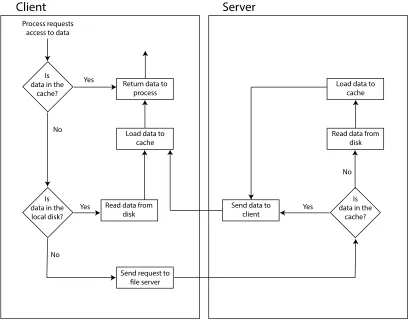
In a local storage system, data is cached in the RAM (random-access memory) or in the
L1-2-3 CPU internal caches. In a distributed system caching occurs also at the node level.
Specifically, data can be cached in four places: the server’s disk, the server’s memory, the
client’s memory, and the client’s disk. Irrespective of the number and types of nodes of a
system, the individual interactions among them are always going to involve two nodes, one
of which acts as a client and the other as a server. The purpose of caching in a distributed
system is to store data to a node that is closer, geographically or topologically, to the client
so that latency is reduced.
Upon retrieving data, the cache is queried first. If the data is found, it is said that
a cache hit occurred and the data is returned. Otherwise, a cache miss occurred and
the data is retrieved from another, slower, location (e.g., the local disk or another node).
Depending on the strategy in place, the retrieved data is added to the cache so that future
requests will result in cache hits.
When caching data, one should take into account the following three issues: (1) the
20
cached data may not be coherent21 across all cache locations; (2) maintaining the cache
coherent and up-to-date22can become expensive and cumbersome over time; (3) the chosen
coherency model may not always satisfy everyone’s needs.
2.1.5 CAP Theorem
The CAP theorem, formulated by Eric Brewer, states that in a distributed system it is
possible to achieve only two of the following three properties:
• Consistency. The data is consistent across all available nodes.
• Availability. The requested data is always available at all reachable nodes.
• Tolerance to Network Partitions. The system is tolerant to failure of parts of the
network [39, 40].
The CAP theorem acts as a “rule of thumb” for distributed system designers and it is
commonly assumed that any distributed system must forfeit one of the three properties.
However, Brewer later rectified that the “2 of 3” rule is misleading, since some trade-off
of the three properties is also achievable [41]. In fact, the CAP theorem defines the above
constraints only when a system is under failure or not running under optimal conditions.
To the support of a more flexible CAP theorem, Abadi has proposed the PACELC23
formulation, which poses the following question: “if there is a partition (P), how does
the system trade off availability and consistency (A and C); else (E), when the system is
running normally in the absence of partitions, how does the system trade off latency (L)
and consistency (C)?” [42].
2.1.6 Replication, Erasure Coding, and Resiliency
2.1.6.1 Replication
Data replication is the process of copying — replicating — data to one or more locations
in order to achieve better data availability and stronger resistance to faults. For instance, if
21Coherency means that all clients requesting the cached data, should get the same exact data.
22
The latest changes to the data.
2.1. Data Storage Concepts
one node crashes or one piece of data is corrupted, the data can still be recovered from the
other replicas. Replication is also important to improve performance of data management
in a distributed system that requires scaling, quantitatively and geographically. Typically,
replication is used to balance load between multiple nodes [32, 43]. Additionally, in a
distributed system, data replication can be used to achieve caching by locating data over
strategic locations.
Replicating some dataDby a replication factor n, results in an overall space cost of n
and a system that can toleraten−1 replica failures. A technique to increase resilience is to
divideD in smaller blocks, which can be distributed independently. In the first approach,
Dis stored innlocations; while in the second approach the blocks can be stored overn×c
locations, wherec= (size(D)/size(block)). This means that the number of locations that
need to be unavailable for Dto become also unavailable is higher in the latter case. The
downside of the latter, however, is that managing blocks that are replicated over many
more locations can be expensive. Chunking data into blocks also result in a system with
better throughput, since blocks can be transferred concurrently.
Overall, when integrating data replication in a system, the following should be taken
into account:
• Replicating data to a remote location has a cost which depends on multiple factors
related to such location: network properties, quality of service, and the actual price
of buying, renting, and/or maintaining the storage location.
• Where to replicate data. A system might want to replicate data closer to where it
is accessed, but also spread it across multiple distant geographical locations, so that
storage is more resistant to geographical related issues.
• How many replicas to have for some given data (the replication factor). Increasing
the replication factor increases also the redundancy, availability, and fault resistance
of the data, but it also requires more storage space, which has a cost in terms of
• When to replicate data. A system might optimise its replication process by
replicat-ing data only when necessary, for example when a particular piece of data is more
requested.
• Keeping track of where the replicas are has a cost, since the storage nodes storing
the replicas should be periodically queried.
• Keeping the replicas consistent has also a cost, since it might involve complicated
algorithms such as the two-phase commit [44] or the paxos [45] protocols.
• Some of the replicas might become out-of-date and policies to update or discard them
should be designed.
Data Consistency
When considering consistency for data storage in distributed systems, we look at two
main approaches: eventual consistency andread-after-write consistency (sometimes known
asstrong consistency). Eventual consistency is achieved if all the replica locations
eventu-ally contain the same data, without any constraints on when consistency will be achieved.
However, in a system with high churn24, eventual consistency may never be achieved. In
the read-after-write consistency model, instead, data is consistently available to be read
im-mediately after it has been written. A system implementing a read-after-write consistency
model usually forfeits availability in favour of consistency (see CAP Theorem, 2.1.5).
2.1.6.2 Erasure Coding
An alternative approach to achieve high redundancy, availability, and resiliency while
saving storage space is via erasure coding [46, 47, 48, 49]. Erasure coding is an
error-correction technique that extends some dataDconsisting ofnsymbols with some additional
ksymbols, such that onlynsymbols are needed to re-construct the original data. A symbol
could be a single bit or byte of data, or, more commonly, a block of data. Erasure coding is
2.1. Data Storage Concepts
used to manage volumes of disks, for some RAID levels (Redundant Array of Independent
Disks) [50], or in distributed systems [51], by distributingn+kblocks over multiple nodes.
The general erasure coding mechanism consists of dividing some dataDinndata blocks
and calculatingkcoding blocks, such that the storage space cost isn+kand the system can
toleratek block failures. The advantage of erasure coding over simple replication (where
data is chunked into smaller blocks), is that it is possible to achieve the same level of fault
tolerance, but with a lower storage cost, as outlined by the ratio:
storage cost(erasure coding)
storage cost(replication) =
c+k
c×(k+ 1);
where:
c = is the number of blocks that the data is divided into
k = is the number of block failures that can be tolerated
It follows, for example, that choosing (n, k) to be equal to (10,4) for erasure coding
and (10,2) for simple data replication (3 replicas), results in a 53.4% storage space saving
and the ability to tolerate 4 block failures instead of 2.
However, maintaining the level of resilience constant when parts of a system fail can
be expensive. The na¨ıve approach for recovering a data block requires the reconstruction
of the data with n blocks to recalculate the missing one. This puts a significant stress
on the system network bandwidth and overall disk IO. More efficient repair mechanisms
have been designed, but require more complex coordination among the components of the
system [52, 53, 54]. Different block placement strategies can also have a significant impact
on the system performance [55].
A technique to increase erasure coding write performance is to divide the data D in
blocks and apply erasure coding for each block, so that when updating D, erasure coding
has to be reprocessed only for the blocks that have changed. This approach is used by
2.1.6.3 Resiliency
Resiliency, or fault tolerance, is the ability of a system to continue to provide its service
in the face of faults (e.g., a part of the system does not return the expected result, a
remote server does not respond or produced an error message, the network is partitioned).
Resiliency is a very important property in distributed systems, where failures are the
norm, not the exception. For a system to be classified as resilient, two requirements must
be satisfied:
1. The system can continue to provide a service even if some of its components are down
or malfunctioning.
2. Components of the system can automatically recover from failures without affecting
the behaviour and performance of other components.
2.1.7 Scalability
Scalability is the ability of a system to cope with growth in the amount of work to
be done. A system is said to be scalable even if its behaviour degrades definitely and
noticeably, as long as such degradation remains acceptable to the users of the system. In
the case of storage systems, scalability is generally considered along the following axes:
• The number of data entities.
• The size of data entities.
• How data is organised (e.g., through directories for files, or buckets for objects in
cloud object storage services).
• The number of nodes, in a networked or distributed storage system, that can be
supported.
• The number of clients that can be served by a node simultaneously.
2.1. Data Storage Concepts
Scalability can be addressed at the software level, by designing and building a system
that can handle more workload within the same time frame, and at the hardware level, by
either scaling horizontally (adding more nodes) or vertically (adding more resources to the
existing nodes of the system). Horizontal scaling is a common approach since it can be
achieved using commodity hardware, but it requires more complex coordination among all
machines. Vertical scaling, instead, is easier to implement, but more expensive and limited
by the amount of resources that can be added to a single machine.
2.1.8 Security
Computer security is the field that studies how to protect a computer system from
being corrupted or damaged, information from being read without authorization, and a
service from being disrupted. Security is a vast topic, so this section will only cover the
concepts relevant to the understanding of this work.
2.1.8.1 Ownership, Access Control and Capabilities
One of the basic protection mechanisms in security is the ability to assign ownership
over data, define who has access to it, and what operations a given user or a collection
of users, a group, is allowed to perform. This section illustrates the basic protection
mechanisms employed by Unix file systems.
The owner/group/other Unix permission model
The owner/group/other Unix permission model is the most common mechanism to
control access over files and directories. In this model, each file or directory is associated
with its owner (e.g., sic2, al, gnck), a named group (e.g., students, staff), and other,
a special group used to indicate any user of the system. Users and groups are associated
with unique system identifiers, ‘uid’ and ‘gid’ respectively. The example in Snippet 2.1
shows the owner/group/other permissions of some files through the use of thels utility.
The owner/group/other Unix permission model, however, provides only limited access
control for systems that have more than one user and/or one group. This limitation is
1 $ ls -l
2 -rw-r--r-- 1 sic2 students 314 30 Aug 14:40 README.md
3 -rw-r--r-- 1 al staff 24093 25 Nov 17:37 bibliography.bib
4 drwxr-xr-x 12 sic2 students 384 28 Nov 11:04 chapters
5 lrwxr-xr-x 6 gnck staff 192 27 Nov 17:50 experiments -> /Users/sic2/git/experiments
6 -rw-r--r--@ 1 gnck staff 25349 27 Nov 17:59 experiments.xlsx
7 -rw-r--r-- 1 sic2 students 6444 27 Nov 17:07 main.tex
Snippet 2.1: Example of ‘ls -l’ output showing the permissions on files and directories. The first
column indicates the mode of the listed entity. The mode is composed by the file type (e.g., ‘-’ for a
regular file, ‘d’ for directory, ‘l’ for symbolic link), and three permission classes for user, group, and
other. Each permission class consists of the triplet ‘rwx’ (read, write, execute). The third column
indicates the user-owner, while the fourth column indicates the group-owner.
Access Control Lists
Access control list (ACL) is a security mechanism to enforce more fine-grained control
over who can access some given data and what operations a user, or group, is allowed to
perform [58]. In ACL, a file or a directory is associated with a list of users/groups and
the type of access they have been granted (e.g., read, write, execute, etc.). Snippet 2.2
illustrates an example of ACL in a Unix file system. Windows systems use a similar
approach by using a list of access control entries [59].
ACLs enable complex access control patterns, however, its maintenance can be
chal-lenging, especially in a system with many users and/or groups.
1 $ getfacl -d main.tex
2 # file: main.tex
3 # owner: sic2
4 # group: students
5 user::rwx # Base ACL Entry, mask not applied
6 user:gnck:rwx # Effective:r-x
7 user:al:rwx # Effective:r-x
8 group::rwx # Base ACL Entry, effective:r-x
2.1. Data Storage Concepts
10 mask:r-x
11 other:r-x # Base ACL Entry, , mask not applied
12 # The default ACL can be specified for files only
13 default:user::rwx
14 default:user:gnck:rwx # Effective:r-x
15 default:group::r-x
16 default:mask:r-x
17
default:other:---Snippet 2.2: Example of an ACL list.
Capabilities
Capabilities are a security technique that defines what operations a user is allowed to
perform on some given data. A capability is an unforgeable token, or key, that grants
its owner permissions to access an entity, such as a file, and to perform operations upon
it [60, 61, 62, 63]. Further, a capability could also be the address of the entity, as suggested
by Fabry [60], so that the address is independent of the location of the entity and a change
in location of the entity does not involve any change in the capability.
Similarly to ACL, capabilities can also be hard to maintain, such as the process of
revoking access to a particular user to a particular entity, when this user has already made
a copy of the entity.
2.1.8.2 Data Integrity
Data integrity is the property of data to be consistent over time. Data integrity is an
important property in the context of security and a system that supports data integrity
should be able to detect unintentional data changes or data integrity loss, such as when
data changes due to hardware faults or a malicious user changes the data.
One of the techniques used to verify data integrity is to generate hashes from the data.
One such hash function isMD5. The MD5 algorithm is a hash function generating 128-bit
hash values (see RFC 1321 [64]). The algorithm, however, has been proven broken multiple
times over the years, making it vulnerable to malicious attackers [65, 66]. More popular
func-tions. The SHA algorithms are a family of hash functions created and published under
the National Institute of Standards and Technology (NIST). As of the time of writing, the
SHA family comprises four sub-family of algorithms: SHA-0, SHA-1, SHA-2, and SHA-3.
SHA-0 was dismissed after a few years of its publication and so it is rarely used [67, 68].
The SHA-1 hash function produces a 160-bit hash value, usually represented as a
hexadeci-mal string 40-character long. An example of the result of a SHA-1 function is the following:
SHA-1(‘‘The quick brown fox jumps over the lazy dog’’) =
2fd4e1c67a2d28fced849ee1bb76e7391b93eb12
SHA-1, unlike the SHA-0, has been more resistant to collisions25, which were found
only recently in early 2017 [69]. The SHA-1 is widely used across a large number of
appli-cations and systems. In storage systems, the SHA-1 function is used to uniquely identify
content.26 The advantage of using a cryptographic function is that (1) it outputs a fixed
size sequence of bits; (2) it is infeasible to reverse; and (3) it can be used to verify the
in-tegrity of the data that generated the hash value. Thus, if one bit of the data has changed,
then re-calculating the hash function will generate a new non-matching hash value. Some
version control systems use SHA-1 to hash both the versioned data as well as a
refer-ence to the previous versions of the data (i.e., the history of the repository). Using this
approach, it is possible to verify the integrity of the versioned content as well as of the
history of the repository (see Sections 2.2.3 and 3.3 to know more about version control
systems). The SHA-2 and SHA-3 algorithms produce larger hash-values and provide
bet-ter security against collisions. However, SHA-2 and SHA-3 have not seen a wide use until
recently, as both computation power and storage space have improved and become cheaper.
SHA-2-256(‘‘The quick brown fox jumps over the lazy dog’’) =
d7a8fbb307d7809469ca9abcb0082e4f8d5651e46d3cdb762d02d0bf37c9e592
25A collision is the event when a function maps two different inputs to the same output.
26
2.1. Data Storage Concepts
SHA-3-256(‘‘The quick brown fox jumps over the lazy dog’’) =
69070dda01975c8c120c3aada1b282394e7f032fa9cf32f4cb2259a0897dfc04
Algorithm (and variant)
Output size (bits)
Max. mes-sage size
Security bits Published year
MD5 128 Unlimited <64 1992
SHA-0 160 264 - 1 <34 1993
SHA-1 160 264 - 1 <63 1995
SHA-2 (-256) 256 264 - 1 128 2001
SHA-2 (-512) 512 2128 - 1 256 2001
SHA-3 (-256) 256 Unlimited 128 2015
SHA-3 (-512) 512 Unlimited 256 2015
Table 2.1: The most relevant cryptographic hash functions. The number of security bits is a measure of the number of possible outputs a hash function has and therefore indicates how hard it is to find an input with a given output.
2.1.8.3 Data Protection via Encryption
In addition to ensuring data integrity, sometimes one may wish to protect data from
be-ing read by unwanted parties. In order to protect data, encryption algorithms are adopted.
Encryption algorithms allow bytes of data, that we want to protect, to be transformed to
another sequence of bytes using an encryption key, so that it becomes very hard to
trans-form such encrypted data back to its original trans-form, unless the decryption key is known. The
encryption algorithms can be classified as symmetric or asymmetric. Without going
into the mathematics of encryption algorithms, symmetric-key encryption requires a single
key to both encrypt and decrypt the data; while asymmetric encryption requires a pair of
keys, where one is used to encrypt the data and the other one to decrypt it. A common
use of asymmetric encryption is one where one of the keys (public key) can be distributed
publicly without compromising the security enforced by the other matching key (private
key). Asymmetric encryption is generally more expensive than symmetric encryption, so
encrypt-ing symmetric keys, and digital signature [70]. The diagram in Figure 2.1 illustrates the
difference between symmetric-key and asymmetric-key encryption.
(a)
Clear Data Encrypted
Data Clear
Data
Symmetric
Key Symmetric Key
(b)
Clear Data Encrypted
Data Clear
Data
Public
Key Private Key
Figure 2.1: A schematic of (a) symmetric encryption and (b) asymmetric encryption. In (a) the symmetric key is used to both encrypt and decrypt the data. In (b) the public key is used to encrypt the data, while the private key is used to decrypt it.
Two relevant symmetric-key algorithms are: DES and AES. The Data Encryption
Standard (DES) was developed by IBM in the ’70s and has been considered the standard
symmetric-key algorithm for about two decades [71]. The Advanced Encryption Standard
(AES) algorithm uses a block size of 128 bits and employs keys of three different lengths:
128, 196, and 256 bits. AES was published in 1998 and it has now taken over DES [69].
One of the most used asymmetric algorithms is RSA (Rivest-Shamir-Adleman), which
is based on the creation of a public key given two large prime numbers that should be kept
secret and whose product is very hard to factor [72]. The RSA algorithm is slow, therefore
it is usually used to encrypt shared symmetric-keys rather than for encrypting the data
itself.
2.1.8.4 Digital Signatures
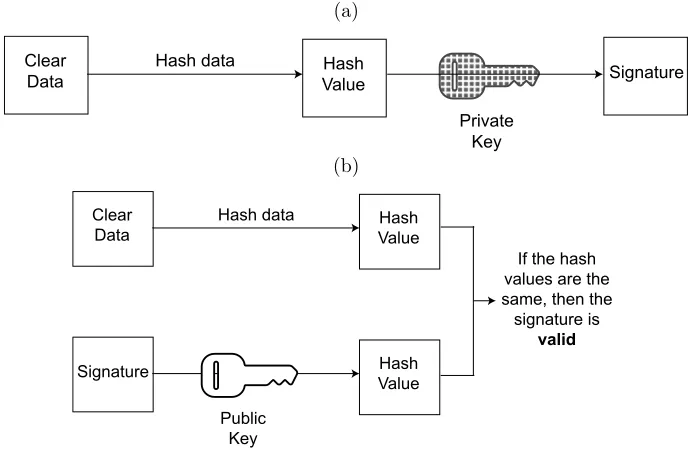
A digital signature is a type of cryptographic algorithm used to ensure authentication,
non-repudiation and integrity over some data [73, 74]. Authentication allows to determine
whether the originator of the data is really whom he/she claims to be; non-repudiation
![Figure 2.10: Clustered File System schematics, derived from [105].](https://thumb-us.123doks.com/thumbv2/123dok_us/9009330.397657/71.612.177.418.86.296/figure-clustered-file-schematics-derived.webp)
![Figure 3.1: (a) GFS architecture - diagram derived from [111]; (b) HDFS architecture - diagramderived from [138].](https://thumb-us.123doks.com/thumbv2/123dok_us/9009330.397657/81.612.89.507.109.636/figure-gfs-architecture-diagram-derived-hdfs-architecture-diagramderived.webp)