Pool Effects on Longitudinal Dispersion in Streams
and Rivers
Wei Zhang, Michel C. Boufadel
Department of Civil and Environmental Engineering, Temple University, Philadelphia, USA E-mail: [email protected]
Received September 6, 2010; revised September 13, 2010; accepted October 11, 2010
Abstract
Surface storage (pools, pockets, and stagnant areas caused by woody debris, bars etc) is very important to solute transport in streams as it attenuates the peak of a spill but releases the solute back to the stream over a long time. The latter results in long exposure time of biota. Pools as fundamental stream morphology unit are commonly found in streams with mixed bed materials in pool-riffle or pool-step sequences. Fitting the tran-sient storage model (TSM) to stream tracer test data may be problematic when pools present. A fully hydro-dynamic 2-D, depth averaged advection-dispersion solute transport numerical simulation study on hypo-thetical stream with pool reveals that a pool can sharply enhance longitudinal spreading, cause a lag in the plume travel-time and radically increase solute residence time in the stream. These effects fade like a “wake” as the solute plume moves downstream of the pool. Further, these effects are strongly influenced by a di-mensionless number derived from the 2-D transport equation − Q D W0 t orq Dt , which outlines the relative transverse mixing intensity of a stream or river, where, of the stream reach concerned, W is the flow width, Q0 is the volumetric flow rate, q is the longitudinal flux density, and Dt is the transverse turbulent dif-fusion coefficient. The breakthrough curves (BTCs) downstream of a pool may be “heavy tailed” which cannot be modeled accurately by the TSM. The internal transport and mixing condition (including the sec-ondary circulations) in a pool together with the pool’s dimension determine the pool’s storage effects espe-cially when >> 1. Results also suggest that the falling limb of a BTC more accurately characterizes the pool's storage because the corresponding solute has more chance to sample the entire storage area.
Keywords:Pool Effects, Solute Transport, Longitudinal Dispersion, Transient Storage, Open Channel
1. Introduction
River and stream pollution is a serious global problem. It threatens the health and well being of humans, plants and animals.
Generally, pollutants are introduced into rivers and stream via point sources and non-point sources. The former includes either various accidental spills, or delib-erate discharge of the effluent of wastewater treatment plant (WWTP) [1]. The latter refers to surface runoff which is recognized as a major source of pollutants to rivers and streams. The occurrence of pharmaceutically active chemicals (PACs) in the natural aquatic environ-ment is recognized as an emerging issue due to the po-tential adverse effects these compounds pose to aquatic life and humans. The study of the fate of these human and veterinary pharmaceuticals (also called
pharmaceu-ticals and personal care products (PPCPs)) has become an active investigation area [2,3], and the task as well as reducing the risk of various spills and mitigating the pollution cannot be done well without a good under-standing of solute transport in streams.
meanders, pool-riffle series etc.). The detained solute is released after the solute concentration peak in the main channel passes. It is a dynamic process because of the continuous exchange between the active channel and the storage zones. These storage zones may strongly affect not only the hydrologic transport but also the total solute dynamics, e.g., the mass loading of solutes from terres-trial and atmospheric sources, the physical transport of solutes within the watershed, and the transformation of solutes due to geochemical and biogeochemical reactions in the hyporheic zone [6].
Solute transport modeling started from Taylor’s [7] classical and pioneering work. The landmark contribu-tion of Fischer [8,9] and several researchers of his time significantly improve the simulation of longitudinal sol-ute transport in open channel flow. Although the one dimensional advection-dispersion model (ADM) has been successfully used in many applications in streams of relatively uniform channels, it is not very successful in reproducing the transport in natural streams [4,10,11]. Many field studies as well as lab experiments reported long tailed breakthrough curves [8-10,12], meaning the processes were far from Fickian. Thus ignoring the posi-tive skewness leads to overestimation of the peak con-centration and underestimation of the residence time of contaminants in the stream system.
To tackle the non-Fickian process due to transient storage, numerous models have been developed. One of the widely used models is the “dead zone” model [10, 11,13], which is also known as transient storage model (TSM) [14]. TSM is a significant improvement over ADM, but it cannot be easily used as a predictive tool, more of an interpretive tool of solute transport. This is because a data set may simulate a particular stream reach very closely, and may be of little or no value for predic-tion outside or even in sub-reaches inside of that reach [15]. The mechanisms that govern longitudinal solute transport in some situations (e.g. the presence of pools) are not well understood.
Ge and Boufadel [15] conducted parameter estimation of the TSM by fitting the breakthrough curves (BTCs) of tracer test data sets from 3 consecutive sub-reaches in Indian Creek, Philadelphia, USA [16]. Although the model was able to closely fit the breakthrough curves at the end of the second and third subreaches, there were no parameter values that allow fitting to the breakthrough curve at the end of the first subreach, which was around 85 m downstream of the injection point. In particular there was not a parameter set that fits both the peak and the tail of the observed BTC. Ge and Boufadel [15] at-tributed the poorness of the fits to the presence of a large pool inside the reach. The pool had a cross-sectional area of 1.8 m2 in its mid-section, but the channels before and
after the pool had cross-sectional areas of less than 0.5 m2. This abrupt enlargement of the channel caused
in-complete mixing that violates the in-complete mixing as-sumption of TSM.
Pools are commonly found in streams with mixed bed materials in pool-riffle or pool-step sequences [17,18]. Thus, knowledge of the effects of a pool – large surface storage – is indispensable to understanding longitudinal solute transport in open channels. It is particularly im-portant, for example, for the design of a constructed wetland to provide efficient supplemental treatment of the effluents of wastewater treatment plant (WWTP) in order to meet wildlife habitat goals [1]. However, not much attention has been paid to how a pool influences longitudinal solute transport in a stream.
We attempt to understand the role of a pool in a stream and its effects on solute transport by conducting numeri-cal experiments using a two-dimensional (depth-aver-aged) model, MIKE21 (www.dhigroup.com) in a hypo-thetical, but realistic stream configuration. We consider four scenarios. The base scenario is of rectilinear stream with no pool within it. The three other scenarios are of streams that contain a pool of width 2 W, 4 W, or 7 W, where W is the width of the rectilinear stream.
The layout of the paper is as follows: First we present the governing equations for depth averaged water flow and solute transport in streams. These are the most rig-orous equations for the two-dimensional problem. The equations are then rendered dimensionless using a unique non-dimensionalization approach, which would allow generalization of the results to a variety of stream sys-tems. We then investigate the following: 1) pool effects on longitudinal solute transport; 2) the transport and mixing processes inside a pool.
2. Methods
MIKE 21 is a software package developed by DHI Water & Environment [19]. It is applied to simulation of hy-draulics, water quality, tides, waves, and sediment trans- port in rivers, lakes, estuaries, bays, coastal areas and seas where stratification can be neglected. For our pur-pose, we will use MIKE21’s hydrodynamic (HD) and the advection-dispersion (AD) modules. The HD module solves the fully hydrodynamic 2-dimensional (i.e., depth averaged), free surface water flow equations. The AD module solves the two-dimensional equation for solute transport, which is the two-dimensional advection-dis- persion equation.
2.1. The Hydrodynamic (HD) Model
model in MIKE 21 [19] consist of the vertically inte-grated conservation of mass and momentum equations:
p q d
t x y t
(1)
2 2 2 2 2 ( ) ( ) 1 [ ( ) ( )]
( ) 0
xx xy
w
x a
w
p p pq
t x h y h
gp p q gh
x C h
h h
x y
h
q fVV p
x (2) 2 2 2 2 2 ( ) ( )
1 [ ( ) ( )]
( ) 0
yy xy
w
y a
w
q q pq
t y h x h
gq p q gh
y C h
h h
y x
h
p fVV p
y (3) Where,
(x,y,t) surface elevation [m]
p (x,y,t), q(x,y,t) flux densities in x and y directions [m3s-1m-1]; p(x,y,t) = u(x,y,t) × h(x,y,t); q(x,y,t) = v(x,y,t) × h(x,y,t); u(x,y.t), v(x,y,t) are depthaveraged velocities in x and y–directions [ms-1]
d(x,y,t) time varying streambed elevation [m] h(x,y,t) water depth [m], h = d
g acceleration due to gravity [ms-2]
C(x,t) Chezy resistance [m1/2s-1], C =nh1/6, n is the
manning number [m1/3s-1]
w density of water [kg m-3] x, y space coordinates[m] t time[s]
xx, xy, yy components of effective sheer stress
[kg m-1s-2] a
p (x,y,t) atmospheric pressure (kg/m/s2) f(V) wind friction factor
V,Vx,Vy(x,y,t) wind speed and components in x- y-direction (m/s)
Coriolis parameter, latitude dependent (s-1) Equation (1) is the mass conservation equation. It
states that the variation of the water mass in time (first term) is balanced by water flows in and out of a control volume along the stream (second term) and across the stream (third term). The right hand side term is zero in
our experiments, because we are assuming that the streambed elevation d(x,y,t) does not vary with time.
Equations (2) and (3) are the momentum equations. The
first terms in Equation (2) and (3) relate to the temporal
accelerations; the second and third terms are the spatial (or convective) acceleration terms; the fourth terms ac-count for the gravity force; the fifth terms represent the force due to friction with the streambed; the next two terms represent internal friction within the fluid due to fluid viscosity; the last three terms – the Coriolis force, wind stress, and atmospheric pressure gradient – are be-yond the scope of this study and will be omitted from this point on.
2.2. The Advection-Dispersion (AD) Model
The AD model simulates the transport of dissolved sub-stances subject to advection and dispersion processes [19]. It solves the advection-dispersion equation:
( ) ( ) ( )
( x ) ( y )
hc uhc vhc
t x y
c c
h D h D
x x y y
(4) Where,
c depth averaged solute concentration (arbitrary units) h (x,y,t) water depth [m]
Dx, Dy dispersion coefficients in the x, y directions,
respectively [m2s-1]
Equation (4) states that the variation of a conservative
solute mass with time (left hand side) is equal to the sol-ute flow in and out of the control volume due to convec-tion (first two terms on the right hand side) and disper-sion (the third and fourth terms on the right hand side) in the “2-D” space. The dispersion coefficients account for turbulent diffusion and the velocity shear that result from the variation of velocity in the vertical direction [20]. Dx, Dy are typically functions of space (x, y) but independent
of time.
2.3. Description the Hypothetical Streams
The main channel of each hypothetical stream was de-signed as a triangular cross-section and the pools were designed to have trapezoidal cross-sections with the same bank slope of 27% (Figure 1). There were four
stream-pool configurations: (a) Stream with no pool, (b) Stream with a 2 W pool, (c) Stream with a 4 W pool, and (d) Stream with a 7 W pool. Longitudinally, the streams had a uniform slope of 0.1%. All the pools were lo-cated at the same location (with the outlet at x = 59.4 m).
Table 1 contains additional stream details. Figure 2 is a
15º W
(a)
15º (2W)
(4 W) (7 W)
(b)
[image:4.595.140.457.57.219.2]Figure 1. (a) Triangular main channel cross-section; (b) Trapezoidal pool cross-section. (Hypothetical streams simulated: 1W (i.e. no pool), 2 W, 4 W, and 7 W. Where W (= 3.8 m) was flow width of the main channel.)
Table 1. Hypothetic stream property summary.
X Y
Z
flow direc
tion 2W
200 m
Figure 2. Hypothetical stream with a 2 W pool. (The lengths of pools were 2W for all. Where W (= 3.8 m) was flow width of the main channel. (Size Factor X: Y: Z = 2.69:1.00:6.19))
The width W was taken to be 3.8 m; the cross-sec-tional area of the flow was 0.938 m2, however, the
di-mensionless formulation that we developed (See Ap-pendix) ensures that our results apply to a wide range of
natural conditions. Simulations were presented as func-tion of the dimensionless group :
0
t
Q D W
(5)
where Q0 is the discharge, Dt is the transverse dispersion
coefficient, and Wis the flow width. Thus, represents the ratio of longitudinal convective transport to trans-verse dispersive transport. It has, thus, the significance of Design requirements Implementation channel properties
Steady state and transversely symmetric flow about thalweg Symmetric, uniform channel and pool, uniform slope
2-D flow−shallow flow condition W/h = 15.2 W = flow width; h = average flow depth
More realistic transverse velocity profile than rectangular channel Triangular cross-section
Markedly distinguishable storage effects among pools and broad range of As/A ratios Pools' dimension differ substantially
[image:4.595.62.529.293.603.2]a physical Peclet number. Large (>> 1) corresponds to high longitudinal mass transport by convection or weak transverse dispersion.
We selected four values of (0.27; 1.08; 3.00; and 5.41) for each geometric configuration. The range of is observed in natural streams/rivers. For example, Bear Creek, Colorado ( = 3.88); Nooksack River, Wash. ( = 4.17 and 3.77); Copper Creek, Va. ( = 5, 2.15 and 4.17); Powell River, Tenn. ( = 4.01); Conococheague Creek, Md. ( = 3.08).
2.4. Mike21 HD AD Model Set Up
A horizontal grid of 0.2 m × 0.2 m was used, which re-sulted in 19,000; 19,361; 20,083; and 21,166 blocks for the pool-stream configurations of no-pool, 2 W pool, 4 W pool, and 7W pool, respectively. Note that the length of the pools was always 2 W. A FORTRAN code was used to generate the digitized bathymetries.
In each simulation, the upstream boundary condition was set as a distributed flux, see Figure 3; the
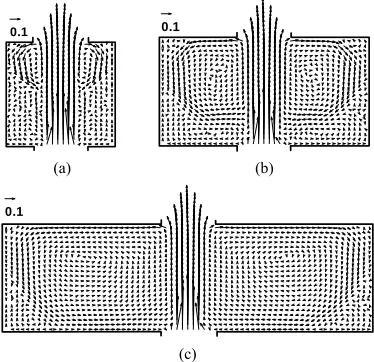
down-stream boundary condition was set as given water level equals to -0.2537 m. Small time steps were used to make the maximum Courant number, Cr, less than 1 [19]. The model was run until hydraulic steady state prior to injec-tion of the tracer. The hydrodynamics in the pools at steady state is reported in Figure 4.
y- dimensionless transverse distance
F
lux
d
e
nsi
ty
(m
3 /s
/m
)
0 0.2 0.4 0.6 0.8 1
[image:5.595.78.265.515.696.2]0.1 0.2 0.3
Figure 3. Upstream flux density boundary condition.
0.1
0.1
(a) (b)
0.1
(c)
Figure 4. Velocity distributions (vector plots) of the pool areas. (a) 2 W pool; (b) 4 W pool; (c) 7 W pool.
The injection location was at the upstream boundary. The dispersion coefficient was considered as isotropic, i.e. Dx Dy = D (a constant). In each simulation, a mass flux boundary condition of a conservative tracer was applied uniformly across the stream. The mass flux was equal to 164.3 mg/s; the injection lasted 16 seconds. The concentration at the source was 400 mg/m3.
Because of the restriction of the numerical platform we used - Mike 21 version 2005 and 2003, we were not able to simulate situations with vary bed resistance and turbulent diffusion coefficients especially in the pool. Although a more detailed two- (or perhaps three-) di-mensional analysis may be needed to get a complete de-lineation of pool effects, the results of this study provide an elementary but very important understanding of pool effects on longitudinal spreading in a stream or river. Simulations in this study were limited to the pulse-like injection only. Increase injection time will raise a pool’s exposure to solute cloud, and some of the reported re-sults herein will thus be changed in form. The focus of this study was the mechanisms that govern how a pool influences longitudinal solute transport, but not quanti-fying a pool’s storage, and so the injection adopted herein – a pulse-like input – is reasonable.
3. Results and Discussion
Two-dimensional breakthrough curves were obtained at cross-sections 2 W upstream of the pool, and 2 W, 10 W, 20 W and 30 W downstream of the pool. They were also obtained at the following transverse distances from the center axis: 0.0 W (stream center), 0.1 W, 0.2 W, 0.32 W, and 0.42 W, where W is the channel flow width. Note that the results were symmetric with respect to the chan-nel thalweg.
The 2-D BTCs were converted into 1-D BTCs by av-eraging arithmetically across the channel because the primary purpose of this paper was to study the longitu-dinal dispersion. The averaged BTCs were reported in groups according to the dimensionless number.
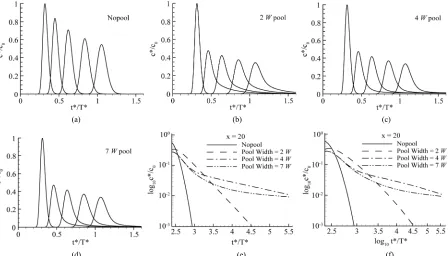
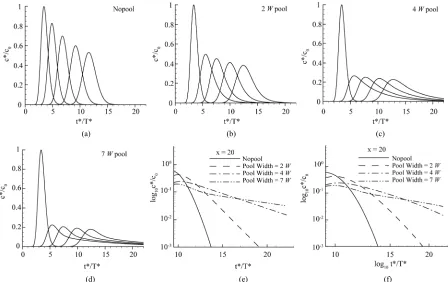
Figures 5 through 8 report the BTCs for all cases. As
there is too much information in the figures to zoom in while showing all the breakthrough curves, we focus on the following properties: The peak concentration, the time of the peak, the fall-off of the tail, and the mass stored in the pools.
3.1. The Attenuation of the Peak Concentration
(a) (b) (c)
[image:6.595.71.526.63.356.2](d) (e) (f)
Figure 5. Simulation results, ε = 5.41. (a) – (d) BTCs at 5 locations: from left, 2 W upstream of the pool, 2 W, 10 W, 20 W, and 30 W downstream of the 1 W, 2 W, 4 W, 7 W pool, respectively; (e) semi-log plot of the falling limbs; (f) log-log plot of the falling limbs, where W = 3.8m. c* is the tracer concentration [M/L-3]; c0 is the tracer concentration at 2 W upstream of the pool; t* is the time after injection [T]; T* = W*2/Dt, where W* is a characteristic length = W, Dt is the transverse dispersion coeffi-cient.
(a) (b) (c)
(d) (e) (f)
[image:6.595.77.525.426.682.2](a) (b) (c)
[image:7.595.79.516.60.351.2](d) (e) (f)
Figure 7. Simulation results, ε= 1.08. (a) – (d) BTCs at 5 locations (from left, 2 W upstream of the pool, 2 W, 10 W, 20 W, and 30 W downstream of the 1 W, 2 W, 4 W, 7 W pool, respectively); (e) semi-log plot of the falling limbs; (f) log-log plot of the falling limbs.
(a) (b) (c)
(d) (e) (f)
[image:7.595.75.523.402.684.2]For larger than 3.00, the peak values were the same regardless of the size of the pools. This is an important finding indicating that complete mixing of the solute in the pool did not take place (otherwise the 7 W pool would result in smaller peak), which is a common as-sumption in stream studies.
The effect of pool size became important at = 1.08 where the peaks of the 4 W and 7 W were less than those of the 2 W pool by about 15%. The case of = 1.08 is particularly interesting, as the peak value at the exit of the 2 W pool was larger than that obtained from other
values (namely = 3.00, 5.41). An explanation for this is related to dispersion in the axial direction. As we as-sumed that the two-dimensional transverse dispersion coefficient Dy is equal to the two-dimensional
longitudi-nal dispersion coefficient Dx, a decrease in results in
a decrease in both Dy and Dx. When = 5.41, this
means that transport by convection (in the longitudinal direction) is 5.41 times of the transport by dispersion in the longitudinal direction. When reaches the value of 1.08, this implies that transport by convection is compa-rable to that of dispersion in the longitudinal direction. This caused the rapid fill up of the 2 W pool with a high concentration in both the transverse and longitudinal direction, and resulted in a “spill” of high peak concen-tration at the exit in comparison with other values. For the 4 W and 7 W cases, the transverse dispersion was not able to fill the pools in the transverse direction before
the plume emerged out of the pool, as the length of the pools was 2 W. One might argue that the small values of
are theoretical. However, this has to be considered in the context of parameterization and scale. For example, if the pool’s bathymetry causes the water to move trans-versely (say to the presence of a gravel bar, a boulder, or a tree in the middle of the pool) then the “effective” transverse dispersion would be large. Of course, if one elects to model the details of water flow within the pool (i.e., transverse convection) then such an effective trans-verse dispersion disappears at the scale of the water pathways. But when treating the pool as a hydraulic unit, transverse convection would need to be treated as an effective transverse dispersion.
An important observation in Figure 9 is that the
[image:8.595.140.456.430.692.2]re-duction of the peak concentration with downstream dis-tance after the pools was mild in comparison with the rectilinear stream (i.e., no pool). This is due to the slow release of solutes from the pool which sustain the solute in the stream for long durations. Accounting for the presence of the pool is of extreme importance when dealing with actual spills (especially of hazardous mate-rial); if one were to measure the concentration at x = 2 W in a stream that has a pool, and if one were not aware of the presence of a pool, then one would expect a relatively large decrease in peak concentration going downstream, which would underestimate the impact on the environ-ment.
3.2. Lag of Concentration Peak
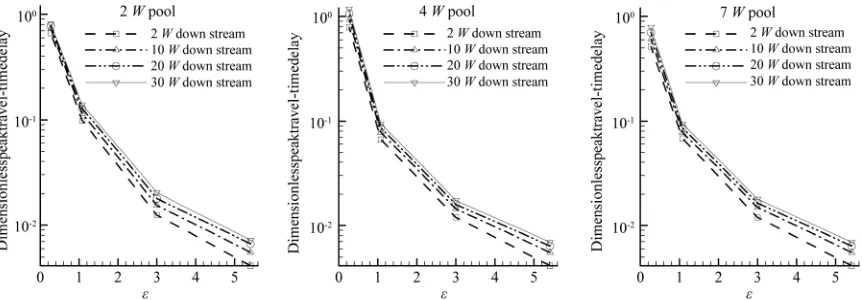
The pools delayed the concentration peak travel-time with respect to the no-pool case. As a matter of fact, the pools delayed the whole solute plumes. The delay was computed as:
( ) ( )
( )
P P
nw
P
t nWpool t nopool tD
t nopool
(6)
As shown in Figure 10, the delays increased sharply
with decreasing . At 2 W downstream of the pools and
= 0.27, the 2 W pool, 4 W pool, and 7 W pool caused delays of 13.6%, 16.1%, and 10.6% of the no-pool ref-erence travel-time. Notice that the 7 W pool caused less delay than the 2 W pool in this case. This inconsistency has something to do with the internal transport and mix-ing which is strongly affected by the secondary circula-tions in a pool. Table 2 and Figure 4(a) (b) (c) show that
the 2 W pool had the strongest secondary circulation and irregular flow pattern, which enhanced both transverse transport across the pool-channel interface and the transport and mixing inside the pool. The 7 W pool had the weakest current and well organized (smooth) flow pattern, which does not engender mixing; the 4 W pool’s behavior was intermediate. The difference of the secon-dary circulations together with pool size come into play in determining pool effects when relative transverse-
mixing intensity become strong enough (characterized by small e.g. = 0.27). This strong relative transverse- mixing ensures long enough effective contact time–the dimensionless time–to make the solute cloud sample the entire pool (deadzone).
[image:9.595.84.515.416.566.2]Then why the 2 W pool caused more peak travel-time delay than the 7 W pool? It is because the stronger inter-nal transport and mixing due to stronger secondary cir-culation made the 2 W pool “absorb” the cloud more efficiently than the 7 W pool as the “same” solute cloud passing by. However, the zero concentration gradient across the storage-active channel interface, or condition-ally “saturated” state of storage came earlier due to both the stronger internal transport and mixing and the much smaller storage capacity. Starting from the saturated state when the detained solute reached maximum, the 2 W pool began to “exude” solute from it; on the other hand, although the 7 W pool “absorbed” the solute plume not as efficiently, it maintained the “negative concentration gradient” which drove the solute into the pool for much longer time due to its much larger size and ended up with more solute absorbed in it than in the 2 W pool. The 4 W pool had stronger secondary circulation than the 7 W pool and much larger size than the 2 W pool, and hence held back the breakthrough most. Therefore, secondary circulation is another key factor influencing pool effects on longitudinal transport.
[image:9.595.82.516.610.723.2]Figure 10. Delay of dimensionless peak travel-time increased with decreasing .
Table 2. Speed distribution in pool areas.
Frequency, % Speed range (× 10-2 m/s)
2 W pool 4 W pool 7 W pool
0.0 < v ≤ 1.0 1.0 < v ≤ 2.0 2.0 < v ≤ 3.0 3.0 < v ≤ 4.0 4.0 < v ≤ 5.0 5.0 < v ≤ 6.0 6.0 < v ≤ 7.0 7.0 < v ≤ 8.2
45.79 20.10 6.82 4.43 6.02 5.91 7.5 3.41
39.50 21.32 11.79 9.21 9.40 6.39 1.25 1.14
47.37 19.62 11.58 11.60 6.46 0.86 1.83 0.68
Average pool speed (× 10-2 m/s)
The delay of the peak travel-time did not demonstrate signs of diminishing in our simulations. The travel-times increased linearly with distance.
Figure 11 reports the variation of mass stored in the
pool, Mp, as a function of time for various pool widths
and various epsilon values. As seen in Figure 11(a), (b),
maximum detained solute in the pools was affected by mainly, and pool size did not affect the entire accumu-lating and partial of the depleting processes; it is inter-esting that the turning point was around = 1.0 under these experiment conditions, and the maximum quantity of the accumulated solute was about 80% of the total injected in the 2 W pool ( Figure 11 (c)); Pool size came
into play regarding the accumulating and depleting proc-esses (Figure 11(d)). Notice that the pool area (the main
channel area (2 W × W) subtracted from the total “gross” pool area (2 W × n W, n = 2, 4, 7)) which we computed the accumulated solute mass is different from the dead-zone area (a cross-sectional area) defined by the TSM1,
but they seemed to be closely correlated.
3.3. The Skewness of the BTCs
The pools made the BTCs skew as well. A comparison of the BTCs in Figure 5(b), Figure 6(b), Figure 7(b), and Figure 8(b) indicates that the skewness or tails would
vanish (i.e., become Gaussian) with decreasing . Nev-ertheless, for a given as seen in Figure 8, the tracer
cloud would eventually become Gaussian which is clearly demonstrated in Table 3. Notice that the BTC
will not be strictly Gaussian due to longitudinal disper-sion occurs during the time taken for tracer cloud to pass a fixed sampling site [20].
The skewness g(x) is calculated as
3 0 0
( ) (1 ) ( ) ( , )
t t
g x m
t c x t dt (7) Where, m x0( ) 0 c x t dt( , )
is the total mass injected;0 0
( ) (1 ) ( , )
t x m tc x t dt
is the mean travel-time of the solute cloud; c(x,t) is the solute concentration in stream, x is the distance from a reference location and we
(a) (b)
(c) (d)
Figure 11. Solute accumulation in the pool areas.
Table 3. Skewness change of 2 W-pool stream (pool was located at x = 0).
x# -2 2 10 20 30
Skewness gt(x) 6.528E + 03 2.326E + 05 2.350E + 05 2.334E + 05 2.164E + 05
set the origin of x coordinate at the outlet of the pool, t is the time after a pulse injection. In Figure 12,
break-through curve A is approximately symmetric about μt1
because of no storage effects, so, 1 3 1
0 ( ) ( , )
t
t
t c x t dt
-1 3 1 ( ) ( , )t t t c x t dt
, and g xt( ) 0 ; Curve B skewsbecause of storage (e.g. a pool), so, t c xt dt t2( t ) ( , )
3 2
> t t c xt dt t ) ( , )
(
2
0
3 2
due to the radical increase of3
)
(tt and the gradual decrease of c(x,t), so, gt(x) > 0. The more skewed the BTC (the longer the tail2), the
greater the gt(x).
A pool keeps stretching a plume during its “passage”. If Lmax is the extent from the pool outlet to the location of
the plume front immediately after the plume “passes” the pool (i.e., c(0, )t is sufficiently close to zero to make the product ( )3
t
t · c(0, )t negligible), then Lmax
represents the plume’s maximum “stretch” caused by the pool, and g xt( ) reaches its maximum at x = Lmax.
Within 0 –Lmax, g xt( ) increases in the flow direction;
beyond x = Lmax, g xt( ) decreases, and the plume starts
to evolve to Gaussian [9]. Table 3 presents the
quantita-tive analysis result that clearly reveals the pattern of the skewness change. The skewness grew and then de-creased instead of increasing or decreasing monotoni-cally. We call this change pattern, together with the other two pool’s effects, “wake” effect just like the down-stream disturbed flow caused by the relative motion be-tween a solid body and a fluid. Obviously, Lmax (2 W
pool) << Lmax (4 W pool) <Lmax (7 W pool).
[image:11.595.74.278.565.650.2]Of the three-fold “wake” effect: concentration peak attenuation (longitudinal spreading acceleration), tailed BTC and delay of peak travel-time, peak travel-time de-lay is the only non-diminishing aspect. However, the cloud will become so spread out after sufficiently long distance downstream that the lag simply becomes trivial. Thus, in this respect, the “wake” fades, too.
Figure 12. Skewness gt(x) (third-order temporal
mo-ment). ( ) ( , ) 0
0
3
t t c xtdt
t
; ( )3( ,) 0
t cxtdt
t t
. t1, t2:
mean travel times of the plumes. Curve A, symmetric (no storage), )gt(x = 0; Curve B, skewed (due to storage),
) (x gt > 0.
For larger (Figure 5 and 6), the rising limbs did
not uniquely identify the pools, while the falling limbs especially the “late-time” behaviors discriminated from each other: virtually Gaussian for the no pool case; ex-ponential for the 2 W pool; the 4 W pool and 7 W pool show very slow decaying tails suggesting very long resi-dence time for some solute detained in these pools (see
Figure 5(e)(f)and Figure 6(e)(f)). With decreasing ,
the rising limbs more and more discriminated different pools. There seemed to be a turning point around = 1.08Figure 7). The differences of the BTCs among the 3
pools became evident after the turning point. The falling limbs especially the late-time transport behaviors dis-criminated noticeably: virtually Gaussian for the no pool case; exponential for the 2 W pool and the 4 W pool (see
Figure 7(e)); the 7 W pool showed very slow decaying
tails still (Figure 7(f)). For very small (Figure 8
(e)(f)), the BTCs of different pools distinguished from
each other significantly: while the BTC of the 2 W-pool stream maintaining exponential but approaching to Gaussian, the late-time behavior of the 4 W and the7 W pool inclined to exponential, and more and more dis-criminating rising limbs emerged. Although the simula-tion time of our results was not long enough to display the well established late-time behavior, we conjecture the BTC tails of surface storage, from a spectrum of a side pocket to a large artificial swamp, may vary from expo-nential to those match the typical hyporheic storages (e.g., lognormal, power-law). Solute corresponding to the rising limb especially the earlier time of the BTC may have less chance to sample the entire pool (deadzone) area than that corresponding to the falling limb of the BTC. Fitting the whole BTC to parameterize the TSM therefore leads to the problem addressed by Ge and Boufadel [15].
4. Conclusions
stor-age effects. It suggests that when >> 1 (that is the case for most natural streams/rivers), the falling limb bears more information about a pool (storage) than the rising limb.
5. Acknowledgements
Our sincere thanks to all those who have helped us in this work, directly or indirectly. Especially the authors would like to thank Dr. Robert J. Ryan for his help with im-proving the writing of the earlier version of this paper. This work was supported in part by a grant from the USDA PENR-2003-01280. Wei Zhang was partially supported by a Temple University Scholarship. No offi-cial endorsement should be inferred from the funding sources.
6. References
[1] S. H. Keefe, L. B. Barber, R. L. Runkel, J. N. Ryan, D. M. McKnight, and R. D. Wass, “Conservative and reactive solute transport in constructed wetlands,” Water Re-sources Research, Vol. 40, W01201, 2004, pp. 12. [2] J. G. M. Derksen, G. B. J. Rijs and R. H. Jongbloed,
“Diffuse Pollution of Surface Water by Pharmaceutical Products,” Water Science and Technology, Vol. 49, No. 3, pp. 213-221, 2004.
[3] M. Velicu and R. Suri, “Presence of steroid hormones and antibiotics in surface water of agricultural, suburban and mixed-use areas”, Environ Monit Assess, Vol. 154, 2009, pp. 349-359.
[4] H. B. Fisher, E J. List, R. C.Y. Koh, J. Imberger and N.H. Brooks, “Mixing in inland and coastal waters,” Academic Press, 1979.
[5] J. R. Webster and T. P. Ehrman, “Solute Dynamics,” In: F. R. Hauer and G. A. Lamberti, ed., Methods in Stream Ecology, Academic Press, Inc., San Diego, Calif., 1996, pp. 145 -160.
[6] R. Runkel, D. M. McKnight and H. Rajaram, “Modeling hyporheic zone processes”, Advance Water Resources, Vol. 26, No. 9, 2003, pp. 901-905.
[7] G.I. Taylor,“The dispersion of matter in turbulent flow through a pipe,” In: Proceedings of the Royal Society London Series A, Vol. 123, 1954, pp. 446-468.
[8] H.B. Fischer, “The Mechanics of Dispersion in Natural
Streams,” Journal Hydraulics Division Proceedings, ASCE, Vol. 93, No. 6, 1967, pp.187-216.
[9] H.B. Fischer, “Dispersion Predictions in Natural Streams,” Journal Sanitary Engineering Division, ASCE, Vol. 94, No. SA5,1968, pp. 927-943.
[10] E. L Thackston, and K. B Schnelle, “Predicting effects of dead zones on stream mixing”. Journal of the Sanitary Engineering Division. Proceeding of The American Soci-ety of Civil Engineering, Vol. 96, No. 2, 1970, pp. 319- 331.
[11] K. E. Bencala and R. A. Walters, “Simulation of solute transport in a mountain pool and riffle stream: a transient storage model,” Water Resources Research, Vol. 19, No. 3, 1983, pp. 718-724.
[12] C. F. Nordin and B. M. Troutman, 1980. “Longitudinal dispersion in rivers: the persistence of skewness in ob-served data,” Water Resources Research, Vol. 16, No. 1, 1980, pp.123-128.
[13] E. M. Valentine, and I. R. Wood, “Longitudinal disper-sion with dead zones”. Journal of the Hydraulics Dividisper-sion, Vol.103, No. HY9, 1977, pp. 975-991.
[14] R. L. Runkel, “One-dimensional transport with inflow and storage (OTIS): a solute transport model for streams and rivers (WRIR 98-4018),” US Geological Survey, Denver, CO 73 pp. 1998.
[15] Y.Ge and M. Boufadel, “Solute transport in multi-ple-reach experiments: Evaluation of parameters and re-liability of prediction,” Journal of Hydrology, Vol. 323, No. 1-4, May 2006, pp. 106-119.
[16] M. Gabriel, “The role of geomorphology in the transport of conservative solutes in streams. M.S. thesis, Temple University, Philadelphia, 2001.
[17] P. A. Carling and H.G. Orr, “Morphology of riffle-pool sequences in the river severn,” England. Earth Surface Processes and Landforms, Vol. 25, No. 4, 2000, pp. 369- 384.
[18] A.Chin, “The periodic nature of step-pool mountain streams,” American Journal of Science, Vol. 302, Febru-ary 2002. pp. 144-167.
[19] DHI Water and Environment, 2003. MIKE 21- Coastal Hydraulic and Oceanography(Hydrodynamic Module: Scientific Documentation; Advection-Dispersion Module: Scientific Documentation).

![Figure 9. Variation of the dimensionless peak concentration with dimensionless downstream distance, where cp is the peak concentration [ML-3]; c0 is the concentration at 2 W upstream of a pool [ML-3]; x* is the distance from a pool [L]; W* = W [L]](https://thumb-us.123doks.com/thumbv2/123dok_us/8988634.395708/8.595.140.456.430.692/variation-dimensionless-concentration-dimensionless-downstream-concentration-concentration-distance.webp)