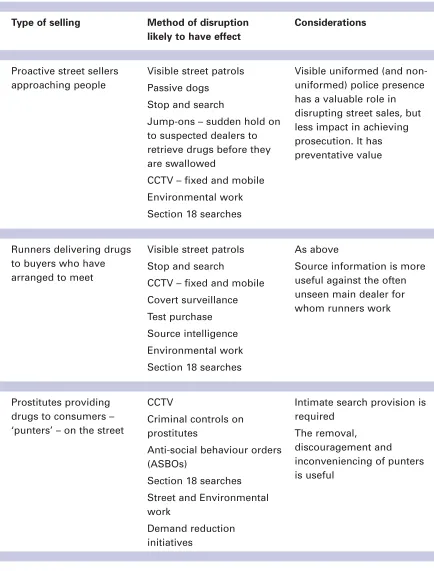
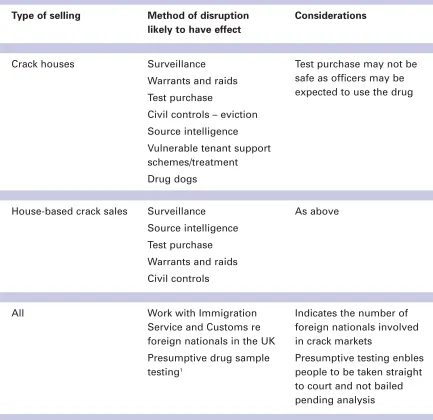
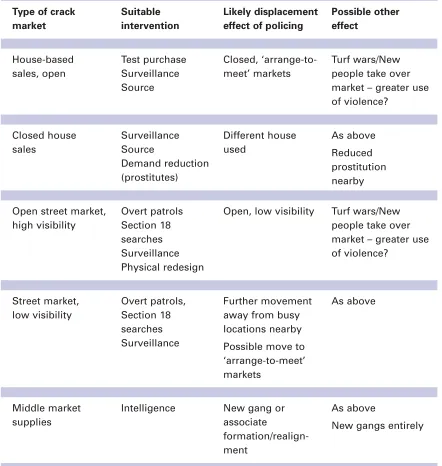
Disrupting crack markets
Robin Burgess of the Drug Strategy Directorate (DSD) at the Home Office wrote this guide, with help from Naomi Abigail, Michelle Lacriarde and Jacob Hawkins.
We should also like to thank colleagues, too numerous to mention individually, in law enforcement agencies – notably members of the Best practice in disrupting drug markets advisory groupwithin DSD – who contributed text and assisted with editing.
Sarah Muir, David Arnold and Diana Symonds are also thanked for their help.
Further copies of this guide can be obtained by police officers, other law enforcement officers, Drug Action Teams (DATs) and Crime and Disorder Reduction Partnership co-ordinators from Prolog on 0870 241 4680.
Home Office 2003
Who is this guide for?
•
Police•
Crime and Disorder ReductionPartnerships (CDRPs) and Drug Action Teams (DATs)
•
Law enforcement agenciesThe purpose of this guide is:
•
To offer practical suggestions to help the police and their partners disrupt crack markets•
To help the police and their partners understand how crack is sold and used, and how buying is financed•
To offer practical advice on mapping a crack market•
To offer advice on tactics that may help disrupt a crack market•
To offer advice on how to evaluate the success of police action•
To stimulate more action against crack markets using a variety of methodsDisrupting crack markets
Disrupting crack markets
Written for police and partnerships in England and Wales, this guide may also be applicable to situations in Scotland and Northern Ireland.
The guide will be supported by additional material produced by the Association of Chief Police Officers (ACPO) drugs business area. These publications will be produced during 2003 and should be used in conjunction with this guide.
Introduction vii
Where to find key themes – a quick guide viii
Section 1 How crack markets operate 1
1.1 How cocaine gets to the UK 1
1.2 How crack gets to street dealers 3
1.2.1 Shipped imports 3
1.2.2 Couriered imports 3
1.3 How middle markets operate 4
1.4 How street markets operate 4
1.4.1 Open street markets 5
1.4.2 Closed street markets 5
1.4.3 Crack houses 5
1.4.4 Crack dealers 6
1.5 Crack users 7
1.5.1 Combined crack and heroin users 7
1.5.2 Primary crack users 7
1.5.3 Race and ethnic status 8
1.6 Crime and crack use 8
1.6.1 Sex work 8
1.6.2 Other crime 9
Key learning points from section 1 9
Further reading 9
Section 2 Preparing for action against crack markets 10
2.1 Middle markets 10
2.1.1 Police intelligence 10
2.1.2 Non-police sources 10
2.2 Street markets 11
2.2.1 Police intelligence 11
2.2.2 Non-police professionals 14
2.3 Managing data streams and information 15
2.3.1 Compiling data 15
2.3.2 Intelligence handlers 16
2.3.3 Data protection 16
2.4 The team and its partners 16
2.5 Resident information and support 17
2.5.1 Groups that promote community engagement 18
Contents
2.6 Planning against community disorder 19
2.7 The media 20
Key learning points from section 2 20
Further reading 20
Section 3 Action to tackle markets 21
3.1 Work to stop cocaine getting to the UK 21
3.1.1 Producer countries 21
3.1.2 Transit countries 22
3.2 Disrupting middle markets 23
3.2.1 Identifying middle-market suppliers 23
3.2.2 Disruption tactics 23
3.2.3 Links with other forces and upstream agencies 24
3.2.4 Foreign nationals 24
3.2.5 Asset tracking and recovery 24
3.2.6 Multiple hits 25
3.3 Disrupting street-level markets 25
3.3.1 Witness intimidation 29
3.4 Disrupting open street markets 29
3.4.1 Aims of action 29
3.4.2 Outcomes 30
3.5 Disrupting crack houses 30
3.5.1 Action to prevent crack houses developing 30
3.5.2 Action against crack houses using criminal law 31
3.5.3 Closing a property using civil powers 33
3.5.4 Community action 36
3.6 Disrupting ‘arrange-to-meet’ markets 36
3.6.1 Methods of disruption 37
3.6.2 Considerations 37
3.7 Tackling crack-related crime 38
3.7.1 Acquisitive crime 39
3.7.2 Sex work and prostitution 39
3.8 Overcoming community conflict and hostility
in black minority ethnic areas 40
3.9 Displacement 44
3.9.1 Buffer zones 44
3.9.2 Benefits of displacement 45
3.9.3 Negative aspects of displacement 45
3.10 Reducing demand 45
3.10.1 Prostitutes 45
3.10.2 Buyers 47
3.10.3 High-risk groups 48
3.10.4 Reducing demand after enforcement action 48
3.10.5 Work with offenders at arrest and within the
criminal justice system 50
3.10.6 Reducing demand in an area marked by
excessive deprivation 52
Key learning points from section 3 53
Further reading 53
Section 4 Assessing the impact of police action
against crack markets 54
4.1 Aims of police action 54
4.1.1 Police and professional groups 54
4.1.2 The local community 54
4.2 Indicators of success 54
4.2.1 Outputs 54
4.2.2 Outcomes 56
4.2.3 Process indicators 57
4.3 Constructing the evaluation process 58
Key learning points from section 4 58
Conclusions 59
Introduction
The sale of crack is one of the most acuteproblems in policing. Uncontrolled crack markets have a propensity for violence and intimidation that affects whole
communities. The criminality associated with crack houses and street markets can be a profound bar to regeneration activities and can depress and further stigmatise deprived areas.
This guide shows how the police can work with partners to implement a range of actions that will reduce demand and control, shrink and close crack markets.
The guide is designed for those working within England and Wales, especially at street level. Whilst its primary audience is the police and law enforcement partners, it is also aimed at partners who assist them with local control and disruption strategies.
This guide does not suggest that disrupting supply is the only way of addressing crack problems in the UK. However, demand-reduction measures, such as treatment and education, are on their own unlikely to lead to the decline of drug markets in the short term. Enforcement tactics and the
disruption and reduction of opportunities to sell crack are an essential part of any local action to tackle crack problems.
Nevertheless, action to reduce demand should also be developed to support enforcement activity.
Drawing on best practice from the UK and beyond, this guide brings together tried and tested approaches to controlling crack markets. It builds on the hard work and commitment of the police and law enforcement and community workers everywhere to show that a body of effective work is emerging. Where possible, project examples are included.
Note:the problems of crack have been more acute in the United States than any other country. As a result the US has had more time and experience in managing the problem. US research literature has been reviewed and US experts have been consulted for relevant learning. However, differences in culture, patterns of crack use, demographics, and in the US criminal justice and police system, mean that not everything that has worked in the US can be easily applied in the UK nor with the same results. Where possible, this guide identifies and cites UK best practice.
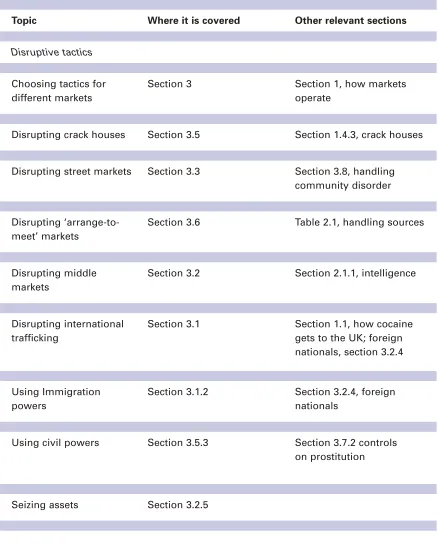
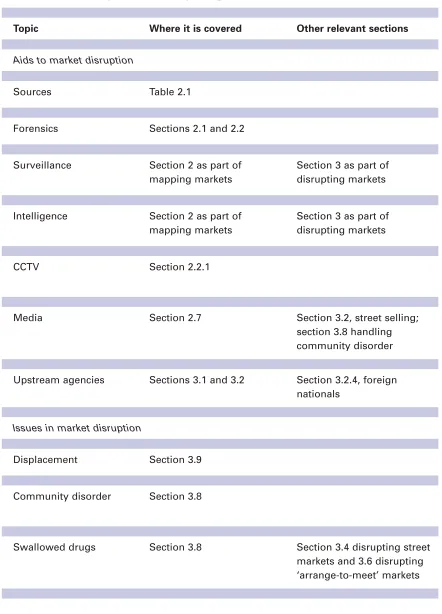
Where to find key themes – a quick guide
Topic Where it is covered Other relevant sections
Market dynamics
Section 3.3, handling
sources; 3.2, tackling middle markets; section 3.6,
tackling ‘arrange-to-meet’ markets
Section 2.4 Building police
intelligence
Section 3.5, disrupting crack houses
Section 2.3 Non-law enforcement
professional intelligence and information
Section 3.8, handling community conflict; section 4, measuring success using community feedback Section 2.2
Gaining community intelligence
Section 2.2 Mapping a market
Section 3, Project Linctus Section 2
Why is there a crack market in a particular area
Section 3.4, disrupting middle markets; and section 2.1.1, mapping
Section 1 How cocaine is turned
into crack for street sale
Section 3.2, specific market disruption tactics; and section 2 for how to gather information on markets Sections 1.3-1.4
How crack markets work
Disrupting international supply, section 3.1; foreign nationals, section 3.2.4 Section 1.1
How crack is produced and brought to the UK
Where to find key themes – a quick guide (continued)
Topic Where it is covered Other relevant sections
Disruptive tactics
Section 3.2.5 Seizing assets
Section 3.7.2 controls on prostitution Section 3.5.3
Using civil powers
Section 3.2.4, foreign nationals
Section 3.1.2 Using Immigration
powers
Section 1.1, how cocaine gets to the UK; foreign nationals, section 3.2.4 Section 3.1
Disrupting international trafficking
Section 2.1.1, intelligence Section 3.2
[image:9.595.80.518.115.662.2]Disrupting middle markets
Table 2.1, handling sources Section 3.6
Disrupting ‘arrange-to-meet’ markets
Section 3.8, handling community disorder Section 3.3
Disrupting street markets
Section 1.4.3, crack houses Section 3.5
Disrupting crack houses
Section 1, how markets operate
Section 3 Choosing tactics for
different markets
Where to find key themes – a quick guide (continued)
Topic Where it is covered Other relevant sections
Aids to market disruption
Issues in market disruption
Section 3.4 disrupting street markets and 3.6 disrupting ‘arrange-to-meet’ markets Section 3.8
Swallowed drugs
Section 3.8 Community disorder
Section 3.9 Displacement
Section 3.2.4, foreign nationals
Sections 3.1 and 3.2 Upstream agencies
Section 3.2, street selling; section 3.8 handling community disorder Section 2.7
Media
Section 2.2.1 CCTV
Section 3 as part of disrupting markets Section 2 as part of
mapping markets Intelligence
Section 3 as part of disrupting markets Section 2 as part of
mapping markets Surveillance
[image:10.595.78.520.107.721.2]Sections 2.1 and 2.2 Forensics
Table 2.1 Sources
Where to find key themes – a quick guide (continued)
Topic Where it is covered Other relevant sections
Related criminality
Reducing the demand for crack markets
Assessing the impact of crack market disruption
Section 2, gathering community intelligence Section 4
Matching indicators to the expectations of key stakeholders
Section 4 Distinguishing outputs,
outcomes and other indicators
Section 3.7.1, handling stolen goods
Section 3.10.5 Offenders
Section 3.10.1 Sex workers
Section 2.5, linking enforcement to other action in an area Section 3.10
All client groups
Section 3.7.1 Stolen goods
Trident case study, section 3.8
Section 3.7, Atrium case study
Tackling gun crime
Section 3.10, reducing demand and section 1.6.1 Section 3.7.2
Tackling sex work
Section 3.5.2 Bail
What is crack?
Crack is a smokeable form of cocaine. It is a white or cream wax-like solid, which is usually sold at street level in small lumps or ‘rocks’.
To produce crack, the following are needed:
•
Cocaine hydrochloride•
A heat source, such as a microwave or a hot plate of a cooker•
An alkali, such as ammonia solution or sodium bicarbonateThe most common way of producing crack is to dissolve the cocaine hydrochloride in hot water and then add the alkali. The water evaporates and the insoluble cocaine base settles as a clear or yellowish oil. On cooling, a solid mass is formed, and the liquid layer is discarded. This method produces a product which, apart from the presence of added cutting agents (for example lignocaine), will be free of sugars, salts or related substances.
The solid material can be ‘cracked’ out of the container and broken up into lumps or ‘rocks’ for distribution. The name crack may also be derived from the cracking sound that is made when rocks are smoked.
Smoking crack has euphoric effects, producing an intense but short lived – no more than half an hour – rush of pleasure. This is followed by an equally rapid come-down, or feeling of depression, which is followed by intense craving for the euphoric reaction.
Section 1
How crack markets operate
Section 1
How crack markets operate
1.1 How cocaine gets to
the UK
Crack sold in the UK is imported as cocaine and turned into crack by dealers (see box: What is crack?). Crack itself is rarely imported. Cocaine is produced mostly in Latin America, especially in Colombia, Peru and Bolivia.
Figure 1.1 (overleaf) shows the main routes by which cocaine is imported to the UK. The majority is shipped from producer countries via Spain, Portugal or countries in West Africa and then onto France, the Netherlands or Belgium, before arriving in the UK. Between 10 and 15% of all cocaine imported to the UK is brought in by
couriers travelling by air. A significant route for this method is via Jamaica. This
Section 1
[image:13.595.73.525.144.738.2]How crack markets operate
Figure 1.1 How cocaine gets to the UK
COLOMBIA CARIBBEAN
UK
BELGIUM AND THE NETHERLANDS
SPAIN
PERU
BOLIVIA
WEST AFRICA PORTUGAL
1.2 How crack gets to street
dealers
1.2.1 Shipped imports
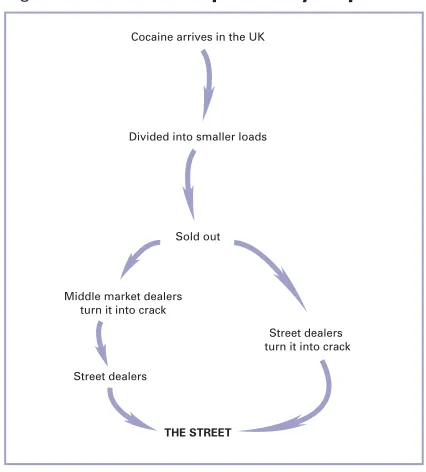
[image:14.595.305.518.108.346.2]Shipped cocaine is concealed and brought through UK ports or imported directly from small boats outside of points of customs presence. It is then divided into smaller loads and sold on to middle-market or level 2 suppliers who turn it into crack and sell it to lower-level street dealers (see box: Drug markets). Alternatively they sell the cocaine to level 1 street dealers, who then produce crack. In general middle-market suppliers are probably responsible for turning cocaine into crack in order to make greater profits.
Figure 1.2 Cocaine imported by ship
1.2.2 Couriered imports
Importers in transit countries recruit couriers who ingest condoms filled with cocaine and then fly to the UK. Couriers pass it onto local dealers or middle-market suppliers, who turn it into crack to sell directly to the street or to street dealers. Street dealers may be involved in direct importation and the chain from Jamaica to the street is very short (see box: Couriers).
Cocaine arrives in the UK
Divided into smaller loads
Sold out
THE STREET Middle market dealers
turn it into crack
Street dealers turn it into crack
Street dealers
Figure 1.3 Cocaine imported by air
Drug markets
The following levels are used to describe different crack markets and the people involved at these stages.
Level 1: Street markets: street dealers sell crack to users.
Level 2: Middle markets: middle-market suppliers buy from importers or brokers and sell on to street dealers.
Level 3: Import markets: importers or brokers are involved in large-scale importation of cocaine.
As explained in sections 1.3 and 1.4the difference between different levels is fluid. Street dealers may also act as middle-market suppliers or be directly involved in importation.
Cocaine arrives in the UK
THE STREET Middle market dealers
turn it into crack
Street dealers
Street dealers turn it into crack
Section 1
[image:14.595.78.291.344.580.2]1.3 How middle markets
operate
In large-scale importation, middle-market suppliers operate between street sellers and importers. However, the definition of a middle market is elastic. The boundaries between importers, middle-market suppliers and street dealers are quite fluid. Street dealers may sometimes replace the middle market and buy directly from importers.
In practice, middle-market suppliers can:
•
Be on the fringe of major importation•
Be actual importers•
Sell to street dealers or•
Sell directly to users themselves In direct importation via couriers, street dealers can replace the need for a middle market. Dealers, who may be foreign nationals themselves, may have contacts in Jamaica or other transit countries, who recruit couriers. Dealers meet them at the airport, retrieve the drugs and then sell them on the street. They may only supply their local area.Most middle-market suppliers handle and sell on quite small quantities of cocaine or
crack (certainly less than 5kg at most times, and sometimes less than 1kg), and a variety of other drugs. Their immediate distribution network may be over a wide area, but is unlikely to be a market monopoly for any area. Some middle-market suppliers may sell to a number of street dealers in any one city or area.
Violence may well accompany selling. The use of guns and other weapons is increasing. Violence is used to enforce debts, intimidate rivals and potential witnesses, and to punish those who challenge a supplier’s dominance. Middle-market suppliers can operate across a range of commodities (such as weapons and tobacco) and the volume of cocaine or crack they handle can vary. They may also be involved in other serious and organised crime.
1.4 How street markets
operate
Crack dealers then turn cocaine into crack immediately before the point-of-sale, sometimes in crack houses. They may operate open or closed markets.
Section 1
How crack markets operate
Couriers
Couriers are frequently Jamaican or other Caribbean Island citizens, but also can be UK nationals conducting a reverse trip, or nationals of other transit countries, notably Nigeria. A significant number of couriers are young women with dependent children.
Couriers are often poor, desperate and usually have no detailed knowledge of the complete operation. They may:
•
Not understand what they are doing•
Need the money•
Believe the penalties in the UK are very slight•
Not understand the risk to health•
Have a dependent relationship with thetrafficker
•
Understand the risk and the penalties and still want the money or the relationship with the dealer or traffickerThe risks they face include:
•
Violence and intimidation from dealers•
Condoms filled with cocaine bursting insidethem, which can be fatal
•
Legal action, which can result in high prison sentences to be served in the UK.It is too simple to regard them as always being innocent victims, although many will prove to be.
Increasingly dealers will not deal in crack alone but also sell other drugs. In the largest urban centres there is greater market
divergence with different dealers for crack and for heroin. In out of city centre estates, or in smaller cities, dealers will supply both heroin and crack, sometimes in ‘pick and mix’ bags, as users often use both drugs.
1.4.1 Open street markets
An openmarket is one where a dealer will sell to anyone. Open markets can be:
•
On the street, where several street dealers can congregate offering drugs or waiting to be approached•
Off the street, at premises which can be approached by anyone. These can be crack houses or clubs, cafés and pubsStreet markets for drugs are the most vulnerable to the simplest enforcement tactics. As a result they are in decline. Nonetheless they are very damaging to neighbourhoods where they still exist.
Street markets usually occur in the public entrances to buildings such as bus, tube or train stations, or in other semi-enclosed settings. Such markets often operate where the behaviour of dealers can be absorbed into larger crowds or groups using those premises, or where buyers are abundant. For this reason they are usually located in busy urban and inner city areas where dealers and users can try to blend in with the crowd, or where there are lots of transient, homeless people or prostitutes.
Some street sellers may carry out some other function or work, which is why they are present on the street – for example prostitutes or people who are begging.
Street sellers may well carry crack in their mouths and swallow it when apprehended. They will not usually carry large quantities of crack, but will store drugs to hand, regularly topping up their supplies. Hiding places might be a nearby flat, or even abandoned furniture in the street.
Some prostitutes selling drugs or acting as runners may have the drug concealed in various orifices and may require intimate searches if apprehended. The procedure for carrying out an intimate search is prescribed in the Codes of Practice in the Police and Criminal Evidence Act 1984.
Open street selling and crack houses (see below) are likely to have the most visual, perceptual and crime impact on a
community.
1.4.2 Closed street markets
A closedmarket is one where a dealer will only sell to users who are known or introduced to them. Closed markets can be:
•
On the street, at meetings arranged via mobile phones•
Off the street, at premises from which drugs are sold only to known orintroduced users, but which are not places where users can stay and consume
•
Crack houses, which only admitintroduced buyers, where users can also use, and from which other goods and services, such as sex, can often be obtained
1.4.3 Crack houses
Apart from open street selling (see above), crack houses are likely to have the most impact on a community.
Crack is sold from a wide range of buildings, which can be residential, uninhabited or semi-derelict. A building from which crack is sold can be open or closed, but it is likely that a degree of control over who is
admitted is applied so that only users known or introduced are allowed in.
The term crack house is used as a catch-all term to describe a range of properties from which drugs are sold. Someone who sells crack from their house to a closed group of people is not really operating a crack house.
Table 1.1 shows some of the features of
crack houses. Section 1
1.4.4 Crack dealers
There is no straightforward profile of a crack dealer but in general terms there is a distinction between those who sell crack as one of several commodities to poly-drug users and those who sell just crack to primary crack users (see section 1.5 for descriptions of different kinds of crack users).
Primary crack dealers (dealers who mainly or only sell crack) may well use crack themselves but at times of acute and binge use are unlikely to be fully capable of dealing successfully. Some may not be users at all, even if their runners, cookers (those who turn cocaine into crack) or enforcers are.
All crack dealers are likely to use excessive violence to patrol their patch, compete with other sellers and intimidate witnesses and users, especially people who owe money. Crack dealers are:
•
More likely to use violence, guns and other weapons than dealers of other drugs – some of this aggression arises from using crack•
Sometimes involved in other crime including:•
pimping, where drugs are used to subdue and make prostitutes compliant (see sections 1.6 and 3.7.2on crack and sex work);•
handling stolen goods;•
gun crime associated with supply; and•
acquisitive crimeSection 1
[image:17.595.82.513.114.496.2]How crack markets operate
Table 1.1 Features of crack houses
Attributes Ownership and tenancy Users
Users may be able to stay for extended periods, even days or weeks, in the house, using drugs and obtaining other services, such as commercial sex
Prostitutes often act as introducers for new buyers Crack houses are often
rented or social housing premises (housing association or local authority)
The crack dealer may have forced the rightful tenant to use the house (see box: People whose houses are taken over for crack supply)
The house may be illegally sub-let. The rightful tenant may not be present and has not been forced to allow the house to become a crack house
The house may be a privately rented property where the owner is absent and has no knowledge of who is occupying the premises
There are controls at the door and security controlling access
Other services such as gas and electricity may be cut off and then illegally supplied
They are often occupied for a short time until enforcement catches up with them
1.5 Crack users
Crack users do not all exhibit the same traits and behaviours. It should be stressed that many users will not exhibit the level of problem behaviour described below, especially where crack is only one of several drugs used or if their use is more occasional.
1.5.1 Combined crack and heroin users
Some – possibly the majority of crack users – have dual dependencies on both crack and heroin. Their crack consumption is usually less than primary crack users (see below) and the heroin can actually tone
down the stimulant or aggressive effects of crack. However, research suggests that those using crack and heroin together will have the highest level of expenditure on drugs and be most likely to be involved in acquisitive crime (Sondhi et al, 2002).
1.5.2 Primary crack users
Primary crack users consume only or mainly crack and tend to have peaks and troughs of acute binge use. Crack use does not cause the same kind of pattern of effect and long-term dependency as heroin. Short-long-term crack use may have little immediate impact
on a user’s behaviour but as their Section 1
How crack markets operate
People whose houses are taken over for crack supply
It is difficult to categorise these people. Undoubtedly dealers use intimidation to force people into letting them use their properties. This coercion can range from relationships where one person is slightly stronger and more persuasive than the other, right through to bullying, extreme violence and cruelty.
Typically people whose houses have been taken over will have at least one of the following:
•
Crack or other drug problems•
Mental health problems•
Drink problems•
Learning difficulties or are likely to be:•
Elderly•
Young women, often single parents, who have some dependency on the dealer•
ProstitutesThe tenant may know the crack dealer well. They may buy from them, use crack with them or have an ongoing or previous sexual
relationship with them, for example, the tenant may have children by the dealer although the main relationship may have ended.
The dealer may gradually spend more time at the residence until eventually they run the house. The tenant may go along with what is happening and may believe that they get something out of it, such as sex, drugs, money or association with powerful people. Ultimately they are powerless and not in control. They may be just irritated by the situation rather than afraid or concerned. They may have personal histories of minor crime, be users themselves or be prostitutes, and may not be morally opposed to what is going on.
In other cases the tenant is gradually seduced into using their property. They may be
vulnerable and the dealer or his associates (prostitutes for example) may be seen initially as friends; only later do they realise they have been duped and are now completely
powerless.
Careful assessment of the role of the
residential tenant or occupier in properties used as crack houses is useful in planning action and in the phase after arrests and closure have been made.
consumption of the drug increases, their acute dependency and need may become more chaotic and desperate. A severely dependent crack user can have acute periods of almost constant craving where normal restraints on their behaviour are relaxed. At the height of a binge, they may be buying crack almost 24 hours a day for several days or even weeks. However, at other times they show little obvious signs of dependency, sometimes going several weeks between purchases.
Primary crack users can exhibit violence, lack of control and occasional psychotic episodes. Most of these episodes cease if crack use is stopped but for some,
problems will persist and may require psychiatric treatment. Neither violence nor mental illness will be present for many users with greater control over their use.
1.5.3 Race and ethnic status
The vast majority of crack users in the UK are white. Many of those who use crack in the white community combine their use with other drugs, such as heroin.
Research shows that African–Caribbean communities use crack at the same level or slightly above that of white and Asian communities. It is not clear what
percentage of primary crack users are black compared to white users. However, unlike white users, African–Caribbean users are much less likely to use heroin.
Asian communities use all drugs less than white communities. The Asian community shows limited evidence to date of
involvement in selling or using, but data on Asian crack use is weaker than that for any other group. Whilst there are few trading links direct from the cocaine producer countries to Asian communities in the UK (which there are for heroin) the patterns of deprivation in some Asian communities provide the environment that could engender the growth of crack problems.
All studies of the use of different drugs by different racial groups are to some degree inaccurate. There is, however, convincing evidence that crack use is disproportionately more damaging and prevalent in
African–Caribbean communities, within cities in which the majority of crack users will still be white (Sangster et al 2002).
This is often because African–Caribbean communities are more likely to be located in the poorest and most deprived inner city neighbourhoods, where some types of crack markets are more likely to be located. Because of the trading links to Jamaica, a percentage of sellers are of Jamaican origin or are themselves Jamaican. However, this does not mean that most or all sellers are African–Caribbean.
See section 3.8Overcoming community conflict and hostility in black minority ethnic (BME) areas.
1.6 Crime and crack use
1.6.1 Sex work
There is a strong association between crack and sex work. Some of the reasons are:
•
Pimps often sell crack•
Crack leaves no track marks and less visible signs of drug use which could put off punters and those who run off-street prostitution•
Sex work provides enough financial return to enable crack to be bought•
Crack helps prostitutes to cope as it is a stimulant drug and reduces inhibitionsSee section 3.7.2on sex work and
prostitution and section 3.10.1on reducing demand from prostitutes.
Section 1
1.6.2 Other crime
Crack users who commit crimes to support their habit, other than sex work, are most likely to be involved in shoplifting and other acquisitive crime. See section 3.7.1on acquisitive crime.
Key learning points from
section 1
•
Crack is trafficked mostly by sea with smaller amounts carried by couriers travelling by air•
Crack is produced close to the street in fairly small amounts which means that the market is dynamic and can respond to change quickly•
Crack is sold on the street, from crack houses and by arrangement via mobile phone•
Crack dealers are particularly aggressive and violent and likely to engage in gun crime•
Crack dependent users may not have long-term dependencies but peaks and troughs of acute binge use•
There is a strong association between crack and sex markets•
Crack has been disproportionately harmful to African–Caribbean communities, but most crack users are whiteFurther reading
General studies of markets, including crack: Jacobs, B.A., 1999. “Crack to Heroin? Drug Markets and Transition”, British Journal of Criminology 39:4, pp. 289-294
On middle markets: Hobbs, D., and Pearson, G., 2001. “Middle Market Drug Distribution”, Home Office Research Study 227, London: Home Office Research, Development and Statistics Directorate
On sex markets and drugs: May, T.,
Edmunds, M. and Hough, M., 1999. “Street Business: The Links Between Sex and Drug Markets”, Police Research Series 118, London: Home Office Policing and Reducing Crime Unit
On market location and relationship to poverty: Lupton, R. et al, 2002. “A rock and a hard place: drug markets in deprived neighbourhoods”, Home Office Research Study 240, London: Home Office Research, Development and Statistics Directorate
On crack houses: UK: Evans, R., 2002. “Rural Crackdown: What a Rural Force is Doing to Tackle the Menace of Crack
Cocaine”, Police Review, 05/07/02, pp.18-19 US: Geter, R.S., 1994. “Drug User Setting: A Crack House Typology”, International Journal of the Addictions, 29:8, pp. 10-15 On race and crack: Sangster, D., Shiner, M., Patel, K. and Sheikh, N. (2002). “Delivering drug services to Black and minority ethnic communities”, London: Home Office On offending and crack: Sondhi, A., O'Shea, J. and Williams, T., 2002. “Emerging Findings from the National Arrest Referral Monitoring and Evaluation Programme”, DPAS Paper 18, London: Home Office
Section 1
This section describes the preparation that is needed before action can be taken to disrupt crack markets. This preparation includes: gathering and handling data to understand and map crack markets; putting together a team and partners to plan operations; and engaging with local communities.
2.1 Middle markets
The first stage of preparation means understanding the crack market that you want to act against. The key features of middle markets are described in
section 1.3. Middle-market suppliers can operate across force boundaries, or just within the boundary of a Basic Command Unit (BCU). They can handle kilo loads or a few grammes. Middle markets can only be fully understood through:
•
Enforcement activity and intelligence•
Information supplied by informants or convicted dealers operating at middle-market level2.1.1 Police intelligence
Police intelligence and information should be gathered: during investigations; during ongoing beat policing;during the course of an operation through debriefs of arrestees at the lower, middle or upper levels; and post conviction where convicted dealers may be prepared to co-operate in
describing general market patterns or agree to become sources.
The key sources of police intelligence for middle markets are:
•
Covert Human Intelligence Sources (CHIS)•
Street dealers who buy from middle-market dealers•
Importers who sell to middle-market dealers•
Middle-market dealers•
CouriersOutreach workers and users can usually contribute very little information and almost no concrete intelligence to help police and upstream agencies working at middle-market level. Any knowledge provided by users gets progressively weaker the higher the level of the dealer.
Data should also be routinely sought and held from those detained or interviewed at level 1. Such data must flow up from level 1 sources.
2.1.2 Non-police sources
Upstream agencies
Data from upstream agencies such as Customs, NCIS and NCS can contribute to understanding the relationship between level 3 brokers and level 2 suppliers. This requires formal and informal links with these agencies. These can be facilitated through attachments, secondments etc. Regular sessions where Customs spend time with CID, or where police spend a period at airports or ports, help to build trust and are opportunities for exchange of information.
Drug agencies
Regional data from drug agencies can help track trading routes and provide general trend analysis.
Section 2
Preparing for action against crack markets
Section 2
2.2 Street markets
The key features of street markets are described in section 1.4. Intelligence to understand street markets and to assist operations can come from a much wider set of sources than for middle markets. There is generally more background information about the market that can be used rather than having to rely on police intelligence as the main data source. This extra information is essential for the visual mapping of crack hotspots.
2.2.1 Police intelligence
Beat officers and sector teams can supply relevant information about local markets, sellers, users and buyers, from observation, their local sources and investigating other crimes. It is essential to ensure that all staff are aware of the need for all suitable sources of data to be channelled into the intelligence picture.
Database systems, such as the West Midlands Police Flints system, can put this map together, but it requires the data to
Predicting the number of crack users in an area and the pattern of demand
The size of the community of users is a determining factor in determining the size of the local market. It is difficult to assess the numbers of crack users as in any given area there will be dual-drug crack users and primary crack users. The number of active street prostitutes is one crucial sub-section of these communities. Drug agency data or intelligence may help clarify the size of the user market, its location and its demography, but it is likely that the problem will be underestimated.
Demand for crack is very often a 24-hour process and those involved in selling, using or finding the money to buy crack will work round the clock. The presence of a 24-hour sex market is a very strong indicator of the size of the local crack scene.
have been acquired in the first place. It can't be stressed enough how important it is to acquire intelligence during the course of interviewing and source handling. Intelligence at this level can help
strategically develop operations against suppliers at all levels.
Users and dealers
Most of the published studies of markets have been structured on individual interviews and discussion between
researchers and dealers. Asking users how a market works and how they buy is essential. Some will become sources or CHIS (see box: Handling users as sources on p 12).
Dealerscan provide the best picture, especially those prepared to act as covert human intelligence sources. Information obtained routinely as part of interviews and debriefs with arrested dealers and those connected with them should be collated to help police identify a map and set of relationships between different sellers.
Users, who may have been arrested for other acquisitive crimes, can identify dealing locations even if they will not name dealers or be prepared to act as sources. It is essential that data is taken about their drug use and where they have obtained drugs. These data sources form an
important pool of data for market analysis. Information must be taken at the time of arrest and recorded properly.
Surveillance– covert or overt – can identify street-level sellers and the patterns of selling.
Forensic analysis of seizures– Forensic analysis of drugs or adulterants and packaging can add to the understanding of drug markets and middle-market trafficking routes. Chemical drug profiling, as it becomes more widely available, offers potential to trace supply routes and to link drug dealers. Currently, this is most developed for heroin; however it can also
be considered for cocaine and crack. Section 2
Price and puritydata can be useful in estimating market size and levels of dealers arrested. The higher the purity of the drugs held by a dealer, the closer they are to the top of the chain. This may also illustrate general local availability. Lower prices indicate a higher availability of crack and cocaine.
Returns on seized drugs should be made to NCIS and to Forensic Services who can supply regional and national pictures.
CCTVcan identify street dealing.
Upstream agency datamay complement police data on street markets, although mostly it will be useful for middle-market disruption.
Local sources, including anonymous phone lines, can provide intelligence about
individual sellers, and especially locations, such as crack houses, at an early stage in their establishment. All of this relies upon public engagement. However, experience has shown that local anonymous phone lines are only effective for a short amount of time following intensive publicity. Some forces already have agreements with Crimestoppers who are well established and can generate the necessary publicity. It is advisable for the police to work in partnership with them.
Section 2
[image:23.595.77.527.151.439.2]Preparing for action against crack markets
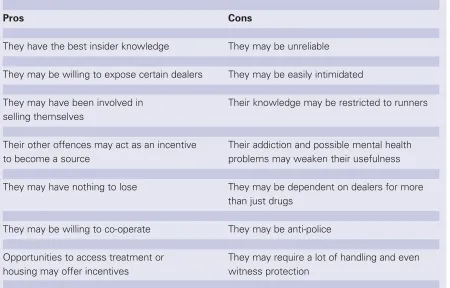
Table 2.1 Handling users as sources
Users of crack should be able to contribute good information about how drugs are sold generally and how individuals sell their drugs. However, there are pros and cons which are summarised here.
Pros Cons
They have the best insider knowledge They may be unreliable
They may be willing to expose certain dealers They may be easily intimidated
They may have been involved in Their knowledge may be restricted to runners selling themselves
Their other offences may act as an incentive Their addiction and possible mental health to become a source problems may weaken their usefulness
They may have nothing to lose They may be dependent on dealers for more than just drugs
They may be willing to co-operate They may be anti-police
Opportunities to access treatment or They may require a lot of handling and even housing may offer incentives witness protection
Section 2
Preparing for action against crack markets
Understanding the environment of crack markets: the problem-solving approach
A problem-solving approach analyses the links between the buyer, seller, drug and location to find out:
• How crack is sold
• Who is buying
• Where it is sold
• The reasons why it is able to survive in this location
This kind of analysis needs specialist skills. Non-uniform environmental officers could provide this analysis as operations kick in.
Example
Residents report that drugs are being sold at a street junction of a main road and a side street. Cars arrive and a person comes to meet them. An exchange is made without the buyer leaving their car. The seller only appears when the car pulls up and the car does not have to wait long. The purchase always happens on one side of the junction in the side street rather than on the main road. This is illustrated below.
From this information, the following questions can be answered:
How is this selling being arranged?
Almost certainly the buyer is calling the seller or an accomplice's mobile phone. The buyer is directed to this corner. The seller is either in a residential property or a pub, café or club nearby. If selling occurs
for short periods of time, they may just be hanging around in the street or have a vehicle nearby.
What circumstances make this sales point attractive?
The buyer can arrive by car and doesn't have to get out. Transaction time is limited which reduces hassle to both buyer and seller. The side street probably offers less open surveillance, such as from CCTV cameras on the main road, and may have less lighting. There may be trees or awnings or bushes that obscure CCTV filming there.
The site is:
• Poorly observable
• Has little hassle factor for buyer and seller
• Is a partly closed selling point – people have to know the number
• Used by hard-to-track buyers, contacting the seller by mobile phone
Further questions need to be asked to show how street dealing relates to its environment. Selling stands out more in certain neighbourhoods. Selling happens when there is a market in an area where crack can be sold with minimal impact on the people or businesses living and working nearby. If they are affected, they are more likely to make reports about drug-related activity, which means more likelihood of disruption. Questions to be answered include:
Who is buying?
• What does observation tell us about the buyers?
• What race, age, class, cultural and gender group do they fall into to? Can this be identified?
• How do they know the number to ring?
• Are they known drug users?
• Is there a pattern of crime associated with these buyers?
• Are they local or travelling there to buy? What impact does this have on the environment?
• Does the main road have shops or businesses and if so how busy are these?
• Are they open at night?
• Is selling done when they are open?
• Is it a 24-hour selling point? Are local people walking by?
• Is it mainly residential property nearby?
• Is there drug debris?
• Is sex sold commercially nearby, on or off street?
• Do only a small percentage of local businesses or residents report that dealing is taking place or is it widely reported?
• Why do they not report? Are they unaware or do they not care?
Pub
Section 2
Preparing for action against crack markets
CASE STUDY
Bristol’s Drug Markets: A Market Snapshot (March 2002)
Previous reports concluded that Bristol had a ‘free’ drugs market, in that there were enough users to allow new dealers to begin dealing unopposed and unnoticed. However, the report Bristol’s Drug Markets: A Market Snapshot(March 2002) showed that the current market structure in Bristol is more complex. As well as a ‘free’ market, there are separate ‘closed’ and ‘open’ markets.
The ‘free’ market
In general, drugs sales in pubs and clubs to ‘recreational’ drug users are part of the ‘free’ market. Users buy their drugs from friends or from known or untried dealers. The price will vary according to the location and how well the buyer knows the seller, with regular customers expecting to pay less.
The ‘closed’ market
The ‘closed’ market mostly supplies ‘problematic’ users, principally with heroin and crack. Typically, this type of market is controlled and defended by established dealers. In general, the drugs supplied through a ‘closed’ market are sold only to known or introduced users. Closed markets are therefore difficult to combat through test purchase operations.
With the exception of the three district sectors of Ashley, Cabot and Lawrence Hill,
the whole of Bristol could be described as a ‘closed’ market, or more accurately a series of ‘closed’ markets with drugs being sourced by local dealers and then sold on to the local drug user population. Local dealers obtain about 20% of their drugs from outside Bristol, including London, Birmingham or Manchester. However, around 80% is
sourced from the ‘open’ market in the centre of Bristol, where drugs can be obtained conveniently and easily, and at a very low price.
The ‘open’ market
Bristol’s ‘open’ market is located in Ashley, Cabot and Lawrence Hill, with its centre around the St Paul’s area and is controlled by intimidation, violence and fear. It is responsible for supplying heroin and crack, not just to local dealers and users, but also to a large area of the South West and South Wales, making the centre of Bristol the drug hypermarket for the region. As well as supplying 80% of the heroin and crack consumed in Bristol, it is estimated that it also supplies 70% of the heroin and crack used in the Avon and Somerset force area, roughly 30% of both drugs used in
Gloucestershire, Wiltshire and southern Wales, and 25% of both used in Devon and Cornwall. The supply to Dorset is thought to be via Wiltshire. The market is estimated to have a customer base of 12,500
Other local tradespeople, such as shopkeepers, taxi drivers and others active on the street, can be sources of information. Some may play key roles to support dealing, such as taxi firms, who may transport dealers or drugs.
2.2.2 Non-police professionals
However, agencies that provide a helping service to drug users (particularly those from Health backgrounds) may be unwilling to co-operate in providing sensitive data about individuals. There are good reasons for this and they are more likely to have data on users rather than dealers. Work to motivate them to co-operate will require long-term discussion and negotiation. There is no reason why data exchange cannot be agreed once cultural opposition has been overcome. From a data protection perspective, data can be cleaned of its personal indicators and discussion restricted to more general information. For more information on data protection see section 2.3.3below.
Housing organisationsare one of the best sources for identifying street markets. They can provide information about crack houses and pass on reports about drug-related antisocial behaviour; resident suspicion about neighbours or people hanging around their properties, who may be selling crack at prearranged meetings; and information about where sex markets operate.
See section 2.3for how to manage data from these various sources.
2.3 Managing data streams
and information
Information and intelligence about drug markets flows from many sources. Once gathered, intelligence needs specific handling and organisation to ensure that it flows and informs action.
2.3.1 Compiling data
Linking different police intelligence can sometimes be a problem. Systems are needed to process, store and link data to map and understand the nature of crack markets.
The key requirement is for intelligence handling capacity. Ideally this should be placed within the local BCU and not solely
at beat level. Local data handling capacity Section 2
Preparing for action against crack markets
‘problematic’ users of Class A drugs. Bristol itself has around 4,500 ‘problematic’ users, or roughly 1% of the city’s population, which is in line with the national average.
The rapid growth in Bristol’s open market appears to have come about as a result of drugs being readily available at low prices rather than a deliberate strategy by suppliers. However, intelligence suggests that the open market is reaching saturation point, and there have been clear signs of groups attempting to expand their markets to other cities in this region. This can weaken their presence in an area and encourage other groups to attempt to take their current market share, which in turn can lead to violent clashes.
Policing policies in operation within the area of Bristol’s open market, including an emphasis on community liaison, are directly responsible for reducing levels of violence. However, drug-related violence can always potentially increase if groups begin
competing for territory in response to market saturation.
Assessing the physical environment where selling occurs is essential for the police to understand and continue to plan their response to Bristol’s crack markets.
is essential, but it must be closely linked to and compatible with Force Intelligence Bureau (FIB) level capacity. This resource should be able to handle intelligence and supporting information from many sources, not just the police.
Once gathered, data should be capable of being displayed in various formats, including map-based systems (such as GIS) showing incident concentration and location which can help plan interventions from various partners. These formats do not release sensitive information, so that they can be shared beyond police circles.
The intelligence picture should also be compatible with broader force-wide intelligence and upstream requirements. The NCIS may have a key role in compiling regional or indeed local intelligence
pictures and threat assessments, especially at level 2 within the National Intelligence Model. Their database on price and Forensic Science Services (FSS) data on purity are useful sources for market understanding. These products should be readily available and included in any market analysis or report produced for planning purposes.
2.3.2 Intelligence handlers
Intelligence handlers need not be police officers but need the right skills, aptitude and outlook. They must know how to scan multiple data sources and specific police crime databases and be able to follow leads.
2.3.3 Data protection
There are data protection issues when using data from other agencies. There are various ways that data from potentially sensitive sources can be gathered that does not breach data protection protocols. A useful Home Office guide available from the Government office for the East Midlands Home Office team (tel 0115 971 2733) sets outs these methods. For
example, certain data cleaning software can strip data of its sensitive elements but retain its usefulness for intelligence purposes.
2.4 The team and its partners
Tackling crack supply is fundamentally a police matter, supported by partners who complement police activity by gathering additional data, using civil powers or reducing demand.
How the team is put together is a local organisational decision. The police skills needed in any team might include:
•
Intelligence handling and assembly•
Communications skills•
Community liaison•
Financial investigation•
Problem solving•
Crime environment analysis•
Undercover skills and credibility (for test purchase)•
Equipment handling skills (for surveillance)Not all of these are going to be available at BCU level and capacity may need to be brought in from force-wide or specialist units.
The following non-police skills will also be required:
•
Housing management•
Management of antisocial behaviour•
Outreach and detached work, especially with young people•
Arrest referral skills for arrested users Partners who may also contribute include:•
Neighbourhood or Community wardens•
Traffic wardens•
Caretakers•
Housing management staff and their legal teamsSection 2
2.5 Resident information and
support
Involving residents is not just about gathering intelligence; it is the cornerstone of effective practice against drug markets. Local people need a sense of being engaged in policing and other action against crack markets. This helps deal with potential resistance and disorder that can ensue from drugs raids. It is essential to engage the trust of residents and provide multiple channels of communication for them to use.
Reasons why local people may not trust the police with information include:
•
A belief that the police will not respond to or prioritise calls from their area•
A hostility to the police arising from local norms and values, some of which may be cultural•
Fear of reprisal from dealers•
A culture of not grassing•
Not knowing how to pass on information These attitudes can be addressed in the following ways:•
Putting the request for information through local people who are trusted by the community•
Creating confidence with high-profile, communicated action•
Providing witness protection•
Educating young people in schools to overcome local norms and values in the case of serious crime•
Ensuring the police are visibly working in Section 2Preparing for action against crack markets
CASE STUDY
The Metropolitan Police’s ‘Rat on a Rat’ campaign was relaunched in 2001. The advertising campaign, which supports Operation Crackdown – the Met’s anti-drug initiative, followed a similar drive in 1999, which caught the public’s imagination and helped generate more than 2,000 calls to the Crimestoppers unit at New Scotland Yard.
The information gathered from the advertising campaign assists operational activity in targeting drug dealers and those who supply dealers.
The Rat on a Rat message was displayed on perimeter fence panels at football stadia, in football programmes and on roadside poster sites. The message was displayed in
washrooms in pubs and clubs, and also on beermats. Local press, ethnic press and radio stations were also targeted by the campaign.
Calls received led to 300 arrests and the recovery of £27,144,491 worth of drugs.
RAT
ON A
RAT
DRUG DEALERS RUIN LIVES.the community manner. They should have extensive local contacts, visibility and track record of delivery, providing local services for young people, local police stations and openness to local people
•
Making anonymous telephone lines available•
Having identifiable senior officers (who are expected to stay in the post for the long term) who will participate in the community in public meetings and hold surgeries with community groups2.5.1 Groups that promote community engagement
Citizens’ juries
A citizens’ jury is a panel of local residents set up to comment on local policies and how the police or other bodies go about their work.
For: They can help organisations such as the police to communicate what they are doing and can make residents feel involved. They can help assess performance, for example, juries can give feedback on the
effectiveness of police or local authority work – see Newark case study.
Against: They may not help prepare the ground for acceptance of how market operations work. They can be cumbersome, expensive and time consuming.
Residents panels
For: Face-to-face consulting can build real trust and confidence.
Against: The group involved may not be representative, or be out of touch with the real community. They may be seen as the usual great and good who always get asked. Panels do not engage the community as a whole.
Outreach work
For: Outreach work reaches hard to reach groups such as users and young people. It is visible and engages people.
Against: It is costly and there are personal safety issues for researchers.
Section 2
Preparing for action against crack markets
CASE STUDY
This case study provides a possible template for community engagement, which can be used for a variety of community issues, including crack.
On Thursday 25 May 2002, the Newark and Sherwood District Council Waste Management Team were in the dock answering questions about recycling, street cleaning and rubbish collection. This was the first of a series of Citizens’ Juries to be held this year as part of a fundamental review of the services the Council delivers to people in the District.
The Waste Management and Transport Manager led the proceedings by introducing the service and gave factual and statistical information. The 12 volunteers on the jury
were a cross section of members of the public and other representatives including a Parish Council Clerk, District Councillors, a representative from Keep Britain Tidy, contractors involved in delivery, an officer from another Council and representatives of service users.
After a thorough questioning session in the morning, the jury discussed their
recommendations for the service. After a full hour of deliberation, members of the jury had agreed a total of 19 recommendations and presented these to the Waste
2.6 Planning against
community disorder
In the crack context, the potential for violent disorder as a reaction to police action is a very real prospect. This is particularly the case where the right community liaison has not taken place and there is not widespread confidence and support in the community for policing.
There should be capacity for impact analysis to identify:
•
Specific triggers for disorder•
Specific locations where reaction might be centred•
Particular individuals or groups who might be central to any activity•
Any groups who may choose to incite activity – for example, the BNPSection 2
Preparing for action against crack markets
Integrating police action with other initiatives (with example)
A neighbourhood with a crack market is a neighbourhood with other social problems. The following example shows why police action needs to be planned alongside the work of other local regeneration strategies that help neighbourhoods to overcome wider social problems.
Kirkside (fictional name) is a deprived outercity estate with a large unemployed young
population who come from families who have not worked in two generations. Policing is difficult, as resident confidence in them is low. Burglary and joy riding, alongside general disorder, antisocial behaviour and vandalism are rife.
Much of the housing managed by the council is in poor condition and the estate has a high number of teenage single parents. There are few local community or youth facilities.
Kirkside has a thriving drug scene, with houses occasionally used as crack houses but most drugs are sold by runners (some as young as 11) at pre-arranged meets, organised by mobile phone. Sellers and buyers are both resident on the estate.
Police intelligence could soon identify the sellers. Test purchase could gather evidence, backed by covert surveillance. Operations could be mounted against dealers’ houses to seize drugs and other stolen goods, weapons and money.
Questions that should be asked:
•
What DAT plans are there for extended treatment services for the estate? When will they take effect? How could they support the police operation?•
What GP prescribing or shared care schemes are there in development?•
What is the local authority doing aboutcommunity facilities, housing improvement, local street lighting, CCTV in the shopping centre, youth clubs etc?
•
Are there any plans for estate re-design or demolition that will affect the places drugs are sold in?•
Are there any plans for housing allocation policy changes?These and other factors need to be considered when planning operations.
In practice good community liaison should enable local community representatives to understand that there is a need for local action, and that it may happen at any time. When it does occur, they should have an overview of the likely tactics and types of intervention that may be applied. For example, when street crack sellers hold drugs in their mouths, they have to be held and the drugs manually released (see box: Handling crack-related risk of disorder, p.45). Local communities are much less likely to react if they understand the purpose of a range of police tactics. It is unlikely that this groundwork will affect the effectiveness of a specific operation or give away its time and location.
2.7 The media
A proactive media strategy is useful in tackling any form of crack market, for the following reasons:
•
It encourages a belief in the community that something is being done•
It stimulates community intelligence•
It reassures elected members•
It helps destabilise dealers•
It offsets later media criticism and labelling•
It helps reduce involvement in using drugs as well as selling•
It creates a negative impact of dealing and offsets negative role models•
It helps communicate the reason for certain tacticsFor these reasons any major initiative should be supported from the start with an active media campaign. Press officers should be fully involved at an early stage.
Key learning points from
section 2
Preparation for action to tackle crack markets requires:
•
Market mapping using a problem-solving approach, which identifies how drugs are sold and analyses the factors that sustain and support that method of selling•
Capacity and systems for handling and mapping multi-agency information•
Team capacity with a wide range of police and non-police skills•
Working in the context of broader, multi-agency approaches to tackling the problems of an area•
Neighbourhood community consultationFurther reading
On how to map markets:
www.crimereduction.gov.uk/toolkits/im00.htm
www.crimereduction.gov.uk/toolkits3/dr/ dr030202.htm
Further resources for planning and engaging communities:
“Winning the Race: Embracing Diversity: Consolidation of Police Community and Race Relations”, H.O. Publications, 2000
Data report from East Midlands: “Data Exchange and Crime Analysis for Crime and Disorder Partnerships”, H.O. Guide, 2002
Section 2
The previous sections have focused on the dynamics of crack markets and how action against these can be planned. This section looks at action that the police can then take and the practical difficulties involved in tackling crack markets of different types. It also looks at the role of partners who can help with demand reduction or use civil powers to disrupt crack markets.
3.1 Work to stop cocaine
getting to the UK
The routes by which cocaine is imported to the UK and converted into crack are summarised in section 1.1. The UK Government supports and assists with work along this route to:
•
Reduce the production of cocaine in the producer countries•
Disrupt trafficking along the routes of transmission, including through handling countries•
Intercept drugs and traffickers at UK ports of entryThe Concerted Inter-Agency Drug Action group (CIDA) brings together the key law enforcement agencies to devise work across these aims.
Cocaine is produced in any quantity in only three countries in the world: Bolivia, Colombia and Peru. Cocaine is imported to the UK and turned into crack just above street level – seesection 1for details of this process. Action against cocaine is concentrated on producer and transit countries.
3.1.1 Producer countries
Action to tackle the growing of coca (the plant from which cocaine is produced) includes:
•
Offering alternatives to growers to encourage them to grow other crops•
Development aid to communities which produce coca, to reduce incentives and the desperation that encourages the growing of coca for conversion to cocaine•
Destroying cropsOther disruption involves infiltrating gangs involved in producing cocaine and intercepting their supplies before they reach ports or airstrips. Much of this action is carried out by the army and police of Bolivia, Colombia and Peru, with assistance and support from the UK and especially the US governments. The UK secret service and Customs staff are deployed to gather intelligence on supplier gangs to help local customs to intercept at points of export; and more specifically, to intercept cargoes after they have left the producer countries.
Drugs pass through many hands on their way to the UK. Therefore intelligence gathered on importers in Colombia is useful to upstream agencies – the Security Services, Customs and the NCS – but it is of less value to police operating in the UK, because there is such a remote relationship to the people selling on the street. Police in the UK will interview people who have only recently acquired the drug, probably from someone else who bought the drug, either as users or dealers, within the UK itself. The UK police have little reason to engage in dialogue or co-operation with their
Bolivian, Peruvian or Colombian colleagues Section 3
Action to tackle markets
Section 3
as they have very little to share. However, it is a different matter when it comes to transit countries.
3.1.2 Transit countries
About 40 tonnes of cocaine are thought to be targeted for the UK annually. The majority is trafficked in bulk shipments brought by sea to the European mainland, then brought through the channel ports. A much smaller percentage goes through transit countries – mainly Jamaica and West African countries, especially Nigeria.
We do not know exactly what percentage of the cocaine that is turned into crack in the UK comes from either the Jamaican or the European route. It is almost certain, however, that the majority comes via the European route, but it is only the latter stages of this supply chain that may become known to the local police through interviews of arrestees. However, there is clearly scope for close work with Dutch or Belgian law enforcement colleagues.
A complicating factor is the presence of Jamaican dealers in the UK. Whilst
Jamaicans are overly represented amongst street dealers in the UK, especially in the south of England, this does not mean they are selling crack derived from cocaine that was trafficked via Jamaica.
Working with the Jamaican authorities
Cocaine trafficked through Jamaica has a short supply chain. Street sellers may have close connections with those who organise couriers. Therefore action to disrupt
trafficking from Jamaica is of much more relevance to police in the UK than action to disrupt trafficking from producer countries.
There is scope for communication,
intelligence sharing and joint work between the Jamaican authorities and the police in the UK. Through this, UK police forces can gather valuable intelligence on specific dealers who may be involved in transit countries.
The UK authorities work closely with their Jamaican counterparts to train them in disruption and interception and screening out couriers at airports. This involves a variety of strategies, including:
•
Ionscan, which detects cocaine on the skin and belongings•
Borderguard, a computerised passport identification service linking international Customs records•
Baggage X-ray facilities•
Educational campaigns to raise awareness of the UK penalties for smuggling, aimed at would-be couriersThese strategies act as a deterrent as traffickers are much less likely to get their cargo through.
UK police can also:
•
Attach officers to UK or Jamaican airports, identifying shared targets•
Liaise with Jamaican police and organise exchange visits•
Help with trainingWorking with upstream agencies
Police data about crack trafficked through Jamaica is of value to upstream agencies and vice versa. For example, foreign nationals detained by police at level 1 should be carefully interviewed for the data they hold on importing routes. The supply chain may be shorter or more flexible, so that local police and upstream agencies may be pursuing the same or closely related targets. There is a clear requirement for close co-operation between domestic forces and their colleagues in National Crime Squad and Customs, actively supported or delivered through NCIS.
In areas of Britain where direct importers are located – predominantly London, Kent and Merseyside – there is co-operation on a routine basis between forces and upstream agencies dealing with these organised gangs, as local forces can gather information about their operations. This highlights the vital need to manage
Section 3
intelligence well throughout all levels of policing.
3.2 Disrupting middle markets
Disrupting crack markets that operate above street level is essentially about system