Accepted manuscript version of the article:
Ullsperger, M. & Danielmeier, C. (2016): Reducing speed and sight: how adaptive is post-error slowing? Neuron, 89(3), 430-432.
Reducing speed and sight: how adaptive is post-error slowing?
Markus Ullsperger1,2,3, Claudia Danielmeier4
1. Institute of Psychology, Otto von Guericke University Magdeburg, 39106 Magdeburg, Germany
2. Center for Behavioral Brain Sciences, 39106 Magdeburg, Germany
3. Donders Institute for Brain, Cognition and Behaviour, Radboud University Nijmegen, 6525 HR
Nijmegen, Netherlands
4. School of Psychology, University of Nottingham, Nottingham NG7 2RD, UK
Corresponding author:
Prof. Dr. Markus Ullsperger
Otto von Guericke University Magdeburg Universitätsplatz 2, 39106 Magdeburg, Germany phone: +49 (0)391 / 67 18475
fax: +49 (0)391 / 67 11947
email: [email protected]
Abstract
After a mistake people often slow down their subsequent actions. This post-error slowing (PES) (Rabbitt, 1966) has been found for various cognitive activities, such as reaction time tasks, lexical decisions, and typewriting. Is it adaptive to slow down after errors? It would, if it reflected a more cautious response mode providing the basis for more accurate behavior in forthcoming trials (Ridderinkhof et al., 2004). In line with this assumption, theories of cognitive control suggest that after errors motor responses are inhibited, for example by raising the threshold that motor cortex activity needs to exceed to elicit an overt action (Botvinick et al., 2001). Such speed-accuracy tradeoff would entail higher accuracy (i.e., lower error likelihood) on post-error trials. However, only a few studies have shown associations of PES with increased post-error accuracy. Often post-error changes in accuracy and reaction time were uncoupled or even in opposition (see Ullsperger et al., 2014, for a review), which is incompatible with a speed-accuracy account.
Purcell and Kiani (Purcell and Kiani, 2016) have addressed this issue in experiments in humans and monkeys performing a perceptual decision task. Participants had to make a saccade according to the perceived predominant motion direction of moving dots. After feedback indicating an error, reaction times in the following trial were prolonged while accuracy did not change; in other words, both species showed PES that cannot be attributed to a simple speed-accuracy tradeoff. Drift-diffusion models (DDM) which accumulate and integrate noisy evidence toward decision bounds have successfully explained behavioral and neuronal data in multiple perceptual decision-making studies. By fitting a DDM to the data the authors found that PES can be explained by a combination of an increased decision bound and a reduction of the accumulator’s sensitivity to perceptual information. The reduced sensitivity thus counteracted the to-be-expected increase in accuracy associated with raised decision bounds. Based on the behavioral data alone, one cannot distinguish different potential causes for the observed changes in decision bound and sensitivity. Recordings of single-neuron activity in the monkey’s lateral intraparietal cortex (LIP), a region known to host single-neurons whose firing dynamics represent evidence-accumulation-to-bound decision signals related to saccades, were used to further specify the mechanisms of PES. LIP responses showed typical ramp-like increases of firing rates when monkeys chose to fixate the target in the neuron’s response field. Interestingly, the static features of the ramp, particularly firing at start and end point, did not differ between post-error and post-correct trials; rather the dynamics of the ramp itself changed. Again, this could be explained best by two contributing factors: a stimulus-independent decrease in urgency and a stimulus-dependent decrease in sensitivity. Thus, instead of a static decision bound, an
urgency signal appears to lead to a stimulus-independent increase of firing as time of evidence accumulation progresses. This urgency signal, which in DDMs can also be interpreted as a collapse of the boundaries with increasing time, was weaker on post-error trials, which in turn explains the slowing. Whether the assumption of an urgency signal can be generalized to other contexts and to decision making in humans has been a matter of debate (Hawkins et al., 2015). The second factor influencing the ramping dynamics in monkey LIP neurons, the decrease of sensitivity to sensory information, could be attributed to a lower evidence signal received by the accumulator rather than increased noise in the accumulator itself.
Thus, in perceptual decision making, PES could not be explained by a mere motor inhibition process but it also entails at least transiently reduced sensitivity to task-relevant sensory evidence. The study therefore answers the question whether PES is adaptive with both a ‘yes’ and a ‘no’. While the decrease in perceptual sensitivity is not adaptive for the task at hand (but could still provide an advantage, see below), the change in decision bound seems to be adaptive. Nevertheless, the data speak against the general assumption that PES serves the prevention of future errors.
crucial components of the decision-making process at a single-neuron level. Important questions for future research are whether the decrease in sensitivity to sensory information generalizes to
‘classical’ response conflict tasks and what would then be the equivalent brain area to LIP. Another aspect of PES that has been shown in the perceptual decision making task by Purcell and Kiani as well as in response conflict tasks in humans is that PES decreases with increasing time between the erroneous response and the subsequent response (Ullsperger et al., 2014; see Fig. 1). With more systematic investigations future studies could reveal in more detail for how long the change in response threshold lasts.
The current study by Purcell and Kiani provides novel and important insights into the mechanisms of PES. But how are the changes in boundary/urgency and sensitivity implemented neurobiologically? Previous work in manual tasks has demonstrated that error monitoring signals in the posterior medial frontal cortex correlate with subsequent PES and with reduced hemodynamic signals in the hand area of primary motor cortex (Ullsperger et al., 2014). Transcranial magnetic stimulation suggests reduced corticospinal excitability on post-error trials (Amengual et al., 2013). Functional and structural connectivity analyses as well as intracranial recordings suggest that activity in a network triangulating the presupplementary motor area, the right inferior frontal gyrus, and the subthalamic nucleus drives PES (Siegert et al., 2014; Ullsperger et al., 2014; Wessel et al., 2015). This network has been associated previously with general motor inhibition and boundary shifts in decision making (Aron et al., 2014; Bogacz et al., 2010). Whether this network could also modulate urgency signals as found in the present study in LIP neurons remains to be established.
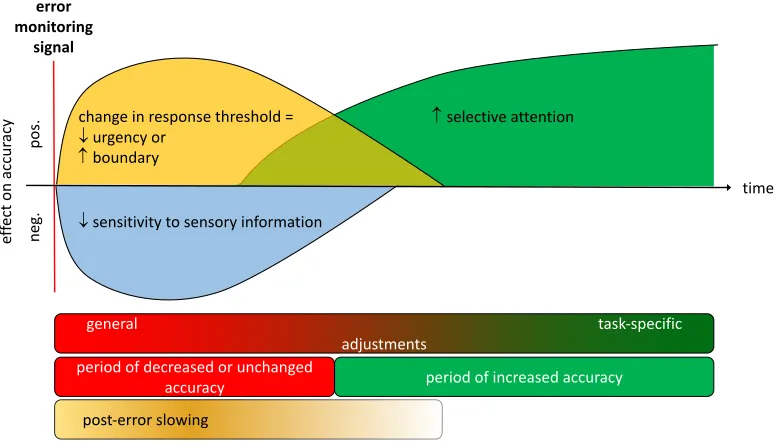
Interestingly, PES seems to be part of a more general phenomenon: an orienting reflex elicited by unexpected events of potential motivational impact (Notebaert et al., 2009), not only errors but also surprising task-irrelevant action outcomes (Wessel et al., 2015). Besides slowing of reactions, the orienting reflex entails an increase in arousal reflected in activity of the locus ceruleus and the autonomic nervous system. Resulting noradrenaline release in the cortex has been suggested to induce a »reset« “by interrupting existing functional networks and facilitating the emergence of new ones” (Sara and Bouret, 2012; p. 135) which allows disengagement of selective attention from its previous focus and subsequent (re)orientation to relevant sensory input. We speculate that this mechanism could explain the reduction in sensitivity of evidence accumulation in LIP to sensory input reported by Purcell and Kiani. Such a general arousal effect disengaging selective attention may also explain the somewhat surprising time course of task-specific post-error attentional adjustments: after errors resulting from distraction, adaptive increases of selective attention to task-relevant sensory input were found only two or more trials after the error, whereas disengagement from task-irrelevant (distracting) inputs seemed to occur immediately (Danielmeier et al., 2015). Thus, we suggest that an orienting reflex, comprising reduced perceptual sensitivity and motor inhibition, immediately follows an error, and only later task-specific adjustments, like increases in selective attention, are implemented (Figure 1). While the orienting reflex is linked to noradrenaline release, a subsequent increase in selective attention depends on cholinergic modulations in task-relevant sensory brain areas (Danielmeier et al., 2015). However, these assumptions as well as specific time courses of these processes need to be tested in future experiments.
Whether or not the impact of the orienting reflex on the accumulator’s sensitivity is adaptive or maldapative depends on the task context and the event that elicits the orienting reflex. For the evaluation whether an unexpected external event is potentially threatening, disengagement from the task at hand and orienting are highly adaptive. Only for errors in activities requiring to keep attention focused to repetitively occurring specific stimuli in a reduced environment, transient disengagement of selective attention from task-relevant input followed by re-engagement appears to be maladaptive. Notably, these activities have become substantially more common with the development of modern technology.
Purcell and Kiani have introduced a new perspective on early post-error adjustments that call for revisions of standard models of cognitive control and new exciting experiments.
Figure 1.
Hypothetical time course of post-error adjustments affecting the accuracy of evidence accumulation positively (plotted upwards) and negatively (plotted downwards). Errors detected by the
performance monitoring system presumably elicit an orienting reflex that entails early general adjustments reflected in a reduced sensitivity and increased decision boundaries/decreased urgency. Task-specific increases of selective attention appear to take effect later, sometimes only several trials after the error. This time course predicts that with short inter-trial intervals, post-error slowing is strong and associated with reduced or unchanged accuracy.
time error
monitoring signal
¯sensitivity to sensory information change in response threshold =
¯urgency or
boundary
selective attention
period of decreased or unchanged
accuracy period of increased accuracy
general task-specific
adjustments
ef
fe
ct
o
n
ac
cu
ra
cy
po
s.
ne
g.
References
Amengual, J.L., Marco-Pallares, J., Richter, L., Oung, S., Schweikard, A., Mohammadi, B., Rodriguez-Fornells, A., and Munte, T.F. (2013). Tracking post-error adaptation in the motor system by transcranial magnetic stimulation. Neuroscience 250, 342-351.
Aron, A.R., Robbins, T.W., and Poldrack, R.A. (2014). Inhibition and the right inferior frontal cortex: one decade on. Trends Cogn Sci 18, 177-185.
Bogacz, R., Wagenmakers, E.J., Forstmann, B.U., and Nieuwenhuis, S. (2010). The neural basis of the speed-accuracy tradeoff. Trends Neurosci 33, 10-16.
Botvinick, M.M., Braver, T.S., Barch, D.M., Carter, C.S., and Cohen, J.D. (2001). Conflict monitoring and cognitive control. Psychol Rev 108, 624-652.
Danielmeier, C., Allen, E.A., Jocham, G., Onur, O.A., Eichele, T., and Ullsperger, M. (2015). Acetylcholine mediates behavioral and neural post-error control. Curr Biol 25, 1461-1468.
Hawkins, G.E., Forstmann, B.U., Wagenmakers, E.J., Ratcliff, R., and Brown, S.D. (2015). Revisiting the evidence for collapsing boundaries and urgency signals in perceptual decision-making. J Neurosci 35, 2476-2484.
Notebaert, W., Houtman, F., Opstal, F.V., Gevers, W., Fias, W., and Verguts, T. (2009). Post-error slowing: an orienting account. Cognition 111, 275-279.
Purcell, B.A., and Kiani, R. (2016). Neural mechanisms of post-error adjustments of decision policy in parietal cortex. Neuron.
Rabbitt, P.M. (1966). Errors and error correction in choice-response tasks. J Exp Psychol 71, 264-272.
Ridderinkhof, K.R., Ullsperger, M., Crone, E.A., and Nieuwenhuis, S. (2004). The role of the medial frontal cortex in cognitive control. Science 306, 443-447.
Sara, S.J., and Bouret, S. (2012). Orienting and reorienting: the locus coeruleus mediates cognition through arousal. Neuron 76, 130-141.
Servant, M., Montagnini, A., and Burle, B. (2014). Conflict tasks and the diffusion framework: Insight in model constraints based on psychological laws. Cognitive psychology 72, 162-195.
Siegert, S., Herrojo Ruiz, M., Brucke, C., Huebl, J., Schneider, G.H., Ullsperger, M., and Kuhn, A.A. (2014). Error signals in the subthalamic nucleus are related to post-error slowing in patients with Parkinson's disease. Cortex 60, 103-120.