New Digital Infrastructure, Cross-border E-commerce and Global Vision of Creating Electronic World Trade Platform
Abstract
The rapid development of cross-border e-commerce has integrated with the global economy more closely in the past decade. How to create global digital customs to facilitate cross-border e-commerce on the basis of national Single Window system has become an important task for national governments and international organizations such as World Customs Organizations? The paper aims to explore the relationship between technological progress, cross-border e-commerce and the establishment of global digital customs from the dimensions of the latest development of new digital infrastructure, national Single Window system and global vision of creating Electronic World Trade Platform (eWTP). It is argued that cross-border e-commerce platforms, national Single Window and eWTP, all of which are indispensable for the establishment of global digital customs, have close linkages in business regulation, data sharing and information exchange. The establishment of global digital customs requires global governance through the joint efforts by firms, national governments and international organizations.
1. Introduction
Since the beginning of 21st century, economic globalisation has been deepening and the pace of cross-border flow of production factors such as labour, capital and technology has been accelerating (Friedman, 2007). The rapid development of digital economy has integrated with the global economy more closely in the past decade (Alcácer, Cantwell & Piscitello, 2016; UNCTAD, 2017). The cloud computing and big data have not only revolutionized the operation of traditional trading companies, but also laid a firm technological foundation for the rapid development of cross-border e-commerce (OECD, 2014).
The rapid development of cross-border e-commerce all over the world has laid a solid foundation for establishing global digital customs. In the past decade, new business models of cross-border commerce have emerged one after another (BOC, 2016). The leading global e-commerce giants such as Alibaba, Amazon, eBay are imposing more and more impacts on shaping global trade regulations. For example, the proposal to create an Electronic World Trade Platform (eWTP) initiated by Jack Ma, executive chairman of Alibaba, was included in G20 communique at Hangzhou summit in China in September 2016. The establishment of national Single Windows offers good support for creating global digital customs. In Doha Round negotiations, WTO members propose to create national Single Window to submit data only once to one agency so as to expedite and simplify the clearance of goods (WTO, 2017).
Digital Customs means ‘any automated or electronic activity that contributes to the
effectiveness, efficiency, and coordination of Customs activities, such as automated Customs clearance systems, the Single Window concept, electronic exchange of information, websites to communicate information and promote transparency, and the use of smart phones’ (WCO, 2015). It can be regarded as one institutional arrangement that monitors and administrates the cross-border e-commerce transactions. As Figure 1 indicates, it is, in fact, one type of trade agreement signed by member states to govern online international trade transactions and accelerate customs clearance. The operation of digital customs depends on the establishment of standardised international regulations and national Single Window system of member states. However, digital customs is not isolated from physical customs. The clearance and inspection of commodities still need to be carried out offline.
Fig. 1. The institutional design of global digital customs
However, establishing global digital customs still faces a lot of challenges. Firstly, there are substantial differences of e-commerce regulations among different countries. The privacy, data and intellectual property rights of trading entities in the cross-border e-commerce cannot be protected properly due to the various national legal and digital trade regulations. Secondly, there is uneven development of digital infrastructure between developed and developing countries. Thirdly, national customs has inadequate practical experiences of processing substantial cross-border e-commerce trading data. Due to the huge statistical differences among nations all over the world, the creation of a unified digital customs database needs more advanced multi-source data fusion technology. Therefore, how to create global digital customs to facilitate global digital trade on the basis of national Single Window system has become an important task for national governments and international organizations such as World Customs Organizations (WCO)? The paper aims to explore the relationship between technological progress, rapid development of cross-border e-commerce and the feasibility of establishing global digital customs from the dimensions of the latest development of new digital infrastructure, national Single Window system and global vision of creating eWTP.
There are six sections in the research paper. Section 2 discusses why the cross-border e-commerce platforms are the driving force of creating global digital customs. Section 3 explores
finance and logistics finance
and logistics
finance and logistics finance and logistics
market entities market entities
Global Digital Customs
eWTP
Single Window (government)
cross-border e-commerce platforms
Single Window (government)
cross-border e-commerce platforms Single Window
(government)
Single Window (government) cross-border e-commerce platforms
Cross-border e-commerce platforms
market entities market entities
Country A Country B
relationship between eWTP vision and establishing global digital customs. Section 5 highlights how new digital infrastructure contribute to creating global digital customs. The final section are conclusions and policy implications.
2. The cross-border e-commerce platforms: the driving force of global digital
customs
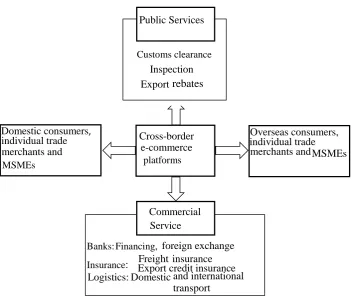
The cross-border e-commerce platforms are online trading providers that offer comprehensive services for consumers, individual trade merchants, Micro-, Small and Medium-sized Enterprises (MSMEs) (Ali Research, 2016). The public services and commercial services they offer link consumers, individual trade merchants and MSMEs home and abroad with relevant regulatory departments (Figure 2). The typical cross-border e-commerce platforms include foreign trade comprehensive services platforms, cross-border e-commerce retailing services platforms and cross-border e-commerce logistic services platforms.
The cross-border e-commerce platforms have standardised and digitalized international trade
procedures, offering one-stop services for MSMEs including contracts, customs clearance, tax rebate and so on. As a result, the MSMEs can concentrate more on R&D, production and marketing.
In addition, the cross-border e-commerce platforms can connect millions of online MSMEs with relevant government organizations and service providers, improving operation efficiency and reducing transaction costs of market entities. Moreover, the cross-border e-commerce platforms not
only provide payment security to both buyers and suppliers, but also offer some financial services such as letter of credit buyout, letter of credit financing, forward foreign exchange settlement and
sales to MSMEs (Ali Research, 2016).
The infrastructure of national digital customs mainly relies on corporate commercial platforms and
e-government platforms. One of the most important corporate commercial platforms are cross-border e-commerce platforms. They can play an important role in linking MSMEs to different
Fig. 2. The trading services offered by cross-border e-commerce platforms
3. Single Window: Foundation of establishing global digital customs
Overseas consumers, individual trade merchants and MSMEs Customs clearance
Inspection Export rebates Public Services
Cross-border
platforms e-commerce Domestic consumers,
MSMEs
individual trade
merchants and
Banks:Financing, foreign exchange
Insurance: Export credit insurance Freight insurance Logistics: Domestic and international
[image:5.595.156.509.112.411.2]The Single Window is a platform which permits parties involved in trade and transport to submit
standardized information and documents through a single entry point to fulfil all of the regulatory requirements regarding export, import and entrepot (UN/CEFACT, 2005). The global digital
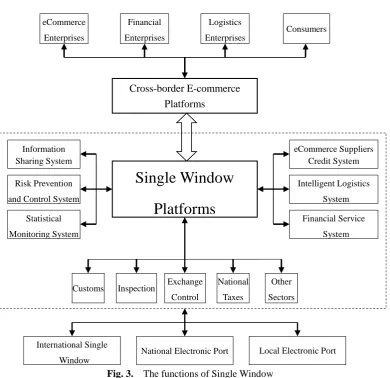
[image:6.595.107.498.222.600.2]customs can be regarded as an advanced edition of Single Window, which integrates customs clearance, cross-border transactions and transport logistics. The latest development also includes payment-related banking services. The functions of a Single Window are shown in Figure 3.
Fig. 3. The functions of Single Window
The technical framework of Single Window mainly relies on information and communication technology as well as internet technology represented by the Automated System for Customs Data
and some guidelines published by WCO and the United
Nations Network of Experts for Paperless Trade. There are three types of operation models of Single Window, namely, the non-government operation model in Germany and
Guatemala, the public-private joint management model in Senegal and the public sector operation model in Finland, Sweden and the United States.
Single Window operates with three different organizational models. Under Single Authority Model, eCommerce
Enterprises
Financial
Enterprises
Logistics
Enterprises Consumers
Cross-border E-commerce Platforms
Single Window
Platforms
eCommerce Suppliers Credit System
Intelligent Logistics
System
Financial Service
System Information
Sharing System
Risk Prevention
and Control System
Statistical
Monitoring System
International Single
Window National Electronic Port Local Electronic Port
Customs Inspection Exchange
Control
National
Taxes
Other
a single government regulator (such as the customs) is established or authorized to receive and
disseminate imports and exports data to all relevant government authorities either through paper or electronically. Sweden and Netherlands adopt this model. A Single Automated System Model means
that a national government sets up an information system to handle all of the imports and exports transactions uniformly. All of the regulatory institutions remain independent from each other, with the operation system decentralized. The United States and Japan adopt this model. An Automated
Information Transaction System Model provides traders with a unified portal or platform to process trade data electronically. Singapore and Mauritius adopt this model (UN/CEFACT, 2005).
The development of Single Window is moving towards regionalization and standardization. The cooperation between national governments and cross-border e-commerce platforms has been
increasingly deepened. More and more countries will set up national Single Windows and connect them together regionally such as Association of Southeast Asian Nations Single Window (ASEAN
SW). There is possibility of establishing a global unified Single Window network in the long run (Cao & Wu, 2015). International organizations such as WCO and the United Nations Centre for
Trade Facilitation and Electronic Business (UN/CEFACT) will play an important role in advancing and promoting the establishment of a unified global Single Window to facilitate international trade and cross-border e-commerce.
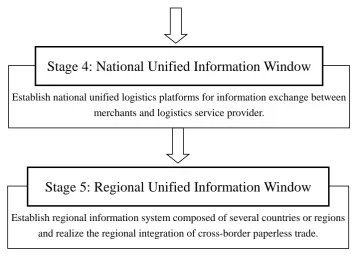
The evolution of Single Window can be roughly divided into the following five stages, which is
shown in Figure 4.
Paperless Customs clearance, electronic payment of tariffs, and electronic
document (such as container lists) exchange with ports or terminals are realized.
Stage 1: Paperless Customs Clearance System
Connect with other government departments’ computer system, transact paperless certificates and exchange electronic licenses with paperless customs clearance system.
Stage 2: Horizontal Electronic Licenses Exchange System
Exchange electronic documents with stakeholders (such as information
exchange terminals in harbor district, shipping agents, airport authorities, port authorities, duty-free area, airlines and insurance companies)
Fig. 4. The evolution of Single Window
Sources: Zhang, M.Z. The model, evolution and key factors of international trade Single Window.
Foreign Economic Relations & Trade, 7 (2014) 14-15.
National Single Window can provide global digital customs with technical experience. At present the core technology of operating national Single Window is the single data element information
exchange system based on internet technology, which provides national digital customs with basic technologies and trade data (UNECE, 2011). The extended functions such as credit assessment and digital authentication will be able to enrich the technological framework of digital customs. In addition, the existing institutional framework of national Single Window provides valuable practical experiences for the institutional development of global digital customs. The operation of national
Single Window is based on a series of laws and regulations. Global digital customs, as an advanced edition of Single Window, needs to implement more rigorous rules and regulations because of its
virtuality.
The deepening international cooperation among national Single Windows can facilitate the
establishment and operation of global digital customs in the long run. The horizontal organization and coordination among relevant departments of national governments need to be strengthened.
Since the number of market entities and stakeholders participating in the development of Single Window is expected to increase, the international cooperation among different government departments needs to improve. It is very important to formulate and implement effective
organizational coordination plans and communication strategies to enhance mutual trust among the relevant departments and stakeholders in different countries and improve operation efficiency of
national Single Window platforms, thereby laying a good foundation for the creation of global digital customs (Gao, 2014). The functional departments of member states need to adhere to the guidelines of participating in global digital customs (Ruan, 2015).
Establish national unified logistics platforms for information exchange between merchants and logistics service provider.
Stage 4: National Unified Information Window
Establish regional information system composed of several countries or regions and realize the regional integration of cross-border paperless trade.
[image:8.595.117.474.74.333.2]The emerging market entities such as global e-commerce enterprises and cross-border e-commerce
platforms should be encouraged to participate in the establishment of national Single Window, improving credit security, data sharing, convenient logistics and financial service functions in their
websites so as to provide powerful industrial support for the creation of global digital customs. Whether secure and effective cross-border supervision can be realized through regional Single Window depends on the degree of compatibility and sharing of national data. International standards
and unified data elements introduced by international organizations such as WCO should be gradually adopted by national governments to promote the establishment of global digital customs.
4. eWTP: Global vision of establishing global digital customs
The multinational corporations or large enterprises usually play the leading role in the global trade system. In order to promote trade facilitation and inclusive trade, it is important to create a new
multilateral platform such as eWTP to learn the demand and feedback of MSMEs since the current international trade regulations lag behind the rapid growth of internet economy and global
e-commerce. As an increasing number of local, regional, national and international business transactions are taking place through a variety of e-commerce platforms, both the developed and developing countries should encourage and support firms of all sizes, in particular MSMEs, to
participate in global digital trade (AliResearch, 2017).
The proposal to create eWTP was included in G20 Leaders’ Communique Hangzhou Summit on 5 September 2016 (European Commission, 2016). It has received the responses and consensus from many countries and regions around the world afterwards (Chen, 2016). eWTP aims to develop and
establish a new ecosystem system of international trade to promote global inclusive growth and cultivate a more equitable digital trade environment. It will help MSMEs around the world to
Fig. 5. The new ecosystem of global digital trade
Creating eWTP and formulating new global digital trade rules have significant strategic value for fighting poverty and improving the welfare of human beings (Figure 6). ‘It has the potential to spark fundamental changes in the way international trade is conducted by lowering costs, reducing and
streamlining intermediaries, improving access to information and financing, and shortening global supply chains’ (AliResearch, 2017, p 49). The MSMEs in the developing countries, particularly
low-income countries (LICs), have opportunities to connect with global market more easily, making use of inclusive finance, e-supplier credit and cross-border e-commerce services in the new international trade ecosystem. Inclusive employment can be promoted worldwide.
eWTP
Promote and Optimize Trade
Resources
Traditional Trade Rules and Agreements Consumers
Government Regulatory
Departments MSMEs,
Self-employed Merchants
Promote Inclusive Technology Employments Inclusive Service
and Trade Consumptions
Assist to Design and Improve Regulations Popularize
Equal Trade Rights
Promote Global Innovations and
Creation Express
Public Needs Coordinate
Negotiations and Settle Disputes
New Ecosystem of Global Trade
Global Digital
Business Rules
Global Micro
Fig. 6. Ten specific fields where eWTP can realize its strategic value
The vision of eWTP, which is in accordance with the institutional development of establishing
global digital customs, encourages the formulation of new digital trade regulations and policies that conform to the rapid development of cross-border e-commerce. Negative list management system,
universal mutual recognition inspection and quarantine system and product traceability system need to be gradually established in the process of creating global digital customs (Ji, 2016). The cross-border flow of international trade data will accelerate after establishing global digital customs. A
faster and more efficient arbitration and conciliation mechanism will be established to solve global e-commerce disputes. In addition, the vision of eWTP promotes global economic cooperation. The
accumulation and deposit of international trade data require horizontal cooperation between national governments. Moreover, the vision of eWTP promotes the establishment of cross-border e-commerce credit evaluation system. A new type of online trade credit evaluation system can be
created for MSMEs on the basis of cross-border e-commerce trade platforms (AliResearch, 2015).
5. New digital infrastructure: Technical Support towards the establishment of global digital Ten specific fields where eWTP can realize its strategic value
Advocate the formulation of unified global electronic trade regulations; encourage development and
promotion of global technical standard system; focus on consumers’ benefit in the scope of new trade
format; push forward the legalization and widespread use of technologies like electronic signs and radio
frequency identification in the regulation of international trade. Cross-border Electronic Trade Business
Set up a transparent and effective protection system for copyright, patents and trademark; promote the establishment of multilateral agreements.
IPR Protection
Include whether to levy taxes, tax jurisdiction, avoidance of double taxation and prevention of tax loss.
Tariff Issues
Objects of protection are merchants, individual security, public security,
national security, etc. Security
Establish new infrastructures and solve the problem of international cooperation in the field of information
access.
Telecom Infrastructures
Develop relevant standards for high-speed data exchange, security and transaction payment; focus on the protection of interconnection.
Technical Standards
Establish bilateral and multilateral guidelines for individual privacy protection and self-discipline rules for
enterprises and industries. Individual Privacy
Promote deep cooperation among national governments and market entities, guard against illicit or criminal acts such as cheating.
counterfeits. Electronic Payment
Enhance assistance and support towards global e-commerce practitioners; provide chances for
micro- and SMEs. Pervasive Services
Improve labor skills, protect the rights and interests of workers and promote inclusive employment in the context of
New digital infrastructure include Clouds, Nets and Terminals. Clouds refer to infrastructures related to big data and cloud computing, which means to serve the clients through creating a data center by clustering the computers. Nets mean infrastructures concerning the Internet of Things (IoT)developed from the traditional Internet, including hardware (mainframes and network service devices used for data storage, processing and transmission, especially Radio Frequency Identification Devices, QR Codes, Global Positioning Systems and so on) and software designed
for information accumulation, storage, retrieval, analysis, application and appraisal (Lin et al., 2016).
Terminals refer to mobile internet infrastructures in terms of accessible terminals, such as personal computers, mobile devices, wearable devices, sensors and their respective software applications (Zhu et al., 2011) Clouds, Nets and Terminals have constituted a new landscape of new digital infrastructure as shown in Figure 7, which is gradually reshaping the daily lives of people around
the world.
Fig. 7. An overall view of new digital infrastructure
Infrastructures such as big data and cloud computing have been enhanced comprehensively. Currently the information technology industry continues to witness rapid progress. The magnitude of network calculation capacity has been overall enhanced. The broadband is no longer facing a
bottleneck of data transmission. The demand for data analytics has been increasing rapidly. Cloud computing and big data application meet new development opportunities (Amankwah-Amoah,
2016). IoT has a potential economic impact between $2.7 trillion to $6.2 trillion until 2025 (Ip, 2016). The application of intelligent terminals and apps has grown rapidly. User devices, represented by intelligent terminals, are becoming an important medium for big data collection and
service provision. Wearable devices such as watches, eyeglasses, wristbands and clothing have been launched to the market frequently. Meanwhile, the content of Internet has been gradually changed
from the domination by the web pages of portal sites to a great variety of apps. Data Fusion, Sharing, Perceiving,
Processing and Management the Cloud Platform
as a Service
Other Neotype Networks Home RF Networks Virtual Private Networks Access Networks Transducers and RFIDs IPTV Networks Conference
Networks 802.11/802.16
Mobile Networks
(GSM、CDMA)
Telecommunication Networks Household Intelligence Integrated Equipment Control Digital and Handhold TVs Processor Resource Sharing Supervision of Securities Market Public Switched Telephone Networks Full Coverage of
New digital infrastructure have made significant contribution to the emergence of new forms of international trade. The synthesis between new digital infrastructure and e-commerce has been
strengthened further. For example, during the first hour of Alibaba’s Singles Day Festival in 2016, the order volume reached 175,000 orders in one second while the number of payments settled per second hit 120,000 at their peak (IPC, 2016). The success of the world's largest online shopping
event was partly attributed to the constant technological innovation and new digital infrastructure development by the Alibaba Group such as Ali cloud computing, one of the largest hybrid cloud
architectures in the world.
The individuals and private enterprises have become the main market entities. The dominant player
of new digital infrastructure has gradually moved from the national government to the private or public enterprises. The users of mobile internet infrastructures are billions of ordinary subscribers.
The user scale and technical level of new digital infrastructure established and operated by the world’s leading e-commerce companies such as Amazon, eBay, Alibaba have leaped into the front ranks of the world. As a result, the governance of information economy has evolved from the previous centralized control model to the co-governance model on the basis of mass innovation.
5.1 Why does new digital infrastructure offer technical support for creating global digital customs?
Cloud computing can provide data analysis technique for the establishment and maintenance of
global digital customs. In the course of creating global digital customs, it is necessary to apply the advanced IT technology such as cloud computing data center to reconcile different statistical systems and store massive data. The maintenance and upgrading of global digital customs are
indispensable to the technological support from cloud computing resource management and scheduling algorithm. The creation of information security and privacy protection modules needs to
adopt cloud computing core service layer model (Luo et al., 2011). Besides, Internet and Io T can provide credit authentication technology to establish global digital customs. They can also provide a basic framework for multi-network integration, data sharing and harmonization of standards
between market entities and national governments, making it possible to create a credit authentication system for market entities of global digital customs and laying a firm technological
foundation for the applications of customs exemption and negative list management (Chen et al., 2013). Moreover, smart client terminals provide market application big data for the operation of global digital customs. In the operation of global digital customs, smart client terminals are the
important sources of market and trade big data and the receivers of data analytics. The data from individual smart client terminals can be used for the dynamic analyses of consumer preferences and
consumption demand (Clegg, 2017). The mobile data from corporate terminals under global digital customs are important sources for making macro-economic decisions (McKinsey Global Institute, 2015).
5.2 How does new digital infrastructure contribute to creating global digital customs?
of emerging technology and knowledge transfer such as cloud computing (AliResearch, 2017). The
integration of production, teaching and research should be promoted. In addition, the establishment of global digital customs requires a high level of informatization of MSMEs. It is important to
accelerate the connection between new digital infrastructure and industrial production network. Market entities, especially MSMEs, should be encouraged to explore, apply and innovate relevant technology and equipment to undertake effective data accumulation and integration. Moreover,
massive nodes need to be created for establishing global digital customs through supporting the development of mobile terminals. The main joint nodes of consumers of global e-commerce
platforms, which are important data sources for global digital customs, are being transferred to mobile terminals on a large scale. Thus, the development of mobile data terminals should be encouraged by national governments because they can generate analytical results more quickly and
constitute one comprehensive information management loop.
6. Conclusions and Policy Implications
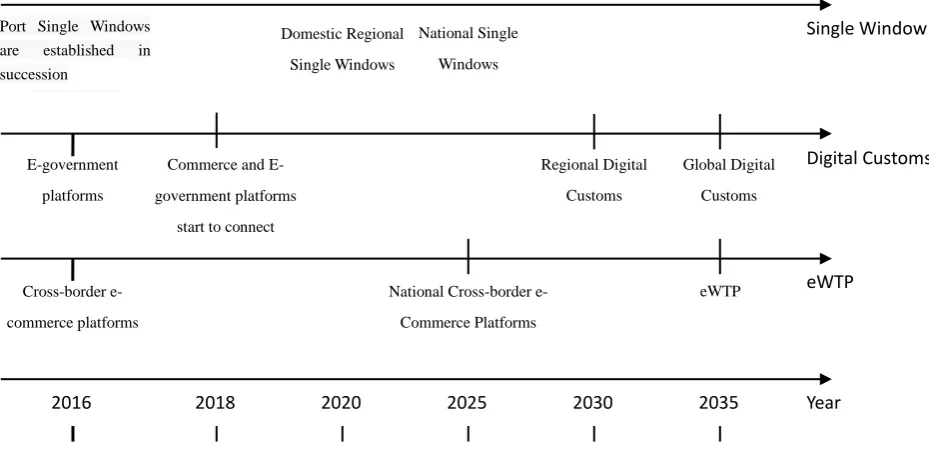
The establishment of global digital customs requires global governance through joint efforts by firms, national governments and international organizations. Firms need to establish their digital business platforms while national governments should upgrade their e-government platforms. These
two types of platforms can be gradually connected, leading to the establishment of domestic regional Single Window and national Single Window. Subsequently, regional integration of national Single
Windows will be gradually realized. The differences in national trade data, policies and regulations need to be harmonized. The criteria of standardization and fairness should be encouraged and maintained by national government. The ultimate goal of establishing global digital customs is to
create eWTP. Figure 8 indicates a general planning of different stages of establishing global digital customs.
Fig. 8. Different stages of establishing global digital customs Cross-border
e-commerce platforms
National Cross-border e-Commerce Platforms
eWTP
Year
2016 2018 2020 2025 2030 2035
Single Window Domestic Regional
Single Windows
National Single Windows Port Single Windows
are established in succession
in Succession
eWTP E-government
platforms
Commerce and E-government platforms
start to connect
Regional Digital Customs
Global Digital Customs
[image:14.595.74.539.528.754.2]Cross-border e-commerce platforms, national Single Window and eWTP, all of which are indispensable for the establishment of global digital customs, have close linkages in business
regulation, data sharing and information exchange. For example, the cross-border e-commerce platforms are closely related to national Single Window in business practice, and eWTP will play an important role in mediating and coordinating international trade through national Single Window.
The establishment of global digital customs is expected to generate synergy among eWTP, national Single Window and cross-border e-commerce platforms, which is shown in Figure 9.
Fig. 9. The coupling effects among cross-border e-commerce platforms, national Single Windows and eWTP in creating global digital customs
Therefore, it is important to encourage and support the development and improvement of national Single Window and cross-border e-commerce platforms with national promotion policies, laws and
regulations, strengthening their communication and integration in data sharing and regulatory decision-making, and guiding them to solve the difficult issues through joint efforts. The cross-border e-commerce platforms should improve business practices and standardize digital trade
procedures to facilitate the regulation by the e-government platforms. Meanwhile, eWTP and the cross-border e-commerce platforms can cooperate in establishing worldwide credit appraisal system
and guaranteeing the legal rights of trading firms in the long run. National governments should adopt an innovative regulatory model to monitor the operation of cross-border e-commerce platforms. They should avoid the multiple taxation, facilitate customs clearance and tax-free
arrangements for small-scale trades and promote the development of bonded cargos and negative list management system in the digital era.
In the course of establishingglobal digital customs, a new global online trade system will gradually
come into being on the basis of coordinating national legal systems, industrial self-disciplines and relevant regulations adopted by cross-border e-commerce platforms in different countries. National governments should cultivate fair and transparent business environment and encourage market
entities to take an active part in formulating and implementing global online trade regulations and join forces to implement the widely accepted and acknowledged global digital trade standards to
ensure the security, stability and credibility of the operation of global digital customs. Coupling Effect:
Intermediary Coordination Coupling Effect: Credit
Investigation System
eWTP
Global Digital Customs Synergy Complement
Development of Single Window e-Government
Platforms Development of
Cross-border e-Commerce Platforms
Coupling Effect: Business Practice
Su b je cts Pr o mo ti n g E ffe
cts Fou
References
Alcácer, J., Cantwell, J. & Piscitello, L. Internationalization in the information age: A new era for places, firms, and international business networks?. J. Int. Bus. Stud. 47 (5) (2016) 499 512. https://doi.org/10.1057/jibs.2016.22
AliResearch. New opportunities of global trade in the Internet era: A trend of inclusive trade.
http://doc.mbalib.com/view/e70b0edad899a676675cc093ebc338e1.html, 2015. (Accessed 13
June 2016).
AliResearch. The future of trade: cross-border e-commerce connects the world.
http://i.aliresearch.com/img/20160901/20160901101059.pdf, 2016. (Accessed 17 January
2017).
AliResearch. Inclusive development and e-commerce: case of China, 2017.
http://unctad.org/meetings/en/Contribution/dtl_eWeek2017c11-aliresearch_en.pdf (Accessed
17 July 2017)
Amankwah-Amoah, J. Emerging economies, emerging challenges: Mobilising and capturing value from big data. Technol. Forecast. Soc. Change, 110 (2016) 167 174.
BOC, 2016. White paper of Bank of China on cross-border e-commerce service.
http://pic.bankofchina.com/bocappd/rareport/201604/P020160413370147122111.pdf
(Accessed 28 November 2016)
Cao, J., & Wu, N. “Single Window”: a major infrastructure project for trade facilitation in the FTA. Port Economy, 1, (2015), 12 15.
Chen, H.M., Cui, L.& Xie, K.B. A comparative study on architectures and implementation methodologies of Internet of Things. Chinese Journal of Computers 1 (2013) 168-188.
Chen, X. eWTP proposal draws attention after B20 summit.
http://china.org.cn/business/2016-09/06/content_39243925.htm (Accessed 8 June 2017).
European Commission (2016) G20 Leaders’ Communique Hangzhou Summit.
http://europa.eu/rapid/press-release_STATEMENT-16-2967_en.htm (Accessed 20 November
2016).
Fang, X., & Zhu, M. Constructing Single Window to improve trade facilitation of China. Practice in Foreign Economic Relations and Trade, 2, (2014) 21 24.
Friedman, T. The World is flat, 3rd ed. Penguin, London, 2007.
Ip, C. The IoT opportunity – Are you ready to capture a once-in-a lifetime value pool? Hong Kong IoT Conference 21 June 2016.
http://hk-iot-conference.gs1hk.org/2016/pdf/_04_Mc%20Kinsey%20-%20(Chris%20Ip%20)%20ppt%20p art%20%201%20_IoT%20-%20Capturing%20the%20Opportunity%20vF%20-%2021%20Ju
ne%202016.1pptx.pdf (Accessed 1 August 2017)
IPC Alibaba’s 2016 11.11 shopping event beats records again, 2016.
https://www.ipc.be/en/knowledge-centre/e-commerce/articles/alibaba-11-11-2016 (Accessed
15 August 2017)
Ji, X.H. Development situation and export risk prevention of Zhejiang foreign trade integrated service enterprises. Finance and Accounting for International Commerce 2 (2016) 10 13.
Lin, C. , Su,W.B., Meng, K., Liu, Q.& Liu, W.D. Cloud computing security: architecture, mechanism and modelling, Chinese Journal of Computers 9 (2013) 1765 1784.
Luo, J.Z., Jin, J.H., Song,A.B.& Dong,F. Cloud computing: architecture and key technologies. Journal on Communications 7 (2011) 3-21.
McKinsey Global Institute. The Internet of Things: mapping the value beyond hype, (2015) http://www.mckinsey.com/~/media/McKinsey/Business%20Functions/McKinsey%20Digital/ Our%20Insights/The%20Internet%20of%20Things%20The%20value%20of%20digitizing%2 0the%20physical%20world/The-Internet-of-things-Mapping-the-value-beyond-the-hype.ashx. (Accessed 15 April 2017)
OECD, Data-driven innovation for growth and well-being: interim synthesis report,OECD Publications, Paris, 2014. https://www.oecd.org/sti/inno/data-driven-innovation-interim-synthesis.pdf (Accessed 20 August 2017).
Ruan, Z.H., The construction mode and countermeasure analysis of China's international trade Single Window. Manager Journal 27 (2015) 224.
UN/CEFACT, Recommendation and Guidelines on establishing a Single Window to enhance the efficient exchange of information between trade and government, The United Nations Centre for Trade Facilitation and Electronic Business, Geneva, 2005.
https://www.unece.org/fileadmin/DAM/cefact/recommendations/rec33/rec33_trd352e.pdf (Accessed 18 February 2017)
UNCTAD, The World Investment Report 2017,United Nations Publication,Geneva, 2017.
UNECE. Single Window implementation framework, United Nations, Geneva and New York, 2011
WTO. Trade facilitation, 2017. https://www.wto.org/english/news_e/brief_tradefa_e.htm (accessed 5 July 2017)
Zhang, M.Z. The model, evolution and key factors of international trade single window. Foreign Economic Relations & Trade, 7 (2014) 14 15.