Tanzania
The National Costed
Plan of Action for Most
Vulnerable Children
2007 – 2010
Department of Social Welfare
The National Costed
Plan of Action for Most
Vulnerable Children
TANZANIANS AND AMERICANS IN PARTNERSHIP TO FIGHT HIV/AIDS
2007 – 2010
Department of Social Welfare
© 2008. This publication is made possible by the generous support of the American people through the United States Agency for International Development (USAID).
Tables and Figures . . . iv
Acronyms . . . v
Foreword . . . vi
Acknowledgments . . . vii
Preamble . . . viii
Executive Summary . . . ix
Introduction . . . 1
Vision, Mission, Goals, and Objectives of the NCPA . . . 3
Institutional Arrangements at the National Level . . . 5
Key Thematic Areas and Plan of Action for MVC . . . 11
Social Protection and Security for MVC . . . 24
Psychosocial Support . . . 37
Plan Implementation Monitoring and Evaluation . . . 41
Resource Mobilization Framework. . . 51
Appendices . . . 57
Contents
Tables
x Summary of NCPA by Strategic Priorities 12 Policy and Service Delivery Environment
14 Policy and Service Delivery Environment Activity Costs 22 Household and Child-Level Action Plan
23 Household and Child-Level Action Plan Activity Costs 28 Cost per Child for Prevention and Withdrawal
29 Number of Children Withdrawn and Prevented in 11 districts: Jan. 2002–March 2005 35 Social Protection and Security of MVC Action Plan
36 Social Protection and Security of MVC Action Plan Activity Costs 39 Psychosocial Support Action Plan
40 Psychosocial Support Action Plan Costs 41 Core National-Level Indicators
44 MVC Monitoring and Evaluation Pipeline for Tanzania (with illustrative indicators) 49 Measuring the Process Action Plan
50 Measuring the Process Action Plan Costing
52 Financial Contributions to National MVC Response (in millions of US$) 54 Resource Mobilization Action Plan
55 Resource Mobilization Action Plan Costing
Figures
6 Figure 1. Coordination and Management of the MVC Response 7 Figure 2. Institutional Arrangements
Acronyms
AIDS Acquired Immune Deficiency Syndrome
AMREF African Medical Research Foundation
ARV Antiretroviral drugs
ASRH Adolescent Sexual Reproductive Health
AYA Awareness Youth Alliance
BCG Baccille Calmette Guerin
CDC US Centers for Disease Control and Prevention
CHF Community Health Fund
C-IMCI Community IMCI
CMAC Council Multisectoral AIDS Committee
COC Continuum of Care
CORPS Community-owned Resource Persons
CSO Civil Society Organization
DSW Department of Social Welfare
EGPAF Elizabeth Glazer Pediatric AIDS Foundation
ELISA Enzyme Linked Immunosorbent Assay
FBO Faith-based Organization
GTZ German Tanzania
HBC Home-based Care
HIV Human Immunodeficiency Virus
HSR Health Sector Reform
IDC Infectious Disease Clinic
IEC Information Education and Communication
ILO International Labor Organization
IMCI Integrated Management of Childhood Illnesses
IPG Implementing Partners Group
ITNs Insecticide Treated Nets
M&E Monitoring and Evaluation
MDG Millennium Development Goals
MoH Ministry of Health
MoHSW Ministry of Health and Social Welfare
MSF Medicines Sans Frontiers
MoLYDS Ministry of Labour, Youth Development and Sports
MTER Medium Term Expenditure Review
MVC Most Vulnerable Children including orphans
MVCC Most Vulnerable Children Committee
NCPA National Costed Plan of Action
NGO Non Governmental Organization
NSC National Steering Committee
OVC Orphans and Vulnerable Children
PACT Private Agencies Collaborating Together
PEPFAR US President’s Emergency Plan Fund for AIDS Relief
PHAST Participatory Hygiene and Sanitation Transformation
PLWHA People Living with HIV/AIDS
PMORLAG Prime Minister’s Office Regional Administration and Local Government
PMTCT Prevention of Mother-to-Child Transmission
RAAAP Rapid Appraisal, Analysis, and Action Planning
RCH Reproductive and Child Health
STI Sexually Transmitted Infection
TACAIDS Tanzania AIDS Commission
TAHEA Tanzania Home Economics Association
TEHIP Tanzania Health Intervention Project
TFNC Tanzania Food and Nutrition Center
U5MR Under-five Mortality Rate
UNF United Nations Fund
UNGASS United Nations General Assembly Special Session
UNICEF United Nation Children’s Fund
USAID United States Agency for International Development
VMAC Village Multisectoral AIDS Committee
WFP World Food Programme
WHO World Health Organization
WMAC Ward Multisectoral AIDS Committee
Chronic poverty, social disintegration, and the HIV/AIDS pandemic have increased the vulnerability of Tanzania’s children. Their basic need for care, support, and protec-tion is not being met. Tradiprotec-tional safety nets provided by extended families and the community are also weak.
The Government of Tanzania recognizes their difficult circumstances, and has begun taking steps to respond to their plight. Through the National Costed Plan of Action for Most Vulnerable Children (NCPA), the government has identified intervention strategies that will have a direct impact on the lives and welfare of the country’s most vulnerable children.
The NCPA includes recommendations for the smooth scale up of service delivery; guidelines for improved standards of care, support, and protection; and advice on how to harness essential resources. It provides an implementation strategy and a clearly defined monitoring and evaluation component. It also includes an estimated cost package.
The NCPA is a tool that will help produce results through clearly defined activities and targets, careful costing, and identification of actors responsible for implementa-tion. The NCPA is relevant to the overall national response to most vulnerable chil-dren within the local Tanzanian context. It offers a multisectoral and standardized approach that can be applied at all levels. Its goals are attainable in a specific time-frame. All will work together to provide a better future for our nation’s children.
Hon. Professor David H. Mwakyusa (MP) Minister of Health and Social Welfare
January 2008
Foreword
The National Costed Plan of Action for Most Vulnerable Children (NCPA) is a significant achievement that underlines the Government of Tanzania’s commitment to helping the most vulnerable children (MVC) in our society.
The plan was developed through hours of consultative meetings with a committed group of local, national, and international stakeholders. Many have worked tire-lessly to make this document a reality. Sincere appreciation to representatives from government ministerial departments and agencies, local government authorities, the Tanzania Commission for AIDS (TACAIDS), bilateral organizations, development partners, United Nations agencies, and international and local nongovernmental, faith- and community-based organizations.
Special thanks to members of the Task Forces on the Rapid Assessment, Analysis and Action Planning Process (RAAP) for Orphans and Vulnerable Children, who worked intensively and constructively on the process in 2004. The RAAP Report provided essential inputs for developing the NCPA.
Thank you, as well, to the United States government and the American people for the funding and technical support provided through Family Health International to produce this document.
Having developed the NCPA, the Government of Tanzania is strongly committed to its successful implementation. Children are the nation’s future. All stakeholders have an obligation to participate in creating a better environment for their growth and development, and especially for their care, support, and protection. Again, we thank all stakeholders for working to achieve implementation of this plan.
Mr. Wilson Mukama Permanent Secretary
Ministry of Health and Social Welfare January 2008
HIV/AIDS and severe poverty continue to threaten the well-being of Tanzania’s children. Those children whose parents are infected often serve as caregivers for their parents and siblings. An increasing number of children are forced to drop out of school or go without essential services, while others are forced to engage in economic activities to contribute to the family’s survival.
The eventual death of parents often subjects children to emotional distress and physical neglect. They may feel they lack love, care, and protection. Many are denied access to health, education, food, legal, financial and psychosocial services. They face stigmatization, social exclusion, deprivation, and discrimination. All sectors of soci-ety—including NGOs, community-based organizations, families, local governments, and international organizations—must combine efforts to mitigate the impact of HIV/AIDS on children.
The National Costed Plan of Action for Most Vulnerable Children (NCPA) is a four-year action plan (2007–2010). Through an analysis of the situation of orphans and most vulnerable children, the NCPA presents a framework of goals, strategies, and actions that will promote the survival, growth, well-being, development, and protec-tion of most vulnerable children in Tanzania. The plan spells out the responsibilities of different stakeholders in achieving objectives within the required timeframe. It also recognizes and seeks to harmonize existing policies, strategies, and programs that in some way address MVC, including Vision 2025, the National Strategy for Growth and Reduction of Poverty (NSGPR), and the National Policy on HIV/AIDS.
Implementation of this plan requires that strategies and actions be integrated into the Medium Term Expenditure Reviews of government ministries and into the budgets of local government authorities. Households, communities, and civil society organiza-tions must also continue to play a role. All stakeholders must recognize that an invest-ment in orphans and most vulnerable children is an investinvest-ment in Tanzania’s future.
Identifying the Most Vulnerable Children
Using data from the population census, a standard classification of most vulnerable children has been developed that incorporates demographic characteristics and indi-cators of poor living conditions. It includes the following children
• those living in child-headed households
• those living in elderly-headed households with no adult from 20–59 years-old present
• those with one or both parents deceased • those with disabilities
• those in rural areas: children with one surviving parent living in a house with poor quality roofing (grass and/or mud) and those with a disability living in similar poor conditions
• those in urban areas: children with one surviving parent living in a house with poor quality roofing (grass and/or mud) or with poor wall materials or with-out toilet facilities and those with a disability living in similar poor conditions This classification recognizes that not all orphaned children are most vulnerable, and it equally recognizes that children living with a parent can be most vulnerable. The number of children in Tanzania Mainland with such characteristics was estimated to be close to 930,000 in 2006—5 percent of the child population.
Census data can be analyzed to derive estimates of most vulnerable children. The district analysis shows that of the 20 districts where the percentage of such children exceeds seven percent of all children in the district, four districts are in Dodoma, four are in Singida, two are in Iringa, and two are in Mbeya. Districts where more than 10 percent of children are most vulnerable include Dodoma Rural (13.3 percent), Singida Rural (10.8 percent) and Manyoni (10.1 percent). Other districts with high numbers of MVC are Iramba (9.7), Bukoba Rural (9.2), and Kondoa (8.1). A combination of factors— including orphanhood and very poor living conditions—causes children in these districts to be the most adversely affected.
Estimating a Level of Support for MVC
The level of support that might be provided to MVC has been estimated under dif-ferent scenarios. In the base analysis, the direct support costs per child are estimated to be the amount of money that would be needed to raise the average per child expenditure for the poorest children (those living in households with expenditures more than 30 percent below the very poor living conditions line) to the average level
Executive Summary
The number of most
vulnerable children in
Tanzania Mainland
was estimated to be
close to 930,000 in
2006—5 percent of
the child population.
of expenditures for children living at around the national poverty level. Costs have been calculated separately for children at different ages: pre-primary, primary school age, and 15 to 17 years-olds, and separately for rural and urban children. Since about 40 percent of the child population lives at or below the national poverty level, it is unlikely that the national program will be able to finance support for vulnerable chil-dren above this level. To do so would imply support for the most vulnerable at levels above the norm for most children in their communities.
Summary of NCPA by Strategic Priorities
STRATEGIC PRIORITY TOTAL COSTS (US$)
YEAR 1 YEAR 2 YEAR 3 YEAR 4
Policy and Service Delivery
Environment 2,760,100 135,600 135,600 135,600
HOUSEHOLD AND CHILD-LEVEL CARE
Providing food support (cash
or in-kind) 10,973,685 11,223,210 11,691,734 12,143,552
Providing support for non-food goods and services (cash or in-kind)
3,648,461 3,738,906 3,903,326 4,060,249
Providing training to care givers on caretaking skills
480,000 Subtotal Household and
Child-level Care
15,102,146 14,962,116 15,595,060 16,203,801
Child Security and Protection 45,300 2,490,000 699,000 690,000
Psychosocial Support 4,483,200
Plan Implementation Monitoring and Evaluation
935,000 161,000 61,000 161,000
Resource Mobilization 935,000 161,000 61,000 161,000
TANZANIA
, like other sub-Saharan countries, con-tinues to be deeply affected by HIV and AIDS. The epidemic poses a threat to the country’s economic and social development and has exacerbated the vulnerability of most children, their households, and communities. A rapid increase in the number of MVC in the country has necessitated development of work-able interventions for scaling up protection, care, and support—that is, the NCPA.The NCPA will serve as a reference tool for govern-ment and stakeholders in their efforts to improve the lives of MVC and promote the rights of children. The thrust of the plan is to develop and implement safety net systems that will deliver multifaceted care and support at the household level. It puts forward a concrete work schedule, specifying stakeholder’s responsibilities and providing a clear framework for the continuation, improvement, and scaling up of OVC interventions. Periodic monitoring and evaluation exercises will guide the quality and effectiveness of the response.
The plan is also indicative of Tanzania’s determination to meet UNGASS goals on HIV/AIDS for OVC, specifically targeting articles 65, 66, and 67 (see key instruments outlining UNGASS goals); governments’ added motivation to realize millennium development goals by 2015; and the AU agreement to ensure OVC universal access to essential services by 2010.
The NCPA is linked to the national multisectoral HIV and AIDS strategic plan and the national AIDS policy. It expands on the country’s MVC responses with support from the government, UN agencies, bilateral organizations, international nongovernmental organizations, and civil societies. To date some noteworthy international and national initiatives include
• ratification of the International Convention on Rights of the Child of 1989 (CRC) and the African Charter on the Rights and Welfare of the Child and the ILO Convention no. 182 on the Worst Form of Child Labour of 1999
• review of Child Development Policy of 1996 to incorporate MVC issues • amendment, review, and enactment of legislation that safeguards the welfare,
care, support and protection of children; the Child Bill is in the drafting process • review, amendment, and renaming of the National Guidelines and Strategies for
Care of Orphans (1994) to National Strategies for Community Based Care, Support and protection of Orphans and Vulnerable Children
Introduction
The NCPA will serve
as a reference tool
for government and
stakeholders in their
efforts to improve the
lives of MVC and
promote the rights
of children.
• conducting in 1999 of a situational analysis of orphaned children in six districts
(Bagamoyo, Makete, Magu, Karagwe, Musoma rural and Kisarawe)
• development of the Early Childhood Development Program for children 0–8 years with an emphasis on vulnerable children
• development of national guidelines for institutional care and support of MVC/OVC, aimed at providing standards for care and support of MVC/OVC living in institutions
• development of training manuals on parenting and community justice facilitation
• formulation of National Policy on HIV/AIDS
• development of the National Plan of Action for Children for Tanzania as an outcome of the “World Fit for Children” agenda agreed to at the 2002 UN-General Assembly Special Session for Children
The NCPA draws on the experience and outcomes of all significant responses to MVC in Tanzania. It was developed following the Rapid Assessment, Analysis and Action Planning Process (RAAAP), an exercise that contributed to identifying MVC interven-tions and formulating a framework for development of the plan. The Department of Social Welfare lead development of the NCPA in partnership with other stakeholders such as TACAIDS, UNICEF, WFO, UNAIDS, civil society organizations, and other government agencies. Resources were provided by the US government with additional leadership from Family Health International. Consultation with community, district, national and cross-sectional stakeholders has taken place to ensure
maximum participation.
The NCPA will be implemented over a four-year period (2007–2010) following the development of concrete annual plans determining priority areas for MVC interven-tions in the districts.
Vision
To see Most Vulnerable Children (MVC) grow and develop to their full potential.
Mission
The NCPA will guide the implementation and expansion of interventions designed to enhance protection, care, and development of children, within the framework of a well-coordinated national response program. The program will be community-based, led by the central government, and supported by local government councils.
Goal
The goal of the NCPA is to scale up the national response to MVC, building on previ-ous and existing experiences in reaching more MVC, with more services over a longer period of time by 2011.
objectives
To ensure that MVC in Tanzania are protected from harm and receive access to essential services
To realize these objectives, the NCPA focuses on the following six thematic areas:
Policy and Service Delivery Environment i.
Partners should carefully coordinate activities with one another, linking pro-grams and mobilizing resources in a way that is most effective. Communities should be mobilized and their capacity built so MVCs can be identified early. Local authorities and communities should participate in the care, support, and protection of MVC, developing coordination mechanisms for MVC programs at the district level. This would include development of policies and guidelines focusing on MVC issue.
Household and Child-level Care ii.
The basic or “core” needs of children and youth must be met to ensure their current and future wellbeing. Their basic needs include food and nutrition and non-food needs such as shelter and care, protection, health care, psychosocial support, education, and economic strengthening.
Protection and Security iii.
Stigma and social neglect faced by MVC must be addressed, as well as all forms of child abuse and exploitation, including child trafficking, child labor, and commercial sex. It also aims to ensure succession of property to MVC.
Vision, Mission, Goals, and Objectives
of the NCPA
The goal of the NCPA
is to scale up the
national response to
MVC, building on
previous and existing
experiences in
reach-ing more MVC, with
more services over a
longer period of time
by 2011.
Psychosocial Support iv.
Fear, grief, trauma, and stigma faced by children must be addressed. The con-tinuity of social relationships of MVC and their caregivers should be ensured. Children should receive love and emotional support, and the opportunity to express their feelings without fear of stigma and discrimination.
Measuring the Process v.
The progress of NCPA implementation should be monitored and evaluated. The quality of MVC responses should be evaluated and intervention effec-tiveness should be assessed. Outcomes should be evaluated (i.e. Have NCPA activities achieved their intended outcomes for MVC and the community?)
Resource Mobilization vi.
Adequate resources must be available to ensure effective and sustainable implementation of the NCPA.
Institutional Arrangements at the
National Level
The Ministry of Health and Social Welfare
At the national level the Ministry of Health and Social Welfare (MOHSW) has overall responsibility in coordinating issues related to the welfare of MVC, undertaken by different stakeholders from the national to the community level. At the national level, the MOHSW will coordinate activities relating to the welfare of MVC supported by other central government ministries to ensure harmonization. They will need to develop mechanisms to promote transparency between key government ministries dealing with children’s welfare—especially in regard to their current plans, budgets, achievements, and constraints.
National Steering Committee for MVC
At the national level the coordination structure and management consists of a steering committee and a national technical committee. The aim of the steering committee is to ensure transparency, efficiency, and partnership in efforts to respond to the needs of MVC. The main functions of the steering committee include the following
• to ensure that government policies and plans conform with the International Convention on the Rights of the Child (1989), the African Charter Protocol on the Rights and Welfare of the Child (1990), the ILO Convention No. 182 (2001) on the Worst Forms of Child Labour
• to ensure there is mainstreaming of support for MVC in relevant government policies, development strategies, and programs in all government ministries, departments, and agencies at all levels
• to ensure adequate resources are allocated for MVC activities in all govern-ment ministries, departgovern-ments, and agencies that support MVC
• to review and approve plans of action prepared or proposed by the Technical Committee for MVC
• to ensure effective coordination of all activities undertaken by stakeholders dealing with MVC
The National Steering Committee for MVC is permanent and led by the government. It has representatives from key government ministries and agencies. Local and inter-national nongovernmental organizations and representatives from the donor commu-nity are invitees to attend committees meetings. The steering committee is chaired by the Permanent Secretary of the Prime Ministers office and meets twice each year.
At the national level
the Ministry of Health
and Social Welfare
has overall
responsi-bility in coordinating
issues related to the
welfare of MVC.
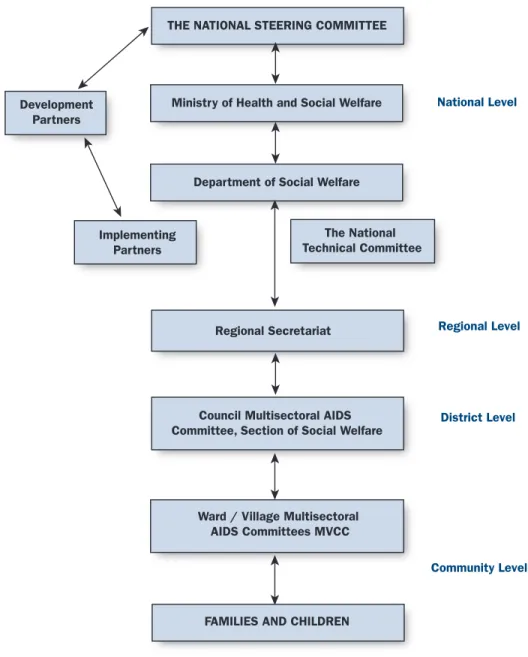
Figure 1. Coordination and Management of the MVC response
National Technical Committee for MVCThe National Technical Committee for MVC is responsible for providing techni-cal advice regarding care, support, and protection of MVC. The National Technitechni-cal Committee helps and advises the National Steering Committee. It is composed of senior government officials from key sectoral and line ministries dealing directly or indirectly with MVC and includes representatives from both local and international NGOs. The National Technical Committee is also responsible for ensuring implemen-tation of instructions from the National Steering Committee.
THE NATIONAL STEERING COMMITTEE
Ministry of Health and Social Welfare
Department of Social Welfare
Regional Secretariat
Council Multisectoral AIDS Committee, Section of Social Welfare
The National Technical Committee
Ward / Village Multisectoral AIDS Committees MVCC
FAMILIES AND CHILDREN
National Level
Community Level District Level Regional Level
Development Partners
Implementing Partners
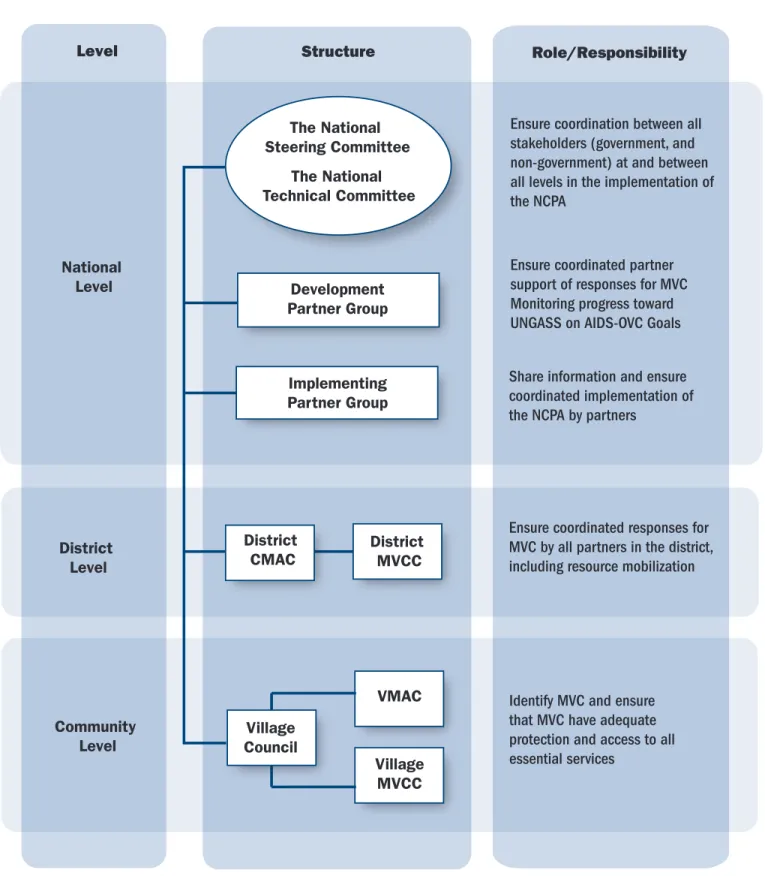
Figure 2. Institutional Arrangements
The National Steering Committee
The National Technical Committee
National Level
Community Level District Level
Development Partner Group
Implementing Partner Group
Level Structure Role/Responsibility
Ensure coordination between all stakeholders (government, and non-government) at and between all levels in the implementation of the NCPA
Ensure coordinated partner support of responses for MVC Monitoring progress toward UNGASS on AIDS-OVC Goals Share information and ensure coordinated implementation of the NCPA by partners
District MVCC
Ensure coordinated responses for MVC by all partners in the district, including resource mobilization
VMAC
Village MVCC Village
Council District
CMAC
Identify MVC and ensure that MVC have adequate protection and access to all essential services
Coordination at district and Lower Levels
No new independent structure is proposed at the district and lower levels. MVC issues will be coordinated by existing structures.
• At the Council level, the Council Multisectoral AIDS Committee (CMAC) will be expanded to function as the District MVC Coordinating Committee by incorporating the social welfare officers responsible for the care, support, and protection of MVC.
• At the Ward level, the Ward Multisectoral AIDS Committees (WMAC) shall be expanded to function as the Ward MVC Coordination Committee by incorpo-rating the Chairpersons and Secretaries of the Village MVC Committees. • At the Village level, the Village AIDS Committee (VMAC) shall be
strength-ened to function as the Village MVC Coordination Committee by incorporating the Village MVC Chairperson and Secretary.
Coordination and Management of Non-State Actors
The Ministry of Health and Social Welfare will be responsible for coordinating non-state stakeholders involved in issues relating to the provision of care, support, and protection of MVC in the country. These stakeholders undertake their objectives and activities in various programs with support from a wide range of development partners and NGOs, both local and international. It is the ministry’s responsibility to ensure that programs undertaken by other stakeholders conform to the guidelines outlined in the NCPA.
The Process
The NCPA has been developed in response to the need to scale-up responses for the most vulnerable children in the country. The process started with the Rapid Assessment Analysis and Action Planning (RAAAP) in 2004. It was followed by the design and development of the NCPA in 2005–2006. Both RAAAP and NCPA were developed in partnership with stakeholders who were involved through a consulta-tive process and through a series of stakeholders’ workshops in July 2006. The docu-ment was submitted to the technical team. It was updated by the technical team and stakeholders from 2006 to July 2007.
Identifying the Most Vulnerable Children
Conceptually, a vulnerable child is one who is living in high-risk circumstances whose prospects for continued growth and development are seriously impaired. In the international community, the term “Orphans and Other Vulnerable Children,” or “OVC” sometimes refers only to children with increased vulnerabilities because of HIV/AIDS. At other times it refers to all vulnerable children, regardless of the cause of their vulnerability (e.g. chronic poverty, armed conflict, famine).1 This defi-nition falls short of capturing the children who are most at risk and in critical need of support.
1. PEPFAR, Orphans and Other Vulnerable Children Programming Guidance for United States Government In-Country Staff and Implementing Partners: The President’s Emergency Plan for AIDS Relief Office of the US Global AIDS Coordinator, July 2006.
The government of Tanzania, together with development partners involved in MVC issues, has coined an operational definition for programming responses for the most vulnerable children (MVC)—that is, those most in need of services in the following way:
A child is any person below the age of 18.
An orphan is a child who has lost one or both parents.
A most vulnerable childis a child who experiences any of the following conditions:
• lives in extreme poverty
• is affected by a chronic illness and lacks adequate care and support • lives without adequate adult support (e.g., in a household with
chronically ill parents; a household that has experienced a recent death; a household headed by a grandparent; and/or a household headed by a child)
• lives outside of family care (e.g., in institutional care or on the streets) • is marginalized, stigmatized, or discriminated against
• has disabilities and lacks adequate support
Using data from the National Population Census and Household Survey of 2002, a stan-dard classification of most vulnerable children has been developed. It incorporates demographic characteristics and indicators of poor living conditions. It includes the following
• children living in child headed households
• children living in elderly households with only adults above 59 years • children with one or both parents deceased
• in rural areas: children with one surviving parent living in a house with very poor quality roofing (grass and/or mud) and children with a disability living in similar poor conditions
• in urban areas: children with one surviving parent living in a house with very poor quality roofing (grass and/or mud) or with very poor wall materials or without a toilet and children with a disability living in similar poor conditions The most reliable criteria for the identifying MVC is derived from the community based participatory definition process. This classification recognizes that not all orphaned children are most vulnerable. It equally recognizes that children living with a parent can be most vulnerable. The number of children in Tanzania Mainland with such characteristics was estimated to be close to 930,000 in 2006—about 5 percent of the child population.
Estimating Level of Support for Most Vulnerable Children
As stated previously, the level of support that might be provided to MVC has been estimated under different scenarios depending on the level of expenditure desired. In the base analysis, the direct support costs per child are estimated to be the amount of money that would be needed to raise the average per child expenditure for MVC (those living in households with expenditures more than 30 percent below the pov-erty line) to the average level of expenditures on children living at about the national poverty level. Costs have been calculated separately for MVC at different ages (0–6 years, 7–14 years, 15–18 years), and separately for rural and urban MVC. Since about 40 percent of the child populations live at or below this level, a national program could finance support for MVC above this level, and to do so would imply support for the most vulnerable at levels above the norm for most vulnerable children in
Policy and Service delivery Environment
An effective policy and service delivery environment is a critical element in address-ing comprehensively the complex needs of MVC. MVC issues are wide rangaddress-ing. Addressing them requires joint multisectoral approaches and policy interventions. Coordination between partners (i.e. central government ministries, departments and agencies; local governments; civil society organizations; faith based organizations; and bilateral, multilateral, and UN agencies) will enable effective and coordinated resource mobilization and program linkages in the process of scaling-up of responses for MVC. Effective policies and programming for MVC are necessary for coordination between government ministries, departments, and agencies in clarifying and harmonizing their roles.
Effective scale up of responses requires building up and/or strengthening the capaci-ties of the existing structures and networks that support healthy child development to gather, share, and use information, and to develop policy and program responses that lead to comprehensive and effective care for MVC. More important, delivering comprehensive support to MVC requires the strengthening of response systems at the community and local government level and/or establishment where they do not yet exist.
In addition, integration and linkage of services is important for enabling provision of a comprehensive package of services to MVC that meet several needs simultaneously. Fostering linkages of MVC responses by various government ministries, departments, and agencies is a crucial aspect of scaling-up MVC responses. It ensures adequate pro-tection and universal access to essential services. Integrated or linked MVC responses have better chances for realizing greater response outcomes than the outcomes of individual responses or services.
Steps in this direction are already gaining momentum. Tanzania is currently imple-menting the National Strategy for Growth and Reduction of Poverty (NSGRP), which provides for a multisectoral approach to addressing vulnerability to poverty and other risks, including HIV/AIDS. Sectoral ministries have reviewed their policies and devel-oped strategic plans to align their activities toward the realization of the NSGRP and Millennium Development Goal (MDG) targets. Ensuring children’s access to essential services is essential to all policy documents and government directives. Coordination is being strengthened to enhance integration, linkages, and synergies in the imple-mentation of various policies and government directives with respect to MVC. Coordination mechanisms have been established to help implementing partners work together effectively and realize integration and linkages of MVC responses. At the national level, coordination space has been created through establishment of the National Steering and Technical Committees. The steering and technical committees
Key Thematic Areas and Plan
of Action for MVC
Delivering
compre-hensive support to
MVC requires the
strengthening of
response systems at
the community and
local government level
and/or establishment
where they do not
yet exist.
meet bi-annually and quarterly respectively. A system of MVC committees has been established at the local government and community levels. These committees bring together various stakeholders involved in MVC responses. Effectiveness of these com-mittees depends on their ability to hold meetings and represent all stakeholders in the committee meetings.
Active involvement of people at the community level is important for the success of efforts to scale-up MVC responses. Social mobilization, advocacy, and enhancement of community participation are important elements of MVC responses programming. Implementing partners realize the importance of increasing the involvement and par-ticipation of communities in action surrounding issues that affect MVC, their house-holds, and communities.
Strategic
actionS actorS/ reSponSibility
Where action iS to be
implemented timeline output indicatorS
objective 1: to ensure coordination between all stakeholders at all levels in responding for mvc, including central and local governments, development partners, civil society, and the private sector
Holding biannual Steering Committee Meetings
National Steering Committee
National level Biannually 2007 to 2011
Number of meetings held and members attended Holding quarterly Technical
Committee Meetings
National Technical Committee
National level Every quarter 2007 to 2011
Number of meetings held and members attended
objective 2: to share information with regard to issues and responses for mvc implemented by government ministries, departments, agencies, and other implementing partners
Producing monthly implementing partner updates for MVC
Implementing partners and MDAs
National level Every month 2007 to 2011
Number of updates for MVC in place and number of meetings held
Producing, printing, and distributing a quarterly MVC newsletter to stakeholders, including members of parliament
Implementing partners
National level Quarterly 2008 to 2010
Number of newsletters distributed to
stakeholders quarterly
objective 3: to strengthen existing mvc response systems (mvc committees) and establish the systems where they do not yet exist
Providing technical support to councils CMACs (Most Vulnerable Children Committee) to improve coordination of MVC issues
Councils Council level 2007 to 2011 Number of councils supported with technical capacity-building Scaling up MVC response
systems in the councils where they don’t exist
Ministry/councils Ministry/ council level
2007 to 2011 Number of MVC identified Number of councils with MVC response systems established
Initial MVC responses laid the foundation for effective social mobilization. These included establishment of a response system that links councils with their communi-ties. The response system has fostered working arrangements between key commu-nity agencies, including civil society organizations, nongovernmental organizations, community-based organizations, and faith-based organizations. The system has also facilitated establishment of partnerships with the private sector to fund community-based initiatives to respond to MVC, although coverage is still limited to a few dis-tricts. The aim is to cover the entire country with response systems.
Advocacy has been used successfully to mobilize responses for MVC at national and local levels. Advocacy has helped raise awareness among policy makers on the need to scale-up responses for MVC. It has influenced attitudes and increased community
Strategic
actionS actorS/ reSponSibility
Where action iS to be
implemented timeline output indicatorS
Developing councils’ strategic plans to implement the councils’ MVC Plan of Action
Councils Council level 2007 to 2011 Number of councils with strategic plans for implementation of the councils’ MVC plan of action
objective 4: to advocate and ensure that actions are taken to guarantee mvc protection and access to essential services
Conducting sensitization session for key government leaders at regional and district levels
MoHSW, regional and district
Regional and district levels
2007 to 2011 • Number of sensitization session held
• Number of regions/ districts sensitized
• Number of leaders sensitized
Organizing awareness fora at the community level by councils on protection and services to MVC
Councils Councils level 2007 to 2011 Number of awareness fora held
objective 5: Quality assurance of responses to mvc
Developing and reviewing existing policies; amending and enacting laws to ensure the rights of MVC are protected
MoHSW and line ministries in collaboration with stakeholders
National level 2007 to 2011 Policies developed and reviewed; laws amended and enacted
Developing and reviewing existing technical guidelines, training manual, and job aides
MoHSW and line ministries in collaboration with stakeholders
National level 2007 to 2011 Technical guidelines, training manual, and job aides reviewed and developed
support. Advocacy has been especially instrumental in encouraging provision of food and non-food materials to MVC and in ensuring that MVC have access to essential services. Advocacy will continue to facilitate the involvement of non-state actors— especially nonprofit organizations. It will make it possible to reach more councils that are inadequately covered by existing MVC programs.
Furthermore, community participation is crucial to the success of MVC responses pro-gramming. Ongoing responses for MVC are a testimony to best practices for effective community involvement and participation that have been realized by supporting inter-ventions that build the capacities of families and communities in making informed decisions on who needs, what type of care, and how best to provide it. The established MVC committees at the community level have facilitated involvement of community members in designing, implementing, monitoring, and evaluating activities for MVC responses. This has enhanced ownership of the program and the likelihood that responses systems will be sustainable over time. The involvement of members of the community has allowed use of local resources (i.e., skills, knowledge and experience) to design and develop local strategies to respond to MVC issues. This approach has helped provide more relevant and effective responses for MVC and their caregivers.
activitieS input deScription meaSure-ment unit Qty/ unitS FrQncy unit coStS* total coStS per year*
yr 1 yr 2 yr 3 yr 4
objective 1: to ensure coordination between all stakeholders at all levels—central and local governments, development partners, civil society, and the private sector in responding for mvc
Holding biannual Steering Committee Meetings Meeting package per committee member covering costs Number of committee members
20 Biannually 50 2,000 2,000 2,000 400
Holding quar-terly Technical Committee Meetings Meeting package per committee member covering costs Number of committee members
30 Quarterly 50 6,000 6,000 6,000 600
30 Monthly 20 600 600 600 600
objective 2: to share information with regard to issues and responses for mvc implemented by government ministries and departments, and other implementing partners
Producing month-ly implementing partner updates for MVC Meeting package per implement-ing partner covering costs Implement-ing partner updates 1 12 (Annually)
100 1,200 1,200 1,200 1,200
Policy and Service delivery Environment Activity Costs
activitieS input deScription meaSure-ment unit Qty/ unitS FrQncy unit coStS* total coStS per year*
yr 1 yr 2 yr 3 yr 4
Producing, printing, and distribut-ing a quarterly MVC newsletter to stakeholders, including members of parliament Overhead costs (content col-lection, layout, design, printing, and distribution) MVC newsletter
400 2 10 8,000 8,000 8,000 8,000
objective 3: to strengthen the existing mvc response systems (mvc committees) and establishing the systems where they are not yet existing
Providing technical support to councils CMACs (MVCC) to strengthen coordination of MVC issues in the Council
Travel costs for Department of Social Welfare (DSW) technical staff
Councils 132 1 400 52,800 52,800 52,800 52,800
Scaling up MVC re-sponse systems in the councils where they don’t exist
Lump sum cost for introducing or implementing systems in the DSW/councils
Local gov-ernments/ councils
71 1 40,000 2,440,000
(61 districts councils) 440,000 (11 districts) Developing coun-cils’ strategic plans to implement the councils’ MVC Plan of Action Meeting Package per councils covering costs Number of coun-cil staff/ consultants
1 250 2,500
Providing technical support to councils CMACs (MVCC) to strengthen coordination of MVC issues in the Council
Travel costs for Department of Social Welfare (DSW) technical staff
Councils 132 1 400 52,800 52,800 52,800 52,800
Scaling up MVC re-sponse systems in the councils where they don’t exist
Lump sum cost for introducing or implementing systems in the DSW/councils
Local gov-ernments/ councils
71 1 40,000 2,440,000
(61 districts councils)
440,000 (11 districts)
* IN US$
activitieS input deScription meaSure-ment unit Qty/ unitS FrQncy unit coStS* total coStS per year*
yr 1 yr 2 yr 3 yr 4
Developing coun-cils’ strategic plans to implement the councils’ MVC Plan of Action Meeting Package per councils covering costs Number of coun-cil staff/ consultants
1 250 2,500
objective 4: to advocate for and ensure that actions are taken to guarantee mvc protection and access to essential services
Conducting sen-sitization session for key government leaders at regional and district levels
Meeting costs per regionand district Number of participants per regional and/or district 50 83 districts
15 18,675 18,675 18,675 18,675
Organizing aware-ness fora at the community level by councils on protec-tion and services to MVC
Travel cost for council staff Number of staff responsible/ council 83 districts
20 wards 200 332,000 332,000 332,000 332,000
objective 5: Quality assurance of responses
Developing and reviewing existing policies; amend-ing and enactamend-ing laws to ensure the rights of MVC are protected
DSW/key ministry staff/ consultancy
Work days 40 1 300 12,000
Developing and reviewing existing technical guide-lines, training manual, and job aides
DSW staff/key ministry staff/ consultancy
Work days 60 1 300 18,000
Overhead cost and workshop package for participants to review materials and guidelines
Workshop participants
Work days 60 4 300 72,000
* IN US$
objectives of the Policy and Service delivery Environment
The objectives of a multisectoral policy intervention and collective and effectively coordinated service delivery environment are
• to ensure coordination between all stakeholders at all levels (central and local governments, development partners, civil society, and the private sector in responding for MVC)
• to share information with regard to issues and programs for MVC • to strengthen existing MVC response systems (MVC committees) and
establish systems where they do not yet exist
• to advocate for and ensure that actions are taken to guarantee MVC protection and access to essential services
• to mobilize and disburse resources for the implementation of the MVC National Plan of Action
Household and Child-level Care
The majority of MVC in Tanzania are cared for by relatives. In most cases the caregiv-ers are poor. Consequently, meeting the core needs of MVC at the household level remains a challenge. MVC face two broad categories of needs that call for intervention. First, MVC have inadequate access to basic “core” livelihood needs. These include food and nutrition, shelter and care, protection, health care, psychosocial support, educa-tion, and economic support. Second, MVC face difficulties related to child rearing and individual child security and protection. Comprehensive interventions are required to address these core needs and ensure that all MVC have access to comprehensive and quality support packages regardless of the funding source or implementing partner.
activitieS
input deScription
meaSure-ment unit
Qty/
unitS FrQncy
unit coStS*
total coStS per year*
yr 1 yr 2 yr 3 yr 4
Printing and distri-bution, and training of implementers
A package of implementa-tion guidelines, training curricula, and job aides for implementing partners
Work days 2,000 1 40 80,000
total coStS 2,760,100 135,600 135,600 135,600
* IN US$
Household level care is crucial in scaling up the response for MVC because wellbe-ing and optimum development of children can only take place if their core livelihood needs are supported. The NCPA suggests two specific areas that must be supported if the wellbeing and livelihood of MVC are to be improved: (i) food and nutrition and (ii) non-food support, which includes shelter; clothing, bedding and other household equipment and necessities, health care, educational and vocational training, and eco-nomic capacity strengthening.
Food and Nutrition
Access to adequate food and nutrition is crucial for children’s physiological and emotional development. Guaranteeing household-level food security is important for ensuring healthy growth of MVC. According to the MVC response review carried out by TACAIDS in February 2004, after education, caregivers and community leaders mentioned food as the second major problem they face. Children often mention their need for food before they mention education. Insufficient food remains a significant issue in rural areas, although it may be even more difficult to meet the nutritional needs of those in the urban areas who are less likely to have land to cultivate. Food and nutrition are fundamentally intertwined with HIV transmission and the impacts of HIV/AIDS. In communities, food insecurity and malnutrition may increase vul-nerability to the impact of HIV/AIDS. In child-headed households, where there are no adults with intimate knowledge of local farming systems, the food situation is believed to be much worse.
Nutrition in families is linked to food insecurity. Most respondents identified food as a basic requirement for the children in households, and indicated food shortages in households and communities affected. One can infer that MVC are likely to be affected by malnutrition much more than non-MVC. Many NGOs and CBOs help with intermittent distribution of food relief to families in areas where they operate. The 2000/2001 Household Budget Survey established that over 35 percent of households were at risk of not meeting their basic needs. Nearly 20 percent of the households were below the food poverty line.
Shelter
Shelter is one of the most important and urgent needs of MVC. The magnitude of MVC needs for shelter varies from household to household and from place to place depend-ing on the economic status of the household and location (i.e. rural versus urban). Shelter needs of MVC households can be categorized into the following groups:
• those who do not have shelter at all and are not capable of constructing any due to their age, physical disability, and/or economic status
• MVC who have shelter but of poor quality, requiring replacement and/or major upgrading
• MVC who have shelter that needs repairs and maintenance to improve its habitability
• MVC who live in rented shelter in urban areas and are not able to meet the cost of monthly rent
Required responses include
• strengthening community-based support for shelter (e.g., strengthening family-based care provided by extended family members; repairing and main-taining houses with MVC; building low-cost shelter)
• promoting innovative community responses to provide care in personalized settings when family options are not available, especially in urban areas (e.g. live-in schools, drop-in centers)
Clothing, Bedding Materials, and other Household Equipment and Necessities
Sustainable access to basic household materials and facilities is important for the wellbeing of MVC. MVC need descent clothing and shoes, bedding materials, cook-ing facilities and utensils, water storage buckets, and other household items like soap; energy for cooking; and lighting, including firewood, charcoal, kerosene; and/or elec-tricity for MVC in urban areas. Unfortunately, most MVC experience dire shortages of these essential items and often have to make do with very little.
Health Care
Through the Ministry of Health and Social Welfare, the government provides for preventive and primary health care needs of children. The government provides free access to health care services for those under five, free immunization for all children, and subsidized malaria prevention (bed-nets). Prevention and ART treatment for HIV infection is also important for MVC. The government in partnership with others pro-vides access to free Prevention of Mother-to-Child Transmission (PMTCT), and offers other measures for preventing HIV/AIDS and STD transmission among adolescents. However, it is difficult for MVC to access even the freely provided health care because they lack money to meet the associated extra expenses. This includes an inability to meet transport costs to the nearest health care provider. Besides difficulties buying prescribed medicines from pharmaceutical shops, a lack of funds often prevents MVC and their caregivers from joining the Community Health Fund in communities where it has been introduced.
Active measures are needed to ensure that MVC have access to essential health services provided by the government, nonprofit organizations, and the private sec-tor. This includes supporting and ensuring that caretakers bring MVC to a clinic for health care and providing financial support to MVC to enable them to access services.
Education and Vocational Training
Securing MVC access to primary and secondary education as well as livelihood training for children affected by poverty and HIV/AIDS is important for building their capabilities and resilience. Through the Ministry of Education, the government has recognized the importance of education in fighting poverty and vulnerability. Measures taken to secure MVC access to school include abolition of primary school fees and provision of scholarships for secondary and tertiary education.
However, MVC face additional constraints that prohibit them from attending school regularly and remaining in the formal education system. This includes care-taking responsibilities—especially those in child-headed households and or those in house-holds with elderly and critically ill parents or caregivers. MVC also often have difficul-ties affording required educational materials and school uniforms. The former could be addressed through community-mobilization efforts to keep MVC in school and/or to provide them with educational alternatives through the established MVC response systems. The latter could be addressed through provision of financial educational sup-port, in-kind or financial, to the MVC to meet additional educational costs.
Capacity development for MVC, Their Households, and Communities
Capacity development for MVC refers to the enhancement of the ability of concerned individuals, households, and communities to respond to their plight and continue with minimum disruption. It also refers to the enhancement of the capacity of MVC and households caring for MVC to access and use the various forms of care and support that may be provided. Families are the best hope for the care of vulnerable children, but they require additional support to meet children’s immediate survival and longer-term development needs. Members of the community and families need a combination of economic, material, and psychosocial support measures to help those affected by HIV/AIDS to live longer, better, and higher quality lives. Building the psy-chosocial and economic capacity of MVC households and communities is an essential component of any strategy to scale up the national MVC response.
Socio-Economic Capacity Building
Socio-economic capacity development constitutes interventions at three levels: child-level, household-child-level, and community-level.
Child-level Interventions
A child is enabled, through his or her own capacities, to act on his or her own behalf to learn, integrate socially, and adapt to local circumstances. Socio-economic strength-ening interventions directed toward children should complement rather than replace other programs, such as those that provide education and psychosocial support. Economic strengthening interventions that serve children directly include vocational training, apprenticeships, formal education, income-generating activities, microfi-nance services, and legal support.
Household-level Interventions
Children’s survival, development, safety, and well-being depend primarily on the household in which they live. The household/family safety net provides belong-ing and emotional support. Common economic interventions at the household level include creation of market-linkages, financial grants, and credit, labor-saving tech-niques, advocacy, and legal support.
Community-level Interventions
Communities can serve as watchdogs and counselors on children’s behalf where urgent needs such as neglect, exploitation, or abuse are rampant. The community also provides direct support such as clothing, food, and health care to vulnerable children when households cannot, due to sickness or economic problems. Key interventions include community fundraising, income-generating activities, and promoting link-ages with existing civil service and faith-based organizations in the district or at national level. They can help mobilize external support.
Maturing children and adolescents need to learn how to provide for themselves and establish sustainable livelihoods. Economic opportunity/strengthening for MVC, their caregivers, and communities will be realized by linking MVC and their families with programs providing economic opportunities. Implementing partners will help communities link and/or undertake joint efforts with organizations that have significant experience and a high level of expertise in programs that support economic-strengthening activities.
objectives of Household and Child-level Care
• Ensuring MVC access to adequate and good-quality food and nutrition • Ensuring MVC access to core non-food necessities
• Ensuring that caregivers—especially in child-headed households—have adequate care-taking skills by providing them with training
• Ensuring MVC and their households have access to economic opportunity/strengthening
Household and Child-Level Action Plan
Strategic actionS actorS/reSponSibility Where action iS to be implemented timeline output indicatorS
objective 1: ensuring mvc access to adequate and good-quality food and nutrition
Providing food support (cash or in-kind)
WFP, DSW, local government councils, MVC committees, CSOs and FBOs
District and community levels
2007 to 2010
Number of MVC provided with food support by districts
objective 2: ensuring mvc access to core non-food necessities
Providing support for non-food goods and services (cash or in-kind)
DSW, local government coun-cils, MVC committees, CSOs and FBOs
District and
community levels 2007 to 2010
Number of MVC pro-vided with support for non-food goods and services by districts
objective 3: ensuring caregivers—especially in child-headed households—have adequate care-taking skills
Providing training to caregivers on care-taking skills
DSW, local government coun-cils, MVC committees, CSOs and FBOs
District and c
ommunity levels 2007 to 2010
Number of trained TOT and caretakers provided with training in care-taking
objective 4: ensuring mvc and their households access to economic opportunity/strengthening
Linking MVC, their caregivers, and communities to programs/ partners offering economic opportunity/strengthening support
DSW, local government coun-cils, MVC committees, CSOs and FBOs
District and
community levels 2007 to 2010
Number of MVC provided with economic opportunity/strengthen-ing support by districts
Household and Child-Level Action Plan Activity Costs
activitieS
input deScrip-tion
meaSure-ment unit
Qty/
unitS FQncy unit coStS*
total coStS per year*
yr 1 yr 2 yr 3 yr 4
objective 1: ensuring mvc access to adequate and good-quality food and nutrition
Providing food support (cash or in-kind)
10,973,685 11,223,210 11,691,734 12,143,552
objective 2: ensuring mvc access to core non-food necessities
Providing support for non-food goods and services (cash or in-kind)
3,648,461 3,738,906 3,903,326 4,060,249
objective 3: ensuring that caregivers, especially in child-headed households. have adequate care-taking skills
Providing training to care givers on care-taking skills
Training package for trainers and care givers per district
Regions 24 1 20,000 320,000 160,000
objective 4: ensuring mvc and their households access to economic opportunity/strengthening
Linking MVC, their care-givers, and communities to programs/ partners offering economic opportunity/ strengthening support
Overhead
costs Districts 132 Qtrly
total 15,102,146 14,962,116 15,595,060 16,203,801
The Context of Social Protection and Child Security
The realization and enjoyment of children’s rights entail fulfillment of four fundamen-tal basic rights, which are also provided for in the CRC and the African Charter on the Rights and Welfare of the Child. These include the following:
i. All MVC, without discrimination of any kind, (physical disability, HIV/AIDS, gen-der, or age) have a right to access basic needs and health services, including
• adequate and nutritious food
• shelter, clothing, and a reasonable standard of living • safe and protective environment
• clean and safe water • immunization
• treatment and medical care
• prevention of mother-to-child transmission of HIV (PMTCT) • integrated management of child illnesses (IMCI)
• reproductive health services
ii. Children’s Right to Development
All children, without discrimination, are entitled to the right to develop-ment, which also includes the right to develop to their fullest potential in every respect, including their personalities, talents, and abilities. Children’s early development is a combination of physical, mental, and social growth. Therefore, the following developmental needs of all OVC must be met
• education and skills training
• practicing cultural and religious beliefs of their own • stimulation and recreation
iii. Children’s Right to Protection
All children have the right to be protected from violence, abuse, neglect, and exploitation. However, throughout their lives children, particularly the most vulnerable among them, are exposed to these negative factors due to their age and vulnerability. When violence against children occurs within families and in schools, communities, and institutions, abused and exploited children suffer out of sight. MVC are entitled to special protection against
• neglect • abuse
• violence, both physical and psychological • exploitation and discrimination
Social Protection and Security for MVC
The realization
and enjoyment of
children’s rights
entail fulfillment
of four fundamental
basic rights:
1) access to basic needs
and health services
2) right to develop to
their fullest potential
3) right to protection
and
iv. Children’s Right of Participation
The right to participation requires that children should be listened to on any matters or decisions that concern or affect them, and that their views should be given due consideration according to their evolving capacities. The best interest of the child should be a paramount consideration in all decisions and actions concerning children.
Another important aspect for consideration is ensuring the welfare of the children cared for in institutions.1 Institutional care should be the last resort after all other means have failed to provide care. Support and protection of MVC in a family environment should be the best means for a child’s opti-mum development. For children living in institutions, it is important to ensure the following important considerations are met:
• Mechanisms for reunification of children in institutional or residential care with their families and communities should be in place. Children should not be placed in institutional care just because they are disabled, but should be protected and raised in a family environment that ensures their care and psychosocial support.
• Existing mechanisms should ensure the power to interfere with and take necessary and prompt actions where it appears that children’s institu-tions are abusing the rights of the children living there.
• When it comes to foster care and adoption, existing mechanisms should be strengthened to ensure that foster care is guided by the Children’s Home Act. No. 4 of 1968 and adoption ordinance cap. 335 of 1955. Resource availability (material and financial) is always among the major constraints for scaling up MVC responses. One of the measures proposed to resolve this con-straint is the establishment of the MVC Fund at the local government and community levels. The main functions of the MVC fund will be as follows:
i. Support local NGOs, CBOs, and local support groups involved in the care and protection of OVC, and vulnerable households taking care of OVC. ii. Support education, scholarship, and medical treatment of OVC and
develop-ment of their vocational training skills; and provide working tools to OVC on a soft credit basis as a mean to reduce poverty among them.
iii. Strengthen community capacity and local government authorities in order to reach more OVC and provide high-quality care and strengthen the capacity of the Department of Social Welfare to provide technical support.
iv. Support coordination at all levels; monitoring and evaluation; data collection, analysis, interpretation, and its use; and research activities related to OVC. v. Provide direct support to MVC and care-givers in terms of livelihood for
survival as a short-term strategy and Income Generating Activities (IGA) as a long-term strategy.
The Guidelines for Community-based Care, Support, and Protection of MVC provide mea-sures and responsibilities to ensure that MVC enjoy basic rights and health services.
These measures and responsibilities are considered in the relevant chapters of this action plan.
The need to enhance and provide social protection and security to children—espe-cially MVC—is necessitated to a great extent by the weakening and even breaking down in some communities of the traditional systems that had safety nets offering protection and security to children. Since there has been an unprecedented increase in the number of MVC in Tanzania and AIDS has stood out as a major factor for orphan-hood, traditional safety nets are overburdened and overstretched. Furthermore, safety nets have always been invoked to prevent children from falling below a given stan-dard and are normally a short-term emergency measure.
Once the providers of those safety nets become overburdened, the safety nets gradu-ally stop working, as for MVC in Tanzania. Parallel with this, the existing policy and legal framework does not sufficiently provide for the protection and security of children—especially those who have already been categorized as MVC.
Research and various studies have come up with findings that cases of child abuse and neglect are on the rise. Corporal punishment, which by global consensus is an inhuman treatment, is legalized in primary schools and tolerated in secondary schools and homes. Cases of sexual violence against children in their communities and by close relatives or dependants within their family; female genital mutilation; and other social vices like children being used for drug peddling or sex work are common.
Increased poverty—especially at the household level—is complicated further by other factors. Many children are subjected to child labor in order to support their families.
Current responses in Social Security and Child Protection
As already indicated in the NCPA, current systems that exist in Tanzania for caring for MVC are still fragmented. At the core is the Department of Social Welfare (DSW), which develops guidelines and mechanisms for services. The DSW has inadequate resources and, until recently, has had a relatively low profile. Government-run social welfare schemes, large international initiatives, and an array of faith-based organiza-tions (FBOs) and community-based organizaorganiza-tions (CBOs) provide services but typi-cally do not work together as a cohesive group. Though MVC support is the mandate of the DSW, the department has had inadequate human and financial resources to respond on a large scale. Moreover, responses to MVC in Tanzania have traditionally relied on extended family networks. With increasing numbers of orphans and MVC due to the HIV/AIDS pandemic, the traditional social safety net is now overextended and disintegrating.
Though DSW has made significant progress in developing a nationally applicable support mechanism, its scale is still far too small to address the majority of MVC and achieve the necessary coordination. Besides, the DSW’s presence and its role within each district are not well understood. Many communities confuse the role and functions of the DSW with those of the Community Development Department. The Community Development Department mobilizes communities to help plan and implement social economic activities on a larger scale. The DSW is supposed to work with individuals and groups to ensure that they gain access to basic social services—a