warwick.ac.uk/lib-publications
Original citation:
Nair, Smitha R., Demirbag, Mehmet, Mellahi, Kamel and Pillai, Kishore G. (2017) Do parent units benefit from reverse knowledge transfer? British Journal of Management
Permanent WRAP URL:
http://wrap.warwick.ac.uk/86160
Copyright and reuse:
The Warwick Research Archive Portal (WRAP) makes this work by researchers of the University of Warwick available open access under the following conditions. Copyright © and all moral rights to the version of the paper presented here belong to the individual author(s) and/or other copyright owners. To the extent reasonable and practicable the material made available in WRAP has been checked for eligibility before being made available.
Copies of full items can be used for personal research or study, educational, or not-for profit purposes without prior permission or charge. Provided that the authors, title and full bibliographic details are credited, a hyperlink and/or URL is given for the original metadata page and the content is not changed in any way.
Publisher’s statement:
"This is the peer reviewed version of the Nair, Smitha R., Demirbag, Mehmet, Mellahi, Kamel and Pillai, Kishore G. (2017) Do parent units benefit from reverse knowledge transfer? British Journal of Management. which has been published in final form at
http://doi.org/10.1111/1467-8551.12234 . This article may be used for non-commercial purposes in accordance with Wiley Terms and Conditions for Self-Archiving."
A note on versions:
The version presented here may differ from the published version or, version of record, if you wish to cite this item you are advised to consult the publisher’s version. Please see the ‘permanent WRAP URL’ above for details on accessing the published version and note that access may require a subscription.
1
Do Parent units benefit from Reverse Knowledge
Transfer?
Smitha R Nair, Mehmet Demirbag, Kamel Mellahi, and Kishore G Pillai
Abstract
Emerging market multinationals resort to knowledge acquisitions from their overseas
subsidiaries to springboard and realise their global ambitions. Drawing from the
knowledge-based view and social capital perspective, this study explores the effects of organisational
collaboration and tacitness on multiple dimensions of reverse knowledge transfer (RKT). Data
were collected through a survey, from senior and middle level managers of parent Indian
multinationals, pertaining to RKT from their overseas subsidiaries. The hypotheses are
analysed using PLS modelling. The results demonstrate positive effects between the extent and
benefits of RKT. Collaboration was found to have a positive influence on both dimensions of
RKT. Tacitness also has a positive impact on the benefits from RKT. The implicationsofthe findings and the limitations of the study are discussed along with suggestions for future research.
2
Introduction
Knowledge transfers, especially involving cross border interactions of multinational
enterprises’ (MNEs) units have attracted considerable attention from international business and
management scholars. By and large these studies (Li, 2005; Minbaeva et al., 2003; Minbaeva
2005; Tran, Mahnke and Ambos, 2010) are focussed on the parent units transferring their
knowledge to their acquired overseas subsidiaries (conventional or primary knowledge
transfers), so that they are able to perform their envisaged role within the MNE network
(Ambos, Ambos and Schlegelmilch, 2006). This is not surprising because these overseas
acquisitions were conventionally performed by the very well-equipped and competent Western
MNEs from the developed economies (DMNEs) and more often than not, their subsidiaries
lagged behind their advanced parent units when it came to strategic resources and
state-of-the-art capabilities. However, as these subsidiaries learn and develop their capabilities, parent units
start recognising their subsidiaries and subsequently tap into the subsidiary knowledge
(Denrell, Arvidsson and Zander, 2004) to leverage their resources, which has fuelled the
interest in reverse knowledge transfers (RKT).
Unlike the DMNEs, the acquisitions of emerging market MNEs (EMNEs), especially in the
developed markets, are driven by knowledge seeking motives to a large extent (Bangara,
Freeman and Schroder, 2012; Buckley et al., 2016a; Jormanainen and Koveshnikov, 2012;
Kedia, Gaffny and Clampit, 2012; Luo and Tung, 2007; Mathews, 2006; Thite et al., 2015;
Wilkinson, Wood and Demirbag, 2014). As latecomers, these acquisitions are vital for them to
rapidly catch up with their global competitors (springboard). This is because, as latecomers,
they are also likely to lag behind their more advanced competitors in the developed markets in
terms of the strategic resources and capabilities (Khan and Nicholson, 2014). The strategic
3 needed competitive edge in international markets. EMNEs have more overseas subsidiaries
that engage in RKT when compared to DMNEs (Giuliani et al., 2014). The DMNEs, on the
other hand, have more passive subsidiaries engaging primarily with conventional knowledge
transfers. This body of evidence lends further support to the argument that EMNEs attempt
knowledge acquisition via RKT and hence it is crucial that we further understand the
knowledge pursuits of EMNEs and the benefits they accrue from the same. Hence, this study
seeks to explore RKT in an emerging market context, more specifically dealing with Indian
MNEs and their overseas subsidiaries.
Prior studies on RKT (Ambos, Ambos and Schlegelmilch, 2006; Hakanson and Nobel, 2001;
Mudambi, Piscitello and Rabbiosi, 2014; Najafi-Tavani, Giroud and Sinkovics, 2012; Pereira,
Munjal and Nandakumar, 2016; Rabbiosi, 2011; Rabbiosi and Santangelo, 2013; Yang,
Mudambi and Meyer, 2008) have dealt largely with DMNEs focusing on the effects of
organisational mechanisms or firm level factors. Some of these studies have also highlighted
the significance of focusing on the benefits or utilisation of RKT (Ambos, Ambos and
Schlegelmilch, 2006; Yang, Mudambi and Meyer, 2008) rather than on the extent of RKT,
which was the conventional approach followed by most scholars. This is based on the premise
that not all knowledge transfer (KT) that occurs is likely to benefit the recipient unit (Ambos,
Ambos and Schlegelmilch, 2006), which is the parent unit in the case of RKT. However, there
is a dearth of studies that investigate the potential links between the extent of RKT and the
benefits that parent units derive from it. It is vital to understand the extent to which the parent
units actually benefit from the RKT, since these transfers are costly and involve significant
investments in terms of resources and time. The first contribution of this study is that it analyses
the potential links between the two dimensions of RKT viz. extent of RKT and the benefits that
4 Knowledge attributes like ambiguity, complexity, stickiness and tacitness have always been
considered as inhibitors to KT (Simonin, 1999; Szulanski, 1996; Szulanski, Cappetta and
Jensen, 2004; Zander and Kogut, 1995). Studies on RKT have seldom investigated the effects
of knowledge attributes on RKT, except for the effects of relevance of knowledge (Yang,
Mudambi and Meyer, 2008). The tacitness of knowledge (Polanyi, 1962) is very crucial and is
central to the discussions pertaining to the knowledge-based view (KBV) of the firm (Grant,
1996a). Tacit knowledge has been viewed as a vital source of competitive advantage for firms
simply because of the fact that it is embedded deep within individuals and organisations
(Nelson and Winter, 1982; Reed and DeFillippi, 1990), thus making it more inimitable,
valuable and beneficial (Barney, 1991; Grant, 1996a), but difficult to transfer (Grant, 1996a;
Park, Vertinsky and Becerra, 2015). In this context, it is vital to understand the effects of
tacitness on both the extent of RKT as well as the benefits derived from RKT to reveal
differential effects if any. The second contribution of this study is that it investigates the effects
of tacitness on the two dimensions of RKT (extent and benefits).
KBV of the firm also discusses the need to observe tacit knowledge through its application in
order to better comprehend it (Grant, 1996a; Kogut and Zander, 1992). It is also vital for
individuals to have shared understanding and experiences while sharing tacit knowledge
(Nonaka and Takeuchi, 1995). Inter-organisational collaboration facilitates such personal
interactions and creation of shared mental models, which are essential to transferring tacit
knowledge (Dhanaraj et al., 2004; Nonaka, 1991). In addition, the social capital perspective
(Nahaphiet and Ghoshal, 1998; Tsai and Ghoshal, 1998) stresses on the significance of aspects
like shared vision, trust, mutual respect, collaboration and commitment, which facilitate KT
5 collaboration and tacitness on RKT. Additionally, the influence of collaboration on the two
dimensions of RKT (extent and benefits) still remains overlooked. Hence the final contribution
of this study is that it explores the inter-linkages between tacitness, collaboration and the two
dimensions of RKT in a joint model.
Theoretical Background
Reverse Knowledge Transfer
The knowledge transfer literature has a fair share of studies devoted to the conventional
knowledge transfer, i.e. flow of knowledge from parent to subsidiaries. Compared to
conventional KT, only a few studies (c.f Ambos, Ambos and Schlegelmilch, 2006; Hakanson
and Nobel, 2001; Mudambi, Piscitello and Rabbiosi, 2014; Najafi-Tavani, Giroud and
Sinkovics, 2012; Rabbiosi, 2011; Yang, Mudambi and Meyer, 2008) have focussed on RKT,
i.e. flow of knowledge from subsidiaries to parent. The conventional flows, often termed as
competence exploitation attempts (Awate, Larsen and Mudambi, 2015) adopted predominantly
by DMNEs, are more “teaching flows” intended to upgrade the subsidiary capabilities. The
parent DMNEs in such cases are likely to be relatively more competent (with superior
capabilities) than their subsidiaries. On the other hand, RKT specifically in an emerging market
context, is more of an imitation-driven catch-up strategy, which is also referred to as an asset
exploration attempt. Here the parent Indian MNE is more likely to be relatively knowledge
deficient than their more competent overseas subsidiaries. In this context, RKT plays an
important role in transforming the location-bound assets in the host countries to create
competitive advantage for the entire EMNE network (D’Agostino and Santangelo, 2012). This
is also relevant considering the fact that EMNEs are latecomers in the international scene when
compared to the DMNEs. This means they do not have the time to ‘reinvent the wheel’ when
6 effectively with their rather advanced global competitors. Hence they resort to acquiring
advanced strategic assets via overseas acquisitions to leapfrog and overcome their inherent
weaknesses and limitations (Luo and Tung, 2007; Mathews, 2006).
The attention to knowledge related attributes have been sparse in the extant RKT literature with
the exception of the effect of knowledge relevance which was found to be more prominent for
RKT than for conventional transfer (Yang, Mudambi and Meyer, 2008). Studies on RKT have
been largely aimed at examining firm level aspects like absorptive capacity (Ambos, Ambos
and Schlegelmilch, 2006), subsidiary roles and mandates (Ambos, Ambos and Schlegelmilch,
2006; Yang, Mudambi and Meyer, 2008), innovativeness (Hakanson and Nobel, 2001;
Mudambi, Piscitello and Rabbiosi, 2014) and integrative and socialisation mechanisms
(Hakanson and Nobel, 2001; Najafi-Tavani, Giroud and Sinkovics, 2012; Rabbiosi and
Santangelo, 2013; Rabbiosi, 2011). Since this study focusses on parent EMNEs seeking
strategic assets, we aim to look at the effects of tacitness which has been widely known for its
strategic potential. Since tacit knowledge is most effectively shared through personal
interactions via collaborations, this study also looks at the effects of organisational
collaboration on RKT. RKT in the context of this study could be defined as the knowledge and
skills that flow from the overseas subsidiaries to their parent units at home (Ambos, Ambos
and Schlegelmilch, 2006; Gupta and Govindarajan, 2000).
Knowledge-Based View
Valuable knowledge has long been considered to be a strategic resource for firms, playing a
vital role in sustaining their competitive advantage (Winter, 1987). The reason why “firms” are
preferred to “markets” is often attributed to the fact that firms are more efficient than markets
in handling KT (especially tacit) and knowledge integration (Almeida, Song and Grant, 2002;
7 vehicle that facilitates such KT in firms (Spender and Grant, 1996). All of this focus on
knowledge has paved the way for the knowledge-based view of the firm (Grant, 1996a), which
has emerged mainly from the resource-based view of the firm (Barney, 1991). The latter
focusses on the effective and efficient utilisation of the firm’s idiosyncratic resources and
capabilities, while the former focusses on the most strategically important intangible resource
for a firm, namely knowledge. This stream of research has espoused concepts and theories such
as tacit knowledge (Polanyi, 1962), organisational routines (Nelson and Winter, 1982),
organisational competency (Prahalad and Hamel, 1990), resource-based view (Barney, 1991),
codified and tacit knowledge (Kogut and Zander, 1992) and organisational knowledge creation
(Nonaka, 1994; Nonaka and Takeuchi, 1995).
KBV emphasises the role of a firm in acquiring, assimilating, creating and utilizing
firm-specific knowledge (Grant, 1996a). The KBV perspective depicts the firm as a repository of
knowledge and competencies. The ability of the firm to exploit knowledge towards value
creation depends on the strategic potential of this knowledge. The strategic potential of this
knowledge is based on its value, rarity, inimitability and non-substitutability, which in turn will
make it difficult for competitors to imitate (Barney, 1991), thus providing competitive
advantage. Tacit knowledge (defined below) scores high on these characteristics and hence has
a high potential in conferring competitive advantage on the firm possessing such knowledge.
However, the problem with such knowledge is the fact that while it prevents competitors from
replicating, it also hinders the transferability and exploitation of this knowledge within the firm
(Spender and Grant, 1996). Hence KBV focusses on issues around transferability of knowledge
and coordination within the firm. This issue of transferability ‘within the firm’ is considered
even more important than ‘between firms’ (Grant, 1996a). At the core of the issues around
transferability is the concept of tacitness, which potentially makes the transfer more difficult,
8 The basic distinction between tacit and explicit knowledge is that the former is difficult to
articulate when compared to the latter (Polanyi, 1962). However, it also needs to be noted that
explicit knowledge is always grounded in tacit knowledge and one needs to have tacit
knowledge to understand explicit knowledge. Tacit knowledge is often embodied in individuals
and organisational practices (Nelson and Winter, 1982) and more specifically in action,
procedures, routines, commitments, ideals, values and emotions (Nonaka, Umemoto and
Senoo, 1996). It is not easily codifiable and teachable (Kogut and Zander, 1992). Tacit
knowledge is more “tied to the senses, tactile experience, movement skills, physical
experiences, intuition, unarticulated mental models or implicit rules of the thumb” (Nonaka
and von Krogh, 2009, p.636). All of these make tacit knowledge extremely strategic and a
source of competitive advantage for the firm as discussed earlier.
Nonaka (1994) views tacit and explicit knowledge as mutually complementary (not separate)
that exist along a continuum. The interaction between these two forms of knowledge (leading
to conversions from one form to another) is used to explain the process of knowledge creation
(Nonaka and Takeuchi, 1995). Regarding the acquisition of this tacit knowledge, it is best
acquired through observation, action, practice and reflection (Nonaka and von Krogh, 2009)
since it is not accessible through consciousness, but is more automatic, non-directed and often
non-intentional (Reber, 1993). Hence tacit knowledge is communicated most effectively when
there is a shared understanding between the entities involved in the transfer (Grant, 1996a).
KBV also emphasises the presence of shared mental models and common experiences that
could facilitate the transferability of this knowledge. All of these demand a collaborative
environment that could trigger more personal interactions in order to facilitate the transfer of
tacit knowledge.
9 In order to effectively transfer knowledge, and more specifically while dealing with tacit
knowledge, collaborations between organisational units are vital. Joint activities involving
individuals or teams from different organisational units create a shared understanding of each
other’s capabilities (Frost and Zhou, 2005) and an understanding of ‘who knows what’. The
social capital perspective (Nahaphiet and Ghoshal, 1998; Tsai and Ghoshal, 1998) emphasises
the importance of such activities in creating a shared identity and common goals, thus aiding
knowledge exchanges and further integration of this knowledge (Lee and Choi, 2003). The
cognitive dimension of social capital focus especially on the role of shared vision and goals
between organisational units (Li, Barner-Rasmussen and Björkman, 2007). The shared values
and understanding between the organisational units are brought about by resource exchanges,
joint participation in projects, working on resolving common issues that strengthen the
emotional ties between the organisational units which in turn could potentially facilitate
knowledge transfers. These cognitive elements act as the ‘glue’ that holds together
geographically scattered organisational units (Persson, 2006).
Further, tacit knowledge is transferred effectively by observing, interacting and jointly
engaging in the actual “doing” (Nonaka and Takeuchi, 1995; Park, Vertinsky and Becerra,
2015). This would also mean that MNEs have to rely more on inter-organisational collaboration
while dealing with tacit KT in order to utilise this knowledge more effectively and efficiently.
Hence the interplay between tacitness, inter-organisational collaboration and RKT needs to be
explored further.
Dimensions of RKT
The initial studies on KT focussed on the extent of the transfer assuming that all knowledge
transferred is likely to be beneficial to the target unit (Ambos, Ambos and Schlegelmilch, 2006;
10 1996; Minbaeva et al., 2003; Schulz, 2001). These studies thus operationalized KT in terms of
the level or stocks of the flows of knowledge (viz. extent of KT) as provided by the source unit
to the recipient unit. In other words, the KT that was studied here indicated the quantity of the
flow rather than the actual value of this transfer to the parent. Other studies (Ambos and Ambos,
2009; Bjorkman, Fey and Park, 2007; Monteiro, Arvidsson and Birkinshaw, 2008;
Perez-Nordtvedt et al., 2008; Tran, Mahnke and Ambos, 2010) questioned this approach by focussing
on other dimensions of KT, which could be more meaningful. One of such dimensions of KT
that has been examined is the actual benefits from KT (Ambos and Ambos, 2009; Bjorkman,
Fey and Park, 2007). The emphasis here is on the impact of KT in that the transfer occurs only
when the knowledge from the source unit actually influences the recipient unit. This line of
inquiry shifted the emphasis from the extent KT to the benefits that the recipient unit has
derived from the incoming knowledge. However, it also becomes pertinent to understand how
these two dimensions, extent of transfer and benefits of transfer, are linked to each other. To
date, the association between the extent of RKT and the benefits from RKT has not been
examined. This is important given the high costs associated with RKT.
One of the main roles of the firm according to KBV is to put the incoming new knowledge to
good use by integrating it with existing knowledge to enhance performance (Grant, 1996a;
Nonaka and von Krogh, 2009). Effective knowledge utilization tends to occur when new
knowledge fits with and builds on existing knowledge. This occurs more effectively when there
is common knowledge that is shared between the two units (Yli-Renko, Autio and Tontti,
2002). This common knowledge is essential for efficient integration of knowledge (Grant,
1996b) since it enables the establishment of innate connections of existing knowledge with
new knowledge. The similarity in vocabulary, conceptual knowledge and exposure to similar
experiences (Grant, 1996b) all contribute to this common knowledge. The incoming knowledge
11 subsidiary unit’s vocabulary, conceptual knowledge and experiences, which helps in building
this much needed common knowledge. The more the build-up of this common knowledge by
way of more incoming RKT (extent of RKT), the more likely that the parent unit can utilise
the transferred knowledge effectively. Further, with more incoming RKT, there is better
communication and shared understanding between the units which facilitates the development
of stronger intra-organisational social capital (Yli-Renko, Autio and Tontti, 2002), which in
turn enables the parent units to make more sense of this incoming knowledge, assess them and
purposively select knowledge that is potentially more useful for them. Hence we propose;
H1: The greater the extent of RKT, the higher is the benefits from RKT.
Tacitness and the two dimensions of RKT
Knowledge is categorised on to two dimension; tacit (knowing how) and explicit (knowing
what) knowledge (Polanyi, 1966). These dimensions of knowledge are not dichotomous, but
are mutually dependent (Alavi and Leidner, 2001). Tacit knowledge is often referred to as the
glue that holds together explicit knowledge (Dhanaraj et al., 2004), making it very vital for
firms to sustain their competitive advantage. Tacitness could be attributed to a large extent to
the codifiability (degree to which it can be encoded) and teachability (easy to train) of
knowledge (Kogut and Zander, 1993). Tacit knowledge is very difficult to articulate and not
very easy to teach others, which is one of the reasons that it is hard to imitate such knowledge
(Nonaka and Von Korigh, 2009). These aspects of tacit knowledge contribute to knowledge
ambiguity (Simonin, 1999), stickiness (Szulanski, 1996; von Hippel, 1994), inimitability (Foss,
Knudsen and Montgomery, 1995) and inertness (Kogut and Zander, 1992). For these reasons,
tacitness is also found to hinder KT (Simonin, 1999; Simonin, 2004; Zander and Kogut, 1995). The contexts of the source and recipient units of knowledge are likely to be different in this
12 more challenging. Hence the tacitness of the subsidiary knowledge may make it more difficult
for the parent units to engage in RKT and could potentially dissuade them because of these
inherent problems. Hence the following hypothesis;
H2a: The more tacit the target subsidiary knowledge, the less will be the extent of RKT.
Because of its inherent value and strategic importance, tacit knowledge is also very valuable
for EMNEs, which could aid their rapid catching up motives by spring-boarding to global
success (Luo and Tung, 2007; Demirbag and Yaprak, 2015) and accelerate their learning
(Mathews, 2006). The tacit knowledge residing with the subsidiary unit is bound to be highly
valuable and beneficial for the parent EMNE in building up the competencies and capabilities,
which they lack. This is especially so as tacit knowledge is rarer and more inimitable than
explicit knowledge thus lending the much needed competitive advantage for EMNEs. The fact
that such knowledge is limited in prevalence also means that this knowledge has the potential
to earn above-normal rents (Barney, 1991; Grant, 1996a). The tacit subsidiary knowledge could
help the EMNE parent to bridge the knowledge gap that they often have in terms of cutting
edge technology, management and marketing know-how. Hence we propose the following
hypothesis;
H2b: The more tacit the target subsidiary knowledge, the greater will be the benefits from RKT.
Collaboration and the two dimensions of RKT
Collaborations increases the level of openness and personal interaction amongst employees
(Lee and Choi, 2003; Park, Vertinsky and Becerra, 2015), which in turn reduces the tendency
to withhold valuable information. Such an environment can also dismantle organizational
barriers between individuals located in different organisational units, thereby facilitating the
13 development of shared cognitive models (Grant, 1996a) which in turn help organisational units
make more sense of the knowledge possessed by other units. These collaborations create strong
ties between employees in different organisational units and aid the formation of shared
understanding and common goals, which is vital for an efficient and effective KT and the
associated learning (Frost and Zhou, 2005; McGuinness et al, 2013). Hence we put forward the
following hypothesis;
H3a: The extent of RKT is positively related to the collaboration between the involved units.
Organisational collaboration is also a pre-requisite to the process of integrating the incoming
knowledge with existing knowledge to create new knowledge (Lee and Choi, 2003). Benefits
can be derived from the transferred knowledge when there is efficient integration (Grant, 1996)
and application of this knowledge by the recipient organisational unit. For this knowledge
integration to materialise, collective sense-making and shared understanding is again very vital
(Newell, Tansley and Huang, 2004). Thus collaboration assists in extracting better value from
the knowledge transferred, because of this shared understanding and collaborative synergy.
Hence the following hypothesis;
H3b: The benefits from RKT is positively related to the collaboration between the involved
units.
As discussed earlier, EMNE units face great difficulties in the transfer of tacit knowledge
owing to its highly contextual and embedded nature. Given that the parent units and their
subsidiary units are geographically scattered, it becomes vital for these units to engage in
inter-organisational collaboration, in order to be able to exchange information and views more
effectively. Hence it is essential to create more potential avenues and opportunities for parent
14 mechanisms would be greater if the target subsidiary knowledge is more tacit in nature. Since
this tacit knowledge is strategic in nature and is much sought after by the parent units, it is
more likely that the parent EMNE will focus more on developing shared understanding and
goals, which could be fostered through inter-organisational collaborations. Hence the
hypothesis;
H4: The parent units rely more on inter-organisational collaboration when the target subsidiary
knowledge is more tacit in nature.
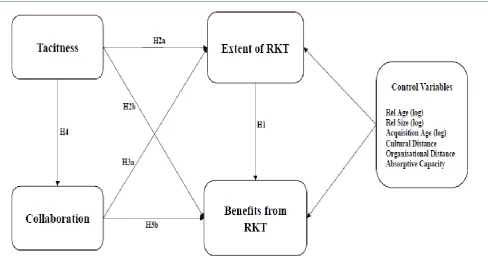
As shown in Figure 1, relationships between dimensions of tacitness, collaboration, the
extent of RKT and benefits from RKT in emerging market MNE subsidiaries are delineated in
a path model in which a series of control variables are also taken into account.
---
Figure 1: PLS Path Model
---
Research Methodology
Sample and Data Collection
The data for this study was collected using a questionnaire that was administered to the
managers of 329 Indian firms, who had engaged in overseas acquisitions between 2000 and
2010. The list of 329 MNEs were mainly compiled from two reports published by Federation
of Indian Chambers of Commerce and Industry (FICCI, 2006; FICCI and Grant Thornton,
2010) and supplemented by other press releases and reports. The MNEs with acquisitions
during the period 2000 to 2010 were selected because of the fact that there was a surge in the
15 by the rise in Outward Foreign Direct Investment during this period. Further, Indian MNEs
have shown a preference for more committed entry modes (mainly majority-owned
acquisitions) and developed countries in terms of location choices (Nair and Demirbag, 2015;
Pradhan, 2007; Sethi, 2009). The learning from such acquisitions has also been discussed
extensively in the literature (Buckley, Fosans and Munjal, 2012; Buckley et al., 2016b; Chittoor
and Ray, 2007; Elango and Pattnaik, 2007). Indian MNEs have thus left an impressive footprint
when it comes to their overseas acquisitions in the last decade and most of them in the
developed markets, indicating their focus on knowledge seeking pursuits.
The data collection phase ran for 6 months following which 114 responses were received, out
of which 101 were found to be useful, while the others had large amount of missing or invalid
data. This provided a firm level response rate of 31%. Services of research firms based in India
were utilised to identify potential respondent managers and establish contacts to administer the
surveys. The respondent managers were mainly senior managers (71%) in these MNEs, which
included CEOs, COOs, CIOs, VPs, GMs and Business Heads. Middle level managers who
responded to the survey (29%) included department or function heads. Extant literature
(Bjorkman, Barner-Rasmussen and Li, 2004; Gupta and Govindarajan, 2000; Simonin, 2004)
indicates that studies on KT have had heads of organisations or specific functions as
respondents, since they have a better overview about overseas operations of subsidiaries,
interactions and transactions with these subsidiaries and other post-integration activities. These
respondent managers had an average tenure of 9 years in their respective organisations. The
study further focusses on the recipient parent unit’s perspective (Ambos et al. 2006; Rabbiosi
2011), since they are best equipped to assess the extent of knowledge they have actually
received at their end and the benefits that such transfers have yielded (nodal study). The
16 (20%), IT & ITeS (17%), Automotive (12%), Chemicals & Fertilizers (11%) and Metals &
Mining (11%). The focal overseas subsidiaries were mainly from USA (32%), UK (19%),
Germany (9%), Canada (3%), Australia (2%), France (2%) and rest of Europe (18%). Thus
92% of the subsidiaries were from developed countries.
Non-response and Common Method Bias
To assess non-response bias, t-tests (independent sample) were conducted to check if the
respondent firms were any different from the non-respondent firms with respect to the main
firm level attributes such as age, revenue, and profit-loss (Ambos and Ambos, 2009). The tests
indicated that there were not any significant differences (at p ≤ .05). In order to reduce common
method bias, procedural remedies were incorporated (Chang, Witteloostuijn and Eden, 2010;
Podsakoff et al., 2003). This includes ensuring anonymity to all the respondents in the study
so that they could provide honest responses, thereby reducing chances of social desirability
bias. There was also a good mix of different response formats (Podsakoff et al., 2003) in the
questionnaire including open ended, fixed alternative and Likert scale questions. The
questionnaire was also provided with two sections, one requesting data on the parent unit and
the other on the focal subsidiary unit. The ordering of questions across these two sections was
done to ensure that potential linkages between the predictor and criterion variables were not
explicitly revealed. Post-hoc analysis using Harmans one-factor test was conducted, including
all the reflective variables from the questionnaire. It showed that no single factor emerged that
accounts for most of the variance (Williams, 2009).
Measures
As discussed earlier, this was a nodal study to capture RKT from the recipient EMNE parent
unit’s perspective. The scales to measure the constructs of this study have been adapted from
17 Agree). The respondents were asked to choose a focal subsidiary that they were most familiar
with, to provide their responses. Based on prior studies (Ambos, Ambos and Schlegelmilch,
2006; Gupta and Govindarajan, 2000), the different knowledge types to be considered for the
transfer were identified as technological know-how, marketing know-how and management
know-how. Technological knowledge plays a crucial role especially in manufacturing,
knowledge intensive and high-tech industries (Almeida, Song and Grant, 2002) and hence
many scholars have explored transfers with this type of knowledge (Simonin, 2004; Zander
and Kogut, 1995; Hakanson and Nobel, 2000). Similarly, the transfer of marketing knowledge
has also been the focus of several other studies (Monteiro, Arvidsson and Birkinshaw, 2008;
Simonin and Ozsomer, 2009). In addition to technological knowledge and marketing
knowledge, organisational knowledge encompasses management knowledge (Fey and Furu,
2008; Zhao and Anand, 2009) that deals mainly with management and competitive strategies
and relevant business models.
The extent of RKT was measured using a three item scale (Gupta and Govindarajan, 2000),
where the respondents were asked to rate the extent to which “the focal subsidiary provides
them with knowledge and skills related to technological know-how”. This question was then
repeated for the other two knowledge types (ERKT_tech, ERKT_marketing and ERKT_mgmnt
as referred to in Table 2) to form a three item scale. Organisational collaboration was measured
using a four item scale (Richey and Autry, 2009) which had the following questions i) Both
Parent and Subsidiary work together to share new ideas (Collab1) ii) Both Parent and
Subsidiary frequently share proprietary information with one another (Collab2) iii) Both Parent
and Subsidiary work together to take advantage of new opportunities (Collab3) iv) Both Parent
and Subsidiary work together toward common goals (Collab4). Tacitness was measured using
18 Arvidsson and Birkinshaw, 2008). The questions were i) A manual describing how your
subsidiary’s activities are executed could be documented (Tacit11, Tacit12 and Tacit13for the
three knowledge types) ii) New staff can easily learn how to perform the operations/services
that your subsidiary offers by talking to skilled employees (Tacit21, Tacit22 and Tacit23) iii)
Training new personnel in subsidiary’s operations/services is typically a quick and easy job
(Tacit31, Tacit32 and Tacit33) iv) New personnel with a university education can perform the
operations/services that our subsidiary offers (Tacit41, Tacit42 and Tacit43). The benefits from
RKT was measured using three item scale (Ambos, Ambos and Schlegelmilch, 2006), where
the respondents were asked to rate the “benefits from the knowledge and skills provided by the
subsidiary related to technological know-how”, which was then repeated for the other two
knowledge types (BRKT_tech, BRKT_marketing, BRKT_mgmnt as referred to in Table 2) to
form a three item scale.
The study has controlled for the effects of country level and firm level variables. The main firm
level controls are the relative size and age of the parent unit with respect to the subsidiary unit.
Size and age are some of the main firm level variables that influence KT (Van Wijk, Jansen
and Lyles, 2008). Acquisition age and organisational distance between the parent and the
subsidiary unit have also been controlled for in this study, based on prior studies (Simonin,
1999; Yang, Mudambi and Meyer, 2008). The logarithmic transformation of age, size and
acquisition age has been performed to address the skewness associated with this kind of data.
Cultural differences between source and recipient units are also likely to inhibit KT (Ambos,
Ambos and Schlegelmilch, 2006), and hence the cultural distance was also controlled for.
Using the approach by Kogut and Singh (1988), the four cultural dimensions (Hofstede, 1980)
were used to measure cultural distance.
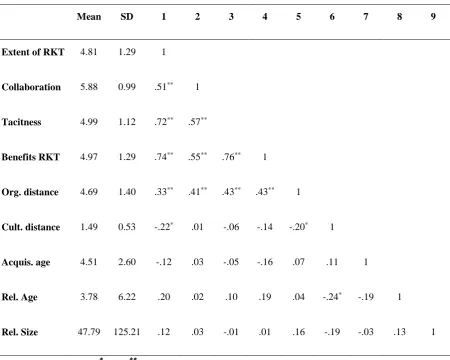
19 The correlations between the various constructs used in the study along with the mean and
standard deviation (from SPSS) have been presented in Table 1. Structural Equation Modelling
using Partial Least Squares (PLS) has been employed in this study using SmartPLS V3.0
(Ringle, Wende and Becker, 2015). This is a soft modelling technique and is variance based,
with many advantages (Cool, Dierickx and Jemison, 1989; Hair et al., 2012; Johansson and
Yip, 1994; Ringle, Sarstedt and Straub, 2012) that include i) flexibility with respect to the
assumptions on multivariate normality ii) usage of both reflective and formative indicators iii)
ability to analyse complex models using smaller samples iv) potential use as a predictive tool
for theory building. The analysis will be performed in two stages, the first being the assessment
of reliability and validity of the measurement model and the second the assessment of the
structural model (Hulland, 1999). This study uses PLS since it involves a relatively smaller
sample to analyse multiple paths that can be estimated simultaneously for the model as a whole.
---
Table 1
---
Measurement Model
The measurement model for this study has only reflective indicators and hence the reliability
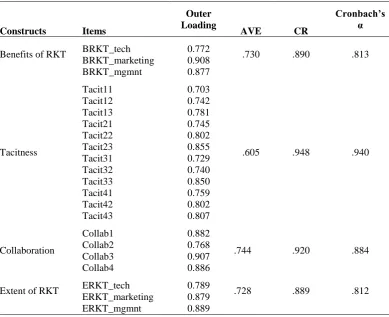
and the validity of all the latent constructs will be assessed. Table 2 provides the latent
constructs assessed along with the loading of the indicators (or manifest variables) on the
respective constructs, average variance (AVE), composite reliability (CR) and Cronbachs alpha
(α). The indicators should load the highest on their respective constructs when compared to the
other constructs (Chin, 1998), and the loading on the constructs should be > 0.55; these criteria
are satisfied and the loadings are all significant (p ≤ .001). This indicates the reliability of the
20 several criteria including Cronbach’s α ≥ 0.7 (Nunnally, 1978), CR ≥ 0.7 (Bagozzi and Yi,
1988) and AVE ≥ 0.5 (Bagozzi and Yi, 1988). These conditions have been satisfied for all the
latent constructs in this study as illustrated in Table 2. Fornell-Larcker criterion (Fornell and
Larcker, 1981) was used to assess discriminant validity. The heterotrait-monotrait ratio
(HTMT) of correlations was also assessed for testing discriminant validity. The HTMT ratio
of correlations were below 0.90 for all the reflective constructs used in the study (Henseler,
Ringle and Sarstedt, 2015). This was done by comparing construct’s correlation with other
constructs (correlation) and the construct’s correlation with its own indicators (square root of
AVE), with the former being less than the latter. This established discriminant validity for the
latent constructs in this study.
---
Table 2
---
Structural Model
The assessment of structural models in PLS is based on the R2 estimates, path coefficients and
their t-statistics. The predictive power of the model is estimated using R2 with values of .67,
0.33 and 0.19 indicating substantial, moderate and weak PLS models (Chin, 1998) respectively.
The strength of the relationship between the predictor and criterion variables is assessed using
the path coefficients and the significance of the same is provided by the t-statistics. PLS
requires a bootstrapping procedure to generate t-statistics (with sample = 2000) which in turn
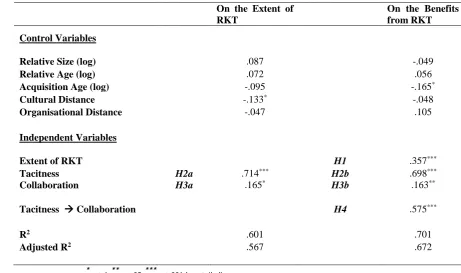
is used for hypotheses testing (Chin, 1998). The model is depicted in Figure 1 and Table 3
provides the R2 estimates, the corresponding path coefficients and their significance, for the
hypothesised relationships in this study. The R2 values indicate that model has adequate
21 variance in the dependent variables. The VIF (Variance Inflation Factor) values were also
checked for the presence of multi-collinearity and the values (< 10) suggest that this is not a
potential issue.
---
Table 3
---
The model analyses the effects of the identified determinants on the extent of RKT and the
benefits from RKT. The effect of tacitness was significant in both the models. However, a
negative relationship was hypothesised in H2a between tacitness of the target subsidiary
knowledge and extent of RKT as against the observed positive relationship (H2a, β = .714 at p
≤ .001). Hence there was no support for hypothesis H2a. The positive effect of tacitness on the
benefits from RKT was significant confirming the hypothesis (H2b, β = .698 at p ≤ .001). The
positive effects of collaboration have been established on both dimensions of RKT. The effect
of collaboration on the extent of RKT (H3a, β = .165 at p ≤ .1) and the benefits from RKT
(H3b, β = .163 at p ≤ .05) were significant. In addition, the positive effects of tacitness on
collaboration (H4, β = .575 at p ≤ .001) and the extent of RKT on benefits from RKT (H1, β =
.357 at p ≤ .001) have also been confirmed.
Discussion and Conclusions
This study examined the link between two key dimensions of RKT, namely the extent of RKT
and the benefits that parent units derive from the RKT. The study also focused on an important
strategic dimension of knowledge for the firm viz. tacitness and the level of organisational
collaboration that enable sharing of tacit knowledge in a joint model involving both the
22 Tacitness of knowledge is associated with difficulty to transfer (Simonin, 1999, 2004;
Szulanski, 1996), while the value of tacit knowledge is widely recognised as vital to the
competitive advantage of firms (Grant, 1996a). Firms have to balance the high costs involved
in the transfer of tacit knowledge with the expected unique and valuable benefits that they
derive from it. The results from this study indicate, surprisingly, that the extent of RKT
increases with the tacitness of the subsidiary knowledge. This indicates that EMNEs have
engaged more with RKT when they encountered tacit knowledge, since it is more difficult to
materialise such transfer. This is perhaps because of its high importance to their springboarding
(Luo and Tung, 2007) and ongoing learning (Mathews, 2006). This underscores their
commitment and their intent towards acquiring strategic knowledge assets, which is facilitated
by cross-border M&As. This is understandable because tacit knowledge, which is closely
linked to the experiences of their overseas subsidiaries, is essential to attain the much needed
competitive edge in global markets, which EMNEs lack as latecomers. Further, as expected,
the study reveals that tacitness of the subsidiary knowledge has a positive influence on the
benefits arising from RKT. The finding that tacit knowledge yields more benefits for the
EMNEs is in accordance with the KBV of the firm (Grant, 1996a). Indeed, one of the
advantages of acquisitions is the relative ease in absorbing tacit knowledge relative to arm’s
length relationships such as strategic alliances.
The positive relationship between the extent of RKT and benefits from RKT is another key
finding from this study. Prior studies have highlighted the fact that knowledge transferred may
not always benefit the recipient unit (Ambos, Ambos and Schlegelmilch, 2006). However, the
advantages emerging from cross-border KT cannot be overlooked. Gaining knowledge through
KT and the associated learning has been cited as the top three reasons for overseas acquisitions
(Kale, 2009), which suggests the potential benefits from these transfers. In the case of EMNEs,
23 global counterparts (Lou and Tung, 2007). In the context of this study, the results indicate that
EMNEs have been able to yield more benefits with greater extent of RKT. Further research
using case studies and in depth interviews could provide much needed insights into why
EMNEs’ benefits more with greater extent of RKT. Organisational mechanisms or other firm
level factors that could potentially mediate or moderate this relationship could also be identified
from such studies.
Collaboration between organisational units involved in a transfer has been found to have
significant positive influence on both the benefits from RKT and the extent of RKT. The social
capital perspective (Nahaphiet and Ghoshal, 1998; Tsai and Ghoshal, 1998), of which
collaboration is an important constituent element, stresses on the creation of shared meanings
and interpretations, and having common goals and shared identities, which are all conducive
to knowledge exchanges. For EMNEs, it is vital that they have organisational mechanisms that
foster personal interactions in order to create a collaborative environment, especially in view
of the cultural and organisational differences between the parent emerging market units and
their overseas subsidiary units. Further, when it comes to the transfer of tacit knowledge, such
personal interactions are most effective (Nonaka and Takeuchi, 1995). This has also been
empirically established by the results from this study, which indicate that EMNEs rely more
on collaborative efforts when dealing with tacit knowledge. Such collaborative efforts enable
the EMNEs to better integrate this incoming knowledge with their existing knowledge to be
able to create more value for themselves. This finding is thus in accordance with the social
capital perspective which postulates that collaborations create shared identity, common goals
and understanding between units, which is vital for sharing tacit knowledge. Hence the need to
rely more on collaborative engagements to transfer such tacit knowledge, which in turn could
24 could further uncover the mechanisms through which tacit knowledge is absorbed and
integrated within EMNEs.
The study has several implications for scholars and practitioners. Theoretically, the extant view
discusses the difficulty in transferring knowledge that is tacit in nature, which may impede
firms from engaging with these transfers. It is true that it could hamper conventional KT where
the main aim could be to engage the subsidiary in lower-end and labour-intensive operations.
In such cases, the parent could prefer to transfer knowledge that can be easily codified and
taught, and hence may deter from transferring tacit knowledge. However, in EMNE parent
units engaging in RKT, the main purpose is to tap into years of subsidiary experience and
expertise. Consequently, tacitness of the associated subsidiary knowledge may not be perceived
as a deterrent (although difficult, indicating they had to engage with more RKT to materialise
such transfers), because of its strategic value in their attempts to springboard their way to global
success. This study thus highlights the importance of the knowledge context and awareness of
knowledge attributes with regards to examining RKT, which has only received scant attention
in the extant literature.
The emerging market parent units have found this tacit knowledge residing with their overseas
subsidiaries to be beneficial as well. Hence this study also provides empirical support for the
much discussed knowledge seeking phenomenon of EMNEs, which is focussed on the
accelerated learning from their overseas subsidiaries. Unique to this study is also a joint model
that examines both the dimensions of RKT. The study shows that the more the emerging market
parent units engage in RKT, the more benefits they accrue, which further throws light on the
effectiveness of such transfers. This is particularly relevant since there could be situations when
considerable levels of knowledge are transferred but the recipient unit is unable to reap any
25 cumulatively from these transfers have been worthwhile. Thus this study extends our current
understanding of RKT. The study did not find any differential effects with respect to the two
dimensions. However, it also needs to be noted that when dealing with knowledge attributes
and other organisational mechanisms, their influence could be different on the various
dimensions. For example, it is possible that certain antecedents could have a greater impact on
the speed of the transfer, while others could influence the frequency of transfer more. This
makes it pertinent to have more studies that explore other multiple dimensions of KT based on
the antecedents that are being analysed. This study also sheds further light into the role of RKT
in bridging the asymmetries between different countries with varying levels of technological
development, skills and competencies.
The results from the study can inform managerial practices in terms of designing appropriate
organisational mechanisms that could potentially lead to knowledge transfers that are more
beneficial and effective. Managers responsible for KT need to be more aware of the nature of
the knowledge involved with the transfer and design their organisational mechanisms
accordingly. They need to understand that the knowledge embedded in the experience of their
competent overseas subsidiaries could be vital to the development of superior skills and
competencies that are extremely valuable for the entire MNE network. For MNEs, with
subsidiaries dispersed globally, tapping into this kind of knowledge could prove to be
extremely beneficial to other units within the MNE network since they could be transformed
into competitive capabilities and other positive outcomes like improved efficiency,
productivity and performance. Managers, especially from EMNEs, could focus more on
cross-border collaborative projects that could enable them to tap into the very valuable expertise of
their advanced subsidiaries, which in turn could help them realise their global ambitions. This
is possible by designing more joint projects across borders, task committees and knowledge
26 competent subsidiaries. Such collaborations could also help organisational units look beyond
their cultural and institutional differences towards developing common goals, mutual trust and
shared understanding, which is even more pertinent when it comes to sharing tacit knowledge.
This further strengthens relationships between the units leading to more knowledge transfers
which in turn leads to cumulative learning, preparing the units even better to utilise more of
such incoming knowledge.
Drawing from the KBV and the social capital perspective, this study reveals the links between
the two different dimensions of RKT and explores the effects of tacitness of target subsidiary
knowledge and collaboration on these dimensions. One of the limitations of this study is that it
has a cross-sectional design and hence would be unable to clearly establish the causalities. The
study is also nodal, which accounts for the parent perspective as the beneficial recipient unit.
A dyadic perspective, which includes the subsidiary perspective could lend more meaningful
insights into the process of RKT. It also needs to be noted that KT could be intentional or
unintentional (Mudambi, 2002) and is sometimes invisible to managers because it could also
materialise informally via employee networks (Whelan et al., 2011). These informal networks
could serve as alternative pathways to KT, with knowledge brokers and their networks playing
an important role in such transfers (Tsai and Ghoshal, 1998; Whelan et al., 2011). Hence further
studies that explore the mechanics of such networks and alternative pathways to KT can
enhance our understanding of how recipient units derive benefits from such transfers. The study
has been conducted in India, one of the emerging markets and hence generalising the findings
to other emerging markets has to be done cautiously because of the heterogeneous nature of
such markets. More studies in other emerging markets could also provide better insights into
28 Table 1: Correlation Table
Mean SD 1 2 3 4 5 6 7 8 9
Extent of RKT 4.81 1.29 1
Collaboration 5.88 0.99 .51** 1
Tacitness 4.99 1.12 .72** .57**
Benefits RKT 4.97 1.29 .74** .55** .76** 1
Org. distance 4.69 1.40 .33** .41** .43** .43** 1
Cult. distance 1.49 0.53 -.22* .01 -.06 -.14 -.20* 1
Acquis. age 4.51 2.60 -.12 .03 -.05 -.16 .07 .11 1
Rel. Age 3.78 6.22 .20 .02 .10 .19 .04 -.24* -.19 1
Rel. Size 47.79 125.21 .12 .03 -.01 .01 .16 -.19 -.03 .13 1
29 Table 2: Reliability and Validity of the Measurement Model
Constructs Items
Outer Loading
AVE CR
Cronbach’s α
Benefits of RKT BRKT_tech
BRKT_marketing BRKT_mgmnt
0.772 0.908 0.877
.730 .890 .813
Tacitness Tacit11 Tacit12 Tacit13 Tacit21 Tacit22 Tacit23 Tacit31 Tacit32 Tacit33 Tacit41 Tacit42 Tacit43 0.703 0.742 0.781 0.745 0.802 0.855 0.729 0.740 0.850 0.759 0.802 0.807
.605 .948 .940
Collaboration Collab1 Collab2 Collab3 Collab4 0.882 0.768 0.907 0.886
.744 .920 .884
Extent of RKT ERKT_tech
ERKT_marketing ERKT_mgmnt
0.789 0.879 0.889
.728 .889 .812
30 Table 3: PLS Path Coefficients (Total)
On the Extent of RKT
On the Benefits from RKT
Control Variables
Relative Size (log) .087 -.049
Relative Age (log) .072 .056
Acquisition Age (log) -.095 -.165*
Cultural Distance -.133* -.048
Organisational Distance -.047 .105
Independent Variables
Extent of RKT H1 .357***
Tacitness H2a .714*** H2b .698***
Collaboration H3a .165* H3b .163**
Tacitness Collaboration H4 .575***
R2 .601 .701
Adjusted R2 .567 .672
*
31
References
Alavi, M. and D. E. Leidner (2001). ‘Review: Knowledge Management and Knowledge
Management Systems: Conceptual Foundations and Research Issues’, MIS Quarterly, 25, pp.
107-136.
Almeida, P., J. Song and R. M. Grant (2002). ‘Are Firms Superior to Alliances and Markets?
An Empirical Test of Cross-Border Knowledge Building’, Organization Science, 13, pp. 147–
161.
Ambos, T. C. and B. Ambos (2009). ‘The impact of distance on knowledge transfer
effectiveness in multinational corporations’, Journal of International Management, 15, pp. 1–
14.
Ambos, T. C., B. Ambos and B. B. Schlegelmilch (2006). ‘Learning From Foreign
Subsidiaries: An Empirical Investigation of Headquarters’ Benefits from Reverse Knowledge
Transfers’, International Business Review, 15, pp. 294-312.
Argote, L. and P. Ingram (2000). ‘Knowledge Transfer: A Basis for Competitive Advantage in
Firms’, Organizational Behavior and Human Decision Processes, 82, pp. 150–169.
Awate, S., M. M. Larsen and R. Mudambi (2014). ‘Accessing vs sourcing knowledge: A
comparative study of R&D internationalization between emerging and advanced economy
firms’, Journal of International Business Studies, 46, pp. 63–86.
Bagozzi, R. P. and Y. Yi (1988). ‘On the evaluation of structural equation models’, Journal of
32 Bangara, A., S. Freeman and W. Schroder (2012). ‘Legitimacy and accelerated
internationalisation: An Indian perspective’, Journal of World Business, 47, pp. 623–634.
Barney, J. B. (1991). ‘Firm resources and sustainable competitive advantage’, Journal of
Management, 17, pp. 99–120.
Björkman, I., C. F. Fey and H. J. Park (2007). ‘Institutional theory and MNC subsidiary HRM
practices: Evidence from a three-country study’, Journal of International Business Studies, 38,
pp. 430-446.
Björkman, I., W. Barner-Rasmussen and L. Li (2004). ‘Managing Knowledge Transfer in
MNCs: The Impact of Headquarters Control Mechanisms’, Journal of International Business
Studies, 35, pp. 443-455.
Buckley, P. J., N. Forsans and S. Munjal (2012). ‘Host–home country linkages and host–home
country specific advantages as determinants of foreign acquisitions by Indian firms’.
International Business Review, 21, pp. 878-890.
Buckley, P. J., S. Munjal, P. Enderwick and N. Forsans (2016a). ‘Cross-border acquisitions by
Indian multinationals: Asset exploitation or asset augmentation?’, International Business
Review, 25, pp. 986-996.
Buckley, P. J., S. Munjal, P. Enderwick and N. Forsans (2016b). ‘The role of experiential and
non-experiential knowledge in cross-border acquisitions: The case of Indian multinational
33 Chang, S.-J., A. V. Witteloostuijn and L. Eden (2010). ‘From the Editors: Common Method
Variance in International Business Research’, Journal of International Business Studies, 41,
pp. 178-184.
Chin, W. W. (1998). ‘The partial least squares approach to structural equation modelling’. In
G. A. Marcoulides (eds), Modern methods for business research, pp. 295–336. New Jersey:
Lawrence Erlbaum Associates.
Chittoor, R. and S. Ray (2007). ‘Internalization Paths of Indian Pharmaceutical firms - A
strategic group analysis’, Journal of International Management, 13, pp. 338-355.
Cool, K., I. Dierickx and D. Jemison (1989). ‘Business Strategy, Market Structure and
Risk-Return Relationships: A Structural Approach’, Strategic Management Journal, 10, pp. 507-522.
D’Agostino, L. M. and G. D. Santangelo (2012). ‘Do Overseas R&D Laboratories in Emerging
Markets Contribute to Home Knowledge Creation? An Extension of the Double Diamond
Model’, Management International Review, 52, pp. 251–273.
Demirbag, M., and Yaprak, A.(Eds) (2015) Handbook of Emerging Market Multinational
Corporations, Chelthenham.
Denrell, J., N. Arvidsson and U. Zander (2004). ‘Managing knowledge in the dark: An
empirical study of the reliability of capability evaluations’, Management Science, 50, pp.
1491-1503.
Dhanaraj, C., M. A. Lyles, H. K. Steensma and L. Tihanyi (2004). ‘Managing Tacit and
Explicit Knowledge Transfer in IJVs: The Role of Relational Embeddedness and the Impact
34 Elango, B. and C. Pattnaik (2007). ‘Building capabilities for international operations through
networks: a study of Indian firms’, Journal of International Business Studies, 38, pp. 541–555.
Fey, C. F. and P. Furu (2008). ‘Top management incentive compensation and knowledge
sharing in multinational corporations’, Strategic Management Journal, 29, pp. 1301-1323.
FICCI (2006). Study conducted on 306 foreign acquisitions by Indian firms from January 2000
to June 2006.
FICCI and Grant Thornton (2010). Investing in the European Union – lists the M&A by Indian
MNEs in the European Union during 2005 to 2010.
Fornell, C. and D. F. Larcker (1981). ‘Evaluating Structural Equation Models with Unobserved
Variables and Measurement Error’, Journal of Marketing Research, 18, pp. 39-50.
Foss, N. J., C. Knudsen and C. A. Montgomery (1995). ‘An exploration of common ground:
Integrating evolutionary and strategic theories of the firm’. In C. A. Montgomery (eds),
Resource-Based and Evolutionary Theories of the Firm, pp. 1-17. London: Kluwer.
Frost, T. S. and C. Zhou (2005). ‘R&D Co-Practice and 'Reverse' Knowledge Integration in
Multinational Firms’, Journal of International Business Studies, 36, pp. 676-687.
Giuliani, E., S. Gorgoni, C. Gunther and R. Rabellotti (2014). ‘Emerging versus advanced
country MNEs investing in Europe: A typology of subsidiary global–local connections’,
International Business Review, 23, pp. 680–691.
Grant, R. M. (1996a). ‘Toward a Knowledge-Based Theory of the Firm’, Strategic
35 Grant, R. M. (1996b). ‘Prospering in Dynamically-Competitive Environments: Organizational
Capability as Knowledge Integration’, Organization Science, 7, pp. 375-387.
Gupta, A. K. and V. Govindarajan (2000). ‘Knowledge Flows within Multinational
Corporations’, Strategic Management Journal, 21, pp. 473-496.
Hair, J. F., M. Sarstedt, C. M. Ringle and J. A. Mena (2012). ‘An assessment of the use of
partial least squares structural equation modeling in marketing research’, Journal of the
Academy of Marketing Science, 40, pp. 414–433.
Hakanson, L. and R. Nobel (2000). ‘Technology Characteristics and Reverse Technology
Transfer’, Management International Review, 40, pp. 29-48.
Hakanson, L. and R. Nobel (2001). ‘Organizational Characteristics and Reverse Technology
Transfer’, Management International Review, 41, pp. 395-420.
Henseler, J., C. M. Ringle and M. Sarstedt (2015). ‘A New Criterion for Assessing
Discriminant Validity in Variance-based Structural Equation Modeling’, Journal of the
Academy of Marketing Science, 43, pp. 115-135.
Hofstede, G. (1980). Culture’s consequences. Beverly Hills: Sage.
Hulland, J. (1999). ‘Use of Partial Least Squares (PLS) in Strategic Management Research: A
Review of Four Recent Studies’, Strategic Management Journal, 20, pp. 195-20.
Johansson, J. K. and G. S. Yip (1994). ‘Exploiting Globalization Potential: U.S. and Japanese
36 Jormanainen, I. and A. Koveshnikov (2012). ‘International Activities of Emerging Market
Firms A Critical Assessment of Research in Top International Management Journals’,
Management International Review, 52, pp. 691–725.
Kale, P. (2009). ‘The Global Indian Firm: Growth Value Creation through Overseas
Acquisitions’, The Indian Journal of Industrial Relations, 45, pp. 41-53.
Kedia, B., N. Gaffney and J. Clampit (2012). ‘EMNEs and Knowledge-seeking FDI’,
Management International Review, 52, pp. 155–173.
Khan, Z. and J. D. Nicholson (2014). ‘An investigation of the cross-border supplier
development process: Problems and implications in an emerging economy’, International
Business Review, 23, pp. 1212–1222.
Kogut, B. and H. Singh (1988). ‘The effect of national culture on the choice of entry mode’,
Journal of International Business Studies, 19, pp. 411–432.
Kogut, B. and U. Zander (1992). ‘Knowledge of the firm, combinative capabilities, and the
replication of technology’, Organization Science, 3, pp. 383-397.
Kogut, B. and U. Zander (1993). ‘Knowledge of the firm and the evolutionary theory of the
Multinational Corporation’, Journal of International Business Studies, 24, pp. 625-645.
Lee, H. and B. Choi (2003). ‘Knowledge management enablers, processes, and organizational
performance: an integrative review and empirical examination’, Journal of Management
37 Li, L. (2005). ‘The effects of trust and shared vision on inward knowledge transfer in
subsidiaries’ intra- and inter-organizational relationships’, International Business Review, 14,
pp. 77–95.
Li, L., W. Barner-Rasmussen and I. Bjorkman (2007). ‘What Difference Does the Location
Make?: A Social Capital Perspective on Transfer of Knowledge from Multinational
Corporation Subsidiaries Located in China and Finland’, Asia Pacific Business Review, 13,
pp. 233-249.
Luo, Y. and R. L. Tung (2007). ‘International expansion of emerging market enterprises: A
springboard perspective’, Journal of International Business Studies, 38, pp. 481–498.
Lyles, M. A. and J. E. Salk (1996). ‘Knowledge Acquisition from Foreign Parents in
International Joint Ventures: An Empirical Examination in the Hungarian Context’, Journal of
International Business Studies, 27, pp. 877-903.
Mahnke, V., T. Pedersen and M. Venzin (2005). ‘The Impact of Knowledge Management on
MNC Subsidiary Performance: The Role of Absorptive Capacity’, Management International
Review, 2, pp. 101-119.
Mathews, J. A. (2006). ‘Dragon multinationals: New players in 21st century globalization’,
Asia Pacific Journal of Management, 23, pp. 5–27.
McGuinness, M., Demirbag, M., and Bandara, S. (2013) Towards a multi-perspective model
of reverse knowledge transfer in multinational enterprises: A case study of Coats plc, European