warwick.ac.uk/lib-publications
Original citation:Kohen, Daniel, Pacetti, Ariel and Masdeu, Marc. (2016) On Heegner Points for primes of additive reduction ramifying in the base field. Transactions of the American Mathematical Society.
Permanent WRAP URL:
http://wrap.warwick.ac.uk/80295
Copyright and reuse:
The Warwick Research Archive Portal (WRAP) makes this work by researchers of the University of Warwick available open access under the following conditions. Copyright © and all moral rights to the version of the paper presented here belong to the individual author(s) and/or other copyright owners. To the extent reasonable and practicable the material made available in WRAP has been checked for eligibility before being made available.
Copies of full items can be used for personal research or study, educational, or not-for-profit purposes without prior permission or charge. Provided that the authors, title and full
bibliographic details are credited, a hyperlink and/or URL is given for the original metadata page and the content is not changed in any way.
Publisher’s statement:
First published in Transactions of the American Mathematical Society. published by the American Mathematical Society. © 2016 American Mathematical Society.
https://doi.org/10.1090/tran/6990
A note on versions:
The version presented here may differ from the published version or, version of record, if you wish to cite this item you are advised to consult the publisher’s version. Please see the ‘permanent WRAP URL’ above for details on accessing the published version and note that access may require a subscription.
arXiv:1505.08059v2 [math.NT] 11 May 2016
REDUCTION RAMIFYING IN THE BASE FIELD
DANIEL KOHEN AND ARIEL PACETTI
with an Appendix by Marc Masdeu
Abstract. LetE be a rational elliptic curve, andK be an imaginary quadratic field. In this article we give a method to construct Heegner points when E has a prime bigger than 3 of additive reduction ramifying in the field K. The ideas apply to more general contexts, like constructing Darmon points attached to real quadratic fields which is presented in the appendix.
Introduction
Heegner points play a crucial role in our nowadays understanding of the Birch and Swinnerton-Dyer conjecture, and are the only instances where non-torsion points can be constructed in a systematic way for elliptic curves over totally real fields (assuming some still unproven modularity hypotheses). Although Heegner points were heavily studied for many years, most applications work under the so called “Heegner hypothesis” which gives a sufficient condition for an explicit construction to hold. In general, if E is an elliptic curve over a number field F and K/F is any quadratic extension, the following should be true.
Conjecture: If sign(E, K) = −1, then there is a non-trivial Heegner system at-tached to (E, K).
This is stated as Conjecture 3.16 in [Dar04]. When F =Q, E is an elliptic curve of square-free conductorN andK is an imaginary quadratic field whose discriminant is prime to N, the conjecture is proven in Darmon’s book ([Dar04]) using both the modular curve X0(N) and other Shimura curves. The hypotheses on N andK were
relaxed by Zhang in [Zha01], who proved the conjecture under the assumption that if a prime pramifies in K then p2 ∤N.
2010Mathematics Subject Classification. Primary: 11G05, Secondary: 11G40.
Key words and phrases. Heegner points.
DK was partially supported by a CONICET doctoral fellowship.
AP was partially supported by CONICET PIP 2010-2012 11220090100801, ANPCyT PICT-2013-0294 and UBACyT 2014-2017-20020130100143BA.
When the curve is not semistable at some prime pthe situation is quite more deli-cate. An interesting phenomenon is that in this situation, the local root number atp
has no relation with the factorization ofp inK. Still the problem has a positive an-swer in full generality, due to the recent results of [YZZ13], where instead of working with the classical group Γ0(N), they deal with more general arithmetic groups. The
purpose of this article is to give “explicit” constructions of Heegner points for pairs (E, K) as above. Here by explicit we mean that we can compute numerically the theoretical points in the corresponding ring class field, which restricts us to working only with unramified quaternion algebras (since the modular parametrization is hard to compute for Shimura curves). For computational simplicity we will also restrict the base field to the field of rational numbers.
Let χ:K×\K×
A →C× be a finite order anticyclotomic Hecke character, and η be
the character corresponding to the quadratic extension K/Q. In order to construct a Heegner point attached to χ in a matrix algebra, for each prime number p the following condition must hold
ǫ(πp, χp) =χp(−1)ηp(−1),
where π is the automorphic representation attached to E, andǫ(πp, χp) is the local root number of L(s, π, χ) (see [YZZ13, Section 1.3.2]). If we impose the extra con-dition gcd(cond(χ), Ncond(η)) = 1, then at primes dividing the conductor of E/K
the equation becomes
εp(E/K) =ηp(−1),
whereεp(E/K) is the local root number atpof the base change ofE toK (it is equal to εp(E)εp(E⊗η)). This root number is easy to compute if p6= 2,3 (see [Pac13]):
• Ifp is unramified in K, then ηp(−1) = 1 and
εp(E/K) =
1 if vp(N) = 0,
p
disc(K)
if vp(N) = 1,
1 if vp(N) = 2,
• Ifp is ramified in K then ηp(−1) =−1
p
and
εp(E/K) =
−1
p
·
1 if vp(N) = 0,
εp(E) if vp(N) = 1,
εp(Ep) if vp(NEp) = 1,
1 if E is P.S.,
−1 if E is S.C.,
whereEp denotes the quadratic twist ofE by the unique quadratic extension of Q unramified outside p;E is P.S. if the attached automorphic representa-tion is a ramified principal series (which is equivalent to the condirepresenta-tion thatE
acquires good reduction over an abelian extension ofQp) and E is S.C. if the
attached automorphic representation is supercuspidal at p (which is equiv-alent to the condition that E acquires good reduction over a non-abelian extension).
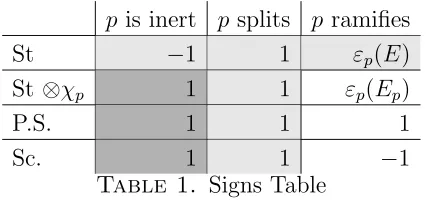
Let E/Q be an elliptic curve. We call it Steinberg at a prime p if E has multi-plicative reduction at p (and denote it by St.). In Table 1 we summarize the above equations for p6= 2,3, where the sign corresponds to the product εp(E/K)ηp(−1).
p is inert p splits pramifies St −1 1 εp(E) St ⊗χp 1 1 εp(Ep)
P.S. 1 1 1
[image:4.612.101.409.96.222.2] [image:4.612.182.395.379.479.2]Sc. 1 1 −1
Table 1. Signs Table
Our goal is to give an explicit construction in all cases where the local sign of Table 1 equals +1. The cells colored in light grey correspond to the classical con-struction, and the ones colored with dark grey are considered in the article [KP15]. In the present article we will consider the following cases:
• E has additive but potentially multiplicative reduction, and εp(Ep) = +1.
• E has additive but potentially good reduction over an abelian extension.
Remark. The situation for p = 2 and p = 3 is more delicate, although most cases can be solved with the same ideas. For the rest of this article we assume p > 3.
can transfer the Heegner points back to our original elliptic curve. To clarify the exposition, we start assuming that there is only one prime p ramifying in K where our curve has additive reduction, and every other prime q dividing N is split in K. The geometric object we consider is the following:
• IfE has potentially multiplicative reduction, we consider the elliptic curveEp
of conductor N/p which is the quadratic twist of E by the unique quadratic character ramified only at p.
• If E has potentially good reduction over an abelian extension, then we con-sider an abelian surface of conductor N/p, which is attached to a pair (g,g¯), whereg is the newform of level N/p corresponding to a twist of the weight 2 modular form Ef attached to E.
In both cases the classical Heegner hypothesis is satisfied (eventually for dimension greater than one), and the resulting abelian varieties are isogenous to our curve or to a product of the curve with itself over some field extension. Such isogeny is the key to relate the classical construction to the new cases considered. Each case has a different construction/proof (so they will be treated separately), but both follow the same idea. In all cases considered we will construct points on (E(Hc)⊗C)χ. These
points will be non-torsion if an only if L′(E/K, χ,1)6= 0 as expected by the results of Gross-Zagier [GZ86] and Zhang [Zha01].
Our construction is interesting on its own, and can be used to move from a delicate situation to a not so bad one (reducing the conductor of the curve at the cost of adding a character in some cases). So, despite we focus on classical modular curves, the methods of this article can be easily applied to a wide variety of contexts, for example more general Shimura curves.
In recent years, following a breakthrough idea of Darmon there has been a lot of work in the direction of defining and computing p-adic Darmon points, which are points defined over certain ring class fields of real quadratic extensions using p-adic methods. For references to this circle of ideas the reader can consult [Dar04], [Dar01], [BD09], [BD07]. These construction are mostly conjectural (but see [BD09]), and there has been a lot of effort to explicitly compute p-adic approximations to these points in order to gather numerical evidence supporting these conjectures. The interested reader might consult [DP06], [Gre09], [GM15], [GMS¸15], [GMS¸16].
In order to illustrate the decoupling of our techniques from the algebraic origin of the points, in an appendix by Marc Masdeu it is shown how these can be applied to the computation of p-adic Darmon points.
extend the result to general conductors and in the fourth section we finish the article with some explicit examples in the modular curves setting, including Cartan non-split curves, as in [KP15]. Lastly, we include the aforementioned appendix.
Acknowledgments: We would like to thank Henri Darmon for many comments and suggestions regarding the present article and Marc Masdeu for his great help and contributions to this project. We would also like to thank the Special Semester “Computational aspects of the Langlands program” held at ICERM for providing a great atmosphere for working on this subject. Finally, we would like to thank the referee for the useful remarks.
1. The potentially multiplicative case
Let E/Q be an elliptic curve of conductor p2 ·m where p is an odd prime and
gcd(p, m) = 1. Suppose thatE has potentially multiplicative reduction at the prime
p. Let K be any imaginary quadratic field satisfying the Heegner hypothesis at all the primes dividing m and such that p is ramified in K. Let p∗ = −1
p
p and let
Ep be the quadratic twist of E by Q(√p∗). We have an isomorphism φ : Ep → E defined over Q(√p∗). The elliptic curve Ep has conductor p·m and sign(E, K) = sign(Ep, K)εp(Ep).
Recall that to have explicit constructions, we need to work with a matrix algebra so we impose the conditionεp(Ep) = 1 (see Table 1). Then, sign(E, K) = sign(Ep, K) =
−1 and the pair (Ep, K) satisfies the Heegner condition. Therefore, we can find Heegner points on Ep and map them to E via φ. More precisely, letc be a positive integer relatively prime toN·disc(K) and letHc be the ring class field associated to
the order of conductor c in the ring of integers of K. Let χ : Gal(Hc/K)→ C× be
any character and let χp be the quadratic character associated to Q(√p∗) via class field theory. Take a Heegner point Pc ∈Ep(Hc) and consider the point
Pχχp
c =
X
σ∈Gal(Hc/K) ¯
χχp¯(σ)Pcσ ∈(Ep(Hc)⊗C)χχp.
Theorem 1.1. The point φ(Pχχp
c ) belongs to (E(Hc)⊗C)χ and it is non-torsion if
and only if L′(E/K, χ,1)6= 0.
Proof. The key point is that since p|disc(K), Q(√p∗)⊂Hc (by genus theory). For
σ ∈Gal( ¯Q/Q), we have φσ =χp(σ)φ, hence,
φ(Pχχp c ) =
X
σ
¯
Finally note that by the Theorems of Gross-Zagier [GZ86] and Zhang [Zha01] the point Pχχp
c is non-torsion if and only if L′(Ep/K, χχp,1) =L′(E/K, χ,1)6= 0. Since φ is an isomorphism the result follows.
2. The potentially good case (over an abelian extension)
Let E/Q be an elliptic curve of conductor p2 ·m where p is an odd prime and
gcd(p, m) = 1. For simplicity assume that E does not have complex multiplication. We recall some generalities on elliptic curves with additive but potentially good re-duction over an abelian extension. Although such results can be stated and explained using the theory of elliptic curves, we believe that a representation theoretical ap-proach is more general and clear. Let fE denote the weight 2 newform corresponding to E.
Let W(Qp) be the Weil group of Qp, and ω1 be the unramified quasi-character
giving the action of W(Qp) on the roots of unity. Using the normalization given by
Carayol ([Car86]), at the prime p the Weil-Deligne representation corresponds to a principal series representation on the automorphic side and to a representation
ρp(f) =ψ⊕ψ−1ω1−1,
on the Galois side for some quasi-character ψ :W(Qp)ab →C×. Note that since the
trace lies in Q, ψ satisfies a quadratic relation, hence its image lies in a quadratic field contained in a cyclotomic extension (since ψ has finite order). This gives the following possibilities for the order of inertia of ψ: 1, 2, 3, 4 or 6.
• Clearly ψ cannot have order 1 (since otherwise the representation is unrami-fied atp).
• If ψ has order 2, ψ must be the (unique) quadratic character ramified at
p. Then E is the twist of an unramified principal series, i.e., Ep has good reduction atp.
• If ψ has order 3, 4 or 6, there exists a newform g ∈ S2(Γ0(p·m), ε), where
ε=ψ−2, such that fE =g⊗ψ. In particular ε has always order 2 or 3.
In the last case, the form has inner twists, since the Fourier coefficients satisfy that
ap =apε−1(p) (see for example [Rib77, Proposition 3.2]).
Remark 2.1. The newform g can be taken to be the same for E and Ep.
2.2. The caseψhas order3,4or6. Letdbe the order ofψ. Letg ∈S2(Γ0(p·m), ε)
as before. Suppose its q-expansion at the infinity cusp is given by g =P
anqn.
Fol-lowing [Rib04], we define the coefficient field Kg :=Q({an}).
Remark 2.2. Kg is an imaginary quadratic field generated by the values of ψ. It is equal to Q(i) ifd = 4 and toQ(√−3) if d= 3 ord = 6.
There is an abelian varietyAg defined overQattached tog via the Eichler-Shimura construction, with an action of Kg on it, i.e. there is an embedding θ : Kg ֒→
(EndQ(Ag)⊗Q). The varietyAg can be defined as the quotient J1(p·m)/IgJ1(p·m)
where Ig is the annihilator of g under the Hecke algebra acting on the Jacobian. Moreover, the L-series of Ag satisfies the relation
L(Ag/Q, s) = L(g, s)L(g, s).
The variety Ag has dimension [Kg : Q] = 2 and is Q-simple. However, it is not absolutely simple. The variety Ag is isogenous over Q to the square of an elliptic curve (called a building block for Ag, see [GL01] for the general theory).
Under our hypotheses we have an explicit description. Let L = Qker(ε) (which is the splitting field of Ag). It is a cubic extension if d = 3,6 (and in particular p ≡1 (mod 3)) and the quadratic extensionQ(√p) ifd= 4 (which impliesp≡1 (mod 4)). Let M be the extension Qker(ψ).
Proposition 2.3. • There exists an elliptic curveE/L˜ and an isogeny, defined over L, ω : Ag → E˜2. Furthermore, if d = 3 (resp. d = 6) ˜E = E (resp.
˜
E =Ep) while if d = 4, E˜ is the quadratic twist of E/Q(√p) by the unique quadratic extension unramified outside p.
• In any case, there exists an isogeny ϕ:Ag →E2 defined over M.
Proof. Ag ≃ E2 over M because (on the representation side) the twist becomes
trivial while restricted to M, so the L-series of Ag becomes the square of that of E
(over such field) and by Falting’s isogeny Theorem there exists an isogeny (defined over M). If d = 3, ε = ψ2 and M = L, while if d = 6, starting with E
p (whose
character has order 3) gives the result. If d = 4, it is clear (on the representation side) that L(Ag, s) = L( ˜E, s) over L, where ˜E is the twist of E (while looked over
¯
Qker(ε) = Q(√p)) by the quadratic character ψ2. Then Falting’s isogeny Theorem
proves the claim.
Proposition 2.4. Let σ ∈ Gal( ¯Q/Q). Then ϕσ : Ag → E2 is equal to ϕκ(σ|
M),
where κ is some character of Gal(M/Q) of order [M :Q].
Proof. Since ϕ and ϕσ are isogenies of the same degree there exists an element aσ ∈
End(Ag)⊗Q=Kg of norm 1 such that ϕσ =ϕaσ. The map κ(−|
K×
g , given by sending κ(σ|M) 7→ aσ is a character, since the endomorphism aσ is
defined over Q. Clearly κ has the predicted order since otherwise the isogeny ϕ
could be defined over a smaller extension (given by the fixed field of its kernel),
which is not possible.
In order to explicitly compute Heegner points it is crucial to have a better under-standing of the isogenies ω and ϕ. Let us recall some basic properties of Atkin-Li operators for modular forms with nebentypus, as explained in [AL78]. Let N be a positive integer, and let P | N be such that gcd(P, N/P) = 1. Let N′ = N
P and
de-compose ε =εPεN′, where each character is supported in the set of primes dividing the sub-index.
Theorem 2.5. Assuming the previous hypotheses, there exists an operator WP :
S2(Γ0(N), ε)→S2(Γ0(N), εPεN′) which satisfies the following properties:
• W2
P =εP(−1)εN′(P).
• If g is an eigenvector for Tq for some prime q ∤ N with eigenvalue aq, then
Wp(g)is an eigenvector for Tq with eigenvalue εP(q)aq.
• If g ∈ S2(Γ0(N), ε) is a newform, then there exists another newform h ∈
S2(Γ0(N), εPεN) and a constant λP(g) such that WP(g) = λP(g)h.
• The number λP(g) is an algebraic number of absolute value 1. Furthermore, if aP, the P-th Fourier coefficient of the newform g, is non-zero then
λP(g) =G(εP)/aP,
where G(χ) denotes the Gauss sum of the character χ.
The number λP(g) is called the pseudo-eigenvalue of WP atg.
Proof. See [AL78, Propositions 1.1, 1.2, and Theorems 1.1 and 2.1].
In our setting N = p ·m, P = p, εN′ is trivial, and Wp is an involution (i.e.
W2
p = 1) acting on the differential forms of Ag.
If η is an endomorphism of J(Γ1(N)) (or one of its quotients), we denote η∗
the pullback it induces on the differential forms. Given an integer u let αu be the endomorphism of J(Γ1(N)) corresponding to the action of the matrix 10 1u/p
on differential forms. Such endomorphism is defined over the cyclotomic field of p-th roots of unity.
Let τ ∈ Gal(Kg/Q) denote complex conjugation. Recall that τ aq = aqε−1(q) for
all positive integers q prime to p·m. Following [Rib80] we define
ητ = X
u(modp)
ε(u)αu.
Lemma 2.6. The element ap has norm p.
Proof. Looking at the curve E over Qp, the coefficient ap is one of the roots of the
characteristic polynomial attached to the Frobenius element in the minimal (totally ramified) extension where E acquires good reduction (see for example Section 3 of [DD11]). Since the norm of the local uniformizer in such extension is p(because the extension ramifies completely) the result follows.
We then consider the normalized endomorphism ητ ap.
Remark 2.7. Our choice is a particular case of the one considered in [GL01], since our normalization corresponds to the splitting map β : Gal(Kg/Q) → K×
g given by β(τ) =ap.
Theorem 2.8. The operatorWp coincides with ητ ap
∗
.
Proof. It is enough to see how it acts on the basis {g, g} of differential forms of Ag. By Theorem 2.5 (since ap is non-zero), Wp(g) = λpg, where λp = G(ε)/ap. On the other hand, ητ(f) = G(ε)f, by [GL01, Lemma 2.1]. Exactly the same argument applies to g, using the fact that G(ε) =G(ε), since ε is an even character. Corollary 2.9. The Atkin-Li operatorWp is defined overL, i.e. it corresponds to an element inEndL(Ag)⊗Q. Its action decomposes as a direct sum of two1-dimensional
spaces.
Let
ω :Ag →(Wp + 1)Ag×(Wp−1)Ag.
Then both terms are 1-dimensional, and the isogeny ω gives a splitting as in Propo-sition 2.3.
Remark 2.10. The explicit map ω satisfies the first statement of Proposition 2.3. In order to get the second statement we need to eventually compose it the isomorphism between ˜E and E. Recall that E = ˜E if d = 3 and ˜E is a quadratic twist of it otherwise, so in any case the isomorphism is easily computed.
2.3. Heegner points. This section follows Section 4 of [DRZ12], so we suggest the reader to look at it first. Keeping the notations of the previous sections, let
ε : (Z/p)× → C× be a Dirichlet character. Extend the character to (Z/p·m)× by composing with the canonical projection (Z/p·m)×→(Z/p)× and define
Γε0(p·m) := {(a b
c d)∈ Γ0(p·m) :ε(a) = 1}.
LetXε
0(p·m) be the modular curve obtained as the quotient of the extended upper
• E is an elliptic curve over C,
• Q is a point of order m onE(C),
• C is a cyclic subgroup ofE(C) of order p,
• [s] is an orbit in C\ {0} under the action of ker(ε)⊂(Z/p)×.
Remark 2.11. There is a canonical map Φ : X0ε(p· m) → X0(p·m) which is the
forgetful map in the moduli interpretation. This map has degree ord(ε).
As in the classical case, there exists a modular parametrization
Xε
0(p·m)
Φ
Ψ //
Ψg
3
3
Jac(Xε
0(p·m))
π // Ag
X0(p·m)
5
5
where Ψ(P) = (P)−(∞) (the usual immersion of the curve in its Jacobian) and π
is the Eichler-Shimura projection onto Ag. These maps are defined over Q, as the cusp ∞ is rational. Our strategy is to construct Heegner points on Xε
0(p·m) and
push them through the modular parametrization Ψg to the abelian variety Ag and
finally project them onto the elliptic curve E. To construct points on Xε
0(p·m), we
consider the canonical map
Φ :X0ε(p·m)→X0(p·m),
and look at preimages of classical Heegner points on X0(p·m).
Since the conductor p·m satisfies the classical Heegner hypothesis with respect to K there is a cyclic ideal n of norm p·m. Let c be a positive integer such that
gcd(c, p·m) = 1. Then, a classical Heegner point onX0(p·m) corresponds to a triple
Pa = (Oc,n,[a])∈X0(p·m)(Hc), where [a]∈Pic(Oc). Such point is represented by
the elliptic curve Ea =C/a and its n torsion points Ea[n] (which are isomorphic to
(an−1/a)) are defined over Hc.
The action of Gal(Q/Hc) on Ea[n] gives a map Gal(Q/Hc) → (an−1/a)×.
Com-posing such map with the character ε gives
ρ: Gal(Q/Hc)→(an−1/a)×→ε C×.
Its kernel corresponds to an extension ˜Hc of degree ord(ε) of Hc. Let ˜Hc =HcM.
Proposition 2.12. Theord(ε)points Φ−1(P
a)lie in X0ε(p·m)( ˜Hc)and are permuted
under the action of Gal( ˜Hc/Hc).
Proof. By complex multiplication ˜Hc lies in the composition ofHc and the ray class field Kp, where pis the unique prime ofK dividing p. The composition HcKp equals
Hc/K is unramified at p. Therefore, the unique extension of degree ord(ε) of Hc
lying inside H(ξp) is given by HcQ¯ker(ψ) =HcM.
Using the aforementioned moduli interpretation, points on Xε
0(p· m) represent
quadruples (Oc,n,[a],[t]) where [t] is an orbit under ker(ε) inside (Oc/(n/p))×.
Remark 2.13. Let σ∈Gal( ˜Hc/K). Its action on Heegner points is given by σ·(Oc,n,[a],[t]) = (Oc,n,[ab−1],[dt]),
where σ |Hc= Frobb, and d=ρ(σ)∈Oc/(n/p) ×.
2.4. Zhang’s formula.
Theorem 2.14 (Tian-Yuan-Zhang-Zhang). Let K be an imaginary quadratic field satisfying the Heegner hypothesis for p·m and let χ˜ : A×
K → C× be a finite order
Hecke character such thatχ˜|A×
Q=ε
−1. ThenL(g,χ, s˜ )vanishes at odd order ats= 1.
Moreover, if such order equals 1, (Ag( ˜Hc))⊗C))χ˜ has rank one over Kg⊗C.
More precisely, consider the Heegner point ([a],n,1)∈ Xε
0(p·m)( ˜Hc) and denote
by Pc its image under the modular parametrization Ψg. Then
Pχ˜ = X
σ∈Gal( ˜Hc/K) ¯˜
χ(σ)Pcσ ∈(Ag( ˜Hc)⊗C)χ˜
generates a rank one subgroup over Kg⊗C.
Proof. See [TZ03, Theorem 4.3.1], [Zha10], and [YZZ13, Theorem 1.4.1].
Let c be a positive integer relatively prime to disc(K)·p·m, and let χ be a ring class character of Gal(Hc/K). Since ¯κ2 = ε±1, the character ˜χ : Gal( ˜Hc/K) → C× given by ˜χ=χκ¯satisfies the hypothesis of Theorem 2.14 (for eitherg or its conjugate ¯
g). Summing up, we get the following theorem:
Theorem 2.15. The point ϕ(Pχ¯κ) belongs to (E2(Hc ⊗C))χ. In addition, it is
non-torsion if and only if L′(E/K, χ,1)6= 0.
Proof. By definition and Proposition 2.4.
ϕ(Pχκ¯) = X
σ∈Gal( ˜Hc/K) ¯
χ(σ)ϕ(κ(σ)Pσ) = X
σ∈Gal( ˜Hc/K) ¯
χ(σ)ϕ(P)σ,
so it lies in the right space. Since ord(κ) = ord(ψ) and ¯κ2 = ε±1 we get ¯κ = ψ±1.
We know that g⊗ψ = ¯g⊗ψ−1 =fE, therefore, using g or ¯g, we obtain L(g,χ, s˜ ) =
L(E, χ, s). Theorem 2.14 and the previous result imply thatϕ(Pχ¯κ)∈(E2(Hc⊗C))χ
2.5. Heegner systems. As in the classical case, the family of Heegner points con-structed using different orders satisfy certain compatibilities.
Proposition 2.16. Let ℓ be a prime such that ℓ ∤N and ℓ is inert in K. Then for every Heegner point Pcℓ ∈Ag( ˜Hcℓ) there exists a Heegner point Pc ∈Ag( ˜Hc) with
(1) TrH˜cℓ/H˜cPcℓ=θ(aℓ)Pc,
where aℓ is the ℓ-th Fourier coefficient of g.
Proof. The proof mimics the classical case one (see [Gro91, Proposition 3.7]).
To construct a point on E, we first apply the isogeny ϕ to a point in Ag and then project onto one of the coordinates (call πi the projection to the i-th coordinate).
But Kg does not act onE! To overcome this problem, we restrict to primesℓ which split completely in L. Let Qc :=πi(TrH˜c/Hcϕ(Pc))∈E(Hc).
Proposition 2.17. Let ℓ be a prime such that ℓ ∤ N, ℓ is inert in K and ℓ splits completely in L. Then for every Heegner point Qcℓ ∈E(Hcℓ) there exists a Heegner point Qc ∈E(Hc) such that
TrHcℓ/HcQcℓ =aℓQc.
Proof. Applyingπi(TrH˜c/Hcϕ) to equation (1), since ϕ commutes with the trace and
aℓ ∈Q (because ℓ splits completely in L) we get
πi(TrH˜c/HcTrH˜cℓ/H˜cϕ(Pcℓ)) =aℓQc.
Also
πi(TrH˜c/HcTrH˜cℓ/H˜cϕ(Pcℓ)) =πi(TrHcℓ/HcTrH˜cℓ/Hcℓϕ(Pcℓ)),
but since πi is defined over Q, this expression equals TrHcℓ/HcQcℓ as claimed.
The previous results are enough for proving a Kolyvagin-type theorem.
Theorem 2.18 (Kolyvagin, Bertolini-Darmon). If πi(ϕ(Pχκ¯)) is non-torsion, then
dimC(E(Hc))χ = 1.
3. General case
While considering the case of many primes ramifying inK, it is clear that the po-tentially multiplicative case works similarly. Some extra difficulties arise in the other cases. To make the exposition/notation easier, we start considering the following two cases:
Case 1: Suppose that the conductor of E equals p2
1· · ·p2r·m where:
• E has potentially good reduction at allpi’s over an abelian extension,
• all characters ψpi have the same order,
• allpi’s are ramified in K,
• m satisfies the classical Heegner hypothesis. LetP =Qr
i=1pi. There are 2r newforms of levelP·mwhich are twists off (obtained,
following the previous section notation, by twisting fE by all possible combinations of {ψpi, ψpi}). Working with all of them implies considering an abelian variety of dimension 2r, but the coefficient field has degree 2 so such variety is not simple over
Q.
Instead, take “any” newformg ∈S2(Γ0(P·m), ε), and consider the abelian surface
Ag attached to it by Eichler-Shimura. The only Atkin-Li operator acting on (the space of holomorphic differentials of) such variety is the operatorWP, which again is an involution, so we can split the space in the±1 part and proceed as in the previous case considered (where the splitting map is determined by β(τ) =Qr
i=1api).
The ambiguity on the choice of g is due to the following: the operators Wpi act transitively on the set of all newforms g. In particular they “permute” the different abelian surfaces (note that such operators are not involutions, but have eigenvalues in the coefficient field Kg which is independent ofg). Although surfaces attached to different choices of g are in general not isomorphic (the traces of the Galois repre-sentations are different), they become isomorphic over M hence all of them give the same Heegner points construction.
Case 2: Suppose the conductor of E equals p2·q2 ·m, where
• E has potentially good reduction at pand q over an abelian extension,
• the order of ψp equals 4 and that of ψq equals 3,
• bothp and q ramify in K,
• m satisfies the classical Heegner hypothesis.
With such assumptions the coefficient field Kg equals Q(√−1,√−3). Let g ∈ S2(Γ0(pqm), ε) be any twist of f, obtained by choosing local characters ψp at p
and ψq at q (so ε =ψ2
pψ2q). By Eichler-Shimura there exists a 4 dimensional abelian
not necessarily as involutions. Since their eigenvalues lie in Kg, we can diagonalize them.
Let σi denote the Galois automorphism of Kg which fixes √−3 and σ√
−3 be the
one fixing√−1 (so their composition is complex conjugation). We have the following analogue of Theorem 2.8.
Theorem 3.1. With the previous notations:
(1) the operator Wp coincides with ησi ap
∗
,
(2) the operator Wq coincides with ησ√−3
aq
∗
,
(3) the operator Wpq coincides with ησiσ√−3
apaq
∗
.
Proof. The proof mimics that of Theorem 2.8. Consider the basis of differential forms given by {g, g, h, h}, where h∈S2(pqm, εpεq) equals σi(g). By Theorem 2.5:
Wpg = G(εp)
ap h, Wpg =
G(εp)
ap h, Wph=
G(εp)
ap g, Wph=
G(εp)
ap g.
A splitting map is given by
β(σi) =ap, β(σ√
−3) =aq, β(σiσ√−3) =apaqψp(q)ψq(p),
(2)
By [GL01, Lemma 2.1] we have
ησi ap
∗
g = G(εp)
ap h,
ησi ap
∗
g = G(εp)
ap h,
ησi ap
∗
h= G(εp)
ap g,
ησi ap
∗
h= G(εp)
ap g.
The same computations proves the second statement, and the last one follows from the fact that if χ, χ′ are two characters of conductors N and N′ with (N : N′) = 1, then
(3) G(χ·χ′) = χ(N′)χ′(N)G(χ)G(χ′).
Then we can split Ag into four pieces over M as in the previous section.
4. Examples
In this section we show some examples of our construction, which were done using [GP 14]. The potentially multiplicative case is straightforward since we only have to find the corresponding quadratic twist and then construct classical Heegner points. The potentially good case is a little more involved. We consider the following two cases:
• The case where ord(ψp) = 2 works exactly the same as the previous one, since we only have to find the quadratic twist.
•In the case ord(ψp) = 3,4 or 6 we start by applying Dokchitser’s algorithm [DD11] (see also the appendix in [KP15]) to find ψp as well as the corresponding Fourier coefficient ap (which give the q-expansion of g). We compute Ag using the Abel-Jacobi map, and then we split it following Section 2.2.
Each factor is isomorphic to E over M. To find the isomorphism explicitly, we compare the lattices of E and the one computed and find one α ∈ M sending one lattice to the other.
N E St Ps K ord(ψp) ap τ P
52·29 .a1 {5,29} ∅ Q(√−5) 45+√−45
145 [8,8]
52·23 .e1 {23} {5} Q(√−5) 4 2−i 15+√−5
5·23 [ −1637
26 ,−
28
−3·52
·127√−5 29 ]
22·72 .b2 ∅ {7} Q(√−7) 3 −5+√−3
2
21+√−7
7·23 [−1394 ,
581√−7 8 ]
2·32·72 .a1 {2} {7} Q(√−7) 3 −1+3√−3 2
21+√−7
28 [39,15]
52·72 .d2 ∅ {5} Q(√−35) 4 1−2i −35+√−35
70 [−15,
15+175√−35 2 ]
{7} 3 1−3√−3 2
Table 2. Examples of ramified primes
The computations are summarized in Table 2. The table is organized as follows: the first two columns contain the curve conductor and its label (following [LMF13] notation). The next two columns list the principal series and the Steinberg primes of the curve (following [Pac13] algorithm). The fifth column contains the imaginary quadratic field. For the computations we just considered the whole ring of integers. The sixth and seventh columns contain the order of the character and the number
ap for the principal series primes ramifying in K. Finally the last two columns show the Heegner points considered in the upper-half plane and the point constructed in
E(K).
Some remarks regarding the examples considered:
• The first example corresponds to a potentially multiplicative case. The class number of OK is 2 and H = Q(
√
5, i). If χ5 denotes the non-trivial
char-acter of the class group, we can trace with respect to it and get the point [9,−9+15√5
2 ]∈E(H)χ 5
• The second and third examples correspond to elliptic curves with only one potentially good reduction prime ramifying inK. The former has ord(ε) = 2 while the latter has ord(ε) = 3
• The fourth example is quite interesting, since the prime 2 splits inK (so we use an Eichler order at 2), the prime 3 is inert in K (so we use a Cartan order at 3), and the prime 7 is ramified in K. This is a mixed case of the Cartan-Heegner hypothesis (as in [KP15]) and the present one. We compute theq-expansion ofg (as explained in the aforementioned article) as a form in
S2(Γ0(2·72)∩Γns(3)) and then twist by the character ψ7 (of order 3) to get
a form in S2(Γε0(2·7)∩Γns(3)). The results of Section 2.2 apply to give the
corresponding splitting.
• The last example corresponds to an elliptic curve with two primes of po-tentially good reduction ramifying in K, hence the coefficient field is Kg =
Q(√−1,√−3).
Appendix A. Computation of a Darmon point (by Marc Masdeu)
Let E denote the elliptic curve [LMF13, 147.c2], of conductor 3· 72 which has
potentially good reduction over an abelian extension at the prime 7. Let K =
Q(√35), which has class number 2. The prime 3 is inert in K, while 7 ramifies. It is easy to see that sign(E, K) =−1.
Let p = 3 and consider the Dirichlet character χ of conductor 7 which maps 3∈(Z/7Z)× to ζ
6 =eπi/3. Let Γ denote the group
Γ = Γχ0(7)[1/3] =n(a b
c d)∈SL2(Z[1/3]) | c∈7Z[1/3], χ(a) = 1
o
.
In the page http://github.com/mmasdeu/ there is code available to make com-putations with such groups.
There is a 2-dimensional irreducible component in the plus-part of H1(Γχ
0(21),Z),
which corresponds to the abelian surface Ag. Let{g1, g2} be an integral basis of this
subspace, normalized such that its basis vectors are not multiples of other integral vectors. Following the constructions of [GMS¸15] with the non-standard arithmetic groups, each of these vectors yield a cohomology class
ϕ(Ei) ∈H1(Γ,Ω1H3), i= 1,2.
HereH3 denotes the 3-adic upper half-plane and Ω1H3 is the module of rigid-analytic
differentials with 3-adically bounded residues.
The ring of integers OK of K embeds into M2(Z) via
√
357→ψ(√35) = 15 10
−19 −15
!
The fundamental unit of K is uK =√5 + 6, which is mapped to the matrix
ψ(uK) = 21 10
−19 −9
!
.
In order to obtain an element of Γχ0(7) we need to consider u14
K, which maps to
γK =ψ(uK)14= −3057309462214237 −4524404717310744 2852342104391556 4221080735198699
!
∈Γχ0(7).
The matrix γK fixes a point τK in H3,
τK = 680113883076491926203393 + 188920523076803312834276α3+O(350),
where α3 denotes a square root of 35 in K3, the completion of K at 3.
We present the above groups using Farey symbols so as to solve the word problem for them. Although the homology class ofγK⊗τK might not lie inH1(Γχ0(7),Div0H3),
its projection into theAgisotypical component is. It can be seen that such projection is given by the operator (T2
2 −3T2+ 3)(T2+ 3), where T2 is the 2-th Hecke operator
(just by computing the characteristic polynomial of the Hecke operator T2 in the
whole space and computing its irreducible factors). This allows to represent (T2
2 −
3T2+ 3)(T2+ 3)(γK⊗τK) by a cycle of the form
−6 1
−7 1
⊗D1+ 1549−−134
⊗D2+ (1 10 1)⊗D3+ 2249−−209
⊗D4+ −−13 521 8
⊗D5,
where Di are divisors of degree 0 obtained by the aforementioned code (each divisor has support consisting of more than a thousand points in H3).
This class was integrated against the cohomology classes ϕ(Ei) using an overconver-gent lift as explained in [GMS¸15] giving a point in Ag(C3) which can be projected
ontoE(C3) by choosing an appropriate linear combination of the basis elements. In
the generic case any projection would work. We have taken in this case the projection ontog1. Concretely, the integral corresponding toϕ(1)E resulted in the 3-adic element
J = 2+(α3+2)·3+32+(2·α3+1)·33+(α3+1)·35+(α3+2)·36+(α3+1)·37+· · ·+O(3120)
If we apply Tate’s uniformization (at 3) to such point, we obtain a point in E(K3)
which coincides up to the working precision of 3120 with
14·13·P = 14·13· 164850
√
7 2809 +
610894 2809 ,
63872781√35√7 297754 +
96772060√35 148877 −
1 2
!
.
Note that P ∈ E(H), whereH =K(√7) =Q(√35,√7) is the Hilbert class field of
Finally, if one takes the trace of P to K one obtains:
PK =P +Pσ =
63367 2000 ,
5823153 200000
√
35−1 2
, Gal(H/K) =hσi,
and one can check that PK is non-torsion and thus generates a subgroup of finite index in E(K).
References
[AL78] A. O. L. Atkin and Wen Ch’ing Winnie Li. Twists of newforms and pseudo-eigenvalues ofW-operators.Invent. Math., 48(3):221–243, 1978.
[BD90] Massimo Bertolini and Henri Darmon. Kolyvagin’s descent and Mordell-Weil groups over ring class fields.J. Reine Angew. Math., 412:63–74, 1990.
[BD07] Massimo Bertolini and Henri Darmon. Hida families and rational points on elliptic curves.
Invent. Math., 168(2):371–431, 2007.
[BD09] Massimo Bertolini and Henri Darmon. The rationality of Stark-Heegner points over genus fields of real quadratic fields.Annals of mathematics, pages 343–370, 2009.
[Car86] Henri Carayol. Sur les repr´esentations l-adiques associ´ees aux formes modulaires de Hilbert.Ann. Sci. ´Ecole Norm. Sup. (4), 19(3):409–468, 1986.
[Dar01] Henri Darmon. Integration onHp×Hand arithmetic applications.Annals of Mathematics,
pages 589–639, 2001.
[Dar04] Henri Darmon.Rational points on modular elliptic curves, volume 101 ofCBMS Regional Conference Series in Mathematics. Published for the Conference Board of the Mathemat-ical Sciences, Washington, DC; by the American MathematMathemat-ical Society, Providence, RI, 2004.
[DD11] Tim Dokchitser and Vladimir Dokchitser. Euler factors determine local Weil representa-tions.arXiv:1112.4889, 2011.
[DP06] Henri Darmon and Robert Pollack. Efficient calculation of Stark-Heegner points via over-convergent modular symbols.Israel Journal of Mathematics, 153(1):319–354, 2006. [DRZ12] Henri Darmon, Victor Rotger, and Yu Zhao. The Birch and Swinnerton-Dyer conjecture
forQ-curves and odas period relations. In Proc. Int. Symp. in honor of T. Oda, Series on Number Theory and its applications, volume 7, pages 1–40, 2012.
[GL01] Josep Gonz´alez and Joan-C. Lario. Q-curves and their Manin ideals. Amer. J. Math., 123(3):475–503, 2001.
[GM15] Xavier Guitart and Marc Masdeu. Elementary matrix decomposition and the computation of Darmon points with higher conductor.Mathematics of Computation, 84(292):875–893, 2015.
[GMS¸15] Xavier Guitart, Marc Masdeu, and Mehmet Haluk S¸eng¨un. Darmon points on elliptic curves over number fields of arbitrary signature.Proc. Lond. Math. Soc. (3), 111(2):484– 518, 2015.
[GMS¸16] Xavier Guitart, Marc Masdeu, and Mehmet Haluk S¸eng¨un. Uniformization of modular elliptic curves viap-adic periods. J. Algebra, 445:458–502, 2016.
[GP 14] GP The PARI Group, Bordeaux. PARI/GP version 2.7.0, 2014. available from
http://pari.math.u-bordeaux.fr/.
[Gro91] Benedict H. Gross. Kolyvagin’s work on modular elliptic curves. InL-functions and arith-metic (Durham, 1989), volume 153 ofLondon Math. Soc. Lecture Note Ser., pages 235– 256. Cambridge Univ. Press, Cambridge, 1991.
[GZ86] Benedict H. Gross and Don B. Zagier. Heegner points and derivatives ofL-series.Invent. Math., 84(2):225–320, 1986.
[KP15] Daniel Kohen and Ariel Pacetti. Heegner points on Cartan non-split curves.To appear in Canadian Journal of Mathematics, 2015.
[LMF13] The LMFDB Collaboration. The L-functions and modular forms database.
http://www.lmfdb.org, 2013. [Online; accessed 16 September 2013].
[Pac13] Ariel Pacetti. On the change of root numbers under twisting and applications.Proc. Amer. Math. Soc., 141(8):2615–2628, 2013.
[Rib77] Kenneth A. Ribet. Galois representations attached to eigenforms with Nebentypus. In
Modular functions of one variable, V (Proc. Second Internat. Conf., Univ. Bonn, Bonn, 1976), pages 17–51. Lecture Notes in Math., Vol. 601. Springer, Berlin, 1977.
[Rib80] Kenneth A. Ribet. Twists of modular forms and endomorphisms of abelian varieties.
Math. Ann., 253(1):43–62, 1980.
[Rib04] Kenneth A. Ribet. Abelian varieties overQand modular forms. In Modular curves and abelian varieties, volume 224 ofProgr. Math., pages 241–261. Birkh¨auser, Basel, 2004. [TZ03] Ye Tian and Shou-wu Zhang.Euler system of CM-points on Shimura curves. preparation,
2003.
[YZZ13] Xinyi Yuan, Shou-Wu Zhang, and Wei Zhang. The Gross-Zagier formula on Shimura curves, volume 184 ofAnnals of Mathematics Studies. Princeton University Press, Prince-ton, NJ, 2013.
[Zha01] Shou-Wu Zhang. Gross-Zagier formula for GL2.Asian J. Math., 5(2):183–290, 2001.
[Zha10] Shou-Wu Zhang. Arithmetic of Shimura curves.Sci. China Math., 53(3):573–592, 2010.
Departamento de Matem´atica, Facultad de Ciencias Exactas y Naturales, Uni-versidad de Buenos Aires and IMAS, CONICET, Argentina
E-mail address: [email protected]
Departamento de Matem´atica, Facultad de Ciencias Exactas y Naturales, Uni-versidad de Buenos Aires and IMAS, CONICET, Argentina
E-mail address: [email protected]
University of Warwick, Coventry, UK