warwick.ac.uk/lib-publications
Manuscript version: Author’s Accepted ManuscriptThe version presented in WRAP is the author’s accepted manuscript and may differ from the published version or Version of Record.
Persistent WRAP URL:
http://wrap.warwick.ac.uk/106793 How to cite:
Please refer to published version for the most recent bibliographic citation information. If a published version is known of, the repository item page linked to above, will contain details on accessing it.
Copyright and reuse:
The Warwick Research Archive Portal (WRAP) makes this work by researchers of the University of Warwick available open access under the following conditions.
© 2017, Elsevier. Licensed under the Creative Commons Attribution-NonCommercial-NoDerivatives 4.0 International http://creativecommons.org/licenses/by-nc-nd/4.0/.
Publisher’s statement:
Please refer to the repository item page, publisher’s statement section, for further information.
Time Preferences and the Pricing of Complementary Durables and Consumables
Iman Ahmadi
([email protected]; +49 69-798-34653) Ph.D. candidate
Department of Marketing, School of Business and Economics, Goethe-Universität Frankfurt Theodor-W.-Adorno-Platz 4, 60323 Frankfurt, Germany
Bernd Skiera
([email protected]; +49 69-798-34649) Chaired Professor of Electronic Commerce
Department of Marketing, School of Business and Economics, Goethe-Universität Frankfurt Theodor-W.-Adorno-Platz 4, 60323 Frankfurt, Germany
Anja Lambrecht
([email protected]; +44 20-7000-8645) Associate Professor of Marketing
London Business School
Regent's Park, London NW1 4SA, United Kingdom
Florian Heubrandner ([email protected])
Willibald Hauthalerstrasse 2, 5020 Salzburg, Austria
The authors gratefully acknowledge financial support of the E-Finance Lab and thank the current editor, Roland Rust, and the previous editor, Eitan Muller, for their very helpful comments and their guidance in the review process. They also acknowledge excellent comments and
Time Preferences and the Pricing of Complementary Durables and Consumables
ABSTRACT
There is strong empirical evidence that consumers discount at significantly higher rates than firms. Yet, most research abstracts from the effect of discount rates on marketing decisions such as pricing. We study the effects of a consumers’ discount rate that is higher than a firm’s discount rate on prices, profits and consumer surplus of complementary products in four competitive settings and an infinite time setting: the firm is a monopolist or competes in the durable market and either ties the consumable to the durable or sells untied products. Our analysis yields five main results: First, a higher time preference of consumers than the firm never increases the optimal durable price and never decreases the optimal consumable price. Second, the optimal consumable price of tied goods is always higher than the optimal consumable price of untied goods, whereas the optimal durable price is always higher when goods are untied. Third, a higher time preference of consumers than the firm never increases profit, always decreases consumer surplus and, as a result, always decreases welfare. Fourth, the ability of the firm to commit to future prices and of consumers to commit to future purchases benefits both consumers and the firm. Fifth, if the firm competes in the durable market, then tying increases consumer surplus when consumers commit to purchasing the consumable. We discuss the implications of our results for firms’ pricing strategies.
1. Introduction
Behavioral research in marketing and economics argues that consumers discount future benefits and payments at a much higher rate than firms. Annual discount rates for 3-year delays, for example, lie in the range of 36% - 46% and for a 1-year delay in the range of 83% - 100% (Thaler, 1981; Frederick, Loewenstein, & O'Donoghue, 2002; Zauberman, Kim, Malkoc, & Bettman, 2009). By contrast, a firm’s weighted average cost of capital, a good indicator of a firm’s discount rate, broadly lies in the range of 7% to 12% (KPMG International, 2014). Yet, despite strong evidence that consumers discount at higher rates than firms, the effects of differences in time preferences of consumers and firms on marketing decisions like pricing, and ultimately on profit and welfare, have rarely been studied (Ho, Lim, & Camerer, 2006).
Consumers’ time preferences influence consumers’ choices when expenditures or benefits occur at least partly in the future as opposed to instantaneously. In the case of complementary products, such as razors and blades, consumers typically purchase the durable (the razor) today but most units of the consumable (the blades) in the future. Likewise, benefits largely arise in the future. A firm aiming to set profit-maximizing prices for its durable and consumable therefore needs to understand how consumers’ time preferences affect their willingness to pay and hence its prices and profit.
Complementary product strategies are widespread in consumer goods markets. They include tied products where the consumable can only be used with the same firm’s durable, such as the patented Polaroid cameras in the 1980s that required Polaroid film, Procter & Gamble’s Swiffer mops, Brita's water pitcher/filter system, or burglar alarms that require yearly servicing.1 They also
include open (or untied) systems where the consumer is free to use a competitor’s consumable with the firm’s durable, such as the iPod and audio/video files that can be purchased at both the iTunes
store or elsewhere, or printers and cartridges.
In this paper, our aim is to analyze how the fact that consumers typically discount future expenditures and benefits more strongly than a firm affect optimal prices of complementary products, profit, consumer surplus and ultimately welfare in a wide range of settings. We also analyze how the firm’s ability to commit to future prices and consumers’ ability to commit to future purchases of the consumable impact these results.
The effect of a higher discount rate of consumers, relative to that of a firm, on profit from complementary products is difficult to predict. Intuitively, one might predict that if consumers discount later payments at greater rates than the firm, then the firm should increase the consumable price (which consumers discount) and decrease the durable price (which is paid immediately). The result might be an increase in profit beyond the profit they would obtain if the firm and consumers had the same time preferences. However, consumers with higher discount rates will also more strongly discount the consumer surplus that comes with the consumption of the consumable. This stronger discounting may decrease the present value of the consumer surplus of the consumable, forcing the firm to lower the durable price. This example illustrates that the question of how the firm should adjust prices when consumers have stronger time preferences than the firm, and how these discount rates affect profits, is difficult to answer.
We analytically model the effect of time preferences of consumers and the firm on optimal prices of complementary products, profit, consumer surplus and welfare. We consider heterogeneous demand functions of consumers and explicitly model the infinite-period nature of the transactions. The durable is purchased immediately (i.e., in the first period, here denoted as period 0) and the consumable in each of the later periods. When consumers purchase the durable, they evaluate the payment for the durable and the discounted value of payments and benefits of the consumable.
Methodologically, because of the similarities between two-part tariffs and complementary products, we extend the modeling approach typically used for the pricing of two-part tariffs (Oi, 1971; Png & Wang, 2010) to account for multiple competitive settings and different time preferences of consumers and the firm. In doing so, our work contributes to four streams of research.
they assume homogeneous demand, use only a two-period setting and do not analyze the effect on profit. In sum, research on complementary products provides little insights on how different time preferences of consumers and firms affect prices, profit, consumer surplus and welfare.
Second, our results add to work that has examined how consumers’ discounting and time preferences impact prices. Empirically, Oster and Scott Morton (2005) find that magazine publishers’ subscription prices reflect consumers’ present bias. Yao, Mela, Chiang, and Chen
(2012) show that underestimating discount rates can result in suboptimal pricing decisions. Further, Dubé, Hitsch, and Jindal (2014) find in data from lab experiments that consumers’ discount rates affect their durable goods adoption decisions. Theoretically, Schaaf and Skiera (2014) outline how differences in time preferences affect optimal prices of advance selling. Stokey (1979) shows that heterogeneity in time preferences makes, under certain conditions, temporal price discrimination a profitable strategy. Related, Landsberger and Meilijson (1985) find that intertemporal price discrimination can be profitable if consumers discount at higher rates than monopolistic firms. Mandy (1991) allows for different time preferences of firms and consumers in the context of two-part tariffs but abstracts from demand heterogeneity. We add to this literature by extending the analysis of time preferences to the pricing of complementary products.
Third, our work contributes to research on commitment. This research has focused on the firm’s ability to commit to prices (e.g., Armstrong, 2006; Desai, Koenigsberg, & Purohit, 2004; Su & Zhang, 2008). For example, Armstrong (2006) concludes in a two-period model that a monopolistic firm’s inability to commit to its prices damages its profit. Similarly, Taylor (2004) concludes that
a firm realizes a higher profit if it is able to commit.
should then adjust their policies (Thaler & Benartzi, 2004; Lambrecht & Skiera, 2006; Schulz, Schlereth, Mazar, & Skiera, 2015).
2. Set-up of model for pricing complementary products under time preferences
We first lay out the set-up of our modeling approach. Next, we derive optimal durable and consumable prices and the resulting profit, consumer surplus and welfare for a durable market monopolist both under tie-in and when the firm does not tie the durable and the consumable but is able to commit to consumable prices. We also derive the results that apply if a durable market monopolist does not commit to the consumable prices. We then turn to a firm that competes in the durable market. We derive optimal prices, profit, consumer surplus and welfare both under tie-in and when the firm does not tie the durable and the consumable. Next, we discuss the results when consumers who bought the durable do not commit to purchasing the consumable in the future.
[Insert Table 1 about here]
Methodologically, we build on the pricing of two-part tariffs because of the strong conceptual similarities between two-part tariffs and complementary products. In both instances, consumers initially purchase the right, or physical option, to use a product and subsequently pay for usage. The access price of a two-part tariff corresponds to the price of the durable and the usage price to the per-unit price of the consumable. We follow Schmalensee (1981) in assuming a continuous distribution of consumer types instead of a discrete number of consumer segments (Oi, 1971).
We assume that there is an infinite number of time periods 𝑇 (𝑇 = {0, 1, 2, … }). In each period
𝑡 ∈ 𝑇, a group that includes the same number of new consumers (here called cohort) arrives and
the firm offers them to purchase the durable (which consumers need to buy once) at price 𝐹𝑡.The
firm offers the consumable in each period 𝑡 to all customers at price 𝑝𝑡. All consumers have the same discount rate but we allow for demand heterogeneity.
The firm has constant marginal durable cost 𝐾 of zero and constant marginal consumable cost
𝑘 > 0 for each unit of the consumable.2 As Schmalensee (1981) notes, relaxing the assumption of
constant consumable cost adds little new insight. Profit from the sale of the durable to a cohort of customers in period 𝑡 occurs in the same period 𝑡, and profit from the sale of the consumable occurs in periods later than 𝑡 (starting with 𝑡 + 1). The firm has the same discount rate of 𝑖𝑓 in all periods.
In other words, the firm discounts the payments in 𝑡 at the discount factor (𝑑𝑓)𝑡 = 1/(1 + 𝑖𝑓)𝑡.
Consequently, the discounted value of a profit at period 0, from a cohort of customers that is acquired in period 𝑡, 𝜋𝑡, amounts to:
1
( ) ( ) ( ) ( )( )
t t t t i t i t i
f f f
i
d F d d q p p k
(1)
where 𝑞(𝑝𝑡+𝑖) is the demand function in period 𝑡 + 𝑖. If the firm sells the durable and the consumable always at the same prices, 𝐹 and 𝑝, then equation (1) simplifies to:3
1
( )
( ) ( )( )
1
t f
t t
f
f d
d F q p p k
d
(2)
The total profit equals the sum of profits from selling to all cohorts that are acquired in all periods 𝑡:
0
tt
(3)Each consumer in a cohort 𝑡′ decides to purchase the complementary product if his discounted
consumer surplus of buying the durable and consumables is > 0. A consumer who decides to purchase the complementary products, first purchases the durable in period 𝑡′, at price 𝐹𝑡′, and
then a quantity 𝑞(𝑝𝑡) of consumables, at price 𝑝𝑡 in each of the later periods than 𝑡′ (i.e., 𝑡 > 𝑡′). A consumer’s demand for consumables is deterministic, 𝑞(𝑝𝑡), and decreases in the
consumable price, 𝑝𝑡, 𝜕𝑞(𝑝𝑡)/𝜕(𝑝𝑡) < 0. All payments and surplus are discounted by the
consumers’ discount factor of (𝑑𝑐)𝑡 = 1/(1 + 𝑖𝑐) 𝑡. Given prior research on time discounting
(Frederick et al., 2002), we focus on consumers having higher time preference than firms, 𝑖𝑐 ≥
𝑖𝑓 > 0, and consequently 1 < 𝑑𝑐 ≤ 𝑑𝑓.
A type parameter of consumer 𝑗 in period 𝑡, 𝜃𝑗𝑡, captures demand heterogeneity, and follows
the uniform distribution 𝑓(𝜃𝑗𝑡), which is bounded by an upper value of 1 and a lower value of 0.
3 Note that ∑ (𝑑𝑓)
𝑖
= 𝑑𝑓/(1 − 𝑑𝑓) ∞
The demand for consumables, 𝑞(𝑝𝑡, 𝜃𝑗𝑡), increases in 𝜃𝑗𝑡 and is assumed to be continuous and
differentiable, 𝜕𝑞(𝑝𝑡, 𝜃𝑗𝑡)/𝜕𝜃𝑗𝑡 > 0.
It follows that, given a set of prices for the durable and the consumable, consumer surplus increases in 𝜃𝑗𝑡 and consumers’ demand functions do not intersect. The assumption of
non-intersecting demand functions avoids multiple solutions for the type parameter of the marginal consumer, 𝜃𝑀𝑡 (Goldman, Leland, & Sibley, 1984). The marginal consumer is the consumer with a consumer surplus of 0 and is indifferent between buying and not buying the durable and the
consumable. All consumers 𝑗 in period 𝑡 with a type parameter 𝜃𝑗𝑡 below 𝜃𝑀𝑡 do not realize a
positive discounted consumer surplus, (𝑆𝑗𝑡(. ) < 0 for 𝜃𝑗𝑡 < 𝜃𝑀𝑡), and purchase neither the durable
nor the consumable. The remaining consumers in the same period 𝑡 have a positive discounted
consumer surplus, (𝑆𝑗𝑡(. ) ≥ 0 for 𝜃𝑗𝑡 ≥ 𝜃𝑀𝑡) and purchase the complementary products (see
equation (4)). We refer to them as customers.
1
1
( ) ( ) , , 0
, ,
( ) ( ) , , 0
t i t i t i t t i t i t t i t t t
c c j j j j j M
i t t t t
j j
t i t i t i t t i t i t t i t t t
c c j j j j j M
i
d d WTP p q p p F if
S p F
d d WTP p q p p F if
(4)
Thereby, 𝑊𝑇𝑃𝑀𝑡+𝑖 is the willingness-to-pay of the marginal consumer in period 𝑡 + 𝑖. In line with Schmalensee (1981) and Leland and Meyer (1976) we ignore income effects. Thus, the optimal price of the durable equals the discounted consumer surplus of the marginal consumer before subtracting durable cost.
22 ( )
) ,
( , 0
t t
t t t
t p
p b b
q p b (5)
It has a constant price elasticity of -2, which is in the range of the price elasticities of the two meta-analytical studies (Tellis (1988) finds an average price elasticity of -1.76 and Bijmolt, van Heerde, and Pieters (2005) a value of -2.62). The multiplicative demand function in equation (5)
decreases with respect to price (𝜕𝑞(𝑝𝑡, 𝜃
𝑗𝑡)/𝜕𝑝𝑡 < 0), meaning that a higher consumable price
leads to a lower demand for the consumable.
The type parameter of consumers (𝜃𝑗𝑡) in equation (5) allows for capturing heterogeneity in
demand functions of consumers. It shifts the demand curve for the respective consumer along the
demand (𝑞) axis (𝜕𝑞(𝑝𝑡, 𝜃
𝑗𝑡)/𝜕𝜃𝑗𝑡 = 1/(𝑝𝑡)2𝑏). One can think of 𝜃𝑗𝑡 as an index for consumers
with different tastes or incomes (Leland & Meyer, 1976). Further, the constant 𝑏 > 0 allows for capturing the effects of all factors other than price and the type parameter of consumers that may shift demand.
This demand function leads to the following discounted profit function (𝜋𝑡) for the cohort of customers in 𝑡 that reflects the net present value of the profit realized from period 𝑡 onward:
1
1
2
( , ) ( ) ,
( )
) (
t
M
t t t t t t t i t i
M f M f t i
i
p d F p d p k d
p b
(6)
We assume that the firm announces that it charges the same durable and consumable prices across all periods 𝑡. Therefore, we continue with 𝑝𝑡 = 𝑝 and 𝐹𝑡= 𝐹. As a result, the marginal
consumer also remains the same across all periods so that 𝜃𝑀𝑡 = 𝜃𝑀. Furthermore, we assume that consumers have complete information, for example, that they know the firm’s profit function. Note that we will also analyze what happens if the firm does not (or cannot) commit to these (constant) prices.
2 2 1 1 0 1 ( , ) ( ) , ( ) ( ) , 1
M Mt t i
M f M f
i f t f M f p b b
p d F p d p k d
d
d F p p k d
d p (7)
The respective discounted consumer surplus (𝑆𝑡) is then:
1 1 0 1 2 2 ( , ) ( ) ( ) , ( ) , 1
M Mt t i
M c c M
i p t c c M c p
S p d d d F p d
d
d d F p d
d b b (8)
We sum up discounted profit (equation (7)) and discounted consumer surplus (equation (8)) to obtain the respective discounted welfare (𝑊𝑡):
2 1 1 2 ( , ) ( ) , 1 ( ) , 1 ( )
M M f t tM f M
f t c c M c p d
W p d F p p k d
d p
d
b
b
d d F p d
d (9)
The total profit (𝜋) is derived by summing the profit across all periods that is realized from each cohort of customers in period 𝑡 (equation (6)). Likewise, we derive total consumer surplus (𝑆), and total welfare (𝑊) by summing across all cohorts of customers in all periods 𝑡 (equations (8) and (9) respectively).
3. Durable market monopolist
3.1. Tie-in between durable and consumable – CS I
In this section we determine how the consumers’ discount rate affects the optimal durable price, consumable price, profit, consumer surplus, and welfare for a monopolist in the durable market that ties the consumable to the durable (e.g. Polaroid cameras and film in the 1980s). First, we discuss the results under the assumption that the firm commits to prices. Then, we discuss how the results change when the firm does not (or cannot) commit to prices.
3.1.1. Optimal prices under price commitment
A commitment device that allows a firm to lock itself into a course of action (Dubner & Levitt, 2007), such as future prices, can be externally (e.g., a written contract, public policy makers, regulators) or internally (e.g., firm’s brand value, risk of losing brand image in other product categories). As a result of such a commitment, the durable and consumable prices always remain the same over time. Given that the prices do not change and the same number of consumers arrive in each period, it is sufficient to derive the optimal prices for one period. We do so for period 0.
The profit from selling durable in period 0 and consumables in later periods to the customers of period 0 is:
,
2 1
0
( ,
( )
1 )
M I
f
I I I I
f I b
d
p F F p k d
d p
(10)𝐹𝐼 is the durable price in CS I (the Greek numbers in subscript represent the CSs across our
results) and 𝑝𝐼 is the consumable price which the firm sets in period 0 for all later periods (periods
1, 2, …). 𝜃𝑀,𝐼 is the type parameter of the marginal consumer in CS I. For the marginal consumer,
consumer surplus (𝑆0) is zero. Thus, the durable price, 𝐹𝐼, equals the consumer surplus before
, , 2
1
(1
)
I
M I M I
c c I I c c p
d
F
bp
b
d
d
d
d
(11)Solving equation (11) for the type parameter yields:
,
(1 )
I I c
c M I b d F p d
(12)Inserting equation (12) into the profit function (equation (10)) and rearranging leads to:
2 0
2
2
( (1 ) )
2 ( )
( ( ) ( 2 ( ) ( (1 ) 3 ( ) ) ))
( 1) ( , )
I I I I
I I
I
I I I I I I I
c
c
f c I f
f
I
p p
p
p
p p p p
bF bF d
F
b d
bF k d d bF k bF k bF d
d
p
(13)
Solving the first-order conditions of equation (13) with respect to 𝐹𝐼 and 𝑝𝐼 leads to the optimal prices (for details see Section 1.2.1 of the Web Appendix):
2
( ( 4 5 ) ( 2 ( 1 3 ) )( 10 ( 1 11 ) ) )
2 ( 1 )
c f c f c c f c c f
c f
I
d d d d d d d d d d
bk d d
F (14)
4 ( 1 )
3 ( 6 9 ) ( 2 ( 1 3 ) )( 10 ( 1 11 ) )
c f
f c f c c f f
I
c c
k d d
d d d d d d d d d
p (15)
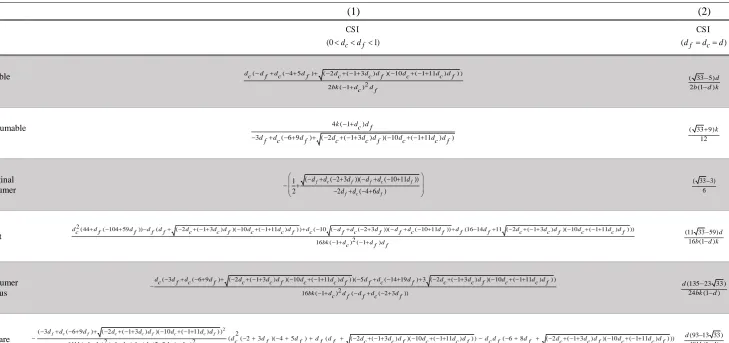
Inserting the optimal durable and consumable price into equations (12), (7), (8), and (9) gives the marginal type parameter, profit, consumer surplus and welfare. Table 2, Column (1) summarizes the solutions corresponding to CS I for the cohort of customers in period 0 (the results for other cohorts are the same) and Column (2) displays how the results simplify (for details see Section 1.2.1 of the Web Appendix) when the firm and consumers have the same discount factor (𝑑𝑓= 𝑑𝑐 = 𝑑).
[Insert Table 2 about here]
remain the same so that equations (12)-(15) also hold for cohorts of new customers in periods other than 𝑡 = 0. Thus the (discounted) profit of all cohorts of customers, called total profit, is:
0 0
0 0
( )
1
t
t II I f I
t t f
d
d
(16)
Similarly, total (discounted) consumer surplus is:
0 0
0 0
( ) 1
t t II I c I
t t c
S
S S d S
d (17)
and total (discounted) welfare is the sum of equations (16) and (17).
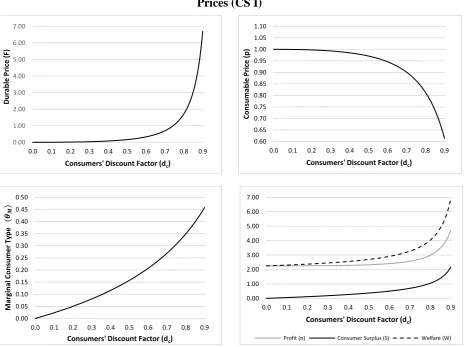
We derive the effect of consumers discounting at a higher rate than the firm on prices, profit, consumer surplus and welfare in the Web Appendix (see Section 1.2.1). This results in large equations that are difficult to interpret. Here, we numerically illustrate the effect of a higher consumers’ discount rate on prices, profit, consumer surplus and welfare for the cohort of
customers in period 0. Figure 1 presents the results for a value of 𝑑𝑓 = .9; other values lead to
similar results. It shows that an increase in consumers’ discount rate (and thus a decrease in 𝑑𝑐)
leads to a lower optimal durable price, which becomes zero (if 𝑖𝑐 is very large and, consequently,
𝑑𝑐 approaches zero). These insights lead us to the following propositions:
Proposition 1: If the firm is a durable market monopolist who commits to its prices and ties
the consumable to the durable (CS I), then a higher time preference of consumers than of the firm leads to a higher optimal consumable price (𝑝𝐼) and a lower optimal durable price (𝐹𝐼).
Proposition 2: If the firm is a durable market monopolist who commits to its prices and ties
the consumable to the durable (CS I), then a higher time preference of consumers than of the firm leads to a lower profit and consumer surplus, and consequently welfare.
Intuitively, higher discounting by consumers diminishes the present value of their surplus from the consumable and hence consumers’ willingness to pay for the durable. Since consumers discount the payments for the consumable but not the payments for the durable, the firm responds by decreasing the durable price and raising the consumable price. This strategy is optimal as long as the firm’s discount rate is lower than consumers’ discount rates. Yet, substituting payments for the durable with payments for the consumable will never fully compensate for the loss in profit. Further, a higher discount rate of consumers, relative to that of the firm, always decreases consumer surplus, because consumers benefit less from the (future) consumption of the consumable. Even a decrease in the durable price cannot compensate for this loss of consumer surplus. Put differently, a firm does not benefit from a higher time preference of consumers since they then value future benefits less.
3.1.2. Optimal prices under no price commitment
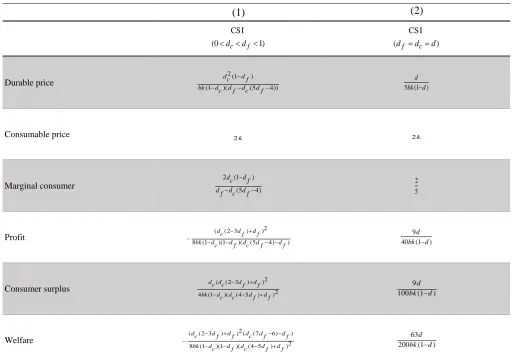
Our analysis provides the following results (for details see the Web Appendix, Section 1.2.2.2). First, the firm has an incentive to deviate from its announced prices after a certain number of customers bought the durable. The underlying reason is that the present value of the loss in profit from all future customers is lower (at the point in time at which prices change) than the present value of the additional profit that is realized from selling the consumable at higher price to all existing customers.
Second, the firm only deviates once. The intuition behind this result is that consumers only trust the firm until it starts to deviate from its announced prices because they were announced as being the same across all periods. Thus, the firm knows that if it deviates from its announced prices, then consumers will no longer trust the firm and consumers will always expect that the firm will charge the durable and consumable prices that provides the firm with the highest profit (called final prices, hereafter). Thus, there are only two sets of prices that the firm considers: prices before and after the deviation (announced and final prices, respectively).
Third, consumers (as they have complete information) recognize that the firm will deviate from its announced prices and will therefore only purchase if the firm charges the final prices. Thus, the durable price and the consumable price will be the same (equal to final prices) in all periods and consequently also profit, consumer surplus and welfare will remain the same.
Table 3, Column (1) describes the solutions and Column (2) displays how the results simplify if the firm and consumers have the same discount factor 𝑑𝑓 = 𝑑𝑐 = 𝑑 (for more details see Section
1.2.2.2 of the Web Appendix).
[Insert Table 3 about here]
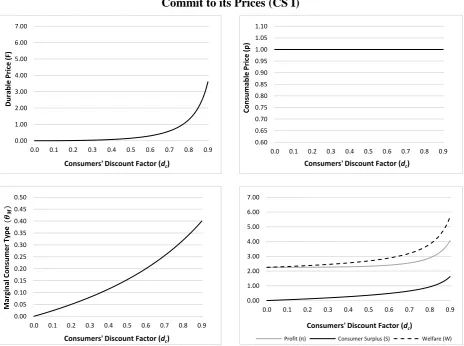
comparable so that results will be similar for them). Figure 2 presents the results for a value of 𝑑𝑓
= .9 (other values lead to similar results). Propositions 1 and 2 hold, except for the consumable price, which remains constant.
[Insert Figure 2 about here]
We additionally find that if the firm does not commit to its prices, the consumable price is higher and the durable price, profit, consumer surplus, and consequently welfare are lower than if the firm commits to its prices (for details see Section 1.4 of the Web Appendix). This insight leads us to the following proposition:
Proposition 3: If the firm is a durable market monopolist and ties the consumable to the durable (CS I), then profit, consumer surplus, and welfare are lower if the firm does not commit to its prices than if it commits to its prices.
3.2. No tie-in between durable and consumable – CS II
We now consider the case where the durable market monopolist does not tie its durable and consumables but competes in the consumable market (e.g. iPod and audio/video files). Thus, the firm has to charge the consumable price of its competitors, otherwise the consumers would replace the firm’s consumable with other consumables available in the market. As a result, the firm will
always sell the consumable at its cost, 𝑝𝐼𝐼 = 𝑘. Competition also guarantees that the firm will never
,1
,
( , ) ( )
,M II
t t
II II f II M II
p F d F p d
(18)As the consumer surplus of the marginal consumer is zero, the type parameter of the marginal consumer is:
,
(1 )
II
M I
c
c I
bF k d
d
(19)
Substituting equation (19) into equation (18) and solving the first-order condition yields:
2 (1 )
c I
c I
d
bk d
F (20)
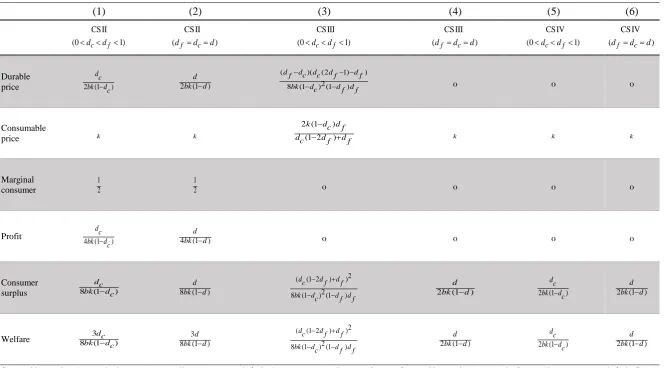
Column (1) in Table 4 summarizes the results of CS II (for details see Section 1.2.3 of the Web Appendix).
[Insert Table 4 about here]
Column (2) displays how the results simplify when the firm and consumers have the same discount factor (𝑑𝑓 = 𝑑𝑐 = 𝑑). These results lead us to the following propositions:
Proposition 4: If the firm is a durable market monopolist but does not tie the consumable to
the durable (CS II), then a higher time preference of consumers than of the firm does not affect the optimal consumable price (𝑝𝐼𝐼) but decreases the optimal durable price (𝐹𝐼𝐼).
Proposition 5: If the firm is a durable market monopolist but does not tie the consumable to
the durable (CS II), then a higher time preference of consumers than of the firm decreases profit and consumer surplus, and consequently welfare.
The intuition is similar to that for CS I. Since the value of consumer surplus in later periods is greater than the value of the consumer’s expenditures in those periods, each consumer’s “loss”
for the consumable. The firm therefore needs to lower the durable price but, unlike in CS I, it cannot increase the consumable price because it competes in the consumable market. Thus, an increase in the consumers’ discount rate will always hurt the profit of a durable market monopolist.
We also compare the profit and consumer surplus of CS I when the firm does not commit to the consumable price with those of CS II (see the respective cells in Column (1) of Table 3 and Table 4). Equations (21) and (22) show that the difference in discount rates between consumers and the firm impacts the difference in profit. If the consumers’ discount rate is much higher than that of the firm (𝑑𝑐 ≪ 𝑑𝑓), then both, the firm and consumers are better off when the firm ties the
consumable to the durable (for more details see Sections 1.4.4 and 1.4.6 of the Web Appendix).
.
2
, 2
( (2 3 ) )
;
8 (1 )(1 ) ( ( 4 5 )) 4 (1 )(1 )
c f f c
c
c f f c f c
I no com II f
f
d d d d
d d
bk d d d d d bk d d
(21)
2
2 2
, . 2
( (2 3 ) )
;
4 (1 ) ( (4 5 ) ) 8 (1 )
c
I no com II f
c f f c
c
c c f f c
d d d d
d d
bk d d d d S bk d
d
S (22)
This insight yields the following proposition:
Proposition 6: If the firm is a durable market monopolist, does not commit to its prices, and
consumers’ time preference is much higher than the firm’s time preference, then profit, consumer
surplus, and consequently welfare are higher if the firm ties the consumable to the durable.
4. Competition in the durable market
4.1. Tie-in between durable and consumable – CS III
4.1.1. Optimal prices under purchase commitment
Since multiple firms offer a durable that is tied to their consumable, profit under perfect competition is zero. Hence, we maximize consumer surplus, equation (8), under the constraint that profit (in equation (6)) is zero (Mandy 1991). Rearranging and simplifying equation (6) (that is set to zero) yields the following optimal durable price, 𝐹𝐼𝐼𝐼 in all periods 𝑡 (for details see Section 1.3.1 of the Web Appendix):
, 2
( ) (1 )
2 ( ) (1 )
III f M
f III III
III
F k p d
b p d
(23)
Substituting equation (23) into consumer surplus (for cohort of customers in period 0) in equation (8) yields:
0
2
2 ,
(( ) ( ( 2 ) ))( 1 ( )
2 ( ) (1 )( )
) 1
III f c III III f M III
III
c f
III
k p d d p k p d
b p d d
S (24)
Solving the system of equations with the first-order conditions of equation (24) with respect to
𝜃𝑀,𝐼𝐼𝐼 and 𝑝𝐼𝐼𝐼 yields:
2 (1 )
(1 2 )
c I
f
c f f
II
k d d
d d d
p (25)
,
0
M III
(26)2
( )( (2 1) )
8 (1 ) (1 )
f c c f
c f
I
f
f II
F d d d d d
bk d d d (27)
Column (3) in Table 4 summarizes consumer surplus, profit, and welfare for CS III for all new customers in period 0. Since competition in the durable market forces profit to zero, consumer surplus, 𝑆𝐼𝐼𝐼𝑡 , equals welfare, 𝑊𝐼𝐼𝐼𝑡 . Column (4) displays the results if consumers and the firm have the same discount factor (𝑑𝑓= 𝑑𝑐 = 𝑑).
The negative durable price leads to a high consumable price, which the firm cannot further increase because the consumers did not pay for the durable and consumers are, consequently, not “locked-in”. Therefore, the firm will not deviate from its announced consumable price. These
results yield the following propositions (for details see Section 1.3.1 of the Web Appendix):
Proposition 7: If the firm competes in the durable market, ties the consumable to the durable
and customers commit to purchasing the consumable (CS III), then a higher time preference of consumers than of the firm leads to a higher optimal consumable price (𝑝𝐼𝐼𝐼) and a lower optimal durable price (𝐹𝐼𝐼𝐼).
A higher time preference of consumers, relative to the firm’s time preference, makes paying higher consumable prices in the future more attractive than paying higher durable prices today. By implication, consumers put less emphasis on the consumable price relative to the durable price. Thus, as a result of higher time preference of consumers, than of the firm, the consumable price increases and the durable price decreases. Similar to CS I, the firm therefore ‘subsidizes’ lower payments from the durable with higher payments from the consumable.
Proposition 8: If the firm competes in the durable market, ties the consumable to the durable
Again, the effect of a higher time preference of consumers on consumer surplus is similar to CS I though we now have zero profits. Intuitively, a higher time preference of consumers than of the firm always decreases consumer surplus because consumers benefit less from the (future) consumption of the consumable. Even a decrease in the (negative) durable price cannot compensate for this loss of consumer surplus.
4.1.2. Optimal prices under no purchase commitment
The purchase commitment of consumers is not required as long as the durable price is not negative such as in CS I, CS II, and CS IV. In CS III, however, the purchase commitment is required because it allows the firm to sell one unit of the durable at a loss and ‘subsidize’ it with higher consumable prices. Otherwise, a negative durable price is no longer feasible because customers could just “purchase” the durable i.e., get the durable (or even worse, multiple units of the durable)
and the money, and walk away without purchasing the consumable. As a result, the firm would not charge a negative durable price but instead set the durable price to zero and, consequently, set the consumable price to 𝑘, which is the solution that we derive for CS IV (see Section 4.2). This new
combination of prices (i.e., the durable price of zero and the consumable price of 𝑘), however, yields lower consumer surplus than the consumer surplus when consumers commit to purchase. The reason is that consumers no longer benefit from a (negative) durable price and even a decrease in the consumable price (from 𝑝𝐼𝐼𝐼 to 𝑘) cannot compensate for the loss in their consumer surplus.
This insight yields the following proposition:
4.2. No tie-in between durable and consumable – CS IV
When the firm’s durable is compatible with other firms’ consumables (as in the case, for example, with Samsung’s SD cards for its digital cameras), the firm offers both consumables and durable at marginal costs in all periods and cannot deviate from those announced prices:
0
IV
F K (28)
and
IV
p
k
(29)Consequently, profit is zero and consumer surplus for all new customers in each period 𝑡 is:
, ,
2
1 1 1
0
,
( )
( , )
1
M IV IV M IV
t
IV M IV
c I
c c
c
V IV
p
S p d d d
d p p
d d
b b b d
(30)
Durable cost of zero leads to the type parameter of the marginal consumer:
,
0
M IV
(31)Column (5) in Table 4 summarizes the results with respect to consumer surplus, profit, and welfare for all customers in period 0. Column (6) displays results if consumers and the firm discount at the same rate (for details see Section 1.3.2 of the Web Appendix). Competition in the consumable market also guarantees that the customers commit to purchasing the consumable in the future. This result leads us to the following proposition:
Proposition 10: If the firm competes in the durable market and does not tie the consumable to
Again, the effect of a higher time preference of consumers on consumer surplus is similar to CS III (when consumers commit to purchase), though the consumer surplus in CS IV is always lower. In CS III, when consumers discount at a higher rate than the firm, the firm can ‘subsidize’ lower payments from the durable with higher payments from the consumable to partly compensate the loss in the consumer surplus (when consumers commit to purchase). However, in CS IV, due to competition in both markets (which results in fixed prices for durable and consumable), this strategy is not feasible.
5. Summary of results
5.1. Summary of effects of differences in time preferences
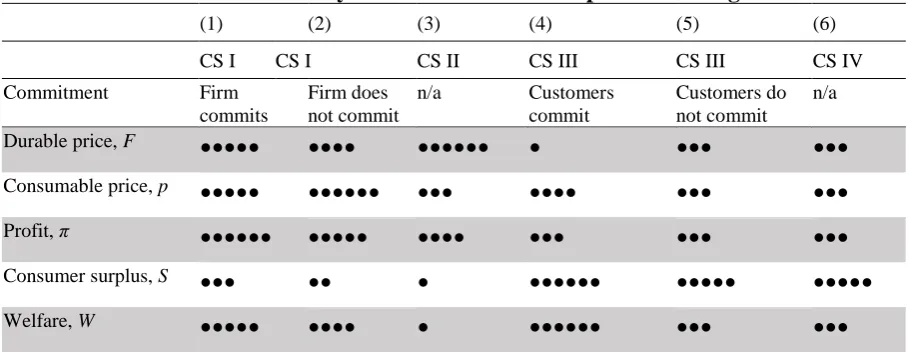
Table 5 compares the relative size of variables across competitive settings when consumers have higher time preference than the firm. The durable price is highest when the firm only has a monopoly in the durable market (CS II), while the consumable price is highest when the firm has a monopoly in both markets (CS I). Further, the optimal consumable price of tied goods is always higher than the optimal consumable price of untied goods, while the opposite holds for the durable price.
[Insert Table 5 about here]
Further, Table 5 illustrates that consumer surplus is highest when the firm competes in the durable market. In this case, tying does not decrease consumer surplus. Welfare is highest in CS III when consumers commit to purchase.
5.2. Summary of effects of commitment
We showed that two kinds of commitment are possible: the firm may commit to its prices (price commitment) and consumers may commit to their future purchases (purchase commitment). In line with previous literature, the results of Table 5 (compare Columns (1) and (2), respectively Columns (4) and (5)) show that everyone is better off if commitment occurs. Thus, commitment never decreases profit, consumer surplus, and welfare.
Commitment, however, is not relevant in all competitive settings. Price commitment is only important when the firm has a monopoly in both markets (CS I) and can set a consumable price higher than its cost. Purchase commitment matters in CS III. Again, the firm can deviate from a consumable price that is equal to its cost. More precisely, we find that if the firm does not (or cannot) commit to its prices, then the durable price decreases and the consumable price increases. In contrast, if consumers cannot commit to their future purchases of the consumable, then the durable price increases and the consumable price decreases.
Profit increases in case of a firm’s commitment to its future consumable prices because the consumers otherwise do not trust that the firm will stick to its announced prices and do not buy until the firm charges prices from which it has no incentive to deviate. The crucial question is, however, whether the firm is able to commit. In many situations, it is unlikely that the firm has a commitment device such as a regulator who may enforce constant prices. As a result, both the firm and consumers will be worse off.
strongly than the firm so that the firm has an incentive to essentially provide the consumer with a loan. We mention as one example of firms giving away a durable below cost and consumers committing to future purchases mobile phones and associated contracts. Note that purchasing consumables in the future essentially means that the consumer pays back the loan. If consumers cannot commit, then they suffer because the firm will not be able to offer such a loan. Instead, they charge a higher (non-negative) durable price and a lower consumable price, which, however, lead to a lower consumer surplus and welfare.
5.3. Summary of effects of tying
Intuitively, one may expect that tying benefits firms but not customers and that tying increases profit but decreases consumer surplus (Economides, 2011). Interestingly, however, if the time preference of consumers is higher than the firm’s time preference, the results are not necessarily in line with this intuition. For example, we find that consumer surplus never decreases if the firm ties the durable to the consumable (compare in Table 5 the relative size of consumer surplus in Columns (1)/(2) with (3) and in Columns (4)/(5) with Column (6)). The reason is that tying enables the consumer and the firm to sign a long-term commitment contract that allows both parties to benefit from the difference in time preferences.
5.4. Summary of effects of higher time preferences of consumers
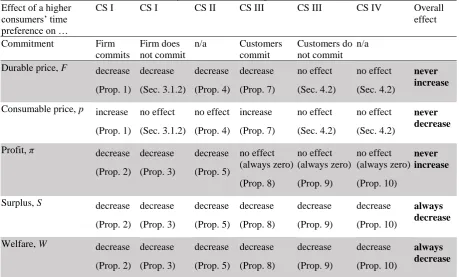
Table 6 summarizes the effect of higher time preference of consumers, relative to those of a firm, on profit, consumer surplus and prices across the different competitive settings.
[Insert Table 6 about here]
optimal durable price decreases with an increase in time preference of consumers, unless the firm competes in both the durable and consumable markets or consumers do not commit to purchase the consumable. The optimal consumable price increases as long as the firm commits to its prices and ties the durable and the consumable.
Table 6 also indicates that a higher time preference of consumers than of the firm never increases profit, always decreases consumer surplus and, as a result, always decreases welfare. This finding is important because it outlines that both firms and public policy decision makers have an incentive to work towards reducing high time preferences of consumers.
Table 6 shows that a higher consumers’ discount rate decreases profit unless the firm competes in the durable market. The reason for this decrease in profit is that even though the firm benefits from a higher discount rate of customers by charging a higher (future) consumable price, the firm also has to lower the durable price because customers discount so strongly. The loss in profit because of this decrease in durable price is higher than the increase in profit from the higher consumable price.
6. Conclusion
There is strong empirical evidence that consumers discount at significantly higher rates than firms. Yet, most research abstracts from the effect of discount rates on marketing decisions, such as pricing. In this research, we examine how the fact that consumers discount at a higher rate than the firm affects the pricing of complementary products as well as the resulting profit, consumer surplus and welfare. We separately analyze four competitive settings depending on whether the firm is a monopolist or competes in the durable market and whether the consumable is tied to the durable or not.
price of tied goods is always higher than the optimal consumable price of untied goods, while the opposite holds for the durable. These findings mean that firms need to carefully assess consumers’ time preferences when setting prices for complementary products. Prior research suggests that such time preferences may differ across time horizons and, potentially, products (Winer, 1997; Zauberman et al., 2009).
We find that when consumers discount at a greater rate than the firm, then profit never increases, consumer surplus always decreases and, as a result, welfare always decreases. Therefore, a firm may, for example, invest into marketing campaigns that try to decrease time preferences of consumers by highlighting the value of consumption opportunities.
We also find that both, price commitment by firms and purchase commitment by consumers never decrease profit, consumer surplus, and consequently welfare.
Further, we show that if consumers discount at higher rates than the firm, then consumers can even benefit from tying. This finding goes against the conventional wisdom that tie-in is disadvantageous for consumers. For example, public policy makers concerned about consumer welfare have in the past attempted to promote legislation that makes tying more difficult (Posner and Easterbrook 1981). The reason for this result is that tying enables consumers and the firm to sign a long-term commitment contract so that the firm can essentially provide the consumers with a loan. Interestingly, the ability to increase consumer surplus is not limited to products that can be “physically tied” such as razor and razorblades, but also holds for independent products that might
be tied via contracts. Thus, our other main result may also explain the popularity of contracts that allow for subsidizing the initial purchase, such as for mobile phones: for example in contracts with “sim lock” cellphones, the firm subsidizes the phone but is later compensated through greater
To conclude, there are some limitations to our findings that presents opportunities for future research. First, our multiplicative demand function does not allow for a consumable price of zero. Second, even though we assume consumers are heterogeneous in their tastes, we assume they have the same time preference. Third, we assume that the firm announces consumable and durable prices that are the same across all periods. An alternative would be the announcement of a price path. Finally, we do not allow for collusion and price coordination among firms, which might yield different insights than the levels of competition that we consider (monopoly and perfect competition).
References
Armstrong, M. (2006). Recent Developments in the Economics of Price Discrimination. Advances in Economics and Econometrics: Theory and Applications: Ninth World Congress, 2, 97–141.
Bijmolt, T. H., van Heerde, H. J., & Pieters, R. G. (2005). New Empirical Generalizations on the Determinants of Price Elasticity. Journal of Marketing Research, 42(2), 141–156.
Borenstein, S., MacKie-Mason, J. K., & Netz, J. S. (2000). Exercising Market Power in Proprietary Aftermarkets. Journal of Economics and Management Strategy, 9(2), 157–188.
Desai, P., Koenigsberg, O., & Purohit, D. (2004). Strategic Decentralization and Channel Coordination. Quantitative Marketing and Economics, 2(1), 5–22.
Dubé, J.-P., Hitsch, G. J., & Jindal, P. (2014). The Joint Identification of Utility and Discount Functions from Stated Choice Data: An Application to Durable goods Adoption. Quantitative Marketing and Economics, 12(4), 331–377.
Dubner, S. J., & Levitt, S. D. (2007, November 15). The Stomach-Surgery Conundrum. New York Times.
Economides, N. (2011). Tying, Bundling, and Loyalty/Requirement Rebates. SSRN Electronic Journal.
Ellison, G. (2005). A Model of Add-On Pricing. Quarterly Journal of Economics, 120(2), 585– 637.
Emch, E. (2003). Price Discrimination via Proprietary Aftermarkets. Contributions to Economic Analysis and Policy, 2(1).
Gabaix, X., & Laibson, D. (2006). Shrouded Attributes, Consumer Myopia, and Information Suppression in Competitive Markets. Quarterly Journal of Economics, 121(2), 505–540.
Gil, R., & Hartmann, W. R. (2009). Empirical Analysis of Metering Price Discrimination: Evidence from Concession Sales at Movie Theaters. Marketing Science, 28(6), 1046–1062.
Goldman, B. M., Leland, H. E., & Sibley, D. S. (1984). Optimal Nonuniform Prices. Review of Economic Studies, 51(2), 305–319.
Hartmann, W. R., & Nair, H. S. (2010). Retail Competition and the Dynamics of Demand for Tied Goods. Marketing Science, 29(2), 366–386.
Heubrandner, F., & Skiera, B. (2010). Time Preference and the Welfare Effects of Tie-In Sales. Economics Letters, 108(3), 314–317.
Ho, T. H., Lim, N., & Camerer, C. F. (2006). Modeling the Psychology of Consumer and Firm Behavior with Behavioral Economics. Journal of Marketing Research, 43(3), 307–331.
KPMG International. (2014). Cost of Capital Study 2014. Retrieved from https://www.kpmg.com/DE/de/Documents/cost-of-capital-study-english-2014-kpmg.pdf
Lambrecht, A., & Skiera, B. (2006). Paying Too Much and Being Happy about It: Existence, Causes, and Consequences of Tariff-Choice Biases. Journal of Marketing Research, 43(2), 212– 223.
Landsberger, M., & Meilijson, I. (1985). Intertemporal Price Discrimination and Sales Strategy under Incomplete Information. RAND Journal of Economics, 16(3), 424–430.
Leland, H. E., & Meyer, R. A. (1976). Monopoly Pricing Structures with Imperfect Discrimination. Bell Journal of Economics, 7(2), 449–462.
Mandy, D. M. (1991). Competitive Two-Part Tariffs as a Response to Differential Rates of Time Preference. Economica, 58(231), 377–389.
Oi, W. Y. (1971). A Disneyland Dilemma: Two-Part Tariffs for a Mickey Mouse Monopoly. Quarterly Journal of Economics, 85(1), 77–96.
Oster, S. M., & Scott Morton, F. M. (2005). Behavioral Biases Meet the Market: The Case of Magazine Subscription Prices. B.E. Journal of Economic Analysis and Policy: Advances in Economic Analysis and Policy, 5(1), 1–30.
Png, I. P. L., & Wang, H. (2010). Buyer Uncertainty and Two-Part Pricing: Theory and Applications. Management Science, 56(2), 334–342.
Posner, R. A., & Easterbrook, F. H. (1981). Antitrust Cases, Economic Notes, and Other Materials (2d ed). American casebook series. St. Paul, Minn.: West Pub. Co.
Schaaf, R., & Skiera, B. (2014). Effect of Time Preferences on Optimal Prices and Profitability of Advance Selling. Customer Needs and Solutions, 1(2), 131–142.
Schmalensee, R. (1981). Monopolistic Two-Part Pricing Arrangements. Bell Journal of Economics, 12(2), 445–466.
Schulz, F., Schlereth, C., Mazar, N., & Skiera, B. (2015). Advance Payment Systems: Paying too much Today and Being Satisfied Tomorrow. International Journal of Research in Marketing, 32(3), 238–250.
Stokey, N. L. (1979). Intertemporal Price Discrimination. Quarterly Journal of Economics, 93(3), 355–371.
Taylor, C. R. (2004). Consumer Privacy and the Market for Customer Information. The RAND Journal of Economics, 35(4), 631–650.
Tellis, G. J. (1988). The Price Elasticity of Selective Demand: A Meta-Analysis of Econometric Models of Sales. Journal of Marketing Research, 25(4), 331–341.
Thaler, R. (1981). Some Empirical Evidence on Dynamic Inconsistency. Economics Letters, 8(3), 201–207.
Thaler, R. H., & Benartzi, S. (2004). Save More Tomorro: Using Behavioral Economics to Increase Employee Saving. Journal of Political Economy, 112(S1), S164–S187.
Tirole, J. (1988). The Theory of Industrial Organization. Cambridge, Mass.: MIT Press.
Warhit, E. (1980). The Economics of Tie-In Sales. Atlantic Economic Journal, 8(4), 81–88.
Winer, R. S. (1997). Discounting and Its Impact on Durables Buying Decisions. Marketing Letters, 8(1), 109–118.
Yao, S., Mela, C. F., Chiang, J., & Chen, Y. (2012). Determining Consumers' Discount Rates with Field Studies. Journal of Marketing Research, 49(6), 822–841.
Table 1: Summary of Competitive Settings (CS)
Tie-in between durable and consumable
Yes No
Monopolist in the durable market CS I CS II
Table 2: Summary of Results for Competitive Setting I (CS I) under Price Commitment
(1) (2)
CSI (0dcdf 1)
CSI (df dcd)
Durable price
( ( 4 5 ) ( 2 ( 1 3 ) )( 10 ( 1 11 ) ) )
2 2 ( 1 )
dc df dc df dc dc df dc dc df
bk d d
c f
( 33 5) 2 (1 )
d
b d k
Consumable price
4 ( 1 )
3 ( 6 9 ) ( 2 ( 1 3 ) )( 10 ( 1 11 ) )
k dc df
df dc df dc dc df dc dcdf
( 33 9) 12
k
Marginal consumer
( ( 2 3 ))( ( 10 11 )) 1
2 2 ( 4 6 )
f c f f c f
f c f
d d d d d d
d d d
( 33 3) 6
Profit 2 (44 ( 104 59 )) ( ( 2 ( 1 3 ) )( 10 ( 1 11 ) ) ) ( 10 ( 2( 2 3 ))( ( 10 11 )) (16 14 11 ( 2 ( 1 3 ) )( 10 ( 1 11 ) ) ))
16 ( 1 ) ( 1 )
dc df df df df dc dc df dc dc df dc df dc df df dc df df df dc dc df dc dc df bk d d d
c f f
(11 33 59) 16 (1 )
d
b d k
Consumer surplus
( 3 ( 6 9 ) ( 2 ( 1 3 ) )( 10 ( 1 11 ) ) )( 5 ( 14 19 ) 3 ( 2 ( 1 3 ) )( 10 ( 1 11 ) ) )
2
16 ( 1 ) ( ( 2 3 ))
dc df dc df dc dc df dc dc df df dc df dc dc df dc dc df
bk d d d d d
c f f c f
(135 23 33 ) 24 (1 )
d bk d Welfare 2 ( 3 ( 6 9 ) ( 2 ( 1 3 ) )( 10 ( 1 11 ) ) ) 2
( ( 2 3 )( 4 5 ) ( ( 2 ( 1 3 ) )( 10 ( 1 11 ) ) ) ( 6 8 ( 2 ( 1 3 ) )( 10 ( 1 11
2 2
64 ( 1 ) ( 1 ) ( (2 3 ) )
f c f c c f c c f
d d d d d d d d d
dc df df df df dc dc df dc dc df d dc f df dc dc df dc d
bk dc df df dc df df c)df) ))
(93 13 33) 48 (1 )
d
bk d
𝑑𝑐= 1/(1 + 𝑖𝑐), where 𝑖𝑐 is the consumers’ discount rate and 𝑑𝑐 is the consumers’ discount factor; 𝑑𝑓= 1/(1 + 𝑖𝑓), where 𝑖𝑓 is firm’s discount rate and 𝑑𝑓 is firm’s discount factor;
Table 3: Summary of Results for Competitive Setting (CS I) under No Price Commitment
(1) (2)
CSI (0dcdf 1)
CSI (df dcd)
Durable price 2 (1 )
(1 )( (5 4))
dc df
bk dc df dc df 5 (1 )
d bk d
Consumable price 2k 2k
Marginal consumer
2 (1 ) (5 4)
dc df df dc df
2 5
Profit
2 ( (2 3 ) )
8 (1 )(1 )( (5 4) )
d d d
c f f
bk dc df dc df df
9 40 (1 )
d bk d
Consumer surplus
2 ( (2 3 ) )
2 4 (1 )( (4 5 ) )
dcdc df df bk dc dc df df
9 100 (1 )
d bk d
Welfare
2
( (2 3 ) ) ( (7 6) ) 2 8 (1 )(1 )( (4 5 ) )
d d d d d d c f f c f f bk d d d d d
c f c f f
63 200 (1 )
d bk d
𝑑𝑐 = 1/(1 + 𝑖𝑐), where 𝑖𝑐 is the consumers’ discount rate and 𝑑𝑐 is the consumers’ discount factor; 𝑑𝑓= 1/(1 + 𝑖𝑓), where 𝑖𝑓
is firm’s discount rate and 𝑑𝑓 is firm’s discount factor; CS I represents the competitive setting 1; profit, consumer surplus, and