go.warwick.ac.uk/lib-publications
Original citation:Charlton, R. J., Fogarty, R. M., Bogatko, S., Zuehlsdorff, T. J., Hine, Nicholas, Heeney, M., Horsfield, A. P. and Haynes, P. D. (2018) Implicit and explicit host effects on excitons in pentacene derivatives. The Journal of Chemical Physics, 148 (10). 104108.
doi:10.1063/1.5017285
Permanent WRAP URL:
http://wrap.warwick.ac.uk/102328
Copyright and reuse:
The Warwick Research Archive Portal (WRAP) makes this work by researchers of the University of Warwick available open access under the following conditions. Copyright © and all moral rights to the version of the paper presented here belong to the individual author(s) and/or other copyright owners. To the extent reasonable and practicable the material made available in WRAP has been checked for eligibility before being made available.
Copies of full items can be used for personal research or study, educational, or not-for profit purposes without prior permission or charge. Provided that the authors, title and full bibliographic details are credited, a hyperlink and/or URL is given for the original metadata page and the content is not changed in any way.
Publisher’s statement:
This article may be downloaded for personal use only. Any other use requires prior permission of the author and AIP Publishing.
The following article appeared in Charlton, R. J., Fogarty, R. M., Bogatko, S., Zuehlsdorff, T. J., Hine, Nicholas, Heeney, M., Horsfield, A. P. and Haynes, P. D. (2018) Implicit and explicit host effects on excitons in pentacene derivatives. The Journal of Chemical Physics, 148 (10). 104108. doi:10.1063/1.5017285
A note on versions:
The version presented here may differ from the published version or, version of record, if you wish to cite this item you are advised to consult the publisher’s version.
Implicit and explicit host effects on excitons
in pentacene derivatives
R. J. Charlton,1,∗ R. M. Fogarty,1 S. Bogatko,1 T. J. Zuehlsdorff,2
N. D. M. Hine,3 M. Heeney,4 A. P. Horsfield,1 and P. D. Haynes1
1Department of Materials, Imperial College London,
Exhibition Road, London, SW7 2AZ, UK
2School of Natural Sciences, University of California Merced,
5200 N. Lake Road, Merced, CA 95343, USA
3Department of Physics, University of Warwick, Coventry CV4 7AL, UK
4Department of Chemistry, Imperial College London,
Exhibition Road, London, SW7 2AZ, UK
Abstract
An ab initio study of the effects of implicit and explicit hosts on the excited state properties of pentacene and its nitrogen-based derivatives has been performed using ground state density func-tional theory (DFT), time-dependent DFT and ∆SCF. We observe a significant solvatochromic redshift in the excitation energy of the lowest singlet state (S1) of pentacene from inclusion in
a p-terphenyl host compared to vacuum; for an explicit host consisting of six nearest neighbour
p-terphenyls, we obtain a redshift of 65 meV while a conductor-like polarisable continuum model (CPCM) yields a 78 meV redshift. Comparison is made between the excitonic properties of pen-tacene and four of its nitrogen-based analogues, 1,8-, 2,9-, 5,12-, and 6,13-diazapenpen-tacene with the latter found to be the most distinct due to local distortions in the ground state electronic struc-ture. We observe that a CPCM is insufficient to fully understand the impact of the host due to the presence of a mild charge-transfer (CT) coupling between the chromophore and neighbouring
p-terphenyls, a phenomenon which can only be captured using an explicit model. The strength of this CT interaction increases as the nitrogens are brought closer to the central acene ring of pentacene.
S0
S1 T2
T1
S2 T3
Laser input ~585 nm
X Y
Z Maser transition
~1.45 GHz (i) Photoexcitation
(ii) ISC
(iii) Non-radiative decay
(iv) Phosphorescence/ Non-radiative decay
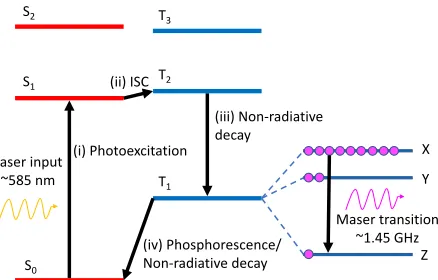
FIG. 1– Schematic illustration of the maser mechanism using the excitation spectrum of pentacene. (i) Photoexcitation of pentacene from S0 to S1 using yellow light laser.
(ii) Radiationless intersystem crossing (ISC) from S1 to T2 (see text for more details).
(iii) Non-radiative decay from T2 down to T1, where the substates X,Y and Z are populated
in the ratio 0.76:0.16:0.08, providing the necessary population inversion for the maser mechanism [? ]. (iv) Decay from T1 back to S0.
I. Introduction
The sustained interest in acenes over the last decade is due to their promising electronic
properties which make them suitable for organic electronic devices [? ]. For instance, high
charge-carrier mobility in the acenes, combined with their high degree of mechanical
flexi-bility [? ], facilitates the use of acenes and their derivatives as thin-film transistors [? ? ?
]. Another potential application is organic photovoltaics, where pentacene and its
deriva-tives lead the way due to the observation of singlet fission within the excitation spectrum
of pentacene enabling much greater efficiency than is otherwise possible [? ]. While the
above examples are concerned with bulk crystals and thin films, the use of linear acenes
as dopant materials has also been widely studied, for instance pentacene in para-terphenyl.
One promising application of the latter system was demonstrated by Oxborrow et al., who
showed that a p-terphenyl crystal doped with pentacene can act as the gain medium for a
room-temperature maser [? ].
[image:4.612.198.417.70.210.2]First, the pentacene is excited by a yellow light laser from the singlet ground state S0 to the
lowest singlet excited state S1. This singlet state is near degenerate with the triplet state T2,
giving rise to a strong mixing of these states by a combination of the spin-orbit interaction
and electron-phonon interactions, thus enabling a radiationless spin-selective intersystem
crossing (ISC) into the triplet state [? ]. The matrix elements involved in this transition
favour the uppermost sublevel of T2, giving rise to a population inversion within T2 which is
preserved upon decay to the lower triplet ground state T1, allowing masing to take place [?
]. While this is the first successful demonstration of masing at room-temperature, further
work is required before this can become a practical device, with improvements required in
both efficiency and enabling continuous operation of the maser [? ? ]. One major constraint
is the slow rate of decay from T1 back to S0, resulting in a build-up of excitons in the lowest
triplet state which suppresses the population inversion in T1.
Given its role in enabling the first working room-temperature maser, pentacene has acted
as the prototype for further experimental and theoretical research into potential maser active
molecule candidates which may bring improvements in performance. One possibility would
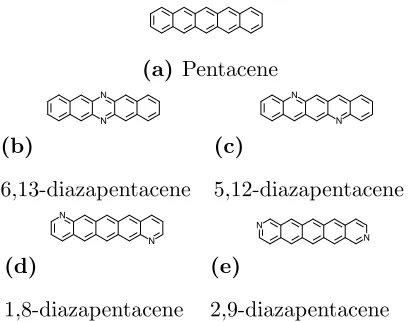
be to replace pentacene with its nitrogen-based analogues, some examples of which are shown
in Figure 2. Experimental studies comparing anthracene to its analogue phenazine, in which
the central aromatic ring contains two sp2 nitrogen groups, find that the zero field splitting
is comparable but there is a much more pronounced population inversion for phenazine,
resulting in strong phosphorescence [? ]. An equivalent effect for a pentacene derivative
would result in a faster ISC in the pentacene inp-terphenyl maser.
It is known experimentally that the pentacene excitation spectrum can vary significantly
depending on the host in which the pentacene resides [? ? ? ]. For instance, Heinecke
et al. demonstrated by laser spectroscopy that the lowest singlet excitation S1 is found at
2.31 eV for gas phase pentacene, but experiments on pentacene inp-terphenyl show results
of 2.1 eV [? ]. The potential impact of this difference on the ISC rate is very significant
– Patterson et al. observed an increase in the rates by two orders of magnitude from a
shift of 20 meV, corresponding to the pentacene being located in one of four different lattice
sites in the p-terphenyl herringbone structure, each of which yields a distinct feature in the
must therefore be able to capture not just the vacuum excitation energies of pentacene, but
also the impact of the host.
First principles calculations of the excitonic properties of pentacene are usually performed
in vacuum or bulk pentacene, rather than in doped molecular structures. Bogatkoet al. have
performed an ab initio study using time-dependent density functional theory (TDDFT) [?
] in order to screen possible active molecules from among the linear acenes [? ], comparing
properties such as the |S1 −Tn| energy splitting in these molecules to provide a qualitative
comparison with pentacene. Much work has gone into understanding from first-principles
the impact of charge-transfer (CT) excitons on the excited state properties of acenes in the
context of Davydov splitting [? ? ] as well as the importance of charge delocalisation
via explicit quantum mechanical descriptions compared with embedded charge models [? ].
Such studies focus on clusters in crystalline acene structures, rather than doped molecular
crystals such as pentacene in p-terphenyl.
Solvent environments can be simulated implicitly by the inclusion of a dielectric medium
but, as Bogatko et al. found with their TDDFT study, the impact this has upon the
ex-citation spectrum is limited [? ]. More detailed explicit solvent simulations have been
restricted by the computational cost involved in explicit quantum mechanical approaches to
such systems, which can extend to include thousands of atoms. Indeed, the limits of wave
function-based quantum chemical methods are already being pushed by pentacene alone, so
any explicit inclusion of the environment with such approaches is currently impossible [? ].
Past studies have sought to identify the importance of including explicit solvent regions in
quantum mechanical calculations when performing QM/MM style calculations with implicit
solvent and polarisable continuum model (PCM). In these studies, shells of water molecules
were included in the quantum mechanical region, yielding shifts in the excitation spectra
depending on the environment and indicating that an explicit description of at least nearest
neighbour molecules is required to accurately capture solvent effects [? ? ? ].
In this paper, we present a first principles study of the ground and excited state
prop-erties of pentacene in an explicit p-terphenyl host. We make use of linear-scaling DFT
as implemented in the ONETEP package [? ] for ground state properties and we
(a) Pentacene
(b)
6,13-diazapentacene
(c)
5,12-diazapentacene
(d)
1,8-diazapentacene
(e)
2,9-diazapentacene
FIG. 2– Dopant molecules considered as part of this study. For brevity, each diazapentacene molecule will be referred to by the shorthand “m,n-dap” throughout this work.
and optimally-tuned range-separated hybrid exchange-correlation functionals in Gaussian
09 [? ]. We extend this approach to compare the behaviour of pentacene to a selection
of its nitrogen-based analogues, displayed in Figure 2, as previously studied by Bogatko et
al. Finally, we discuss the electronic structures of these acenes, their interaction with the
host environment and the implications that these phenomena have for the maser and similar
systems.
II. Ground state methods –
Linear-scaling DFT
Kohn-Sham density functional theory (KS-DFT) [? ? ] has become a popular method
due to its balance between accuracy and computational efficiency when compared with other
electronic structure methods. Standard implementations of KS-DFT have a computational
cost that scales cubically with system size [? ]. While this is very good compared to other
quantum chemical methods, it renders larger systems consisting of thousands of atoms, such
as the p-terphenyl crystal studied as part of this work, beyond the limits of conventional
DFT codes. One approach to avoid this unfavourable scaling is to treat the single-particle
[image:7.612.201.406.69.230.2]to exploit the nearsightedness of electronic structure for insulators [? ? ], which reduces
the theoretical cost of the problem to linear scaling [? ]. In this work, we make use of
linear-scaling DFT as implemented in the ONETEP package [? ]. In ONETEP the density
matrix is expanded in terms of a set of localised atom-centred orbitals {φα}, referred to as
non-orthogonal generalised Wannier functions (NGWFs) [? ], such that
ρ(r,r0) = X
α,β
φα(r)Kαβφβ(r0), (1)
whereKis the density kernel, a generalisation of the Kohn-Sham orbital occupancies that, if
sparse, yields linear-scaling. Convergence of the total energy is performed in two nested loops,
whereby the elements of K and the NGWFs are iteratively adapted in sequence until
self-consistency is achieved. The accuracy of the NGWF basis is controlled by two parameters:
the NGWF radius, outside of which the NGWFs are zero, and the kinetic energy cutoff, which
sets the spacing for the grid upon which the NGWFs are expanded. Using this basis enables
us to perform calculations with linear-scaling effort that are systematically improvable to
plane wave accuracy [? ].
A. Chromophores and the crystal host
All geometry optimisations were performed in ONETEP using the PBE
exchange-correlation functional [? ? ]. Our crystal host was generated by constructing a p-terphenyl
crystal in a 3×4×3 periodic cell of 72 p-terphenyl molecules with atomic positions and
lattice parameters taken from experiment [? ]. At room temperature, p-terphenyl has a
crystal structure with just two distinct lattice positions. A pentacene molecule was
substi-tuted in place of a singlep-terphenyl in this structure, maintaining the same orientation and
centre of mass. This is in keeping with the experimentally observed pentacene inp-terphenyl
structure, where the pentacene occupies a region of similar size to thep-terphenyl it replaces.
Due to the lack of dispersion in PBE, we did not perform a full geometry optimisation of
the crystal at this point. Instead, the pentacene geometry was reoptimised while holding
the p-terphenyl carbon atoms fixed so as to maintain the experimentally observed structure
(a) (b) (c)
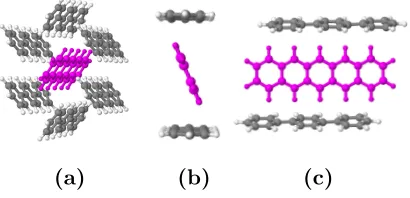
FIG. 3– (a) Arrangement of the pentacene (centre, pink) and the six nearest neighbour
p-terphenyls for cluster calculations. (b) Orientation of pentacene within the herringbone structure. A transformation of pentacene via reflection through its major axis would show the alternative lattice position. (c) Alignment of the acene rings within pentacene and
p-terphenyl.
subsequent work – see the Supplementary Material (SM) for more details.
Four alternative dopant molecules were considered based on the previous work of Bogatko
et al. [? ] by substituting nitrogen for carbon in the pentacene to generate the molecules
shown in Figure 2. The geometries were subsequently reoptimised using the same procedure
as for pentacene. We did not investigate any of the other linear acenes considered by Bogatko
et al. as, due to the significant difference in their size from pentacene, they would not fit
comfortably within the p-terphenyl crystal. The choice of an appropriate host for these
alternative molecules remains an open question both theoretically and experimentally.
For excited state properties discussed later, we extracted a cluster of pentacene and its six
nearest neighbourp-terphenyls from the periodic crystal as shown in Figure 3. This acted as
the explicit host for the subsequent excited state calculations. The cluster was selected by
analysis of the HOMO and LUMO states of pentacene in the periodic crystal – inclusion of
an explicit host results in a non-zero contribution from neighbouring p-terphenyls to these
orbitals with semi-local functionals. We selected the cluster of six p-terphenyls to ensure
that these states could be fully captured by the pentacene and its neighbouring molecules –
see SM for more details. A conductor-like polarisable continuum model (CPCM) was also
[image:9.612.209.414.75.174.2]III. Excited state methods
In this work we have used two methods to calculate excited state energies –
time-dependent density functional theory (TDDFT) and ∆SCF, the latter for the T1 state for
comparison with TDDFT results. As T1 is the ground state of the system with electron spin
in a triplet state, it can be studied reliably using ground state DFT.
A. TDDFT and the conjugated states
It is well known that TDDFT implementations that utilise semi-local exchange-correlation
functionals have problems describing the excited states of linear acenes [? ? ? ]. Singlet
ex-citation energies in particular are significantly underestimated due to the failures to describe
the π-conjugated states of pentacene. This precludes using semi-local functionals in direct
comparison to experimental results or more accurate first principles approaches for absolute
energies which have been explored elsewhere for vacuum pentacene [? ]. Instead, we will
focus on comparing PBE vacuum results with similar calculations using hybrid functionals,
which will enable us to evaluate whether trends in molecular behaviour between pentacene
and its derivatives are dependent on the functional used.
For environment comparisons, it is necessary to determine whether the distortion of
ex-citation energies by semi-local functionals is systematic in nature and thus whether trends
between different functionals can be rigorously compared. In particular, the use of semi-local
exchange-correlation functionals with TDDFT does not give a good representation of
long-range interactions, resulting in long-long-range charge-transfer (CT) states being unphysically
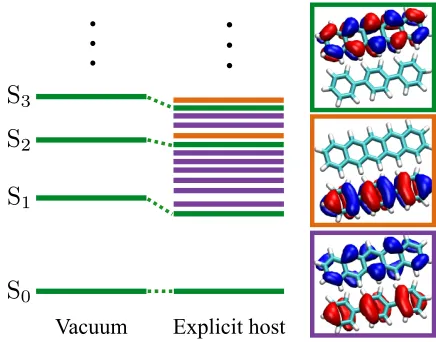
low in energy. Figure 4 gives a graphical demonstration of this issue for pentacene in a p
-terphenyl environment. The physical, localised pentacene excited states have become mixed
with CT states from the host system, requiring the calculation of a large number of states in
order to obtain the pentacene spectrum. This is problematic as the cost of calculating the
excitation spectrum with linear-response TDDFT scales asO(Nω2), where Nω is the number
of excited states, rendering higher energy excited states beyond the reach of this method.
S0
S1
S2
S3
Vacuum Explicit host
..
.
..
.
FIG. 4– Schematic representation of the TDDFT excitation spectrum of pentacene in an explicit p-terphenyl host compared to the vacuum equivalent using a semi-local
exchange-correlation functional. The figures on the right depict the electron (blue) and hole (red) densities of the excitations for a pentacene andp-terphenyl system. From top to bottom: pentacene excited state (green),p-terphenyl excited state (orange), charge-transfer state (purple). The green pentacene states are shifted in energy by the influence of the host.
states in a host structure.
One approach to remove these spurious CT states is the kernel truncation strategy
em-ployed by Zuehlsdorff et al. [? ]. In that work, excited states composed of Kohn-Sham
transitions between the chromophore and shells of explicit solvent were forbidden outside
of a specified radius. Although we did attempt to use this for our system, we found that
the impact of this truncation on the excitation energies was too severe to be of use for this
system, thus the results are not presented here. Further information can be found in the
[image:11.612.197.415.71.242.2]B. Optimally tuned range-separated
hybrid functionals
Hybrid functionals that include a portion of exact exchange give a more realistic
descrip-tion of these CT states by correcting the self-interacdescrip-tion error associated with semi-local
functionals, thus removing them from the low-lying spectrum. In particular, the use of
optimally tuned (OT) range-separated hybrid functionals has previously led to accurately
calculated excitation energies even in cases which are difficult for TDDFT, including the
acene series and CT excitations [? ? ? ]. For this reason, we employ the OT-LCωPBE
functional alongside PBE for excited states. The OT-LCωPBE functional has the same
form as the standard LC-ωPBE functional, with 100% semi-local exchange at short range
and 100% exact exchange at long range [? ]. The range separation parameter is tuned such
that the calculated ionisation energy matches the negative of the highest occupied molecular
orbital (HOMO) eigenvalueH; this is a property of the exact (unknown) Kohn-Sham DFT
functional and hence this tuning procedure is physically motivated [? ]. The calculated
ionisation energy is determined as the difference in energies from an SCF calculation on the
neutral and ionised species, such that the tuning criterion isEN−1−EN =−H, where N is
the number of electrons in the system.
IV. Calculation specifications
All ONETEP calculations presented here have been performed using a kinetic energy
cutoff of 750 eV and the PBE exchange-correlation functional for ground state DFT
calcu-lations. For valence states, the NGWF radius was fixed at 10 bohr, while conduction state
NGWFs had a radius of 15 bohr [? ]. In both cases the number of NGWFs centred on each
atom was chosen as 1 per H, 4 per C and 4 per N [? ].
All Gaussian 09 calculations were carried out with the cc-pVTZ basis set [? ] at geometries
obtained from ONETEP calculations. The numerical integration grid was tightened from
the defaults to a pruned grid with 99 radial shells and 590 angular points per shell. For
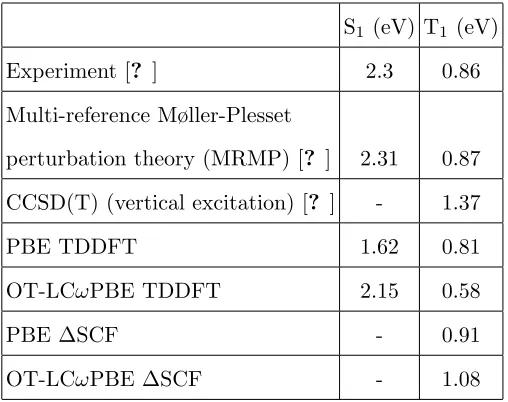
TABLE I – Experimental and selectedab initio data from this study and the literature for lowest pentacene excitations in vacuum.
S1 (eV) T1 (eV)
Experiment [? ] 2.3 0.86 Multi-reference Møller-Plesset
perturbation theory (MRMP) [? ] 2.31 0.87 CCSD(T) (vertical excitation) [? ] - 1.37
PBE TDDFT 1.62 0.81
OT-LCωPBE TDDFT 2.15 0.58
PBE ∆SCF - 0.91
OT-LCωPBE ∆SCF - 1.08
value was used due to the similarity between the dielectric constant of p-terphenyl in the
microwave spectrum (2.98) and at optical frequencies (2.81) [? ? ].
Excited state calculations were performed using both TDDFT and ∆SCF in Gaussian
09 [? ]. For ∆SCF, single point calculations were performed in both the singlet and triplet
ground states S0 and T1 respectively. In both cases the S0 geometry was used, corresponding
to vertical excitation energies. TDDFT and ∆SCF calculations in ONETEP were also
performed and are reported in the SM [? ]. No corrections were employed to account
for the Stokes shift that would result from relaxation of the molecular geometry into the
excited state configuration.
Population analysis was performed using the natural bond orbital (NBO) method [? ]
as implemented within the GENNBO package [? ] and interfaced with ONETEP [? ].
Density of states (DOS) plots were generated using Gaussian functions with a full width at
half-maximum of 0.2 eV. For the local DOS (LDOS), the area for each Gaussian was set to
-0.39 +0.16 +0.04 +0.16 +0.04 +0.14 -0.34 -0.34 +0.15 +0.15 +0.14 6,13-diazapentacene
+0.15 -0.18 +0.10 -0.18 +0.10 +0.17 -0.37 -0.37 +0.19 +0.19 +0.17 -0.04 +0.05 -0.04 -0.04 +0.05 -0.04 5,12-diazapentacene
+0.02 +0.08 -0.09
+0.08 -0.09 +0.16 -0.37 -0.37 +0.22 +0.22 +0.16 -0.04 +0.04 -0.04 -0.04 +0.04 -0.04 1,8-diazapentacene
+0.02 +0.01 -0.02
+0.01 -0.02 +0.18 -0.36 -0.36+0.22 +0.22 -0.04 +0.18 -0.05 -0.04 +0.02 -0.05 +0.02 2,9-diazapentacene
FIG. 5– Natural bond orbital (NBO) analysis of populations for each atom (left) and acene ring (right) with respect to pentacene. For nitrogens, results are compared to the total electron population of the corresponding C-H bond. The radius of each circle is proportional to the net electron population displayed. Atoms with charge variation of±0.01e or lower are omitted.
V. Vacuum results
A. Ground state electronic properties
Before we begin our study of the excitonic properties of the chromophores, it is useful
to consider the ground state electronic structure of the various molecules and, in particular,
what impact the presence of the nitrogens has compared to pentacene. Figure 5 shows
the population on each atom within each chromophore with respect to pentacene using
[image:14.612.114.503.70.344.2]compared to carbon, we see a significant accumulation of negative charge at the nitrogen
sites with corresponding decreases in the electric charge of neighbouring carbon atoms or
C-H structures. This is consistent with past studies of the impact of nitrogen substitution
on pentacene dimers [? ] andπ-π interactions in benzene and pyridine [? ], whereby charge
redistribution across the acene structure results in a mild electric dipole and the spatial
extent of the π-electron density is reduced.
Chemically, the central acene ring of pentacene is more reactive than the outer rings due
to variations in the charge density. Applying our NBO analysis to the rings of pentacene, we
observe a small redistribution of charge across the molecule; the three central rings possess
a net charge of -0.004e while the outer rings possess a net +0.006e charge. Figure 5 also
displays the change in acene ring populations with respect to pentacene for each molecule.
6,13-diazapentacene (dap) shows a significant net accumulation of −0.39e charge on the
central ring, with a smaller change of +0.16e for the neighbouring rings. A similar but less
striking effect is observed for 5,12-dap, with significant variations of charge on each ring
though the effect is more balanced than for 6,13-dap. By contrast, 1,8-dap and 2,9-dap
reveal little change in the electronic properties of each ring; indeed, 2,9-dap shows virtually
no change at all compared to pentacene as all the charge collected by the nitrogens come
from the same ring due to its unique location, thus the net change on each ring is effectively
neutral. Similarly for 1,8-dap, the nitrogens are located on the outermost rings, such that
charge is being absorbed from other atoms on this ring, resulting in a small net change
in the charge across these rings with respect to pentacene. This phenomenon can be seen
by examining the atomic populations in Figure 5, where the only appreciable change in
population takes place on the same rings as the nitrogens occupy, implying that this is
a highly localised effect. Even so, the charge variations within all our chromophores are
significantly greater than the pentacene results mentioned above. Our ground state analysis
thus implies that 1,8- and 2,9-dap maintain a predominantly acene-like character, whereas
the electronic structure of 6,13-dap has been substantially distorted, making it distinct from
1.50 1.60 1.70 1.80 1.90 2.00 2.10 2.20 2.30 Pen
tacene2,9-dap 1,8-dap 5,12-dap 6,13-dap
E x ci ta ti o n en er g y (e V ) PBE OT-LCwPBE
FIG. 6 – Comparison of S1 energy for each chromophore in vacuum with TDDFT using PBE
and OT-LCωPBE exchange-correlation functionals.
0.50 0.60 0.70 0.80 0.90 1.00 1.10 1.20 1.30 Pen
tacene2,9-dap 1,8-dap 5,12-dap 6,13-dap
E x ci ta ti o n en er g y (e V ) PBE OT-LCωPBE
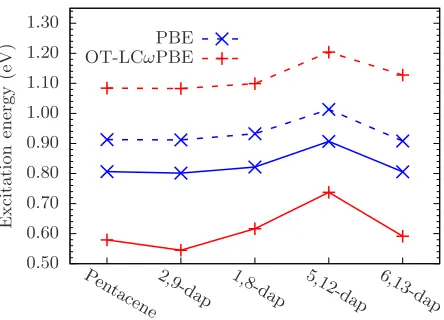
FIG. 7– Comparison of T1 energy for each chromophore in vacuum with TDDFT and
∆SCF calculations. Solid lines use the same key as Figure 6 for TDDFT data. Broken lines represent ∆SCF results.
B. Vacuum excitations
Next, we consider the excited state properties of our chromophores in vacuum. This will
form the reference for our study of the environment effects on the acenes. Figures 6 and 7
[image:16.612.194.417.70.230.2] [image:16.612.195.417.319.479.2]TDDFT and ∆SCF in Gaussian. We see that PBE behaves consistently for S1 and T1, with
the same trends between molecules observed regardless of method or exchange-correlation
functional. As expected from our discussion in Section III A, the absolute PBE S1 energies
are considerably lower than experimental and quantum chemical results presented in Table
I. Hybrid functionals perform much better for S1, while for T1 with TDDFT we observe a
significant underestimation of the energy level using hybrid functionals, where PBE gives a
considerably better result. This is most likely a result of the triplet instability associated
with linear-response TDDFT [? ? ? ]. For comparison, we include ∆SCF results using each
functional. The closest results to experiment for the T1 state of pentacene are obtained using
PBE, as hybrid functionals now appear to overestimate the excitation energy. Nonetheless,
the hybrid result is in line with past first principles calculations of T1with high-level methods
[? ]. Once again we observe the same trends regardless of functional and method, indicating
that the variation in excitonic properties caused by nitrogen doping can be captured by PBE
without requiring exact exchange, even if the absolute energies are underestimated, but the
use of full TDDFT can lead to poor results with hybrid functionals. Further consistency tests
have been performed using the Tamm-Dancoff Approximation (TDA) and other
exchange-correlation functionals which confirm the observations discussed here. In particular, using
the TDA yields results in agreement with ∆SCF. Details are included in the SM.
VI. Host effects
We now consider the impact of placing our molecules in both implicit and explicit p
-terphenyl hosts, the former a conductor-like polarisable continuum model (CPCM) and the
latter a cluster of six p-terphenyls as shown in Figure 3. Our focus is on the trends that
we observe by comparing these results to the vacuum results outlined in Section V B. Due
to the close agreement between TDDFT with OT-LCωPBE and past studies for S1, as well
as ∆SCF and TDA, from here on all S1 energies will be calculated using TDDFT and T1
−200 −180 −160 −140 −120 −100 −80 −60 −40 −20 Pen
tacene2,9-dap 1,8-dap 5,12-dap 6,13-dap
E n er g y sh if t w rt va cu u m (m eV ) PBE/CPCM OT-LCwPBE/CPCM PBE/cluster OT-LCwPBE/cluster
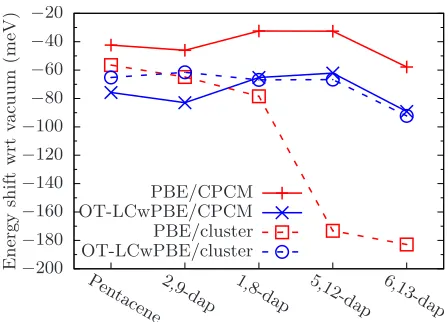
FIG. 8– Change in S1 energy level for each chromophore by insertion into a CPCM (solid
lines) and explicit host of 6p-terphenyls (dashed lines) compared to vacuum with PBE (red) and OT-LCωPBE (blue). All calculations were performed with TDDFT. This figure uses the same legend as Figure 9.
A. Results
Figure 8 displays our results for the S1 excitation energies of all our chromophores in
both implicit and explict host with PBE and OT-LCωPBE. Starting with the CPCM, we
see a redshift in S1 for all molecules, though for PBE the magnitude of the redshift is
30-40 meV smaller than the OT-LCωPBE result. Both functionals predict the same trend
between different chromophores, with 2,9- and 6,13-dap showing a greater redshift than
pentacene, while the solvatochromic shift is reduced for 1,8- and 5,12-dap. With an explicit
host, we observe significant divergence between PBE and OT-LCωPBE. While there is a
greater redshift for OT-LCωPBE than PBE for pentacene, this trend is reversed for the other
chromophores and appears to be magnified as the nitrogens are brought closer together,
with PBE predicting a greater redshift for all nitrogen-based analogues than the hybrid
functional. Indeed, the S1PBE results for 5,12- and 6,13-dap in explicit host predict redshifts
of 173 meV and 189 meV respectively, far greater than any other shift presented here. With
OT-LCωPBE, pentacene is redshifted by 65 meV, a result comparable to those for all other
[image:18.612.193.417.69.230.2]−40
−30
−20
−10 0 10
Pen
tacene2,9-dap 1,8-dap 5,12-dap 6,13-dap
E
n
er
g
y
sh
if
t
w
rt
va
cu
u
m
(m
eV
)
PBE/CPCM OT-LCωPBE/CPCM PBE/cluster OT-LCωPBE/cluster
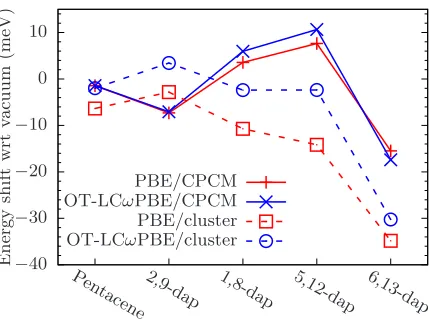
FIG. 9– Change in T1 energy level for each chromophore by insertion into a CPCM (solid
lines) and explicit host of 6p-terphenyls (dashed lines) compared to vacuum with PBE (red) and OT-LCωPBE (blue). All calculations were performed with ∆SCF.
Turning our attention to T1, Figure 9 shows the equivalent results for the lowest triplet
state using ∆SCF, the scale of which are considerably smaller than S1. Looking at the CPCM
results, we notice that near-zero redshifts are predicted for pentacene with both the PBE and
OT-LCωPBE functionals, which amounts to just 2 meV. We observe the same trends between
chromophores for both functionals as well, with the magnitude of the solvatochromic shift
being significantly reduced compared to S1. Indeed, 1,8- and 2,9-dap have small blueshifts
of 6 meV and 11 meV respectively compared to vacuum, with only 6,13-dap predicting a
significant redshift of 15-18 meV. With the cluster, we see that both PBE and OT-LCωPBE
predict the same trends between the chromophores, though the latter predicts a smaller
redshift in all cases; indeed, for 2,9-dap OT-LCωPBE produces a blueshift, though since the
shift is below 5 meV this may not be an significant result. As with the CPCM, 6,13-dap sees
the most significant change, being redshifted by 30-35 meV relative to vacuum.
B. Discussion
At this stage, we must try to unravel the effects of the choice of exchange-correlation
[image:19.612.201.416.71.231.2]stand-95 96 97 98 99 100 Pen
tacene2,9-dap 1,8-dap 5,12-dap 6,13-dap
H O M O → L U M O co n tr ib u ti o n (% )
[image:20.612.194.417.71.231.2]Implicit host (CPCM) Explicit host (Cluster)
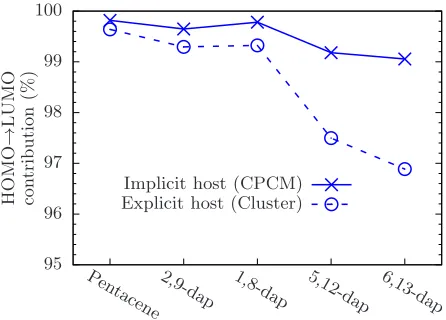
FIG. 10– Contribution of the HOMO→LUMO Kohn-Sham transition vector to the S1
excited state of the chromophores in implicit and explicit p-terphenyl host using OT-LCωPBE.
out data from Figures 8 and 9 is the shift in S1 for 5,12- and 6,13-dap using PBE, results
which are distinct from all the others presented here. A closer look at the composition of
the S1 state for each molecule reveals the reason for this. While in vacuum this transition
is entirely HOMO→LUMO in character, for explicit host we see a mixing of other
charge-transfer (CT) transitions between the chromophore and p-terphenyl into the S1 excitation
for these molecules, with the HOMO→LUMO transition contributing only 56% and 66% to
S1 for 5,12- and 6,13-dap respectively. By comparison, the S1 states for pentacene, 2,9-dap
and 1,8-dap possess a 97%, 95% and 94% HOMO→LUMO contribution respectively – see
SM for more details. Figure 10 shows the equivalent results using OT-LCωPBE, where the
HOMO→LUMO transition dominates for all molecules. It thus appears that this spurious
CT mixing caused by the failure of PBE to capture long-range interactions has resulted in
an unphysically large redshift for S1. We do not observe the same phenomenon for T1 since
this state retains its highly localised Frenkel excitonic state in all oligoacenes.
Comparing the energetic trends for CPCM and explicit host, we notice near identical
behaviour for 1,8-, 5,12- and 6,13-dap using OT-LCωPBE for S1, while the two models
di-verge for pentacene and especially 2,9-dap. Note that, in contrast to the explicit host, we
−2 −1 0 1 2 3 4 5 6 7
Pentacene 2,9-dap 1,8-dap 5,12-dap 6,13-dap
HOMO LUMO
D
en
si
ty
o
f
S
ta
te
s
[image:21.612.200.416.72.227.2]Energy relative to HOMO (eV)
FIG. 11– Local density of states (LDOS) of the different chromophores in explicit host as a function of energy with OT-LCωPBE. Blue/solid: acene LDOS. Red/patterned: p-terphenyl cluster LDOS. Energies are relative to the HOMO of the given chromophore in explicit host.
underestimates the magnitude of the redshift in S1 that OT-LCωPBE predicts. Comparing
functionals alone, however, masks the impact of the nitrogen doping on S1, as the CPCM
predicts a smaller redshift for 1,8- and 5,12-dap than pentacene, in contrast to the explicit
host results, as well as underestimating the scale of the shift for 6,13-dap relative to
pen-tacene. This becomes clearer form Figure 9, where the two models predict markedly different
trends despite producing identical results for pentacene with OT-LCωPBE. This indicates
that, while the CPCM does provide a good description of the impact of the electrostatic
in-teraction on between pentacene and thep-terphenyl host, it fails to capture the full impact
of the environment interactions on the nitrogen doped molecules.
Figure 10 compares the contribution of the HOMO→LUMO transition to S1 for both
im-plicit and exim-plicit hosts using OT-LCωPBE. While in vacuum this is a pure HOMO→LUMO
transition, we observe a small but significant dilution of this excited state from inclusion of
an explicit host, the magnitude of which increases as the nitrogens are brought closer
to-gether within the acene. Note that this is qualitatively similar to our observations for PBE,
even though the scale of the dilution is vastly overestimated by semi-local functionals. The
CPCM is unable to capture this CT contribution to the excited state, leading to the
is related to nitrogen doping, consider the local density of states (LDOS) plots displayed in
Figure 11. While in vacuum pentacene the HOMO and LUMO are isolated energetically,
the inclusion of an explicit host introduces additional molecular orbitals above the vacuum
HOMO-1 and below the LUMO+1. The HOMO/LUMO states of pentacene in p-terphenyl
retain their purity but nitrogen doping brings the occupied states of the host molecules
closer to the HOMO in energy. Our calculations show that the nitrogen lone pairs provide
a bridging mechanism between the pentacene molecular orbitals and those of p-terphenyl,
rendering these states available for inclusion as weak CT contributions to the oligoacene
excited states.
Hohenstein and Sherrill have shown the importance of the substitution of nitrogen
het-eroatoms in π-π interactions using the example of benzene and pyridine dimers [? ]. The
highly electronegative nitrogens reduce the spatial reach of the electron density, resulting in
a stronger bond with benzene due to the orientation of this nitrogen with the net-positively
charged hydrogen on the benzene molecule. A similar mechanism can be expected for the
doping of pentacene with nitrogen, as from Figure 3b we see that there will be a high degree
of overlap between the pentacene and p-terphenyl rings in the herringbone structure. As
we have just seen, however, the strength of the CT coupling resulting from this
interac-tion varies significantly for our oligoacenes, with pentacene, 1,8- and 2,9-dap showing near
identical singlet and triplet excitation energies in vacuum and explicit host, while 5,12- and
6,13-dap are more distinct. This is consistent with our observation in Section V A that the
latter two molecules show a significant redistribution of their electron charge due to the
introduction of the nitrogen lone pairs into the aromatic system, while the former are almost
indistinguishable from pentacene. Since 1,8- and 2,9-dap retain a predominantly acene-like
character, their excitonic behaviour resembles that of pentacene, unlike 5,12- and 6,13-dap.
From a geometric perspective, Figure 3 shows clear differences between the regions that
each nitrogen lone pair interacts with on neighbouring p-terphenyls. In addition, from
Fig-ure 2, we see that, apart from 6,13-dap, all diazapentacene molecules lack the mirror
symme-try through the major axis plane that pentacene possesses. We thus considered rotating all
the molecules to give the alternative lattice position in thep-terphenyl crystal, with the view
in excitation energies or molecular orbital composition for any molecule, which appears to
rule out this geometric theory. We therefore conclude that the unique excitonic properties
of 6,13-dap can be attributed to the strong distortion of the local electronic structure by the
presence of the nitrogens.
VII. Conclusions
In this paper, we have presented a first-principles study of the excitonic properties of
pentacene and its nitrogen based analogues doped in both implicit and explicit p-terphenyl
hosts. We have demonstrated, using both ground-state DFT and TDDFT, that the presence
of a host has significant effects upon the S1 excitation energy of the chromophore. Implicit
solvation is often insufficient to understand host effects, requiring one to employ explicit
treatments of the host in regions neighbouring the chromophore due to a weak charge-transfer
interaction between the guest dopant and neighbouring p-terphenyls. However, an implicit
model does provide a qualitative understanding of the importance of the environment for
treating excited excited states of these oligoacenes from an electrostatic perspective. For
instance, our CPCM predicted a significantly stronger redshift in the lowest triplet state T1
for 6,13-diazapentacene than the other chromophores which, though it does not match the
explicit results, indicates that these oligoacenes have quantitatively different behaviours in
host systems. Even with semi-local functionals, it is possible to obtain indicative trends of
environment behaviour of these chromophores that match hybrid treatments as in CPCM the
spurious charge-transfer mixing is not a factor. This, however, hides the failure of semi-local
functionals with explicit host and highlights that explicit host models with hybrid
exchange-correlation functionals are the combination required to obtain reliable results for the full
impact of the environment in such systems.
From the perspective of the search for new chromophores for the room-temperature maser,
our study shows that significant variations in the excited states of these molecules can result
from the presence of nitrogen in the molecule due to the highly electronegative behaviour
of the nitrogen atoms causing charge redistribution across the molecules. This facilitates a
resulting in a greater redshift of the low-lying excited states. For 1,8- and 2,9-dap, the
effect of charge redistribution is localised on the outer rings, thus the variation in electric
charge across the rings is significantly reduced and the impact on excitation delocalisation
is minimal. These molecules thus have excitation spectra that are very similar to pentacene,
suggesting that they could be functional maser media dopant molecules. 5,12-dap behaves
similarly to pentacene in response to thep-terphenyl host, but T1 is significantly higher than
for any other molecule studied here, which would have a detrimental effect on the decay rate
from T1 back to S0. 6,13-dap sees a significant distortion of the excitation spectrum, due to
the presence of the nitrogens on the central acene ring, as well as a greater redshift in a p
-terphenyl host than for pentacene. The significant redshift of T1could aid the decay rate and
avert bottlenecking that affects the current device. The use of nitrogen substitution enables
one to largely preserve the excitation spectrum of pentacene while tuning the interaction
between the chromophore and its host, thus understanding the interactions between such
molecules and their hosts is essential for such techniques to be used in practical applications.
Supplementary Material
See the Supplementary Material for additional information on geometry optimisations
and how the cluster was constructed, as well as additional excitation energy plots using the
Tamm-Dancoff approximation (TDA) and other exchange-correlation functionals. The
re-search data from this publication is freely available at https://doi.org/10.5281/zenodo.1167847.
Acknowledgments
The authors wish to thank Dr Mark Oxborrow and Dr Jess Wade for useful discussions.
The authors acknowledge support from the Thomas Young Centre under grant TYC-101.
RJC acknowledges studentship support from the EPSRC Centre for Doctoral Training Centre
in Theory and Simulation of Materials (EP/L015579/1) and an Imperial College Presidents
PhD Scholarship. PDH acknowledges support from the Engineering and Physical Sciences
acknowledge funding by the Leverhulme Trust under Research Project Grant
RPG-2014-125. NDMH and PDH acknowledge support from the Engineering and Physical Sciences
Research Council (EPSRC) Grant EP/P02209X/1. Calculations were performed at the