Original citation:
Haslegrave, John and Cannings, Chris. (2017) Majority dynamics with one nonconformist.
Discrete Applied Mathematics, 219. pp. 32-39.
Permanent WRAP URL:
http://wrap.warwick.ac.uk/84436
Copyright and reuse:
The Warwick Research Archive Portal (WRAP) makes this work by researchers of the
University of Warwick available open access under the following conditions. Copyright ©
and all moral rights to the version of the paper presented here belong to the individual
author(s) and/or other copyright owners. To the extent reasonable and practicable the
material made available in WRAP has been checked for eligibility before being made
available.
Copies of full items can be used for personal research or study, educational, or not-for-profit
purposes without prior permission or charge. Provided that the authors, title and full
bibliographic details are credited, a hyperlink and/or URL is given for the original metadata
page and the content is not changed in any way.
Publisher’s statement:
© 2017, Elsevier. Licensed under the Creative Commons
Attribution-NonCommercial-NoDerivatives 4.0 International
http://creativecommons.org/licenses/by-nc-nd/4.0/
A note on versions:
The version presented here may differ from the published version or, version of record, if
you wish to cite this item you are advised to consult the publisher’s version. Please see the
‘permanent WRAP URL’ above for details on accessing the published version and note that
access may require a subscription.
Majority dynamics with one nonconformist
John Haslegrave
1, Chris Cannings
2November 25, 2016
Abstract
We consider a system in which a group of agents represented by the vertices of a graph synchronously update their opinion based on that of their neighbours. If each agent adopts a positive opinion if and only if that opinion is sufficiently popular among his neighbours, the system will eventually settle into a fixed state or alternate between two states. If one agent acts in a different way, other periods may arise. We show that only a small number of periods may arise if natural restrictions are placed either on the neighbourhood structure or on the way in which the nonconforming agent may act; without either of these restrictions any period is possible.
Keywords: majority dynamics; threshold automata; voter model; social learning; periodicity.
1
Introduction
We consider a general setting in which a number of agents with a system of neigh-bourhood relationships have binary opinions which they update synchronously based on their neighbours’ opinions. Neighbourhood is an arbitrary symmetric relation, and we represent the agents as vertices of a graph with edges, and, if necessary, loops, corresponding to the neighbourhood relation. Perhaps the most natural model for such updating of opinion is for each agent to adopt the more popular opinion among its neighbours (majority dynamics). A more gen-eral model along the same lines is to allow each agent to be inclined against a particular opinion, only adopting that opinion if sufficiently many neighbours (not just a simple majority) do. Different agents can be inclined toward differ-ent opinions or to differdiffer-ent degrees. Such a system forms a threshold network; threshold networks were introduced by McCulloch and Pitts [9] to model acti-vation of neurons. They also arise naturally as myopic best response strategies in networks of agents playing a coordination game (see e.g. [2], [14]).
Majority dynamics and the more general threshold networks have been much studied. A classical result is the period-2 property. Since any finite threshold network has only a finite number of states and the progression from state to state is deterministic and memoryless, periodic behaviour must eventually arise from any possible starting state. What lengths of period are possible? It is not obvious that there is any constant bound on the period, but in fact the only possible periods are 1 and 2. This was proved independently by Goles and
Olivos [6] (see also [5]) and Poljak and Sˆura [12]. Poljak and Turz´ık [13] gave good bounds on the time until periodic behaviour begins.
If the network is infinite then the system does not necessarily reach a periodic state. Furthermore, even if it does, any period can occur. Moran [10] showed that with the additional conditions of bounded neighbourhoods and subexpo-nential growth, both of which are necessary, again only periods 1 and 2 are possible. Ginosar and Holzman [4] show that under suitable conditions on an infinite graph a local period-2 property holds, in that each agent will eventually have a constant or alternating opinion (though the system as a whole may never become periodic since the times at which agents settle into these patterns could be unbounded).
If the updates are asynchronous, it is easy to see that on any finite threshold network the state is ultimately constant. Tamuz and Tessler [16] showed that this again holds locally on an infinite graph under suitable conditions. This con-trasts with the closely related zero-temperature stochastic Ising model, which updates as asynchronous majority dynamics except that ties are broken ran-domly; Nanda, Newman and Stein [11] showed that under the latter model on
Z2, almost surely every vertex changes its opinion infinitely often.
Other facets of majority dynamics have been studied, such as the question of whether a bias in the initial opinions tends to be preserved by this process (Tamuz and Tessler, [16]), and the threshold of initial bias which results in consensus on infinite trees (Kanoria and Montanari, [8]). Probabilistic versions of majority dynamics have been studied on highly-structured graphs. A model where agents make synchronous updates to the majority opinion among their neighbours, but occasionally make errors, dates back at least to work by Gray from the 1980s [7], but a similar model was considered significantly earlier by Spitzer [15]. Most studies on this model are merely computer simulations, but the few rigorous results include Gray’s proof that the 1-dimensional version does not have a phase transition [7] and, more recently, the result of Balister, Bollob´as, Johnson and Walters [1] that if the probability of error is small then the 2-dimensional torus spends almost all its time in a consensus state.
The opposite notion to majority dynamics, where each agent adopts the minority opinion of its neighbourhood, also arises naturally from the myopic best response strategy for a congestion game [14]. We may similarly generalise this to an anti-threshold network, where each agent adopts an opinion if it is sufficiently unpopular in the neighbourhood. The period-2 property for finite anti-threshold networks follows immediately from the result on threshold networks.
Cannings [3] considered various situations on simple graphs in which there were both majority and minority agents present, showing that cycles of various lengths could occur. He analysed particularly the case of a complete graph, proving that only cycles of length 1, 2 and 4 are possible, with length 4 only occurring in the special case of having equal numbers of majority and minority agents. A further class of cubic graphs was considered and possible cycle lengths for various numbers of minority agents obtained by direct simulation. A striking feature of these data is that when only one agent makes minority updates while the others make majority updates, only periods 1, 2 and 4 appear. However, this is not true for all graphs (or even all cubic graphs, e.g. Figure 1b).
one additional agent following a different protocol. This result applies in the much more general setting where the nonconforming agent updates his opinion as any function of its neighbours’ opinions, not necessarily choosing the minority opinion, and also if triangles are permitted so long as the nonconformist is not part of any triangle. If loops are permitted then there are more possibilities, but we prove that only a few different periods can arise. We also show that if the nonconforming agent does update to the minority opinion of his neighbours, then again only a few different periods can arise, with no restriction on triangles. We will prove all our results for the general threshold situation, but they could equivalently be re-stated in terms of majority updates. It is easy to see that an agent updating according to an arbitrary threshold may be simulated by a suitable bundle of majority agents, and so any dynamics arising from arbi-trary threshold networks with one nonconformist can also arise from majority dynamics with one nonconformist on a larger graph. This larger graph can also easily be chosen in accordance with the various restrictions on graphs that we consider.
Formally, we fix a finite graphG, which may have loops but not multiple edges, on vertex set{v1, . . . , vn}. For eachi, writeNi for the neighbourhood of
vi (includingvi if there is a loop there). The graph is initialised by giving each vertex one of two opinions, which we represent as {+1,−1}, at time 0, and all vertices simultaneously update their opinions at each time step. Write Ut for the set of vertices having opinion +1 at time t. Each vertex vi has an update rule which depends only on the state ofNiat the previous time step, i.e. for each
ithere is a set systemSi ⊆ PNi such thatvi∈Ut+1if and only ifNi∩Ut∈ Si.
We say thatvihas athreshold rulewith thresholdriifSi={A⊆Ni:|A|>ri}
for some ri, and an anti-threshold rule ifSi ={A ⊆Ni : |A| < ri}. We will always assume that every vertex except v1 has a threshold rule, withvi having
thresholdri fori >1. WriteUt∗ forUt\ {v1}.
2
A Lyapunov operator
Proofs of the period-2 property for threshold networks (see [6], [12], [5] and [2]) proceed by defining a suitable Lyapunov operator, proving that it is bounded, integer-valued and non-decreasing, so must be ultimately constant, and showing that if at any step the value does not change then the state is identical to the previous state but one. In this section we give a modified Lyapunov operator for the situation wherev1 has an arbitrary rule, and show that provided every
other vertex has a threshold rule this is still bounded and non-decreasing, and must be an integer multiple of 1/2, so is ultimately constant. The analysis of what can happen once this operator has reached its final value is much more complicated than for pure threshold networks, and we carry out this analysis separately for triangle-free graphs in Section 3 and for general graphs with v1
having an anti-threshold rule in Section 4.
Theorem 1. For t sufficiently large, if vi ∈ Ut∗−14Ut∗+1 then vi ∈ N1 and
|Ni∩Ut∗|=ri−1.
Proof. Fori= 2, . . . , n set
si=
(
ri−1 ifvi ∈N1
ri−1
Note that if i ∈ Ut∗+1 then |Ni∩Ut∗| > si, if i /∈ Ut∗+1 then |Ni∩Ut∗| 6 si,
and if vi6∈N1 then both inequalities are strict. (If vi is a neighbour ofv1 and
|Ni∩Ut∗|=si then the opinion ofvi at timet+ 1 equals that ofv1 at timet.)
Fort >0 definex(t) to be the number of pairs (i, j) such that i∈Ut∗ and
j∈Ut∗−1∩Ni. Lety(t) =P
i∈U∗
t si, and letz(t) =x(t)−y(t)−y(t−1).
Note that z(t+ 1)−z(t) =x(t+ 1)−x(t) +y(t−1)−y(t+ 1). We may writex(t+ 1) asP
i∈U∗
t+1|Ni∩U
∗
t|andx(t) as
P
i∈U∗
t−1|Ni∩U
∗
t|. Consequently
x(t+ 1)−x(t) = X
i∈Ut∗+1 i /∈Ut∗−1
|Ni∩Ut∗| −
X
i∈Ut∗−1 i /∈Ut∗+1
|Ni∩Ut∗|,
and so
z(t+ 1)−z(t) = X
i∈Ut∗+1 i /∈Ut∗−1
|Ni∩Ut∗| −si
+ X
i∈Ut∗−1 i /∈Ut∗+1
si− |Ni∩Ut∗|
.
By our earlier observation, this is a sum of non-negative terms, and soz(t+ 1)>
z(t) for eacht. Further, ifvi contributes to either sum then the corresponding term is strictly positive, and soz(t+ 1)> z(t), unlessvi is adjacent tov1.
Since 2z(t) is an integer, and at most 2n2 + 4n, z(t) must eventually be
constant. Therefore, fortsufficiently large thatz(t) has reached its final value, all terms in the sum are zero. Consequently if vi ∈ Ut∗+14Ut∗−1 then vi is adjacent tov1 and we must have|Ni∩Ut∗|=si=ri−1.
3
General rules in triangle-free graphs
In this section we consider graphs where v1is not in a non-degenerate triangle.
In the loopless case we show that only periods 1, 2 and 4 are possible, but when loops are permitted several other periods may arise. These additional periods do not necessarily require a loop atv1 (e.g. Figure 2b).
Theorem 2. If no two distinct neighbours ofv1are adjacent, and loops are not
permitted, then for any update rule atv1the system reaches a1-,2- or 4-cycle.
Proof. By Theorem 1, for sufficiently large t and any fixed vertex vi which is
neitherv1 nor adjacent to it, the opinion of vi is a function of the parity of t.
Ifvi is a neighbour of v1 then the opinion ofvi at any sufficiently large timet
depends on the state of the neighbours of vi at time t−1; except for the state of v1 at time t−1, all of these depend only on the parity of t. Likewise the
state ofv1 at timet+ 1 depends only on the state of its neighbours at timet,
which in turn depends only on the state ofv1 at timet−1 and the parity oft.
Consequently either v1 is in the same state for every sufficiently large oddtor
it alternates between states in successive oddt, and the same possibilities apply to sufficiently large event. It follows thatv1 is in the same state at timestand
t+ 4 for sufficiently larget, and therefore that eachvi in the neighbourhood of
v1 is in the same state at times t+ 1 and t+ 5. Therefore the state of every
Theorem 3. If no two distinct neighbours of v1 are adjacent but loops are
permitted, then for any update rule at v1 the system reaches a1-, 2-,3-,4-,6-,
8-,10- or12-cycle.
Proof. First we deal with the case where the state of v1 is either ultimately
constant or ultimately alternating. In that case, for fixediand sufficiently large
t, the state ofvi at timetdepends only on the parity oftand the state ofviat timet−1. Moreover, since it plays a threshold rule, changing its state att−1 cannot change its state attin the opposite direction. So either at all sufficiently large oddtit is a fixed state, or at all sufficiently large oddtit is the same state as at t−1, and likewise for event. Consequently it is either a fixed state or alternating in state for sufficiently large t. Since this is true for every vertex, the system has period 1 or 2.
Now suppose that the state ofv1is neither ultimately constant nor ultimately
alternating. Fix 1< i6n, then one of the following is the case for all sufficiently large event, and one is the case for all sufficiently large odd t:
(1) vi∈Ut;
(2) vi∈Ni andvi∈Utiffv1∈Ut−1 orvi∈Ut−1;
(3) vi∈/Ni andvi∈Utiffv1∈Ut−1;
(4) vi∈Ni andvi∈Utiffv1∈Ut−1 andvi∈Ut−1;
(5) vi∈/Ut.
There are then 21 possibilities for which pair of these rules applies (since it is not possible for (2) or (4) to apply at one parity and (3) at the other). In some cases the behaviour may be simplified. If (1) applies at one parity and (2) at the other, or if (2) applies at both, then in fact (since we are assumingv1 is
not ultimately constant)vi∈Utfor all sufficiently larget. Similarly if (4) and
(4) or (4) and (5) apply thenvi∈/ Utfor all sufficiently larget. If (1) applies at
one parity and (4) at the other, or (5) at one and (2) at the other, then in fact for the second parityvi∈Utiffv1∈Ut−1.
For j ∈ {0,1}, write Xj for the set of vertices which satisfy (2) for t ≡ j
mod 2 and (4) for t6≡j. Write Yj for the set of vertices which satisfy (3) for
t ≡j, or which satisfy (2) for t≡j and (5) for t6≡j, or which satisfy (4) for
t≡j and (1) fort6≡j; we observed above that all such vertices satisfy vi∈Ut
iffv1∈Ut−1fort≡j. WriteZj for the set of vertices which satisfy (4) fort≡j
and (2) fort6≡j; note thatZj =X1−j.
Ifi6= 1 andvi6∈X0∪Y0∪Z0 thenvi is a fixed state for all sufficiently large
even t. Since we are assuming v1 is not alternating, eventually v1 ∈Ut−1 for
some even t or v1 6∈Ut−1 for some odd t; in either case all vertices in X0 will
be the same state at time t, and this will remain true at all future times. We will refer to a set being monochromatic if all its vertices have the same state; similarlyY0andZ0are each monochromatic for all sufficiently larget. Also note
that, if tis even, thenZ0⊆Ut⇒Y0⊆Ut⇒X0⊆Ut. So there are only eight
possible states which occur at arbitrarily large event: eitherX0∪Y0∪Z0⊆Ut, X0∪Y0⊆Ut butZ0⊆Ut{,X0⊆Utbut Y0∪Z0⊆Ut{, orX0∪Y0∪Z0⊆Ut{,
for four possibilities, and we may have v1 ∈ Ut or v1 ∈Ut{. The states must
In fact not all of these can occur infinitely often. If any of the sets defined above are empty then for some parity of t there are at most 6 possible states, so the period is at most 12. Now suppose that they are all non-empty. If
t is sufficiently large we may represent the state of the system by a vector in
{0,1}×{−1,+1}4, withs= (j, x, y, z, w) representing the state wheret≡jand
Xj,Yj,Zjandv1 have statesx,y,zandwrespectively (i.e.x= +1 ifXj ⊆Ut
and x= −1 otherwise). We know that we are further restricted to states for whichx>y>z. There is some functionf mapping, for sufficiently larget, the state at time t to the state at timet+ 1. Note that ifsis (0,−1,−1,−1,−1), (0,+1,−1,−1,−1), (0,+1,−1,−1,+1), (0,+1,+1,−1,−1), (0,+1,+1,−1,+1) or (0,+1,+1,+1,+1) then f(s) is of the form (1, x, x, x, w) for some x and
w. Consequently the image under f of the set of vectors representing states at even time has size at most 6 (the above four possibilities together with
f((0,−1,−1,−1,+1)) and f((0,+1,+1,+1,−1))), so at most six states occur at sufficiently large odd time and the period is at most 12.
If the period,p, is odd, then every state which occurs infinitely often does so both at both odd times and even times. So iftis sufficiently large and even,
Z0⊆Ut⇒X0∪Y0⊆Ut ,
and, sinceX0=Z1,
Z0⊆Ut⇒Z1⊆Ut
⇒Z1⊆Ut+p ⇒X1∪Y1⊆Ut+p ⇒X1∪Y1⊆Ut.
Similarly,
Z0⊆Ut{⇒X1⊆Ut{ ⇒X1⊆Ut{+p
⇒Y1∪Z1⊆Ut{+p
⇒Y1∪Z1⊆Ut{,
and, sinceX0=Z1,
Z0⊆Ut{⇒X0⊆Ut{
⇒Y0⊆Ut{.
Consequently, whenpis odd, every state which occurs infinitely often is mono-chromatic on X0∪Y0∪Z0∪X1∪Y1∪Z1. There are therefore only 4 possible
states, depending on the states of that set and v1, so the only possible odd
periods are 1 and 3.
4
Minority rule in general graphs
rule. We consider the possible sequences of states of v1, and show that, once
the system has reached a recurrent state, only a few sequences are possible. As a result, we show that only a few different periods can arise from such a system: 1, 2, 4, 5, 6 and 10 if loops are not permitted, and the same periods with the addition of 3 and 8 if loops are permitted (in fact a loop at v1must be present
to obtain either of these periods). Throughout this section we assume that the system has already reached a recurrent state, and writectfor the state ofv1at
timet. Recall that in this case|Ni∩Ut∗+1|=ri−1 for allvi ∈Ut∗4Ut∗+2, and so Ut∗⊆Ut∗+2 ifct+1= +1 but Ut∗⊇Ut∗+2 ifct+1=−1.
Lemma 4. If (ct, . . . , ct+2) = (x,−x, x) thenUt∗+1=Ut∗+3.
Proof. We prove the case x= +1; the second case is equivalent by swapping
the states. ThenUt∗⊇Ut∗+2, and consequentlyUt∗+1⊇Ut∗+3, since every vertex has at least as many edges to Ut as to Ut+2. But also Ut∗+1 ⊆ Ut∗+3 since
ct+2= +1.
Lemma 5. If (ct, . . . , ct+4) = (x,−x, x, x,−x) thenv1 has a loop.
Proof. By Lemma 4,Ut∗+1=Ut∗+3. Sincect+46=ct+2we must haveN1∩Ut+36=
N1∩Ut+1. SinceUt+34Ut+1={v1}, we must havev1∈N1.
Lemma 6. If (ct+1, . . . , ct+3) = (−x, x, x) then Ut∗ ⊆ Ut∗+4 if x = +1 and
Ut∗⊇Ut∗+4 ifx=−1.
Proof. We prove the casex= +1; the second case is equivalent by swapping the
states. Sincect+2= +1,Ut∗+3⊇Ut∗+1. SimilarlyUt∗+4⊇Ut∗+2. Ifvi∈Ut∗4Ut∗+2
thenvi hasri−1 edges to vertices in Ut∗+1, so at leastri−1 edges to vertices in Ut∗+3, and sovi∈Ut∗+4. ThereforeUt∗+4⊇Ut∗.
Lemma 7. If (ct+1, . . . , ct+4) = (−x, x, x, x)thenct+5=−x.
Proof. Again we may assumex= +1. ThenUt∗+4⊇Ut∗by Lemma 6 and since
v1 ∈ Ut+4, Ut+4 ⊇Ut. Since v1 obeys an anti-threshold rule, ct+5 ≤ ct+1 =
−1.
Lemma 8. If (ct+1, . . . , ct+5) = (−x, x, x,−x, x) thenUt+6=Ut.
Proof. Again we assume x= +1. By Lemma 6,Ut∗ ⊆Ut∗+4. Since ct+5> ct+1,
and v1 obeys an anti-threshold rule, we must have|Ut+4|<|Ut|, which is only
possible if Ut∗ =Ut∗+4 andct= +1. By Lemma 4,Ut∗+4 =Ut∗+6. If ct+6 =−1
then Ut+6 =Ut+4, and the system repeats with period 2, but this contradicts
the assumption that we started in a recurrent state. So ct+6 = +1 and so
Ut+6=Ut.
Lemma 9. If (ct+1, . . . , ct+10) = (−x, x, x, x,−x,−x, x, x, x,−x)then ct+11=
−x.
Proof. As usual, assumex= +1. We haveUt∗+7 ⊆Ut∗+3, so Ut∗+8 ⊆Ut∗+4 and
Ut∗+9 ⊆Ut∗+5 (since ct+7 = ct+3 and ct+8 = ct+4). But also Ut∗+9 ⊇Ut∗+5, so
they are equal, and soUt∗+10⊇Ut∗+6. Now ifvi∈Ut∗+4\Ut∗+6then|Ni∩Ut∗+9|=
|Ni∩Ut∗+5| =ri−1 and so vi ∈Ut∗+10. Consequently Ut∗+10 ⊇Ut∗+4. Now we
distinguish two cases. Ifct=−1 thenUt+10⊇Utsoct+11=−1. Otherwise we
must haveUt∗⊂Ut∗+10 (sinceUt6=Ut+4) and so|N1∩Ut| ≤ |N1∩Ut+10|, again
Theorem 10. If the system starts from a recurrent state and v1 follows an
anti-threshold rule then one of the following applies:
(i) (ct)is constant and the system has period 1 or 2;
(ii) (ct)alternates and the system has period 2;
(iii) (ct)repeats the sequence+1,+1,−1,−1 and the system has period 4;
(iv) (ct)repeats +1,+1,+1,−1,−1,−1 and the system has period 6;
(v) (ct)repeats x, x, x,−xforx=±1 and the system has period 4;
(vi) (ct)repeats x, x, x,−x,−xforx=±1 and the system has period 5 or 10;
(vii) (ct)repeats x,−x,−xforx=±1 and the system has period 3 or 6; or
(viii) (ct) repeats x,−x,−x, x, x,−x,−x,−x for x = ±1 and the system has
period 8.
In addition, if loops are not permitted then one of (i)–(vi) must apply.
Proof. If (ct) is constant thenU0, U2, . . . is a monotonic sequence and so
even-tually constant, so the system has period at most 2. Henceforth we assume (ct) is not constant, and since we started in a recurrent state both possible values of ctoccur infinitely often. Consider the possible lengths of intervals on which
ct does not change. By Lemma 7 it is impossible for (ct+1, . . . , ct+5) to equal
(−x, x, x, x, x), so no such interval can have length exceeding 3.
Suppose two consecutive intervals have length 1, i.e. for some t we have (ct, . . . , ct+3) = (x,−x, x,−x). ThenUt∗+1 =Ut∗+3 by Lemma 4 so the states at
t+ 1 andt+ 3 are identical and (ii) applies.
Suppose there are two consecutive intervals of length 3, say (ct, . . . , ct+7) =
(−1,+1,+1,+1,−1,−1,−1,+1). Then Ut∗+6 ⊆Ut∗+2 by Lemma 6, and so also
Ut∗+7⊆Ut∗+3, since for anyi6= 1|Ni∩Ut∗+6| ≤ |Ni∩Ut∗+2|. Ifvi∈Ut∗+3\Ut∗+1
then|Ni∩Ut∗+6| ≤ |Ni∩Ut∗+2|=ri−1 and sovi6∈Ut∗+7. ThusUt∗+7⊆Ut∗+1, and
ct+7 =ct+1 so Ut+7 ⊆Ut+1; sincev1 obeys an anti-threshold rulect+8 = +1.
It follows that Ut∗+8 ⊆Ut∗+2, soct+9 = +1,Ut∗+9 ⊆ Ut∗+3, so ct+10 =−1, and
Ut∗+10 ⊆ Ut∗+4. Now applying the same arguments with inclusions reversed to
t0=t+ 3 gives Ut∗0+7 ⊇Ut∗0+3, i.e. Ut∗+10=Ut∗+4. Consequently the system has
period 6 and (iv) holds.
Suppose there are two consecutive intervals of length 2 preceded by an in-terval of length at least 2. Without loss of generality we have (ct, . . . , ct+6) =
(−1,−1,+1,+1,−1,−1,+1) for some t. By Lemma 6, Ut∗+4 ⊇ Ut∗ and so Ut∗+5 ⊇ Ut∗+1 and Ut∗+6 ⊇ Ut∗+2. However, again by Lemma 6, Ut∗+6 ⊆ Ut∗+2,
so Ut+6=Ut+2 and (iii) applies.
By Lemma 8, if an interval of length 2 is followed by an interval of length 1 then (vii) holds. Suppose (vii) does not hold, but there is some interval of length 1 followed by one of length 2, i.e. without loss of generality we have (ct, . . . , ct+4) = (−1,+1,−1,−1,+1). Then ct+5 = +1 (since otherwise (vii)
holds). By Lemma 4, Ut∗+1 =Ut∗+3, andUt∗+5 ⊇Ut∗+3, so Ut+5 ⊇Ut+1 and so
ct+6 ≤ct+2=−1. Nowct+7 =−1 since otherwise (vii) holds,ct+8 =−1 since
otherwise (iii) holds, andct+9= +1 by Lemma 7. Suppose further thatct+10=
recurrence ofUt, so the intervals fromtonwards begin 1,2,2,3,2. From now on
there cannot be two consecutive intervals of length 2 (which would imply (iii)) or two consecutive intervals of length 3 (which would imply (iv)), so intervals of length 3 and 2 must alternate until an interval of length 1 occurs (which it must, by recurrence of Ut). But this interval of length 1 cannot follow one of length 2 (by Lemma 8) or one of length 3 (by Lemma 9). Consequently, by contradiction, we must have ct+10 =−1. NowUt∗+8 ⊆Ut∗+4 and Ut∗+9⊆Ut∗+5.
If vi ∈ Ut∗+54Ut∗+3 then |Ni ∩Ut∗+4| = ri −1 and so |Ni∩Ut∗+8| ≤ ri−1, so vi 6∈ Ut∗+9. So Ut∗+9 ⊆ Ut∗+3, and Ut∗+3 = Ut∗+1. If Ut∗+9 6= Ut∗+3 then
|N1 ∩Ut+9| < 1 +|N1∩Ut+3|, which is impossible since ct+10 < ct+4. So
Ut∗+9=Ut∗+1 and (viii) applies.
If none of (i), (ii), (iii), (iv), (vii) or (viii) hold, then, no interval of length 1 can be followed or preceded by one of length 2, and no two consecutive intervals can have the same length. We cannot have three consecutive intervals of lengths 1,3,2, since subsequent intervals must alternate lengths 3 and 2 until another interval of length 1 occurs, but this cannot follow an interval of length 2, nor one of length 3 by Lemma 9. So the only remaining possibilities are that periods of lengths 1 and 3 alternate, or that periods of lengths 2 and 3 alternate.
In the former case we havect constant for allt of one parity, say all oddt, implying thatU0∗, U2∗, . . .is a monotonic sequence. Hence this sequence must be constant, and (v) applies. In the latter case, suppose without loss of generality that (c0, . . . , c4) = (+1,+1,−1,−1,−1) and this pattern repeats. We have
U4∗⊆U0∗,U9∗⊆U5∗andU10∗ ⊆U8∗⊆U6∗. Ifvi∈U6∗\U4∗then|Ni∩U5∗|=ri−1 and so |Ni∩U9∗| ≤ri−1, so vi 6∈ U10∗. So U0∗ ⊇ U10∗ ⊇U20∗ · · ·, and so this sequence is constant, giving (vi).
Thus one of the enumerated situations occurs. If there are no loops, by Lemma 5 we cannot have an interval of length 1 followed by one of length 2, so (vii) and (viii) are impossible and one of (i)–(vi) occurs in this case.
5
Graphs achieving these periods
In this section we show that Theorem 10, Theorem 2 and Theorem 3 are best possible, by giving example graphs to show that all periods mentioned may be attained. We also demonstrate that the restriction in Theorems 2 and 3 that no triangle containsv1 is necessary, by giving a family of graphs on which any
period can be obtained with a suitable choice of rule atv1.
It is easy to attain period 1 or 2, for example on any bipartite 3-regular graph in which all vertices except v1 follow the majority rule, by starting all
vertices at the same state (period 1) or all vertices of one part in one state and all vertices of the other part in the other state (period 2). It is easy to see that each vertex other than v1 will have the desired period unaffected by v1, since
its other neighbours will form a majority of one state. Consequently, no matter what rulev1 follows it must also have the same period after the first time step.
5.1
Graphs without loops
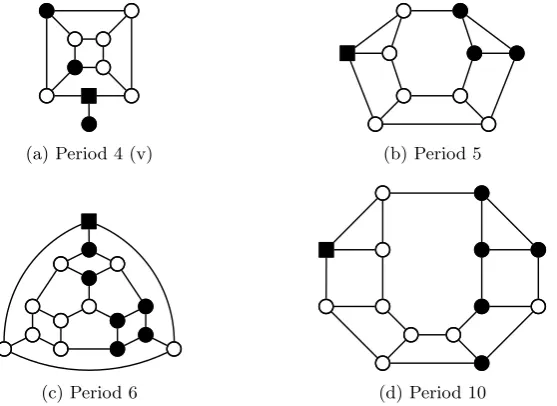
Here we give examples to show that the remaining alternatives given by Theo-rem 10 for graphs without loops are all possible. In each case all vertex degrees are odd and every vertex obeys the majority rule except for v1 (indicated by
the square) which obeys the minority rule.
(a) Period 4 (v) (b) Period 5
[image:11.595.166.445.203.406.2](c) Period 6 (d) Period 10
Figure 1: Loopless graphs with minority rule at v1
5.2
Triangle-free graphs with loops
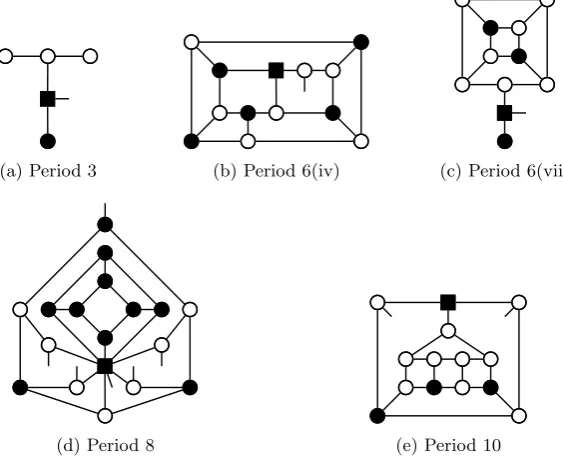
Here we give examples of triangle-free graphs which attain periods other than 1, 2 or 4; by Theorem 2 such graphs must have loops. The additional periods possible when loops are permitted are 3, 6, 8, 10 and 12. By Theorem 10, period 12 is not possible if v1 obeys an anti-threshold rule. In fact the other
periods are possible even with this restriction, as shown in Figure 2. Again all neighbourhoods are odd and every vertex obeys the majority rule except forv1
(indicated by the square) which obeys the minority rule; each loop is indicated by a short line leaving its vertex. While Theorem 3 applies even if triangles which do not meetv1 are permitted, in fact all possible periods can be obtained
(a) Period 3 (b) Period 6(iv) (c) Period 6(vii)
[image:12.595.158.440.130.361.2](d) Period 8 (e) Period 10
Figure 2: Triangle-free graphs with minority rule atv1
5.3
More general rules at
v
1Finally we give an example of a triangle-free graph on which period 12 is at-tained, together with a general construction to show that any period is possible without the restriction thatv1is not in a triangle. In each case a more
compli-cated rule is required atv1. In Figure 3a,v1takes state +1 at timet+ 1 if and
only if|N1∩Ut| ∈ {0,2,3,4}, and every other vertex follows the majority rule.
(a) Period 12 (b)G5
Figure 3: Graphs with more general rules atv1
To show that any period except 3 may be realised on a graph with no restric-tion on triangles (even if loops are not permitted), we define the graph Gk, for
k≥2, on vertex setv1, . . . , v2k+8 as follows. v1has neighboursv2, . . . , v2k+2, of
whichv2, . . . , vk+2 have no other neighbours andvk+3, . . . , v2k+2induce a path.
The remaining vertices form two triangles connected by a pair of edges, with two further edges between the ends of the path and the triangles. Figure 3b shows
G5. Start from the state shown, i.e.U0={v1, v2k+3, v2k+4, v2k+5}. Settingv1
[image:12.595.171.424.496.590.2]gives period 2k+ 1, whereas setting v1 to have state +1 at time t+ 1 if and
only if|N1∩Ut| ∈ {0,1, k+ 1, . . . ,2k−1}gives period 2k. Thus any period of
at least 4 occurs on some graph in this sequence, and of course periods 1 and 2 can be obtained even with the majority rule atv1. The final case of period 3 is
not possible without loops, and Figure 2a shows that it is possible if loops are permitted.
Proposition 11. For any graphGwithout a loop atv1 and for any rule atv1
which is a function of the states of its neighbours, period 3 is not possible.
Proof. Suppose not, and start the system in a recurrent state of period 3, so
that U0 →U1 → U2 → U0. If v1 is in the same state at every time then U2∗t
is monotonic, so constant, contradicting period 3. So without loss of generality (by swapping states and shifting if necessary),ct= +1 ift≡0,1 (mod 3) and ct=−1 otherwise. NowU0∗⊆U2∗⊆U1∗. We must haveU1∗6=U2∗, sincec26=c0.
But if vi∈U1∗\U2∗ then|Ni∩U1∗|<|Ni∩U0∗|, contradictingU0∗⊆U1∗.
6
Acknowledgements
Both authors acknowledge support from the European Union through fund-ing under FP7-ICT-2011-8 project HIERATIC (316705), and the first author also acknowledges support from the European Research Council (ERC) under the European Union’s Horizon 2020 research and innovation programme (grant agreement No. 639046).
References
[1] P. Balister, B. Bollob´as, J. R. Johnson and M. Walters, Random majority percolation,Random Structures and Algorithms 36(2010), 315–340.
[2] S. K. Berninghaus and U. Schwalbe, Conventions, local interaction, and automata networks,J. Evolutionary Economics 6(1996), 297–312.
[3] C. Cannings, The majority game on regular and random networks,
Inter-national Conference on Game Theory for Networks (GameNets) (2009),
i–xvi.
[4] Y. Ginosar and R, Holzman, The majority action on infinite graphs: strings and puppets,Discrete Mathematics 215(2000), 59–72.
[5] E. Goles, Lyapunov functions associated to automata networks,Automata
networks in computer science 58–81, Manchester University Press (1987).
[6] E. Goles and J. Olivos, Comportement p´eriodique des fonctions `a seuil binaires et applications,Discrete Applied Math.3(1981), 93–105.
[7] L. F. Gray, The behavior of processes with statistical mechanical proper-ties. In Percolation theory and ergodic theory of infinite particle systems,
Proc. Workshop IMA, Minneapolis, MN, 1984/85, IMA Vol. Math. Appl.
[8] Y. Kanoria and A. Montanari, Majority dynamics on trees and the dynamic cavity method,Annals of Applied Probability 21(2011), 1694–1748.
[9] W. McCulloch and W. Pitts, A logical calculus of the ideas immanent in nervous activity,Bulletin of Mathematical Biophysics 5(1943), 115–133.
[10] G. Moran, On the period-two-property of the majority operator in infinite graphs,Transactions of the American Math. Soc.347(1995), 1649–1667.
[11] S. Nanda, C. M. Newman and D. L. Stein, Dynamics of Ising spin systems at zero temperature. InOn Dobrushin’s Way (from Probability Theory to
Statistical Mechanics), R. Minlos, S. Shlosman and Y. Suhov, eds. (2000)
183–194. Amer. Math. Soc., Providence.
[12] S. Poljak and M. Sˆura, On periodical behaviour in societies with symmetric influences,Combinatorica 3(1983), 119–121.
[13] S. Poljak and D. Turz´ık, On pre-periods of discrete influence systems,
Dis-crete Applied Math.13 (1986), 33–39.
[14] R. Southwell and C. Cannings, Best response games on regular graphs,
Applied Mathematics 4(2013), 950–962.
[15] F. Spitzer, Interaction of Markov processes,Adv Math 5(1970), 246–290.