EXTEDNED ABSTRACT
Title: Modelling and Solving the Multi-Trip Multi-Objective Pollution Routing Problem on Urban Road Networks
TRB Paper number: 18-05406
Ramin Raeesi, Corresponding Author Lancaster University Management School, Department of Management Science,
Centre for Transport and Logistics (CENTRAL), Lancaster LA1 4YX, UK Tel: +44-746-380-9482; Email: [email protected]
Konstantinos G. Zografos
Lancaster University Management School, Department of Management Science,
Centre for Transport and Logistics (CENTRAL), Lancaster LA1 4YX, UK Tel: +44-152-459-2384; Email: [email protected]
1
INTRODUCTION
Urban freight distribution is essential for sustainable economic growth. However, it also contributes to problems such as traffic congestion and environmental pollution. At the same time, shippers are expected to continuously improve their service levels at lower costs (1). This situation calls for the development of multi-objective models that take into account those objectives and the real operating conditions of urban road networks.
Fuel consumption is commonly used as a proxy for environmental performance of vehicle routing problems (VRPs). Several factors such as vehicle type, speed, and load that contribute to the amount of fuel consumed have already been considered in green extensions of the VRP. Early VRP studies with explicit environmental considerations only tried to incorporate the effect of the load carried by the vehicle on the fuel consumption level of routes (2; 3; 4); however, later research approached time-dependent variants of the VRP in order to incorporate the effects of time-varying congestion into a more accurate estimation model of fuel (5; 6; 7; 8; 9). Some of these studies also considered the possible benefits of waiting at the depot (3; 5; 7). The type and the number of the vehicles that are included in the fleet to execute the routes has also been recently considered (10), and few studies have focused on the trade-off between business and environmental performance of the routes through studying the problem as a bi-objective optimization problem (11; 7). The aim of this paper is to develop a variant of the pollution routing problem (PRP) on urban road networks that not only integrates all the afore-mentioned attributes, but also considers multiple trips in a multi-objective setting.
The proposed extension is defined on a directed graph, representing a real road network which comprises a depot, a set of customers and other network nodes. There is a fleet of heterogeneous vehicles which is assumed to be composed of different types of vehicles. To each vehicle a maximum payload and a daily hiring fixed cost among other vehicle-specific factors is attributed. Each customer is associated with a certain demand to be delivered within its pre-determined hard time window, with a certain service time. The depot working hours is considered as the planning horizon, and reloading vehicles for operating a new tour takes a certain amount of time in the depot. To each road link in the geographical graph, a distance and a time-dependent travel time, depending on the time of the day that vehicles depart from the origin node is attributed.
The aim of the problem is to determine an optimal composition of vehicles in the fleet to operate routes that start and finish at the depot and serve every customer exactly once within their pre-defined time-windows, without violating vehicle capacities and working day limits, such that the vehicle cost, the total duration of the tours and the total amount of fuel consumed are minimized.
To incorporate the effects of congestion, historical traffic speed recorded during the day for each road link in the network are used in order to estimate the time-dependent travel time of the link at each possible departure time. To do so, an enhanced extension of the work done in (12) and (13), which provides a FIFO-consistent non-linear travel-time function of the time, is used.
2
factors that are of interest to this paper (i.e. distance, load, speed, and vehicle characteristics) and could be simply extended to accommodate time-dependency.
For experimental purposes, in this paper similar to (10), the fleet is considered to be composed of light, medium and heavy duty vehicles and the same values for the common and vehicular
specific parameters which are obtained for the three main vehicle types of MAN Trucks by (10) are used.
The contribution of this paper is on the modeling and solution of the multi-objective time and load dependent fleet size and mix PRP with multiple trips, time windows, and flexible departure times. In particular, the added value of this paper is in integrating all previously studied attributes contributing to fuel consumption, and other new important decisions such as multiple trips, into a single modelling and solution scheme.
METHODOLOGY
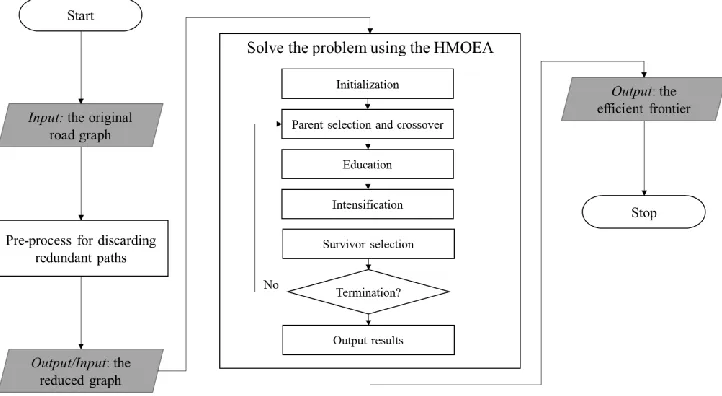
[image:3.612.126.487.488.686.2]To solve the problem a multi-phase solution algorithm is developed (Fig. 1). In the first phase, in order to cope with the challenges in solving the problem on the original sparse geographical graph, the road network is first pre-processed to identify and discard all proven to be redundant paths between the pairs of the required nodes (i.e. depot and the customers) using a network reduction approach that basically works by identifying the time-dependent least fuel consuming path for a heavy duty truck (P1) at a given time instant, and comparing such path with the fastest path (P2) at the same time instant. This algorithm terminates immediately after it is verified that both of such paths are the same (i.e. P1 = P2); Otherwise, if the two paths are different (i.e. P1≠ P2), both of them are added to the set of the retained paths, and the algorithm in each iteration searches for the next fastest path and compares it with the paths which are already in the retained set to see if it is eligible to enter the set. Once the next fastest path fails the eligibility criteria, the algorithm terminates and outputs a set of retained paths between every pair of the required nodes on the geographical graph.
3
Following the application of the proposed network reduction approach, instances of the problem are solved on the reduced network using a hybrid multi-objective evolutionary algorithm
(HMOEA). The framework of the proposed HMOEA is comprised of the general steps of
initialization, parent selection and crossover, education, intensification, and survivor selection. In general, at the beginning of each iteration of the algorithm, solutions are initially represented as giant TSP tours and then split into a set of feasible vehicle tours in terms of the problem of concern. The first population of the solutions in the algorithm is generated using a route
construction and improvement heuristic, and a maximum number of iterations within a time limit is determined as the stopping criterion for the proposed algorithm. In each iteration of the
algorithm parents are selected using the binary tournament method, and the classical OX crossover is used to generate two new offsprings. The education and the intensification phases are both based on the simulated annealing (SA) algorithm. In the intensification phase an elite solution is randomly selected from the top 1/3 of the population and is intensified using the SA algorithm. All offsprings and new solutions found through the education and the intensification phases are added to the population, and in the survivor selection phase only the best solutions are selected to survive. At each iteration of the algorithm, education and intensification are applied on a candidate chromosome (an offspring or/and elite solution) with certain probabilities. The proposed HMOEA uses the non-dominance sorting criterion of (17) in its global search MOEA. Based on this non-dominated (ND) sorting criterion the population is divided into ND fronts and all individuals on the same front are given a similar fitness value (normally a rank), such that the lower is the front, the fitter is the solution. At termination, the algorithm generates the
approximated set of the ND solutions.
FINDINGS
A set of small and large time-dependent road networks (with 10% of their nodes required) were generated for computational experimentations. Several experiments were carried out, but here due to space limitation, only one set of results indicating partially the performance of the
proposed HMOEA is presented in Table 1. In this table, the exact solutions to all small instances for the identification of extreme points were used as a benchmark against the extreme points found by the proposed HMOEA. Note that objective number one refers to the total vehicles cost (£), objective number two is the total fuel consumption (liter) and objective number three is the total travel time (minutes). According to this table the overall performance of the proposed algorithm seems to be quite satisfactory.
4
TABLE1 A Summary of the Performance of the Proposed HMOEA for Finding the Extreme Points of Small Size Test Instances
Instance Sizes
Extreme points comparison
Average Runtime (seconds) Objective
No. Exact HMOEA Deviation Exact HMOEA
1 42.00 42.00 0.00%
840 480
<40 2 4.11 4.23 2.91%
3 26.60 27.40 3.00%
1 47.66 47.66 0.00%
1740 480
40 2 4.87 4.96 1.84%
3 33.77 33.77 0.00%
1 48.60 48.60 0.00%
5760 600
50 2 6.38 6.43 0.78%
3 43.17 43.17 0.00%
1 76.65 76.65 0.00%
12500 600
100 2 13.42 13.57 1.11%
[image:5.612.209.400.426.542.2]3 107.00 107.00 0.00%
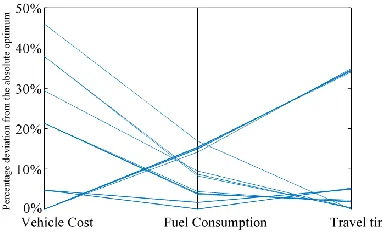
FIGURE 3 The value path diagram for a selected 1000-node instance
CONCLUSIONS
Business and environmental objectives should be considered simultaneously in urban freight distribution models in order to examine the trade-off between distribution cost and
5
to study it directly on the original road network, and to overcome the difficulties of such requirement a network reduction approach and an efficient HMOEA were introduced. The method can approximate the efficient frontier which can help the decision maker to select from a pool of ND solutions with regard to their criteria of interest.
REFERENCES
1. Taniguchi, E., and R. E. Van Der Heijden. An evaluation methodology for city logistics. Transport Reviews, Vol. 20, No. 1, 2000, pp. 65–90.
http://dx.doi.org/10.1080/014416400295347.
2. Kara, I., B. Y. Kara, and M. Kadri Yetis. Energy Minimizing Vehicle Routing Problem. Combinatorial Optimization and Applications, 2007, pp. 62–71. https://doi.org/10.1007/978-3-540-73556-4_9.
3. Xiao, Y., Q. Zhao, I. Kaku, and Y. Xu. Development of a fuel consumption optimization model for the capacitated vehicle routing problem. Computers and Operations Research, Vol. 39, No. 7, 2011, pp. 1419–1431.
https://doi.org/10.1016/j.cor.2011.08.013.
4. Ubeda, S., F. J. Arcelus, and J. Faulin. Green logistics at Eroski: A case study. Int. J. Production Economics, Vol. 131, 2011, pp. 44 –51.
https://doi.org/10.1016/j.ijpe.2010.04.041.
5. Franceschetti, A., D. Honhon, T. V. Woensel, T. Bektas, and G. Laporte. The time-dependent pollution-routing problem. Transportation Research Part B, Vol. 56, 2013, pp. 265–293. https://doi.org/10.1016/j.trb.2013.08.008.
6. Ehmke, J. F., A. M. Campbell, and B. W. Thomas. Vehicle routing to minimize time-dependent emissions in urban areas. European Journal of Operational Research, Vol. 251, No. (2), 2016, pp. 478–494. https://doi.org/10.1016/j.ejor.2015.11.034.
7. Androutsopoulos, K. N., and K. G. Zografos. An integrated modelling approach for the bicriterion vehicle routing and scheduling problem with environmental
considerations. Transportation Research Part C: Emerging Technologies, Vol. 82, 2017, pp. 180–209. https://doi.org/10.1016/j.trc.2017.06.013.
8. Figliozzi, M. Vehicle routing problem for emissions minimization. Transportation Research Record: Journal of the Transportation Research Board, Vol. 2197, 2010, pp. 1–7. https://doi.org/10.3141/2197-01.
9. Figliozzi, M. A. The impacts of congestion on time-definitive urban freight distribution networks CO2 emission levels: Results from a case study in Portland,
Oregon. Transportation Research Part C: Emerging Technologies, Vol.19, No. 5, 2011, pp. 766-778. https://doi.org/10.1016/j.trc.2010.11.002.
10. Koç, Ç., T. Bektaş, O. Jabali, and G. Laporte. The fleet size and mix pollution-routing problem. Transportation Research Part B: Methodological, Vol. 70, 2014, pp. 239– 254. https://doi.org/10.1016/j.trb.2014.09.008.
11. Demir, E., T. Bektaş, and G. Laporte. The bi-objective Pollution-Routing Problem. European Journal of Operational Research, Vol. 232, No. 3, 2014, pp. 464–478. https://doi.org/10.1016/j.ejor.2013.08.002.
12. Horn, M. E. Efficient modeling of travel in networks with time-varying link speeds. Networks, Vol. 36, No. 2, 2000, pp. 80–90.
https://doi.org/10.1002/1097-0037(200009)36:2<80::AID-NET2>3.0.CO;2-B.
6
routing and scheduling problem for hazardous materials distribution. EURO Journal on Transportation and Logistics, Vol. 1, No. 1, 2012, pp. 157–183.
https://doi.org/10.1007/s13676-012-0004-y.
14. Barth, M., T. Younglove, and G. Scora. Development of a heavy-duty diesel modal emissions and fuel consumption model. Technical report, UC Berkeley: California Partners for Advanced Transit and Highways (PATH), 2005.
15. Barth, M., and K. Boriboonsomsin. Energy and emissions impacts of a freeway-based dynamic eco-driving system. Transportation Research Part D, Vol. 14, No. 6, 2009, pp. 400–410. https://doi.org/10.1016/j.trd.2009.01.004.
16. Bektas, T., and G. Laporte. The Pollution-Routing Problem. Transportation Research Part B: Methodological, Vol. 45, No. 8, 2011, pp. 1232–1250.
https://doi.org/10.1016/j.trb.2011.02.004.