Research Archive
Citation for published version:
Darren Dalcher , (2016),"Rethinking project practice:
emerging insights from a series of books for practitioners",
International Journal of Managing Projects in Business, Vol. 9
Issue, 4 pp. 798 – 821, December 2016.
DOI:
http://dx.doi.org/10.1108/IJMPB-03-2016-0027
Document Version:
This is the Accepted Manuscript version.
The version in the University of Hertfordshire Research Archive
may differ from the final published version. Users should
always cite the published version of record.
Copyright and Reuse:
This manuscript version is made available under the terms of
the Creative Commons Attribution licence
(http://creativecommons.org/licenses/by/4.0/), which
permits unrestricted re-use, distribution, and reproduction in
any medium, provided the original work is properly cited.
Enquiries
If you believe this document infringes copyright, please contact the
Research & Scholarly Communications Team at [email protected]
Rethinking project practice: Emerging insights from a series of books for practitioners
Darren Dalcher
Abstract:
Purpose — The purpose of this paper is to identify the major trends and
contributions published in the Advances in Project Management book series and place them in the context of the findings and outputs from the Rethinking Project Management Network. A key aim is to address the concerns of project
practitioners and explore the alternatives to the assumed linear rationality of project thinking. The paper further offers a guided catalogue to some of the key ideas, concepts and approaches offered to practitioners through the book series.
Design/Methodology/Approach — This is a conceptual review paper that reflects on the main areas covered in a book series aimed at improving modern project practice and explores the implications on practice, knowledge and the relationship between research and practice. The topics are addressed through the prism of the Rethinking Project Management Network findings.
Findings — The paper explores new advances in project management practice aligning them with key trends and perspectives identified as part of the
Rethinking Project Management initiative. It further delineates new areas of expertise augmenting those mentioned in the disciplinary canons of knowledge.
Originality/value — New areas of interest and activity are identified and examined, offering a catalogue of new writing and perspectives in project practice. Reflection on the relationship between research and practice
encourages fresh thinking about the crucial role of practitioner knowledge and reflection.
Practical implications — The primary implication is to explore the new directions and perspectives covered by authors in the Advances in Project Management series, and identify main areas and topics that feature in the emerging discourse about project management practice. In addition, new
conceptualisations of the role of practitioners in making sense of project realities are offered and considered.
Research Limitations/implications — The paper offers a new understanding of how knowledge is created in, for and by practice. Improving the relationship between theory and practice may require a new appreciation of the role of practitioners and the value of their reflection in context.
Keywords: theory, practice, reflective practitioner, project management theory, theory-practice gap, rethinking project management, modern project
Paper type: Conceptual paper
Introduction
There have been many debates about the extent, role, nature and existence of underpinning theory in project management. Theory appears to play a key, if subtle, role in defining both knowledge and practice. Indeed, Einstein opined that “it is the theory which decides what we can observe”.
The field and discipline of project management have been dominated and defined by explicit bodies of knowledge and matching certification schemes presented and formulated by a number of professional associations. The instrumental rationality presented in these bodies of work has been utilised in many textbooks and courses devised for students and practitioners emphasising a linear interpretation of how projects ought to be performed in the real life environment of project work.
The narrow conceptualisation that projects begin with a well-defined intention and progress sequentially through an agreed sequence of activities was
challenged by the UK Government funded Rethinking Project Management Network (Winter & Smith, 2006; Winter, Smith, Morris, & Cicmil, 2006). Over the course of two years, the Network brought together senior practitioners and leading researchers “to develop a research agenda aimed at extending and enriching project management ideas in relation to developing practice” (Winter & Smith, 2006). The result was a new agenda presented in the form of five directions for future research.
The Network identified the need to progress the dialogue around project management from a singular focus around product creation, emphasising the staged delivery of an asset, towards a wider focus on stakeholders, value, benefits and complexity as befitting 21st Century project management. The
Network encouraged practitioners and organisations to review their approaches to project management training and practitioner development. A direct
implication was the need to shift from a focus on adopting methods and tools that match an instrumental mindset towards the development of practitioner capabilities that address the challenges of a growing and expanding profession and discipline.
The main output of the Network was disseminated as a special issue of the International Journal of Project Management in November 2006. One of the eight papers appearing in that special issue focused on expanding on the fundamental uncertainties in projects and the scope of project management (Atkinson,
Crawford, & Ward, 2006); contending that more sophisticated efforts were needed to recognise and manage the sources of uncertainty, an increasingly important, yet often neglected, key part of project work. The paper
Within eighteen months of the publication of the Network findings, a new series of books focused on Advances in Project Management, aimed at practitioners and informed by research, was launched. The inaugural title Managing Project
Uncertainty (Cleden, 2009) aimed to plug the key gap identified during the Network deliberations around the notion of uncertainty. This was followed by the publication of over twenty additional titles featuring a full range of topics ranging from risk, ethics, sustainability and stakeholder engagement, to governance, programmes, complexity and urgency.
This paper reflects on this series of books that aimed to offer an alternative perspective for practitioners and fulfil the remit identified by the Network. It is written from the perspective of an occasional participant in the Network’s deliberations and the editor of the Advances in Project Management book series. It starts by mapping the key findings of the Network from a practice perspective, and highlighting the new challenges faced by practitioners, before asking if there is such a thing as project management theory and exploring the theory-practice divide and the need for enhanced dialogue between them. Next, the book series is introduced, and the published titles are considered in terms of clusters and areas, the match with the findings of the research Network and the key insights offered to practitioners, prior to revisiting the challenges to the development of practitioners.
Ultimately, the main aims of this paper are to address the concerns of project practitioners and re-examine the discourse around project practice, and its relation to theory and knowledge. One of the key objectives is to highlight the contributions included by the Advances in Project Management book series by utilising the prism of the findings of the Rethinking Project Management
Network. The paper concludes by reconsidering the impact of the Network and the lens of Advances in Project management, before reflecting on the meaning of modern project practice and identifying some of the major trends gleaned through this lens.
Rethinking Project Management
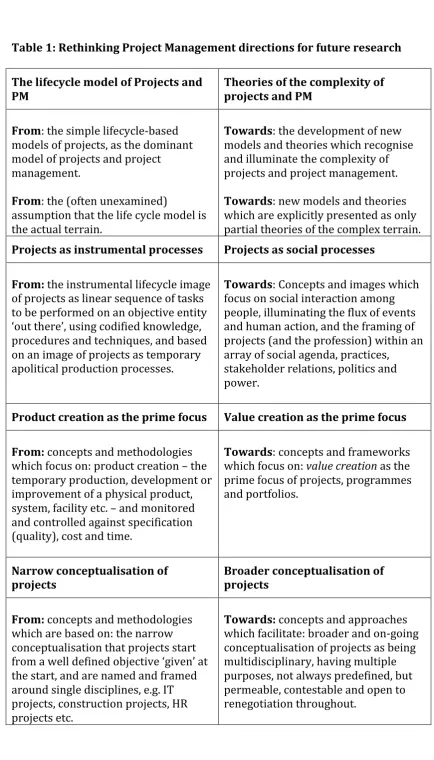
Analysis of the impact of the Rethinking Project Management Network is often limited to scrutinising its key output; an explicit framework of five directions for future research. The five directions focus on the development of new concepts and approaches identified by participants as critical to the management of projects.
Table 1: Rethinking Project Management directions for future research
The lifecycle model of Projects and
PM Theories of the complexity of projects and PM
From: the simple lifecycle-based models of projects, as the dominant model of projects and project management.
From: the (often unexamined)
assumption that the life cycle model is the actual terrain.
Towards: the development of new models and theories which recognise and illuminate the complexity of projects and project management.
Towards: new models and theories which are explicitly presented as only partial theories of the complex terrain.
Projects as instrumental processes Projects as social processes
From: the instrumental lifecycle image of projects as linear sequence of tasks to be performed on an objective entity ‘out there’, using codified knowledge, procedures and techniques, and based on an image of projects as temporary apolitical production processes.
Towards: Concepts and images which focus on social interaction among people, illuminating the flux of events and human action, and the framing of projects (and the profession) within an array of social agenda, practices,
stakeholder relations, politics and power.
Product creation as the prime focus Value creation as the prime focus
From: concepts and methodologies which focus on: product creation – the temporary production, development or improvement of a physical product, system, facility etc. – and monitored and controlled against specification (quality), cost and time.
Towards: concepts and frameworks which focus on: value creation as the prime focus of projects, programmes andportfolios.
Narrow conceptualisation of
projects Broader conceptualisation of projects
From: concepts and methodologies which are based on: the narrow conceptualisation that projects start from a well defined objective ‘given’ at the start, and are named and framed around single disciplines, e.g. IT projects, construction projects, HR projects etc.
Practitioners as trained technicians Practitioners as reflective practitioners
From: training and development which produces: practitioners who can follow detailed procedures and
techniques, prescribed by project management methods and tools, which embody some or all of the ideas and assumptions of the ‘from’ parts above.
Towards: learning and development which facilitates: the development of reflective practitioners who can learn, operate and adapt effectively in complex project environments, through experience, intuition and the pragmatic application of theory in practice.
Taken together, the five different directions offer an agenda to inform people already working within the field and discipline of project management and those interested in developing new research, and to challenge the dominant model, domains and development related to current practice.
While the temptation is to present the five directions as a coherent framework, there is a further level of subtlety that needs to be explicitly recognised. To illustrate the different kinds of concepts and approaches that were needed a finer the distinction between the concepts was also established. The specific directions can also be disaggregated and presented under three different levels of relating theory to practice, that will be explored below.
I. Theory about practice
The first level relates to theory that helps to understand and make sense of practice, typically from a particular perspective or viewpoint. This relates to the first direction identified.
The clearest pattern to emerge from the deliberations of practitioners in the Network was the sheer complexity of projects across all sectors and at all levels (Winter, Smith, Morris, et al., 2006). Projects involve multiple groups of
stakeholders, with different agendas, interests, politics and values that interact, diverge and conflict. The classical representation of a project lifecycle concept is therefore insufficient to capture all nuances of project work and cannot be taken as an all-encompassing representation of actual practice (Cicmil, Williams, Thomas, & Hodgson, 2006; Svejvig & Andersen, 2015).
The implication was that there is a need to develop new models and theories capable of acknowledging the inherent complexity of projects and offering new insights about the realities of projects perceived within a wider organisational and societal context (see, for example, (Hodgson & Cicmil, 2006)). While the temptation may be to seek an alternative model that could replace the rational deterministic model, the real value of the insights is in encouraging a plurality of models and ways of engaging with the actuality of projects and project
II. Theory for practice
The second level pertains to concepts and approaches that have a practical application and a direct impact on practice. This relates to the next three directions.
The discussions during the Network workshops indicated a critical need to develop new theories, models, frameworks and approaches to help practitioners deal with the observed complexity in actual projects. This was interpreted as the ability to deal with multiple images rather than a single all encompassing
representation (Morgan, 1986). During the sessions it was confirmed that many practitioners already use multiple perspectives and approaches (Winter, Smith, Morris, et al., 2006).
The Network noted that the literature in general fails to acknowledge the political and personal context of projects in practice. Indeed, the instrumental life cycle image promoted by the discipline offers little guidance on the ‘softer’ aspects of managing projects. In all, three directions were proposed for practice. The first two are concerned with content and new orientation around social aspects and value. The third direction is related to the process of conceptualising (Normann, 2001) projects from different perspectives beyond single disciplinary constraints (Maylor, et al., 2006), whilst allowing for variation and
differentiation (Winter, et al., 2006).
III. Theory in practice
The third level addresses the interaction between practitioners and their knowledge and application (i.e. how practitioners learn – and execute – their craft). This relates to the fifth and final direction.
This level focuses on the use in action and the qualities of reflection (Schön, 1983, 1987, 1988) and pragmatism exercised by leading practitioners and Network participants. It is primarily concerned with people and their development as capable project managers with the competence to address increasingly complex and messy terrains (Hancock, 2010). It also follows the broadening of the application of project management and recognition of the richer application and actuality of managing projects in wider and more demanding contexts (Crawford, et al., 2006).
IV Practice is changing
Such a view requires the adoption of a more resilient mindset that eschews the centrality of instrumental rules, prescriptions, schedules and procedures, starting instead with permeable boundaries, messier situations, less clear responsibility lines and chains of relationships, connections and influences that require time to gauge and engage with. Such situations also necessitate a greater subjectivity in interpreting the subject area and call for informed deliberation and sensemaking mechanisms.
It is instructive to observe that contemporary efforts to define the requisite characteristics of reflective and deliberative practitioners were making similar journeys to improve their existing practice and identifying parallel needs and skills. Table 2 shows one such attempt informed by the domain of health and social care (adapted from (Fish & Coles, 1998)).
Table 2. The evolving practitioner
Contemporary practitioner Future practitioner
Follows rules and prescriptions Starts where rules fade; sees patterns and frameworks
Uses diagnosis, analysis Uses interpretation/appreciation Wants efficient systems Wants creativity
Sees knowledge as graspable and
permanent Sees knowledge as temporary, dynamic and problematic Relies on prescriptive approach to
practice Employs a pragmatic approach to practice Emphasises the known Embraces uncertainty
Assumes standards are fixed Encourages trust in professionals Relies on technical expertise Employs professional judgement Embraces assessment and
accreditation Emphasises reflection and deliberation Requires technical training Seeks professional development
Ultimately, the shift in practitioner development seems to be from relying on fixed expectations, standards and models in a pre-understood and pre-defined contexts towards a more dynamic and reflective approach informed by the relevant context and situational needs and therefore capable of coping with the inherent complexity and uncertainty. An important question is whether project management knowledge and theory can support such a shift.
Where is the theory of project management?
upon agreed knowledge (Fish & Coles, 1998). Bodies of knowledge, such as the PMBoK Guide (2012) can satisfy the latter definition given by the Oxford Dictionary, by offering a selective grouping of conceptual principles and
normative assertions that are said to apply to a discipline or profession. Indeed, Sibeon (1991) notes that one of recognised hallmarks of a profession is a body of specialist knowledge which acts as the basis for professional expertise.
According to Koskela and Howell (2002) an explicit theory of project management would serve various functions, including: an explanation of observed behaviour which contributes to understanding, a basis for predicting future behaviour, a common language, pinpointed direction for further progress, a basis for devising tools, and a condensed source for teaching.
Some of the extant literature posits that there is no explicit theory of project management (see for example, Shenhar (1998); Turner (1999)). Others
(including, Maylor (2001); Morris (1994)) point to a growing dissatisfaction with the ability of project management methods and theories to deliver on their promises as a justification for significant re-examination of the dominant doctrines in project management (Cicmil & Hodgson, 2006).
Koskela and Howell (2002) lament the lack of underlying theory in project management, which makes it almost impossible to gain access to the deficient assumptions or to argue with the advocates of the status quo. While agitating for a paradigm change, they note that practitioners continue to observe the
shortcomings of the approach, blaming the deficient and implicit theoretical foundation for the crisis in the discipline of project management. In their view, the mounting evidence will ultimately result in a paradigmatic transformation that will enable theory and practice to develop concurrently supporting a
continuous dialogue between researchers and practitioners. It might well be that the findings of the Rethinking Project Management Network will still engender a further push to rethink the bodies of knowledge and related qualifications (Crawford et al., 2006).
Further evidence for a paradigm shift often accumulates as a result of failures and mismatches. Williams (2005) notes the commonality of failing projects in many sectors, identifying a dissonance with the underlying assumptions of the current project management discourse. He invokes Morris’ (1994) observation that project management is a “systems management practice”, which “in many respects is still stuck in a 1960s time warp”. Koskela and Howell (2002) assert that the underlying theory of project management is obsolete. The knowledge promulgated by the professional associations “is presented as a set of normative procedures which appear to be self-evidently correct” (Williams, 2005).
Mounting empirical evidence appears to suggest that accepting received project management wisdom, methods and approaches does not appear to either guarantee success or to eliminate failure. Koskela and Howell (2002) even suggest that “in … big, complex and speedy projects, traditional project
management is simply counterproductive; it creates self-inflicted problems that seriously undermine performance”.
Determining why project management is not performing as intended would necessitate uncovering the underlying assumptions and impacts in the project environment. It would also require exposing the issues, constraints or mindsets that underpin and enforce the dynamics of project work as proposed by the Network.
Yet it is plausible that in the project world we have failed to evolve our
constructions and expectations. The Rethinking Project Management Network observed that the bodies of knowledge were initially formulated, and have been subsequently maintained largely in terms of the certification programs.
Ironically, despite the enormous changes in the development in the discipline, the bodies of knowledge appear to have maintained their basic structure (Morris, et al., 2006).
“It was Keynes who suggested that people who described themselves as practical men, proud to be uncontaminated by any kind of theory, always turned out to be the intellectual prisoners of the theoreticians of yesteryear” (Winter, Smith, Cooke-Davies, & Cicmil, 2006).
Definitions are often constrained by earlier agreed interpretations. Hodgson (Hodgson, 2002) points out that claims of universal and political neutrality of the project management toolkit and approaches lead to an imposed ontology and specific ways of thinking in companies. This implies that normative prescription can be adopted and copied—ultimately, becoming part of a new project reality against which projects are initiated and judged. Questioning the worthiness of the tools and measures, their origin and implications enables an exploration of the epistemological relevance of underlying knowledge and insights.
(as current approaches) do not solve the systemic and structural problems that plague projects”. Radical improvement in our understanding thus depends on the ability to reconceive and re-conceptualise project situations in new and meaningful ways.
This might well require a deeper understanding of human related issues extending beyond methods and instrumental approaches. People construct the social worlds–clusters of human associations and communities that mediate human experience and shape reality–that they inhabit. Morris (2002) acknowledges that knowledge is personal, situated and experiential. While humans may exist in a world inhabited by physical objects, their interactions with others, and with objects, help to shape and conceive their reality. Social construction implies that interactions with social selves create concepts, practices and perspectives that bring forth shared systems, images and constructs (Berger & Luckmann, 1966; Searle, 1995, 2009). These constructions are continuously made and remade through the meanings and practices that constitute and define them as outcomes of meaningful human activity systems (Checkland, 1981). The reality of everyday life is shared with others through this common perspective.
While individuals inhabit social worlds, the relationship between these two aspects and the role that each plays in shaping the other provide a fertile ground for discussion and speculation regarding the interaction between social
structure and human agency and the degree to which behaviour and conduct are learned, acquired or are innately pre-programmed. For indeed we could query, “how exactly are individuals and managers equipped to act in particular project situations?”. The question could be reconstituted around the degree to which behaviour and conduct in a project are learned, acquired or enforced (innately pre-programmed). Indeed, the modern view of practice implies a significant shift from the expectation that ‘theory is applied to practice’ to one that accepts that ‘theory emerges from practice’ (Fish & Coles, 1998).
Theory – practice divide?
At some level, practical activity in any professional field is theory laden, irrespective of whether the practitioner is aware of the theory guiding their action (Blomquist, et al. 2010; Winter, Smith, Cooke-Davies, et al., 2006). Popper (1968) postulated that “theories are nets cast to catch what we call ‘the world’: to rationalise, to explain and to master it”.
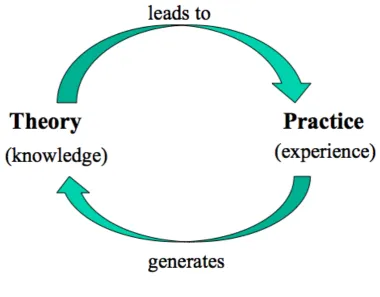
Figure 1. Accommodating theory and practice (after Checkland, 1985)
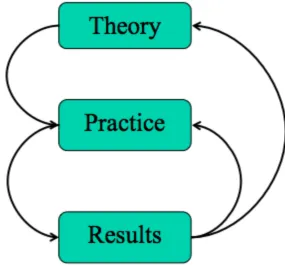
Checkland’s causal loop relationship offers one way of depicting the relationship between research and practice. In reality, many practitioners may draw on a particular depiction or representation (such as a body of knowledge or accreditation scheme); replicating or repeating particular practices that are emphasised through such scheme. Over time complete communities can adopt specific practices and rituals and apply them in somewhat uniform formats. The results of such application can normally be used to make minor adjustments and changes to the practice in order to maintain or improve performance. This is normally referred to a single loop feedback (Argyris & Schon, 1978; Dalcher, 2000). Single loop learning occurs when techniques, strategies and frameworks are taken for granted and reflection is avoided in order to increase operational efficiency and minimise attention resources. However, when the results continue to defy expectations, there is a need to refine, or amend, the basic theory through double-loop learning and feedback (Argyris, 1976, 1977, 1982, 1988; Argyris & Schon, 1978). In other words, significant deviations in the results, should encourage a review of the underpinning theory and the expectations that it encourages by questioning the framing and the underlying systems expected to deliver the results.
Figure 2 depicts a simplified double-loop learning cycle, incorporating the core need to reflect on results and amend the underlining theory. It extends on
mechanism able to account for continuing deviations in results. The figure thus provides a mapping, which includes the defining role of actual results in the theory-practice interrelationship. Fostering the double-loop element that challenges and questions the framing, assumptions and approaches requires commitment to a more fundamental form of learning and improvement. It also leads to re-visiting the theory in an attempt to make sense of the results that are achieved through practice (a currently neglected part of the reflective process).
Figure 2. Theory, practice, results double loop
The gap between theory and practice has drawn significant interest and
discussion in multiple domains (see for example, (Bero et al., 1998; Deadrick & Gibson, 2007; Le May, Mulhall, & Alexander, 1998; Robinson, 1998)). While the gap cannot be completely eliminated, it is possible to consider gap bridging measures between the different communities (Kieser & Leiner, 2009).
An interesting perspective is to consider theory and practice as two banks of a river or lake, which may have some connection but exist separately (Cron, et al. 2014). At one level, each bank is distinct, albeit connected via ferry; yet, from a higher vantage point, the two can be seen to be part of one system, indelibly coupled through a wider system of interest, continually enriching and supporting one another.
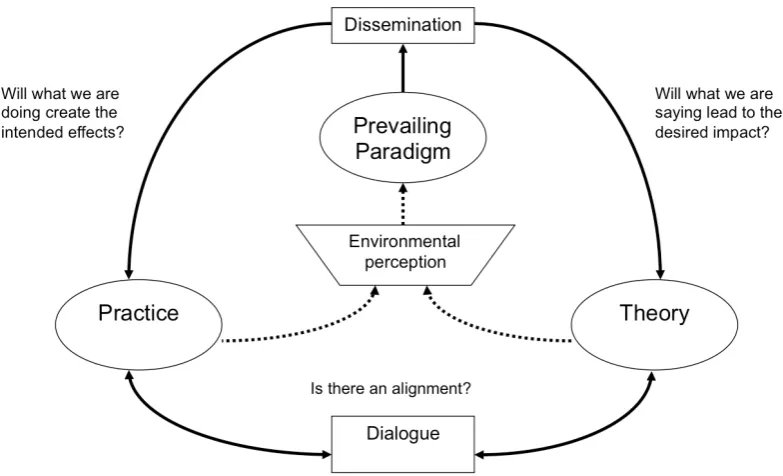
Figure 3 offers a wider schematic depiction of the gap between theory and
perception. Nonetheless, the two address fundamentally different sets of questions related to the different nature and purpose of each area. The bottom part identifies, the missing component of bridge building required between the areas. The dialogue around alignment and shared understanding and principles, very much at the core of the Rethinking Project Management Network, is an important, albeit, often ignored element.
Figure 3. Bridging the Research-practice-knowledge gap
To encourage and sustain dialogue that has the potential to inform and improve both aspects would necessitate conscientious attention to the double loop nature of the interaction (as shown in figure 2). It would also require bridge building activities across the different communities that are based on common
understanding and willingness to explore and engage across the divide.
The Advances in Project Management book series
The launch of the Advances in Project Management book series published by Gower was an attempt to bridge the research-practice divide. The series was launched in 2009 with a book focused on uncertainty in projects (Cleden, 2009), a key area that featured through the Network workshops and discussions
(Atkinson et al., 2006; Crawford et al., 2006).
interdisciplinary rigour and practical relevance thus offering new insights and understanding of key areas and approaches.
The books in the series were written by leading researchers and expert
practitioners and were designed to provide short state of play guides to the main aspects of project management. To this end, the aims were to:
1. Identify and focus on key aspects of project, programme and portfolio management;
2. Offer practical case examples of how new applications have been tackled in a variety of industries;
3. Provide access to appropriate new models in these areas, as they emerge from academic research.
In other words, the series endeavoured to provide those organizations and people who are involved with the developments in project management with the kind of structured information that will inform their thinking, their practice and improve their decisions. Put simply, the books were intended to offer that bridge and connection between research and practice.
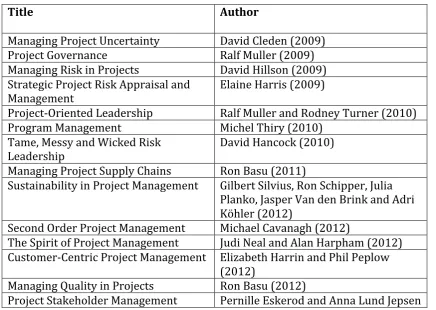
The Advances in Project Management series was thus able to address a range of topics and challenges pertinent to practitioners and project organisations looking to improve the understanding, competence and specific capabilities of their managers. Table 3 lists the published titles in chronological order,
[image:15.595.83.520.462.772.2]identifying the main authors.
Table 3. Titles in the Advances in Project Management book series
Title Author
Managing Project Uncertainty David Cleden (2009) Project Governance Ralf Muller (2009) Managing Risk in Projects David Hillson (2009) Strategic Project Risk Appraisal and
Management Elaine Harris (2009)
Project-Oriented Leadership Ralf Muller and Rodney Turner (2010) Program Management Michel Thiry (2010)
Tame, Messy and Wicked Risk
Leadership David Hancock (2010) Managing Project Supply Chains Ron Basu (2011)
Sustainability in Project Management Gilbert Silvius, Ron Schipper, Julia Planko, Jasper Van den Brink and Adri Köhler (2012)
Second Order Project Management Michael Cavanagh (2012)
The Spirit of Project Management Judi Neal and Alan Harpham (2012) Customer-Centric Project Management Elizabeth Harrin and Phil Peplow
(2012)
Managing Quality in Projects Ron Basu (2012)
(2013)
Project Ethics Haukur Ingi Jonasson and Helgi Thor Ingason (2013)
Advances in Project Management: Narrated Journeys in Uncharted Territories
Darren Dalcher (ed.) (2014a)
Managing the Urgent and Unexpected Stephen Wearne and Keith White-Hunt (2014)
Program Management 2nd edition Michel Thiry (2015)
Performance Coaching for Complex
Projects Tony Llewellyn (2015) A Practical Guide to Dealing with
Difficult Stakeholders
Jake Holloway, David Bryde and Roger Joby (2015)
Net Present Value and Risk Modelling
for Projects Martin Hopkinson (2016) Further Advances in Project
Management: Guided Exploration in Unfamiliar Landscapes
Darren Dalcher (ed.) (2016)
The next section provides an analysis of the books in the series and their relationship to the directions proposed by the Rethinking Project Management Network, whilst also addressing the challenges of developing reflective
practitioners.
Analysis of topics and impacts
It is not common to see an analysis of book topics and their wider link to the discipline. However, the emergence of the series aimed at practitioners provides an opportunity to review the core areas addressed to date and look for emerging trends and influences.
Bibliometric and source research techniques used to measure the impact of a publication offer limited value in this context because the series is more likely to be read by practitioners and students rather than academics, who tend to use peer-reviewed journals as their sources. Similarly, even Google Scholar citations would provide very limited data on the use of the material by practitioners. Nonetheless, the series have had an impact in terms of course adoptions by various universities, primarily those with courses aimed at practitioners. More crucially, the books have been used to inform new practice standards, national standards and accreditation schemes, with examples such as Thiry’s book (2010) used as the primary reference for the PMI standard in program management (PMI, 2013).
I. Content categories, clusters and areas
The published books encompass a wide range of topics, orientations,
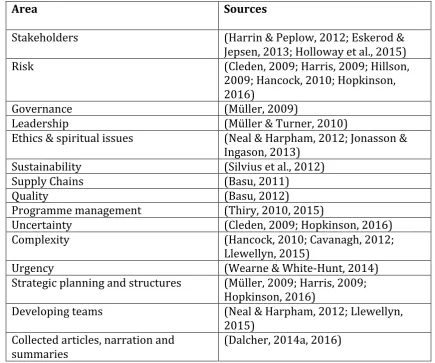
[image:17.595.79.515.226.589.2]perspectives, approaches and areas related to the management of projects. The books address a diversity of practitioner concerns using approaches borrowed from many disciplines. The key areas addressed by the published titles are summarised in Table 4.
Table 4. Key focus areas and sources
Area Sources
Stakeholders (Harrin & Peplow, 2012; Eskerod & Jepsen, 2013; Holloway et al., 2015) Risk (Cleden, 2009; Harris, 2009; Hillson,
2009; Hancock, 2010; Hopkinson, 2016)
Governance (Müller, 2009)
Leadership (Müller & Turner, 2010)
Ethics & spiritual issues (Neal & Harpham, 2012; Jonasson & Ingason, 2013)
Sustainability (Silvius et al., 2012) Supply Chains (Basu, 2011)
Quality (Basu, 2012)
Programme management (Thiry, 2010, 2015)
Uncertainty (Cleden, 2009; Hopkinson, 2016) Complexity (Hancock, 2010; Cavanagh, 2012;
Llewellyn, 2015)
Urgency (Wearne & White-Hunt, 2014) Strategic planning and structures (Müller, 2009; Harris, 2009;
Hopkinson, 2016)
Developing teams (Neal & Harpham, 2012; Llewellyn, 2015)
Collected articles, narration and
summaries (Dalcher, 2014a, 2016)
Titles were allocated to areas deemed to be within the primary focus of the text. Many of the books touch on additional areas, offering further links, perspectives and connections, but these were ignored to highlight the key focus area in each title.
there appears to be a plethora of books and resources dedicated to risk
management. In fact, it is noteworthy that out of the first 20 book proposals, 16 were primarily focused on new advances related to the areas of risk and
opportunity management. Looking at the year of publication seems to indicate that risk continues to feature as a key area of interest, suggesting perhaps that more improvements are needed, or that there are additional aspects of risk that need to be explored in relation to projects. Alternatively, it may indicate that the risk lens is well entrenched and is utilised whenever practitioners, or
researchers, are asked to frame and make sense of difficult or challenging project situations.
It is also worth noting a potential growing cluster encompassing ethical, spiritual and sustainability aspects. The themes share a common interest in greater
responsibility, shared values, and the adoption of a longer-term perspective that extends beyond single projects and beyond the handover and delivery point of projects.
II. Rethinking Project Management
The Rethinking Project Management Network identified five major directions for the development of research and improved understanding of practice, namely enhancing work looking into:
• Theories of the complexity of projects and project management; • Projects as social processes;
• Value creation as the prime focus;
• Broader conceptualisation of projects; and, • Practitioners as reflective practitioners.
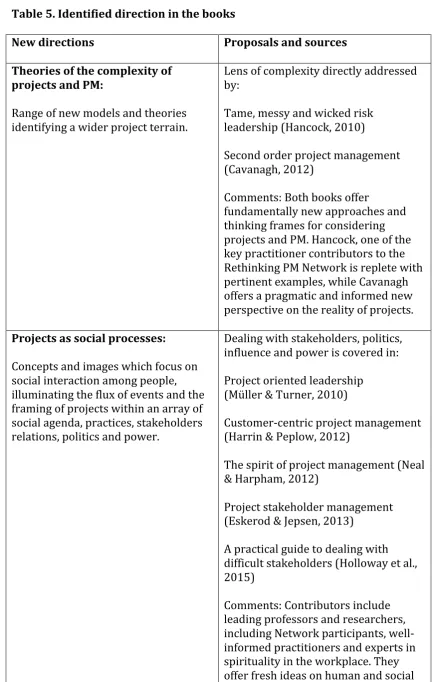
To assess the impact of the book series, it would be useful to map the main contributions and perspectives covered by titles in the series against the original directions for development identified by the Rethinking Project Management Network.
“The principal finding of the network was the need for new thinking in the areas of project complexity, social process, value creation, project conceptualisation and practitioner development… What the five directions represent are the principal areas in which new concepts and approaches are needed to guide practitioners in the management of projects.” (Winter, Smith, Morris, et al., 2006; p. 641).
Table 5. Identified direction in the books
New directions Proposals and sources
Theories of the complexity of projects and PM:
Range of new models and theories identifying a wider project terrain.
Lens of complexity directly addressed by:
Tame, messy and wicked risk leadership (Hancock, 2010)
Second order project management (Cavanagh, 2012)
Comments: Both books offer
fundamentally new approaches and thinking frames for considering projects and PM. Hancock, one of the key practitioner contributors to the Rethinking PM Network is replete with pertinent examples, while Cavanagh offers a pragmatic and informed new perspective on the reality of projects.
Projects as social processes:
Concepts and images which focus on social interaction among people, illuminating the flux of events and the framing of projects within an array of social agenda, practices, stakeholders relations, politics and power.
Dealing with stakeholders, politics, influence and power is covered in: Project oriented leadership
(Müller & Turner, 2010)
Customer-centric project management (Harrin & Peplow, 2012)
The spirit of project management (Neal & Harpham, 2012)
Project stakeholder management (Eskerod & Jepsen, 2013)
A practical guide to dealing with difficult stakeholders (Holloway et al., 2015)
aspects of projects and consideration of aspects such as the stakeholder’s stakeholders, dealing with gatekeepers and sponsors, and the need to market and sell the project, and its relevance, impacts, outputs and potential
outcomes to create more meaningful and lasting engagement.
Value creation as the prime focus:
Concepts and frameworks, which focus on value creation as the prime focus of projects, programmes and portfolios.
Frameworks and approaches
emphasising the delivery of value are explored in:
Programme management (Thiry, 2010, 2015)
Sustainability in project management (Silvius et al., 2012)
Customer-centric project management (Harrin & Peplow, 2012)
Project ethics (Jonasson & Ingason, 2013)
Net Present Value and Risk Modelling for Projects (Hopkinson, 2016) Comments: Program management encompasses a discussion of value and benefits. Book length coverage of ethics and sustainability, and detailed insights into the use of NPV and creating a customer-centric environment.
Broader conceptualisation of projects:
Concepts and frameworks which facilitate broader and on-going
conceptualisation of projects as multi-disciplinary, multi-purpose, permeable, contestable and open to renegotiation.
Broader and on-going
conceptualisation of projects, includes: Managing project uncertainty (Cleden, 2009)
Project governance (Müller, 2009) Managing risk in projects (Hillson, 2009)
Strategic project risk appraisal and management (Harris, 2009)
2013)
Programme management (Thiry, 2010, 2015)
Comments: Titles address key topics such as uncertainty, risk, governance and strategy and how they can be framed and applied in a project context.
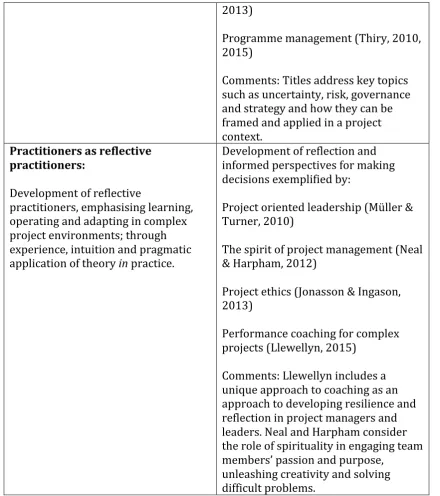
Practitioners as reflective practitioners:
Development of reflective
practitioners, emphasising learning, operating and adapting in complex project environments; through experience, intuition and pragmatic application of theory in practice.
Development of reflection and informed perspectives for making decisions exemplified by:
Project oriented leadership (Müller & Turner, 2010)
The spirit of project management (Neal & Harpham, 2012)
Project ethics (Jonasson & Ingason, 2013)
Performance coaching for complex projects (Llewellyn, 2015)
Comments: Llewellyn includes a unique approach to coaching as an approach to developing resilience and reflection in project managers and leaders. Neal and Harpham consider the role of spirituality in engaging team members’ passion and purpose,
[image:21.595.81.522.70.567.2]unleashing creativity and solving difficult problems.
Table 5 reveals that the five main directions are addressed in detail throughout the book series. Some of the books focus on offering new models and
perspectives; others attempt to make sense of the actualities of project practice; while others offer new theories related to the complexity of projects and their environment.
Given that the books were written by leading practitioners and researchers, it is interesting to note that the mapping confirms that the areas covered through the series match the concerns expressed during the Rethinking Project Management workshops conducted by the Network, even though the books were not
commissioned with that intention in mind. It is also revealing that some of the titles fit across multiple directions identified during the sessions. Moreover, it is encouraging that the mix of new insights, models and frameworks covered in the published work are concerned with thinking about, for and in practice originally identified as separate focus areas. Indeed, many of the books bridge across the different directions and different levels and orientations of theories, offering a plethora of new ways for thinking about, reflecting on and making sense of project work.
III. Challenges for developing practitioners
This paper has drawn attention to the role and position of practitioners, especially in light of the Rethinking Project Management initiative. The deliberations of the Network involved researchers and practitioners working together to make sense of the environment of actuality of project work. It is only apt therefore that the final perspective examined in this analysis is dedicated to practitioners and their development.
It has been noted that practitioners question the way the actualities of projects are depicted and shared, in the traditional literature as well as in existing training and qualification schemes (Winter & Thomas, 2004). Similar concerns were expressed during the Network workshops leading to a summary of
challenges with specific implications for practitioner development (Crawford et al., 2006). The challenges recognised by the Network commentators are included in Table 6, which also identifies pertinent discourse in the book series.
Table 6. Particular challenges to practitioner development
Challenge Examples, in series include:
Application of project management to a range of project types with
characteristics that differ from those for which project management practices were first developed
Specific new challenges in the form of urgent and unexpected projects to take advantage of business opportunity, protect against a sudden threat, or restore damaged assets (Wearne & White-Hunt, 2014)
Assessing strategic level risks and benefits in seven different settings ranging from business development to compliance projects and events
management (Harris, 2009)
problem types including tame, messy and wicked configurations, the need to select appropriate tools and
approaches and the shift from risk management to risk leadership (Hancock, 2010)
Selecting a suitable governance structure to account for the project process and expectations (Müller, 2009)
Extension beyond execution focused project management to a whole-of-life concept of projects
Use of experiential learning, managing for outcomes, systems approaches, leadership techniques, and appropriate contracting models to address the complex nature of undertakings (Cavanagh, 2012)
Adopting a sustainability mindset both for projects, and in business, and integrating it into the full project cycle from initiation to closure, and beyond (Silvius et al., 2012)
Application of ethical theory to identify opportunities and risks and encourage sustainable practice, whilst addressing competing values and clashing
perspectives (Jonasson & Ingason, 2013)
Use of appreciative inquiry and of spirituality thinking as a lens to
consider impact on future generations (Neal & Harpham, 2012)
Change of focus from product creation
to value creation Embracing customer-centricity and meaningful value delivery as a way of increasing project performance (Harrin & Peplow, 2012)
Using NPV during the earliest phases of a project to inform the business case, influence the project plan and shape the project solution (Hopkinson, 2016) Increasing actual and perceived
Using a variety of approaches to address uncertainty, unknown unknowns, ambiguity and
unpredictability across the full life cycle from planning to completion and benefits realisation (Cleden, 2009) Integration with (rather than isolation
from) business Application of comprehensive programme management framework to develop the essential link between strategy and projects and integrate projects with business as usual, incorporating agile management in programmes and the integration of benefits, value delivery and change management activities (Thiry, 2015) Addressing quality in project
management to encompass meaningful operational and project excellence (Basu, 2012)
Ageing of the workforce and the need
for succession planning Not directly, but, consideration of performance coaching in complex project settings to develop team
members and improve communication and team performance (Llewellyn, 2015), as well as fostering creativity, engaging team members’ passion and purpose and problem solving ability (Neal & Harpham, 2012)
It is worth pointing out that many of the books address multiple challenges, however Table 6 gives a flavour of some of the unique perspectives that they open for practitioners. Ageing and succession planning is not covered in great detail, however the development of project managers and team members is featured throughout the corpus of work.
Books for practitioners offer a different perspective on what is known and what is needed. Many of the titles provide a direct and detailed comparison between different definitions, standards and models (e.g. contrasting different models of risk and depictions of programme management, in Hillson (2009) and Thiry (2015), respectively). A further tendency shared by most authors is the
preference for interpretation and deliberation over prescription, especially as authors recognise the situated nature of project work. Finally, most authors are able to draw on extensive experience and offer vignettes, and in some cases, well explained detailed examples of situations, enabling readers to join in the
Rethinking Project Management reprised
A ten-year retrospective offers an opportunity to reflect on the impact of the Network, primarily in terms of perceived changes to project practice.
I. Project management knowledge
The original researchers and participants advocated for a significant re-thinking within the discipline. Yet, some aspects of project practice remain unaltered. Morris et al. commented on the role of formal bodies of knowledge in defining the profession, posing the key challenge: “What empirical evidence is there that the knowledge base used in the professional discipline is in fact valid and appropriate?” (2006; p. 714).
At first glance, it would not appear that the practice of project management has not been transformed in the way the original researchers and Network
participants were advocating. Research still plays a very limited part in refreshing, informing or supporting the content of the bodies of knowledge. “An example of the limited effect of research on the BOKs is its minimal impact to date on their structures. Once set these have shown little flexibility in
representing new knowledge.” (Morris et al., 2006, p. 715)
Evidence regarding the theoretical basis of project management remains elusive. However, to an extent, the argument about the theoretical basis of project
management misses the point. Project management is a portmanteau activity that brings together a whole range of established business, organisational and social scientific theories about working collaboratively, communicating, making decisions, managing resource and so on, that are already documented in other contexts. Given the tendency to import what works from other areas, does project management need an exclusively theoretical basis of its own or rather just a link to each of the established forms of activity associated with managing projects involving people in social and societal contexts?
In summary, it might prove simpler to refer to the instrumental rationalistic nature of classical project management knowledge observed by the Network and remark that it retains its hold on certain parts of the profession. Challenging the hegemony of professional body infused knowledge may require a considerable investment in time and momentum to engender the more significant and far reaching rethink advocated by the Network.
II. Practitioner development
Fish and Coles (1998) contend that there are two fundamentally different views of professional practice. The first view accords with an instrumental technical rationality, implying an achievable competency-based perspective concentrated on the elements of practice. The classical approach thus prescribes and
proscribes all the practitioner’s activities. The second view acknowledges the situated and fast changing reality, replete with uncertainty and therefore
advocates a reflective and deliberative practice. This modern view acknowledges that practice is messy, unpredictable and unexpected requiring continuous refinement and update as practitioners endeavour to understand complexities and investigate actions and theories.
The classical view sits comfortably with the fixed notions of prescribed bodies of knowledge, but fails to account for the complexities of practice. The modern view encourages practitioners to challenge their theories with ideas from other
perspectives (Fish and Coles, 1998) and to seek to update and refine their practice, and its underlying theory.
The relation to theory is clearly paramount. The classic perspective views theory as formal constructs produced by researchers – standing apart from
practitioners (Fish and Coles, 1998). The implication is that the formal theory can be specified, learned and applied. The modern view, in contrast, recognises that both action and theory are developed in practice.
Refining practice involves unearthing the theories that underpin practice (Fish and Coles, 1998). Development of practice occurs through the challenging and extending of understanding as learning is created through the transformation of experience. Practitioners are able to develop their own personal theories arising from their own experience through cycles of contemplation, reflection and application (Dalcher, 2014b) as practice and theory are allowed to co-develop. The shift from the ‘known’ to the uncertain and unexplored relies on the ability to engage, reflect and question (Dalcher, 2014b). Similarly, understanding that the details of practice cannot be predicted, pre-determined or proscribed defies the orthodoxy of the classical approach, thereby challenging the view that formal theory must come first, whilst enabling the connections and relationships
depicted in Figures 1 and 2 to prosper and enrich practice. Indeed, the theory-practice gap may well be a product and artefact of the separation inherent in and encouraged by the classical approach (Fish & Coles, 1998), and the resistance by discipline and knowledge body keepers to the development of integrated and reflective knowledge.
Attempting to bridge the gap – see Figure 3 – through reflection and
dissemination allows for the continuous development and refinement of practice in context. As a result, instead of applying theory to practice, theory is thus allowed to emerge, and co-emerge (from and) in practice.
The book series launched following the conclusion of the Network workshops attempted to bridge the gap between research and practice by creating the continuous dialogue depicted at the bottom of Figure 3. A further dedicated series of workshops and events was also used to encourage further
conversations and enable professionals to reflect in tandem with authors and leading practitioners.
The key output of the network offered new directions of focus for future theories and knowledge about, for and in practice. The book series, much like the
Network sessions, has shown that practitioners are able to revitalise their practice through reflection and pragmatism. Perhaps one of the key learning points is that the new knowledge as formulated through the series is able to address the three different levels. Successful practitioners reflect in practice regarding knowledge and its application. They reflect for practice by extending their knowledge through reflection and holding multiple perspectives in order to select the most suited approach. Moreover, in doing so, they reflect about
practice, re-inventing and re-positioning the discipline in the process. Note however, that during such engagements practitioners create their own local theories about and for practice.
The book series has shown that such theories, frameworks and insights extend beyond the classical, traditional approach, enabling practitioners to engage with situated and rapidly changing conditions by borrowing, importing,
experimenting and adapting. The view of static bodies of knowledge offers limited utility to modern practitioners willing to challenge their theories. If it is the theory, which defines what we can observe, and if what we observe, is the basis for how we act and respond, there is a clear need for more dynamic and relevant base of situated theories that can be applied to practice.
The key challenge for researchers is to continue to engage with reflective
practitioners in order to maintain the dialogue about the intersection of research and practice. Research will be expected to show a continued relevance and a willingness to adapt to changing and developing view of practice. It also needs to become open to challenging the hegemony of the static knowledge guarded by professional associations and to encourage an ever growing integration of new perspectives, ideas and insights that will continue to influence and re-shape both practice and received theory as new learning and reflection cycles make sense of experienced results. Doing so would require a growing openness to new ideas, importation from and sharing with established domains and the development and adoption of new perspectives, images and lenses to facilitate questioning and continuous reflection.
The book series embodies the move from the prescription of classical, or traditional, project management, towards the reflective interpretation that underpins modern project thinking. In doing so, the series has built on, reflected upon, articulated and still continues to refine and expand the understanding of project practice.
Conclusion
The aim of the paper was to address the concerns of project practitioners,
especially in light of the findings of the Rethinking Project Management Network. Following the work of the Network, a book series for practitioners focusing on Advances in Project Management was launched. The paper uses some of the findings and suggestions derived from the Network to re-visit the books delivered in the series.
The analysis of the published books suggests that the concerns of many of the practitioners attending the Network workshops were addressed and supported by the authors of the books published in the series. This should not come as a major surprise as many of the authors contributed to the workshops session; nonetheless, the findings and directions proposed by the Network appear to resonate with the authors in the series.
While project management is often introduced as a practice, the majority of the literature still conveys an instrumental rationality associated with a prescriptive model that assumes universal applicability in all contexts. Practitioners often struggle to accept such a position, and the book series is able to offer new perspectives, tools and approaches which can be applied by practitioners. Re-reading the findings of the Network from a practitioner’s perspective uncovers the distinction between theory about, in, and for practice. It also reinforces the need to overcome the challenges of dealing with greater uncertainty, deliberating and making sense by adopting a pragmatic and
reflective stance and seeking professional development and growth beyond the assumption of standardised solutions.
The relationship between theory and practice maintains a challenge that requires both sides to engage in a meaningful dialogue. The results of practice need to inform and challenge research to think and question in new ways. The potential disconnect can hopefully be bridged through greater dialogue
championed by networks of academics and researchers, journals attuned to the need of the profession and publications, including book series, aimed at
overcoming the challenges to practice and developing reflective, deliberative and better informed practitioners.
ability of research and practice to inform each other; and on the emerging new directions and developments in project practice.
References
Argyris, C. (1976). Single and Double Loop Models in Research on Decision Making. Administrative Science Quarterly, 21, 363-375.
Argyris, C. (1977). Double Loop Learning in Organisations. Harvard Business Review, 115-125.
Argyris, C. (1982). The Executive Mind and Double-Loop Learning.
Organisational Dynamics, 5-22.
Argyris, C. (1988). Problems in Producing Usable Knowledge for Implementing Liberating Alternatives. In D. E. Bell, H. Raiffa & A. Tversky (Eds.), Decision Making: Descriptive, Normative and Prescriptive Interactions (pp. 540-561). Cambridge: Cambridge University Press.
Argyris, C., & Schon, D. (1978). Organisational Learning. Reading, Mass.: Addison Wesley.
Atkinson, R., Crawford, L., & Ward, S. (2006). Fundamental uncertainties in projects and the scope of project management. International Journal of Project Management, 24(8), 687-698.
Basu, R. (2011). Managing project supply chains. Farnham: Gower Publishing, Ltd. Basu, R. (2012). Managing Quality in Projects. Farnham: Gower Publishing, Ltd. Berger, P. L., & Luckmann, T. (1966). The Social Construction of Reality. New
York: Doubleday.
Bero, L. A., Grilli, R., Grimshaw, J. M., Harvey, E., Oxman, A. D., & Thomson, M. A. (1998). Closing the gap between research and practice: an overview of systematic reviews of interventions to promote the implementation of research findings. British Medical Journal, 317(7156), 465-469.
Blomquist, T., Hällgren, M., Nilsson, A., & Söderholm, A. (2010). Project‐as‐
practice: In search of project management research that matters. Project Management Journal, 41(1), 5-16.
Cavanagh, M. (2012). Second order project management. Farnham: Gower Publishing, Ltd.
Checkland, P. (1981). Systems Thinking, Systems Practice. Chichester: John Wiley. Checkland, P. (1985). From optimizing to learning: A development of systems
thinking for the 1990s. Journal of the Operational Research Society, 757-767.
Cicmil, S., & Hodgson, D. (2006). New possibilities for project management theory: A critical engagement. Project Management Journal, 37(3), 111. Cicmil, S., Williams, T., Thomas, J., & Hodgson, D. (2006). Rethinking project
management: researching the actuality of projects. International Journal of Project Management, 24(8), 675-686.
Cleden, D. (2009). Managing project uncertainty. Farnham: Gower Publishing, Ltd.
Crawford, L., Morris, P., Thomas, J., & Winter, M. (2006). Practitioner development: From trained technicians to reflective practitioners.
Cron, d. P., Feldmüller, D., Rietiker, S., Böhle, F., & Witschi, U. (2014). Visualizing the worlds of theory and practice. In S. Rietiker & R. Wagner (Eds.),
Theory meets practice in projects. Nuremberg: GPM.
Dalcher, D. (2000). Feedback, Planning and Control- A Dynamic Relationship.
Paper presented at the FEAST 2000, Imperial College, London. Dalcher, D. (2014a). Advances in Project Management: Narrated Journeys in
Uncharted Territories. Farnham, Surrey: Gower.
Dalcher, D. (2014b). Beyond Knowledge: Growing Capability for an Uncertain Future. Cutter IT Journal, 27(3), 7.
Dalcher, D. (2016). Further Advances in Project Management: Guided Exploration in Unfamiliar Landscapes. London: Routledge.
Deadrick, D. L., & Gibson, P. A. (2007). An examination of the research–practice gap in HR: Comparing topics of interest to HR academics and HR
professionals. Human Resource Management Review, 17(2), 131-139. Eskerod, P., & Jepsen, A. L. (2013). Project stakeholder management. Farnham:
Gower Publishing, Ltd.
Fish, D., & Coles, C. (1998). Developing professional judgement in health care: Learning through the critical apreciation of practice. Oxford: Butterworth-Heinemann.
Flyvbjerg, B., Bruzelius, N., & Rothengatter, W. (2003). Megaprojects and risk: An anatomy of ambition. Cambridge: Cambridge University Press.
Hancock, D. (2010). Tame, messy and wicked risk leadership. Farnham: Gower Publishing, Ltd.
Harrin, E., & Peplow, P. (2012). Customer-Centric Project Management. Farnham: Gower Publishing, Ltd.
Harris, E. (2009). Strategic Risk Appraisal and Management. Farnham: Gower Publishing, Ltd.
Hillson, D. (2009). Managing risk in projects. Farnham: Gower Publishing, Ltd. Hodgson, D. (2002). Disciplining the professional: the case of project
management. Journal of Management Studies, 39(6), 803-821.
Hodgson, D., & Cicmil, S. (2006). Making projects critical. Basingstoke: Palgrave Macmillan.
Holloway, J., Bryde, D., & Joby, R. (2015). A Practical Guide to Dealing with Difficult Stakeholders. Farnham: Ashgate Publishing, Ltd.
Hopkinson, M. (2016). Net Present Value and Risk Modelling for Projects. Farnham: Gower Publishing, Ltd.
Jonasson, H. I., & Ingason, H. T. (2013). Project Ethics. Farnham: Gower Publishing, Ltd.
Kieser, A., & Leiner, L. (2009). Why the rigour–relevance gap in management research is unbridgeable. Journal of Management Studies, 46(3), 516-533. Koskela, L., & Howell, G. (2002). The underlying theory of project management is
obsolete. Paper presented at the Proceedings of the PMI Research Conference.
Le May, A., Mulhall, A., & Alexander, C. (1998). Bridging the research–practice gap: exploring the research cultures of practitioners and managers.
Journal of advanced nursing, 28(2), 428-437.
Llewellyn, T. (2015). Performance Coaching for Complex Projects: Influencing Behaviour and Enabling Change. Farnham: Ashgate Publishing, Ltd. Maylor, H. (2001). Beyond the Gantt chart:: Project management moving on.
European Management Journal, 19(1), 92-100.
Maylor, H., Brady, T., Cooke-Davies, T., & Hodgson, D. (2006). From
projectification to programmification. International Journal of Project Management, 24(8), 663-674.
Morgan, G. (1986). Images of Organisation. London: Sage Publications.
Morris, P., & Hough, G. (1987). The anatomy of major projects. Chichester: wiley. Morris, P. W. (1994). The management of projects. London: Thomas Telford. Morris, P. W. (2002). Science, objective knowledge and the theory of project
management. Civil Engineering, 150(2), 82-90.
Morris, P. W. G., Crawford, L., Hodgson, D., Shepherd, M. M., & Thomas, J. (2006). Exploring the role of formal bodies of knowledge in defining a profession– The case of project management. International Journal of Project
Management, 24(8), 710-721.
Müller, R. (2009). Project Governance. Farnham: Gower Publishing, Ltd.
Müller, R., & Turner, J. R. (2010). Project-oriented leadership. Farnham: Gower Publishing, Ltd.
Neal, J., & Harpham, A. (2012). The Spirit of Project Management. Farnham: Gower Publishing, Ltd.
Normann, R. (2001). Reframing business: When the map changes the landscape: John Wiley & Sons.
PMI. (2013). The standard for program management (third edition ed.). Newton Square, PA: PMI.
PMI, P. M. I. (2012). A guide to the project management body of knowledge (fifth edition ed.). Newton Square, Pennsylvania: Project management institute. Pollack, J. (2007). The changing paradigms of project management. International
Journal of Project Management, 25(3), 266-274.
Popper, K. R. (1968). The Logic of Scientific Discovery. London: Hutchinson. Robinson, V. M. (1998). Methodology and the research-practice gap. Educational
researcher, 27(1), 17-26.
Schön, D. A. (1983). The reflective practitioner: How professionals think in action
(Vol. 5126): Basic books.
Schön, D. A. (1987). Educating the reflective practitioner: Toward a new design for teaching and learning in the professions. San Francisco.
Schön, D. A. (1988). From technical rationality to reflection-in-action.
Professional judgment: A reader in clinical decision making, 60-77. Searle, J. R. (1995). The construction of social reality. London: Simon and
Schuster.
Searle, J. R. (2009). Making the social world: The structure of human civilization. Oxford: Oxford University Press.
Shenhar, A. J. (1998). From theory to practice: Toward a typology of project-management styles. Engineering Management, IEEE Transactions on, 45(1), 33-48.
Silvius, G., Schipper, R., Planko, J., van den Brink, J., & Köhler, A. (2012).
Sustainability in Project Management. Farnham: Gower Publishing Inc. Smyth, H. J., & Morris, P. W. (2007). An epistemological evaluation of research
into projects and their management: Methodological issues. International Journal of Project Management, 25(4), 423-436.
Steele, M. D. (2003). Margins count: systems thinking and cost. AACE International Transactions, PM31.
Svejvig, P., & Andersen, P. (2015). Rethinking project management: A structured literature review with a critical look at the brave new world. International Journal of Project Management, 33(2), 278-290.
Thiry, M. (2010). Program Management. Farnham: Gower Publishing, Ltd.
Thiry, M. (2015). Program Management. 2nd edition, Farnham: Gower Publishing,
Ltd.
Turner, J. R. (1999). Project management: A profession based on knowledge or faith? International Journal of Project Management, 17(6), 329-330. Wearne, S., & White-Hunt, K. (2014). Managing the Urgent and Unexpected:
Twelve Project Cases and a Commentary. Farnham: Ashgate Publishing, Ltd.
Williams, T. (2005). Assessing and moving on from the dominant project management discourse in the light of project overruns. Engineering Management, IEEE Transactions on, 52(4), 497-508.
Winter, M., Andersen, E. S., Elvin, R., & Levene, R. (2006). Focusing on business projects as an area for future research: An exploratory discussion of four different perspectives. International Journal of Project Management, 24(8), 699-709.
Winter, M., & Smith, C. (2006). Rethinking project management: Final Report
EPSRC Network (Vol. May 2006). Manchester.
Winter, M., Smith, C., Cooke-Davies, T., & Cicmil, S. (2006). The importance of ‘process’ in rethinking project management: the story of a UK
government-funded research network. International Journal of Project Management, 24(8), 650-662.
Winter, M., Smith, C., Morris, P., & Cicmil, S. (2006). Directions for future research in project management: The main findings of a UK government-funded research network. International Journal of Project Management, 24(8), 638-649.
Winter, M., & Thomas, J. (2004). Understanding the lived experience of managing projects: the need for more emphasis on the practice of managing.