© 2019, IRJET | Impact Factor value: 7.211 | ISO 9001:2008 Certified Journal
| Page 4855
Seismic Analysis of Composite Frames
Prathiba.G
1, K.Soundhirarajan
2, S.Raja
31
M.E Structural Engineering, Department of Civil Engineering, Gnanamani Engineering College, Namakkal
2Assistant Professor, Department of Civil Engineering, Gnanamani Engineering College, Namakkal
3Chief Scientist, Group Head, Dynamics and Adaptive Structures, Structural Technologies Division CSIR-National
Aerospace Laboratories, Bangalore
---***---Abstract -
The seismic analysis of composite frames ofvarious materials has been carried out. Transient response
analysis of the framed structure is studied. A real-time recorded seismic data is obtained for open source, and then the seismic data is applied as a transient load on the structure. The seismic analysis is carried out on frame structure by considering the real-time history data. The typical acceleration behaviours are obtained in order to understand the seismic effect on the structure. Analysis of various composite materials is carried out to study the behaviour of each frame; it gives us an idea on the most suitable and durable composite material to attenuate seismic load. The studies carried out show the effect of acceleration response on the seismic response on composite frames under earthquake loading.
Key Words: FEA (Finite Element Analysis), ANSYS (Analysis
Systems), Composites, Modal Analysis, Seismic Analysis.
1. INTRODUCTION
Seismic analysis is an important part of structural analysis and is the calculation of the response of a building structure to earthquakes. A building has the potential to 'wave' back and forth during an earthquake. This is called the 'fundamental mode', and is the lowest frequency of building response. Most buildings, however, have higher modes of response, which are uniquely activated during earthquakes. The first and second modes tend to cause the most damage in most cases.
The earliest provisions for seismic resistance were the requirement to design for a lateral force equal to a proportion of the building weight (applied at each floor level). This approach was adopted in the appendix of the 1927 Uniform Building Code (UBC), which was used on the west coast of the United States. It later became clear that the dynamic properties of the structure affected the loads generated during an earthquake. In the Los Angeles County Building Code of 1943 a provision to vary the load based on the number of floor levels was adopted (based on research carried out at Caltech in collaboration with Stanford University and the U.S. Coast and Geodetic Survey, which started in 1937.
The University of California, Berkeley was an early base for computer-based seismic analysis of structures.
Earthquake engineering has developed a lot since the early days, and some of the more complex designs now use special earthquake protective elements either just in the foundation (base isolation) or distributed throughout the structure or composite materials can be tailored to provide high stiffness and strength to weight ratio by tailoring.
2. COMPOSITE MATERIALS
The construction industry is currently implementing the “Four Savings and Environment Protection” policy, which requires energy, land, water and materials saving and environmental protection in every building project been changed from the initial entry points such as the thermal insulation of external wall, roof, doors and windows to further wide areas, such as the Optimization of building material, component manufacturing, construction quality and method, all of which could be realized by the industrialized composite panels and walls completely. Industrialized composite panels and walls bring thorough innovations on wall materials and construction, the improvement of the construction accuracy so that the wall thermal insulation performance is much higher than the traditional buildings.
© 2019, IRJET | Impact Factor value: 7.211 | ISO 9001:2008 Certified Journal
| Page 4856
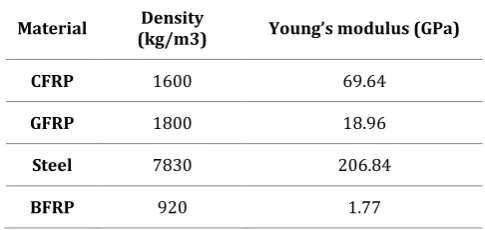
For the analysis composites ie the fibre reinforced [image:2.595.39.282.170.285.2]polymers(FRP) of Carbon, Bamboo and glass is considered. The analysis is also done for steel.
Table -1: Engineering Properties of Composites
Material (kg/m3) Density Young’s modulus (GPa)
CFRP 1600 69.64
GFRP 1800 18.96
Steel 7830 206.84
BFRP 920 1.77
3. METHODOLOGY
ANSYS is used to implement step by step time history analysis; it is not so easy to achieve it from the graphical user interface. Therefore, a special solution is developed to implement the seismic analysis [3,4]. Firstly, the structural system, including element type, material properties, meshing and boundary conditions is constructed in ANSYS by using GUI or APDL. Then, the APDL code of the model is exported for post-processing. This code is used in batch mode analysis. The earthquake data loading system is developed suitable for PEER earthquake database system. The earthquake record may be downloaded from the Peer Strong Motion Database (Url-1). The damping value and earthquake load direction are introduced to the system. Firstly, modal analysis is executed, and the frequency value of the first vibration mode is saved. The and coefficients for Rayleigh damping are calculated by using this value. Then, the time history analysis is executed by applying each acceleration value to the model step by step.
The earthquake data loading system is developed suitable for PEER earthquake database system. The time interval, time limit and the data are extracted from the PEER file. A link is added to the system for easily reaching to PEER web database. The loaded earthquake data may be limited depending on the user choice. In general, the whole seismic record may not be applied to the structure because of the memory size economy of the computer. The dominant part of the record may be selected by checking the peak point of the data. The earthquake load direction and damping ratio is introduced to the system.
4. ANSYS® SOFTWARE & APDL
ANSYS® is a finite element analysis software used to simulate engineering problems. The software creates simulated computer models of structures, to simulate strength, toughness, elasticity, temperature distribution.
ANSYS is used to determine how a product will function with different specifications, without building test products or conducting crash tests. Most ANSYS simulations are performed using the ANSYS Workbench software. Typically, ANSYS users break down larger structures into small components that are each modelled and tested individually. ANSYS software simulates and analyses movement, fatigue, fractures, fluid flow, temperature distribution, electromagnetic efficiency and other effects over time.
APDL is the acronym of ANSYS Parametric Design Language. It is a scripting language which allows the user to automate general tasks and construct the structural model in terms of parameters. A wide range of other features such as repeating a command, macros, if-then-else branching, do-loops, and scalar, vector and matrix operations are included in APDL. It also offers many conveniences that can be used in particular analyses for structural engineers. Two types of parameters are used in ANSYS. These are scalar and array parameters. APDL also provides several types of array parameters. These are numeric, character, string and table.
5. MODAL ANALYSIS
Modal analysis is the study of the dynamic properties of systems in the frequency domain. In structural engineering, the modal analysis uses the overall mass and stiffness of a structure to find the various periods at which it will naturally resonate. These periods of vibration are critical to note in earthquake engineering, as it is imperative that a building's natural frequency does not match the frequency of expected earthquakes in the region in which the building is to be constructed. If a structure's natural frequency matches an earthquake's frequency, the structure may continue to resonate and experience structural damage. Once a set of modes has been calculated for a system, the response at any frequency in response to many inputs at many points with different time histories can be calculated by superimposing the result from each mode. This assumes the system is linear. The goal of modal analysis in structural mechanics is to determine the natural mode shapes and frequencies of an object or structure during free vibration. It is common to use the finite element method (FEM) to perform this analysis because the object being analyzed can have an arbitrary shape, and the results of the calculations are acceptable. The types of equations which arise from the modal analysis are those seen in Eigen systems. The physical interpretation of the eigenvalues and eigenvectors which come from solving the system are that they represent the frequencies and corresponding mode shapes. Sometimes, the only desired modes are the lowest frequencies because they can be the most prominent modes at which the object will vibrate, dominating all the higher frequency modes.
© 2019, IRJET | Impact Factor value: 7.211 | ISO 9001:2008 Certified Journal
| Page 4857
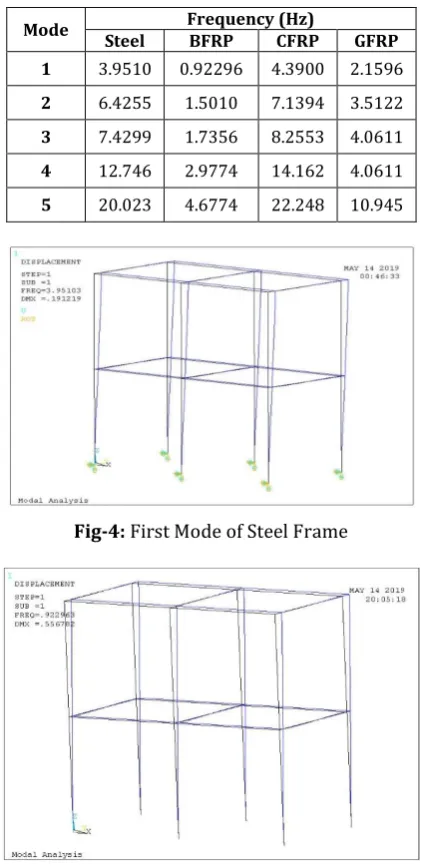
framework shown in figure 2 and 3. The dimensions are in [image:3.595.325.549.75.271.2]centimetres. The results are compared with the FEM [2] and analytical solution [1]. Take E = 206.84 GN/m2 and ρ = 7.83×10³ kg/m3. The frequencies and mode shape for composite materials are presented in table 3 and from figures 4 to 7, respectively.
[image:3.595.52.273.182.316.2]Fig-1: Geometric Details of Steel Frame
Table -2: Antisymmetric frequencies of steel frame
Mode Present FEM [2] Analytical [1]
1 15.14 15.14 15.14
2 53.321 53.32 53.32
3 155.68 155.48 155.31
4 186.76 186.51 186.23
5 272.14 270.85 270.07
Fig-2: First Antisymmetric Mode
[image:3.595.63.543.289.762.2]
Fig-3: Second Antisymmetric Mode
Table- 3: Frequencies Comparison of Composite Frames
Mode Steel Frequency (Hz) BFRP CFRP GFRP
[image:3.595.328.540.306.741.2]1 3.9510 0.92296 4.3900 2.1596 2 6.4255 1.5010 7.1394 3.5122 3 7.4299 1.7356 8.2553 4.0611 4 12.746 2.9774 14.162 4.0611 5 20.023 4.6774 22.248 10.945
Fig-4: First Mode of Steel Frame
[image:3.595.54.268.353.660.2]© 2019, IRJET | Impact Factor value: 7.211 | ISO 9001:2008 Certified Journal
| Page 4858
Fig-6: First Mode of Carbon Reinforced PolymerComposite (CFRP)
Fig-7: First Mode of Glass Reinforced Polymer Composite (GFRP)
6. SEISMIC ANALYSIS
Seismic analysis is a subset of structural analysis and is the calculation of the response of a building structure to earthquakes. It is part of the process of structural design, earthquake engineering or structural assessment and retrofit in regions where earthquakes are prevalent. The propagation of seismic waves and resulting ground displacement during an earthquake is picked up even at far off places, but the damages caused by earthquakes were restricted to within few hundreds of kilometres from the causative fault.
Structural analysis methods can be divided into the following five categories.
1. Equivalent static analysis 2. Response spectrum analysis 3. Linear dynamic analysis 4. Nonlinear static analysis 5. Nonlinear dynamic analysis
Industrialized composite frames, panels and walls bring thorough innovations on materials and construction, the
improvement of the construction accuracy so that the wall thermal insulation performance is much higher than the traditional buildings. The typical seismic response due to the earthquake is shown in figure 8. The procedure for seismic analysis is presented in figure 9.
0 5 10 15 20 25 30
-0.2 -0.1 0.0 0.1 0.2 0.3
Seismic Load in Ac
ce
leration (m/
s
2)
Time(s)
Fig-8: Seismic Load due to Earth Quake [3]
© 2019, IRJET | Impact Factor value: 7.211 | ISO 9001:2008 Certified Journal
| Page 4859
7. RESULTS
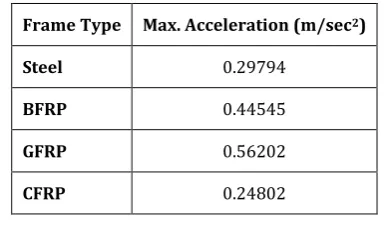
The results of Modal and Seismic analysis are tabulated. The seismic analysis is carried out through transient response with Rayleigh damping. Antisymmetric validation of steel frame is compared with existing and present values. The mode frequencies of the four composite frames are tabulated and compared. The peak acceleration response due to earthquake loading for different material is presented in figures 9, 10, 13, 14. The corresponding acceleration due to seismic loads under spectrum is shown in figures 10 and 12 through analysis, and the results of the four composites are compared in table 4. The stiffness ratio of steel is the highest in comparison with composites. The idea of introducing composite frames is to reduce the weight of the structure, which in turn reduces the damage during the earthquake.
Fig-9: Acceleration due to seismic load at 3.025 sec for steel frame
0 5 10 15 20 25 30
-0.3 -0.2 -0.1 0.0 0.1 0.2 0.3
Acc
eleration (m/s
2 )
Time (s)
Fig-10: Seismic acceleration response in X direction due to seismic load at the tip of the steel frame
Fig-11: Acceleration due to seismic load at 7.855 sec for carbon composite frame
0 5 10 15 20 25 30
-0.2 -0.1 0.0 0.1 0.2 0.3
Acc
eleration (m/s
2)
Time (s)
Fig-12: Seismic acceleration response in X direction due to seismic load at the tip of carbon frame
© 2019, IRJET | Impact Factor value: 7.211 | ISO 9001:2008 Certified Journal
| Page 4860
Fig-14: Acceleration due to seismic load at 3.02 sec forcarbon composite frame
Table -4: Acceleration Response of Composite Portal Frame
Frame Type Max. Acceleration (m/sec2)
Steel 0.29794
BFRP 0.44545
GFRP 0.56202
CFRP 0.24802
8. CONCLUSION
Seismic analysis is carried out for data generated by PEER database. Currently, in this study for composites, bidirectional laminates are considered. Tailoring of composites would give better stiffness to strength ratio. In comparison, although steel is an excellent material, it is heavy and expensive in comparison with other fibres. CFRP is good but it would produce hazardous emissions. BFRP is good for low-cost constructions. These composites are very useful for tall buildings. This is because the weight of the structure and cost is reduced, which in turn reduces damage to life and property during earthquakes. A hybrid construction concept for seismic structures can be achieved through steel in the lower frames, and composite frames can be used in the upper frames. In this way, the optimized lightweight configuration can be achieved.
REFERENCES
[1] Gladwell, G. M. L. (1964). The vibration of frames.
Journal of Sound and Vibration, 1(4), 402– 425.doi:10.1016/0022-460x(64)90056-2
[2] Petyt M. Introduction to finite element vibration
analysis. Cambridge university press; 2010 Aug 23.
[3] Şahin, A., “ANSeismic – A Simple Assistant Computer
Program for Implementing Earthquake Analysis of Structures with ANSYS and SAP2000”, The Ninth International Congress on Advances in Civil Engineering (ACE 2010), 27 to 30 September 2010, Trabzon, Turkey.
[4] Şahin, A., “ANSeismic – Seismic Analysis of Structures
with ANSYS and SAP2000”, MATLAB Central File Exchange:http://www.mathworks.com/matlabcentral/ fileexchange/27401
[5] Satasivam S, Bai Y, Yang Y, Zhu L, Zhao XL. Mechanical
performance of two-way modular FRP sandwich slabs. Composite Structures. 2018; 184: 904-16.
[6] Lacey AW, Chen W, Hao H, Bi K. Structural response of
modular buildings – An overview. Journal of Building Engineering. 2018; 16: 45-56.
[7] Wu H, Chen A, Laflamme S. Seismic behavior of glass
[image:6.595.64.258.348.462.2]