computers
and people
formerlyComputers and Automation
SCIENCE AND USINE
cOctober, 1975
Vol.
24, No.
10
-~---~--~
liBRARY USE ONLY
CIRCUIT CHIPS FOR COMPUTER, WITH SUGAR IN TEASPOON
Federal Legislation on Antitrust and Monopoly Operations Research for Immediate Application:
A "Quick and Dirty" Manual
Computer Programming Languages in Use in Business: A Survey Science and the University: The Developing Dilemmas
"Almost True" Theorems, Computations, and Computers
- - A.
G.
W. Biddle
- - R.
E.
D. Woolsey and
H.
S.
Swanson
- - Neil Macdonald
- - A.
G.
Hansen
- - H.
E.
Salzer
"RIDE THE EAST WIND:
Parables of Yesterday and Today"
by Edmund C. Berkeley, Author and Anthologist
The Fly, the Spider, and the Hornet
Once a Fly, a Spider, and a Hornet were trapped inside a window screen in an attic. For several hours they walked up and down, left and right, here and there, all over the screen. They could look through the screen at the summer woods, feel the summer breezes, and smell the summer smells; but they could not find any hole to pass through the screen to the woods and fields so tantalizingly close, yet so far away.
Finally they decided to hold a conference on the problem of get-ting through the screen. The Fly spoke first, and said, "My Col-leagues, . . . .
The Fox of Mt. Etna and the Grapes
Once there was a Fox who lived on the lower slopes of Mt. Etna, the great volcano in Sicily. These slopes are extremely fertile; the grapes that grow there may well be the most delicious in the world; and of all the farmers there, Farmer Mario was probably the best. And this Fox longed and longed for some of Farmer Mario's grapes. But they grew very high on arbors, and all the arbors were inside a vineyard with high walls, and the Fox had a problem. Of course, the
Fox of Mt. Etna had utterly no use for his famous ancestor, who leaping for grapes that he could not reach, called them sour, and went away.
The Fox decided that what he needed was Engineering Techno-logy. So he went to a retired Engineer who lived on the slopes of Mt. Etna, because he liked the balmy climate and the view of the Mediterranean Sea and the excitement of watching his instruments that measured the degree of sleeping or waking of Mt. Etna. The Fox put his problem before the Engineer . . . .
The Fire Squirrels
Scene: Two squirrels, a young one named Quo, and an older one named era-era, are sitting by a small campfire in a field at the edge of a wood. Behind them hung on a low branch of a tree are two squirrel-size hammocks. Over each of the hammocks is a small can-opy that can be lowered to keep out biting insects. It is a pleasant summer evening,' the sun has just recently set, and the stars are coming out:
-Quo: Cra-Cra, you know I don't believe the old myths any more. Tell me again how it really happened.
era-era: Just this: we received our chance because they dropped theirs. It is as simple as that.
Quo: In other words, they were the first animals to use tools, and we are the second?
era-era: Yes. There is a mode of surviving in the world . . . .
. Published by Quadranglerrhe New York Times Book Co., 1974, 224 pp, $6.95
Missile Alarm from Grunelandt
Once upon a time there were two very large and strong coun-tries called Bazunia and Vossnia. There were many great, impor-tant, and powerful leaders of Bazunia who carefully cultivated an enormous fear of Vossnia. Over and over again these important and powerful leaders of Bazunia would say to their fellow coun-trymen, "You can't trust the Vossnians." And in Vossnia there was a group of great, important, and powerful leaders who pointed out what dangerous military activities the Bazunians were carrvinQ on, and how Vossnia had to be militarily strong to counteract them. The Bazunian leaders persuaded their countrymen to vote to give them enormous sums of money to construct something called the Ball istic Missile Early Warning System, and one of its stations was installed in a land called Grunelandt far to the north of Bazunia.
Now of course ballistic missiles with nuclear explosives can fly any kind of a path all around a spherical world, and they do not have to fly over northern regions. But this kind of reasoning had no influence on the leaders of Bazunia who wanted the money for building BMEWS. Nor did it have influence on their country-men, who were always busy; trying to make money - in fact often too busy to think clearly . . . .
52 parables (including fables, anecdotes, allegories)
23 never published before
27 authors
18 full-page illustrations
330 quotations and maxims
7 Parts: The Condition of Man / On Flattery and
Persuasion / On Perseverance and Resourcefulness /
Behavior - Moral and Otherwise / The Problem
of Truth / On Common Sense / Problem Solving
THE VALUE OF THIS BOOK TO YOU
CAN BE VERY GREAT
JUDGE FOR YOURSELF AT NO COST
RETURNABLE IN 10 DAYS FOR FULL REFUND IF NOT SATISFACTORY
You can read it all in 10 days - and keep it only if you think it is worth keeping.
HOW CAN YOU LOSE?
- - - - (may be copied on any piece of paper) - - -
-I
I To: Berkeley Enterprises, Inc.
815 Washington St., 59, Newtonville, MA 02160
Please send me copy(ies) of Ride the East Wind:
I enclose $7.00 per copy (includes handling).
Total enclosed _ _ _ _ _ (Prepayment is necessary)
MULTI-ACCESS FORUM
SURVEILLANCE AND INFLATION - SOME COMMENTS
1. From: R. A. Sobieraj 702 Columbus Circle Perth Amboy, N.J. 08861
The "Daily Surveillance Sheet, 1987" reprinted (from 1969) in the August 1975 issue did offer some food for thought.
It showed that inflation had not only been stopped but annihilated: 10¢ for a phone call, 10¢ for the Wall Street Journal. But I don't understand the $8.10 for the purchase of a newspaper (last line). Could this be a program bug? An I/O error?
Spending $3.00 to fill the tank of a VW indicates that the oil shortage has long been solved.
I'm optimistic in thinking that a National Data Bank would be no more politically possible then than it would be today.
2. From the Editor
I believe your optimism is unjustified -- and I hope I am wrong.
A national data bank already exists in many coun-tries, certainly in the Soviet Union, very likely in Spain, certainly in Brazil, Uruguay, and other countries where the government is a dictatorship ei-ther by an individual or a party and which are well enough off to understand and to pay for the compu-terized equipment needed. The strong efforts in the United States to put together a national data bank while at the same time denying that such exists is a modern pattern of incipient authoritarian estab-lishments. It is not reasonable to expect that any dictatorship or incipient dictatorship will normally admit the existence of a national data bank of the kind able to produce a "daily surveillance sheet" on suspected persons.
INSTRUCTIONAL APPLICATIONS OF COMPUTERS
From: Dr. Howard A. Peelle
Instructional Applications of Computers School of Education
University of Massachusetts Amherst, Mass. 01002
The program here in Instructional Applications of Computers is a specialized program of graduate study with emphasis on uses of computers in learning and teaching. Master's and Doctoral degrees are offered.
Study is interdisciplinary, and broadly includes
COMPUTERS and PEOPLE for October, 1975
the fields of computer science, psychology, mathe-matics and education. Foci of interest are: Com-puter-Assisted Instruction / Simulation and Gaming / Programming Language / Computer Art / Artificial Intelligence / Mathematics Education.
Current topics of research are: (1) conceptual-izing and testing new approaches to computer-related curriculum development, e.g., the Computer Glass Box Approach; (2) use of artificial intelligence tech-niques in computer-assisted instruction (AI in CAl); (3) mathematics teacher training via Afrogramming 1anguages (APL); (4) sexism in the use of computers
and the teaching of mathematics; (5) semi-quantita-tive problem-solving processes in children; (6) an existential philosophy of educational computing;
(7) critique of computer-managed instruction; (8) use of APL for teaching college mathematics; (9) teaching mathematical modeling of ecosystems;' and (10) a comparison of programming languages (par-ticularly, APL, BASIC, LOGO) as frameworks for teaching children thinking.
The program maintains a modest computer-assisted instruction laboratory, with access via remote ter-minals to a CYBER 74 time-sharing computer provided by the University Computing Center.
Faculty and students in the program interact freely with prospective teachers and students in the field, as well as with other Clusters within the School of Education, other departments in the University and colleges in the Pioneer Valley area of Massachusetts. Local relationships include Mark's Meadow Elementary School, Amherst Regional High School, Deerfield Academy, Hampshire College, and UMass Department of Computer and Information Sciences. Additional contacts are with MIT (Artificial Intelli-gence Laboratory), IBM (Philadelphia Scientific Cen-ter), and SECOS (Shared Educational Computer Systems, Inc.). For more information, please write me.
COMPUTER NETWORKS: THE INTERNATIONAL JOURNAL OF DISTRIBUTED INFORMATIQUE
From: North Holland Publishing Co.
P.O. Box 103
Amsterdam, The Netherlands
Our present-day society is undergoing important changes due to the rapid introduction and expansion of new communications concepts. Among these, none is affecting more fundamental changes than computer net-works. These new systems and their application raise technical, economic, social, legal, -and regulatory questions at a rate that taxes the ability of human institutions to consider them. Yet no regularly-scheduled journal is gathering information on these issues in a form which is both timely and interesting
(please turn to page 20)
Vol. 24, No. 10
October, 1975
Editor and Edmund C. Berkeley
Publisher
Assistant to Judith P. Callahan
the Publisher
Assistant Barbara L. Chaffee
Editors Neil Macdonald
Art Editor Software
Editor Contributing
Editors
London Correspondent
Grace C. Hertlein
Stewart B. Nelson
John Bennett John W. Carr III Grace C. Hertlein Linda Ladd Lovett Ted Schoeters Richard E. Sprague Edward A. Tomeski Thomas Land
Advisory Ed Burnett
Committee James J. Cryan
Editorial Offices
Advertising Contact
Berkeley Enterprises, Inc.
815 Washington St. Newtonville, MA 02160
617-332-5453
The Publisher
Berkeley Enterprises, Inc.
815 Washington St.
Newtonville, MA 02160 617-332-5453
"Computers and People," formerly "Computers and Automation," is published monthly, 12 issues per year, at 815 Washing-ton St., NewWashing-tonville, MA 02160, by Berkeley Enterprises, I nco Printed in U.S.A. Second Class Postage paid at Boston, MA, and addi-tional mailing points.
Subscription rates: United States, $11.50 for one year, $22.00 for two years. Canada: add $1 a year; elsewhere, add $6 a year.
NOTE: The above rates do not inclUde our publication "The Computer Directory and Buyers' Guide". If you elect to re-ceive "The Computer Directory and Buyers' Guide," please add $12.00 per year to you,r subscription rate in U.S. and Canada. and $15.00 elsewhere.
Please address mall to: Berkeley Enter-prises, Inc., 815 Washington St., Newton-ville, MA 02160.
Postmaster: Please send all forms 3579 to Berkeley Enterprises, Inc., 815 Washing-ton St., NewWashing-tonville, MA 02160.
© Copyright 1975, by Berkeley Enter-prises, Inc.
Change of address: If your address changes, please send us both your new address and your old address (as it ap-pears on the magazine address imprint), and allow three weeks for the change to be made.
computers
and people
formerly Computers and AutomationComputers and Operations Research
7 Operations Research for I mmediate Application: A Quick [ A ] And Dirty Manual - Excerpts
by Robert E. D. Woolsey and H. S. Swanson, Golden, Colo. Excerpts from a book which sets out to correct the unfortu-nate condition where "academics write about methods of operations research in such a way as to ensure acceptance in academic journals and thereby ensure that the methods will remain incomprehensible to the final consumer".
Contains a dozen interesting computer programs in FORTRAN. 6 "Quick and Dirty" Methods in Operations Research
by Edmund C. Berkeley, Editor
Commentary on the book mentioned above.
Computers and Monopoly
10 Federal Legislation on Antitrust and Monopoly: I mprovements Needed
by A. G. W. Biddle, President, Computer Industry Association, Rosslyn, Va.
[ E ]
[ A ]
What the Computer Industry Association is recommending to the Senate of the United States in order to make the computer industry less subject to the constraints of mono-poly practices and more competitive.
Computers, Science, and Society
16 Science and the University - The Developing Dilemmas [A by Arthur G. Hansen, President, Purdue Univ., Lafayette, Ind.
The decline in the support for science; the relation of goals of investigation in science to the goals of society; the res-ponsibility of science to people who need the truth; etc. 3 Computer Networks: The I nternational Journal of [ F ]
Distributed I nformatique
by North Holland Publishing Co., Amsterdam.
A new scholarly journal on computer networks and their effects - in technical, legal, social, economic, regulatory, and other aspects of society.
3 Surveillance and Inflation - Some Comments
by R. A. Sobieraj, Perth Amboy, N.J., and the Editor Is a national data bank probable or improbable?
Computer Applications
26 Local Air Pollution Levels
[ F ]
[ N ]
The magazine of the design, applications, and implications of
information processing systems - and the pursuit of truth in
input, output, and processing, for the benefit of people.
28 Solar Energy Collection by Satellite, and Conversion to N ] Use on Earth
by Diane Wilson, Univ. of Notre Dame, Notre Dame, Ind. The optimal design of ten billion collecting elements over a collection circle six miles in diameter is being studied by computer modeling.
Computer Programming
22 Computer Programming Languages in Use in Business - A ] A Survey
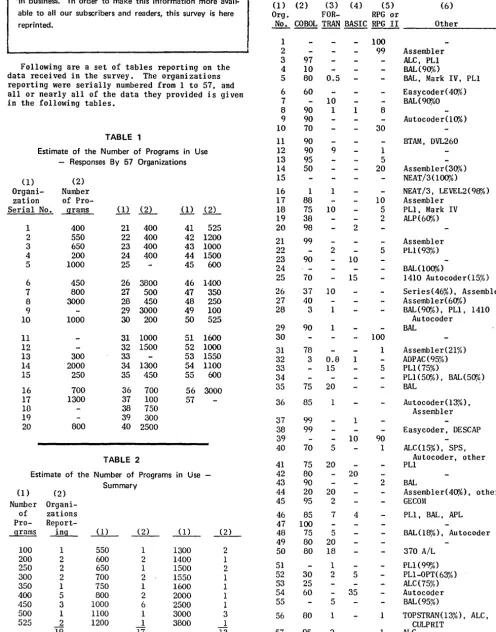
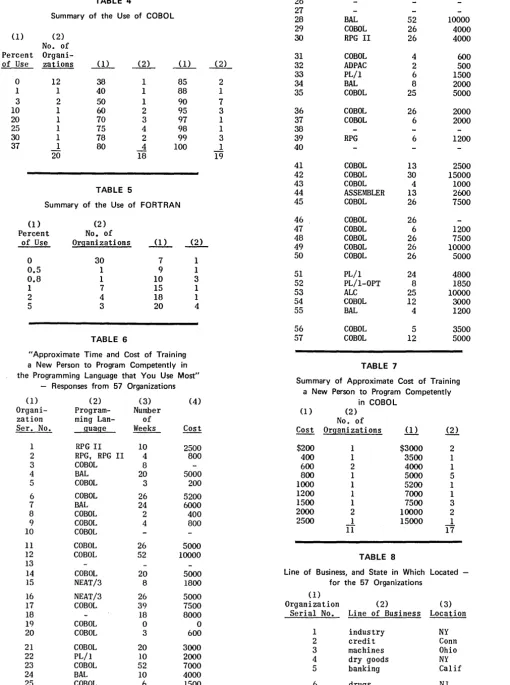
by Neil Macdonald, Survey Editor, Computers and People Some indications of: the prevalence of COBOL, FORTRAN, and other programming languages in business; the cost of training programmers; etc. - based on a 30% sample of 200 large companies.
Computers and Education
3 I nstructional Applications of Computers [ F ]
by Dr. Howard A. Peelle, School of Education, University of Massachusetts, Amherst.
A report on the new frontiers being investigated and taught here in: teaching children thinking; training teachers to use computer programming languages; etc.
Computers and Mathematics
19 "Almost True" Theorems, Computations, and Computers [A by Herbert E. Salzer, Brooklyn, N.Y.
Some thought-provoking ideas illuminated by investigation of the sums of "tetrahedral" numbers.
Computers, Games, and Puzzles
27 Games and Puzzles for Nimble Minds - and Computers [C by Neil Macdonald, Assistant Editor
NAYMANDIJ - A systematic pattern among randomness? NUMBLES - Deciphering unknown digits from arithmetical relations.
MAXIMDIJ - Guessing a maxim expressed in digits.
Announcements
28 Computer Graphics and Art - A New Magazine. 2 Ride the East Wind: Parables of Yesterday and Today
New monthly magazine published by Berkeley Enterprises:
"PEOPLE AND THE PURSUIT OF TRUTH"
A few of the articles in the first five issues:
The Assassination of President Kennedy: The Involvement of the Central Intelligence Agency in the Plans and the Coverup / Richard E. Sprague
Substantial Evidence of Conspiracy Ignored by the Warren Commission / Mark Allen a!1d others
Chile and Central Intelligence Agency Intervention, 1964-1973 / Hortensia de Allende
COMPUTERS and PEOPLE for October, 1975
Front Cover Picture
The front cover shows five circuit chips contrasted with granulated sugar in the hollow of a teaspoon. Each chip is about
% inch square; each holds 48,000 binary digits (bits) of information. The chips use Metal Oxide Semiconductor Field Effect Transistor (MOFSET) Read-Only Storage (ROS) circuitry. Such chips are part of the IBM 5100 Portable Com-puter announced September 9. The cir-cuit chips are made by the I BM Systems Communications Division, Manassas, Va.
Message from
Neil Macdonald:
WOULD YOU LIKE
A COLLECTION
OF THE PUZZLES
PUBLISHED IN
COMPUTERS AND
PEOPLE?
IF SO, WRITE US AND
TELL US WHAT
YOU WOU LD LI KE.
MAYBE WE CAN WORK
SOMETHING OUT.
Key
[A]
[C) [E]
[F]
[N]
[R]
Article
Monthly Column Editorial
Forum Newsletter Reference
NOTICE
*0 ON YOUR ADDRESS IMPRINT MEANS THAT YOUR SUBSCRIP-TION INCLUDES THE COMPUTER DIRECTORY. *N MEANS THAT YOUR PRESENT SUBSCRIPTION DOES NOT INCLUDE THE COM-PUTE R 01 RECTORY.
EDITORIAL
~~Quicl{
and Dirty" Methods in Operations Research
A stream of books flows through the office of "Computers and People" for review or mention or no-tice in the pages of this magazine. Every now and then, an unusually interesting and important book appears in the stream: widely applicable instead of narrowlYj wise instead of academic or technicalj and sometimes even thoroughly entertaining as well.
Such a book is "Operations Research for Immediate Application: A Quick and Dirty Manual" by Robert E. D. Woolsey and Huntington S. Swanson. This book is published by Harper and Row, 10 East 53 St., New York, N.Y., 10022, copyright 1975, paper bound, 204 pages.
A quotation at random (from page 67) will show the flavor and practical significance of this book:
[Beginning of Quotation]
The person proposing to inject methods into a large organization should beware of doing it from the top down. Too often, in this author's experience, upper management tends to view this new tool as the answer to all ills. In the initial burst of enthusi-asm the upper manager will sell it to his peers and embody this new method in the policy manual before the analyst is really aware of what may happen.
The inexperienced analyst will view the embodiment of his technique with great joy, not yet realizing that for his method to ~, the data must be sup-plied and implemented in the model by ~ manage-ment.
At some point in this process the phrase "Let's now disseminate this to lower management" will be used by the big dog who has been sold on the method. Let us list the steps of dissemination in order:
1. The new method is shoved down the throat of lower management.
2. Lower management appears to comply.
3. The usual process grinds to a halt.
4. The upper manager points out that "lower management in this company is against progress."
5. The method dies (at least as far as this company is concerned).
We should note however that if we start from the bottom and go up, the shark we have chosen sees im-plementation of this method as a way to get ahead. Therefore we are assured of implementation at least at this level of management.
[End of Quotation]
Chapter 7 is enti tled "Networks we have Node and Loved"j Chapter 11, "Esotericae - Academic Quick and Dirtys". The subjects of the remaining nine chapt-ers include production scheduling, inventory control, capital budgeting, Markov chains, geometric program-ming, economic analysis, etc. And whenever a friend-ly explanation for some high-brow term is needed, the authors give a "tutorial".
Fourteen computer programs in conversational FOR-TRAN are sta·ted in two dozen pages of the book. The authors say with their usual fresh, "early morning" mode of expression:
It is certainly not expected by the authors that any of the programs will be used with no modification in an industrial situation. They should be treated as signposts rather than a road and certainly not a freeway.
I have never found the important and interesting subject of operations research treated with more ap-parent irreverence and more real respect. "Learning can be fun" and irreverent, down-to-earth learning can be the most fun. I think the authors should re-ceive an award for common sense, elementary and ad-vanced.
We are grateful to receive the permission of Har-per and Row to reprint in this issue of "Computers and People" a large part of fourteen pages in the early part of the book. We hope that many of our readers will find the whole book instructive, amus-ing, and worthwhile.
Operations Reseach for Immediate Application:
A Quick and Dirty Manual -- Excerpts
Robert E. D. Woolsey Huntington S. Swanson
Rocky Mountain Fire Brigade, Inc. Golden, Colorado 80401
"Let me define operations research . .. as I see it: Operations research is the application of logic and mathematics to a rea/~world problem in such a way that the method doesn't get in the way of common sense."
Preface
Before you plunge into this Quick
&
Dirty manual, I would like to say a few words as to what it is and how it came about.For some time now, I and a few other practitioners in the areas of operations research, management sci-ence, and industrial engineering, have had the feel-ing that our profession is turnfeel-ing more and more in-ward and is talking less and less to the managers who have real problems.
This trend is exemplified by the appearance of papers in the journals of the profession that seem to be cures searching for a disease. On the rare occasions when a real problem is presented, it is usually disguised by a level of mathematical jargon that is beyond the potential user.
Over a period of years as a consultant, this author discovered that some of the simple methods for selected real-world problems, which have been known by the academics in this field for some time, were totally unknown to the people who really needed them. Study of this problem showed that the main reason was that the academics, naturally, wrote about the methods in such a manner as to ensure acceptance in academic journals. Unfortunately, the degree of mathematical rigor and fashionable notation required by these journals assured that the methods were in-comprehensible to the final consumer.
This Quick
&
Dirty manual is an attempt to bridge this gap in communication. With rare exceptions, this author has simply taken the creative work he has learned from others and presented it in what he hopes to be plain English.This manual is, frankly, a cookbook. This means that using the recipes herein may cause acute cor-porate (or governmental) indigestion if some careful thought is not given to the actual circumstances of the problem. Thoughtful consideration of the ref-erences supplied is a requirement for meaningful use of thi s manual.
The basic format for each chapter is a general discussion and brief summary of each Quick
&
Dirty, followed by the Quick & Dirtys themselves, each with an example and a reference. In a number of cases conversational FORTRAN programs are supplied to show how the methods may be implemented in practice.COMPUTERS and PEOPLE for October, 1975
Some chapters, however, are rather more concerned with HOW a given quantitative approach may be in-troduced into an organization. For example, Chap-ter Three, on capital budgeting, has "The Prince" of Niccolo Machiavelli as its principal inspiration. It is the contention of this author that DEFINING the model is often the easiest part of the optimi-zation problem. The most difficult part is con-vincing someone with the problem to USE your solu-tion. For this reason, various apparently cynical comments and suggestions for practical use of the methods and programs in this book are scattered throughout the text. Some chapters are really essays on case studies in which the author, at worst, has hit the wall at high speed or, at best, has done a little better than break even. I realize the im-plication that this author has not always done splen-didly in his professional work breaks with the usual scholarly tradition that authors of operations re-search texts never admit error. However, after a few years of professional experience, this author must confess that you win a few and you lose a few. It is painfully clear that the best way to be un-beaten, untied, and unscored is simply not to play.
To the academic reviewers of this book, I can only say that this book is not for you, but rather for your students -- who are often turned loose on the world knowing all about the problem but who are unable to find the answer. Let me define opera-tions research/management science as I see it:
Operations research is the application of logic and mathematics to a real-world problem in such a way that the method doesn't get in the way of common sense.
Robert E. D. Woolsey
Note: This book was NOT supported by the National Science Foundation.
Instructions for Industry
This book should not be considered a cure for all ills. The probability that anyone of the Quick
&
Dirtys or one of the programs will exactly fit a real-world situation is extremely small. The Quick&
Dirtys are, at best, a guide for develop-ing a rule of thumb to fit the situation at hand. The programs are only examples of how a given method might be presented in order to help itsacceptance in the real-world situation at hand. As is sometimes suggested in the text, forms may be easily constructed to accomplish the desired objec-tive without a computer. Whenever possible, this should be the goal and some examples of this are provided. People will use a nomogram or a chart long before they will consider using a computer. Say, for example, that a nomogram is constructed that will tell an inventory controller when to re-order so that total costs are minimized. Acceptance of this chart is helped by (1) making it look just like the form he has been using for years, (2) mak-ing it easy to read, and (3) if it is to be placed on a wall, having a full-color pin-up above the chart to ensure that it will not be misplaced.
Instructions for Students
This book should be used as a supplement to the usual college course in operations research or man-agement science. Some problems are provided in this text, but they are not keyed to any given chap-ter. Experience has shown this author that problems at the end of Chapter X are usually attacked with the methods to be found in Chapter X. The student will notice considerable commentary on the fact that the data fed into most models is usually not ac-curate. This was brought home to this author most strongly when he realized that an operations re-search group in an oil company was worried about the third decimal place in a linear programming output, when the data on viscosity of the input stream had been obtained by a refinery worker rubbing it be-tween his fingers! Indeed, one of the bigger prob-lems faced by the young management scientist is to construct a model for which data may be obtained quickly and at reasonable cost. Woolsey's bean-counter theorem states that: "Either the data is not present, or if it is present, it is not in the right form." The student is strongly encouraged to include in his school program sufficient account-ing so that he can use data with some understandaccount-ing of the assumptions under which it was collected. For example, many economic order quantity models
require that an inventory holding cost for some item be obtained before the model may be implemented. The budding analyst who asks the accounting organi-zation to give him the holding cost will discover that they will give it to him every time. The good accountant will ask the analyst i f he wants a first-in first-out, last-first-in first-out, lower-of-cost-or-market, or a how-we-do-it figure. If the analyst states that his model needs only one number, the usual reaction of the bean counter is to "give 'em what they want" just to get rid of the interruption. The student is therefore encouraged to give his in-structors a bad time by asking questions on how the data is to be collected for models, assuming that such data CAN be collected if it exists. Finally, the student is encouraged to inquire as to how to "sell" the model once it is defined. I f the in-structor feels that this is of no importance, be-cause the method is so elegant that it will "sell itself," ASK FOR EVIDENCE. If the instructor states that he is interested only in the theory, you must decide if that is also your interest and make plans accordingly. There is no question that theory is important as a conceptual tool; however, to allow a student to think that he is a competent manage-ment scientist because he has earned a degree in it on the basis of good absorption of theory is tragic. The student should therefore examine what is presented to him as "useful" theory with care.
Instructions for Teachers
This manual can best be used for teaching in the following way. The presentation of Quick & Dirtys
in this text should be contrasted with the presen-tation that appears in journals or other books. The methods presented here are deficient in that mathe-matical rigor and elegance of presentation is ig-nored. The original articles contain carefully list-ed assumptions concerning the conditions under which optimality may be proven. The purpose of the ori-ginal presentation was to provide a conceptual base for further development. The presentation here is solely on the basis of maximizing utility, an in-elegant deity at best. After exposing students to, say, the two- and three-machine job~shop methods, homeworks are suggested in which the students have to construct their own Quick
&
Dirty for a case where different machine orderings are allowed. The Quick& Dirty must be written so that a person WITH THAT
PROBLEM can understand and use it. Then take it to a man with that problem. Assign a grade of F to anything he finds difficult to understand. Assign a grade of C to anything he can READ. Assign a grade of A to the few he would like to put on a wall and USE. The instructor will find that only a few homeworks like this will do wonders for the stu-dent's ability to communicate effectively.
General Discussion
For some years there has been a communication gap of some magnitude between the theory of production scheduling and its day-to-day implementation. Ele-gant formulations of production scheduling appear in journals but for some reason never seem to be implemented. The academic who ventures into a real-world situation is often made to feel as Sir Isaac Newton must have felt the first time he informed a maj or of the Royal Arti llery that "The cannon ball will fall right THERE, neglecting air resistance." The major's reply has not, alas, been recorded for posterity. However, there is little doubt as to its content. As a result, Sir Isaac went back to Cambridge and the major went back to doing it the way he had always done it -- both with a solid con-tempt for the other.
Unfortunately, much the same situation still exists today in production scheduling. The academ-ics cheerfully go on designing total systems that seem to work only with at least a 5-megabuck com-puter, three management scientists to explain the printout, and ten programmers to keep it working. The author recently had the unnerving experience of being asked to demonstrate some of the simple-minded programs in this book, on his Brand X mini-computer, for the production-scheduling organization of a large plant manufacturing Brand Y computers. Upon close questioning, the head production-sched-uling supervisor admitted that the overall system really didn't work too well in practice. The rea-son given was that because the system considered EVERYTHING, no one group was ever able to figure out why they should follow it.
What was wanted was something that THEY could use and understand. At this point the author pro-ceeded to pass out copies of the "Quick & Dirty" methods to be found later in this book. It can be seen that implementation of these techniques on a teletype on the shop floor is quite straightfor-ward. For this purpose some programs with examples are provided. By looking at the sample program one can see that the basic idea is that of CONVER-SATION. That is, there is no barrier between the user and the computer. The computer can be made to get the data needed from the scheduler in English, and to return the answer in the same language.
A Note on the Shop Scheduling Program
The shop scheduling program examples that follow the Quick
&
Dirtys allow the user to do conversa-tionally the eight different shop scheduling methods covered in this chapter. The program will first ask the user how many processes (machines) the jobs have to go through. Note that a whole shop may be con-sidered as one process if desired. If the user ans-wers that there is only one process, the program then goes into the subroutine for one-process scheduling and proceeds to request how many jobs are to be pro-cessed over the one machine or process. After the user gives an answer, the program will then allow the user to choose which of five different criteria to use to optimize the schedule. After the appro-priate criterion is chosen, the program will then request such data as is needed for optimization of the schedule. When the schedule is optimized, the answer is printed out in the form of the sequence that is optimum for the criterion chosen. The pro-gram then will ask if it is desired to "optimize this problem another way?" If the answer is yes, the program will return to the place where the user is asked which of the criteria he wishes to choose.If the user inputs two different processes, the program branches to the Johnson two-machine method discussed in the first Q
&
D. However, if the ans-wer to the next question, "All jobs processed in the same order thru the shop?," is "no," the program then branches to the Q&
D that considers the two-machine case with technological ordering. In this case not only the processing time data is required but also the order that each job is to be processed through the two machines.If the user inputs that there are three or more processes, the program branches to the Q
&
D based on the method of Gupta, and proceeds accordingly. (The program itself -- Program 1.1 -- will be found in the appendix on page 172 of the book from which these excerpts are taken.)The following 'Quick
&
Dirty' methods are, of course, severely restricted in their applications. Most assume that in-process inventory is available, and that no passing of jobs is allowed. Others as-sume that all jobs have equal priority. Candor com-pels the author to admdt that the only place he ever found where all jobs had the same priority was the County Clerk's office of Jefferson County, Colorado.The methods presented here are not to be consid-ered as panaceas, but only as methods that work (under the conditions stated) and that are simple to teach and to understand. All that this author has accomplished here is to act as a translator. The following Quick & Dirtys are the creative work of the referenced authors only.
Q & D To Minimize Total Processing Time for N Jobs on Two Machines
This method, due to S. M. Johnson, is probably one of the most referenced papers in production scheduling. It makes the usual amusing assumptions about inventory being present when needed, no passing of jobs, set-up and tear-down time included, no break-downs, and no strikes. However, the importance of this method is that it requires only that the user can read, can tell when one number is larger than another, and knows left from right.
Q & D To Minimize Total Processing Time for N Jobs on Three Machines (Special Case)
This method, also due to Johnson, is the natural
COMPUTERS and PEOPLE for October, 1975
extension of the above problem to the three-machine case. In this extension, Johnson shows that if the minimum processing time over all jobs on the first process is greater than or equal to the maximum pro-cessing time on the second process, then an equivalent two-machine job shop problem can be constructed. Fur-ther, another equivalent two-machine problem can be constructed if the minimum processing time on the third process is greater than or equal to the maximum element in the second process. In short, if the sec-ond process is dominated by either the first or the last, we can solve the problem as an equivalent two-machine problem.
Q & D To Minimize Total Processing Time for N Jobs on M Machines
With three or more machines, we leave the world of optimal solutions and enter the area of heuristic techniques. The procedure presented here was ex-tensively explored by Dudek and Ghare, and shows that the logical extension of Johnson's three-machine special case to more machines is a reasonable and easy-to-use heuristic. This method is presented here, but careful note should be made of another ap-proach to this problem, presented later in this manual, based on the method of J. N. D. Gupta. Gupta's method is perhaps easier for hand computa-tion; however, the programming of both methods is quite straightforward.
Q & D To Minimize the Number of Late Jobs for N Jobs on One Machine
This method is due to Moore and is one of two methods presented in his paper. The method assumes that all jobs are of equal priority, and makes the usual above-stated assumptions in inventory, and so forth. The method is extremely simple, and a form can be easily designed for scheduling use. The most obvious application is to treat the whole shop as one process and operate from there. A sample of the program for conversational mode treatment is provided.
This method has its greatest potential in its use as a defensive weapon for production schedulers in their continuing war with the marketing or sales departments. Let us now explore how this method can be used to sandbag the opposition into letting the production run optimally. Let us assume that our production scheduler had used this method to come up with an optimum schedule that will make only one job late out of six jobs to be done. The law of
scheduling states that: "The late job is the one that becomes the hot job." Now we usually assume that all accounts are equal, but we know that they never are. As soon as the optimal schedule is posted, the salesman whose job is to be late will scream. He will usually bring pressure to bear higher up, which will force the production scheduler to place his job in the sequence in such a way that it is on time. This, naturally, means that some-body else is going to be late. He will scream in turn, forcing another change in the schedule, and so on. However, the alert production scheduler can use this situation to his own advantage in the following way. The scheduler resequences the jobs in such a way that the late job is now on time. This will cause, say, two other jobs to be late. The scheduler then sends a memo to the person whose job WAS late, stating that his job will now be on time at the expense of making two other salesman's jobs late. A copy of this memo is also sent to the two salesmen whose orders will NOW be late. These two people will usually form a coalition against the first salesman. They will take the memo to the
(please turn to page 15)
Federal Legislation on Antitrust and Monopoly:
Improvements Needed
A. G. W. Biddle, President Computer Industry Association
1911 No. Fort Meyer Drive, Suite 801 Rosslyn, Va. 22209
"The chief executives of our member companies are fully cognizant of the realities of competing on the merits in an extremely competitive market place. "
As this committee knows from prior appearances before it of the Computer Industry Association, the Association represents some 35 member companies with combined revenues in excess of $1.5 billion dollars annually, and employing more than 40,000 persons in facilities throughout the country. Our member firms range in size from under a million dollars in annual sales to something in excess of $300 million. Their products cover the full spectrum of goods and serv-ices associated with computers and data processing --mainframes, memories, tape drives, disk drives, printers, data entry devices, terminals, software and services such as leasing and systems consulting.
Free and Open Competition
The Association was formed three years ago this month. Its objective then and now is to endeavor to bring about free and open competition within the computer and data processing industry -- an industry that has, since its inception, been dominated and controlled by one company.
At the outset I would like to state that the Com-puter Industry Association wholeheartedly supports Title I (the declaration of policy contained in 5-1284). In this regard, the Association may be somewhat unique among business leagues and some ex-planation is in order.
"Tiers" in the Computer Industry
The membership of our association includes a sub-stantial portion of the viable business organizations that comprise what I might refer to as the third tier in the computer industry. The first tier consists essentially of the International Business Machines Corporation.
The third tier, which our Association represents, includes those companies who have chosen to compete as specialty producers within the total market en-vironment. As such they are sensitive to the prob-lems of competing in a market place that evidences a monopoly or oligopoly structure.
Competing on Merits
The chief executives of our member companies are fully cognizant of the realities of competing on the merits in an extremely competitive market place. In many respects they represent the personification of the American free enterprise system at work, since many were founders of their companies or represent second generation management in rapidly developing high technology fields. Here past success is quickly forgotten and customer service and performance today establishes success or failure. As with all business executives, their day-to-day decisions are affected by a variety of pressures. They must compete effect-ively and they must compete within the strictures of established law and legislative mandate. At the same time they must maximize both their corporate growth and profitability, if in turn they are going to have reasonable access to the capital that is essential to sustain further growth. This is especially true in the computer industry since the dominant company within our industry has established rental of equip-ment as the prevalent means of doing business -- as a result, ours is an extremely capital intensive field.
The chief executives of our member companies are also motivated to achieve sound growth because in so doing they are able to provide opportunity and job security to their employees, appropriate rewards to their shareholders which facilitates the raising of needed additional capital, and generate the profits
The-second--tierconsists-of-some-ri-ve~eve"'-I1---'needed-to-deve-lop-superior-products-and technological companies who are primarily involved in the computer innovations so necessary to insure the company's systems marketplace. These include firms such as the future growth. Obviously most chief executives are UNIVAC division of Sperry Rand, National Cash Regis- also aware that the attainment of these objectives ter, Burroughs, Honeywell, Control Data Corporation, will result in both personal recognition and reward. Xerox Data Systems, and Digital Equipment
Corpora-tion. I list these firms as being in a market tier separate from that of IBM because they have individ-ually been unable to capture more than a l~/o share of this marketplace in a little more than 2 decades. All together, they hold approximately 3~/o of the general purpose computer systems market, well behind IBM's approximately 7~/o.
Based on the statement of the "Computer Industry Association", by
Effective Working of the Free Market System
As our members see it, the free market system in America today is not working as effectively as it should. They view the Antitrust Improvements Act of 1975 as but one of a number of constructive steps that are needed in our nation's efforts to seek ways to correct the basic conflicts that now exist between what is perceived to be for the common good by many within our society and the objectives of the capital-ist system as perceived by business management. We seek to stimulate a return to a balanced economic structure where industry can provide the consumer with goods and services at the lowest prices consis-tent with a fair and equitable return to management, labor, and capital. We believe that American indus-try is capable of providing a continuing stream of new products, goods and services, through innovation and the exploitation of American technological skill.
We share with the sponsors of 8-1284 the belief that unhealthy concentrations of economic power serve to undermine the workings of free markets for goods, capital, labor, and ideas. Unhealthy concentration of anyone of these ingredients essential to the workings of the free enterprise system can, we be believe, lead to undue concentration of political power and in turn to an erosion of our free demo-cratic society.
For these reasons, although some of the provisions of 8-1284 that we endorse today may come back to haunt one or more individual member companies in the years ahead, we must as citizens endorse and support many of the specific provisions of this important legi slation.
I would now like to submit for the subcommittee's consideration our specific thoughts with respect to the various sections of the bill.
TITLE II
The Tool of "Discovery"
Section 201 would in major substance extend the Antitrust Division'S authority to issue Civil Inves-tigati ve Demands to include authority to issue "CIDs" to individuals as well as to companies, and to in-clude the taking of depositions and written interrog-atories. In many respect, this section would give the anti trust division the tools of "discovery" prior to bringing an action, instead of waiting for the case to be filed.
As keenly interested observers of the antitrust enforcement process over the past few years, it has become obvious to the Computer Industry Association, that the Department of Justice is at a distinct dis-advantage in carrying out its mandate to enforce the antitrust laws if it must depend on voluntary cooper-ation by industry in its investigative activities. Generally -- and particularly -- now that the Anti-trust Division and the FTC are focusing their efforts on the larger monopolization cases, customers and competitors are reluctant to testify or to provide information to the Department. In part this stems from fear that the information so provided might in turn be misused by the Antitrust Division in an attack on the company that provided the information. In addition, it is only reasonable that a company would fear a possible adverse impact upon its rela-tions with the financial community if the "truth were known" about the severe impact that an antitrust violator has had, or may in the future have, upon that company's viability and future prospects.
COMPUTERS and PEOPLE for October, 1975
Reluctance to Testify Because of Fear of Retaliation
And lastly, as we have observed in the current US vs. IBM litigation, many persons and entities who could shed light on the specific practices of the alleged violator of our antitrust laws and the impact that these practices have had on the marketplace are reluctant to come forward for fear of retaliation by the company under investigation. This retaliation can take many forms, including the loss of business, and in the case of an individual, the loss of employ-ment or the prospects of meaningful employemploy-ment in the future.
The broadening of the Antitrust Division's ability to obtain information under this new CID authority would thus serve to protect these individuals and entities in a number of important ways and thus facilitate the Antitrust Division'S enforcement efforts.
The ability to develop many of the facts pertain-ing to the alleged violation before filpertain-ing the com-plaint would be beneficial to the antitrust enforce-ment process. Cases might also be shortened some-what, since some of the delay now involved in post-complaint pretrial "discovery" might be cut down by "discovery" before the complaint is filed.
Blind Alleys for the Department of Justice
In the current IBM case, this procedure would undoubtedly have served to more precisely match the allegations and proposed relief contained in the original complaint with the realities that exist in the marketplace -- thus minimizing the defendant's ability to send the Department of Justice down blind alleys. It would also have served to insure that relief is consistent with trends in the marketplace, technology, and consumer needs.
The Company That is Striving to Obey the Law
Furthermore, our members believe that the company that is striving to conduct its operations well within the letter and the intent of our antitrust laws should have little to fear from the basic pro-visions of Title II. In fact, it would serve to eliminate possible damage to a firm's reputation or market position that might result from the bringing of a federal action that was without merit. The entity in violation of our nation's antitrust laws would have much more to fear since the Antitrust Division would be better equipped to carry its case forward aggressively once the decision had been made to bring suit. This, too, would benefit most indus-tries, for any shortening of the trial process would serve to remove the clouds of uncertainty surrounding an industry during the course of any major antitrust legislation.
In summary, our Association supports Title II. As we note in the paragraphs to follOW, some provis-ions should be tightened up to limit its scope where appropriate. For example, we would suggest that access to, and use of, data obtained under aCID should be limited to those members of the Antitrust Division directly involved in the investigation for which the information was obtained. It should not be made available to the Federal Trade Commission, other government agencies, or to other members of the Department of Justice unless it bears directly upon the alleged antitrust violation specified as set forth in 20l(d). It would seem to us that ex-ceptions to this restriction should require prior notification to the party or entity representing
the CID and that they should be provided the oppor-tunity to seek the protection of the Courts through due process. This is not meant to imply that we oppose the transfer of documents from the Antitrust Division to other antitrust enforcement agencies when this is appropriate.
Defense Strategy: Bury the Plaintiff in Paper
We have observed several recent cases where part of the defense strategy has been to bury the plaintiff under masses of paper and extensive deposition pro-grams. The plaintiff's task has largely become one of sorting and selecting from this mass of material.
IBM Paid $100 Million to Destroy the CDC Index
The value of this sorting and selection process was clearly demonstrated by IBM's willingness to pay Control Data Corporation something in excess of $100 million to destroy the computerized index to materials that had been prepared by CDC in the course of its pretrial preparation. Certainly, if the Anti-trust Division has expended substantial amounts of taxpayer dollars in obtaining and organizing infor-mation as to an antitrust violation, this inforinfor-mation should be available to other enforcement agencies. However, consistent with legislation now pending in the personal privacy area, notification should be required and the opportunity to oppose the transfer before a court of law should be made available to the affected parties.
Protection of Certain Material
Similarly, although our Association has been a strong supporter of the Freedom of Information Act, we believe that care must be taken to protect the eID material from public access. Current law prob-ably provides this protection, since the materials are of an investigatory nature; however, we would suggest that S-1284 provide specific legislative protection. Failure to do so would undoubtedly reduce the benefits otherwise provided by Title II.
We concur with many of the suggestions relative to Title II proposed by the Assistant Attorney General in his appearance before this committee on May 7th. Specifically, inconsistencies between section 201 and the Federal Rules of Civil Procedure should be elim-inated. Likewise, we would recommend elimination of the phrase, "or may have reasonable means of access to" information from sections 201 (0, and 201 (j).
TITLE III
Title III, Federal Trade Commission Acts Amend-ments -- provides for increased penalties for failure to comply with FTC special orders and subpoenas. It places the burden of proof for a stay of the accumul-ation of such penalties on the party seeking relief. It also prohibits the courts from issuing an order enjoining the enforcement of legislatively authorized subpoenas and orders unless the plaintiff has first demonstrated that the required subpoena or order is unduly burdensome or that the information is not reasonably relevant to the inquiry being conducted by the Commission.
"Hard" Economic Information in the Actual "Real World"
Our Association believes that the Federal Trade Commission Line of Business program can be of sub-stantial benefit to our total economy. To illustrate, in April of 1974 the Computer Industry Association wns a co-sponsor of a major national conference on
Industrial Concentration. Under the sponsorship of the Columbia University School of Law, leading econ-omists, industrial organization specialists, and members of the bar met at Arlie House to discuss the issue of industrial concentration within our economy. Few significant conclusions were reached. In large measure this was because the economists and indus-trial organization specialists lacked sufficient "hard" information as to the overall structure and actual "real world" operation of the industrial sector of our economy. At a time in our nation's history when we need all of the help we can get with respect to solving the dual problems of inflation and recession, the leading experts in our nation were stymied in their efforts to reach sound conclusions simply because SIC two and three digit information was inadequate to make objective judgements as to the ramifications of concentrated economic power.
Meaningful line of business information would be of benefit in our nation's antitrust enforcement efforts and also stimulate the working of the free enterprise system. This was suggested to the com-mittee during the course of hearings on the computer industry in July of 1974 by Marylin Walter-Carlson. She noted during the 'course of her testimony that the lack of meaningful data about IBM - which in turn means a lack of meaningful data about the computer industry -- limits the amount of venture capital available to the industry, since no prudent investor wishes to make a commitment without knowledge as to the structure and potential profitability of the industry in which he is investing. From the smaller businessman's point of View, aggregate line of business information would serve to identify new market opportunities and areas of unusually high profit potential. This in turn would stimulate the competitive process and benefit all consumers.
Title III would substantially increase the fines imposed upon a company that was non-responsive to an FTC request for an annual or special report or that failed to obey an FTC subpoena.
Delaying Tactics
We agree that a means must be found to accelerate the compliance process and stop the delaying tactics that are often used to frustrate the intent of Congress. However, we believe that the fines levied for non-compliance with FTC orders should be commen-surate with the parties' ability to pay, and the value of that delay to them. For example, the pro-visions of Title III could have very serious finan-cial impact upon a smaller company, whereas the amounts that are involved would be insignificant to a multi-billion dollar company such as IBM or AT&T. We would hope that this committee would give some consideration to amending this portion of the bill to provide for a fine which is proportionate to the gross annual revenues of the entity that fails to comply with appropriate orders. For example, a fine based upon 1000th of 1 percent of gross annual rev-enues for each and every day of the continuance of such failure would in all probability achieve the desired objectives. Under this proposal, a company with revenues of $10 million a year would be fined $100 per day. Whereas a company with revenues of $1 billion a year would face a maximum fine of $10,000 per day. In both cases the parties would be motivated to accelerate compliance.
Section 301 (b) addresses itself to a significant problem -- that of insuring speedy compliance. This we believe to be a commendable objective.
.e
It
s
y f
1 '
,
"-1"
"
...
One Year's Delay and No Fine
For example, in the pretrial proceedings in the current US vs. IBM case, Judge Edelstein levied sanctions of $150,000 per day upon IBM for its fail-ure to deliver up documents relevant to the plain-tiff's case. IBM was able to obtain a stay of execu-tion of this sancexecu-tion and appeal the Court's order all the way to the Supreme Court. Although the Supreme Court denied the relief IBM sought ,thei r objectives had been achieved. They had prevented the Department of Justice from obtaining the neces-sary documents for nearly a year and had diverted significant portions of the Antitrust Division staff to the appeal rather than to preparation of their pending case. When it was all said and done, IBM delivered the documents and paid no fine. It would
seem to us that this is a miscarriage of justice.
On the other hand, we would not wish to see business firms subjected to materially enhanced risks and liabilities in those areas where legitimate dif-ferences of opinion may exist between the corporate entity and the government agency. A legislative mandate that calls for a substantial increase in fines while putting the courts on notice that stays of execution should be used with extreme care may well make it prohibitive for a company to move to protect its interests. We do not know the proper solution for this problem.
Speedy Judicial Review of Contested New Legislation
In the case of the FTC line of business program, it may well be appropriate to consider legislation that would provide for expedited judicial review of contested new legislation. Under present procedures, the 1973 line of business information that has been collected may well be out of date and useless by the time the judicial review process is complete. This is particularly important in a legislatively mandated program such as LOB where the life of the program is
limi ted.
TITLE IV
Class Actions
Title IV, the Parens Patriae section of 5-1284 would permit state attorneys general to file actions on behalf of their citizens as a class, and politi-cal subdivisions to gain single damages for anti-trust violations. The state could sue for treble damages as to federally funded programs. The Attor-ney General of the United States could sue in the
states place if the state declined to act.
The members of our Association believe that there is a need for a procedure by which damages can be recovered where antitrust law violations have caused small individual damages to large numbers of natural persons. Without such a procedure, those antitrust violations which have the broadest scope, and often the most direct financial impact on the man in the street, would be most likely to escape the penalty of loss of illegally obtained profits. Those whose injuries were too small to bear the burden of com-plex litigation would have no effective access to the courts. We strongly support legislation that would attain this objective and we believe that section IV c (1) would achieve it.
However, we believe that Parens Patriae actions under our antitrust laws should be limited to in-dividual consumers, resident in the state in ques-tion, since they would be most likely not to have
COMPUTERS and PEOPLE for October, 1975
the resources and potential claims to initiate their own actions. It would also seem appropriate that such actions be limited to those violations where a subst'antial portion of the state's ci tizen-consumers are affected.
If, for example, the telephone company were guilty of over-charging for services, IV c(l) would permit the Attorney General to sue on behalf of individual residential subscribers. nusiness subscribers, and the city and state government could sue to collect damages under rule 23 as class actions.
Damages to the Economy
We cannot support section IV C(2) because we be-lieve that the difficulty involved in any rational attempt to measure and apportion antitrust damages to the general economy of the state or its political subdivisions would be an almost insurmountable under-taking.
In summary, as we see it, one of the basic pur-poses of section IV is to stimulate the state at-torneys general to seek out localized violations of the antitrust laws that affect large numbers of their citizen-consumers. This is a commendable objective. The delegation of this power to the state attorneys general would in turn free the U.S. Department of Justice of focus on violations which are more perva-sive in nature. This separation of responsibility and emphasis seems worthwhile. If both the states' attorneys general and the Department of Justice as-sume responsibility for prosecuting those violations of the laws in their respective areas, we would an-ticipate substantial consumer benefit. We would question, however, whether section IV D which auth-orizes the U.S. Attorney General to sue in behalf of the states would then be necessary or even desirable.
TITLE V
Concentration of Economic Power
Title V of 5 1284 deals with pre-merger notifi-cation. A few comments relative to the specific sections of this portion of the Antitrust Improve-ments Act of 1975 may be appropriate. The members of our Association, like the sponsors of Title V, are deeply concerned about the growing concentration of economic power in the hands of the very few large and dominant corporations. During the 1950's and 1960's, a substantial portion of this concentration came about as a direct result of the merger and ac-quisition activities of a relatively small handful of companies. The Congress acted through the Wil-liams Act and the Federal Trade Commission to in-sure that the merger wave was closely monitored and controlled. It would appear that this has largely been effective.
Pre-Merger Notification
Our members are of two views as to a substantial increase in the overall scope of the pre-merger notification program. We recognize that this could serve to reduce actual or incipient monopoly situa-tions in many parts of our economy. On the other hand, the extension of the pre-mergcr notification requirement to include companies with a hundred million dollars in sales or asscts would cover lit-erally thousands of transactions which have no le-gally significant anti-competitive impact. Further, this would impose unjustified and pointless burdens on many small and medium sized companies when the real intent of the legislation is to prevent undue concentration among what might be appropriately