
Poverty & technology : on justice, technology & human development
100
0
0
Full text
(2) Cover photograph Children in Block E, Rehoboth, Namibia. August 2010..
(3) POVERTY & TECHNOLOGY ON JUSTICE, TECHNOLOGY & HUMAN DEVELOPMENT. Master thesis for the study Philosophy of Science, Technology and Society University of Twente, the Netherlands. Author Bernd Kottier BSc Supervisors Prof. dr. Philip Brey, University of Twente Dr. Michael Nagenborg, University of Twente.
(4)
(5) Abstract In this world, there are many people that live in poverty, while at the same time scientists and engineers create new technologies that solve problems that were too big to solve only decades ago. It would seem that if we did our best effort, a technological fix for poverty would be at our doorstep. Yet at the same time, could it not also be true that some new technology only increase poverty? The aim of this thesis is to investigate the relation between technologies and poverty, from the point of view of justice. The justice approach that I choose in this thesis is the Capability Approach, an approach that looks at what a person can truly do and be (his or her capabilities), instead of what he or she has or achieves. More specifically, the Capability Approach of Martha Nussbaum is used as a more concrete interpretation of the more general approach that Sen introduced. Based on this version of the Capability Approach, poverty is then defined as violation of the minimal right to vital security, or the hindrance of attaining social goods. A person’s (lack of) capabilities can be influenced by technologies either by directly introducing or prohibiting capabilities, or by influencing our perceived choices between capabilities, or by doing either one indirectly. Because of this, the introduction of a (new) technology in a society should include an assessment of how the technology influences capabilities. In this assessment, interplay between technology experts and local actors can provide valuable insights that can be beneficial for citizens, governments, and corporations..
(6)
(7) Table of contents 1 Introduction ......................................................................... 3 1.1 Problem description................................................................ 4 2 Justice and well-being ............................................................ 7 2.1 Conceptualizing Justice .......................................................... 8 2.2 Theories of justice: Rawls, Sen and Nussbaum ................... 11 2.3 Comparison .......................................................................... 17 2.4 Conclusion ............................................................................ 27 3 Capability and poverty ......................................................... 29 3.1 Capability deprivation .......................................................... 29 3.2 Capability Levels ................................................................... 30 3.3 Capability and Poverty .......................................................... 43 3.4 Where are the poor? ............................................................. 48 3.5 Conclusion ............................................................................ 51 4 Technology and Capability .................................................. 53 4.1 Technology in the Capability Approach .............................. 54 4.2 Influence of technology ........................................................ 58 4.3 A dynamic view on technology and capability ..................... 62 4.4 Conclusion ............................................................................ 68 5 Justice, Technology & Development.................................... 69 5.1 Why to open the black box of technology? .......................... 70 5.2 Capability Sensitive Design .................................................. 72 5.3 Act locally, think globally ..................................................... 78 5.4 Conclusion ............................................................................ 82 Conclusion ............................................................................... 83 5.5 Evaluation & future research ............................................... 85 Bibliography ............................................................................ 87.
(8)
(9) 1 I N T R OD U CT I ON “Overcoming poverty is not a gesture of charity; it is an act of justice”; words that were spoken by Nelson Mandela at the Live 8 concert in 2005. Two decades had passed since Live Aid – a charity event for famine-struck Ethiopia – but still Africa needed help. The goal in 2005 was not to raise money, but to raise public awareness and political commitment; awareness and commitment for helping ‘the poorest of the poor’. In the year 2000, the United Nations had already ambitiously set up their Millennium Development Goals, committing the member states to (1) fight poverty and hunger, (2) give universal access to education, (3) end gender discrimination, (4) improve child and maternal health, (5) halt the spread of HIV/AIDS, while (6) ensuring environmental sustainability and (7) a fair international position for all countries. But now – near the target date of 2015 – the progress towards many of the goals seems to be too little1. What can be done to realize these goals? Looking at the current state of the world, it is remarkable that while the highest levels of welfare have risen steadily over the past centuries, most of the world’s population still lives under circumstances marked by deprivation. Four billion people are deprived of sufficient nutrition, clean water, health care, education, or other needs for a. 1. Millenium Development Goals: 2012 progress http://www.un.org/millenniumgoals/reports.shtml (20 December 2012). 3. chart,.
(10) POVERTY & TECHNOLOGY. basic level of welfare. As Nelson Mandela – among others – claimed, this is not an issue of charity, but an issue of justice. That claim gives the problem another dimension: a moral one. Not being charitable is not immoral, but being unjust is. So why is extreme poverty a problem of justice? Can justice really help solve the problem? And would everybody agree with that? Despite the attention that extreme poverty has received in the last decades, the results of fighting it are not impressive. There are of course the stories of some countries in Asia and South America that have seen a steady increase in economic growth, increasing the living conditions for many of their citizens, but for many other countries – especially in Africa – poverty proves to be difficult to eradicate. So why don’t we transfer the ‘proven’ principles? For the rich countries in the world, the road to wealth was paved with technology. Sanitation, medicine, the printing press, steam engines, motorized transport, and communication technologies are just a few of the technologies that have driven the welfare levels up, directly or indirectly. Can’t we use these technologies to justly improve the living conditions of people in less developed countries?. 1.1 Problem description The problem area that I have described has multiple aspects: justice, human development, and technology. Justice concerns the observation that many people live under conditions that are below our standards of human dignity, while at the same time others live in excessive wealth. Human development is in the list because we want people to develop their lives, not only accept that what is given out of charity. This is nicely described with the Chinese proverb “Give a man a fish and he will eat for a day. Teach him how to fish and he will eat for a lifetime”. Technology has always been a driving force in human development and it may be put to use to advance human development. Together, these aspects form the parts of the main question that I will investigate: 4.
(11) INTRODUCTION. How can the lives of the poor be given attention and improved in a just way in the development of new technologies and the introduction of existing technologies? The aim of my research, and the type of answer I hope to give, is to describe a process that will lead to technologies that can fulfill the goal of improving the lives of the poor in a just way. How these technologies should actually be designed is outside the scope of this paper, though it will sometimes be touched upon. To find the answer to the main question, I will first discuss three issues that are important in the question. First, I will elaborate on the idea of justice that I will use, after that I will look into poverty, followed by an account of the influence of technology. In the end, these three sub-questions will form the basis for answering the main question concerning the development of new and the introduction of existing technologies. The first main topic that I will discuss (Chapter 2) is justice, more precisely its distributive part: justice that deals with what people are entitled to. Part of the discussion of justice will be about what counts a good life. The topic of the next chapter will be poverty (Chapter 3), in which I will use the earlier conception of justice to discuss when people can be considered to be poor. The third topic will be what the influence of technology can be on human lives (Chapter 4): how, if at all, could technology actually influence the lives of people? Finally, given these definitions of justice and poverty, and the description of the role of technology on human lives, I will discuss (Chapter 5) how the creation and introduction of technologies can take place so that the improvement of the lives of the poor is taken into account.. 5.
(12)
(13) 2 J US T I CE. A N D W E L L - BE I N G. “But in this new century, millions of people in the world’s poorest countries remain imprisoned, enslaved, and in chains. They are trapped in the prison of poverty. It is time to set them free. Like slavery and apartheid, poverty is not natural. It is man-made and it can be overcome and eradicated by the actions of human beings. And overcoming poverty is not a gesture of charity. It is the protection of a fundamental human right, the right to dignity and a decent life. While poverty persists, there is no true freedom.” (Mandela 2005) The words of Nelson Mandela sound true, at least to me: it does not feel right that so many people are starving, while so many others live in excessive wealth. But is the current distribution of standards of living in the world merely uncomforting or can we really call it unjust?2 When it is the former, we cannot put any strong demands on those who have a high standard of living to help those who have a much lower standard. When we want to demand action, then we should argue that there is an injustice in the world: that those who. 2. In Kantian terms, are we talking about duties of virtue (virtutis) or duties of rights (juris)?. 7.
(14) POVERTY & TECHNOLOGY. cannot live a decent life have a claim on the more fortunate to do them justice. My goal for this chapter is therefore to formulate a theory of justice focused on poverty that I can use in further chapters. First, I will introduce the term justice, to clarify the further discussion. Next, I will look at the theories of justice of three modern philosophers: John Rawls, who has written the most influential book on justice of the last century; Amartya Sen, who has described a new approach to look at poverty and justice; and finally Martha Nussbaum, who has built further on the work of Sen, but has given more attention to how his ideas can be put into practice by governments. I will analyze these three views to come to a theory of justice that will be used throughout the rest of this thesis.. 2.1 Conceptualizing Justice As we shall see, there are many different variations of the idea of justice. In very broad terms, justice is about “giving people what is due to them” (Swift 2006), as can be also read in the Nicomachean Ethics by Aristotle (350BC). It is not about what would be nice or good for people to have (giving that would be charity or virtue), but what they have a right to3. To which things and how much thereof people have a right, and how we make sure people get what is due to them, are issues on which the different conceptions4 of justice vary among each other. Often we cannot simply say that these conceptions are right or wrong and there may be no other choice than to agree to disagree. The different conceptions of the concept of justice must be seen as the result of different goals, and contexts, and different starting. 3. For a good explanation of how to interpret rights in the light of this chapter, see (Nussbaum 2000). 4 “The ‘concept’ is the general structure, or perhaps the grammar, of a term…. A ‘conception’ is the particular specification of that ‘concept’, obtained by filling out some of the detail”(Swift 2006, p. 11).. 8.
(15) JUSTICE AND WELL-BEING. points; and they must be evaluated with these in mind. I will now first set out the playing field in which the different theories of justice contest, so that we have a basis from which differences between the theories can be analyzed. The playing field will be based on the prominent concepts in earlier thought on justice: social order, freedom and equality. 2.1.1 SOCIAL ORDER The first concept, social order, marks an important distinction that we have to make in theories about justice: the intended goal. Is it aiming at a complete set of rules that will result in a perfectly just society? Or do we want a less demanding theory that may be easier to implement? These differences were already described by Plato (360BC): against the Socratic ideal of perfectly virtuous human behavior, some opponents posed a more practical position. Because Socrates idea seems so far from reality, they said that social order is based on reciprocity: arrangements for mutual benefits. This entails the idea that ‘what goes around comes around’; so when I treat someone badly, I can expect to be treated badly myself, so I better treat others like I want them to treat me. Besides this schism between an ideal and a more practical goal, there are many different ideas of how to treat others well and what a good life for oneself looks like. Amartya Sen recalls (2009, p. 20-21) the Sanskrit notion of matsyanyaya, or ‘justice in the world of fish’, meaning that big fish can freely devour little fish. In the context of fish, this may very well be called just and notions from biology about ‘survival of the fittest’ fit this kind of justice very well. However, the people who would want this concept to apply in the world of man will probably form a minority, though they might very well exist. 2.1.2 FREEDOM Freedom is a term that is often used in many different forms. As we will see, the biggest difference is that between ‘being free from 9.
(16) POVERTY & TECHNOLOGY. interference’ and that of ‘really being able to do something’. Two examples to clarify this distinction: consider that you are walking in a city and see a man begging for money. You only have a one euro coin, but you feel empathy for him and you have decided that when you reach him, you will give him that euro. But when you reach him, he suddenly pulls forth a knife and demands that you give him one euro. Frightened, you give him the euro and quickly walk away. The result would have been equal whether he had threatened you or not, but what about your freedom? Next, you are walking past an election location and you see a woman, who has the freedom to vote, ready to make her voice heard. But at the bottom of the stairs before the entrance, she looks up helplessly from her wheelchair. Nobody stops her from voting, but does she really have the freedom to vote? 2.1.3 EQUALITY Equality is a less difficult concept, but there needs to be some caution about how the term is used. In its most strict (mathematical) form, equality means that two things are exactly the same. In the justice debates, however, a softer definition of equality is at play. This conception does not demand absolute equality on every point, but equality on points that are relevant. Thus when we are talking about equality, we must always give the characteristic(s) that the equality is based on, or otherwise it must mean the hard definition of total equality5. This means that we must always, as Amartya Sen puts it, ask ourselves: equality of what?. 5. Claiming that all people should be equal is thus arguing for a world of clones, whereas claiming that all people should be equal in the rights they have is a more common stance.. 10.
(17) JUSTICE AND WELL-BEING. 2.1.4 FREEDOM AND EQUALITY Though freedom and equality are sometimes thought to be fighting for the priority in theories of justice, Sen shows that this is a categorical mistake. Theories of justice, he explains, can be analyzed in terms of two different categories. The first category is that of the relevant personal features, and the second that of the combining characteristics. The personal features can be e.g. happiness, rights, resources or freedom and the combining characteristics can be e.g. summation, maximal minimum or equality. When we consider for example the standard utilitarian approach (which says that we should aim for the greatest utility) the relevant personal feature is happiness and the combining characteristic is summation (Sen 1995). In discussing theories about justice, we thus need to look at (at least) three aspects: the goal of the theory, what it is that we should look at to evaluate the position of a person, and how we want that evaluation to take place. With these three points in mind, I will now discuss three influential modern theories of justice.. 2.2 Theories of justice: Rawls, Sen and Nussbaum After the Second World War, welfare steadily increased in the Western world but so did the social and economic inequalities. In many European countries, these inequalities were dampened by extensive social welfare systems, but less so in e.g. the United States (Bourguignon and Morrisson 2007). The problem of how to deal with these inequalities led to a new attention to justice. In this section I will give an overview of three different conceptions of justice. The first is John Rawls’ theory of justice as fairness. His theory has been very influential in this field and no work on justice can do without either stating how it is influenced by Rawls or where it differs from Rawls’ theory. The second and third theories are two versions of what is called the Capability Approach. This approach is often used in theoretical as well as empirical discussions about poverty and. 11.
(18) POVERTY & TECHNOLOGY. therefore fits in well with the focus of my thesis on poverty. The Capability Approach was pioneered by Amartya Sen in the 1980’s. In the 1990’s, Martha Nussbaum joined him in the development of the approach, but they have distinct conceptions of the approach. 2.2.1 JUSTICE AS FAIRNESS: RAWLS John Rawls (1921-2002) was an American political philosopher and a professor at Harvard University. In A Theory of Justice (Rawls 2005, original 1971), he puts forward an argument for a liberal moral and political ideology that is still very influential. Rawls’ search for the principles underlying his theory of justice starts from the original position. In this thought experiment, people come together to decide upon the laws of justice that they would want to live by. But these are not people from the real world – after all, it is a thought experiment – but people that are separated from the real world. They are, as Rawls calls it, behind a veil of ignorance. They do not know what physical characteristics or talents they would have in the world, nor do they know their social status or their wealth. These natural endowments are all results of the natural lottery and, from a moral point of view, they are distributed arbitrarily. Also, they do not know what they value in their life. They do however know about psychological and sociological aspects of human life6. Given this situation of the original position, Rawls argues that the laws they would choose will be a fair theory of justice: a theory consisting of a coherent set of principles (a social contract) that people will reasonably choose to live by. Based on these basic principles of justice, the people in the original position can then go further to generate laws to put these principles into action. The next step of Rawls is of course to make a prediction of what would be the outcome of the deliberation in the original position.. 6. One could question how universal these are, so perhaps they only know that there is also diversity on these points.. 12.
(19) JUSTICE AND WELL-BEING. Because Rawls is not in the original position, there are some assumptions that he implicitly makes. These include that people need incentives to do extra effort and that people would prefer a higher chance of living a life as good as they can get above a small chance of living a life in wealth. Furthermore, he assumes that liberty is considered as something that is valued or at least something that is a necessary means for achieving things that are valued. According to Rawls, there can be two sets of principles coming out of this experiment, depending on the circumstances in society. When there are not enough resources to assure that every person has at least enough to maintain himself, the only principle is that all social goods should be distributed so that inequalities benefit those who are worstoff. More well-known is the other set of principles that should be in place when everyone’s basic needs can be met. The first (and dominating) principle is then that basic liberties should be distributed so that everybody has a fully adequate system of basic liberty, compatible with similar systems for all. The second principle concerns the distribution system of social and economic goods (excluding liberty). The system should be such that inequalities are “attached to offices and positions open to all under conditions of fair equality of opportunity” and “to the greatest benefit of the least advantaged members of society” (Rawls 1993, p. 6). The goods that are to be distributed according to this theory of justice are called the primary goods, and these include income, wealth, opportunities, and the social bases of self-respect. These primary goods are considered to be useful in the pursuit of the many different conceptions of a valuable life; they are thus valued as a means for an end. They are “things that every rational man is presumed to want” (Rawls 2005, p. 62). 2.2.2 CAPABILITY APPROACH: SEN Amartya Sen was born in 1933, in what is now Bangladesh. His original field of expertise is (welfare) economics, and in 1998 he 13.
(20) POVERTY & TECHNOLOGY. received the Nobel Prize for his work in that field. He is currently a professor at Harvard University, where he worked together with Rawls. About a decade after the publication of Rawls’ book, Sen started publishing about what he calls the Capability Approach. With the Capability Approach, he provides an alternative way of looking at and measuring poverty, which he has explained in several essays and books. Most of his ideas are brought together in his book The Idea of Justice (2009). In his own field, the dominating view was that poverty can be described by factors relating only to resources, like the Gross National Product, which sums up the economic value of activities in a country. Sen argues that there are problems with relying exclusively on such aggregated, resource-based indicators. In the first place, aggregated numbers, like the Gross National Product give no information about the distribution among the people. The 80-20 ‘rule’ illustrates this problem: the distribution of resources within (poor) countries often comes close to the situation in which 20% of the population holds 80% of the resources. And even when we look at the household level, there can be big differences in the shares of different family member (Sen 2001). Sums are therefore not very suitable for assessing poverty of individuals. In the second place, people can be deprived in other ways than in terms of resources. Though resources surely help in attaining wellbeing and there is a correlation between higher income and better health and higher education, there are other important factors that contribute to well-being. Take, for example, Aung San Suu Kyi. She left her home and family in England and went back to her native Myanmar (Burma) to fight for the rights of her people. Though she won elections, the military junta stayed in control and placed her under house arrest. Even though she has quite some resources, especially compared with other people in Myanmar, she was deprived. 14.
(21) JUSTICE AND WELL-BEING. of free movement (she did not even attend her husband’s funeral), and freedom of speech7. Resources do not take these freedoms into account. Thirdly, resources in themselves do not promote well-being. Only in their relation to a person and the environment can resources be converted into well-being. How this conversion happens depends on many different things: what Sen calls the conversion factors. The focus should therefore not be on the resources that people have, but on the freedom or capability that they can get from those resources. A person’s capability consists of the different lives that person could live: all the doings and beings that are within a person’s reach. Factors that play a role are physical characteristics, geographical location, social structures, personal skills etc. In Africa, thick clothing does not add much to a person’s capability, just as a deaf person will get little excitement from a music CD. How people will choose what capabilities they will realize (their functioning) is not of importance in the evaluation of their freedom, according to Sen. He does not want to look at realizations, because nobody is in a position to judge whether the functionings of somebody else are valuable. The approach of asking people themselves how they judge their lives will also not give a good impression, because people adapt their perceived happiness level to their situation. It should be noted that Sen does not provide a full theory of justice. He only points out the weaknesses of other theories of justice: weaknesses that are based on what counts as poverty. What Sen argues for is to shift our focus from resources and realizations to capabilities, no matter what distribution we think is best for that.. 7 Aung San Suu Kyi was given the opportunity to get her freedom if she promised never to return to Burma. This is an example of what Sen calls the difference between agency freedom and well-being freedom: she was offered well-being freedom, in exchange for her agency freedom (Sen 1995, p. 59-60).. 15.
(22) POVERTY & TECHNOLOGY. 2.2.3 CAPABILITY APPROACH8: NUSSBAUM In the early 1990’s, Sen was accompanied by Martha Nussbaum in his work on the Capability Approach. Nussbaum, born in 1947, is a professor of Law and Ethics at the University of Chicago. She studied philosophy at Harvard University, a period that she, as a woman, recalls as a struggle9. Nussbaum took the Capability Approach further and added more body to it from her background of legal philosophy. Compared to Sen, she goes further than merely giving a framework for evaluation: she wants to give a bigger theory of justice that includes a threshold level for each of the central capabilities that she lists and a justification for these capabilities and the threshold levels. She calls her theory (Nussbaum 2000) universal, focused on human capabilities, and “set in the context of a type of political liberalism” (Nussbaum 2006, p. 70) and she defends this at the beginning of this book, giving a justification for each important term in this description. Following Sen, Nussbaum opposes resources and realizations as ways of assessing the well-being of people and focuses on what people are able to do: their capabilities. She distinguishes different kinds of capabilities: basic, internal and combined. Basic capabilities are those that we have from birth: hearing, sight etc. and internal capabilities are those that we develop during our life, like speech and reasoning. The combined capabilities are connected to the environment: they require not only basic and internal capabilities, but also the cooperation of others or the possession of goods.. 8. Nussbaum calls her approach the Capabilities Approach, but to avoid confusion, I will only use the term Capability Approach, accompanied by the relevant author if necessary. 9 Martha Nussbaum Interview: Conversations with History: Institute of International Studies, UC Berkeley, http://globetrotter.berkeley.edu/people6/Nussbaum/nussbaumcon1.html. Accessed 16 February 2010.. 16.
(23) JUSTICE AND WELL-BEING. Nussbaum also makes a case for universal values that are important for anyone, wherever that person lives. But she does not fail to identify the possible opposition to universal norms. Therefore, Nussbaum limits the norms to those “that are facilitative, rather than tyrannical”: they must be there “to foster a political climate in which [citizens] will each be able to pursue the good […] according to their own lights, so long as they do no harm to others” (Nussbaum 2000, p. 59). While Sen does not want to give a list of important capabilities, Nussbaum does just that (p. 78-80). These central human functional capabilities are about (1) life, (2) bodily health, (3) bodily integrity, (4) senses, imagination and thought, (5) emotions, (6) practical reason, (7) affiliation, (8) other species, (9) play, and (10) control over one’s environment, both (a) political and (b) material.. 2.3 Comparison The three theories I described do not nearly represent a complete discussion of the major philosophical approaches to justice. However, these three theories are in my opinion most important in finding a theory of justice that can be used to assess the life of the poor. I will now compare the theories of Rawls, Sen, and Nussbaum with each other and also discuss some of the critiques from other theories. By considering these different arguments for and against the presented theories, I will construct an argument for what is, in my view, a theory of justice that best suits the specific purpose of assessing the lives of the poor. Earlier, I already introduced some points that are important for the analysis. In the first place, it is important to see what the goals of the theories are and what this means for the demands it puts on individuals and society. Secondly, the theories that I introduced give high priority to the autonomy of individuals and I will see whether this really is the most important thing to consider. In the third place, I will look at the different ways in which inequalities can be measured 17.
(24) POVERTY & TECHNOLOGY. to decide on the measure that is best suitable to define poverty. Finally, I will discuss the different ways of dealing with inequalities to decide on the best method of distribution for all. I will end with how these theories of justice are themselves justified. 2.3.1 PRACTICAL GOALS OF THE THEORIES Theories of justice are always about what system should be in place in a society. Of course, it should be a system that increases justice, as we will see in the following subsections, but it should also be a feasible system. When the system is complex or expects much of citizens, it will be less likely to be successful than a system that is easy to implement and does not pose much requirements on the citizens. Feasibility is thus the key aspect that I will now consider for the theories of Rawls, Sen and Nussbaum. The theory of Rawls, following philosophers like Locke, Rousseau and Kant, fits in the category of transcendental theories. This means that the goal of the theory is to have a blueprint of institutions that will assure that a society will be just. As Rawls points out in the preface of his book, his theory of justice “constitutes the most appropriate moral basis for a democratic society” (Rawls 2005, p. xviii). According to Sen, however, a transcendental approach will not bring it very far, because it is too much an intellectual exercise and too little a practical possibility. A completely just system, as described by Rawls, requires people to perfectly cooperate in that system. They should all rationally accept that just behavior is the best way to act, and they should all have the same conception of justice. That last point is vital, but as already explained, there are many conceptions of justice and they are not all compatible. In fact, Rawls himself admits that there may not be one single set of principles that will result from the original position. He is not completely blind for the fact that what he describes is an ideal theory, but he chooses not to focus on the non-ideal part: “Nonideal theory, the second part, is worked out after an ideal conception of justice has been chosen; only then do the parties ask 18.
(25) JUSTICE AND WELL-BEING. which principles to adopt under less happy conditions” (Rawls 2005, p. 216). Sen, on the other hand, does not have a theory that has such breadth. Instead of focusing on a perfectly just system, he wants to focus on actual systems and how they can be compared and, after that, improved in terms of justice. Sen’s approach is therefore more practical; however I do have a doubt about how well it will work in practice. Making small, manageable, steps might mean a gradual improvement in terms of justice, but how likely is it that it will give the best result? Perhaps a combination of less optimal individual steps will lead to more justice in the end. The ad hoc approach of Sen looks only at the problems at hand and seems to miss the grand scheme that Rawls offers. Nussbaum also struggles with the problem of how a ‘good idea’ might be put into practice. She takes somewhat of a middle road: first, Nussbaum wants to reach a broad consensus about the central capabilities10 in the society (the grand scheme). When there is a good conception of central capabilities, these should be brought into practice through the political system: in democracies, the people themselves choose to implement these capabilities in their society by means of the available democratic tools. Internationally, there should be an urge towards non-democratic governments to adopt these capabilities in their policies too (Nussbaum 2000, p. 103-104). Nussbaum thus opts for defining the grand scheme first and after that the steps that should be taken to reach it. Though I think that it is important to have a fixed goal in mind, the actual tools for reaching that goal should not be fixed, or at least not in a universal way. Because of different and dynamic circumstances, it. 10 The way towards consensus is Rawls’ reflective equilibrium. This means that we look both at our system of norms and our intuition. When these are in conflict, we should look which of these two we think is incorrect and change it so the conflict is resolved. In the end this will result in a system that is in accord with our intuitions.. 19.
(26) POVERTY & TECHNOLOGY. is unfeasible to have one implementation that will always work. In business terms, a society needs a mission statement, but how that mission is implemented is something that needs to be evaluated and adapted to the circumstances from time to time in a policy plan. Translated back to societies, it is good to have a constitution with a fixed view on the society, but the practical implementations should be in normal laws. Nussbaum’s theory incorporates this with the central capabilities as a (democratically reached) constitution, but the actual implementation as an ongoing democratic process. 2.3.2 VIEW OF A GOOD LIFE: AUTONOMY11 The theories of Rawls, Sen and Nussbaum all agree that the autonomy of individuals is an important good, because individuals should be able to decide for themselves what a worthy life is. With Rawls, this is apparent in the veil of ignorance that obscures the person’s conception of a valuable life. In the Capability Approach, the key concept of capability is aimed at promoting “objectives that we have reasons to value”. Rawls, Sen and Nussbaum ideas about what is valuable is an individual choice. Therefore, it has no place in the public debate; they are all supporters of autonomy as individual liberalism. But is autonomy really the most important issue, or are there other things to consider? In the political spectrum, there can be said to be four positions, aligned on two axes. The first axis is the amount of redistribution by the government (‘socialists’ vs. ‘capitalists’), and the second axis is the level of government regulation (‘democrats’ vs. ‘republicans’, ‘left’ vs. ‘right’). The four quarters of this space then represent12. 11 A more elaborate discussion about (moral) autonomy can be found in (Christman 2009) or (Swift 2006). 12 This is a more elaborate view than the traditional left vs. right view, but still a limited view. Different authors give different names to the axes and sections of the spectrum.. 20.
(27) JUSTICE AND WELL-BEING. • • • •. ‘Libertarian’: little redistribution, little regulation; ‘Liberal’: more redistribution, little regulation; ‘Communitarian’: more redistribution, more regulation; ‘Conservative’: little redistribution, more regulation.. Rawls, Nussbaum, and Sen fall in the liberal quarter: the government should redistribute goods for increased equality, but should leave citizens the choice what to do with their lives. But not everybody agrees with a liberal view of the good life. Some will argue that the government/society has the right or even the duty to intervene in the lives that people choose to live. When the freedom of others is at stake, this is widely accepted, but when there is no obvious harm to others, opinions may differ. Should a government, for example, forbid or discourage smoking and euthanasia? Should it impose taxes to aid the worst off in society? Liberalism argues for individual freedom, but conservatives and communitarians will argue for government intervention. For libertarians and conservatives, the amount of redistribution that liberalism demands is too much of an interference with individual freedom. Every form of redistribution means that some people, the best off, will have to give away a part of their income to those that are worse off. This introduces an inequality for the wealthy people: an inequality that has to be justified. According to some philosophers, these inequalities cannot be justified. For Nozick, a colleague of Rawls at Harvard, private property is one’s own and people should not interfere with other’s possessions. Nozick also denies that there is something like common goods: goods that are owned by men collectively. Therefore, there is no need for a strong government to keep that in order, but only a night-watchmen government that provides some services, giving people more autonomy. As an argument from a Kantian perspective, he claims that redistribution “uses some people as a means to other people’s ends” (Swift 2006),. 21.
(28) POVERTY & TECHNOLOGY. something that should not happen according to Kant, who is also one of the philosophers that Rawls builds on. Now, most people will not deny that autonomy is a good thing, but still many think that we need a government to keep a watchful eye. The most common argument against complete autonomy is that it will go too far. When there is no-one to tell them what not to do, people will have no limits for their behavior, as Nietzsche fears would happen after he said that “God is dead”. The social aspects of a human life would be ignored when the only thing we care about is the freedom of the individual. A society needs its members to work together to achieve common goals or avoid common pains. As Locke said, “ill deserves the name of confinement which hedges us from bogs and precipices” (Locke 1690, p. §57). Some government restrictions of autonomy may be well justified. As can be seen in any democratic election, all quarters of the political spectrum have its followers and there is no argument that will settle the discussion once and for all. On the axis of regulation, I think that the autonomy of the individual is an important thing, as long as it takes into account the freedom of other citizens (both born and unborn). On the point of redistribution, I will save my conclusion for a coming subsection. 2.3.3 WHAT TO MEASURE For a theory of justice, we need a way to measure the difference between individuals: the informational basis of justice (Sen 2001, p. 56-57). To decide upon the best measure for the evaluation of individual lives, I will compare three sorts of measures in this section, which are resources, capabilities and realizations. Resources and liberty are the subjects of comparison that Rawls chooses. More specifically, he looks at the basic liberty and primary goods that a person possesses. With liberty, he means that “this or that person (or persons) is free (or not free) from this or that constraint (or set of constraints) to do (or not to do) so and so” (Rawls 22.
(29) JUSTICE AND WELL-BEING. 2005, p. 177). Among the basic liberties, Rawls names political liberty, freedom of speech and assembly, liberty of conscience and freedom of thought, freedom of the person and the right to hold property, and freedom from arbitrary arrest and seizure. The other criterion that Rawls uses is that of primary goods: rights and liberties, opportunities and powers, income and wealth, and the social bases of self-respect. These goods are chosen because whatever personal view of the good, everybody would prefer to have more of these rather than less. But if we look closely, this is not what Rawls wants to measure, but is it what Rawls wants to distribute. In terms of measurements, Rawls only speaks in very general terms about welfare and identifying the worst off, but ultimately this comes down to wealth and income: to resources. In the Capability Approach the resources are only marginally important in the measurement. Resources alone do not tell us how well we are really doing, because that may depend on many other things: the conversion factors. What really matters for the Capability Approach is what a person is able to do: a person’s freedom. This freedom is more than the ‘mere’ liberty that Rawls demands, and includes the ‘worth of liberty’ that Rawls dismisses: people’s “capacity to advance their ends within [this system]” (Rawls 2005, p. 179). For Sen, liberty cannot be seen, let alone be measured, apart from its worth. What the Capability Approach tells us is that we should look at what that (specific) person is capable of, instead of looking what a (average) person would be capable of. Again, we see the distinction between an all-encompassing ‘ideal’ theory and a much more practical theory. Beside resources and capabilities, we can also look at the realizations, or utility, that a person really achieves. This approach takes into account the critique of Sen towards resources, which is that we have to take conversion factors into account. When somebody has a lower level of capability, then this will definitely result in low functionings. But the opposite is not necessarily true: if a man from 23.
(30) POVERTY & TECHNOLOGY. the Netherlands were to go on a hunger strike, he may (in terms of nutrition) temporarily have the same functioning as a refugee in Sudan. The objection against utility from Rawls, Sen and Nussbaum is based on the issue I discussed before: liberalism. Every person should be free to pursue his or her own conception of the good, and we have no absolute grounds on which we can favor one, chosen, way of living above the other. In terms of practical feasibility, resources are the best candidate, because they can be measured relatively easily13, but they may not give all the information that we want to know. Utility faces the problem of interpersonal comparison: how do we know how much utility or pleasure two people get from performing the same action? Capabilities are also difficult to measure, so Sen gives three distinct ways of measurement based on the Capability Approach: comparison on (a set of) capabilities, comparison on income and some indicators of capability (see the HDI in Chapter 3), and comparison on the income adjusted with capabilities (raising the income when more capabilities are present and reverse)14. Though the first gives the best view of capabilities, the last approach is the easiest. But the easier the evaluation, the more things become invisible in the outcomes. Money cannot buy capability and the difference between hunger and starvation cannot be easily seen in income figures (Sen 2001). But even though a theory should be useable, convenience of comparison should not be a ground for the way in which we judge the life of persons.. 13. In Less Developed Countries, expenditure can be a better measure than income, because income is often very irregular and people have a clearer idea of their expenditure than their income (White 2008). 14 I should note that, as we will see in the next chapter, some of the indicators based on the capability approach are actually functionings. Though these are functionings of a system and not of individuals. 24.
(31) JUSTICE AND WELL-BEING. For evaluation of the lives of people, a focus on resources misses the attention for differences between people, while a focus on realizations misses the attention for the freedom to pursue one’s own goals. Capability is the intermediate form that does take these two issues into account. For practical applications, however, the Capability Approach has to depend on the other two: capabilities do show correlation with income and realizations are easier to quantify than capabilities, so these can be used as indicators for the capability level, though they will never absolutely define it. 2.3.4 MORALITY: SEN AND NUSSBAUM As I have already stated, the way in which Sen and Nussbaum want to put their versions of the Capability Approach into action are different. Sen offers a broad framework aimed at tackling one issue at a time, while Nussbaum wants to make progress along the entire front: “it applies to all social justice issues, and to the global world”. Because of this, Sen refuses to give a list, because, as he states, that would require an ordering that cannot be given. Nussbaum’s approach however does not need an ordering, because the social level of each central capability must be met. This does have implications for the possible solutions that are available, because there are far less solutions that satisfy the requirements of each central capability than there are solutions on just one issue. It also is decisive for how we look at problems related to the social conversion factors. Sen gives more thought to the conversion factors than Nussbaum does. For Sen, the social conversion factors are givens that we should take into account when we try to find a solution for the problem. For Nussbaum, however, they are a part of the problem (though not necessarily the problematic part). Therefore, the social conversion factors of Sen have a place in the list of central capabilities of Nussbaum. To give an example: Sen names (among others) “the prevalence or absence of crime and violence” (Sen 2001, p. 71) as a variation in 25.
(32) POVERTY & TECHNOLOGY. social climate that can affect the conversion of resources into functionings. So what does this mean? If you live in a violent part of town, but you have a lot of money to buy a good alarm system and an armored car, your capability is fine? Should we not, to a certain level, be able to choose ourselves what we spent our money on instead of letting the social circumstances dictate our spending? The latter is the position that Nussbaum would take. 2.3.5 JUSTIFICATION OF JUSTICE A theory of justice needs a proper justification if we want to give it any power in the real world, because while we may acknowledge that people need things like food and shelter, we might argue that this does not affect us. We might argue that what people have is the product of their own work and that therefore there should be no redistribution. So can we justify the justice principles described above? Do all people have the right to a minimal level of capability? The big questions about autonomy and redistribution all come down to this justification of justice. Sen and Nussbaum often fall back to Aristotle in their justification for a theory of justice based on capabilities. The argument is that human life (being a full human being) can be marked by the presence or absence of the most important functionings. By being born, everybody has the moral right to be able to live a life that is worth to be called human: we should see every single person as an end, not a means. A more theoretical justification of capabilities can be found in Gewirth (1998), who has stated the Principle of Generic Consistency (PGC) in which he grants capabilities to every human based on the fact that each person is an agent, i.e. a purposeful actor. Based on the observation that agents need freedom and well-being (a general description of capabilities) to be an agent, no human could claim these capabilities for himself and deny them to others. This justification can be seen shimmering through other justifications we have seen. A similar argument was already raised against Socrates: 26.
(33) JUSTICE AND WELL-BEING. humans agree on justice because otherwise other humans could harm their agency. Rawls’ original position can also be traced back to this argument: it might have been you who was born in extreme poverty, so what theory of justice would you choose? Though these arguments may be very appealing, they can still be contested. History has shown several cases in which the PGC and related justifications were circumvented by claims that others were lesser people, who lacked the rights of full humans15. The only relative safety we can have is a world-wide agreement on justice: a definition of the basic level of capability that every human being, no matter the circumstances, should have. Because, in the end, a justification of justice is no more (but also no less) than a general agreement: an agreement for which “uncurbed critical scrutiny is essential for dismissal as well as for justification” (Sen 2009, p. 387).. 2.4 Conclusion It is not surprising that Rawls’ theory is still influential, because he points out many important points in the debate about justice and addresses them from the point of liberty. And few people would contest that liberty is an important thing to have. But when he fills in the details of his ideal system of justice, he seems to have made choices that left room for the Capability Approach to step up. At some points, it is hard to say that Rawls would really oppose the Capability Approach, especially when he speaks about compensating the worst off, but he chose to focus on the resources instead. Sen has made clear in his writings that this focus is not the best when we want to identify the worst off, because it does not show what these people can actually do with the resources they have. But it is with Nussbaum that I really find a theory of justice that can be put to use in the real. 15. Tutsis in 1994, Jews in WWII, slaves throughout history, and so on.. 27.
(34) POVERTY & TECHNOLOGY. world. Even though her definition of the list of central capabilities may be disputed, it gives a good starting point for further discussion. So it is Nussbaum’s version of the Capability Approach that I will use as a theory of justice in the rest of this thesis. In short, Nussbaum’s theory has the following aspects: • Judgment of individual lives based on capabilities • A clear list of central capabilities • Democratic tools for decisions on what should be on the list. 28.
(35) 3 C A P A BI L I T Y. AN D P O V E R T Y. “It is not an unfortunate cluster of random events, nor differences in individual behaviours, that consistently keep the health of some countries and population groups below others. Where systematic differences in health are judged to be avoidable by reasonable action globally and within society they are, quite simply, unjust.” (WHO Commission on Social Determinants of Health 2008, p. 26) In the previous chapter, justice was shown to be related to distribution. I have chosen for capabilities as the object of that distribution, in particular the basic capabilities defined by Nussbaum. In this chapter, I will look at poverty as capability deprivation and take a closer look at each basic capability and the ‘level’ of that capability around the world. After that I will look at who would count as poor by this standard, and where most of the poor people live.. 3.1 Capability deprivation In everyday use, the word poverty is mostly limited to the meaning of little financial assets. But this does not do justice to many people who are poor in other ways, because poverty is not limited to the financial dimension: poverty is multi-dimensional (Deneulin and Shahani 2009), it includes e.g. health, education and Rawls’ social bases for self-respect. Because when we talk about a ‘poor human’, it 29.
(36) POVERTY & TECHNOLOGY. essentially means that the person does not meet the standard of humanity. Not by his or her own choosing (that would make a bad human), but because of deprivation. A poor human lacks what he or she needs to live a humane life. Physical goods (alone) are not a good measure for this as I explained in the previous chapter16. In the Capability Approach, this ability to be a human being is defined as the ability to do and be what one wants. Another philosopher following this line of thought is Alan Gewirth, who sees humans as purposive agents, and agency is all about the ability to act or function (Gewirth 1998). So, just as we can say of soil that it is poor when it cannot function as the giver of nutrients to plants, a human life is poor when it cannot function as an agent. And whether that agent wants to be happy or just content, and whether he only needs basic goods or needs a wheelchair, those individual factors should not be fixed by a definition of poverty that looks only at resources or outcomes. A definition that looks at the possible actions of individuals is much more appropriate. For this, according to Gewirth, we need well-being and freedom, the two key characteristics of capabilities.. 3.2 Capability Levels Before deciding how this well-being and freedom should be distributed among people, and how to define what counts as poverty, I will give an overview of the current state of each of the ten central capabilities that are given by Nussbaum. I will not give a complete evaluation of the state of each capability in each country, but I will try to give an idea of the current capabilities levels, mainly in what are called Less Developed Countries (LDC’s), either by data or by examples that stress the importance of the capability.. 16. See (Laderchi, Saith, and Stewart 2003) for a more elaborate discussion of the merits and defects of a monetary measure of poverty.. 30.
(37) CAPABILITY AND POVERTY. 3.2.1 LIFE “Being able to live to the end of a human life of normal length; not dying prematurely, or before one’s life is so reduced as to be not worth living” The capabilities of life and health will not likely be disputed by many, but they are not within everybody’s reach. A report of the World Health Organization (2008)17 gives an overview of the causes of death in different countries grouped by income level. For high-income countries, the major causes of death are chronic diseases and 70% of the population reaches the age of 70 years. In the low-income countries, however, infectious diseases take most lives and only 21% of the population reaches the age of 70 years. Though this capability cannot be guaranteed to everybody (not all diseases can be cured), these major differences in life expectancies – the injustice that whether you live is correlated to where you live – are a clear form of deprivation. Life is the minimal indicator of well-being, and that human right should not be denied when there is no lack of the means to sustain it (WHO Commission on Social Determinants of Health 2008, p. 26). 3.2.2 HEALTH “Being able to have good health, including reproductive health; to be adequately nourished; to have adequate shelter.” Health, both physical and psychological, determines to a large degree how well a person is able to do and be what he wants. At the root of this capability are the ‘social determinants of health’, which include social policies (and attitudes), politics and economics. 17. The data in the report are from 2004.. 31.
(38) POVERTY & TECHNOLOGY. (Deneulin and Shahani 2009). For nutrition, not only the amount of food is important, but also the variety of the food (Shetty 2008). Finally, decent protection from the environment by adequate shelter can prevent diseases by improving the direct environment of people (WHO Commission on Social Determinants of Health 2008, p. 6465). On a global scale, the United Nations has set goals for fighting some of the major causes of death in the Millennium Development Goals, these are: • halting the spread of HIV/AIDS, malaria and other infectious diseases, • increasing the survival rate of children, and • increasing the care for women around their pregnancy. But the results so far are not that staggering. Yearly HIV-infections have only dropped by ten percent in the first six years; child deaths have declined, but not as much as hoped; and “fewer than half of pregnant women in developing countries have the benefit of adequate prenatal care” (United Nations 2009, p. 27). In food supply, though great famines are not as common nowadays, they are still there, mainly in the Horn of Africa. Another threat is that part of the available food that is grown in LDC’s is exported to other countries or land is used for economically more interesting products, like bio-fuel. This can drive up the prices, leading to insufficient nutrition. UN rapporteur Jean Ziegler concludes that “we are looking at a 20-40 per cent increase in food prices between now and 2020. And the poorest … will be unable to foot the bill.”18. 18. Jean Ziegler, UN Rapporteur on food, quoted in Swissinfo. 2007. UN rapporteur calls for biofuel moratorium. Bern: swissinfo.ch.. 32.
(39) CAPABILITY AND POVERTY. 3.2.3 BODILY INTEGRITY “Being able to move freely from place to place; having one’s bodily boundaries treated as sovereign…; having opportunities for sexual satisfaction and for choice in matters of reproduction.” Even though the capability of safety is valued by most people, there are still many people that suffer and die by the hands of others. But actual harm is not even necessary to have less of this capability: the fear of being harmed might already hinder people in their freedom to go where they want. For women and children, this capability is more often denied than for men: according to the Development Programme of the United Nations (2006), “[u]p to half of all adult women have experienced violence at the hands of their intimate partners”. A study by the WHO (2005) shows comparable, alarming estimates, but it also investigated the attitude of women towards violence (Figure 1).. Figure 1 Percentage of women agreeing with certain reasons that justify wife-beating, by site. Those figures show the need for other capabilities like practical reason to break with social patterns that diminish the capabilities of women. A quote in the same report (p. 10) from a woman in Bangladesh illustrates the point: 33.
(40) POVERTY & TECHNOLOGY. “My husband slaps me, has sex with me against my will and I have to conform. Before being interviewed I didn’t really think about this. I though this is only natural. This is the way a husband behaves.” 3.2.4 SENSES, IMAGINATION AND THOUGHT (EDUCATION AND EXPRESSION) “Being able to use the senses, to imagine, think, and reason…” This capability is described by Nussbaum with many different examples, but in general it comes down to the capability for mental development; in reasoning, knowledge and expression. For this capability, education19 is a resource that helps a person to develop a better view of the environment and his or her place in it. In addition, it also provides the tools for further reasoning (Young 2009, p. 259). Besides education, there are other important aspects of this capability: use one’s mind freely, act freely, and express oneself freely. In education, things are starting to look a lot brighter on the global stage. The enrolment rates for primary education have risen steadily. In Sub-Saharan Africa, in 2008, 80% of the children were enrolled in primary education, up from 72% in 1995 and 52% in 199120. Differences between the enrollment rates of boys and girls have decreased from 14% to less than 5%. For the future, this means that education levels of men and women will be both higher and closer. 19 Though education is often linked to literacy, this is a very narrow conception for this capability. Literacy is only a means for the mental capabilities, but in the end it is important that a person has the mental capability to reason. What education should be focused on is on what a person needs to know to live in his (changing) environment. This can include education about personal hygiene, basic health issues and nutrition, but also a focus on vocational training in more traditional societies (Young 2009). 20 Data from United Nations Statistics Division for minimally 23 Sub-Saharan countries: http://unstats.un.org/unsd/mdg/Data.aspx.. 34.
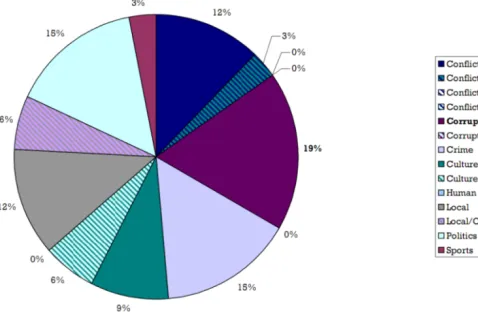
(41) CAPABILITY AND POVERTY. together. However, it must be noted that these are only aggregates, and data grouped by income and ethnicity is not available. Freedom of expression is much more difficult to assess, and the proxy used is often what treaties on human rights are signed by a country. But this says nothing about whether the treaty is followed and it also does not include violations by non-government parties, like criminal groups. Another proxy that gives a better view is that of the number of journalists’ deaths. In these figures, politics only plays a small part, smaller than crime (including local crime) or corruption.. Figure 2 Deaths of Journalists in Jan-Jun 2010 Divided by Topics Covered21. 3.2.5 EMOTIONS (MENTAL WELL-BEING) “Being able to have attachments to things and people outside ourselves…”. 21. Source: International Press Institute Death Watch June 2010. One has to keep in mind that the numbers are too low for a good evaluation. The total number of journalists killed was steady in 2010 and 2011, but rose in 2012.. 35.
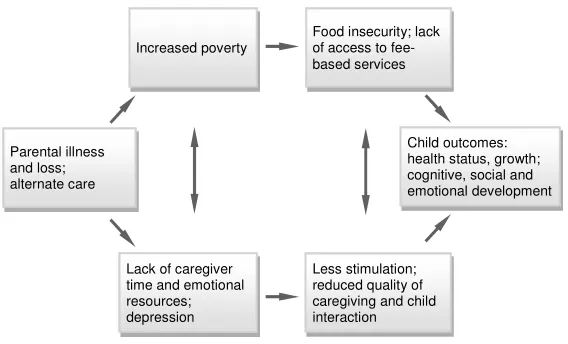
(42) POVERTY & TECHNOLOGY. Besides being able to develop one’s mind, the capability to develop one’s emotions towards others is an important capability, whether it concerns loving, grieving, longing or justified anger. According to Nussbaum (2000), people should not have their “emotional development blighted by overwhelming fear and anxiety” (p. 79). Especially children have a need for this capability for their emotions to develop normally or their emotions will “remain at an infantile level and are felt as threatening and shameful power, totally disconnected from the ‘true’ and ‘adult’ self.” (D’Addelfio 2006, p. 10). In LDC’s, especially in those countries that are plagued by HIV/AIDS, many children are depending on care from others than from their parents. Families often take over the care for orphans within their family and sometimes foster parents can be found, or otherwise the children end up in social child care (Maundeni 2009). Private and social care-givers alike run into the problems of increasing demand, due to HIV/AIDS deaths. A friend who did an internship in a South-African orphanage wrote about the lack of attention for the children and how this affected their emotional development (van Rikxoort 2010). Life and health are the key capabilities that are provided in those places, because they do not have the resources to focus on other capabilities. Her experience fits the picture that is sketched in a working paper by Patrice Engle (2008), especially in the diagram in Figure 3.. 36.
(43) CAPABILITY AND POVERTY. Food insecurity; lack of access to feebased services. Increased poverty. Child outcomes: health status, growth; cognitive, social and emotional development. Parental illness and loss; alternate care. Lack of caregiver time and emotional resources; depression. Less stimulation; reduced quality of caregiving and child interaction. Figure 3 pathways to child outcomes (remake). 3.2.6 PRACTICAL REASON (CONSCIENCE) “Being able to form a conception of the good and to engage in critical reflection about the planning of one’s life.” The capability for practical reason relies heavily on the previous two capabilities. How much and what kind of education we receive, and how we develop emotionally will guide the conception of the good that we will form. In moral psychology, J. Piaget’s theory of moral development explains (Oesterdiekhoff 2009) that the morality of a child reaches higher levels by parental influences, cooperation and cognitive maturation. In addition to the development of morality, Nussbaum also mentions the ability to act upon one’s morality. This means that we should not restrain to do what we believe is right because our society will punish us for it. In all societies there are norms and values that are so entrenched that it is difficult to critically reflect on them, and when one does, it may prove to be hard to change them. Often the people who are in control (e.g. men, whites, Hutu’s or Arians), remain in control because they have a large 37.
(44) POVERTY & TECHNOLOGY. influence on the norms of the society and have developed the reasoning to support their rule. The flaw in the Principle of Generic Consistency of Gewirth (see page 26) is exploited by distinguishing between different groups of people, where the other group is denied the right to agency. In Rwanda, in 1994, this could be seen at work, as is told by Rakiya Omaan, who was following the events from northern Rwanda (Montgomery and Smith 2004). “In Rwanda they referred to Tutsis as cockroaches,” explains Omaar. “They were not human beings. This is very important to understand, [there are] very close parallels to what happened in Hitler’s Germany. [They said,] ‘Don’t worry; you’re not killing humans like you. You are killing some vermin that belongs under your shoe. You’re killing cockroaches.’” 3.2.7 AFFILIATION C OMPASSION TOWARDS OTHERS “Being able to live with and toward others…” When I visited Namibia, the most striking aspect of the poverty I witnessed was the lack of compassion. The daily struggle for basic needs can lead people to think only about their own interests, and only on the short term. Children are brought up in an environment in which (small) arguments are settled with anything that is sharp. One morning, this was brought to my attention, that same afternoon a small argument during a soccer match was about to be settled with the neck of a broken bottle. The institutions that constitute and nourish compassion, as Nussbaum calls it, do not exist or cannot reach all people, certainly not those at the bottom of society.. 38.
(45) CAPABILITY AND POVERTY. R ESPECT “Having the social bases of self-respect and nonhumiliation…” The minimum level of this capability, non-discrimination, is not completely absent is any society, but there are examples of extremes, such as the one discussed in capability 6. Another well-known example of this is the caste system in India, where people who are born in the caste of the untouchables have less chance and freedom to pursue their ends than people who are born in a higher caste22. The caste system, however, has no formal backing anymore and is prohibited in the constitution of India. Nevertheless, in the minds of the citizens, it still exists23; that is where the minimum level of nondiscrimination has to rise to that of respect. 3.2.8 OTHER SPECIES (ENVIRONMENT) “Being able to live with concern for and in relation to animals, plants, and the world of nature.” This capability is concerned with our environment. Injustice is visible here in the observation that most of the degradation in the environment is (probably) caused by the large consumption of rich countries that cause world-wide problems. Indirectly, the well-being of people is compromised by the changing environment: food supplies are in danger (Simatele, Binns, and Simatele 2012), and carriers of diseases move to new areas (Patz et al. 1996). But the living. 22 This is a big difference with the ‘American Dream’, where everyone, no matter their status or background, can become important, even if only few actually succeed in doing so. 23 An interesting book about this topic is Amartya Sen’s “Identity and Violence” (2006).. 39.
(46) POVERTY & TECHNOLOGY. environment of people can also be affected more directly, as was the case with the Trafigura toxic waste incident24. The impacts of environmental changes on the lives of people in LDCs are visible in several ways. Changes in climate cause problems in fishing (Nellemann, Hain, and Alder 2008). Deforestation can threaten entire societies, and cause their collapse (Diamond 2005). Melting glaciers and water dams can cause flooding or drought etc. An example is “the Akosombo Dam in Ghana, completed in 1972, [which] has rarely functioned to projected capacity and created a wide range of ecological and human problems in the catchment area. Worse, however, were the downstream effects. In the two decades after the dam’s commissioning, a growing swath of beach in neighbouring Togo has disappeared, damaging roads, port facilities, fishing villages and threatening Lake Togo, an important wildlife habitat and source of human drinking water.” (Smillie 1991) 3.2.9 PLAY “Being able to laugh, to play, to enjoy recreational activities” The capability for play seems to be a somewhat odd one. In the fourth capability, Nussbaum already mentions the ability ‘to have pleasurable experiences’, so it is strange that it appears again as a separate capability. But though play may result in a pleasurable experience, for children it also helps to develop certain functions. Health and mental well-being are increased by recreational activities, and for children play is an important instrument to learn social and emotional skills. Pellegrini and Smith (1998) discuss several studies. 24. See export.. http://www.guardian.co.uk/world/2010/jul/23/trafigura-dutch-fine-waste-. 40.
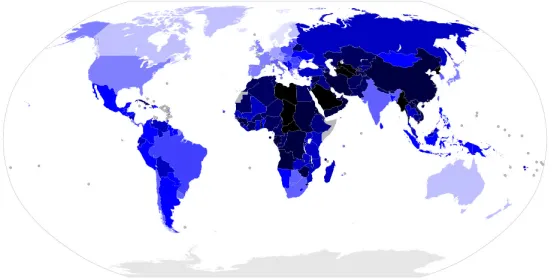
(47) CAPABILITY AND POVERTY. into the importance of play (exploration, fantasy, and locomotor) and experimental deprivation studies25. Little practical information can be found about this capability. There is however a relation between income poverty and recreation: those who have less to spend are less likely to participate in recreational activities, even when these activities are free of charge (Park, A. P. Turnbull, and H. R. Turnbull 2002, p. 6). The same paper reports that free activities for people with a disability are biased towards skills development and miss the real recreational aspect. 3.2.10 CONTROL OVER ONES ENVIRONMENT P OLITICAL ( DEMOCRACY ) “Being able to participate effectively in political choices that govern one’s life…” This capability follows up on the fifth capability: that of practical reason. Political influence helps to ensure that everybody’s voice is heard and everybody can have influence in how the society in which they live is organized. Without other capabilities, however, Sen argues that the capability is worthless, because when the capability for bodily integrity, freedom of expression, and practical reason are not present, the result of elections are not representative for the thoughts of the voters (Sen 2009, p. 327). Though the news shows images of protest for more democracy in countries like Myanmar (Burma), Iran, Yemen, Syria, Libya and Egypt, democracy is facing a difficult time, according to the Democracy Index 201026 (Economist Intelligence Unit 2010), see Figure 4. In high. 25 Experimental deprivation studies test the hypothesis that children who are deprived from one of the forms of play will compensate for it when they are not deprived of it anymore. 26 “The Economist Intelligence Unit’s Democracy Index is based on five categories: electoral process and pluralism; civil liberties; the functioning of government; political. 41.
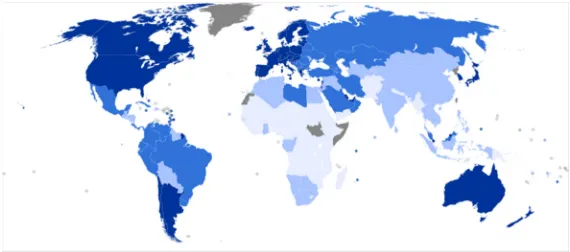
(48) POVERTY & TECHNOLOGY. scoring countries, the decline is mostly because of declining political interest under citizens (the political culture), and the rise of populists.. Figure 4 Democracy index 2010 (lighter means more democracy). M ATERIAL (P ROPERTY ) “Being able to hold property, not just formally but in terms of real opportunity” Nussbaum stresses equal opportunity in gaining property, and in a footnote mentions sex inequality in land rights as a reason to list this capability. But is private property, which Nussbaum means here, really a basic capability? Can publicly held property not offer the same opportunities for people? The fact is however, that most societies work with private property, and in that case, the acquisition and possession of property should be open to all. The world-wide differences in economic freedom are shown in Figure 5. In LDC’s, the wealth of people is much lower than in more developed countries. In some cases, this has a direct relation with the political control over one’s environment. Thomas Pogge (2007, p. 48-. participation; and political culture. The index provides a snapshot of the current state of democracy worldwide for 165 independent states and two territories.”. 42.
(49) CAPABILITY AND POVERTY. 49) explains that the resource privilege gives those who are in control in a country full ownership over the natural resources of that country. The rulers can sell the national resources and use the profits to benefit themselves and buy protection against opposition. Examples of this are the Blood Diamonds in Sierra Leone and the oil reserves in Nigeria.. Figure 5 Economic freedom index 2010 (the Fraser institute). 3.3 Capability and Poverty The differences in levels of capability are clear in many of the sources discussed. There are differences in health between highincome and low-income countries; differences in respect between social groups within a country; and differences in bodily integrity between men and women within households. But can we say that those who have the least are poor? What is a just distribution of capabilities and when is somebody counted among the poor?. 43.
Figure

+6


Related documents
13,14 Although these studies incorporated either moderate or vigorous physical activity as part of the weight loss intervention, the relationship between salivary androgen levels
There is, however, a significant degree of variation both across LEAs and across ethnic groups: segregation is higher for pupils of Indian, Pakistani or Bangladeshi origin than
Each entity in the system model has specific strengths that we wish to exploit on behalf of distributed appli- cations: (i) the application initiator is best for holding private
institutions outside the juvenile justice system, racial disparities will persist in juvenile justice. Ultimately, many institutions drive disproportionately in juvenile justice, and
This was achieved using a com- bination of daily average and diurnal airborne Olea pollen counts recorded at Badajoz (south-western Spain), daily aver- age and diurnal airborne
[r]
[r]
* Patients in the Afgh1 and Ghan1 studies were individually randomized to malaria diagnostic method; data are not included in this analysis because all patients in scenarios with
