http://www.scirp.org/journal/jmf
ISSN Online: 2162-2442 ISSN Print: 2162-2434
DOI: 10.4236/jmf.2018.81013 Feb. 28, 2018 161 Journal of Mathematical Finance
A Linear Regression Approach for Determining
Option Pricing for Currency-Rate Diffusion
Model with Dependent Stochastic Volatility,
Stochastic Interest Rate, and Return Processes
Raj Jagannathan
Department of Management Sciences, Tippie College of Business, The University of Iowa, Iowa City, USA
Abstract
A three-factor exchange-rate diffusion model that includes three stochastical-ly-dependent Brownian motion processes, namely, the domestic interest rate process, volatility process and return process is considered. A linear regres-sion approach that derives explicit expresregres-sions for the distribution function of log return of foreign exchange rate is derived. Subsequently, a closed form workable formula for the call option price that has an algebraic ex-pression similar to a Black-Scholes model, which facilitates easier study, is discussed.
Keywords
Option Pricing, Interest-Rate Parity Condition, Black-Scholes Model, Linear Regression Approach, Spot Option, Ito Calculus
1. Introduction
A foreign exchange rate depends on the supply and demand dynamics of a cur-rency. The exchange rate is a function of trade balance, the interest rate differen-tial and differendifferen-tial inflation expectations between the two countries [1][2].
Let S(u), u≥0 = exchange rate process over the time interval: u≥0, where
u = number of domestic currency units, e.g., $, per unit of foreign currency = $-price of foreign currency.
As interest rate rD
( )
u increases, $ appreciates because investors prefer$-denominated bonds. Assuming a frictionless, arbitrage-free continuous-time economy in [1], we define a diffusion process model for S(u). In addition, using
How to cite this paper: Jagannathan, R. (2018) A Linear Regression Approach for Determining Option Pricing for Curren-cy-Rate Diffusion Model with Dependent Stochastic Volatility, Stochastic Interest Rate, and Return Processes. Journal of Mathematical Finance, 8, 161-177.
https://doi.org/10.4236/jmf.2018.81013
Received: August 14, 2017 Accepted: February 25, 2018 Published: February 28, 2018
Copyright © 2018 by author and Scientific Research Publishing Inc. This work is licensed under the Creative Commons Attribution International License (CC BY 4.0).
http://creativecommons.org/licenses/by/4.0/
DOI: 10.4236/jmf.2018.81013 162 Journal of Mathematical Finance
interest-rate parity condition we have
( )
0( ( ) ( ))d 0e
h
D F
r u r u u
S h S
− ∫
= , see [1].
In the following section, the formula for valuations of currency spot options is considered, where we obtain a closed form formula for the call option price that has a simple algebraic expression, which is similar to the call option price ex-pression of a Black-Scholes model, making it much easier to compute its value and study. As in [2], we can define an implied volatility function and derive its skewness property.
Subsequently, the proposed three-factor exchange-rate diffusion model is discussed, such that the stochastic volatility process and the stochastic domestic interest rate process each have a stochastically dependent Brownian motion re-turn process.
In the next section, a linear regression approach that derives explicit expres-sions for the distribution function of lnS s
( )
is treated.Foreign exchange rate option modeling is the subject of several well-known papers and in chapters within [3][4][5][6]. Leveraging Heston’s model [4] for this application would introduce complexity due to the need to numerically in-tegrate conditional characteristic functions obtained as solutions of nonlinear pdf to derive the call option prices. An equivalent two-factor Black-Derman-Toy model [2] can be formulated with introduction of H(u).
The method suggested in this paper results in Black-Scholes type formula for call option pricing, which is easily computable.
Finally, we provide concluding remarks and suggestions for future direction.
2. Currency Spot Option
Given the spot rate S
( )
0 =s0, consider the present value of option(
)
( )
(
( )
)
*
0 0
0
, ,* exp d *
s D
C s K =E − r u u S s −K+
∫
(1)where K is the known strike price and
(
rD( )
u u, ≥0)
is a mean-revertingsto-chastic process given in (2) below. S s
( )
is the value of the exchange rate at the option’s maturity price. The option to purchase foreign currency over the coun-ter can be exercised when S(s) > the strike price exchange rate K.3. A Diffusion Process Model
A continuous-time risk-adjusted and risk-neutral exchange rate model, under a Martingale Measure Q, is defined below as a diffusion process (2), mean-reverting stochastic processes: Volatility
{
H u u( )
, ≥0}
(3) and domestic interest rate( )
Dr t process (4), and foreign interest rate rF is a known constant.
( )
( )
(
( )
)
( )
(
( )
)
( )
2
1
d
d d
2
D F
S u H u
r u r u H u B u
S u υ
= − + + +
DOI: 10.4236/jmf.2018.81013 163 Journal of Mathematical Finance
( )
(
( )
)
1( )
dH u =α H u −θ du+ηdV u , ,θ η≥0,α >0 (3)
( )
(
( )
)
2( )
drD u =β rD u −λ du+ζdV u , ,λ ζ ≥0,β >0 (4)
( )
( )
2(
( )
)
1( )
d ln d d
2
D F
S u r u r υ u H u υ B u
∴ = − − + +
(5)
Equation (5) is obtained from Equation (2) by the application of Ito calculus [7]. Assumption:
( )
( )
( )
1 1
V t =ρB t +δC t , where δ 1−ρ2 and
( )
1
B t and C t
( )
arein-dependent Brownian processes.
( )
( )
( )
2 1 1 1 1
V t =ρB t +δC t , where 2
1 1 1
δ = −ρ
and B t1
( )
and C t1( )
are independent Brownian processes. (6)From the assumption above, the return processes Vj
( )
u ,u≥0,j=1, 2 arecorrelated with B u1
( )
and that Vj( )
t ,j=1, 2 are standard Brownian motion processes.Then it follows, see [2] [3], that the distributions of H u
( )
and rD( )
u areGaussian processes.
Alternatively, H u
( )
and rD( )
u may be expressed as:( )
( )
( ) ( )
( )
( )
( )
( )
( )
1 0
1 0
d .
d d .
u u
H u q u t V t
H u q u t B t C t
ψ
ψ ρ δ = +
∴ = + +
∫
∫
(7)
( )
(
)
( )
(
)
(
)
e 1 e
e , 0,
u u
u
E H u q u α α
α
κ θ θ κ θ α
− −
−
= = + −
= + − >
where θ is the long-term mean and where H
( )
0 =κ .( )
(
)
( )
( )
(
)
2
2 2 2 2 2
0 0
1 e
var d e d
2
So 0
u u u
t H
H H
H u t t t
P H u
α α
σ ψ η η
α µ
σ
−
− −
= = =
< = Φ −
∫
∫
(8)
Remark 1:
From (8), choosing θ >0 and that is small in value, we can make
( )
(
0)
P H u < negligible.
If, alternatively, we assume that
{
H u( )
,u≥0}
has a square root process [8],then the random variable H(u) distribution is non-central χ2
( )
. . For simplicitywe chose the mean-reverting process model (3).
( )
(
)
1( )
1e(
1 e)
(
1)
e , 0u u u
D
E r u =q u =κ −β +λ − −β = +λ κ −λ −β β >
( )
(
)
2( )
1 0
var d
u D
r u = ψ t u
∫
where 1
( )
e , 0u
u β u
ψ =ζ − > and
( )
1
0
D
r =κ
( )
1( )
1( )
1 1( )
1 1( )
0
d d
u D
r u q u ψ t ρ B t δ C t
DOI: 10.4236/jmf.2018.81013 164 Journal of Mathematical Finance
Assuming rD
( )
0 =κ1, and( )
( )
(
)
(
)
( )
( )
(
)
1
1 1 1
1 1 1
0
e , , 0, 0
e 1 e e
1 e d
t
u u u
s s
t t u
q u
Q s q u u s
β
β β β
β
ψ θ θ β
κ λ λ κ λ κ λ λ
β
−
− − −
−
= ≥ ≤ ≤
= + − = + − − =
∫
= − +(10)
The Brownian motion processes V u1
( )
and B u1( )
are as follows:( )
( )
( )
1 1 1
V u =ρB u +δC u , where δ = 1−ρ2 (11)
In addition, the Brownian motion processes B u1
( )
and C u1( )
under Q areindependent. Remark 2:
( )
, 0H u u≥ : the volatility process.
It follows from [2] that the distribution of H u
( )
is:( )
( )
(
2)
1 2~ , 1 e , 0 .
2
u
H u N q u η α u s
α
−
− ≤ ≤
(12)
Alternatively, H u
( )
may be expressed as( )
( )
( ) ( )
( )
( )
( )
( )
1 0
1 0
d
d d
u u
H u q u t V t
q u t B t C t
ψ
ψ ρ δ = +
= + +
∫
∫
(13)
where 2
1
δ −ρ and ψ
( )
u =ηe−αu, ,η α≥0.See [9] for a similar assumption. See also [2] and [3].
Note that B s1
( )
has a normal distribution with mean 0 and variance s, so( )
1
B s can be written as B s1
( )
=Z s( )
s, where Z s( )
is a standard normalvariable. Then lnX s
( )
can be written as a quadratic function of( )
1( )
, 0
B s
Z s s
s
= > plus a residual term ε
( )
s . {See Proposition 1 below}.For d
ξ
=dC t( )
, 0≤ ≤t u, 0≤ ≤u s, we define a volatility process( )
( ) ( )
0
d , 0
u u
V ξ =V = ψ t C t ≤ ≤u s
∫
.Define
(
( )
)
(
)
1 2
2 2
0
1 e 1
d 2
u s
V s u V
s
α
η σ
α
−
−
∫
, as the average standard
deviation in the case of uncorrelated Brownian motion process
( )
{
C u , 0≤ ≤u s}
ξ [See [10], p. 182].Proposition 1:
( )
1( )
1( )
1 1( )
1 1( )
0
d d ;
u D
r u =q u +
∫
ψ t ρ B t +δ C t ( )
( )
( )
( )
( )
( )
( )
(
( )
( )
)
( )
1 1 1 1 1 1
0 0 0 0
1 1 1 1 1 1 1 3
d d d d d
.
s s s u
D
r u u q u u u t B t C t
Q s B s G s s V e s
ψ ρ δ
ρ χ δ
∴ = + +
= + − + +
DOI: 10.4236/jmf.2018.81013 165 Journal of Mathematical Finance
where
( )
( )
(
)
(
)
( )
(
)
( ) ( )
( )
(
) ( )
1 1 1
0
1 1
0
1
1 1
1 e d
1 e
d 1
!
1 1 !
s s
t j
s
j j
j j
j j
Q s q u u s
s
G s t
j j
s
j j
s
s
β
β
κ λ λ β
ζ ζ β
β β
ζ β β χ
−
− ∞
+
=
+
∞ +
=
−
= − +
−
= −
−
+
=
∫
∑
∫
∑
(15)
Proof: See Appendix B.
We consider a mean-reverting Gaussian process model (2), the volatility sto-chastic processes
{
H u( )
, 0≤ ≤u s}
and the processes, V u1( )
and B u1( )
in(3) to be correlated; where V u1
( )
is a standard Brownian motion returnprocess. In addition, in (3), we define the volatility H u
( )
εR as a meanrevert-ing Gaussian process with θ as its long-term mean.
Assumption 1:
( )
( )
( )
21 1 1 1 , where 1 1 1
V t =ρB t +δC t δ = −ρ (16)
In (4), we define the domestic interest rate process rD
( )
u as a meanrevert-ing Gaussian process with λ as its long-term mean. The process
( )
{
rD u , 0≤ ≤u s}
is such that the return process V2( )
u is a correlatedstan-dard Brownian motion process to B u1
( )
. The foreign interest rate rF( )
u is a constant rfAssumption 2:
It follows from [2] that the distribution of rD
( )
u :( )
( )
(
2)
1 21
~ , 1 e , 0 .
2
u D
r u N q u ζ β u s
β
−
− ≤ ≤
(17)
Now we use the results obtained in Proposition 1 to derive an explicit expres-sion for
( )
( )
00
d ln ln ln
s
S u = S s − S
∫
Proposition 2:
( )
( )
(
)
( )
( )
( )
(
( )
( )
)
( )
0
2
0 1
0 0
1 1
0 0
d ln
d d
2
d d d ;
s
s s
D F
s u
S u
r u r u s q u B u
t B t C t B u
υ υ θ
ψ ρ δ
= − − + + +
+ +
∫
∫
∫
∫ ∫
(18)
Remark 3:
From the expression for
( )
1( )
1 1( ) ( )
(
1 1( )
)
1 1 0d
s D
r u u=Q s +ρB s G s −χ s +δV
DOI: 10.4236/jmf.2018.81013 166 Journal of Mathematical Finance
( )
(
( )
( )
)
1B s1 G s1 1 s
ρ −χ modifies n s
( )
and the constant term Q s1( )
+δ1 1Vmodifies *
( )
,
p s h with the addition of ρ1B s1
( )
(
G s1( )
−χ1( )
s)
and thecon-stant terms Q s1
( )
+δ1 1V modifies( )
*,
p s h with the addition of Q s1
( )
+δ1 1V .Then, using the results in [2], Proposition 1 and those in Appendix A and Appendix B we have:
( )
(
) ( )
( ) ( )
( )
( )
( )
( )
( )
( ) ( )
(
( )
)
( )
( ) ( )
( ) ( )
( ) ( )
( ) ( )
2
0 1 1 1 1
2 1
2 2 1
1 1 1 1 1 1 1 3
2
ln ln
2
2 2
, 2
F
S s s s r s B s s B s e s
B s s
s e s Q s
B s G s s V Y e s
m s
Z s Z s n s p s s U s s
υ υ θ γ
γ ρ
ρ χ δ
ε ξ ε = − − + + + +
+ − + +
+ − + +
+ + + +
(19)
Therefore,
( )
2( ) ( )
( ) ( )
( )
, ,
2 m s
U sξ =Z s +Z s n s +p s
( )
2( )
;m s =ργ s s
( )
(
)
1( )
3( )
(
1(
1( )
1( )
)
1 1)
;n s =
υ θ δ
+ + V +γ
s +γ
s +ρ
G s −χ
s +δ
V sRemark 4:
Note that n s
( )
in this paper is an updated version from the n s( )
in [2], due to our treatment of a stochastic interest rate:( )
0
d
s D
r u u
∫
( )
2( )
( )
( )
0 2 1
1
ln ;
2 2 F
s
p s = s − υ s−ργ s +ε s +Q s −r s
( )
(
)
(
)
(
)
(
)
(
)
2 2
2
0
2
2 2
0
2 2
2 2
1 e d 2
1 e 1
d 2
2 1 e
1
, 4
u s
u s
s
V s u
u s
s
V s
α
α
α
η σ
α η
α η α
α
−
−
−
−
=
−
=
− − =
∫
∫
In the case of C u u
( )
, ≥0.( )
(
)
2(
(
2)
)
2 2
1 2 1
2 1 e
1
4
s
s
V s V
s
β
ζ
β
σ
β
−− −
= , where C u1
( )
,u≥0 (20)( )
( )
( )
(
)
( )
( )
(
( )
( )
)
( )
( )
( )
( )
2
2 3 2 1 1 1
2
0 2 1 1 1
;
1 ln
2 2 F
m s s s
n s V s s G s s s
s
p s S s s s Q s r s V
ργ
υ θ δ γ λ γ ω ρ χ
υ ργ ε δ
=
= + + + + + + + −
= − − + + − +
(21)
( )
s e s1( )
e2( )
s e3( )
sDOI: 10.4236/jmf.2018.81013 167 Journal of Mathematical Finance
( )
( )
(
)
(
)
( )
( )
(
)
(
)
( )
( )
(
)
(
)
(
)
1 1 1 1 1 0 1 0 02 2 2
0 0 0
2 2 1 e d ; 1 e 1 d ; 1 e 2 2
d d d
1 e 2 . s s s s u
s u s
s
Q s q u u s
s q u u
s s
s t t u u
s s s s β α α α κ λ λ β κ θ γ α η η γ ψ α α η α − − − − − − = = + − − = = − = = − − =
∫
∫
∫ ∫
∫
(22)( )
(
)
(
)
2 2 21
1 e 1 e
; 2
s
Var e s
s α α κ θ α α − − − − = − −
( )
(
)
2 2(
)
(
)
22
2 2 1 e 2 1 e
2 4
s s
s s
Var e s η η α η η α
α α α α
− − = − − − − −
( )
(
3)
Var e s is provided in (B1)
( ) ( )
(
i , j)
0; , 1, 2, 3,Cov e s e s = i j= i≠ j
Case 1:
ρ
>0;( )
( )
(
)
(
( )
)
( )
( )
( )
(
( )
( )
)
( )
( )
(
( )
( )
)
0 21 1 0 1
0 0 0
1 1 1 1 1 1 1
0 0 0
d ln
d d d
2
d d d d ;
s
s s s
D F
s u s
S u
r u r u s q u u q u B u
t B t C t B u t B u C u
υ λ υ θ
ψ ρ δ ψ ρ δ
= − − + + + + + + + + +
∫
∫
∫
∫
∫ ∫
∫
Let S
( )
0 =s0( )
(
)
( )
( ) ( )
( )
( )
( )
( )
( )
( ) ( )
(
( )
)
( )
2 0 1 2 11 1 1 2 2
1 1 1 1 1 1 1 3
ln ln
2
2 2
.
F
S s S s r s V B s
B s s
s B s e s s e s
Q s B s G s s V e s
υ υ θ δ
γ γ ρ
ρ χ δ
= − − + + + + + + − + + + − + +
Let
( )
2( ) ( )
( ) ( )
( ) ( )
( ) ( )
ln ,
2 m s
S s Z s +Z s n s +p s +ε s U sξ +ε s .
Assumption 3: U s
( )
,ξ and ε( )
s are independent random variables.Assumption 4: 2
( )
( ) ( )
(
)
, 2 , 0
n sξ − m s p s h −ω ≥ .
Assumption 5: m s
( )
≠0 and m s( )
<1.If Assumptions (4) and (5) hold, then the conditional risk-neutral distribution of lnS s
( )
is:Proposition 3: ( )
(
)
( )
( )
(
)
(
( )
)
(
( )
)
(
)
(
)
ln 1 2 1 ,1 , , ,
ln |
1, , ,
S s
F h
z h z h h
P S s s h
h
ω
ω ω ρ ξ ω ε
ω ω ρ ξ
∗
∗
−
− Φ + Φ ≥
= ≥ = =
DOI: 10.4236/jmf.2018.81013 168 Journal of Mathematical Finance
( )
(
)
(
( )
( )
)
( )
(
)
(
( )
)
(
)
(
)
1 2
ln
, , ,
, ln |
0, , .
S s
z h z h h
F h P S s s h
h
ω ω ρ ξ
ω ω ε
ω ω ρ ξ
∗
∗
Φ − Φ ≥
∴ = ≤ = =
≤
(23) where
( ) ( )
( )
( )
( )
( ) ( )
(
)
(
)
( )
( )
( )
2
1 2
2 *
, 2
, , ,
,
2
n s n s m s p s h
z z h z h
m s
n s
h h p s
m s
ξ ω
ξ ξ
ω ρ
− ± − + −
= =
= + −
(24)
If 2
( )
( ) ( )
(
*)
, 2 0
n sξ − m s p s − −h ω = , then the roots of the equation defined
in (24) are equal so that 1 2
( )
( )
( )
, n s
z z z
m s
ξ ξ
∗
= = = − , then there exists a value
(
, ,h)
ω ρ ξ∗ such that
( )
(
) ( )
( )
(
ln , | , 2)
1P S s ≥ω ρ∗ h ε s =h V s =ξ = .
In other words, *
(
)
, ,h
ω ρ ξ is the lowest value for the conditional random
variable ln
(
S s( )
)
.Remark 5:
Since we know the CDF of lnS(s) we can estimate the parameters of the un-derlying model (2)-(5).
Case 2: Conditional Risk-neutral Distribution function of
( ) ( )
( )
(
lnS s |ε s =h V s, =ξ)
, m s( )
<0. Supposeρ
<0, Conditional risk-neutraldistribution of lnS s
( )
|(
ε( )
s =h V, 2( )
s =ξ)
is as follows:( )
(
)
( )
( )
(
)
( )
(
)
(
( )
)
(
)
(
)
ln |
2 1
1 ,
ln | ( ) ,
, , ,
0, , ,
S s
F h
P S s s h V s
z h z h h
h
ξ ω
ω ε ξ
ω ω ρ ξ ω ω ρ ξ
∗
∗
−
= ≥ = =
Φ − Φ ≤
= ≥
( )
(
)
( )
(
)
(
( )
)
(
)
(
)
2 1
ln |
1 , , ,
,
1, ,
S s
z h z h h
F h
h ξ
ω ω ρ ξ ω
ω ω ρ
∗
∗
− Φ + Φ ≤
∴ =
≥
where
( ) ( )
( )
2( )
( )
( ) ( )
(
)
1 2
, , 2
, , , n s n s m s p s h
z z h z h
m s
ξ ξ ω
ξ ξ − ± − + −
= =
Example 1
( )
(
( )
)
( )
( )
( )
(
( )
)
( ) ( )
( )
(
( )
)
( ) ( )
( )
(
( )
)
( ) ( )
2 1
2 1
1
d d d , , 0, 0, 0 ;
d 0.3 0.02 d 0.04d , 0 0.03;
d d , 0 ;
d 0.1 d 0.3 , 0 0.6
D D D
D D D
r u r u u V u r
r u r u u V u r
H u H u u V u H
H u H u u V u H
β λ ζ λ ζ β κ
α θ η κ
= − + ≥ > =
= − + =
= − + =
DOI: 10.4236/jmf.2018.81013 169 Journal of Mathematical Finance
( )
Dr u :
β λ ζ rD
( )
0 =κ1 ρ10.3 0.2 0.4 0.03 0.6
( )
H u :
α θ η ρ κ rf
1 0.1 0.3 −0.8 0.6 0.8
Then
( )
( )
( )
( )
*
1 1 1
, ln 0 ln
p s h p s + −h Q s − s + K−ρY
Remark 6:
From the expression for
( )
1( )
1 1( ) ( )
(
1 1( )
)
1 1 0d .
s D
r u u=Q s +ρB s G s −χ s +δV
∫
the stochastic terms ρ1B s1
( )
(
G s1( )
−χ1( )
s)
modify the term n s( )
and theconstant terms Q s1
( )
+δ1 1V modifies( )
* ,p s h with the addition of
( )
1 1 1
Q s +δV.
Proof:
Apply a proof similar to the one in Appendix A of [2] using the result for
( )
0d
s D
r u u
∫
in Appendix B of the current paper. See also Proposition 4. Remark 7:Assume
ρ
>0, which implies that m s( )
>0.If Assumption (3) holds then the conditional risk-neutral distribution of
( ) ( )
( )
{
lnS s |ε s =h V s, =ξ}
is:( )
(
)
( )
( )
(
)
(
( )
)
(
( )
)
(
)
(
)
( )
(
)
(
( )
( )
)
( )
(
)
(
( )
)
(
)
(
)
ln
1 2
1 2
ln
1 ,
1 , , ,
ln |
1, , ,
, , ,
, ln |
0, , ,
S s
S s
F h
z h z h h
P S s s h
h
z h z h h
F h P S s s h
h ξ
ω
ω ω ρ ξ ω ε
ω ω ρ ξ
ω ω ρ ξ
ω ω ε
ω ω ρ ξ
∗
∗
∗
∗
−
− Φ + Φ ≥
= ≥ = =
≤
Φ − Φ ≥
∴ = ≤ = =
≤
(25) where
( ) ( )
( )
( )
( )
( ) ( )
(
)
(
)
( )
( )
( )
2
1 2
2 *
, 2
, , ,
,
2
n s n s m s p s h
z z h z h
m s
n s
h h p s
m s
ξ ω
ξ ξ
ω ρ
− ± − + −
= =
= + −
(26)
If n2
( )
s,ξ −2m s( ) ( )
(
p s − −h ω*)
=0, then the roots of the equation definedin (26) are equal so that 1 2
( )
( )
( )
, n s
z z z
m s
ξ ξ
∗
DOI: 10.4236/jmf.2018.81013 170 Journal of Mathematical Finance
(
, ,h)
ω ρ ξ∗ such that P
(
lnS s( )
≥ω ρ∗(
,h) ( )
|ε s =h V,2( )
s =ξ)
=1.In other words, *
(
)
, ,h
ω ρ ξ is the lowest value of the conditional random
variable
{
lnS s( ) ( )
|ε
s =hσ
ε( )s}
.Call option price:
( )
( )
(
)
( )
( )
*
0
0
, , , 0 exp d ln ln
s Q
D
c s S s K S =E − r u u + S s − K+
∫
Proposition 4:(
)
( )( )
(
)
( )
(
)
( )
( )
(
( )
)
( )
( )
(
)
( )
(
( )
)
( )
( )
(
)
( )
( )
( )
(
)
( )( )
0 0 0 d 0 2 10 1 2 1 2
2 d
*
, , , , , 0
e |
0, for ln , ;
1 1
1
1 1 1
exp , e | ln ln
2 1 s
D
s d
r u u Q
r u u
C s K r h
E S s K s h
K h
z h m s n s z h m s n s
s
m s m s m s
n s
p s h KE S s K
m s η ρ ε ω ρ ∗ − + ∗ − ∫ ∫ < = − = > − − − −
= Φ − Φ
− − − ∗ + − ≥ −
where from Proposition 1
( )
1( )
1 1( ) ( )
(
1 1( )
)
1 1 0d .
s D
r u u=Q s +ρB s G s −χ s +δV
∫
See Appendix B.
( )
{
( ) ( )
}
( )
*
0 1 1 1
, | ln ln
p s h = p s ε s =h + s − K+Q s +δV
Remark 8:
Given the formula for
( )
1( )
1 1( ) ( )
(
1 1( )
)
1 1 0d
s D
r u u=Q s +ρB s G s −χ s +δV
∫
, the stochastic expression( )
(
( )
( )
)
1B s1 G s1 1 s
ρ −χ modifies the function n s
( )
and the constant terms( )
1 1 1
Q s +δV, modifies p*
( )
s h, with the addition of Q s1( )
+δ1 1V.( )
( )
( )
(
)
(
( )
( )
)
{
}
( ) ( ) 0 2 2 1 2 2 1 1 d 21 1 1 1 1
2
e | ln ln
exp e d
e d ;
s D h h h h
r u u
z z
z
z A s A s z z z
K S s K
K Q s V G s s z s z
K z
δ χ ρ
− − + − ∫ ≥ = + + − =
∫
∫
(27) Let( )
(
( )
( )
)
( )
(
( )
( )
)
( )
( )
1 1 1 1 1 1 1 1
1 1 1
;
A s z G s s B s G s s z s
A s Q s V
ρ χ ρ χ
δ
− = −
= +
( )
( )
2( )
2( )
12( )
1 1 2 2 ;
2 8
A s
z
DOI: 10.4236/jmf.2018.81013 171 Journal of Mathematical Finance
Then
( ) ( )
( )
( )
( )
( )
2
2 1
1
2
2 1
2 1 1 1
e d
2 2 exp ;
8 h
z A s A s z z z
h h
K z
A s
z A s z A s A s
+ −
= Φ − − Φ − −
∫
Hedge Ratio:
( )
( )
( )
(
( )
)
( )
( )
(
)
( )
(
( )
)
( )
( )
(
)
( )
(
( )
( )
)
(
)
(
)
* 0
2 1
1 2 1 2
2
* *
*
.
1 1
1
1 1 1
exp , , ln , ;
2 1
0, ln , ;
C s
z h m s n s z h m s n s
m s m s m s
n s
p s h K h
m s
K h
ω ρ
ω ρ ∂
∆ = ∂
− − − − Φ − Φ − − −
=
∗ + < −
≥
∆-Neutral Portfolio
Delta-Neutral Portfolio
Consider the following portfolio that includes a short position of one Euro-pean call and a long position of delta units of the domestic currency.
The portfolio of delta-neutral positions is defined as:
( )
*
0 Hedge ratio 0
P=s∆− ⇒c P =
We obtain below Conditional Risk-neutral Distribution function of
( ) ( )
( )
(
lnS s |ε s =hσε,V s =ξ)
,m s( )
<0 (29)by considering the cases of: h = 1, 0 and −1 We use a discrete approximation (see [2], (28)). Suppose
ρ
<0, which implies m s( )
≤0.Again, we consider the Equations (1)-(4) to define Example 1 below.
( )
( )
( )
( )
(
( )
)
( )
2
1
d
d d ;
2
D F
S u H u
r u r u H u B u
S u υ
= − + + +
(30)
( )
(
( )
)
1( )
dH u =α H u −θ du+ηdV u , ,θ η≥0,α >0; (31)
( )
(
( )
)
2( )
drD u =β rD u −λ du+ζdV u , ,λ ζ ≥0,β >0; (32)
( )
( )
2(
( )
)
1( )
d ln d d ;
2
D F
S u r u r υ u H u υ B u
∴ = − − + +
(33)
Let
( )
(
( )
)
( )
( )
( )
(
( )
)
( ) ( )
( )
(
( )
)
( ) ( )
( )
(
( )
)
( ) ( )
2 1
2 1
1
d d d , , 0, 0, 0 ;
d 0.3 0.02 d 0.04d , 0 0.03;
d d , 0 ;
d 0.1 d 0.3 , 0 0.6
D D D
D D D
r u r u u V u r
r u r u u V u r
H u H u u V u H
H u H u u V u H
β λ ζ λ ς β κ
α θ η κ
= − + ≥ > =
= − + =
= − + =
DOI: 10.4236/jmf.2018.81013 172 Journal of Mathematical Finance
Then, H u
( )
:υ α η θ ρ κ δ s H
( )
00.08 1 0.2 0.1 −0.8 0.1 0.6 0.5 0.06
And rD
( )
u :β θ1 λ δ1 ζ ρ1 rf
0.3 0.2 0.1 0.5 0.04 3 4 0.06
If Assumption (2) holds then the unconditional risk-neutral distribution of
( ) ( )
(
2( )
)
lnS s | ε s =h V, s =ξ and U s
( )
,ξ
are independent random variables.Then Figure 1 depicts the unconditional risk-neutral distribution of
( )
{
ln |}
ln(S s( )(
|)
P S s ≤u h =F u h .
Remark 9:
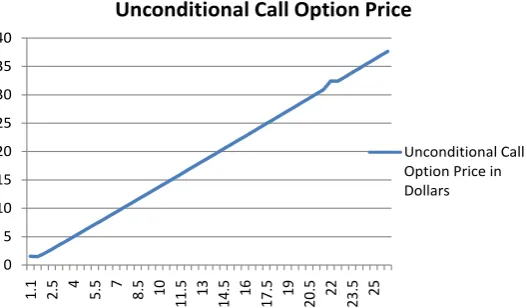
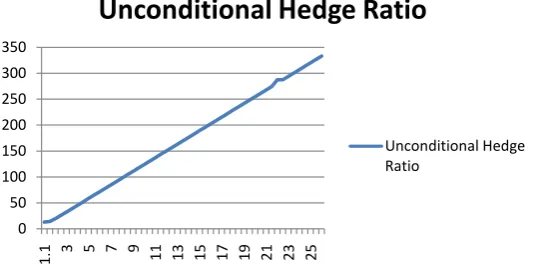
[image:12.595.207.542.81.185.2] [image:12.595.243.511.356.489.2]Future movement of values of risk-free interest rate and volatility are uncer-tain and as they increase, they affect call option values as depicted in the above
[image:12.595.244.508.537.691.2]Figure 2, Figure 3 ([5], p. 204). Sudden changes in their values may occur be-cause of economic shock. See the models suggested in [11][12].
Figure 1. Unconditional risk-neutral CDF of lnS(s), strike price (cents) k
from 1.1 to 16.2.
Figure 2. Unconditional call option price with strike price k (cents) from 1.1 to 26.
0 0.1 0.2 0.3 0.4 0.5
1.
2
2.
7
4.
2
5.
7
7.
2
8.
7
10.
2
11.
7
13.
2
14.
7
16.
2
Unconditional Risk Neutral Cumulative
Distribution Function of ln(S(s))
Unconditional Risk Neutral CDF
0 5 10 15 20 25 30 35 40
1.
1
2.
5 4
5.
5 7
8.
5 10
11.
5 13
14.
5 16
17.
5 19
20.
5 22
23.
5 25
Unconditional Call Option Price
DOI: 10.4236/jmf.2018.81013 173 Journal of Mathematical Finance
Figure 3. Unconditional hedge ratio with strike price k (cents) from 1.1 to 26.
4. Conclusion
We define a three-factor exchange-rate diffusion model with 1) stochastic vola-tility process, 2) stochastic domestic interest rate process, and 3) return process which are Brownian motion return processes that are stochastically dependent. Further generalization is possible with the assumption of domestic and foreign stochastic interest rate processes which are subject to economic shocks [11][12]. The results are applicable to bond option models ([5], p. 783).
References
[1] Krugman, P.R. and Obstfeld, M. (2000) International Economics. 3rd Edition, Ad-dison Wesley, Boston, 360-362.
[2] Jagannathan, R. (2016) A Linear Regression Approach to Two-Factor Option Pric-ing Model. Journal of Math Finance, 6, 317-337.
[3] Vasicek, O. (1977) An Equilibrium Characterization of the Term Structure. Journal Financial Economics, 5, 177-188.https://doi.org/10.1016/0304-405X(77)90016-2 [4] Heston, S. (1993) A Closed-Form Solution for Options with Stochastic Volatility
with Applications to Bond and Currency Options. Review of Financial Studies, 6, 327-344.https://doi.org/10.1093/rfs/6.2.327
[5] Hull, J.C. (2009) Options, Futures and Derivatives. Pearson, Prentice Hall, Upper Saddle River.
[6] Garman M.B. and Kohlhagen, S.W. (1983) Foreign Exchange Option Values. Jour-nal of InternatioJour-nal Money and Finance, 2, 231-237.
https://doi.org/10.1016/S0261-5606(83)80001-1
[7] Oksendal, B. (2003) Stochastic Differential Equations—An Introduction with Ap-plications. Springer, New York.
[8] Cox, J.C., Ingersoll, J.E. and Ross, S.A. (1985) A Theory of the Term Structure of Interest Rates. Econometrics, 53, 385-407.https://doi.org/10.2307/1911242 [9] Trolle, A.B. and Schwarz, E.S. (2009) A General Stochastic Volatility Model for the
Pricing of the Interest Rate Derivatives. The Review of Financial Studies, 22, 2007-2057. https://doi.org/10.1093/rfs/hhn040
[10] Duffie, D. (1996) Dynamic Asset Pricing Theory. 2nd Edition, Princeton University Press, Princeton.
[11] Merton, R.C. (1976) Option Pricing When the Underlying Stock Returns Are
Dis-0 50 100 150 200 250 300 350
1.
1 3 5 7 9 11 13 15 17 19 21 23 25
Unconditional Hedge Ratio
DOI: 10.4236/jmf.2018.81013 174 Journal of Mathematical Finance continuous. Journal of Financial Economics, 3, 125-144.
[12] Jagannathan, R. (2008) A Class of Asset Pricing Models Governed by Subordinated Processes That Signal Economic Shocks. Journal of Economic Dynamics and Con-trol, 32, 3820-3846.https://doi.org/10.1016/j.jedc.2008.04.004
[13] Bakshi, G., Cao, C. and Chen, Z. (1997) Empirical Performance of Alternative Op-tion Pricing Models. The Review of Financial Studies, 52, 2003-2049.
https://doi.org/10.1111/j.1540-6261.1997.tb02749.x
DOI: 10.4236/jmf.2018.81013 175 Journal of Mathematical Finance
Appendix A
( )
( )
(
(
)
)
(
)
(
)
2 2 2 2
0 0 0
2 2
1 e
2 2 1 e 2
d d d
1 e 2
.
s
s u s u
s
s
s u t t u
s s s
s
s
α α
α
α
γ ψ η η
α α
α η
α
− − −
−
= = =
− − =
∫ ∫
∫
( )
( )
2 2
0 0
2
d d
s u
s u t t
s
γ =
∫ ∫
ψis the regression coefficient.
( )
(
( )
( )
)
( ) ( )
2 2 2 1 1
0 0
2
d d .
s u
e s t s B t B u
s ψ γ
=
∫ ∫
−( )
(
2)
0;(
1( )
)
0,(
1( ) ( )
, 2)
0E e s = E e s = Cov e s e s = (2A1)
( )
(
)
(
( )
( )
)
2 2( )
2( )
2 2 2 2
0 0 0 0
2
d d d d
s u s u
Var e s u t s t t t u s
s
ψ γ ψ γ
=
∫ ∫
− =∫ ∫
−Then the regression equation is
( )
( )
( )
( )
** 2
2 1 2 2 ;
2
s
s s B s e s
ψ
=γ
− + (2A2)
Assumption 6:
( )
(
1 2(
( )
)
)
2 ~ 0, 2
e s N Var e s (Approximately) (2A3)
Note that Cov e s
(
1( ) ( )
,e2 s)
=0 and( )
(
1 2(
( )
)
)
1 ~ 0, 2
e s N Var e s .
( )
(
)
(
( )
)
(
1/2)
(
( )
)
(
( )
)
1 2 1 2
Var e s Var e s Var e s Var e s
∴ + = +
Assumption 7:
( )
( )
( )
(
(
(
( )
)
(
( )
)
)
1 2)
1 2 ~ 0, 1 2
s e s e s N Var e s Var e s
ε = + + (Approximately)
(2A4) Proof of Proposition 1:
( )
{
( )
}
( )
( )
(
( )
( )
)
(
)
( )
2
0 0
0 1 1 1
0
d ln d
2
d d d ;
f
s s
d
u
S u u r u r
q u t B t C t B u
υ
υ θ ψ ρ δ
= − −
+ + + + +
∫
∫
∫
( )
{
}
(
) ( )
( ) ( )
( )
( )
( )
( )
( )
( )
(
)
( )
( ) ( )
( )
( )
( )
( )
( )
2
0 1
2 1
1 1 1 2 2 1
2 1 2
0 0
2 1
1 1 1 1 2 2
1
ln ln d
2
2 2
1
ln d
2 2 2
.
2 2
f
s d
s
d
S s r u r u s B s
B s s
s B s e s s e s VB s
B s s
s r u u s
B s s
s B s e s VB s s e s
υ υ θ
γ γ ρ δ
υ υ θ ρ
γ δ ρ γ
= + − − + +
+ + + − + +
= + − + + −
+ + + + − +
∫
DOI: 10.4236/jmf.2018.81013 176 Journal of Mathematical Finance
Appendix A from [2]
( ) ( ) ( )
( )
( ) ( )
( )
( )
( )
( )
1 1 2 1 1 2
0 0 0
2
2 1 2
d d d
2
s u s
B u t B t s B u B u e s
s
s B s e s
ψ γ
γ
= +
= − +
∫
∫
∫
where
( )
( )
(
)
(
)
(
(
)
)
2 2 2
0 0 0
2 2 2
2 2 1 e
d d d
1 e 1 e
2 2
s u s u
s s
s u t t u
s s
s s
s s
α
α α
γ ψ η
α α α
η η
α α
−
−
= =
− − − −
= =
∫ ∫
∫
( )
(
*( )
( )
)
2 2
0
d ,
s
e s =
∫
ψ u −γ s uwhere
( )
( )
( )
(
)
(
( )
)
( )
(
)
(
)
* 0
2
* 2
2 2
0
2 2
2 0
d
d d
1 e
1 e 2
d 2
u s
s
s u
u t t
Var e s u t u s
s u
s
α α
ψ ψ
ψ γ
α
η η
α α
−
=
= −
− −
−
= −
∫
∫
∫
Appendix B
( )
( )
( )
( )
( )
( )
( )
( )
( )
( )
( )
( )
( )
( )
( ) ( )
(
( )
)
( )
( )
( )
1 1 2
0
1 1 1 1 1 1
0
1 1 1 1 1 1
0 0 0 0
1 1 1 1 1 1 1 3
1 1
0
d
d d ;
d d d d d
d ;
u
D
u
s s s u
D
s
r u q u t V t
q u t B t C t
r u u q u u u t B t C t
Q s B s G s s V e s
Q s q u u
ψ
ψ ρ δ
ψ ρ δ
ρ χ δ
= +
= + +
∴ = + +
= + − + +
=
∫
∫
∫
∫
∫ ∫
∫
See [13].
( )
2 32! 3!
s s
G s s
ϑ β
= − +
because
( )
2 30
d
2! 3!
s u u
G s u u
s
ϑ β
= − + +
∫
Let 1
( ) ( )
1( ) ( )
1 4( )
0d
u
t B t u B u e u
ψ
γ
+∫
where 4
( )
( )
2 2 2
1 0
d .
u
e u u u
DOI: 10.4236/jmf.2018.81013 177 Journal of Mathematical Finance
Let
( )
( )
(
)
( ) ( )
( ) ( )
( ) ( )
( ) ( )
( ) ( )
(
( )
)
2 3
0 0
1 1 1
0 0 0
1
1 e
d d
2! 3!
d d d
u
v v
s s s
v v
G u u u v
u
u B u u B u G u B s G s G u B u
B s G s s
β
ϑ ϑ
υ γ
β β
ρ γ ρ ρ
ρ χ
−
−
= = − + +
= = −
= −
∫
∫
∫
∫
∫
Let
( ) ( )
( )
( )
3( )
0 0
d d ;
s s
G u B u
χ
s B u +e s∫
∫
where applying Wilk’s linear regression [14], we get
( )
( )
( )
( )
( )
(
)
3
2 2 2
0
2 3
0 0 0
0
d
1 e
d d d
d
2! 3!
s
e
t
s s u
s
s G u u s
G u u u t
t u u
s u u
s s s
β
σ χ
ϑ
β ϑ
χ
β
−
= −
−
= = = − + +
∫
∫
∫ ∫
∫