ISSN 2042-2695
CEP Discussion Paper No 1574
September 2018
Teacher Effectiveness and Classroom Composition
Esteban M. Aucejo
,
Patrick Coate
Jane Cooley Fruehwirth, Sean Kelly
Zachary Mozenter
Abstract
This paper studies how the effectiveness of teachers varies by classroom composition. We combine random assignment of teachers to classrooms with rich measures of teacher effectiveness based on a popular observational protocol, Framework for Teaching, to overcome key endogeneity concerns related to measurement and matching. We find that complementarities between classroom composition and teaching practice play a significant role in student achievement. We identify two main mechanisms that are driving this result: 1) negative interactions between challenging and/or student-centered practices and heterogeneity in classroom prior achievement, and 2) positive interactions between classroom management skills and average classroom prior achievement. Our findings illustrate the multidimensional nature of teacher effectiveness and have important implications for prescribing teaching practice and evaluating teachers. Simulations show that teacher rankings change substantially simply from within-school classroom reallocations, suggesting the need for caution when using popular teaching evaluation rubrics in high-stakes settings.
Key words:teacher, practices, peer effects, effectiveness JEL Codes: I2; I20; I21
This paper was produced as part of the Centre’s Education and Skills Programme. The Centre for Economic Performance is financed by the Economic and Social Research Council.
This research was supported by the Institute of Education Sciences, U.S. Department of Education, through Grant R305A170269 to University of North Carolina, Chapel Hill. The opinions expressed are those of the authors and do not represent views of the Institute or the U.S. Department of Education. Fruehwirth also thanks the British Academy and the Leverhulme Trust's Philip Leverhulme Prize. We thank seminar participants at the Kentucky-Cleveland Fed Workshop on the Economics of Education, and NBER Summer Institute. We also thank Pat Bayer, Ken Bollen, Cassie Guarino, David Guilkey, Laura Hamilton, Joe Hotz, Ju Hyun Kim, Spyros Konstantopolous, Lindsay Matsumara, Doug Staiger, Greg Veramendi, Valentin Verdier for helpful comments and conversations.
Esteban M. Aucejo, Arizona State University and Centre for Economic Performance, London School of Economics. Patrick Coate, National Council on Compensation Insurance. Jane Cooley Fruehwirth, University of North Carolina. Sean Kelly, University of Pittsburg. Zarhary Mozenter, University of North Carolina.
Published by
Centre for Economic Performance
London School of Economics and Political Science Houghton Street
London WC2A 2AE
All rights reserved. No part of this publication may be reproduced, stored in a retrieval system or transmitted in any form or by any means without the prior permission in writing of the publisher nor be issued to the public or circulated in any form other than that in which it is published.
Requests for permission to reproduce any article or part of the Working Paper should be sent to the editor at the above address.
1
Introduction
Teachers are largely understood to be the most important school-level determinant of achievement. Dating at least back to the Coleman Report of 1966, school peers have also been viewed as a key factor. While a vast literature has contributed to significant improvements in our understanding of the roles of teachers and peers (Gamoran et al., 2000; Rivkin et al., 2005; Sacerdote, 2011; Epple and Romano, 2010), a significant limitation of this literature is the treatment of teachers and peers in isolation. We address this gap by studying complementarities between teachers and classroom composition. The existence of complementarities has important implications for key teacher-related policies, including the importance of taking classroom composition into account when measuring teacher effectiveness and prescribing teaching practice. It further pushes the envelope on peer-effect-related policies beyond the often stark tradeoffs of regrouping students to the question of better matching teachers or teaching practice to different classroom compositions.
Why might complementarities between teachers or teaching practice and classroom composition be an important part of achievement production? One example is that the benefits of encouraging classroom discussion may vary depending on the heterogeneity in initial achievement of a student’s classmates. Furthermore, teachers can play a central role in determining the nature of classroom peer interactions. For instance, peer effects could be amplified by teaching practices that create a positive learning environment and promote a learning dialogue among students.1
Two important barriers have hindered the exploration of complementarities between teachers and classroom composition. First, detailed longitudinal data on teaching practices on a large scale are relatively rare. Second, endogeneity concerns related to nonrandom allocation of teachers to classrooms has posed significant challenges to identification. We overcome these challenges by exploiting a unique data set—the Measures of Effective Teaching (MET) Longitudinal Database. The key features of the data are rich information on teaching practices in a context where teachers are randomly assigned to classrooms. Teachers are evaluated by trained raters using a research-based protocol that is increasingly used to measure teaching effectiveness in schools nationwide,
1
Teaching practices not only involve the principles and methods used for instruction (e.g. class discussions vs. recitation), but also those actions that affect the social dynamics of a given classroom (e.g. classroom management).
the Framework for Teaching Evaluation Instrument (FFT) (Danielson, 2011).2 For classroom
composition, we focus on classroom peer initial achievement, the most-studied type of peer spillover in the literature (Sacerdote, 2011).
The random assignment of teachers eliminates one of the most important confounding factors for measuring teacher effectiveness, the systematic matching of students to teachers that would lead us to confound teachers or peer effects with unobservable teacher or peer quality. However, even with random assignment, our identification strategy needs to address a number of remaining endo-geneity concerns. The first is that there is considerable non-compliance in the data. We address this by relying on the variation generated by the randomly-assigned teacher rather than the actual teacher. Second, classroom composition may be endogenous. We apply a result in Bun and Harri-son (2018) and Nizalova and Murtazashvili (2014) to show that the random assignment of teachers to classrooms is enough to obtain consistent estimates of the complementarities between teaching practice and classroom composition as long as students do not re-sort to classrooms in response to teachers, which we can test using initially-assigned classrooms.3 Third, if teachers choose practices to maximize student achievement, the observed teaching practice could be endogenous to the class-room composition. We address this primarily by focusing on prior year teaching practices, thus capturing teachers’ proclivity toward certain practices. Fourth, teaching practice is measured with error. We exploit multiple measures of teaching practice and use factor models to identify what aspects are separable in the data. We rely primarily on averages of multiple measures of teaching practices to address measurement error, but show robustness to a number of other approaches.4
We ground our empirical strategy in a simple theoretical model of student behavior, which helps inform the structure of the estimating equations and illustrates the potential pervasiveness of the complementarities in teaching practice and classroom composition. We show that even when the learning production function does not directly depend on the interaction between teaching practice
2
Kane et al. (2011) shows the importance of this teacher evaluation protocol in an observational context. 3
Balancing tests support that classroom composition is indeed random within randomization blocks and that similar results hold when we use initially assigned classrooms, before students had an opportunity to re-sort based on teachers.
4
These include instrumenting contemporaneous teaching practices with prior practice and adapting the estimation approach developed by Hausman et al. (1991) for nonlinear error in variables models to apply to our setting, a panel model where the nonlinearity takes the form of complementarities.
and peer initial achievement, a complementarity between teachers and peers could emerge indirectly through students’ endogenous responses to teaching practices. One such example is when teachers with better classroom management practices make engagement less costly, and students benefit more from their peers if they are engaged with the material.
Our main finding indicates that complementarities between classroom composition and teaching practice play a key role in student achievement. More specifically, we identify two main mechanisms that are driving this result. While certain subdomains of FFT, which we label as classroom manage-ment practices, interact positively with average peer initial achievemanage-ment; other subdomains, which we label as challenge/student-centered practices, interact negatively with the interquartile range of prior achievement. Moreover, FFT does not emerge as an important predictor of achievement until classroom composition is taken into account. Finally, we illustrate the importance of comple-mentarities in determining teachers contribution for measuring teacher effectiveness through some simulations. We show that re-allocations of teachers across classrooms within school has signifi-cant effects on measures of teachers’ contributions to learning. This points to the need for caution particularly in implementing high-stakes policies such as those that aim to replace the worst 5% to 10% of teachers with average teachers (Chetty et al., 2014; Hanushek, 2011).5
The identification of the mechanisms behind our main finding is not simple given that measured teaching practice may be correlated with some unobservable aspects of the teacher. This is an issue that all the literature that seeks to evaluate characteristics of effective teaching shares.6 To address this concern, we explore whether our findings are driven instead by some other correlated teacher attribute. First, we show that after combining our teaching practices in a single specification our key results become stronger than specifications that include them separately, suggesting that (if any) omitted variable bias is attenuating our main results. Second, we show that our results are robust to controlling for an unusually rich set of teacher quality measures, including principal and student surveys along with a teaching knowledge assessment.7
5
Section 7 describes how we define teacher contribution to learning. 6
For instance, see Araujo et al. (2016) and Taylor (2018) for discussions of this challenge. 7
Taylor (2018) also shows that different type of instructional methods play an important role on student achieve-ment beyond just teaching skills. Although educational researchers make an important distinction between teacher quality and teaching quality (Hamilton, 2012; Kennedy, 2010), we use the term “teacher” here, assuming the teacher knowledge measures reflect relatively stable traits.
We make several important contributions to the literature. First, we demonstrate how failing to capture the heterogeneity in the effectiveness of teaching practice by classroom composition leads us to understate the importance of measures of teacher effectiveness and even, in some cases, to infer that the practice does not matter when in fact the effects are sizable in certain classrooms. This provides insight into why observable teacher measures may often do a poor job of capturing teacher quality (e.g. Rivkin et al., 2005). From a policy perspective then, understanding this type of heterogeneity is crucial for identifying what teaching practices matter and in what classroom contexts.
Second, our research connects closely to a number of recent studies that consider heterogeneity in teacher effectiveness by student background characteristics (Lavy, 2015; Fox, 2016; Konstan-topoulos, 2009).8 However, by focusing on heterogeneity by classroom composition, our work is substantively different in focus. Furthermore, we show that heterogeneity by classroom composition seems to be of significantly larger magnitudes than heterogeneity by a student’s prior achievement. Third, our study also provides useful complementary evidence to the value-added literature which argues fairly persuasively that teachers matter (Jackson et al., 2014; Koedel et al., 2015; Rivkin et al., 2005; Chetty et al., 2014; Rothstein, 2010). Consistent with our central hypothesis that teacher effectiveness varies with who the teacher teaches, interesting recent work by Stacy et al. (2013) shows that value-added estimates are significantly more stable year-to-year for teachers of students with higher-initial achievement. The most closely related work is an innovative paper by Jackson (2013), which demonstrates a significant role for match quality between teachers and schools. While the econometric issues associated with allowing estimated teacher value-added to vary by classroom composition are also of interest, illustrating the potential variation in teacher effectiveness using teacher evaluation protocols is a natural starting point, particularly given the increasing importance of these protocols for schools. Another key benefit of using the protocols is to examine teacher effectiveness as a multidimensional construct, which proves central to our analysis and is less straight-forward from a value-added perspective.
8
For instance, Lavy (2015) finds larger effects of challenge/student-centered teaching for girls and low-SES students. Connor et al. (2004) show larger effects of some types of challenge/student-centered practices for children with higher initial achievement. Finally, Konstantopoulos (2009) finds somewhat larger effects of teacher effectiveness for high-SES students.
A number of other studies have used the MET data to identify effective teachers. Already studies from the MET project have generated important insights (Cantrell and Kane, 2013). For instance, Kane et al. (2013) verify that value-added metrics can be effective ways of evaluating teacher effectiveness in observational data and that multiple metrics of teacher effectiveness, including observations of practice, further improve understanding of a teachers’ underlying effectiveness. Mihaly et al. (2013) show that the different metrics of teacher effectiveness (value-added, classroom observation video scores and student survey reports) have important commonalities. Araujo et al. (2016) and Bacher-Hicks et al. (2017), in different settings, also illustrate the importance of teacher observation protocols for measuring teacher effectiveness. In the present study, we shift the emphasis from identifying effective teachers to analyzing whether teachers who display higher skills in certain dimensions are more effective in certain types of classrooms.
Fourth, our paper also contributes to the literature on peer effects. The literature has consid-ered fairly extensively how peer effects vary by student background characteristics because of the important implications of this type of heterogeneity to tracking and desegregation policies (For instance, see Burke and Sass, 2006; Fruehwirth, 2013; Gibbons and Telhaj, 2006; Hanushek et al., 2009; Hanushek and Rivkin, 2009; Hoxby and Weingarth, 2005; Lavy et al., 2012, among others). Zimmer (2003) and Duflo et al. (2011) consider heterogeneity by student prior achievement and by whether the school tracks or not, which relates to the present study in interesting ways. A handful of recent studies of peer effects may be driven by how the teacher adapts or targets her teaching (Jackson, 2016; Duflo et al., 2011; Lavy et al., 2012; Lee et al., 2014). None of these estimate complementarities between peer composition and teaching practice. The strong complementarities between peer initial achievement and teaching practice also suggest that failure to account for this leads us to understate the importance of peers.
The rest of the paper proceeds as follows. We first describe the data in Section 2, including our measures of teaching practice. Section 3 presents our theoretical framework and Section 4 our empirical strategy. Section 5 presents our main findings, followed by an analysis of the possible mechanisms behind our main results in Section 6. Section 7 performs simulation exercises that study how reallocation of teachers into classrooms affects their contribution to learning and their
relative rankings. Finally, Section 8 concludes.
2
Data
The Measures of Effective Teaching (MET) Longitudinal Database provides detailed information on teaching practices, student outcomes, and classroom composition from six large urban public school districts in the United States over two academic years (2009-2010 and 2010-2011).9 The data are linked to district administrative records, which include detailed student information, most im-portantly, current and prior measures of student achievement, but also age, race/ethnicity, gender, special education status, free lunch eligibility, gifted status, and English language learner status. The data also include rich measures related to teacher aptitude, such as the Content Knowledge for Teaching (CKT) assessment, and school principal evaluations.10 Finally, a key aspect of the MET data is that teachers were randomly assigned within school and grade to classrooms of students during the second academic year of the study (2010-2011).11
We analyze students’ math performance because it has traditionally been shown to be more malleable to school inputs. Moreover, we focus on elementary school students (grades four and five) given that most of them are taught by general elementary teachers in self-contained classrooms with more concentrated exposure to the same peers and teachers.12
9
These districts include New York City Department of Education, Charlotte-Mecklenburg Schools, Denver Public Schools, Memphis City Schools, Dallas Independent School District, and Hillsborough County Public Schools. Kane and Staiger (2012) provides a detailed description on how schools were selected to participate in the MET project. More importantly, Kane and Staiger (2012) argues that MET teachers are comparable by most measures to their non-MET peers in the district, suggesting that they are representative of the districts included.
10
The purpose of the CKT math assessment is to measure knowledge tied to the teaching of mathematics, such as: choosing and using appropriate mathematical representations; choosing examples to illustrate a mathematical concept; interpreting student work, including use of nonstandard strategies; and evaluating student understanding.
11
When schools joined the MET study in 2009-2010, principals were asked to identify groups of teachers that 1) were teaching the same subject to students in the same grade, 2) were certified to teach common classes and, 3) were expected to teach the same subject to students in the same grade the following year. These groups of teachers were called “exchange groups.” The plan was for principals to create class rosters as similar as possible within an exchange group, and then send these rosters to MET to be randomly assigned to “exchangeable” teachers. One issue in practice was that, when it came time to perform the randomization, not all teachers within an exchange group were able to teach during a common period. As a result, randomization was performed within subsets of exchange groups called “randomization blocks”.
12
2.1 Measuring Teaching Practice
We make use of a well-known, research-based classroom observation protocol that measures teach-ing practices, the Framework for Teaching (FFT). Increasingly school districts have begun to use
these types of protocols for teacher evaluation purposes and FFT is the most popular (AIR, 2013). According to MET project (2010b), “FFT has been subjected to several validation studies over the
course of its development and refinement, including an initial validation by Educational Testing
Service (ETS).”13 The protocol divides teaching into four domains and the MET database rates
teachers on two of them: classroom environment and instruction. We observe scores for eight
dif-ferent subdomains of these two domains by a median of seven difdif-ferent highly trained, independent raters, many of them current or former teachers.14 These raters had to pass reliability tests in which their scores were compared with master scores on a number of videos. This provides some assurance of the quality of these observational data and help us to address measurement error, as we discuss further in Section 4.
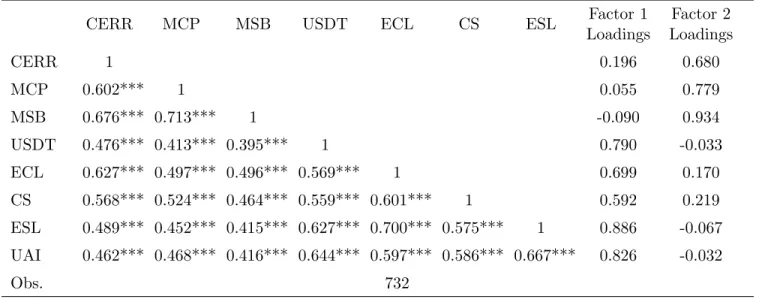
Though FFT was designed so that each subdomain represents a separate aspect of teaching practice, we perform an exploratory factor analysis to determine the number of components that are actually separable in the data. Appendix Table 7 shows the correlations between the different subdomains and the loadings on each subdomain after performing an oblique rotation of the fac-tors.15 This analysis suggests that FFT measures can be divided into two separable broad teaching practices. There are five sub-scales which load heavily on the first factor, including establishing a
culture of learning, communicating with students, engaging students in learning,using assessment
in instruction and using questioning and discussion techniques. These all reflect what we will call
challenge/student-centered practices that encourage classroom dialogue and student involvement.16
13
Of the MET observation protocol, two, FFT, and CLASS are generic protocols designed to apply across instruction in a range of subject-matters. In our view, of these, FFT has the most comprehensive architecture capturing teaching practices.
14
The score assigned to each component ranges between 1 and 4, where each each number refers to a level (1:unsatis-factory, 2:basic, 3:proficient, 4:distinguished). Appendix Table 6 provides a description of each of the sub-components of the FFT protocol.
15
The results reported take the average across raters so that there is one observation per component per teacher. Results are similar if we perform the exploratory factor analysis at the level of the rater or if we use orthogonal rotations. They are also similar if we extract rater fixed effects and video quality prior to performing the factor analysis.
16
The subdomains that load on the second factor arecreating an environment of respect and rapport,
managing student behaviors and managing classroom procedures. We will refer to these as
class-room management practices, as they all relate to teaching practices that lead to a better classroom
environment. Taken together the factors explain 92% of the total variance in the data.17
As a final robustness check, we also implemented confirmatory factor analysis with the aim to establish whether the proposed grouping of the FFT subdomains provides a better fit of the data than alternative models. First, we compare our model with a competing specification in which all the FFT subdomains load in only one latent factor. Second, we test our classification with the grouping that has been predetermined in the FFT protocol (i.e., classroom environment and instruction domains).18 In both cases, the Bayesian information criterion (BIC) indicates that our proposed classification provides a better fit of the data.19 Our empirical strategy will mainly make use of averages across the sub-scales that according to the exploratory factor analysis correspond to each broad practice (i.e., classroom management and challenge/student-centered practices), but we also explore other ways of addressing measurement error, as described in detail in Section 4.20
2.2 Summary Statistics
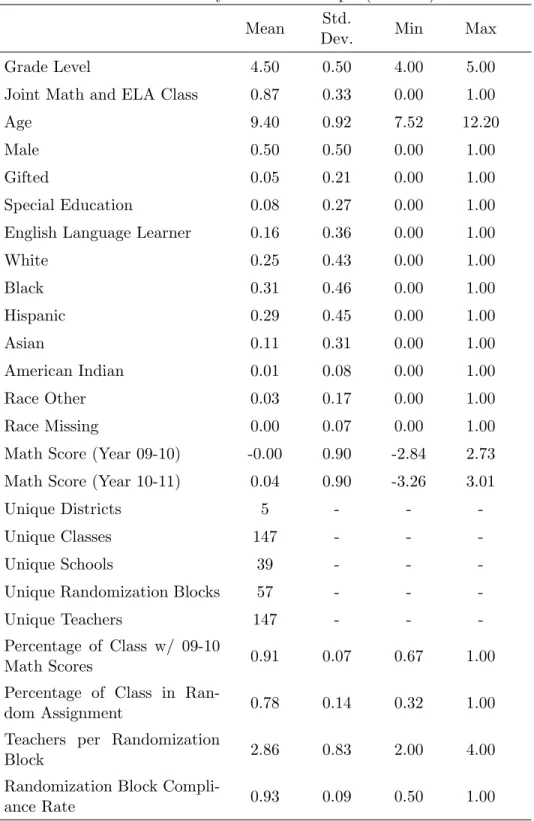
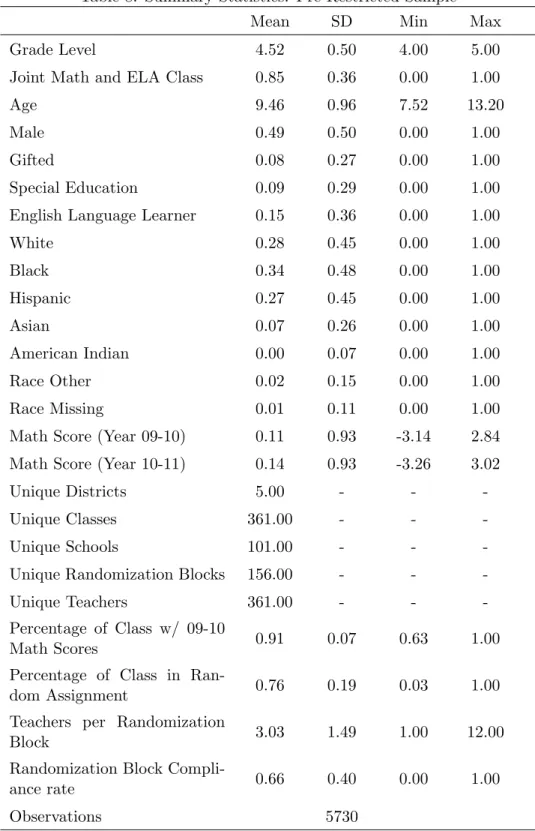
Table 1 reports summary statistics for characteristics of the students in our final sample.21 This is a racially-diverse sample; 31% of students are black, 25% are white, 29% are Hispanic, and 11% are Asian, indicating that the school districts included in our data are not necessarily representative
model items. Many of the FFT domains entail elements of student-centered instruction (e.g., in the engaging students in learning domain,“students identify or create their own materials for learning”). Yet, it is important to note that the FFT protocol is well balanced with “challenge” items (e.g. the first indicator of proficiency in the questioning and discussion techniques sub-domain is “questions of high cognitive challenge” (Danielson, 2011).)
17
An initial exploratory factor analysis shows that there is only one eigenvalue greater than 1, a possible rough rule of thumb for determining the number of factors. However, one factor explains 0.79 of the variation and a second factor explains a substantial additional part, 0.13, which is an additional criteria used to determine the number of factors.
18
Classroom environment includes: environment of respect and rapport, establishing a culture for learning, man-aging student behaviors, and manman-aging classroom procedures. While instruction includes: communicating with students, engaging students in learning, using assessment in instruction, and using questioning and discussion tech-niques.
19
This analysis has been performed using the “confa” command in Stata, which deals with problems of identification in factor models (Kolenikov, 2009).
20
We also replicated our empirical strategy using principal component and following the FFT classification as alternative measures of challenge/student-centered and classroom management practices. Results in all cases are similar.
21
Table 1: Summary Statistics: Sample (N=2632) Mean Std.
Dev. Min Max
Grade Level 4.50 0.50 4.00 5.00
Joint Math and ELA Class 0.87 0.33 0.00 1.00
Age 9.40 0.92 7.52 12.20
Male 0.50 0.50 0.00 1.00
Gifted 0.05 0.21 0.00 1.00
Special Education 0.08 0.27 0.00 1.00 English Language Learner 0.16 0.36 0.00 1.00
White 0.25 0.43 0.00 1.00 Black 0.31 0.46 0.00 1.00 Hispanic 0.29 0.45 0.00 1.00 Asian 0.11 0.31 0.00 1.00 American Indian 0.01 0.08 0.00 1.00 Race Other 0.03 0.17 0.00 1.00 Race Missing 0.00 0.07 0.00 1.00
Math Score (Year 09-10) -0.00 0.90 -2.84 2.73 Math Score (Year 10-11) 0.04 0.90 -3.26 3.01
Unique Districts 5 - -
-Unique Classes 147 - -
-Unique Schools 39 - -
-Unique Randomization Blocks 57 - -
-Unique Teachers 147 - -
-Percentage of Class w/ 09-10
Math Scores 0.91 0.07 0.67 1.00
Percentage of Class in
Ran-dom Assignment 0.78 0.14 0.32 1.00 Teachers per Randomization
Block 2.86 0.83 2.00 4.00
Randomization Block
Compli-ance Rate 0.93 0.09 0.50 1.00
Notes: See Appendix A for a description of how this sample was obtained. Joint Math/ELA Class refers to a self-contained course in which students learn both math and ela, the remaining courses are either math or ela only. We summarize the percent-age of each class w/ prior math test scores since students new to the district will not have prior test scores. We also summarize the percentage of each class in
randomiza-of the whole US population randomiza-of students. The bottom part randomiza-of Table 1 further characterizes the data by displaying the number of districts (5), schools (39), teachers (147), and randomization blocks (57) in our final sample.
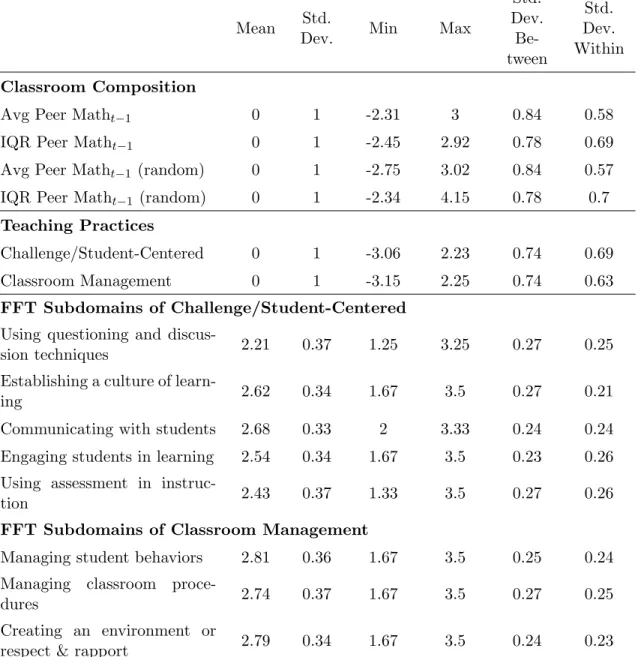
Table 2 displays summary statistics corresponding to the the FFT domains and classroom prior achievement average and inter-quartile range (IQR) in prior achievement.22 The last two columns of Table 2 show standard deviations within and between randomization blocks. We find considerable within-randomization block variation in teaching practice and classroom composition.
3
Model
We motivate here how interactions between teaching practice and peer initial achievement arise through a number of intuitive mechanisms. The simplest model has these interactions arising through the production technology. This makes sense for a number of possible teaching practices. For instance, encouraging classroom discussion would create more of a team production climate where peers matter more for each student’s achievement. Alternatively, for some practices, teacher practice could enter indirectly to the achievement production function through students’ behavioral responses (e.g., engagement, attentiveness). In this case, complementarities would arise if good behavior changes whether students benefit from their peers. For instance, classroom management practices could help ensure the necessary behavior to create a good learning environment. While the production technology channel is straightforward, it is helpful to illustrate the behavioral channel with a simple model. The model also informs the empirical specification we take to the data.23
Let Yit denote achievement of a student i at time t. Let the index ct = c(i, t) denote i’s
classroom in period t and then the vector of classroom peer achievement excluding i is denoted Y−ictt= (Y1t, ..., Yi−1,t, Yi+1,t, ..., YN t). A student’s class has a teacher indexed j =j(i, t) who uses
22
We use IQR (i.e. difference in test score performance between the 75th and 25th percentile students in a given class) to measure classroom heterogeneity rather than standard deviation due to the fact that IQR is less sensitive to the presence of outliers, which is a particular concern in a context where classrooms could be small in size. Nevertheless, our main specifications presented in columns (1) and (2) of Table 5 are robust to replacing IQR with the standard deviation.
23
We take the teaching practice as given in order to focus on student responses. We can identify most convincingly the effects of a fixed or persistent aspect of teaching practice and postpone considering the endogenous response of teachers to the classroom composition in future work.
Table 2: Within and Between-Randomization Block Variation in Classroom Measures
Mean Std.
Dev. Min Max
Std. Dev. Be-tween Std. Dev. Within Classroom Composition
Avg Peer Matht−1 0 1 -2.31 3 0.84 0.58
IQR Peer Matht−1 0 1 -2.45 2.92 0.78 0.69 Avg Peer Matht−1 (random) 0 1 -2.75 3.02 0.84 0.57 IQR Peer Matht−1 (random) 0 1 -2.34 4.15 0.78 0.7
Teaching Practices
Challenge/Student-Centered 0 1 -3.06 2.23 0.74 0.69 Classroom Management 0 1 -3.15 2.25 0.74 0.63
FFT Subdomains of Challenge/Student-Centered
Using questioning and
discus-sion techniques 2.21 0.37 1.25 3.25 0.27 0.25 Establishing a culture of
learn-ing 2.62 0.34 1.67 3.5 0.27 0.21
Communicating with students 2.68 0.33 2 3.33 0.24 0.24 Engaging students in learning 2.54 0.34 1.67 3.5 0.23 0.26 Using assessment in
instruc-tion 2.43 0.37 1.33 3.5 0.27 0.26
FFT Subdomains of Classroom Management
Managing student behaviors 2.81 0.36 1.67 3.5 0.25 0.24 Managing classroom
proce-dures 2.74 0.37 1.67 3.5 0.27 0.25
Creating an environment or
respect & rapport 2.79 0.34 1.67 3.5 0.24 0.23
Notes: The sample size is 2632 and focuses on 2010-11 school year when students were randomly assigned within randomization blocks. Teaching practices are measures in t−1 based on FFT. The last two columns decompose the standard deviation for each variable into between randomization block and within randomization block components.
teaching practice(s) Pj. We begin with a value-added model where achievement production is a
function of prior achievement, some moment of the prior achievement distribution of their time t classmates (m(Y−ictt−1)). We introduce student behavior, bit, which we conceptualize broadly as
behaviors conducive to achievement, such as attentiveness, engagement and/or effort. Achievement production includes direct interactions between teaching practice and classroom composition and the possibility of an indirect channel by allowing the marginal benefits of behavior to vary by the classroom composition, i.e.,
Yit =β0+βbbit+βbybitYit−1+βby¯bitm(Y−ictt−1) +βyYit−1+βy¯m(Y−ictt−1)+
+βpPj0+βpyPj0Yit−1+βpy¯Pj0m(Y−ictt−1) +it, (1)
where it denotes the residual. Note that this form of the achievement production function is
comparable to the classic achievement production function with peer spillovers that is generally the focus of the literature whenm(Y−ictt−1) is equal to average peer prior achievement (Sacerdote,
2011), though it is augmented with controls for measures of teaching practice and teaching practice interacted with peers. This is understood to capture the reduced-form effect of peers, inclusive of both endogenous (effects arising through simultaneity in achievement) and contextual effects (arising through direct spillovers from peer prior achievement). Other models in Appendix B consider potential teacher effects by changing the behavior of both the student and her peers, but we begin here as it is the most straightforward model to connect with the literature.
Students choose their behavior to maximize their expected utility from achievement net of the costs of behavior. To introduce a role for teaching practice in affecting behavior, we also permit that the marginal utility/cost of behavior varies with the practice, i.e.,
Uit=γyYit−
γb
2b 2
it+γbpPj0bit.
Student utility-maximizing behaviorb∗it is then
b∗it= γy γb
(βb+βbyYit−1+βb¯ym(Y−ictt−1)) +
γbp
γb
Behavior is increasing in initial achievement, peer initial achievement and importantly teaching practice. Classroom management practices may affect behavior directly through minimizing op-portunities for disruptive behavior, whereas challenge/student-centered practices might do so by better engaging students in learning.
We cannot estimate (1) directly because we do not observe behavior. Instead, we assume that the achievement we observe in the data is coming through student optimizing behavior. To obtain the achievement production we can take to the data, we plug in for utility-maximizing behavior to obtain the following reduced form
Yit∗= ˜β0+ (βb γbp γb +βp)Pj0+ (βby¯ γbp γb +βpy¯)Pj0m(Y−ictt−1) + (2βby¯βb γy γb +βy¯)m(Y−ictt−1)+ +βb2y¯γy γb m(Y−ictt−1) 2+ (β y+ 2βbyβb γy γb )Yit−1+βby2 γy γb Yit−2 1+ (βby γbp γb +βpy)Pj0Yit−1+ + 2βbyβby¯ γy γb
Yit−1m(Y−ictt−1) +it,
=α0+αpPj0+αpy¯Pj0m(Y−ictt−1) +αy¯m(Y−ictt−1) +α¯y2m(Y−ictt−1)
2+α
yYit−1+αy2Yit−2 1 (2) +αpyPj0Yit−1+αyy¯Yit−1m(Y−ictt−1) +it.
Note that even if βp = βpy = βpy¯ = 0, so that teaching practice does not affect achievement directly and, more importantly, does not have direct complementarities with peer achievement, this specification illustrates how we would also get complementarities from the indirectly behavioral channel. This relies on two intuitive conditions. First, student behavior is affected by practice (βbp 6= 0). Second, the achievement spillovers from peers vary with behavior (βby¯ 6= 0). Note that in this model, the spillovers from peer prior achievement arise both directly through the production technology and indirectly through peer effects on the unobserved behavior of the student coming from the marginal return of behavior varying with peer prior achievement. In Appendix B, we discuss some alternative forms of the behavioral model which could also underlie these complementarities, including popular conformity-style models (Brock and Durlauf, 2001; Epple and Romano, 2010) or the classic treatment of the classroom environment as a congestible public
good (Lazear, 2001).
4
Estimation
Our empirical strategy focuses on estimation of the reduced form model described in equation (2), which relates most closely to models estimated in the literature. We take as a starting point that m(Y−ictt−1) = ¯Y−ictt−1 and expand to include the IQR of the peer initial achievement distribution
in the application, i.e.,
Yit =α0+αpPj0+αp¯yPj0Y¯−it−1+αy¯Y¯−ictt−1+αy¯2Y¯
2
−ictt−1+αyYit−1+αy2Y
2
it−1
+αpyPj0Yit−1+αyy¯Yit−1Y¯−ictt−1+it, (3)
where we assume that observed achievement is a result of students’ utility-maximizing behav-iors. Our main parameter of interest is αp¯y, which captures how the marginal benefits of
teach-ing practices vary with the classroom composition.24 Without loss of generality we set E(Pr) =
E( ¯Y−ictt−1) = E(Yit−1) = 0. Demeaning these variables aids in interpretation of the level terms
αp, α¯y and αy in equation (4) by making them invariant to adding the interaction terms to the
equation while leaving the interactions unchanged.
As discussed above, a unique aspect of these data is that teachers are randomly assigned to rooms within randomization blocks. However, even with random assignment of teachers to class-rooms, several important endogeneity concerns remain. First, there is considerable non-compliance to the random assignment in the data. Largely, this was because assignments are made from pre-liminary rosters before school administrators had a good sense of who would be attending their school. Second, classroom composition may be endogenous as principals were not required to ran-domly assign students to classrooms. Third, teaching practice may still be endogenous even with random assignment because of measurement error. We discuss each of these issues in turn.
24
To simplify exposition, we ignore the role of other student and teacher observables though we include these additional controls in the analysis.
4.1 Non-compliance
Because the data include an indicator of the teacher that was randomly assigned to the stu-dent, we can use standard approaches for dealing with non-compliance, focusing on the variation from the randomly assigned teacher. We focus most of our discussion around the more conserva-tive “intent-to-treat” estimates, which replace the observed teaching practice with the randomly-assigned teaching practice. Let Pr denote the teaching practice of the randomly-assigned teacher,
indexedr =r(i, t), then
Yit =α0+αpPr0+αpy¯Pr0Y¯−ictt−1+αy¯Y¯−ictt−1+αy¯2Y¯
2
−ictt−1+αyYit−1+αy2Y
2
it−1
+αpyPr0Yit−1+αy¯yYit−1Y¯−it−1+αb+ ˜it. (4)
Because teachers are randomly assigned at the randomization block levels, we include randomization block fixed effects αb, where b = b(i, t) indexes randomization blocks. We show that our results
are very similar when we instrument the observed with the randomly-assigned teacher’s teaching practice, and so choose to focus on the intent-to-treat estimates for simplicity.
4.2 Endogeneity of classroom composition
Classroom composition could be endogenous for two reasons. First, the principals were not re-quired to assign classroom composition randomly, though there was incentive to create comparable classrooms within randomization blocks to make the random assignment of teachers to either class-room palatable. Second, non-compliance by students could lead the classclass-room composition to be endogenous even after addressing non-compliance at the teacher-level.
The question is then whether we can identifyαpy¯even though ¯Y−ictt−1is potentially endogenous.
Nizalova and Murtazashvili (2014) show that indeed with randomized control trials that interac-tions of the random treatment with endogenous characteristics are exogenous. Bun and Harrison (2018) expand this and provide weaker conditions for identification.25 The key assumption is that ( ¯Y−ictt−1, it) are jointly independent ofPr, conditional on other controls. This means that
match-25
ing of students to peers based on unobservables does not vary with teaching practice. Thus, the main concern is about potential re-sorting of students after teachers are randomly assigned. We do not believe this poses a threat to identification for several reasons, which we discuss in Section 4.4.
4.3 Measurement error and endogeneity of teaching practice
Recall that we have multiple observations of teaching practice taken from video observations from multiple raters of the teacher both in the initial observational year and in the random assignment year to help deal with potential measurement error in teaching practice. As in Araujo et al. (2016), our preferred approach is to use t−1 measures to capture the teaching practice. This address two related concerns. First, video raters may have difficulty separating the teacher’s practice from the students they are teaching. Second, if teachers change their practice in response to classroom composition, then teaching practice would no longer be exogenous, violating our key identifying assumptions.
Our main strategy relies on the most straightforward approach to measurement by taking simple averages of the measures of practice (Prt−1). To clarify the potential effects of measurement error on our estimates, let the subscriptk capture different observations of the teaching practice, i.e.,
Prkt−1=Pr+urkt−1. (5)
Substituting in the the average measured practice for the true measures, we have
Yit =α0+αpPrt−1+αpy¯Prt−1Y¯−ictt−1+αy¯Y¯−ictt−1+αy¯2Y¯
2
−ictt−1+αyYit−1+αy2Y
2
it−1
+αpyPrt−1Yit−1+αyy¯Yit−1Y¯−ictt−1+αb+νit,
whereνit= ˜it−αpu¯rt−1−αpy¯u¯rt−1Y¯−ictt−1−αpyu¯rt−1Yit−1. Note that as the number of observations
of practice increases, ¯urt−1 goes toward 0, if urkt is mean independent of urk0t fork 6=k0. This is
reasonable in our setting given the use of multiple trained raters to rate the same teacher, leading to arguably independent random draws of rater-related measurement error.26
26
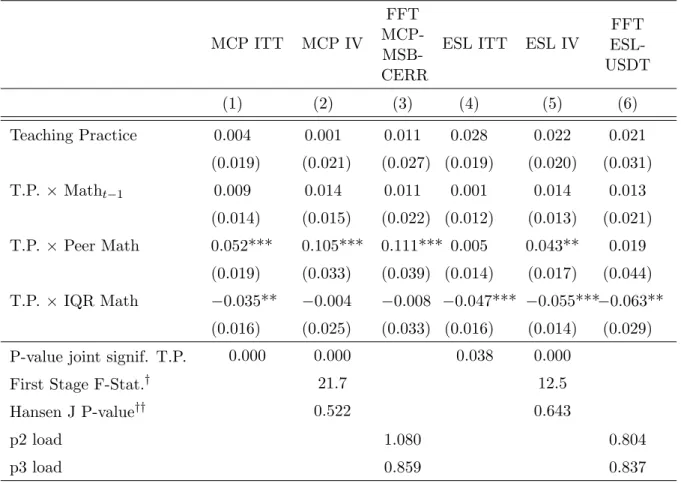
We show results are robust to using principal component analysis to construct our measures (the primary approach we have seen applied in this literature) or factor models to extract the underlying teaching practice from multiple measures as in equation (5). We are also aware of the concern that simply including extracted factors in nonlinear models does not completely deal with measurement error. We adapt the method developed in Hausman et al. (1991) to deal with nonlinear errors in variables models to our setting where the nonlinearity takes the form of interactions. We describe this approach in detail in Appendix C.2. If anything these results imply that our estimates of the interactions are biased toward 0, which is typical of these types of models in the literature (Jaccard and Wan, 1995; Busemeyer and Jones, 1983).
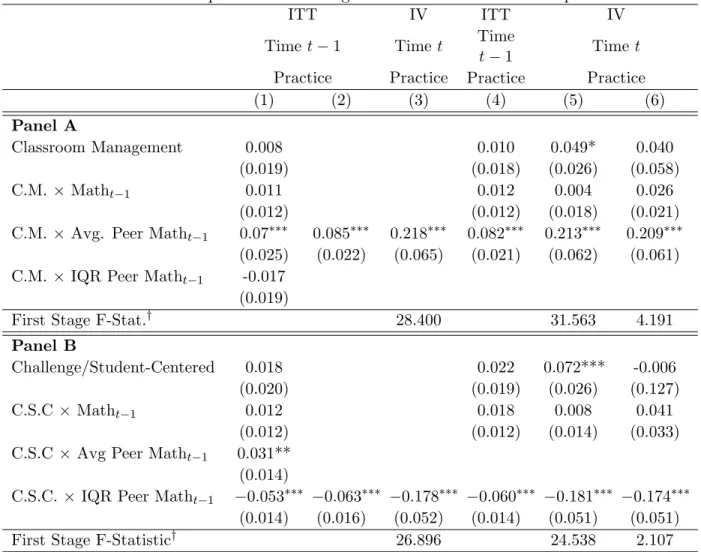
To the extent that practice is time-varying, the focus ont−1 measures may understate the total effect of teaching practice. For time-varying practice, we can extract instead the common compo-nent from the correlation between time t−1 and t practices, which captures a persistent aspect of teaching practice. We discuss in Section 5.3 the findings when we instrument contemporaneous teaching practice with t−1 practices. These results show that if anything our estimation strategy provides conservative estimates of the interaction of practice with classroom composition.
4.4 Testing identifying assumption
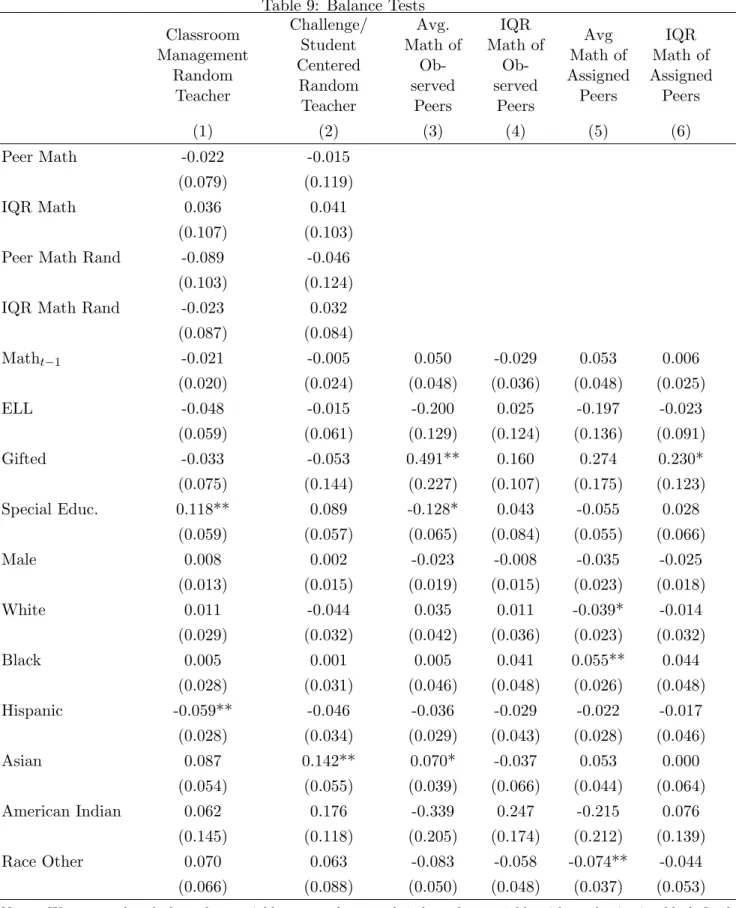
We perform a number of tests to ensure that our key identifying assumption holds. First, we test whether the practice is mean independent of peer characteristics directly by separately regressing randomly assigned teaching practice (based on t−1 averages) on different variables of classroom composition after controlling for randomization block fixed effects.27 Appendix Table 9 presents these balancing tests which show that teaching practice is not correlated with either of our mea-sures of classroom composition, whether we use observed peers or initially-assigned peer. Second, regressions of the randomly-assigned teaching practice on student-level covariates also suggest that random assignment of teachers held. Third, though random assignment to classroom is not needed for identification, Appendix Table 9 also presents balancing tests which regress student characteris-tics on peer characterischaracteris-tics to see if there is evidence of matching in the data. Again, the balancing
systematic rater differences and again results were very similar. 27
test generally supports that there is no matching of students (either using the observed or initially-assigned peers), suggesting that classroom composition does not appear to be endogenous, at least in terms of observables.28 That results of our balancing tests for peer characteristics and teachers are similar in the initially-assigned and observed classroom compositions helps to alleviate con-cerns about students re-sorting after teachers were randomly assigned. We can test further the implications for our estimation if there is some matching based on unobservables that we did not detect with our tests, by replacing the observed peer characteristics with the initially-assigned peer characteristics in our regressions. We show that results are robust to this setting in Section 5.3, alleviating any remaining concerns about potential violations of non-random sorting of students in response to randomly-assigned teachers.
5
Results
To ground our analysis more closely in the literature, we begin with the typical specifications that treat teachers and peers as separable inputs. We then add interactions with classroom composition to show how the significance of measured teaching practices change across these specifications. All estimates include controls for randomization block fixed effects, student characteristics and teacher aptitude, the Content Knowledge of Teaching (CKT) assessment, though results are robust to their exclusion.29 For the endogeneity concerns described in Section 4, we focus the initial analysis on lagged measures of teaching practice, and consider contemporaneous measures in Section 5.3.
5.1 Do Teaching Practices have a Direct Effect on Test Scores?
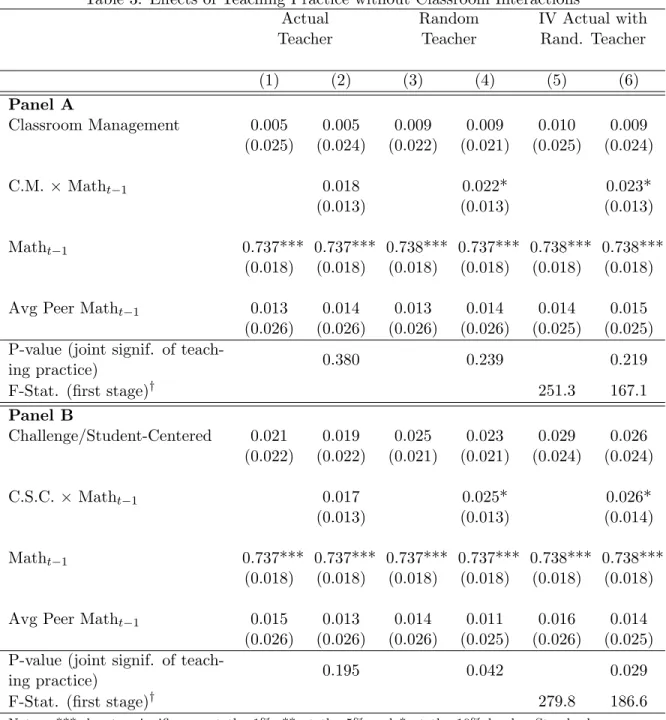
Panels A and B of Table 3 display estimates of the effect of classroom management and challenge/ student-centered practices, respectively on math performance. Even columns allow the effect of teaching practice to vary by a student’s initial achievement. Results in columns (1) and (2) are naive OLS specifications, where the lagged teaching practice of the current teacher (Pjt−1) is the
28
We find 3 out of 22 coefficients to be statistically significantly different from 0 at the 0.1 level, which is less than expected by chance.
29
See MET project (2010a) and footnote 10 for a description of this teacher assessment. The controls help with standard errors but do not matter for consistency because of the random assignment of treatment.
variable of interest. Columns (3) and (4) report intent-to-treat (ITT) estimates, replacing Pjt−1 with the teaching practice of the randomly-assigned teacher (Prt−1). Columns (5) and (6) present treatment on the treated (TT) results wherePjt−1 is instrumented withPrt−1.
Given the breadth of the measures, it is perhaps surprising that none of the specifications (in both panels) show that the level of teaching practices play a statistically significant role in math performance.30 However, these results are consistent with the findings in Garrett and Steinberg (2015), where the average of all FFT measures do not seem to have a direct impact on students’ per-formance in their ITT and IV specifications.31 In a similar vein, while interactions of student prior achievement with classroom management or challenge/student-centered practices are statistically significant in ITT and IV specifications, F-tests (reported at the bottom of each panel) show that the coefficients associated with these practices are in many specifications not jointly significant. At first glance, these findings suggest that our constructs of teaching practice may not capture an aspect of teaching practice that is meaningful for math performance. However, the next section shows that these conclusions are misleading when we build in complementarities between teaching practice and peers.
5.2 Teaching Practice and Classroom Composition
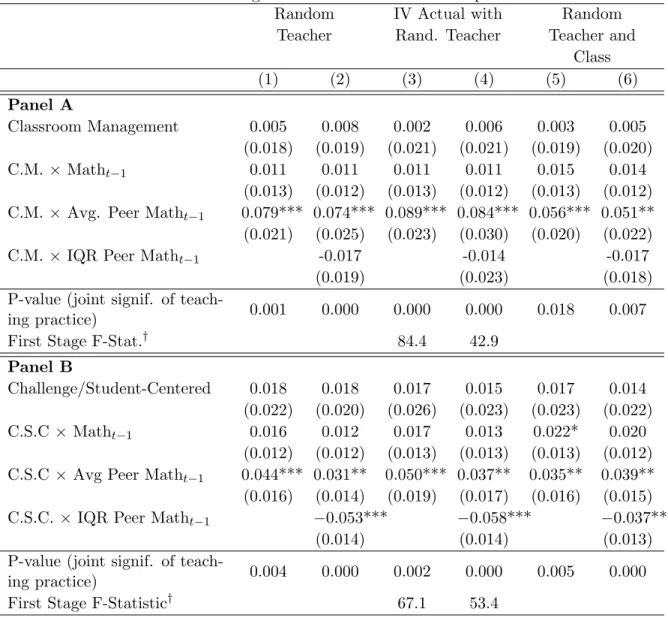
We expand the previous analysis by fully estimating equation (3), including interactions between classroom composition and teaching practice. Panels A and B of Table 4 present results for class-room management and challenge/student-centered practices, respectively. Odd columns accommo-date models where average peer prior achievement is interacted with teaching practice (in addition to student prior achievement), while even columns additionally control for classroom interquartile range and its interaction with teaching practice.32 Columns (1) and (2) report ITT results (i.e. Pjt−1 is replaced with Prt−1 as per equation (4)). Columns (3) and (4) report TT estimates where Pjt−1 is instrumented with Prt−1.
30
These results also holds if instead of using averages of the sub-domains, we consider a principal component approach or the Hausman et al. (1991) econometric strategy described in Appendix C.2.
31
We also performed ITT specifications where average of all FFT measures are included as a regressor (instead of the subdomains). Our results also show that there is no direct impact of average FFT on student achievement.
32
Table 3: Effects of Teaching Practice without Classroom Interactions
Actual Random IV Actual with Teacher Teacher Rand. Teacher
(1) (2) (3) (4) (5) (6) Panel A Classroom Management 0.005 0.005 0.009 0.009 0.010 0.009 (0.025) (0.024) (0.022) (0.021) (0.025) (0.024) C.M.× Matht−1 0.018 0.022* 0.023* (0.013) (0.013) (0.013) Matht−1 0.737*** 0.737*** 0.738*** 0.737*** 0.738*** 0.738*** (0.018) (0.018) (0.018) (0.018) (0.018) (0.018) Avg Peer Matht−1 0.013 0.014 0.013 0.014 0.014 0.015
(0.026) (0.026) (0.026) (0.026) (0.025) (0.025) P-value (joint signif. of
teach-ing practice) 0.380 0.239 0.219
F-Stat. (first stage)† 251.3 167.1
Panel B Challenge/Student-Centered 0.021 0.019 0.025 0.023 0.029 0.026 (0.022) (0.022) (0.021) (0.021) (0.024) (0.024) C.S.C. ×Matht−1 0.017 0.025* 0.026* (0.013) (0.013) (0.014) Matht−1 0.737*** 0.737*** 0.737*** 0.737*** 0.738*** 0.738*** (0.018) (0.018) (0.018) (0.018) (0.018) (0.018) Avg Peer Matht−1 0.015 0.013 0.014 0.011 0.016 0.014
(0.026) (0.026) (0.026) (0.025) (0.026) (0.025) P-value (joint signif. of
teach-ing practice) 0.195 0.042 0.029
F-Stat. (first stage)† 279.8 186.6
Notes: *** denotes significance at the 1%, ** at the 5% and * at the 10% levels. Standard errors are clustered at the randomization block level. Panel A and B correspond to different regressions with math as the dependent variable. Lagged teaching practices are used and sample size is 2632. These regressions include randomization block fixed effects and controls for the level and a squared term of prior math achievement and average peer prior achievement, as well as CKT and student characteristics listed in Table 1. †Reports the Kleibergen-Paap rk Wald statistic for a weak instrument test.
Panel A shows that classrooms benefit more from higher average peer initial achievement when the teacher uses good classroom management practices, which is consistent with the mechanisms discussed in our model. For example, ITT and TT results show that a one standard deviation increase in classroom management increase test scores around 7.4% to 8.9% of a standard deviation when peer average prior year performance is one standard deviation above the mean. In contrast, the even columns show that the effectiveness of classroom management practices does not vary significantly with the IQR in classroom prior achievement. On the one hand, these results have the intuitive interpretation that a student cannot benefit from higher-achieving peers if the teacher does not have good classroom management practices, which would foster positive classroom behaviors. On the other hand, it could be expected that classroom management practices are more effective among low-achieving students. Instead, our finding is consistent with the understanding that classroom management is also an important challenge in higher-achieving classrooms, though the sources of disengagement may be different from in lower-achieving classrooms (Shernoff et al., 2003). Furthermore, consistent with the results in Table 3, the level effects of classroom manage-ment practices are still not statistically significantly different from 0 and point estimates are small. Moreover, the interactions between classroom management and student’s prior achievement become statistically insignificant in most specifications, suggesting that failure to account for complementar-ities with classroom composition may lead to stronger conclusions about student-level heterogeneity in the effects of teaching practice. A further notable change is that classroom management emerges as a jointly statistically significant predictor of test performance when interacted with average peer prior achievement at the 99% confidence level in most specifications.
Panel B shows results for challenge/student-centered practices. Generally, we find that classes with higher average initial achievement also benefit more for challenge/student-centered practices. However, the benefits of challenge/student-centered practices are smaller in classrooms with higher IQR in initial achievement. A standard deviation increase in this practice leads to a 5 to 6% reduction in achievement for classrooms that are a standard deviation above average IQR. Like in the case of classroom management, the level effect of challenge/student-centered practices are not statistically significantly different from 0 and neither are the interactions with initial
achieve-ment, after controlling for interactions with classroom composition. Furthermore, joint tests also confirm that challenge/student-centered practices emerge as statistically significant predictors of achievement at the 99% confidence level after permitting heterogeneity by classroom composition. In summary, the findings in Table 4 provide four main messages.33 First, teaching practices seem to show significant complementarities with classroom characteristics, ranging in magnitude from 3% to 8.9% of a standard deviation increase in math, for a standard deviation increase in teaching practice in a class that is one standard deviation above the mean in prior performance. We view these estimates as sizable given that some of the larger estimates of a standard deviation increase in teacher value-added on math scores range from 0.11 to 0.16 (Chetty et al., 2014). A standard finding in the literature is that the first two years of teacher experience, where experience effects are largest, increase student performance by only 0.06 of a standard deviation (Ladd and Thompson, 2008).
Second, failure to account for complementarities with classroom composition lead us to un-derstate the importance of these teaching practices. Third, student-level heterogeneity in ef-fects of teaching practice appear less relevant after accounting for the complementarities with classroom composition. Finally, the contrasting evidence between classroom management and challenge/student-centered practices also points to the importance of considering these measures separately, i.e., a single measure of teaching quality, the focus in the literature, does not fit the findings when we allow for classroom context to moderate effects. We return to explore this in more detail in Section 6.
5.3 Robustness
Endogeneity of classroom composition Given that teachers are randomly assigned to class-rooms and that we focus ont−1 practices, a primary remaining endogeneity concern, as discussed in Section 4, is potential resorting of students to classrooms based on the teacher who is randomly
33
We also performed similar regressions on a broader sample to test to what extent our sample restrictions described in Appendix C.1 are affecting our results. If instead we restrict the data to: a) fourth and fifth grade students who were randomly assigned a teacher, b) both a student’s actual and randomly assigned teacher have non-missing year 1 teaching practice measures, c) students have non-missing test scores in both years, and d) keep randomization blocks with at least a 25% compliance rate, leads to a sample of 4086 students. This larger sample provides very similar results to those reported in columns (3) and (4) of Table 4.
Table 4: Teaching Practice and Classroom Composition
Random IV Actual with Random Teacher Rand. Teacher Teacher and
Class (1) (2) (3) (4) (5) (6) Panel A Classroom Management 0.005 0.008 0.002 0.006 0.003 0.005 (0.018) (0.019) (0.021) (0.021) (0.019) (0.020) C.M.× Matht−1 0.011 0.011 0.011 0.011 0.015 0.014 (0.013) (0.012) (0.013) (0.012) (0.013) (0.012) C.M.× Avg. Peer Matht−1 0.079*** 0.074*** 0.089*** 0.084*** 0.056*** 0.051** (0.021) (0.025) (0.023) (0.030) (0.020) (0.022) C.M.× IQR Peer Matht−1 -0.017 -0.014 -0.017
(0.019) (0.023) (0.018)
P-value (joint signif. of
teach-ing practice) 0.001 0.000 0.000 0.000 0.018 0.007
First Stage F-Stat.† 84.4 42.9
Panel B
Challenge/Student-Centered 0.018 0.018 0.017 0.015 0.017 0.014 (0.022) (0.020) (0.026) (0.023) (0.023) (0.022) C.S.C×Matht−1 0.016 0.012 0.017 0.013 0.022* 0.020
(0.012) (0.012) (0.013) (0.013) (0.013) (0.012) C.S.C×Avg Peer Matht−1 0.044*** 0.031** 0.050*** 0.037** 0.035** 0.039** (0.016) (0.014) (0.019) (0.017) (0.016) (0.015) C.S.C. ×IQR Peer Matht−1 −0.053*** −0.058*** −0.037***
(0.014) (0.014) (0.013)
P-value (joint signif. of
teach-ing practice) 0.004 0.000 0.002 0.000 0.005 0.000 First Stage F-Statistic† 67.1 53.4
Notes: *** denotes significance at the 1%, ** at the 5% and * at the 10% levels. Standard errors are clustered at the randomization block level. Sample size is 2632. Lagged teaching practices are used throughout; columns (5) and (6) control for characteristics of initially randomly assigned peers. Panel A and B correspond to different regressions with math as the dependent variable. These regressions include randomization block fixed effects and controls for the level and a squared term of prior math achievement and average peer prior achievement, as well as CKT and student characteristics listed in Table 1. Even columns also include the IQR in peer prior achievement. Whenever peer variables are included we also include their square, and all pairwise interactions of peer variables and prior achievement. †Reports the Kleibergen-Paap rk Wald statistic for a weak instrument test.
assigned. Balancing tests reported in Section 4.4 already suggest that this is not the case, in that observable student and peer characteristics are not correlated with the randomly-assigned teacher’s practice. However, given that we observe the students who were initially randomly assigned to the teacher, we can also test whether estimates of the interaction are systematically different if we re-place actual peers with randomly-assigned peers. These estimates are reported in columns (5) and (6) of Table 4. Interactions between classroom composition and teaching practice are not statisti-cally significantly different from their comparable estimates in columns (1) and (2), though smaller in magnitude. This is consistent with a slight downward bias in columns (5) and (6) generated from random measurement error in peers.
Contemporaneous teaching practice One implication of focusing on lagged measures of teach-ing practice is that our estimates of the interactions between classroom composition and teachteach-ing practice may understate the true effects. While we prefer focusing on these conservative estimates because of concerns about the endogeneity of contemporaneous teaching practice, we also explore how the interactions of teaching practice with classroom composition change when we instrument for contemporaneous teaching practices with lagged teaching practices. These results are presented in Appendix table 10 and discussed in detail in Appendix C.1. We show that interactions between teaching practice and classroom composition remain robust, but (as expected) are significantly larger in magnitude.
Measurement error in teaching practice An additional concern with our findings is to what extent our results (e.g. lack of significance in the level of the teaching practice measures) are affected by problems of measurement error in our key teaching practice variables. In order to address this point, we implement a measurement error correction strategy that follows Hausman et al. (1991). This approach is more convenient than the usual IV strategy that accounts for error in variables, because the variables of interest enter non-linearly into our model and we are over-identified by having more than 2 measures of each practice. In appendix C.2, we provide a description of how we adapt the Hausman et al. (1991) method to our context, and describe results obtained after implementing it. For completeness, we also report results when performing IV corrections (i.e.
instrumenting one of the measures that corresponds to a given teaching practice with the remaining measures of that teaching practice). Overall, the findings indicate that our current strategy of taking averages of the teaching practice variables provides similar results to strategies that correct for measurement error following these alternative approaches. The level effects and interactions with initial achievement remain close to 0, but the interactions with classroom composition increase slightly after correcting for measurement error.
Aggregation We also consider whether our aggregation of the 8 subdomains into 2 separable components masks important heterogeneity. Appendix Table 12 shows that similar findings hold when we consider the 8 different subdomains. The estimates, while still significant, are generally smaller in magnitude as would be expected due to increased measurement error.34
6
Mechanisms
6.1 Teaching Practice vs. Teacher “Quality”
While the previous section provides compelling evidence that teacher effectiveness varies by class-room composition, we now explore the extent to which classclass-room-management and challenge/student-centered practices may proxy for similar aspects of teacher effectiveness and/or whether more stan-dard, unidimensional measures of teacher quality are the primary channel through which our teacher effectiveness measures operate. For instance, teachers who have better classroom management prac-tices may also engage in more challenge/student-centered pracprac-tices; therefore not including both domains in the same specification may bias our estimates. This exploration raises a number of interesting questions. To be clear, there is no consensus on how teaching quality should be mea-sured, and FFT was designed to capture different aspects of effective teaching. This means that in some ways classroom management and challenge/student-centered practices are in fact measures of quality. Furthermore, the fact that classroom-management and challenge/student-centered prac-tices interact differently with classroom composition already suggests that a single unidimensional quality may not be correct. Yet, we have other relevant unidimensional scales of quality, such as
34
the Content Knowledge for Teaching assessment, as well as principal and student surveys, which we consider here.
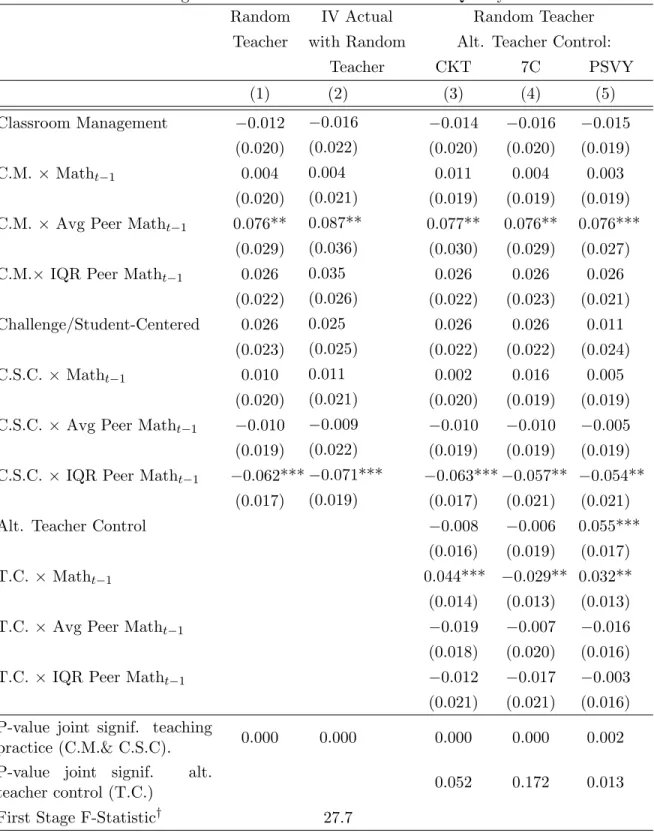
In order to address these key points, Table 5, Columns (1) and (2) present ITT (i.e. Pjt−1 is replaced with Prt−1) and IV (i.e. Pjt−1 is instrumented with Prt−1) results from a model that simultaneously controls for classroom management and challenge/student-centered practices and their interactions with peer composition. These results show that interactions of classroom man-agement with the average peer initial achievement are robust, but seem to explain the interaction of challenge/student-centered practices with the average peer initial achievement in the previous tables because of strong correlations between these two practices. In contrast, interactions of challenge/student-centered practices with the IQR in peer initial achievement remain robust.35 Fi-nally, in comparing the results in Tables 4 and 5 we see that key classroom composition interactions become stronger when both teaching practices are included in a single specification. This suggests that if there is a bias in our interactions from omitted teaching practice/quality, it is leading us to understate the true complementarity with classroom composition.
Columns (3) to (5) of Table 5 report results from ITT specifications similar to column (1) where we additionally include different proxies for overall teacher “quality” and their interactions with classroom characteristics.36 First, we included teacher performance in the Content Knowledge for Teaching (CKT) assessment interacted with classroom characteristics. Second, we included the teacher’s lagged average score on student assessments from the TRIPOD survey. TRIPOD as-sesses the extent to which students experience the classroom environment as engaging, demanding, and supportive of their intellectual growth.37 Finally, we included school principal evaluations on teachers performance which are reported in the MET database.38 These results show that across all specifications our key interactions between teaching practices and classroom composition
re-35
Appendix tables 13, 14, and 15 report all the parameters of these specifications. 36
Notice that in all previous specifications, we were controlling for a measure of teacher aptitude (i.e. CKT), but it was not interacted with classroom characteristics. We cannot control for the usual measures of teacher value-added (i.e. adjusted random effects) because these models inherently neglect the presence of classroom-teacher interactions.
37
Tripod is a protocol that measures teacher effectiveness based on student surveys. See Kane and Staiger (2012) for a description of this tool and the importance for predicting teacher value-added.
38
The fact that our specifications include randomization blocks (which in this case are school-grade fixed effects) should account for systematic difference in principals’ reporting.
main significant, and the size of these coefficients is very similar to our previous specifications.39 Furthermore, we see that these alternative measures of “quality” do not interact with peer average initial achievement and IQR in the same way as our two practices. This is true despite CKT and principal surveys being statistically significant predictors of math achievement. In contrast to our practice measures, these show statistically significant heterogeneity in effects by the student’s ini-tial achievement, suggesting that “quality” as measured through CKT and principal assessments matters more for better students.
6.2 Class size
Because IQR is correlated with class size, an interesting question is whether interactions of chal-lenge/ student-centered practices are driven by larger class sizes. We test this by adding interactions of classroom management and challenge/student-centered with class size to column (1) of Table 5. We do not include these results as we find no evidence that either practices interacts with class size. Furthermore, positive interactions of classroom management and average peer prior achievement and negative interactions of challenge/student-centered practices with the IQR remain robust, and if anything increase in magnitude with the additional controls.
7
Evaluating Teachers
The development of teacher evaluation protocols have been at the core of the education policy debate in recent decades. For example, policymakers in the US have widely implemented account-ability programs that intended to reward or punish teachers based on students gains in achieve-ment.40 More recently, schools have also incorporated classroom observation protocols like FFT to further assess teachers. For example, in 2012, the New Jersey Legislature passed the TEACHNJ Act, which mandated implementation of a new teacher evaluation system starting in the 2013 -2014 school year and links tenure decisions to evaluation ratings. In response to this mandate, New
39
Specifications than include teacher experience (as an alternative teacher control) and its interactions with class-room and students characteristics provide almost identical results to those reported in columns (3)-(5) of Table 5.
40
For example, North Carolina implemented the ABCs (Accountability for Basic skills and for local Control) program in 1997, and the US federal government developed the NCLB (No Child Left Behind) program in 2002.
Table 5: Teaching Practices and Alternative Teacher “Quality” Controls Random IV Actual Random Teacher
Teacher with Random Alt. Teacher Control:
Teacher CKT 7C PSVY (1) (2) (3) (4) (5) Classroom Management −0.012 −0.016 −0.014 −0.016 −0.015 (0.020) (0.022) (0.020) (0.020) (0.019) C.M.× Matht−1 0.004 0.004 0.011 0.004 0.003 (0.020) (0.021) (0.019) (0.019) (0.019) C.M.× Avg Peer Matht−1 0.076** 0.087** 0.077** 0.076** 0.076***
(0.029) (0.036) (0.030) (0.029) (0.027) C.M.×IQR Peer Matht−1 0.026 0.035 0.026 0.026 0.026
(0.022) (0.026) (0.022) (0.023) (0.021) Challenge/Student-Centered 0.026 0.025 0.026 0.026 0.011
(0.023) (0.025) (0.022) (0.022) (0.024) C.S.C. ×Matht−1 0.010 0.011 0.002 0.016 0.005
(0.020) (0.021) (0.020) (0.019) (0.019) C.S.C. ×Avg Peer Matht−1 −0.010 −0.009 −0.010 −0.010 −0.005 (0.019) (0.022) (0.019) (0.019) (0.019) C.S.C. ×IQR Peer Matht−1 −0.062***−0.071*** −0.063***−0.057** −0.054**
(0.017) (0.019) (0.017) (0.021) (0.021) Alt. Teacher Control −0.008 −0.006 0.055***
(0.016) (0.019) (0.017)
T.C.×Matht−1 0.044*** −0.029** 0.032**
(0.014) (0.013) (0.013) T.C.×Avg Peer Matht−1 −0.019 −0.007 −0.016 (0.018) (0.020) (0.016) T.C.×IQR Peer Matht−1 −0.012 −0.017 −0.003 (0.021) (0.021) (0.016) P-value joint signif. teaching
practice (C.M.& C.S.C). 0.000 0.000 0.000 0.000 0.002 P-value joint signif. alt.
teacher control (T.C.) 0.052 0.172 0.013
First Stage F-Statistic† 27.7
Notes: *** denotes significance at the 1%, ** at the 5% and * at the 10% levels. Standard errors are clustered at the randomization block level. Sample size is 2632. Dependent variable is math and teaching practices are measured at t−1. Regressions use lagged teaching practice of current teacher and include randomization block fixed effects and controls for the level and a squared term of prior math achievement and average and IQR of peer prior achievement, their square and all pairwise interactions of peer variables and prior achievement, as well as student characteristics listed in Table 1. †Reports the Kleibergen-Paap rk Wald statistic for a weak instrument test. CKT denotes Content Knowledge for Teaching assessment,7C
denotes overall student survey teacher ratings based on Tripod and PSVY denotes principal assessments
Jersey has developed the program AchieveNJ that relies on classroom observation protocols such
as FFT to evaluate teachers.41
Due to the increasing availability of data to evaluate teachers (e.g. value-added measures), many scholars have highlighted the benefits of replacing the least effective 5% to 7% of teachers with average teachers (Chetty et al., 2014; Hanushek, 2011). However, these exercises in evaluating teachers and determining rankings rely crucially on the assumption that teacher effectiveness can be isolated from classroom characteristics. Our findings of a statistically significant complemen-tarity between teaching practices and classroom composition suggest that the estimated teacher contributions will depend on classroom composition. To further quantify the relevance of these complementarities within the context of our empirical strategy, we implemented different simula-tion exercises that aim to determine how rankings of teacher contribusimula-tions to learning vary when teachers are re-allocated into different classrooms.
We focus on our estimates in column (5) of Table 5 to create, based on our measures of teaching practices, a measure for teacher contribution to learning. We choose these estimates because they include a role for overall teacher quality through principal surveys, which is shown to have a direct effect on math achievement and so offers a useful anchoring of our two FFT practices, which do not have a statistically significant direct effect. We define the teacher contribution as
ˆ T Cj = 1 Nj Nj X i=1 ( ˆαpPj0+ ˆαpy¯Pj0Yit−1+ ˆαpyPj0Y¯ctt−1+ ˆαpIPj0IQRctt−1),
where IQRctt−1 denotes the interquantile range of the classes prior achievement, Nj denotes the
class size for teacherj,αpI the related coefficient estimate andPj is a vector of classroom
manage-ment practices, challenge/student-centered practices (using the average prior measures as discussed above) and the principal’s evaluation of teacher quality. We explore two different thought experi-ments to understand the magnitude of the effects.
First, consider a teacher whose classroom management, challenge/student-centered and princi-pal evaluation are all one standard deviation above average. Giving this teacher a classroom that
41
Teacher practice accounts for 55% of the teacher evaluations. The following link provides the list of approved teacher practice evaluation instruments used in New Jersey: https://www.nj.gov/education/AchieveNJ/teacher/ approvedlist.pdf