1877-0428 © 2015 The Authors. Published by Elsevier Ltd. This is an open access article under the CC BY-NC-ND license (http://creativecommons.org/licenses/by-nc-nd/4.0/).
Peer-review under responsibility of the Sakarya University. doi: 10.1016/j.sbspro.2015.01.577
cTrakya University Faculty of Engineering,EDIRNE 22030 Turkey
Abstract
Applied training is important in mechatronics engineering, a multidisciplinary science. Laboratory practice should be done theoretical training to be efficient. Expert trainers are required for mechatronics education which is a complex science. In this study, a network infrastructure is made for education and control of modular production system which is a mechatronics system. The structure was applied to mechatronics laboratory where is Trakya University İpsala Vocational School. In this way, an educator will provide the education of trainees, from any location with internet. Also, a modular production system can be controlled remotely.
© 2015 The Authors. Published by Elsevier Ltd.
Peer-review under responsibility of the Sakarya University.
Keywords: Mechatronics Systems Education, Remote Access for Education
1.Introduction
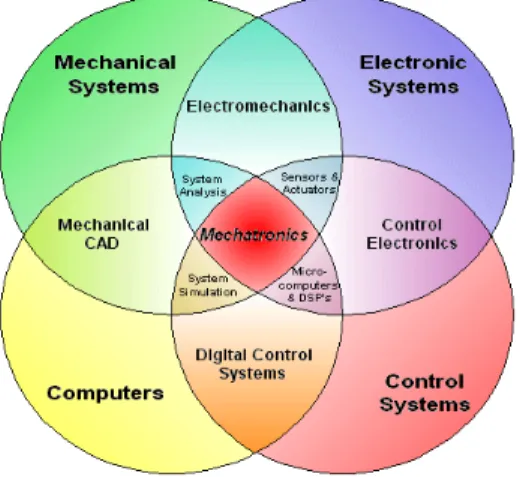
Mechatronics is a design process that includes a combination of mechanical engineering, electrical engineering, telecommunications engineering, control engineering and computer engineering(Department, 2011; Faculty of Mechatronics, 2011). Mechatronics Systems Structure shown in Figure 1. Mechatronic systems consist of mechanical and electronic piece. These systems detects around with using sensors and with the software installed on controls the actuator(Auslander, 1996; Bishop, 2006; Bradley, Dawson, Burd, & Loader, 1991). With the advances in technology, these systems are continuously developed. The development of mechatronic systems can be software or hardware; such a programmable logic controllers (PLC), human machine interface(HMI) sensor or actuator.
* Corresponding author. Tel.: +90-505-783-6611; fax: +90-284-616-3534.
E-mail address: [email protected]
© 2015 The Authors. Published by Elsevier Ltd. This is an open access article under the CC BY-NC-ND license (http://creativecommons.org/licenses/by-nc-nd/4.0/).
Fig. 1. Mechatronics Systems Structure
For the implementation of these changes to the system or to teach students, need to get support. Educators must be experts in the field for hardware and software training. In this study, an infrastructure has established to get help when needed from expert educators. With this infrastructure, over the internet from anywhere educators will be able to practical training in the laboratory. At the same time, control of the system in the laboratory can be done remotely, too. Educators will be able to tell lessons, visual and audible via projection, to students in the laboratory.
With the growth of internet in recent years, many studies are being conducted in the remote-access laboratory. Some of them; For phase-aided 3D microscopic imaging and metrology laboratory has been set up remote access(Wang et al., 2014). This study was made of the animation of laboratory equipment in remotely (Schulz, Chen, & Payne, 2014). In addition to remote access labs are carried out several studies on management and training (Maiti, Maxwell, & Kist, 2014; Pearson, 2014; Schauer et al., 2014). Remote accesses to the lab for different educational subjects are provided (Soares, Leão, Carvalho, Vasconcelos, & Costa, 2014).
In this study; from the training set used in laboratory is discussed in Chapter 2. Established network infrastructure in the laboratory is discussed in Chapter 3. Application notes are discussed in Chapter 4. In Chapter 5, results and evaluation are discussed.
2.Mechatronics systems
In this study, provided remote access and control of mechatronic systems, is located in Trakya University Ipsala Vocational School Mechatronic Laboratory. The system consists of six different stations. Stations respectively are distribution station, testing station, electrical handling station, processing station, pneumatic handling station and sorting station. The stations are shown in figure 2. All stations are a demonstration of the production system. The system is flexible and be programmed. Therefore it is called modular production system (MPS). Each station can operate independently of each other. The software can be designed to operate fully automatically. Each station has Siemens S7-1200 PLC. The transactions at stations are perceived by various sensors. Thereby data collected in the PLC, Output elements are controlled. Also there are five computers, six HMI and a projector in the laboratory. PLCs and HMIs communication protocol are Industrial Ethernet. All of the devices to communicate with each other and wi-fi access point switches are used. Established network is described in chapter 3. In this study, all six stations and HMIs can be accessed from a remote location with Internet. The students in the laboratory, practical software and station information, how it works, can be given by educators in remote locations.
Fig. 3. Computer and HMI Station
3.Remote access infrastructure
Industrial devices in the mechatronics laboratory are communicating via Industrial Ethernet protocol. Four of the computers can communicate with both Ethernet and wireless Wi-Fi. These computers are bridged Ethernet and WiFi connections. Last one computer can communicate via only Ethernet. Switches are used for cable communication. There are there four port switches in system. There is one access point, which has four ports, for Wi-Fi communication. The access point's WAN port is connected to the Trakya University network. The access point gives IP over DHCP to the devices in the laboratory. A fixed IP is given industrial devices to avoid IP conflicts. All other devices are given an IP address automatically. University and laboratory IP address is configured as different from each other. All network infrastructure diagrams are shown in Appendix 1.
4.Application
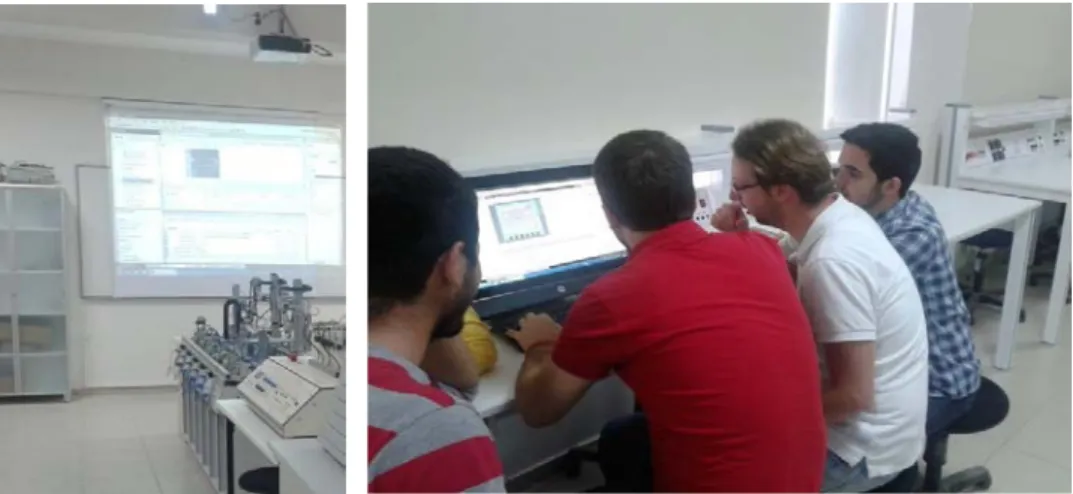
Remote access to all devices maintained in the laboratory is provided on the internet with the network connection established. Permitted persons can update the firmware of the device. In the laboratory, a computer that can connect remotely and online video lectures can be made. Images of training in the laboratory are shown in Figure 4.
In this study, two different distance education methods have been tried. The first of them; with the help of the Team Viewer program by making a remote connection is made lectures and station control. Team Viewer has set up a remote desktop connection to the computer in lab. Students with the help of the projector and speaker can follow the course. Education makes lectures over the internet thanks to Skype program. Students are able to follow the online course from their own computer or projector. Educators know the IP address of the station is able to remotely access and control hardware. Both methods were remotely practical lectures.
(a) (b)
Fig. 4. (a) Stations and Projection Image (b) Students follow courses
5.Results and discussion
Mechatronic systems, known as of intelligent systems, are constantly evolving. Development can be hardware or software. The systems to perform the training, expert trainers are required. In this study, for remote education of mechatronic systems network infrastructure has been established. Remote access to the Trakya University Ipsala Vocational School Mechatronic Laboratory is provided with this infrastructure. Training and control can be done making connection to devices in laboratory with remote access. Training is provided in two different ways. One of them; video conference had established a remote desktop connection is made with the program. The second method; educators in remote locations to connect are provided with IP access to the laboratory. Either method, away from the laboratory via the Internet by connecting the educators gave practical training.
In this study, remote access infrastructure for mechatronics laboratory has been established. By designing a new interface, a link can be established more professional. At the same time, this infrastructure is the infrastructure of remote practical laboratory training.
Whiteboard Door 192.168.0.34 192.168.0.32 192.168.0.54 192.168.0.35 192.168.0.101 192.168.0.102 192.168.0.105 192.168.0.112 192.168.0.108 192.168.0.109 192.168.0.32 192.168.0.31 192.168.0.51 192.168.0.50 192.168.0.10 192.168.0.30 Net Mask: 255.255.255.0 Gateway: 192.168.0.1 DNS1 :193.255.140.17 DNS2 :193.255.141.17 PLC PLC PLC PLC PLC PLC PLC HMI HMI HMI HMI HMI HMI Bridge Ethernet+Wifi Bridge Ethernet+Wifi LAN RJ45 DHCP Switch Switch Switch Modem Wfi+Switch+WAN MKT-101 MKT-104 MKT-100 HMI-03 HMI-02 HMI-04 HMI-01 HMI-Asansor Asansor-PLC HMI-MPS Sorting Station Testing Station Distribution Station Electrical Handling Station
Processing Station Pneumatic Handling Station
References
Auslander, D. M. (1996). What is mechatronics? Mechatronics, IEEE/ASME Transactions on, 1(1), 5-9. Bishop, R. H. (2006). The Mechatronics Handbook, -2 Volume Set: CRC Press.
Bradley, D. A., Dawson, D., Burd, N., & Loader, A. (1991). What is mechatronics? : Springer.
Department, M. a. M. E. (2011). "What is Mechatronics Engineering?". Retrieved 30 May 2011, from http://www.mme.uwaterloo.ca/undergrad/mechatronics/prospective/prospective.html
Faculty of Mechatronics, I. a. I. S. T. (2011). "Mechatronics (Bc., Ing., PhD.)". Retrieved 15 April 2011, from http://mechatronics.tul.cz/ Maiti, A., Maxwell, A. D., & Kist, A. A. (2014). Features, Trends and Characteristics of Remote Access Laboratory Management Systems.
International Journal of Online Engineering (iJOE), 10(2), pp. 30-37.
Pearson, T. R. (2014). A Low-Cost Full-Featured Extensible Laboratory For Online Hardware Engineering. International Journal of Online Engineering (iJOE), 10(3), pp. 24-30.
Schauer, F., Krbecek, M., Beno, P., Gerza, M., Palka, L., & Spilakova, P. (2014). REMLABNET-open remote laboratory management system for e-experiments. Paper presented at the Remote Engineering and Virtual Instrumentation (REV), 2014 11th International Conference on. Schulz, M., Chen, F., & Payne, L. (2014). Real-time animation of equipment in a remote laboratory. Paper presented at the Remote Engineering
and Virtual Instrumentation (REV), 2014 11th International Conference on.
Soares, F., Leão, C., Carvalho, V., Vasconcelos, R., & Costa, S. (2014). Automation and control remote laboratory: a pedagogical tool. International Journal of Electrical Engineering Education, 51(1), 54-67.
Wang, M., Yin, Y., Liu, Z., He, W., Li, B., & Peng, X. (2014). Remote laboratory for phase-aided 3D microscopic imaging and metrology. Paper presented at the SPIE Photonics Europe.