1
Generative modelling and inverse problem
solving for networks in hyperbolic space
Alessandro
Muscoloni
DISSERTATION
to achieve the academic degree
Doktoringenieur (Dr.–Ing.)
5th July 2019
Faculty of Computer Science
Technische Universität Dresden
Committee:
Prof. Thorsten Stufe (Chair)
Dr. Carlo Vittorio Cannistraci (Subject expert)
Prof. Michael Schroeder (1. Reviewer)
Prof. Giuseppe Mangioni (2. Reviewer)
Prof. Gerhard Weber (Committee member)
2
Acknowledgements
After having reached this scientific and career achievement, I would like to personally and warmly thank all the people that contributed to make this possible.
To my group leader Carlo, for having guided and supported me through these three years of continuous growth, as well as for sharing my same exploratory mentality during our travels.
To my academic supervisor Michael, for the wise suggestions during our meetings, in particular towards the preparation of the dissertation.
To the secretaries Gloria, Michelle, Janett and Claudia, for the patient support on the boring bureaucracy.
To all my colleagues, in particular to Claudio, Aldo and Alberto for the wonderful time spent together also outside work, as well as to Sara, Phine, Ali, Umberto, Ilyes and all the people that helped to create a positive working environment.
To my girlfriend Ceciel, for the lovely experiences shared in the last years.
3
Papers & Contributions
The three papers of the publication-oriented dissertation are listed below. The detailed contributions are reported for each paper.
Paper A
A. Muscoloni, J. M. Thomas, S. Ciucci, G. Bianconi, C. V. Cannistraci. (2017). Machine learning meets complex networks via coalescent embedding in the hyperbolic space. Nature Communications, 8, 1615.
Alessandro Muscoloni’s contributions:
- Design and implementation of the code for the coalescent embedding algorithm and for the evaluation measures HD-corr, C-score and GR-score.
- Computational simulations for HD-corr, C-score and GR-score evaluations, community detection and rich-club analyses.
- Analysis and interpretation of the results. - Realization of figures and tables.
- Analysis of the computational complexity of the coalescent embedding variants. - Drafting of the article.
4
Paper B
A. Muscoloni, C. V. Cannistraci. (2018). A nonuniform popularity-similarity optimization (nPSO) model to efficiently generate realistic complex networks with communities. New Journal of Physics, 20, 052002.
Alessandro Muscoloni’s contributions:
- Design of the nonuniform distributions for the nPSO model. - Design and implementation of the code for the nPSO model. - Computational simulations.
- Analysis and interpretation of the results. - Realization of figures and tables.
- Mathematical demonstration of the equivalence of the implementations for link generation. - Mathematical analysis of the computational complexity.
- Drafting of the article.
Paper C
A. Muscoloni, C. V. Cannistraci. (2018). Leveraging the nonuniform PSO network model as a benchmark for performance evaluation in community detection and link prediction. New Journal of Physics, 20, 063022.
Alessandro Muscoloni’s contributions:
- Implementation of the code. - Computational simulations.
- Analysis and interpretation of the results. - Realization of figures and tables.
5
Table of Contents
Acknowledgements ... 2
Papers & Contributions ... 3
Table of Contents ... 5
Abstract ... 6
Part I: Research Summary ... 7
1. Introduction ... 7
2. Related work ... 12
3. Results ... 22
4. Discussion ... 32
Part II: Papers of the dissertation ... 37
Paper A: Machine learning meets complex networks via coalescent embedding in the hyperbolic space ... 37
A.1 Introduction ... 38
A.2 Results ... 39
A.3 Discussion ... 48
A.4 Methods... 51
A.5 Figures and Tables ... 70
A.7 Supplementary Information ... 85
Paper B: A nonuniform popularity-similarity optimization (nPSO) model to efficiently generate realistic complex networks with communities ... 129
B.1 Introduction ... 130
B.2 Methods ... 131
B.3 Results and Discussion ... 140
B.4 Conclusion ... 151
B.5 Figures ... 155
B.6 Supplementary Information ... 173
Paper C: Leveraging the nonuniform PSO network model as a benchmark for performance evaluation in community detection and link prediction ... 199
C.1 Introduction ... 200
C.2 Results and Discussion ... 201
C.3 Conclusion ... 209
C.4 Methods ... 210
C.5 Figures and Tables ... 225
C.6 Supplementary Information ... 234
6
Abstract
The investigation of the latent geometrical space behind complex network topologies is a fervid topic in current network science and the hyperbolic space is one of the most studied, because it seems associated to the structural organization of many real complex systems. The popularity-similarity-optimization (PSO) generative model is able to grow random geometric graphs in the hyperbolic space with realistic properties such as clustering, small-worldness, scale-freeness and rich-clubness. However, it misses to reproduce an important feature of real complex systems, which is the community organization. Here, we introduce the nonuniform PSO (nPSO) generative model, a generalization of the PSO model with a tailored community structure, and we provide an efficient algorithmic implementation with a O(EN) time complexity, where N is the number of nodes and E the number of edges. Meanwhile, in recent years, the inverse problem has also gained increasing attention: given a network topology, how to provide an accurate mapping into its latent geometrical space. Unlike previous attempts based on a computationally expensive maximum likelihood optimization (whose time complexity is between O(N3) and O(N4)), here we show that a class of methods based on
nonlinear dimensionality reduction can solve the problem with higher precision and reducing the time complexity to O(N2).
7
Part I: Research Summary
1. Introduction
The Oxford English Dictionary (OED, 2019) provides several definitions for the term network, among which the most general and intuitive is ‘collection of interrelated things’. Network science is the academic interdisciplinary field that, combining theories from mathematics, physics, computer science, statistics and more, aims at studying physical systems represented as networks. In particular, the elements of the system are represented by nodes (or vertices) and the interactions between them are represented by links (or edges). The way in which the connections between the elements are arranged defines the structure (or topology) of the network. Most of the real networks intended to be modeled are considered complex networks, meaning that they exhibit structural features that are not purely regular nor purely random [1]. From the historical point of view, the beginning of network science dates back to 1736, when Leonhard Euler published the famous work on the Seven Bridges of Königsberg [2]. The problem described four land areas separated by a river and connected by seven bridges, asking whether it was possible to visit all the four land areas crossing each bridge once and only once. Euler noticed the only information relevant for approaching the problem was the interconnectivity between the land areas through the bridges, and therefore he could reformulate the problem in abstract terms representing the land areas as vertices and the bridges as edges. This corresponded to the foundation of graph theory, which studies graphs as mathematical structures used to model pairwise relations between objects, being therefore the mathematical framework for network science.
In the scientific literature the terms network, node and link from network science are often used interchangeably with the terms graph, vertex and edge from graph theory. However, for the sake of clarity, networks and the related terminology refer to the physical systems that are represented, whereas we use graphs while referring to the mathematical representation of these systems. The mathematical object usually adopted to describe a graph is the adjacency matrix, which is in the simplest case a binary square matrix having as many rows and columns as the number of nodes, and where each element in position (i,j) indicates whether the nodes i-th and j-th are connected (value 1) or not (value 0) [1].
Being the definition of network very general, it can be adopted to describe systems of completely different nature and scale. For example, in a protein-protein interaction network,
8
the nodes are protein molecules and the links represent physical contacts between them. At a larger scale, a typical example is a social network, modeling social interactions between people, like friendship or collaboration. Countless further examples could be mentioned, like brain networks, ecological networks, economical networks, technological networks, telecommunication networks and so on [1].
Networks can also be classified depending on different ways in which pairs of nodes can be connected. In fact, links might have a directionality, beginning from a given node and ending to another node. In this case the network is known as directed network and an example is given by the World Wide Web, where the links between pages are directed. In the opposite scenario, when the directionality is meaningless, we would refer to an undirected network, as in a Facebook social network where the links represent the friendship between two users, which is a mutual relationship. A network might also allow a link between a node and itself, known as
self-loop, for example to describe autocatalytic reactions in metabolic networks. Finally, we can have a weighted network, where a weight is assigned to each link, for example to indicate the strength of a physical interaction between molecules, the distance between two geographical points in a road map or the average amount of passengers in a flight between two cities [1].
Structural properties
Provided a preliminary overview on networks and the basic terminology, we will now introduce the main topological properties commonly adopted to characterize the structure of a network. The two simplest features consist of the number of nodes (N) and the number of links
(L), which are both indicators of the network size. Their values might differ widely between systems of different scale, going for example from a small friendship network within a sport club with tens of athletes, up to a large online social network with millions of users and billions of interactions between them. Another property related to the number of nodes and links is the network density, which is defined as the ratio between the number of links over the number of possible links. Many real networks are sparse, meaning that the number of links is much smaller than the number of possible links (low density) [3]. A key feature of each node of the network is its degree, which is the number of links it has to other nodes. For example in a social network modelling the friendship within a community, the degree of each individual indicates the number of friends. A network property closely related to the density is the average degree, simply defined as the average of the node degrees [3]. The degree distribution, which is the
9
probability distribution for a certain node having a certain degree, has a central role in characterizing the network organization and will be discussed more in details in later sections. An important concept in networks is the one of path length. A path is a sequence of links visiting a sequence of nodes, which usually have to be all distinct. Its length is simply the number of links in the sequence. In networks, the distance between two nodes is often represented by the shortest path between them, which is the path with the lowest amount of links. Shortest paths are at the base of many topological properties, for example the diameter, defined as the longest shortest path, or the characteristic path length, defined as the average of the shortest path between all pairs of nodes [4].
Another fundamental concept used to characterize the structure of a network is clustering. For a given node, its local clustering coefficient is the ratio between the number of links between its neighbors over the number of possible links that its neighbors could have. In other words, it is equal to the density of the subgraph of its neighbors and it is therefore a measure of local density. The average clustering coefficient of a network is simply defined as the average of the local clustering coefficient over all the nodes [4]. More intuitively, in a network with a high clustering the nodes tend to cluster together by closing triangles. For example, social networks usually exhibit a high clustering since if the individual A is friend with B and B is friend with C, then it is also likely that A is friend with C. Indeed, the concept of clustering in a network is strictly related to the concept of transitivity [5].
Looking for patterns of topological organization in networks, many real systems present a
community structure. In intuitive terms, the network is composed of several communities (groups of nodes), such that nodes that belong to a community have a higher probability to link to the other members of that community than to nodes that do not belong to the same community [6]. These groups of densely connected nodes can have completely different meanings depending on the system in observation. In a social network, a community can represent a tight group of friends, people sharing the same hobbies or the same job. In a protein-protein interaction network it corresponds to protein-proteins with a similar functionality, whereas in a citation network it represents a set of scientific papers with a related topic. Many algorithms have been developed for detecting communities in networks and also a measure, the
modularity, indicating the extent to which a network can be partitioned into communities [7].
Network models
One of the main goals of network science is to develop models that are able to reproduce features as close as possible to the ones of real networks. A large amount of models have been
10
currently designed, each of them trying to emulate certain network characteristics [3]. In this section we will recall three models that certainly marked the history of network science. The first well known model for generating random networks is the Erdős-Rényi model introduced in 1959 [8]. As presented in the original publication, the model has two parameters, the number of nodes N and the number of links L, and the network is generated by choosing at random (with equal probabilities) L links among all the possible pairs of nodes. In a slight variation introduced by Gilbert, the model has as parameters the number of nodes N and the connection probability p, and for each pair of nodes a link is established with probability p [9]. Networks generated with the Erdős-Rényi model exhibit a small characteristic path length and a small average clustering coefficient. The degree distribution follows a binomial distribution, which becomes a Poisson distribution for large values of N [3].
In 1967 Stanley Milgram published the results of experiments investigating “the small-world problem” [10]. In the experiment, several random people living in the center of the USA were asked to send a letter to a target person living in Massachussets, or, in case they did not know personally the target person, they should have sent the letter to someone they knew and that could know the target person. By following the trajectory of the letters, the resulting network showed two main properties: the average path length was low (in particular around 6, from which the popular expression “six degrees of separation”), and the local clustering coefficient was high. While the first feature is found in the Erdős-Rényi model, the second one is lacking. In 1998, Watts and Strogatz proposed a new network model able to reproduce both the properties [4]. The parameters required are the number of nodes N, the average degree k and the rewiring probability p. Starting from a ring lattice, placing the nodes in a circle and connecting each node with the k nearest neighbors, each link is then rewired with probability
p. In the extreme case p = 1, the generated network is an Erdős-Rényi network, with low characteristic path length and low average clustering coefficient. In the opposite case p = 0, the network remains a ring lattice, with high characteristic path length and high average clustering coefficient. However, there is a region of p values for which the characteristic path length is low and the average clustering coefficient is high, typical of small-world networks. The degree distribution, like for the Erdős-Rényi model, is a Poisson distribution [3].
In 1999, Barabasi and Albert argued that many large real networks have a degree distribution following a power-law function, which arises naturally introducing two generic mechanisms: growth and preferential attachment [11]. In other words, the network expands by the addition of new nodes, and these new nodes preferentially attach to nodes that are already well connected. According to the generative procedure of the model, starting from a small number
11
of nodes, at every step a new node is added and it connects to m nodes already present in the network, where the links are chosen with probabilities proportional to the degrees of the nodes. The resulting networks with power-law degree distribution are also reported as scale-free networks [11]. The main characteristic that makes the power-law different from the Poisson degree distribution of the previous models is the fat tail, implying that there are many nodes with few connections and few nodes with many connections, and such rich nodes are known as hubs. However, the rareness or universality of scale-free networks, as well as the definition of scale-free network itself, it is still a controversial topic [12]–[14].
12
2. Related work
Given a general introduction on network science, this section will focus more on the specific subfield on which the dissertation is based, which is network geometry. It will summarize, mainly in chronological order, the most important papers that provided significant contributions to the rapid growth and interest that this topic has gained around the last decade. Both the models and the inference methods that represent the milestones in this subfield will be reported, together with examples of applications from the literature. This overview will give the knowledge required in order to present, in the next section, the results of the three papers that characterize this dissertation. Note that some models will be commented in this section in a more qualitative and conceptual fashion, without going into the mathematical details, since they are already reported within the papers.
In 2008 Serrano et al. introduced the concept of hidden metric space [15]. The basic idea of hidden metric space of a complex network is that the nodes are located at certain geometrical coordinates, such that for each pair of nodes a distance is defined, and nodes that are closer to each other in the space are more likely to be connected in the network topology [15]. The original motivation of Serrano et al. was that self-similarity and scale-freeness, traditionally known as characteristics of certain geometric objects such as fractals, are still not properly defined in a geometric sense for complex networks, since many complex networks are not explicitly embedded in a physical space [15]. In order to test whether real networks could exhibit self-similarity, they designed a degree-normalization procedure, considering increasing degrees as thresholds, and analyzing for each threshold the subgraph consisting of the nodes with degree higher than the threshold. After analyzing few real networks, they concluded that the topological characteristics of the subgraphs, like degree distribution and clustering coefficient, were very similar, and therefore those networks could be considered self-similar with respect to the renormalization procedure [15]. As a further validation, they noticed that the self-similarity was not present after a randomization of the original topology while preserving the degree distribution (in particular, in this case the clustering was not self-similar). In addition to the self-similarity, another characteristic suggesting the presence of a hidden metric space behind complex networks was the high clustering measured in the real topologies [15]. Indeed, if the distance between the nodes in the hidden metric space satisfies the triangle inequality, then a high concentration of triangles, and therefore high clustering, will arise naturally. The triangle inequality states that for any triangle, the sum of the lengths of any two sides must be greater than or equal to the length of the remaining side. In intuitive words,
13
considering that nodes that are closer are more likely to be connected, if A is close (and connected) to B and B is close (and connected) to C, then A cannot be too far away from C, therefore they will likely be connected too, closing the triangle [15]. In the rest of their work, Serrano et al. introduced a network model where the nodes exist in a one-dimensional metric space (a circle) underlying the network topology, and that is able to generate networks with a scale-free degree distribution, strong clustering and the small-world property. They also emphasized that there were already in literature models of network embedded in a metric space, but that none of them could simultaneously reproduce all the characteristics mentioned above [15].
In 2009 Boguña et al. presented a second advantage of the adoption of a hidden metric space [16]. Not only it can offer an explanation for the topological characteristics typically observed in real networks, but it can also provide a plausible framework to justify the high navigability
efficiency that networks often exhibit [16]. Many real systems have transport as their primary function, such as Internet or airport networks. When the elements of the system have a full view of the global network topology, finding the shortest route from the source to the target destination has a well-known computational solution. However, when the elements of the system do not have any global knowledge, for example in signaling pathways and neural networks, the protocol followed for reaching a highly efficient routing is not always clear. Boguña et al. adopted a greedy routing protocol to investigate this second case, in which the nodes of the network need to send information to a target destination only exploiting local information. In particular, each node knows only the position of its neighbors and of the destination in the hidden metric space, and it forwards the information to its neighbor closest to the destination [16]. They generated synthetic networks adopting the model of Serrano et al. [15] in order to reproduce characteristics observed in real networks and also to have a hidden geometric space behind the network topology. After several experiments they noticed that within the hidden metric framework and greedy routing protocol adopted the networks could route information with high efficiency, although the elements of the system were lacking global knowledge [16]. The main motivation that inspired the work of Boguña et al. was the scalability problem of the Internet architecture. In order to route packets to target destinations, the routers need to communicate to keep a coherent view of the global Internet topology. Due to the continuous growth in size and dynamics of the Internet, this communication processing overhead might become a crucial bottleneck for routing scalability in the near future. The adoption of a hidden metric space for the Internet network would theoretically remove the need
14
for maintaining global knowledge allowing the routers to greedily forward packets to the target destination based on the hidden distances [16].
In 2010 Krioukov et al. [17] make a further step in the field of network geometry. Under the assumption that there is a hyperbolic geometry underlying the topology of complex networks, then strong clustering and a power-law degree distribution emerge naturally. On the other side, assuming that the network has a hidden metric space and that the degree distribution is power-law, then the metric distances can be rescaled such that the hidden geometry is hyperbolic. Considering the greedy routing framework previously discussed by Boguña et al. [16], they also show that the routing efficiency is maximized if the hidden metric space underlying the network topology is hyperbolic. Furthermore, in order to test the robustness of the routing in case of damages to the Internet topology, they simulated the failure of certain percentages of the network links, highlighting a high robustness of the routing efficiency in presence of such perturbations events [17]. These results of this work paved the way for a large variety of studies and investigations about the hidden hyperbolic geometry of complex networks, which is currently a very hot topic in the area.
In line with the motivation behind the work of Boguña et al. [16] and the discovery of Krioukov et al. [17], in 2010 Boguña et al. introduced a method to map the Internet network to a hyperbolic space [18]. The paper shows that using this map and the greedy routing protocol, the scaling properties of the Internet routing become theoretically close to the best possible, potentially solving the problem of sustaining the Internet scalability [18]. The mapping method adopted is not specific for the Internet network, it is generic and can be applied to any other complex network with hidden metric structure and power-law degree distribution. The mapping method is based on likelihood maximization, therefore it aims at maximizing the likelihood that the observed Internet topology has been generated by the network model [18]. In particular, the model considered is the one described by Krioukov et al. [19], which is similar to the one previously introduced by Serrano et al. [15]. As indicated by the authors, methods based on maximum likelihood estimation can be very time consuming and the running times might become prohibitive for substantially large networks [18].
In 2012, Papadopoulos et al. [20] introduced a new fundamental concept for describing the mechanisms characterizing the growth of complex networks. Since the well-known paper of Barabasi et al. [11], it has been widely accepted that the popularity was a main attractive force during the network evolution, where new nodes entering the system preferentially link to nodes already popular in the network. This “rich get richer” process was naturally giving rise to a degree distribution following the power-law function [11]. In this work, Papadopoulos et al.
15
[20] show that popularity is only one dimension of attractiveness, with another dimension being the similarity. Indeed, nodes that are more similar have a higher chance of establishing a connection, regardless of the fact that they are popular or not [20]. In the social science this effect is known as homophily, and it has been observed in many other real networks [21]. Therefore, Papadopoulos et al. [20] developed a new framework in which new connections optimize a certain trade-off between the popularity and the similarity between the nodes. The simplest way to model the popularity would be the node birth time t. If there are no other factors in play, the older nodes have higher likelihood to become popular and attract more connections. In order to model the similarity, the nodes are randomly placed with an angular coordinate ϑ
on a circle, which represents a simple similarity space where nodes at lower angular distance are more similar. In this basic model, the network is initially empty, and at each subsequent time step one new node enter in the network, linking to a prefixed number m of the existing nodes, chosen as the ones that minimize the product between birth time (popularity) and angular distance (similarity) [20]. Papadopoulos et al. [20] show that this basic model has an interesting geometrical interpretation. If we map the nodes not on a circle but on a plane adding also a radial coordinate, defined as the logarithm of the birth time 𝑟 = ln 𝑡, then establishing the links optimizing the product between birth time and angular distance is equivalent to connecting to the nodes at the lowest hyperbolic distance. Assuming the network with a hidden hyperbolic space, the hyperbolic distance can therefore be adopted as a unique metric representing the trade-off between the two forces of attraction in the network growth: radial popularity and angular similarity [20]. Papadopoulos et al. [20] comment also that there are crucial differences between the pure preferential attachment of the Barabasi-Albert model [11] and the model here proposed. The most important regards the clustering coefficient, which becomes asymptotically zero for increasing network size in the Barabasi-Albert model, whereas this model is able to reproduce the strongest possible clustering for a given degree distribution [20]. To the basic model, initially described for a more conceptual discussion, Papadopoulos et al. [20] added two main modifications in order to provide the possibility of tuning the clustering coefficient and the exponent of the power-law degree distribution. The first modification consists in introducing the concept of temperature, which intuitively indicates whether the network topology is congruous or not with the underlying metric space. At zero temperature the topology maximally reflects the underlying geometry, the new nodes connect only to the geometrically closest existing nodes and the clustering coefficient is maximized. At increasing temperature, new nodes establish links with a connection probability inversely related to the geometrical distance, therefore also connections between nodes far from
16
each other are possible, and the clustering coefficient decreases [20]. The second modification consists in introducing the concept of popularity fading, according to which, while the network grows, the existing nodes increase their radial coordinate drifting away from the center of the hyperbolic disk, which is the point of maximum popularity. Changing the speed of this popularity fading allows to tune the exponent of the power-law degree distribution. Papadopoulos et al. [20] let also notice that, by letting the different nodes move with different speeds, this geometric optimization model can be mapped to the Bianconi-Barabasi model [22]. This model is an extension of the Barabasi-Albert model [11] adding to the concepts of growth and preferential attachment the one of fitness. Each node has a value of fitness that indicates its ability to attract new links regardless of its degree. The introduction of the fitness model allows also to new nodes entering the system to become popular [22]. Note that more details on the popularity-similarity optimization (PSO) models can be found in the Methods sections of the Papers A, B and C of the dissertation.
While the PSO model [20] lead to a significant progress in understanding the role of the hidden metric space behind the structure and dynamics of real complex networks, in order to translate this knowledge into practical applications a reliable network mapping method is required. An embedding method, given the observed topology of the real networks, infers the geometric coordinates of the nodes in the hidden metric space. Only provided such mapping, further analysis and applications based on the hidden geometry of the network would be possible. Given the ability of the PSO model to generate synthetic networks that well resemble real systems over a wide range of structural and dynamical features, Papadopoulos et al. [23] raised the question of whether it would be possible to map a network into the hyperbolic space in a way congruent to the PSO model. In order to answer to this question, Papadopoulos et al. [23] design an embedding methods that they named HyperMap. HyperMap, like the mapping method previously introduced by Boguña et al. [18], is based on maximum likelihood estimation. The algorithmreplays the geometric growth of the network according to the PSO model and assigns coordinates to the nodes by maximizing the likelihood that the network is produced by the model [23]. The authors applied HyperMap to the Autonomous Systems topology of the Internet. As a first result, they showed that the mapping highlights soft communities of Autonomous Systems belonging to the same geographic region, where by soft communities they indicate groups of nodes located close to each other in the space. This is reasonable, since Autonomous Systems belonging to the same country tend to connect more densely between each other than to the rest of the world [23]. Given the Internet embedding, Papadopoulos et al. [23] also tested link prediction as practical application, and in particular
17
the prediction of missing links [23]. They adopted a standard framework of evaluation in which a percentage of links is randomly removed from the original topology, the remaining topology is provided in input to the algorithm, which provides in output a score for each nonobserved link, representing the likelihood of that link to exist. The performance is then evaluated by verifying whether the missing links originally removed obtained higher likelihood with respect to the other nonobserved links, computing several possible evaluation metrics, such as precision [24]. In the case of HyperMap, the hyperbolic distance was used to assign likelihood scores: the smaller the hyperbolic distance between two disconnected nodes, the higher the likelihood of the nonobserved link between them to exist [23]. The performance of HyperMap resulted similar to the one of basic link predictors adopted in literature, whereas it was better when hard-to-predict links (between low degree nodes without common neighbors) where evaluated [23]. At last, similarly to Boguña et al. [18], Papadopoulos et al. [23] applied the Internet mapping also for testing the navigability of the network, obtaining that the greedy routing is highly efficient, in agreement with previous results [23].
In the same year, Papadopoulos et al. [25] developed an extended variant of HyperMap, which adopts also common neighbors’ information in order to infer the coordinates of the nodes in the hyperbolic space. In particular, while in HyperMap the likelihood function to maximize only contains information about the connections and disconnections between the nodes, in this new approach the likelihood function also includes information about the number of common neighbors between the nodes [25]. The authors state that this extension leads to a more accurate inference, although the approach is computationally expensive with a complexity of O(N4),
being N the number of nodes in the network. Therefore they also developed a hybrid approach adopting the likelihood function of the new variant, based on common neighbors’ information, only for inferring the coordinates of high degree nodes, and the likelihood function of HyperMap for the remaining nodes, arguing that the computational complexity is reduced to O(N3) without significant loss in mapping accuracy [25]. Note that more details on the
HyperMap method and its extension (referred to as HyperMap-CN) can be found in the Methods sections of the Papers A and C of the dissertation.
In 2013, Mangioni and Lima [26] presented a separate work that also builds on the results of Krioukov et al. [17]. Analogously to Papadopoulos et al. [20], they noticed that the preliminary model presented by Krioukov et al. [19] was static, and therefore it did not properly reproduce the dynamical properties of many real networks, which in most of the cases evolve and grow over time, with new nodes entering the system. Therefore, they proposed a new model that is a variation of the one presented by Krioukov et al. [19], with the main differences that the
18
network grows over time and that the space is discretized, meaning that the nodes can only occupy specific discrete slots within the hyperbolic space. The focus of the work of Mangioni and Lima [26] was to present a model more devoted to be adopted in practical applications such as building overlay networks in distributed computing environment [27]. The authors also commented that the discretized growing model developed conserves the desirable properties of the static model of Krioukov et al. [19], such as a power-law degree distribution and an extremely efficient greedy routing.
After the introduction of the PSO model from Papadopoulos et al. [20], in 2015 Zuev et al. [28] perform an additional step. The authors argue that, although there is no consensus in what are the most common properties of real networks, power-law degree distribution, high clustering and community structure are certainly frequent [28]. While we have already discussed how the PSO model is able to reproduce the first two features in growing networks, a simple mechanism that provides also a non-trivial community structure is still lacking [28]. In order to fill this gap, Zuev et al. [28] introduce the concept of geometric preferential attachment (GPA). The model proposed is similar to the PSO but with a new main assumption. The similarity space is not equally attractive, instead it contains hot regions that are more attractive for the new nodes entering the system [28]. For example, in a collaboration network where nodes are scientists, a hot region can represent a hot working area in science. In order to model this new hypothesis, the new nodes are not placed in the similarity space with uniform probability, but they are placed in the hot regions with higher probability, therefore generating regions of higher node density. As a consequence, the distribution of the node angular coordinates in the similarity space is not homogeneous as in the PSO model, but heterogeneous [28]. The attractiveness of the regions is characterized by two factors in the model. The first one is the number of existing nodes that lie in the proximity of that regions, intuitively meaning that regions where many nodes are present are more attractive. The second factor is a parameter of initial attractiveness, which allows mainly to tune the heterogeneity of the angular coordinates distribution [28]. The authors comment that, while in the PSO the choice of a position in the similarity space is a passive decision performed uniformly at random, in the GPA it can be considered an active decision made by the node depending on the attractiveness of the different locations. The heterogeneous distribution of the angular coordinates of the nodes encodes a non-trivial community structure, where the communities are indicated by clusters of spatially close nodes [28]. In particular, Zuev et al. define a soft community as a group of nodes separated from the rest of the network by two gaps that exceed a certain critical value, and based on this definition they also propose a method to detect the communities from the similarity space [28]. In
19
summary, starting from the framework of hyperbolic network geometry, considering the popularity and similarity as driving forces in the network evolution, and adding the mechanism of preferential attachment of the nodes to hot geometric regions, the GPA model is able to grow networks with a power-law degree distribution, strong clustering and an emergent soft community structure [28]. Note that more details on the GPA model can be found in the Methods sections of the Paper B of the dissertation.
In 2016 Krioukov [29] brings further support to the field of network geometry, motivated by the problem that it is usually not possible to know if a given real network has a hidden geometry, or in other words, if such real network is an element in the set of random geometric graphs. In his work, Krioukov [29] demonstrates that given random graphs with expected degree and clustering of each node fixed to some constants, if the clustering if sufficiently strong, then they are equivalent to random geometric graphs on the Euclidean line. The degree distribution of such random geometric graphs is the Poisson distribution, however it can be enforced to be a power-law distribution as typically observed in real networks by enforcing a hyperbolic geometry [29].
In the same year, Kleinberg et al. [30] extend the study of hidden metric spaces to multiplex networks. Despite the presence of contradictory terminology in literature [31], in this case a
multiplex or multilayer network is considered a system composed of multiple networks having all the same set of nodes but with different patterns of interactions, usually representing different types of relationships between the nodes [31]. For example, in a transportation multilayer network the nodes could be cities and different layers might represent different types of connections between the cities (bus, train, flight and so on). In this work they show that multiplex systems are not random combinations of single network layers. Instead, they are organized in specific ways dictated by hidden geometric correlations between the layers, and they are hidden since they cannot be observed looking at the individual network topologies [30]. In their analysis, each single network layer is separately mapped into the hyperbolic space (in this case using the HyperMap method), assigning to each node radial and angular coordinates for each layer. The coordinates of the nodes can then be compared across layers, and the authors found that they are significantly correlated, meaning also that the distances between the nodes in the underlying hyperbolic spaces of the each network layer are also significantly correlated [30]. As a first result, the authors discovered an overabundance of two-dimensional soft communities, defined as sets of nodes that are similar (located at small angular distance) in both layers of the multiplex. These clusters of similar nodes do not appear in reshuffled counterparts of the systems, where the node ids are randomly permutated [30]. As
20
second result, the authors show that the strong geometric correlations between layers allow to perform an accurate trans-layer link prediction, meaning that the hyperbolic distances in one layer can be used to predict the connections in another layer [30]. Kleinberg et al. comment that this could be useful when there is knowledge of the connections between nodes in one context, for example structural connections between brain regions, and we need to perform a prediction in another related context, for example the likelihood of functional connections between the same brain regions [30]. At last, their work investigated the importance of the geometric correlations for the navigability of the networks. While it has been already shown in previous works that real networks, like the Internet network, has a highly efficient greedy routing when mapped in the hyperbolic space [18], this has not been analyzed by exploiting multiple layers yet. We recall that in the single-layer greedy routing protocol, the node send the information to their neighbor that is closest to the destination in the geometric space. In the multilayer scenario, the authors defined the process as mutual greedy routing, where the information can flow also across layers, therefore the node forwards the message to its neighbor that is closest to the destination in any of the layers of the system [30]. If we think about the previous example of multilayer transportation network, where different layers represent different types of transport, then such protocol would be equivalent for example to go from a source city to an intermediate city by train, and then to switch layer and proceed from the intermediated city to the destination city by bus. In particular, in this paper they showed that the mutual greedy routing in the multiplex network consisting of the IPv4 and IPv6 topologies is more efficient than the greedy routing performed in the single IPv4 and IPv6 networks [30]. In 2017, Allard et al. [32] made a further step towards the generalization of network models based on hyperbolic geometry and extended the current framework also to weighted networks. They introduce a new general model that can be used to quantify the level of coupling between the topology, the weights and the hidden metric space, and also to reproduce both the topology and weights of real networks. Their results suggest that the formation of links and the assignment of their weights are governed by different processes [32].
We conclude this section with a recent work released in 2019 as an arXiv preprint, where Kitsak et al. [33] performed a wide investigation about the usage of hyperbolic geometry for link prediction, due to contradictory results presented in the previous literature. We recall that link prediction with hyperbolic geometry is a two-step procedure. First, the network has to be mapped in the hyperbolic space, meaning that the coordinates of the nodes need to be inferred. Second, from the given coordinates the nonobserved links that are more likely to be missing can be identified. As a first result of the article the authors notice that some evaluation measures
21
of link prediction accuracy are extremely sensitive to inaccuracies in the inference of the hyperbolic coordinates of the nodes. For such reason, the authors developed a new method for network embedding in the hyperbolic space that, as they report, maximizes the accuracy of such inference. As second main result, the work highlights that there are many link prediction methods able to infer more obvious and easy-to-predict links, among which hyperbolic link prediction is usually not the best but still competitive, whereas it becomes the best when the task is to predict less obvious and hard-to-predict missing links, such as missing links in largely incomplete networks and missing links between nodes without common neighbors [33].
22
3. Results
After the general introduction on network science and a review of the most important works related to the field of network geometry, this section will focus on the three papers of the dissertation. Fistly, the content of each paper is briefly reported, then the main results of each paper will be discussed.
In Paper A we introduce a new class of topological machine learning algorithms for embedding networks in the hyperbolic space, named ‘coalescent embedding’, which reduces the computational complexity to O(N2), versus O(N3)-O(N4) of the state-of-the-art methods based
on maximum likelihood approaches. We adopted the PSO model as a framework to compare the mapping accuracy and greedy routing efficiency of coalescent embedding against state-of-the-art methods, using three evaluation measures introduced in this paper: HD-correlation, C-score and GR-C-score. As example of application, we exploit the geometrical information inferred using coalescent embedding to boost community detection algorithms on real networks. At last, we show how the coalescent embedding algorithms are able to provide mappings not only in the two-dimensional hyperbolic disk but also in the three-dimensional hyperbolic sphere.
In Paper B we introduce the nonuniform PSO (nPSO) model, which generates synthetic networks in the hyperbolic space, where heterogeneous angular node attractiveness is forced by sampling the angular coordinates from a tailored nonuniform probability distribution. The model is able to reproduce synthetic networks with high clustering, small-worldness, scale-freeness and a desired community organization, with the possibility to fix the number of communities, their relative sizes and to tune the mixing between them. An efficient implementation of the nPSO model is provided, with computational complexity of O(EN). In addition, we investigate the detectability of the communities by a state-of-the-art algorithm, showing that the model generates a meaningful community structure. At last, we perform a wide analysis to investigate the impact of a variable community organization on the main structural properties of the synthetic networks.
In Paper C we leverage the nPSO model introduced in Paper B as a benchmark for comparing the performance of community detection and link prediction methods. First, we evaluate state-of-the-art community detection methods using the communities generated by the nPSO model as ground-truth, showing the agreement with previous studies. Second, we test the performance of state-of-the-art link prediction methods on PSO and nPSO networks and verify the importance of community organization for link prediction and the agreement with respect to
23
real networks. Third, we show that the community detection performance can be improved using information gained by the network embedding in the hyperbolic space. At last, we discuss that link prediction in the hyperbolic space still needs further investigation.
Paper A: A. Muscoloni, J. M. Thomas, S. Ciucci, G. Bianconi, C. V. Cannistraci. (2017). Machine learning meets complex networks via coalescent embedding in the hyperbolic space. Nature Communications, 8, 1615.
In the previous section, we have reported state-of-the-art methods for embedding a given network in the hyperbolic space. Such methods, provided in input a network topology, infer the radial and angular coordinates of the nodes in the hyperbolic space. The algorithms described, such as the pioneering one of Boguña et al. [18], HyperMap [23] and its extension HyperMap-CN [25], are all based on maximum likelihood approaches, which are generally very time consuming. The time complexity of the embedding methods developed are indeed between O(N3) and O(N4), which is still reasonable for networks of small size, but it becomes
unfeasible for large systems.
In this paper we show that, adopting topological-based machine learning for nonlinear dimension reduction, the node angular coordinates of the hyperbolic model can be directly approximated in the embedding space according to a persistent node aggregation pattern, which we term ‘angular coalescence’, and we name the related algorithms ‘coalescent embedding’. Manifold machine learning for unsupervised nonlinear dimensionality reduction is an important sub-class of topological machine learning algorithms. They learn nonlinear similarities between points distributed over a hidden manifold in a multidimensional feature space, in order to preserve, map and visualize them in a reduced space [34]. These methods are already used in network biology for instance to predict node similarities in protein interaction networks [35], [36], therefore it was likely for us to envisage their usage for network embedding in the hyperbolic space. We notice that the maximum likelihood approaches previously developed rely on an underlying hyperbolic network model for the inference of both radial and angular coordinates of the nodes. Instead, coalescent embedding algorithms infer the angular coordinates of the nodes in a model-free way, whereas the inference of the radial coordinates is still based on the PSO model theory. Most importantly, the time complexity of the class of algorithms proposed is O(N2), allowing a fast and accurate embedding also for
networks of large size. As a running time example, we embedded large networks of 10000 nodes in less than one minute and 30000 nodes in few minutes.
24
The mapping accuracy of the hyperbolic embedding methods has been compared on synthetic networks generated with the PSO model, ranging over several combinations of the model parameters. In order to evaluate the mapping accuracy we designed two different measures. The first one is the HD-correlation, which is the Pearson correlation between all the pairwise hyperbolic distances of the network nodes computed from the original coordinates of the PSO model and from the inferred coordinates. This measure provides an overall score of mapping accuracy considering both radial and angular coordinates. The second one is the Concordance score (C-score), which can be interpreted as the proportion of node pairs for which the angular order in the inferred network corresponds to the angular order in the original network. This measure only evaluates the angular ordering of the nodes and therefore their similarity, which are usually the most difficult to infer. Considering both the metrics, we show that the coalescent embedding techniques are outperforming the state-of-the-art methods.
Another important characteristic that can be studied in a network embedded in a geometrical space is its navigability. The network is considered navigable if the greedy routing (GR) performed using the node coordinates in the geometrical space is efficient [16]. In the GR, for each pair of nodes, a packet is sent from the source to the destination and each node knows only the address (coordinates) of its neighbors and the address of the destination, which is written in the packet. In the GR procedure adopted [23], at each hop the packet is forwarded from the current node to its neighbor at the lowest hyperbolic distance from the destination and it is dropped when a loop is detected. In previous works, the GR was generally evaluated computing the percentage of successful paths and the average length of successful paths with respect to the shortest paths. In this paper we designed a new measure for evaluating the efficiency of the GR, which we named GR-score (or GR-efficiency), and it merges both the previous measures in a unique score. The GR-score assumes values between 0, when all the routings are unsuccessful, and 1, when all the packets reach the destination through the shortest path. Comparing the performance of the hyperbolic embedding methods on the PSO networks, we noticed that HyperMap-based algorithms obtained the highest GR-score, followed by the coalescent embedding techniques. The main reason is that the success of the greedy routing is very sensitive to the fact that connected nodes are mapped close in the geometrical space and disconnected nodes far apart. In fact, mapping disconnected nodes close in the geometrical space is likely to cause the routing of packets into wrong paths. While HyperMap maximizes the fact that connected nodes are at low hyperbolic distance and disconnected nodes are at high hyperbolic distance, coalescent embedding put connected nodes close and disconnected far only in the angular coordinates space and not directly in the hyperbolic space, where instead
25
the greedy routing navigation occurs. This point might be improved in future works, designing algorithms still based on fast machine learning techniques but able to optimize hyperbolic distances rather than angular distances only.
Once in possession of fast methods that are able to map complex networks in the hyperbolic space with high precision, several studies can be lead exploiting the geometrical information. Here, as an example of application we show how the hyperbolic distances can be used to feed community detection algorithms. Community structure is a relevant feature of real networks, and consists in the organization of network nodes into groups within which the connections are dense, but between which connections are sparser. The development of algorithms for detection of such communities is a key topic that has broad applications in network science. We modified four approaches for community detection that a recent comparative study has shown to be the best among the state-of-the-art and that accept in input also weighted adjacency matrices. We demonstrate that they can be boosted when applied to the networks weighted according to the hyperbolic distances, which were inferred by our coalescent embedding techniques. The visualization of the inferred coordinates for several real networks also highlights that the communities are well separated over the similarity space of the angular coordinates.
In comparison to the other approaches for hyperbolic embedding developed in previous studies and tailored for the two-dimensional hyperbolic disk, a peculiar property characterizes the class of unsupervised topological-based nonlinear machine learning algorithms adopted here. Being based on matrix decomposition methods for dimensionality reduction, there are not constraints on the number of dimensions that can be used to perform the embedding. Therefore, we investigate the possibility to enlarge the geometrical space from the hyperbolic disk to the hyperbolic sphere, with the addition of a further dimension. The evaluation of the 3D hyperbolic embedding with respect to the 2D embedding for the greedy routing and the community detection applications highlighted that the addition of the third dimension does not lead to a clear and significant improvement in performance. However, further investigations should be provided on networks of larger size and different types of origin, because the 3D space might conceptually offer an advantage with networks of large size. Finally, we want to emphasize that, while the other hyperbolic embedding methods should be re-designed to fit for the three-dimensional space, with the adoption of coalescent embedding approaches the exploration of additional dimensions of embedding is free of charge.
26
Paper B: A. Muscoloni, C. V. Cannistraci. (2018). A nonuniform popularity-similarity optimization (nPSO) model to efficiently generate realistic complex networks with communities. New Journal of Physics, 20, 052002.
In the previous section we have already introduced the PSO model [20], which describes how random geometric graphs grow in the hyperbolic space optimizing a trade-off between popularity and similarity. In this framework, the popularity of the nodes is represented by the radial coordinate in the hyperbolic disk, whereas the angular coordinates distance is the geometrical counterpart of the similarity between the nodes. Networks generated through the PSO model exhibit strong clustering and a scale-free degree distribution, two among the peculiar properties that usually characterize real-world topologies [11], [37], [38]. However, another important feature commonly observed is the community structure [6], [39], [40], which is lacking in the PSO model, since the nodes are arranged over the angular coordinate space according to a uniform distribution. This issue has been addressed in the study of Zuev et al. [28], introducing the geometric preferential attachment (GPA). The GPA couples the latent hyperbolic network geometry with preferential attachment of nodes to this geometry in order to generate networks with strong clustering, scale-free degree distribution and a non-trivial community structure [28]. Recalling from the previous section, the GPA is characterized by heterogeneous angular attractiveness: the higher the attractiveness of a region the higher the probability that the nodes are placed in that angular section. However, the GPA model does not allow, at least in its current implementation, to directly control in an explicit and efficient way the number and size of the communities, a property that instead might be interesting, for example, while proposing a community detection benchmark. Furthermore, the GPA model does not take into account the possibility to vary the network temperature, an important parameter of the PSO model for tuning the clustering coefficient. For this reasons, in this paper we introduce a variation of the PSO model, which we call nonuniform PSO (nPSO) model, whose key aspects are the possibility of: a) fixing the number and size of communities; b) tuning their mixing property through the network temperature; c) efficiently producing also highly clustered realistic networks.
The procedure to generate a network is the same as for the PSO model, with the only difference that the angular coordinates of the nodes are not sampled uniformly but according to the given nonuniform probability distribution. In particular, without loss of generality, we concentrated on the mixture of distributions where the components are either Gaussian or Gamma distributions, which we consider suitable for describing how to build a nonuniform distributed sample of nodes along the angular coordinates of a hyperbolic disk, with communities that
27
emerge in correspondence of the different components. For instance, given a Gaussian mixture distribution the communities will emerge in correspondence of the different Gaussians, therefore the number of Gaussians can be used to fix the number of desired communities and the mixing proportions of the components can be used to tune their relative size.
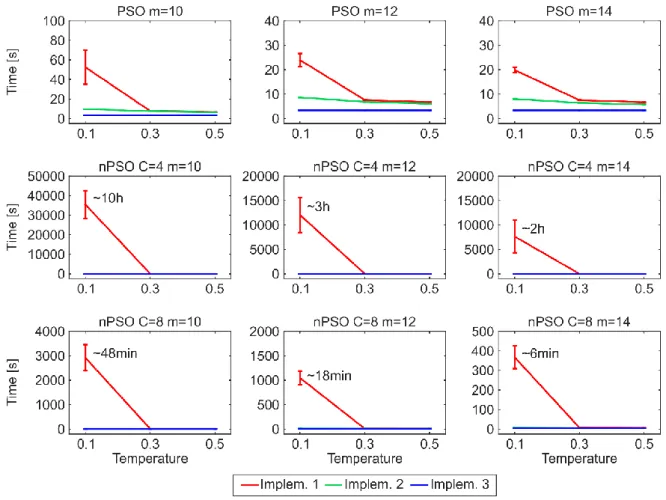
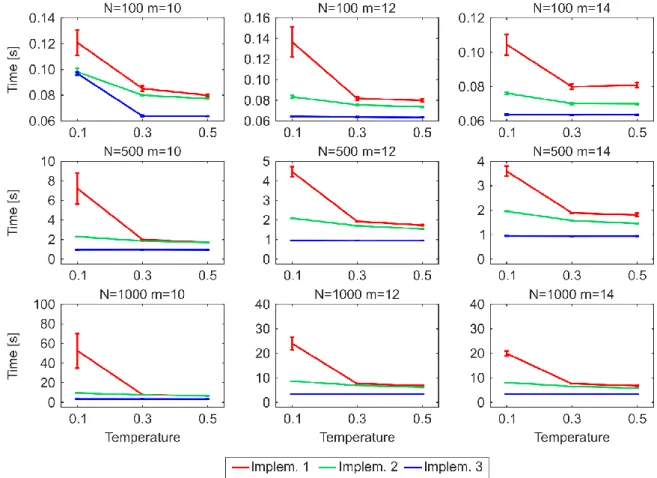
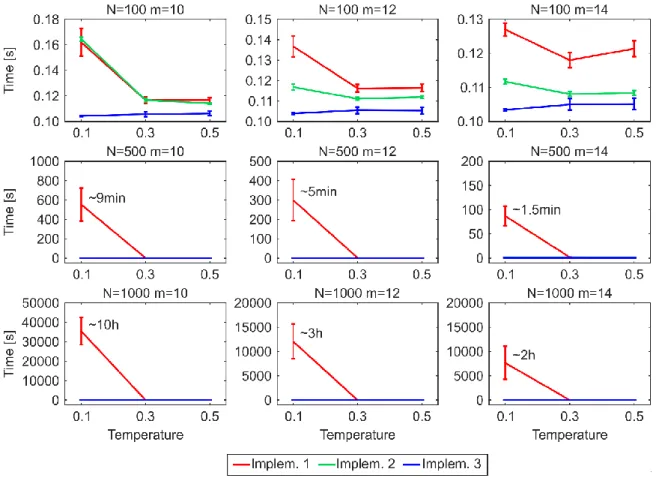
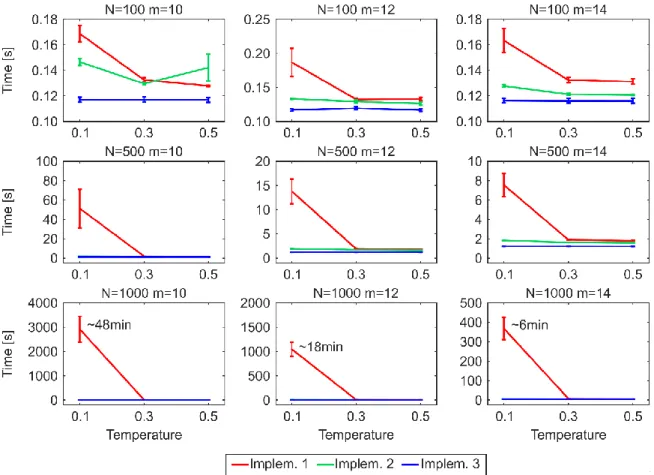
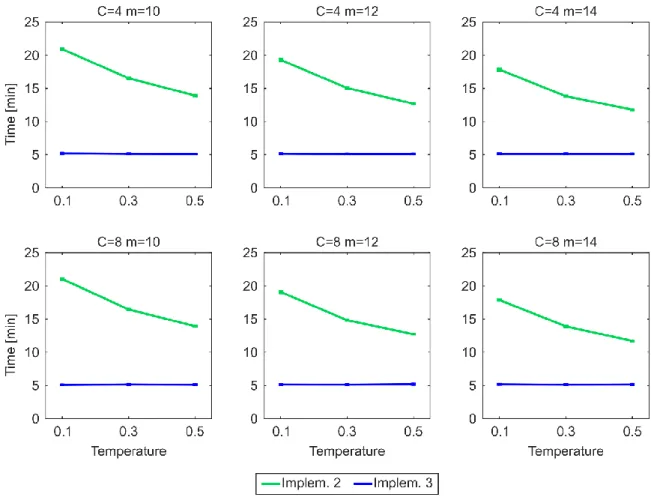
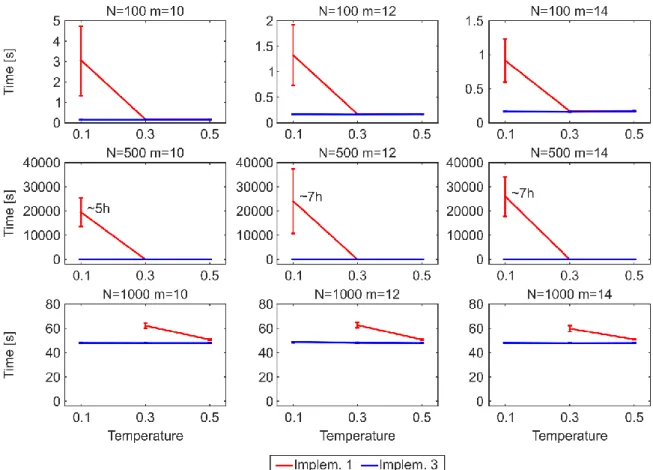
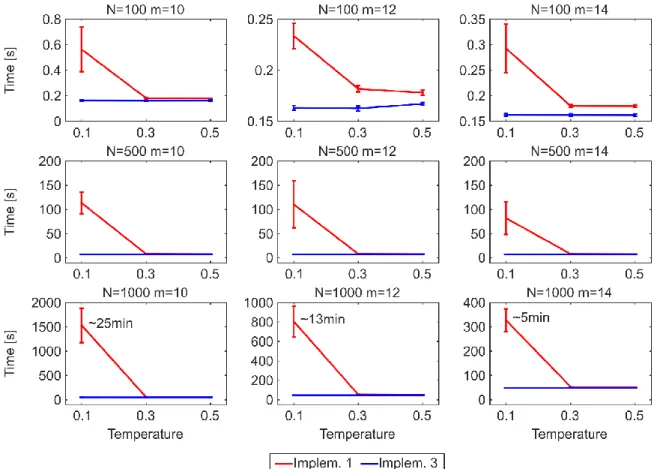
One of the main drawbacks to use the original algorithmic implementation (#1) to establish links adopted by the PSO and GPA models also for the nPSO model, is the lack of efficiency in generating networks with communities characterized by high clustering (low temperature), or more in general, with features such that most of the connection probabilities to the targets are low during the network growth. Indeed, the computational time of implementation #1 for generating PSO networks of size N = 1000 is in the order of seconds, whereas for nPSO networks with low temperature it might take up to several hours, depending on the number of communities. Here we propose two other different algorithmic implementations (#2 and #3), showing that both the implementations do not present any issue for generating nPSO networks with low temperature. Analysing the time complexity, both the implementations #1 and #2 have a dependency on the average connection probability to the targets during the generative procedure, which is mainly affected by the temperature and by the extent of the hyperbolic distances. Their complexity formulation is not straightforward to explicitly report since it is function of many parameters of the model. We recommend implementation #3, which resulted the fastest from running time simulations, and whose computational complexity is only dependent on the number of nodes and edges and it is O(EN), requiring 5 minutes to generate large size nPSO networks of N = 10000. In the paper we also provide the mathematical proof that the three implementations generate equivalent network topologies.
As a second result of the paper, we performed a wide investigation on the parameter combinations of the nPSO model for which the emerging communities are detectable by a state-of-the-art algorithm, considering also more complicated settings with asymmetric angular coordinate distributions over the angular space. We highlighted that, for most of the parameter combinations representing realistic scenarios, the community organization can be spotted by the state-of-the-art algorithm Louvain. The main factor that reduces the detectability is the ratio between the number of communities and the network size, in particular community detection in nPSO networks reduces significantly for small size networks that present many communities. These results suggest that realistic community structure is properly reproduced by the model and the nPSO might be employed as a benchmark for testing community detection algorithms, which is the topic of Paper C.
28
As last analysis, we evaluated and compared several topological measures of the synthetic networks generated using the PSO and nPSO models, and from this wide investigation two important results emerge. First, the parameters of the model allow to reproduce a great variety of the structural properties observed in real-world complex networks, and we provide heatmaps that can be used as a guide for the choice of parameters while generating networks with desired characteristics. Second, the diverse community organization has only a minor impact for most of the main topological measures. This suggests, for example, that if you want to model a given real network and you need to fit the temperature parameter of the model, this can be inferred from the clustering coefficient regardless of the community structure.
Paper C: A. Muscoloni, C. V. Cannistraci. (2018). Leveraging the nonuniform PSO network model as a benchmark for performance evaluation in community detection and link prediction. New Journal of Physics, 20, 063022.
In Paper B we introduced the nPSO model, which grows random geometric graphs in the hyperbolic space, reproducing networks that have realistic features such as high clustering, small-worldness and scale-freeness, with the additional possibility to control the community organization, tuning the number of communities, their size and their mixing. In this paper, we leverage the model as a benchmark for comparing the performance of community detection and link prediction methods.
Providing a benchmark for community detection requires the possibility to manipulate structural properties such as average node degree, clustering, small-worldness and scale-freeness, in order to assess how differently community detection algorithms react to these controlled topological variations. Several generative models have been proposed in the past years as synthetic benchmarks for community detection [40]. One of the first benchmark has been developed by Girvan and Newman [6], where all the nodes have the same degree and all the communities identical size, and has been later extended by Danon et al. [41] in order to generate communities with different size. A generative model able to reproduce structural properties closer to the ones observed in real networks has been proposed by Lancichinetti-Fortunato-Radicchi (LFR) [42], which is characterized by a power-law distribution of degree and community size. A further benchmark for overlapping communities has been introduced by Ball et al. [43], however, having all the nodes the same expected degree, it is less realistic and flexible than the LFR [40]. Interestingly, all these well-known models of networks with communities are not generated according to a latent geometry, which instead is the fundamental theme of this study.
29
The community detection algorithms Louvain [44], Infomap [45], Walktrap [46] and Label propagation [47] are four state-of-the-art approaches that have been shown to provide high performances on synthetic benchmarks [48]–[50]. Louvain [44] is a model-free and unsupervised heuristic method based on modularity optimization; Infomap [45] finds the community structure by minimizing the expected description length of a random walker trajectory using the Huffman coding process; Walktrap [46] is based on an agglomerative method for hierarchical clustering, where the similarities between the nodes or groups are obtained using random walks; Label propagation [47] is an iterative algorithm in which each node label is updated with the one owned by the majority of the neighbours until reaching a consensus. In this study, we compare these four community detection approaches across synthetic networks generated using diverse nPSO parameter combinations. The results indicate that overall Louvain appears as the strongest approach, with an almost perfect detection over different values of network size, average node degree and temperature. Analysing the advantages and disadvantages of each method over the nPSO parameter combinations, we noticed that the results were in agreement with previous studies [48], in which for example it was shown that for a high mixing of the communities Louvain and Walktrap are more robust, whereas Infomap and Label propagation tend to drop in performance. Therefore, the nPSO model seems to provide a good benchmark to test community detection algorithms on networks generated using a latent geometry model which is based on the hyperbolic space.
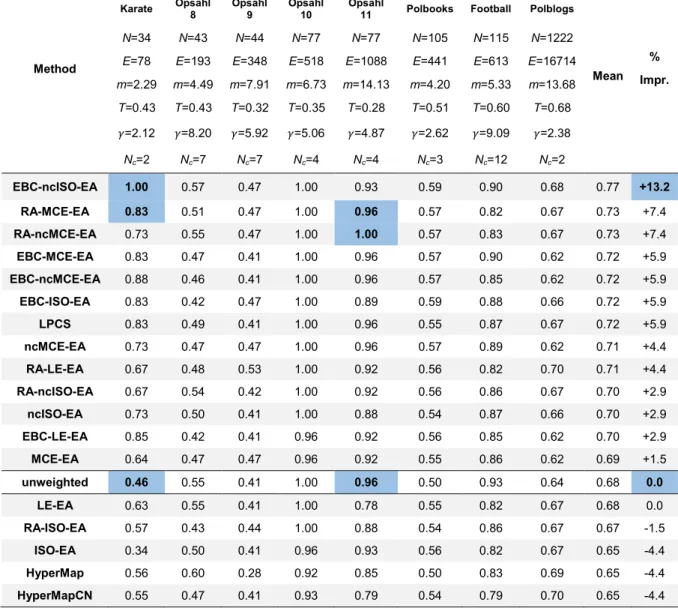
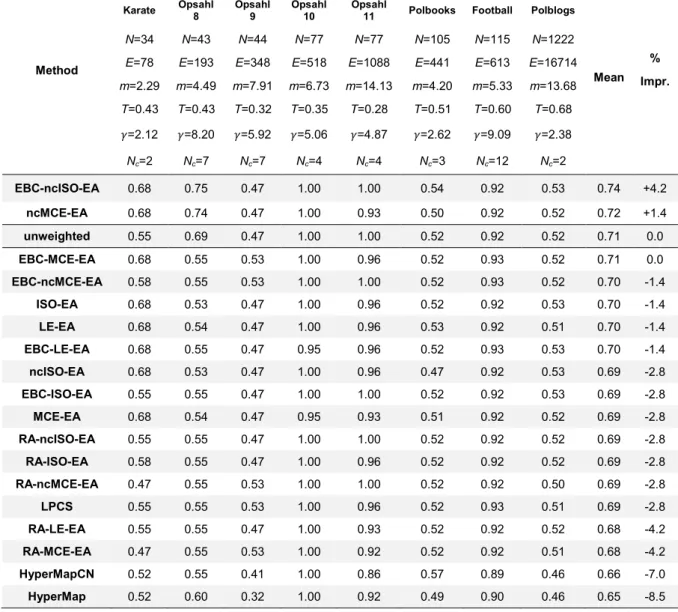
The study in Paper A demonstrated that, exploiting the geometrical embedding information in order to weight the adjacency matrix in input to the community detection algorithms, the performance of the respective unweighted variants can be improved [51]. Since the evaluation tests were executed on real network datasets, it remained the doubt that the performance evaluation could have been possibly biased by the restricted metadata available on the community annotation. This is a perfect example for clarifying the utility of the nPSO model. We would like to have a dataset of realistic networks for which we know the ground-truth community organization and that we can use as a benchmark to test whether the community detection algorithms benefit from being applied according to the geometrical embedding information in the hyperbolic space. Therefore, we repeat the same tests of Paper A [51] on real networks, but here we use nPSO synthetic networks as benchmark. More precisely, each network is embedded in the hyperbolic space using the coalescent embedding techniques and the hyperbolic distances between the nodes are used to weight the input network for the Louvain, Infomap, Walktrap and Label propagation algorithms. The results show that almost all the geometrically-weighted methods increase their performance with respect to the