Knowledge transfer in University Quadruple Helix Ecosystems: An Absorptive capacity perspective.
Abstract
Increased understanding of knowledge transfer from Universities to the wider regional knowledge ecosystem offers opportunities for increased regional innovation and commercialisation. The aim of this paper is to improve the understanding of the knowledge transfer (KT) phenomena in an open innovation context where multiple diverse stakeholders are interacting. An absorptive capacity-based conceptual framework is proposed, using a priori constructs which portrays the multidimensional process of KT between universities and its constituent stakeholders in pursuit of open innovation and commercialisation. Given the lack of overarching theory in the field, an exploratory, inductive theory building methodology was adopted using semi-structured interviews, focus groups and longitudinal observation data over a three year period. The findings identify various factors, namely human centric factors, organisational factors, knowledge characteristics, power relationships and network characteristics which mediate both the willingness of stakeholders to engage in KT and the effectiveness of knowledge acquisition, assimilation, transformation and exploitation. This research has implications for policy makers and practitioners by identifying the needs to implement interventions to overcome the barriers to KT effectiveness between quadruple stakeholders to be able to more fully develop an open innovation ecosystem.
1.0 Introduction
This paper focuses on the role knowledge plays in commercialisation, within a University knowledge ecosystem context and explores how to improve the effectiveness of knowledge transfer (KT) from universities. Traditionally, university KT and Knowledge Exchange comprised of the ‘pushing’ or brokering of discipline-specific research outputs and/or the provision of more generalised education and skills development (Etzkowitz and Klofsten, 2005; Urbano and Guerrero, 2013). However, in recent years, universities have been required to take on a more entrepreneurial role as core actors within regional innovation ecosystems resulting in new and diverse opportunities for Knowledge Transfer (Ambros et al, 2008; Arnkil et al, 2010; Hewitt-Dundas, 2012). Within such systems, universities can be viewed as both a generator of knowledge and also a conduit between government and industry (Etzowitz and Klofsten, 2005; Bercovitz and Feldman, 2006; D'Este and Patel, 2007; Cao et al., 2009; Alexander and Childe, 2012 ).
Whilst this triple helix ‘ecosystem’ approach is purported to be one of the core elements of regional economic growth, within a knowledge-based economy (Chesbrough, 2003:2006; Nambisan and Sawhney, 2007a; Urbano and Guerrero, 2013) a number of studies suggest that this largely normative University Technology Transfer (UTT) process has not and is not delivering the expected levels of commercialisation in terms of GDP and increased jobs (Cooke, 2005; Asheim and Coenen, 2005; Grimaldi et al., 2011). Cooke (2005), Arnkil et al (2010) and Kenney and Mowery (2014) suggest that from an open
innovation perspective, the normative and primarily closed innovation through Triple Helix-based KT process adds to the ‘internalisation’ or isolation of knowledge rather than enabling more widespread opportunities for knowledge as a source of innovation. More recently user-driven innovation models have emerged, which add a fourth stakeholder group to the triple helix model. This approach recognises the increased role that end-users and therefore society are playing in regional and project-based innovations. These end-users in essence create the ‘pull’ or demand for innovation which can lead to opportunities for open innovation (Arknil et al., 2010; Carayannis and Rakhmatullin, 2014). Moreover, recent regional and national policy in Europe has recognised the need for universities to strengthen their offerings to retain a place at the core of a quadruple helix ‘open innovation’ ecosystem, where the need for the unconstrained flow of knowledge and expertise is embodied in collaboration and cooperation between quadruple helix stakeholders (Leydesdorff, 2010; Alexander and Martin, 2013; Kenny and Mowery, 2014).
Alexander et al. (2012) suggests that the changing role of universities within a complex open innovation ecosystem of diverse stakeholders poses considerable challenges for effective knowledge transfer. However, this area is currently an underexplored area which is in need of improved understanding and conceptualisation as to how knowledge can be effectively transferred within an open innovation context (Holi et al., 2008; Chesbrough, 2011; Carayannis and Rakhmatullin, 2014). Within this study, Chesbrough and Vanhaverbeke’s (2006, p 2) definition of open innovation is adopted which
defines it as “the use of purposive inflows and outflows of knowledge to accelerate internal innovation, and expand the markets for external use of innovation, respectively.” Chesbrough et al. (2006; 2011) suggests two knowledge-based dimensions of open innovation which closely mirror knowledge transfer practices from universities and their quadruple helix stakeholders. The first dimension is “outside-in” where external knowledge transfer involves accessing and leveraging knowledge to increase innovation through, for example, environmental scanning routines. The second dimension is “inside-out” where knowledge transfer includes sharing knowledge with external organisations to commercially exploit innovation (Prahalad and Ramaswamy, 2004; Chesbrough, 2011; Edvardsson et al, 2011).
The aim of this paper is to improve the understanding of the knowledge transfer (KT) phenomena in an open innovation context where multiple diverse stakeholders are interacting. To achieve this aim, an ex ante framework, derived from literature on knowledge transfer between multiple stakeholders and triple helix based innovation is proposed. It is then applied to an in-depth case study. The case study aims to stimulate co-creational commercialisation outputs in the quadruple helix context. Based on the empirical findings, the initial framework has been revised and an ex post framework presented to aid understanding and conceptualisation of the actual knowledge transfer processes which take place within an open innovation context. The paper commences with a critique of KT between universities and regional quadruple helix stakeholders in an open innovation context and
knowledge transfer boundary spanning challenges. The initial ex ante framework is then presented from which the research questions are derived. The following section then presents the methodological rationale and method; which is followed by critical evaluation of case study findings, which resulted in the ex post framework. Finally, the implications for theory and practice are considered.
2.0 Knowledge Transfer within an Open Innovation System
The importance of universities and the increasingly important role they play in knowledge transfer and commercialisation is well documented (Lerner, 2005; O’Shea et al., 2008; Grimaldi et al, 2011). Traditionally their primary mission was to engage in teaching, research and to disseminate knowledge across both academic and student communities, referred to as mode 1 knowledge transfer (Gibbons et al. 1994). However, with the emergence of the knowledge economy and more competitive marketplaces, universities have extended their role to directly contribute to economic development, especially at regional level (Urbano and Guerrero, 2013).
Universities are increasingly viewed as a hub of new knowledge, especially in the areas of science and technology-based innovation (Sharma et al., 2006; McAdam et al., 2010). Etzkowitz et al. (2000) identify that the university can act as a human capital provider and seedbed for new firms. Indeed, O’Shea (2008: 655) notes that whilst “Universities have historically been the centre for the accumulation; creation and dissemination of new knowledge… [they] must
now use this knowledge to enhance competitive advantage”, i.e. mode 2 knowledge transfer (Gibbons, 1994; Swann et al, 2010). This development has seen universities take on a more entrepreneurial role in KT within the regional knowledge ecosystem (Etzkowitz and Leysdorff, 2000; Urbano and Guerrero, 2013) whereby they are considered a core conduit for regional KT and innovation through their engagement in commercialisation activities (Van Looy et al., 2011).
Bercovitz and Feldman (2006) and Johnson et al. (2010) suggest that the presence of a university and supporting regional innovation strategy (RIS) does not guarantee that KT will take place, rather it attempts to create conducive conditions for KT and more radical innovation and commercialisation within the regional innovation ecosystem (Johnson et al., 2010; Carayannis et al., 2012; Leydesdorff, 2012). Indeed, despite numerous governmental reports and initiatives over the past decade encouraging collaborations between triple helix stakeholders (e.g. Lambert Review, 2003; House of Commons Science and Technology Committee Report, 2006; Sainsbury 2007; Wilson, 2012; Governments Science and Innovation Investment Framework 2004-2014), key KT challenges in the this context remain.
KT within the Triple Helix is conceptualised within literature as boundary spanning KT across academia, Industry and regional Government. The transfer of knowledge across such organisational boundaries is a challenging and multifaceted process (Pries and Guild, 2007; Etzkowitz, 2008). Szulanski (1996) identifies that KT involves “a process of dyadic changes of knowledge between
source and recipient unit” (pp.28). However, with the emergence of the knowledge economy, and a network based knowledge ecosystem leading to quadruple helix structures, KT involves multidirectional flows of knowledge between multiple stakeholder communities (Lindgren et al., 2010; Kenny and Mowery, 2014). Indeed, KT is now deemed to be a both an entrepreneurial process (Dakin and Lindsey, 1991) and a valorisation process (Leloux et al., 2009) in the context of open innovation ecosystems.
3.0 Conceptualising Knowledge Transfer between multiple stakeholders using an Absorptive Capacity lens
KT has been explored in a wide variety of practice based contexts however, there is a lack of an overarching or unified theory within the field (Chesbrough, 2011; Kim et al., 2012) reflecting its relative immaturity (Mitton et al, 2007; Arnkil et al., 2010; Carayannis and Rakhmatullin, 2014). Hence there is a need for improved conceptualisation. We suggest building on the conceptualisation of Su et al. (2013) who identify that an absorptive capacity lens can be used within an inductive theory building study to explore the process of KT. Escribano et al. (2009) found that absorptive capacity is an important source of competitive advantage for organisations by enabling them to identify, internalise and exploit knowledge flows. Absorptive Capacity has also been used to explore why some organisations transfer knowledge more successfully than others, particularly in regards to University based KT within an open innovation ecosystem (Easterby-Smith et al., 2008; McAdam et al., 2010). Furthermore, Absorptive Capacity is seen as playing a crucial role in intra and
inter-organisational knowledge transfer (Mowery et al., 1996; Zahra and George, 2002; Lane et al., 2006). Hence following Su et al. (2013) Absorptive Capacity is put forward as a core construct in an initial ex ante theoretical framework on which to inductively build further conceptualisation and theoretical development of the process of KT from universities.
Absorptive Capacity in a KT context is defined as the ability to acquire external knowledge, assimilate it, and exploit it for commercial ends (Cohen and Levinthal, 1990) where Absorptive Capacity is viewed as a knowledge-based capability (Zahra and George, 2002). Following Cohen and Levinthal’s (1990) initial conceptualisation and further conceptual development by Zahra and George (2002), Lane et al. (2006) and Todorova and Dursin (2007), Absorptive Capacity is viewed as the capability to recognize, assimilate and apply new external knowledge to advance commercialisation and competitiveness. Knowledge sources and recipients (i.e. stakeholders within an open innovation ecosystem) may vary in their Absorptive Capacity capability levels and hence this may impact KT effectiveness between organisations (Cohen and Levinthal, 1990; Zahra and George, 2002; Todorova and Dursin, 2007; Su et al., 2013). In particular, Easterby-Smith et al., (2008) and McAdam et al., (2010) identify that Absorptive Capacity has become a useful construct to understand why some organisations develop more innovative products and are more successful at innovation activities than others (Easterby-Smith et al., 2008; McAdam et al., 2010). There is a paucity of studies using absorptive capacity
constructs to explore KT processes within a quadruple helix knowledge ecosystem where an open innovation climate of inflows and outflows of knowledge coexist (Johnson et al., 2010; Miller et al., 2010; McAdam et al., 2012). Hence there is an opportunity to at least partially address this knowledge gap and facilitate theoretical development and refinement through using absorptive capacity as a lens to explore the process of KT from universities to its respective stakeholders within an open innovation ecosystem (Easterby-Smith et al., 2008; McAdam et al., 2010).
4.0 Ex Ante Model Development
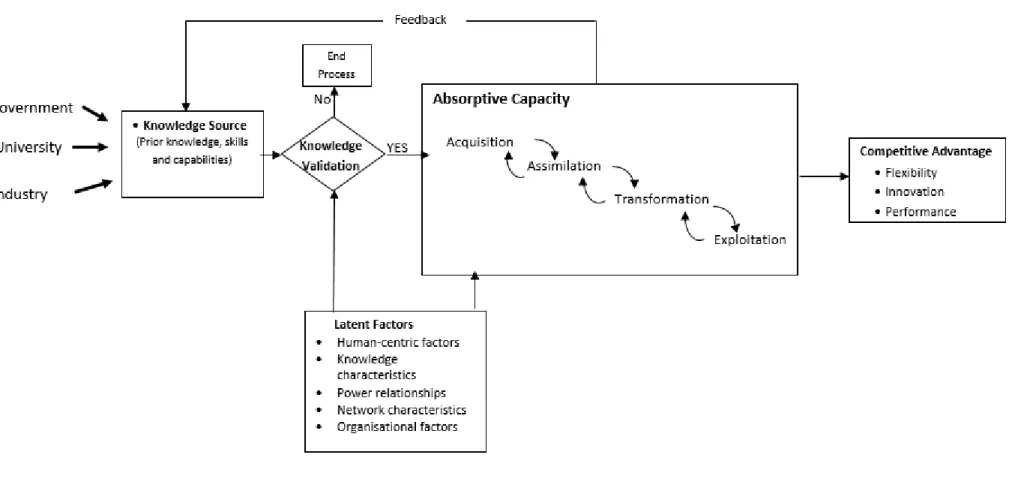
An ex ante model was developed using a priori concepts as suggested by Bendassolli (2013) from the extant literature. Figure 1 presents the ex ante model which uses an absorptive capacity lens to portray the process of knowledge acquisition, assimilation, transformation and exploitation (Zahra and George, 2002) between universities and their constitute stakeholders. Figure 1 suggest that KT from universities for commercialisation traditionally happens within a complex network of triple helix stakeholder interactions. Figure 1 also suggests that a knowledge validation decision needs to take place or what Zahra and George (2002) deem an ‘activation trigger’ where each of these stakeholders make the conscious decision to engage in knowledge transfer.
As shown in Figure 1, the KT literature also identifies a number of influencing factors which can impact the effectiveness of KT. These can be grouped into
the characteristics of the knowledge source and recipient, properties of knowledge, network characteristics and organisation context (Szulanski, 1996). The characteristics of the knowledge source and recipient is underpinned by human centric characteristics such as motivation, personality and attitudes which have been found to affect knowledge transfer behaviour between knowledge sources and recipients (Gupta and Govindarajan, 2000; Mooradian et al., 2006, Matzler and Meuller, 2011).
Once ‘buy in’ has been achieved (represented as knowledge validation in figure 2) in relation to participating in KT, absorptive capacity is needed to recognise the value of new knowledge, acquire, assimilate, transform and apply that knowledge to commercial ends (Cohen and Levinthal, 1990; Zahra and George, 2002; Easterby-Smith et al., 2008; McAdam et al., 2010). As mentioned, absorptive capacity is a capability and as with all capabilities, organisations vary in their ability to develop and leverage these capabilities (Kogut and Zander et al., 1992; Van den Bosh, 1999; Vega-Jurado et al., 2008). Similar to the knowledge validation decision, figure 1 identifies that capability development is mediated by various factors which are said to have varying impact on how knowledge flows between stakeholders at each KT stage (Zahra and George, 2002). Whilst a number of barriers and enablers to KT have been identified forming this conceptual model, the lack of overarching theoretical conceptualisation (Chesbrough, 2011; Kim et al., 2012) stresses the need for exploratory and inductive theory building to gain further understanding of the process of KT (Holi et al., 2008). This is particularly important when moving
from a triple helix to a Quadruple Helix context in progressing towards effective mechanisms for open innovation and commercialisation (Sharifi and Liu, 2010; Readman, 2010; Johnson et al., 2010; Alexander et al., 2012; Su et al, 2013).
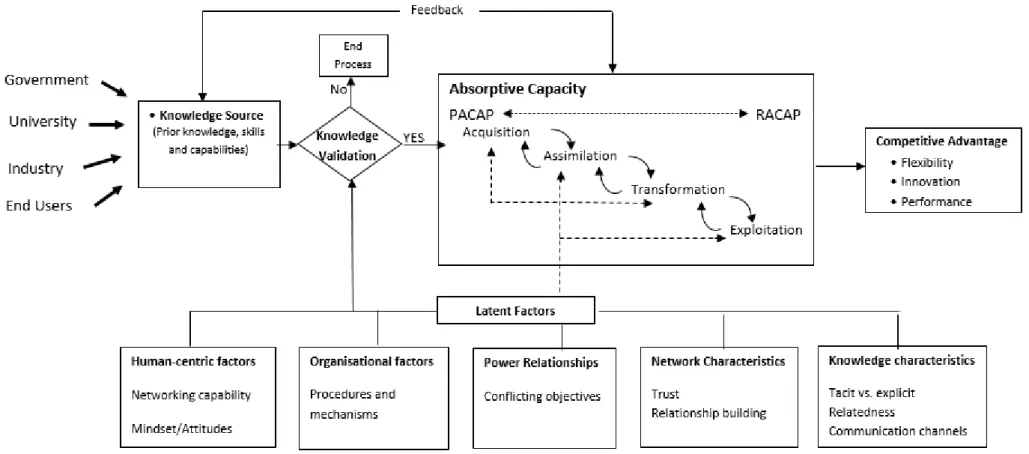
Previous research on absorptive capacity (i.e. models by Cohen and Levinthal, 1990 and Zahra and George, 2002), have portrayed absorptive capacity as involving linear stages between knowledge acquisition, assimilation, transformation and exploitation. However, as suggested in figure 2, this model draws upon Todorova and Dursin’s (2007) where each of the stages can happen concurrently and knowledge flows bi-directionally to try to depict the interactive, non-linear and multidimensional nature of KT from universities. KT in the context of innovation, does not always reach the exploitation or commercialisation phase, however learning still takes place and will inform prior knowledge for future innovation activities (Cohen and Levinthal, 1990; Lane et al. 2006). Therefore a feedback loop is presented in figure 2, depicting
Based on the conceptual framework shown in figure 1, and the move from triple helix to quadruple helix structures within regional innovation systems, identifying a new stakeholder group, namely end users, three main questions have been identified. These were the cornerstones of the empirical phase of our research, where we explore in-depth the applicability of the framework in a quadruple helix context.
RQ1) What factors enable or prevent university KT effectiveness in relation to the absorptive capacity constructs of knowledge acquisition, assimilation, transformation and exploitation?
RQ2) What role do quadruple helix stakeholder relationships play in progressing KT through the absorptive capacity constructs of knowledge acquisition, assimilation, transformation and exploitation in the context of open innovation and commercialisation?
RQ3) How can KT theory and practice be progressed through empirical findings demonstrating the relevance and further development of a absorptive capacity lens to depict the multidimensional nature of the process of KT amongst multiple stakeholders.
14 5.0 Research Methodology
In order to scrutinise the conceptual model based on a priori concepts (Su et al., 2013; Bendassolli, 2013), an interpretivist, qualitative methodology was employed in order to inductively build theory in an under researched context. Qualitative research is appropriate for exploring complex and unique situations thus is appropriate in contexts which require rich and thick description of behaviours, such as those involving knowledge transfer between multifarious stakeholders (Blaikie, 2000; Bryman, 2007; Easterby-Smith et al., 2008). To facilitate in-depth, nuanced understanding in order to refine the conceptual model, one intrinsic case study (Stake, 2000) of a University was undertaken. Brennan (2006) and Fromhold-Eisebith and Weker (2013) identify that the idiosyncratic nature of universities and their complex processes is best explored through single intrinsic case studies. Data was collected longitudinally over a period of 3 years and comprised of observational analysis of knowledge transfer meetings and semi-structured interviews which were carried out with key informants, namely academic entrepreneurs (n=12) knowledge transfer staff (n=5) and regional government support staff (n=3) to understand the complex process of KT from universities and quadruple helix stakeholder in the pursuit of open innovation. Several repeat interviews were conducted with a select number of interviewees to further probe key themes (n=6). Appendix one presents the profile of the interviewees and their respective codes. In addition, publically available documents were analysed relating to knowledge transfer from universities and regional quadruple helix stakeholder collaborations, in order to gain a holistic view of the area under study (Eisenhardt, 1989; Yin, 2011). These documents included governmental strategies and white papers focused on collaborative
KT between universities and quadruple helix stakeholders for the purposes of innovation.
Each interview was recorded via Dictaphone and lasted on average 1 hour for the interviews in stage one. The repeat interviews lasted between 30-40 minutes each. The observational research was recorded by means of detailed notes which were then developed into learning logs. A method of open inductive coding was followed (Strauss and Corbin, 1998) both manually and through the use of NVivo 12. These open codes were then grouped into themes and sub themes through an iterative process of theoretical coding (Strauss and Corbin, 1998) parallel to the collection of data. This iterative process of data analysis built up a chain of evidence by means of data triangulation from the interviews and documents (Cresswell, 2003; Saunders et al., 2007; Konecki, 2008); thus helping alleviate some of the limitations of lack of generalisation often associated with case study research (Kisfalvi, 2002).
6.0 Results and Discussion
Given the qualitative nature of the findings the results and discussion sections are combined as suggested by Yin (2011). Based on the empirical findings, Figure 2 presents the ex post model of knowledge transfer from universities from an absorptive capacity lens. This model presents the dynamic interaction between the quadruple helix stakeholders within the case study and thus aids refinement of the enablers and challenges of knowledge transfer within an open innovation context. This section will first discuss emergence of quadruple helix collaborations in the context of university
16
technology commercialisation and the importance of effective KT. This will be followed by a discussion of key enablers and barriers as reflected in figure 2.
6.1 Quadruple helix stakeholder knowledge transfer with the aim of commercialising university research
Figure 2 shows that the commercialisation of knowledge from the case university is increasingly becoming a collaborative process whereby universities, industry, government and end users were increasingly engaging in KT to help commercialise knowledge in an open innovation process (Alexander and Martin, 2013; Kenney and Mowery, 2014). Previously technology commercialisation within the case university was predominantly a closed system, following a push model of innovation where academics commercialised their knowledge with minimal engagement with industry and end users (Lambert, 2003; McAdam et al., 2012; Miller et al., 2014). However, the longitudinal observation data showed there was increasing collaboration between the helices driven by the regional innovation strategy which emphasises improved links and knowledge transfer between universities, industry and end users in society to help stimulate economic development (RIS, 2014; Etzkowitz and Ranga, 2011; Leydesdorff, 2012; Wilson, 2012). Furthermore, it was noted by a knowledge transfer strategic manager within the knowledge transfer office (KTO) and recent policy documentation (RIS, 2014; DETI, 2014) that there was increasing pressure and financial incentives for the University to take a more central role within a quadruple helix open innovation ecosystem. The recent annual funding allocation from the Higher Education Innovation Fund (HEIF) stressed the need for the university to explicitly demonstrate their scope and depth of knowledge-exchange with industry and wider society. Such performance
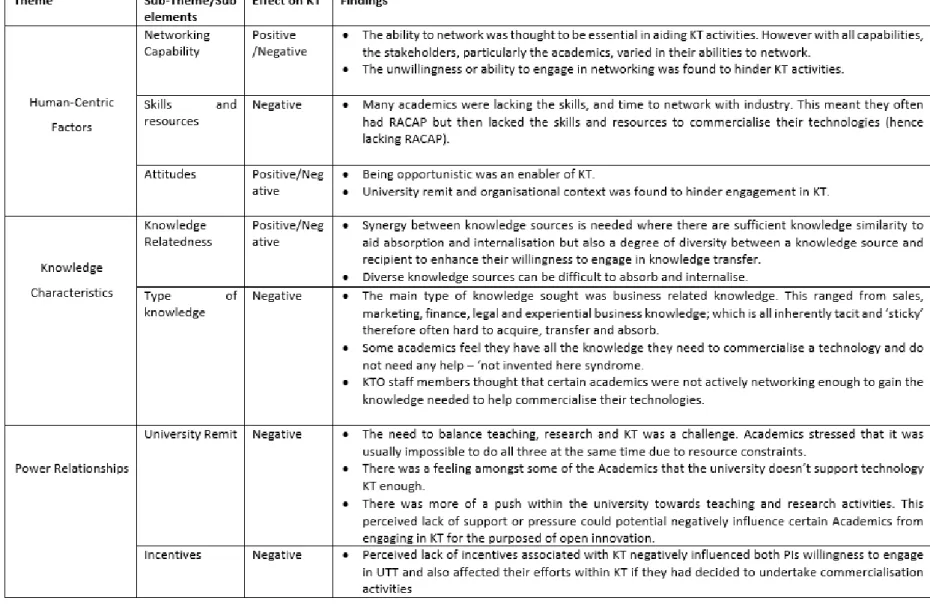
measures include, engagement in joint supervision projects, such as Knowledge Transfer Partnerships (KTPs), collaborative research and contract research. These developments include engagement in co-creational KT to increase technology commercialisation effectiveness in the market place (McAdam et al., 2012). KTOM stated that these new performance measures posed significant challenges for the exchange of knowledge and stakeholder engagement. From the observational and interview data it was identified that a number of enablers and challenges existed in relation to KT between stakeholders with the emergence of more open innovation processes. In regional innovation strategy documentation (Wilson, 2012; RIS, 2014; DETI, 2014) it is often assumed that KT occurs between these universities and their regional stakeholders, with a failure to recognise the factors which mediate the flow of knowledge between the helices (Lee, 2010; Alexander et al., 2012). These are represented as latent factors within figure 2 and largely mirror the core enablers and barriers of KT identified from literature within in ex ante model however, with increased pressure from government in pursuit of a quadruple helix open innovation ecosystem there is a need for exploratory and inductive theory building to gain further understanding of these processes of KT, particularly within the quadruple helix context in progressing towards effective mechanisms for open innovation and commercialisation (Sharifi and Liu, 2010; Readman, 2010; Johnson et al., 2010; Alexander et al., 2012; Su et al., 2013). Each of the core enablers and barriers were found to impact how knowledge was acquired, assimilated, transformed and exploited are summarised in table 1 and will be discussed in the sections which follow.
18
6.2 Enablers and Challenges for effective Knowledge Transfer
Whilst the core enablers and challenges within the case study appeared to align with prior literature, figure 2 differs from the ex ante model to show the interdependent nature of the latent factors which mediate both engagement in KT and the effectiveness of KT. It was found that a combination of those factors may have either a positive or negative impact on knowledge acquisition, assimilation, transformation and exploitation. Prior research often fails to represent the dynamic nature of factors which mediate the flow of knowledge between stakeholders (Volberda et al., 2008; McAdam et al., 2010), with Lee (2010) noting that KT is often taken for granted with less known about how absorptive capacity is created and developed.
6.2.1 Human-centric Characteristics
A number of personal characteristics and skills were found to affect stakeholders from engaging in KT and sharing (hence affecting knowledge validation, as shown in figure 2) and were also found to impact the effectiveness of knowledge acquisition, assimilation, transformation and exploitation when engaging with other stakeholders in the pursuit of open innovation and technology commercialisation. Concurring with prior literature, human-centric characteristics of stakeholders such as the ability to network and individual attitudes and traits were found to affect absorptive capacity (Cohen and Levinthal, 1990; Zahra and George, 2002).
The networking capability of academic entrepreneurs within the case university was identified as a mediator of collaborative open innovation processes. Driven by the introduction of new performance measurements for promotion, academics were
22
increasingly expected to actively engage in KT through networking and collaboration with industry in the pursuit of commercialisation opportunities (Walter et al., 2006; Wilson, 2012). However, it was identified that actual levels of networking and collaboration varied. This variation was found to be a result of individual attitudes with some academics expressing their dislike of engaging with industry due to cultural differences which often caused conflict with their research agendas. PI6 identified “industry want results yesterday whereas what they don’t understand is that it can take weeks to perfect a test which we are happy to stand over”. Concurring with past research, it was identified that some academics have a lack of expertise which prevents them from engaging in effective networking and KT with industry (Lockett et al., 2003; Mosey and Wright, 2007). “It’s a personal thing. Everyone have their own personal mechanisms for networking and I suppose academic scientists are not exactly known for their interpersonal skills... I don’t think there is anything that can be done” (PI12). However, the importance of engaging in KT with industry and end users was identified as being useful in enhancing technology commercialisation (Audretsch and Feldman, 2003; McAdam et al., 2010). The KTO staff interviews identified that there was increased pressure to collaborate with regional stakeholders which was evident in the new criteria governing research council funding and Proof of Concept (POC) finding which often specifies direct industry and end user involvement in projects. The ability to network was considered important to not only acquire new knowledge but those stakeholder relationships were then utilised to help understand and transform knowledge to increase the chances of commercialisation (Zahra and George, 2002; Adams et al., 2006; McAdam et al., 2010). Furthermore the findings showed that the exploitation of knowledge and consequently the commercialisation was more successful when academic entrepreneurs had two-way flows of knowledge industry networks and interaction with end users who
helped to build awareness and interest in the innovations (Mitten et al., 2007; Livange et al., 2009).
PI5 and PI8 identified that often academic entrepreneurs were able to develop their ideas enough to get them patented and possibly gain funding such as Proof of Principal (POP) to develop their ideas in the early stages to increase potential absorptive capacity (PACAP) (i.e. the ability to acquire and assimilate external knowledge, Zahra and George, 2002). However, it was identified that engagement with end users was need to increase realised absorptive capacity (RACAP) (i.e. transform and exploit knowledge, Zahra and George, 2002). Whilst it was evident in the case study, that engagement with industry and end users had improved in recent years, cultural differences were still identified as a core barrier to effective KT (Goh, 2002; Easterby-Smith et al., 2008). However, the KTO staff perceived their role to be boundary spanning (Carlile, 2004) whereby they helped bridge interactions between academic entrepreneurs and industry, alleviating variances between cultures and processes (McAdam et al., 2010). Indeed, concurring with Reagans and McEvily (2003), KTO1 identified that language differences between the diverse stakeholders often limited the knowledge acquisition and assimilation. “You have to have a capability to draw that out of the conversation because academics can be so absorbed in their work that they can not necessarily articulate that themselves” (KTO1).
Within the case, it was evident that intrinsic mind-sets and attitudes of individual stakeholders affected their willingness to engage in KT (Lucas and Ogilvie, 2006). It was recognised by all interviewees that within universities, academics are often working in academic silos, therefore there is a need for them to be opportunistic and to actively chat with external stakeholders to help the university fulfil their role as part of an open
24
innovation ecosystem. PI5 notes “It is really up to us to engage with it and make an effort to meet different people and that is where the opportunities for collaboration arise”. However, through the interviews and observation, it was unravelled that these mind-sets and attitudes to collaborate with industry and end users were largely a function of the organisational context, whereby organisational processes and mechanisms often shaped knowledge sharing behaviours (Szulanski, 1996; Bhagat et al., 2002; Laursen and Salter, 2006; Yeoh, 2009; Duan et al., 2010; Argote, 2012).
6.2.2 Organisational factors
Within the case study, it was evident that organisational factors played a key role in affecting knowledge absorption, sharing and transfer between the various stakeholders (see figure 2 and table 1). Organisational procedures and mechanisms were found to mediate stakeholder engagement and impact the effectiveness of KT. For example, the emergence of a dedicated KTO identified the commitment of the university to develop internal procedures which enable academic entrepreneurs to engage in KT through open innovation activities. However, concurring with Locket et al., (2005) and Miller et al., (2014), the academic remit of teaching and producing high quality research publications was found to deter some academics from collaborating with external stakeholders. “They keep expecting more and more from us however, I do not know how they expect us to teach, produce 3 and 4 star publications and have time to attend events to network with industry and engage in technology commercialisation when over 50% of the time it does not result in something fruitful” (PI2). Indeed, a number of academics and the KTO staff noted that academics were judged by the Research Excellence Framework (REF) outputs rather than KT and commercialisation success measures limiting their willingness and motivation to engage in
KT and collaborative innovation with industry and end users (Van Looy et al., 2011; Hewitt-Dundas, 2012).
6.2.3 Knowledge characteristics
Within the case study, the characteristics of the knowledge being transferred was found to influence its ability to be acquired, absorbed and exploited. Consistent with past research on KT (Siegel et al., 2003; Wright et al., 2009) the main type of knowledge being transferred during open innovation processes was business-related knowledge. This ranged from sales, marketing, finance, legal and experiential business knowledge; which has tacit and ‘sticky’ elements and is therefore often hard to acquire, transfer and absorb (Szulanski, 2002; Gourley, 2006). Finding relevant knowledge on target markets was deemed to be difficult despite specialised databases and consultants. “One of the hardest things is to understand the global market place and it very hard to understand as you could never get the full story so you have to try and build a picture from different sources with relation to volume” (PI21). Hence the opportunity to increase collaboration of industry and end users at earlier stages of technology commercialisation processes was suggested as beneficial by the interviewees. It was recognised by the majority of the academics that having a good technology with a patent and protected IP was not enough “Having IP is almost immaterial because if you are a good sales person you can have dreadful IP but still sell” (PI11). This type of knowledge was thought to be based on personal attitudes, abilities and experience; therefore was difficult to acquire and absorb (Dyer and Singh, 1998; Nonaka and von Krough, 2009). Therefore it was identified that there was a need for academics to engage in open innovation processes with industry to help bridge this knowledge gap (Gassmann and Chesbrough, 2010; McAdam et al., 2010). KTO staff were aware of academics deficiencies in
26
knowledge “I know that whilst academics may be very good in their own research area and the specific areas they specialise in. Not very many of them have actually formed and sustained relationships with industry” (KTO3). However, one KTO expressed concern that some academics felt they have all the knowledge they need to commercialise a technology and do not need any help. “It may be the case in a few instances that they are not aware of the existence of that knowledge or they feel that they can progress without it but this is often not the case” (TTO3). Similarly, Hayes and Clark (1985) refer to ‘not invented here syndrome’ which results in resistance to accepting external knowledge and ideas hence limits KT.
Knowledge relatedness was identified within the interviews and observational data as important in facilitating effective KT. It is noted in prior studies that in an open innovation context, synergy between knowledge sources is needed where there are sufficient knowledge similarity to aid absorption and internalisation but also a degree of diversity between a knowledge source and recipient to enhance their willingness to engage in knowledge transfer (Cohen and Levinthal, 1990; Dyer and Singh, 1998; Reagans and McEvily, 2003; Abecassis-Moedas and Mahmoud-Jouini, 2008). The academics in the case study identified the need for synergistic partnerships to entice their willingness to engage in KT with industry and end users. Moreover, the tacitness of knowledge often transferred between universities and it’s constitute quadruple helix stakeholders demanded rich communication channels and frequent engagement (Szulanski, 1996; Nadler et al., 2003; Preeble, 2005; Labelle and Aka, 2012). It was identified that a clear two way flow of communication aided KT and open innovation activities concurring with Hughes et al., (2009). A scenario was identified by PI6 where they were engaging in open innovation with
industry via mechanisms such as email and telephone. “We tried to do it remotely so we never actually met the people involved ...the project was full with problems ... our experience was that face to face communication is superior” (PI6). Thus it was noted that complex or ‘sticky’ knowledge, such as that required for innovation was said to require rich communication channels such as face to face communication to facilitate transfer and absorption (Szulanski, 2002; Yeoh, 2009; Alexander & Childe, 2012).
In prior studies, open communication has been found to reduce knowledge asymmetry (Vandekeckhove and Dentchev, 2005) which is essential when multiple diverse stakeholders are interacting in an open innovation context. However, the case study showed that with an increasing number of stakeholder’s becoming involved in commercialisation processes, it was becoming increasingly difficult to negotiate and compromise on stakeholder objectives which are often diverse. Recent government policies (Wilson, 2012; RIS, 2014; DETI, 2014) identify the ‘ideal’ of co-creational KT in an open innovation quadruple helix ecosystem however, as noted previously, inherent organisation factors were found to constrain full engagement between universities, industry and end users. Furthermore, coinciding with research by Miller et al., 2014) it was identified that conflicting objectives and performance measurements need to be addressed before universities, industry, government and end user are able to fully engage in co-creational open innovation systems.
6.2.4 Power relationships
It was noted throughout the research period that knowledge transfer between multiple diverse stakeholders in pursuit of open innovation was complex and often difficult. Consistent with prior research (Szulanski, 1996; Easteby-Smith et al., 2008; McAdam et al.,
28
2012), this source of conflict was often the result of varying aims and objectives governing the transfer of knowledge. Indeed, Easterby-Smith et al. (2008) identify that different actors and interest groups often compete for the control of knowledge which can affect the internal processes leading to the adoption and utilisation of external knowledge. Furthermore, Todorova and Dursin (2007) identify that the existence of power relationships can either inhibit or enable knowledge exploitation. From the case study findings (and as shown in figure 2 and table 1) it was found that power relationships had have an effect on both stakeholder willingness to engage in KT and the effectiveness of KT, which will have a consequential impact on commercialisation success.
University remit was a reoccurring theme, whereby the need to publish often conflicted with the priorities and objectives of industry during collaborative innovation projects (Van Looy et al., 2011; Hewitt-Dundas, 2012). The KTO staff recognised this issue when trying to bridge KT between industry and academics; “well academic publications run directly counter to the commercialisation task. That is one of the great ironies at the heart of the academic research system!” (KTO3). However, it was identified that IP applications can be sough quite quickly thus it was thought that two way communication was needed to eliminate potential conflict between stakeholders (Nadler et al., 2003; Van Wijlk et al., 2008).
A number of the academics perceived that that the university did not support technology commercialisation enough which was recognised as a barrier to fully engaging in collaborative innovation projects with industry and end users. “There is a real feeling that it’s not a core initiative. Teaching is promoted, research well if you are a member of the RAE you have time dedicated to that. Enterprise, well there is not such a structure” (PI17). This suggests conflicting priorities between the core remit of the university and the need to
adhere to increasing pressure from government policy to engage in collaborate innovation activities (McAdam et al., 2012; Miller et al., 2014. However, with the new structure of the REF, one PI highlighted that they had received their academic promotion by engaging in UTT activities therefore, internal processes did appear to be changing reflecting their efforts to embrace their entrepreneurial obligations in striving towards meeting government objectives (Bhagat et al., 2002; Lucas, 2006). However, conflict was evident between The KTO and the local government body. A KTO staff member stated, “XXX (referring to local government agency) have the programmes, they have the time frames, they have their spend profiles and they are driven by those targets but it might not fit with the timetable that we have because we might need money to get that person working on it in the next month. Otherwise they will go off and take the knowledge with them and work with some company”. This view suggests that whilst government strategy and programmes are encouraging quadruple helix collaboration, a mismatch between objectives and realities of innovation which does not follow linear timescales may impede KT and innovation success (Rothaermel et al., 2007; Miller et al, 2014).
It was suggested by several academics and KTO staff that government do not fully understand the challenges involved in KT between universities, industry and end users in the pursuit of innovation;“...the nature of the stuff coming out of the universities labs at that stage is a very fragile concept and you can’t directly take those things and in 6 months time be employing 100 people ... It is not like that. You are looking at ideas and discoveries which on the day that they are disclosed to us that no one can put their hand on their heart that that is worth investing in or not... They think it (referring to KT between universities and industry) is perhaps an automatic one rather than a kind of hand holding, steering,
30
developing, mentoring type one” (KTO4). GOV2 admitted that there are a lot of bureaucracy governing quadruple stakeholder collaborations however, that this was driven by disappointing results from previous programmes and innovation strategies. It appeared that the KTO and Government were both trying to exert their power to influence how quadruple interactions should progress. However, drawing upon Mitchell et al. (1997) and Frooman, (1999) the more dominant stakeholder appeared to be government since they had the power to withhold/withdraw funding which potentially could affect the KT activities.
6.2.5 Network characteristics
As identified, with the emergence of the quadruple helix, there is increased pressure for more networked relationships between universities and their stakeholders (Johnson et al., 2010; Carayannis et al, 2012; Urbano and Guerrero, 2013). Within the case study it was identified that KT between universities, government, industry and end users was aided through the case university’s KTO which acted as a broker to help bridge KT between the diverse stakeholder groups. The KTO was often the first point of contact for KT between academic entrepreneurs and external stakeholders hence were considered to have a central network positon (Burt, 1992). The KTO staff considered their role to be invaluable in helping eliminate any cultural or language problems between diverse knowledge groups. Therefore the KTO appeared to be ‘boundary spanners’ and played an important role in aiding knowledge transfer (Tortoriello and Krackhardt, 2010; Jones, 2006; Zahra and George, 2002).
The ability to effectively engage in KT was also found to be mediated by the need to build trust between stakeholders; however, this was considered to be challenging when dealing
with diverse stakeholders, many of which interact in an ad-hoc manner (McAdam et al., 2012; Miller et al., 2014). Furthermore, PI12 noted that there is always the challenge of balancing secrecy and IP with the need to engage in collaborative KT when it comes to innovation, “even with people I know, I would be a bit candid... the less people that know, the less opportunity it could leak out (PI12). This finding indicates the importance of building up relationships to facilitate trust and collaboration between quadruple helix stakeholders over time. Indeed, concurring with Levin and Cross (2004) and Szulanski et al. (2004) it was stressed that a lack of trust could potentially hinder knowledge sharing and transfer within technology commercialisation activities since it prevents knowledge openness. “I think it’s important as a model for whatever academic community or social community who undertake with no hidden agendas, just for sheer joy of finding out what other people do and then having a one to one or whatever conversation with them that you are not going to steal their ideas. The trust has to be built before partnerships can foster” (PI21).
The ability to build personal relationships was found to be essential to use not only as a source of prior knowledge but helped convert ideas into products and services. The interviewees recognised the value of creating and maintaining relationships which could be cultivated in the future. “Ultimately never burn bridges and give people your information because you never know perhaps 2 or 3 years down the line those people might have an answer or query” (PI12). Thus building relationships and actively maintaining those relationships was found to facilitate access to knowledge (Miller et al., 2010). However, the resources required to network and maintain these networks was identified as a reoccurring issue, with many PIs indicating that they do not have the time or skills to network with industry. Many academics identified that they felt that it was the role of the KTO was to
32
create and maintain relations with industry. It was found that that whilst the case university did have some very good links with industry, there is a need for more resources to be allocated to aid academics to build strong relationships with diverse stakeholder groups to enhance open innovation systems through KT and exchange.
6.2.6 Learning from knowledge transfer
In contrast to figure 1, the feedback loop in figure 2 presents a continuous cyclical process (depicted by double arrows) of KT and learning where prior experience and engagement in KT influences the ability to engage in KT activities (Zahra and George, 2002; Sun and Anderson, 2010). The findings suggested that KT and learning is cumulative and path dependent (Cohen and Levinthal, 1990; Lane et al., 2006) where learning from past experiences and KT was a core source of prior knowledge for future innovation activities. However, it was found that learning mechanisms within the case university required further development. Whilst it was evident that academics reflected on past commercialisation failures, there appeared to be a lack of internal systems and procedures which captured knowledge from past unsuccessful commercialisation efforts so that lessons could be learned for future KT efforts (Cohen and Levinthal, 1990; Easterby-Smith et al., 2008). Thus in the case study, single loop learning appeared to still prevail at the university level (Argyris and Schon, 1978) which could be considered a core barrier to KT since, the case university did not appear to alter their processes or policies as a result of ‘lesson’s learned’ through prior KT with stakeholder in the pursuit of innovation.
Empirical studies on KT and absorptive capacity to date show serious shortcomings signalling the need for further conceptualisation and development (Foss et al. 2009; Holi et al. 2008). Indeed, in an open innovation context, where multiple diverse stakeholders are interacting, new challenges emerge (Chesbrough et al., 2006) identifying the need for improved knowledge and understanding of the processes of KT between multiple stakeholders. Within this article we aimed to contribute to this discourse by exploring how knowledge can be effectively transferred between universities and their constitute stakeholders within an open innovation quadruple helix context. As a result of the empirical research, we proposed an absorptive capacity based model representing the complex and dynamic process of KT from universities. This proposed model responds to calls from Holi et al. (2008) and Carayannis and Rakhmatullin (2014) who identify the need for further development of KT flows and processes to represent the multidimensional nature of KT between diverse stakeholders. In addition, it aligns with Mitton et al. (2007) who identify the need for refinement of KT discourse. The proposed model identifies a number of interdependent factors can enable or restrain KT effectiveness, namely human centric factors, knowledge characteristics, organisational factors, power relationships and network characteristics. These factors were found to both determine the initial decision to engage in KT and mediated the acquisition, assimilation, transformation and exploitation of knowledge when multiple stakeholders are engaging in commercialisation activities.
Concurring with Chesbrough et al. (2006), Arnkil et al. (2010) and Lawler (2011) it was identified that an open innovation context presents significant challenges for KT where diverse stakeholder groups, each with organisational-specific traditions, experiences and idiosyncratic practices create specific challenges impacting KT effectiveness. In particular,
34
the impact of power relationships were found to significantly impact KT, where a dominant stakeholder can exert their power which impinges upon the balance of the quadruple helix and has the potential to affect KT behaviours. A defining feature of an effective quadruple helix is mutual interdependence between all stakeholders (Leysdorff, 2012; Carayannis et al., 2012) however, it was evident in the case study that the different stakeholders often tried to exert their salience (Frooman, 1999; Miller et al, 2014) creating an imbalance of power. This contest for power had the ability to affected KT willingness, behaviours and effectiveness at all stages. Therefore there is a need to more fully identify and address power relationships in open innovation projects involving diverse stakeholders. Following Labelle and Aka (2012) it is suggested that in order for universities to fully participate in open innovation activities, proactive stakeholder dialogue and engagement is necessary in order to create trusting relationships which will ease KT effectiveness and facilitate platforms which enable communication and mutual adjustment between all the helices to accommodate quadruple helix requirements and goals.
The empirical findings identified that the KTO played a key boundary spanning role in helping mediate relationships between the diverse stakeholders and helping progress KT through the absorptive capacity constructs of knowledge acquisition, assimilation, transformation and exploitation in the context of open innovation and commercialisation. Thus it is suggested that KT between diverse stakeholders demands intermediaries to help eliminate the barriers of KT (Howells, 2006; Mitton et al., 207) and champion the value of KT.
Furthermore, the case study findings identified that that move from a triple helix to a quadruple helix ecosystem did appear to be beneficial to aid collaborative innovation efforts, with the role of industry and end users being viewed as important in helping progress from potential absorptive capacity to realised absorptive capacity. However, it was identified that the case university was still yet to fully embrace the concept of open innovation due to the overarching priorities of the academic remit of teaching, research and producing high quality publications which was limiting KT between the university and their constitute stakeholders (Hewitt-Dundas, 2010; Miller et al., 2014). However, recent government strategy documents identify that these activities should be complementary in nature (Wilson, 2012; RIS, 2014). For universities to fully embrace their core role in a quadruple helix ecosystem, more supportive organisational mechanisms facilitating academics to build relationships with industry and end users is needed.
Increased pressure from government for more collaborative open innovation processes between quadruple helix stakeholders (Ahonen and Hämäläinen 2012), raises questions as to how KT can be effectively managed with an increased number of diverse stakeholders expected to mutually collaborate. Within this study, our model is useful since it helps conceptualises of the multidimensional nature of the process of KT and proposes that absorptive capacity is a meaningful construct to identify the flows of knowledge between diverse stakeholder groups in pursuit of open innovation practices. Within this research, a single case study approached was followed in order to explore the applicability of a priori concepts (Bendassolli, 2013). Single case study approaches do not lend themselves to empirical generalisation across different contexts (Yin, 2012) however, the proposed model and absorptive capacity constructs can be reinterpreted and reconstructed in varying
36
contexts thus facilitating theoretical generalisation (Eisenhardt, 1989). It is suggested that future research should develop the proposed model into testable propositions to be used in other contexts where multiple stakeholders are engaging in KT thus facilitating empirical generalisation and development of the KT field. In addition, future research should also explore mechanisms and platforms which may help balance power relationships in an open innovation context which will help aid KT effectiveness and commercialisation success.
References – I am working on these today
Aerts, K., Matthyssens, P., and Vandenbempt, K. (2007) Critical role and screening practices of European business incubators. Technovation, 27, 254-267.
Ahmad, A.J., Ingle, S., 2011. Relationships matter: Case study of a university campus incubator. International Journal of Entrepreneurial Behaviour and Research 17(6), 626–644.
Ahonen, L., & Hämäläinen, T. (2012). CLIQ: A Practical Approach to the Quadruple Helix and More Open Innovation, Sustaining Innovation: Collaboration Models for a Complex World. SpringerLink : Bücher. ISBN: 1461420776, 9781461420774
Alsos, G. A., Hytti, U., and Ljunggren, E. (2011) Stakeholder theory approach to technology incubators. International Journal of Entrepreneurial Behaviour and Research, 17, 607-625.
Ambros, T.C. Makela, K., Birkinshaw, J., D’Este, P., 2008. When does university research get commercialised? Creating ambidexterity in research institutions. Journal of Management Studies 45 (8), 1424-1447.
Arnkil R., Järvensivu A., Koski, P. & Piirainen, T. (2010). Exploring Quadruple Helix – Outlining user-oriented innovation models. University of Tampere, Institute for Social Research, Work Research Centre,
Asheim, B.T., Coenen, L., 2005. Knowledge bases and regional innovation systems: comparing Nordic clusters. Research Policy 34 (8), 1173–90.
Barca, F., McCann, P. & Rodríguez-Pose, A. 2012, "THE CASE FOR REGIONAL DEVELOPMENT INTERVENTION: PLACE-BASED VERSUS PLACE-NEUTRAL APPROACHES", Journal of Regional Science, vol. 52, no. 1, pp. 134-152.
Bercovitz, J. and Feldman, M.P. (2006) Entrepreneurial universities and technology transfer: A conceptual framework for understanding knowledge-based economic development. Journal of Technology Transfer, 31, 175-188.
Breznitz, S.M., O’Shea, R.P., and Allen, T.J. (2008) University commercialization strategies in the development of regional bio clusters. Journal of Product Innovation Management, 25, 129–142.
Campbell, E., Powers, J., Blumenthal, D., and Biles, B. (2004), Inside the triple helix: Technology transfer and commercialization in the life sciences. Health Affairs, 23, 64-76.
Carayannis, E. G., Rogers, E. M., Kurihara, K., and Allbritton, M.M. (1998) High technology spin-offs from government R&D laboratories and research universities. Technovation, 18, 1-11.
Chesbrough, H. (2003) Open Innovation: The New Imperative for Creating and Profiting from Technology. Boston, MA: Harvard Business School Press.
Chesbrough, H. (2007) Why companies should have open business models. MIT Sloan Management Review, 48, 22-28.
Chesbrough, H. (2010) Business model innovation: Opportunities and barriers. Long Range Planning. 43, 354-363.
Chesbrough, H. (2011) Bringing open innovation to services. MIT Sloan Management Review. 52, 85-91.
38
Chesbrough, H. 2006. Open Business Models: How to Thrive in the New Innovation Landscape. Harvard Business School Press, Boston, MA.
Chesbrough, H. and Schwartz, K. (2007) Innovating business models with co-development partnerships. Research Technology Management, 50, 55-59.
Clausen, T.H. & Rasmussen, E. 2013, "Parallel business models and the innovativeness of research-based spin-off ventures", Journal of Technology Transfer, vol. 38, no. 6, pp. 836-849.
Clay, A. and R. Paul. 2012. Open Innovation: A Muse for Scaling, Stanford Social Innovation Review, Fall 2012, 17–18.
commercialization of university knowledge. Technovation, 26, 518-533.
D'Este, P. & Patel, P. 2007, "University-industry linkages in the UK: What are the factors underlying the variety of interactions with industry?", Research Policy, vol. 36, no. 9, pp. 1295.
Doloreux, D., Parto, S., 2005. Regional innovation systems: Current discourse and unresolved issues. Technology in Society 27 (2), 133-153.
Easterby-Smith, M., Lyles, M. A., and Tsang, E. W. K. (2008) Inter-organizational knowledge transfer: current themes and future prospects. Journal of Management Studies,
45, 677–690
Edvardsson, B., Tronvoll, B., and Thorsten G., (2011) Expanding understanding of service
Eisenhardt, K. (1989) Building theories from Case study research, Academy of Management Review, Vol. 14, pp. 532-550.
Etzkowitz, H. (2003) Research groups as 'quasi-firms': The invention of the entrepreneurial university. Research Policy, 32, 109-121.
Etzkowitz, H. (2008).The Triple Helix: University-Industry-Government Innovation in Action .London: Routledge.
Etzkowitz, H. and Klofsten, M. (2005) The innovating region: Toward a theory of knowledge based regional development. R&D Management, 35, 243–255.
Etzkowitz, H. and Leydesdorff, L. (2000) The dynamics of innovation: from national systems and ‘Mode 2’ to a triple helix of university-industry-government relations. Research Policy,
29, 109-23.
Etzkowitz, H. and Ranga, M. (2011) “Spaces”: A Triple Helix Governance Strategy for Regional Innovation’,In Rickne A., Laestadius and Etzkowitz, H. (Eds), Regional innovation systems: The Swedish experience of policy, governance and knowledge dynamics, London: Routledge.
Etzkowitz, H., M. Ranga, J. Dzisah, C. Zhou. 2007. University-Industry-Government Interaction: the Triple Helix Model of Innovation’, Asia Pacific Tech Monitor, 24 (1): 14-23.
Foster, D. and Jonker, J. (2005) Stakeholder relationships: The dialogue of engagement. Corporate Governance, 5, 51–57.
Garrett-Jones, S., Turpin, T., Burns, P., Diment, K., 2005. Common purpose and divided loyalties: the risks and rewards of cross-sector collaboration for academic and government researchers. R&D Management 35 (5), 535-44.
Gibbons, M., Limoges, C., Nowotny, H., Schwartzman, S., Scott, P., Trow, M., 1994. The new production of knowledge: the dynamics of science and research in contemporary societies. London: Sage.
Gourlay, S (2006) Conceptualizing knowledge creation: a critique of Nonaka's theory. Journal of Management Studies, 43(7), pp. 1415-1436.
Grimaldi, R., M. Kenney, D.S. Siegel, and M. Wright. 2011. 30 Years after Bayh-Dole: Reassessing Academic Entrepreneurship. Research Policy, 40(8): 1045–1057.
Hall J, Bachor V, Matos S. Developing and Diffusing New Technologies: STRATEGIES FOR LEGITIMIZATION. California Management Review [serial online]. Spring2014 2014;56(3):98-117
40
Hewitt-Dundas, N., 2012. Research intensity and knowledge transfer activity in UK Universities. Research Policy 41 (2), 262-275.
Holi, M., Wickramasinghe, R. and van Leeuwen, M. (2008) Metrics for the Evaluation of Knowledge Transfer Activities at Universities, UNICO Report, http://ec.europa.eu/invest-in-research/pdf/download_en/library_house_2008_unico.pdf.
Howells, J. Ramlogan, R., Cheng, S.L., 2012. Innovation and University collaboration: paradox and complexity within the knowledge economy. Cambridge Journal of Economics 36 (3), 703-721.
Hughes, A. (2006) University-industry linkages and UK science and innovation policy centre for business research, (Working Paper No. 136), Cambridge: University of Cambridge
Kenney, M. and D. Mowery. 2014. Public Universities and Regional Development: Insights from the University of California System. Palo Alto, CA, Stanford University Press.
Lambert S, Davidson R. Applications of the business model in studies of enterprise success, innovation and classification: An analysis of empirical research from 1996 to 2010. European Management Journal. December 2013;31(6):668-681.
Lambert. R. (2003) Lambert Review of Business–Industry Collaboration. Final Report, December, HMSO.
Leydesdorff, L. & Deakin, M. (April 2011). The Triple-Helix Model of Smart Cities: A Neo- Evolutionary Perspective, Journal of Urban Technology, 18(2), 53-63.
Leydesdorff, L. & Sun, Y. (2009). “National and International Dimensions of the Triple Helix in Japan: University-Industry-Government Versus International Co-Authorship Relations,” Journal of the American Society for Information Science and Technology 60(4), 778–788.
Lindgren P, Taran Y, Boer H. 2010, From single firm to network-based business model innovation. International Journal Of Entrepreneurship & Innovation Management, 12(2):122-137.
Lockett, A., Siegel, D., Wright, M., Ensley, M.D., 2005. The Creation of Spin-Off Firms at Public Research Institutions: Managerial and Policy Implications. Research Policy 34 (7), 981-993.
Lu, L. and Etzkowitz, H. (2008) Strategic challenges for creating knowledge-based innovation in China: Transforming triple helix university-government-industry relations. Journal of Technology Management in China, 3, 5-11.
McAdam, M. and McAdam, R. (2008) High tech start-ups in university science park incubators: The relationship between the start-up’s lifecycle progression and use of the incubators resources. Technovation, 28, 227-290.
McAdam, M., McAdam, R., Galbraith, B., and Miller, K. (2010) An exploratory study of principal Investigator roles in UK university proof-of-concept processes: An absorptive capacity perspective. R&D Management, 40, 455.
McAdam, R., Miller, K., McAdam, M. and Teague, S. (2012) The development of University Technology Transfer stakeholder relationships at a regional level: Lessons for the future. Technovation, 32, 57-67.
McCann, P. & Ortega-Argilés, R. 2013, "Transforming European regional policy: a results-driven agenda and smart specialization", Oxford Review of Economic Policy, vol. 29, no. 2, pp. 405-431.
McCann, P., Ortega-Argilés, R. 2013. Transforming European regional policy: a results-driven agenda and smart specialization. Oxford Review of Economic Policy 29 (2), 405-431.
Mian, S., 2011. Science and Technology Based Regional Entrepreneurship: Global Experience in Policy and Program Development. Cheltenham, Edward Elgar Publishers.
Miles, M. B., Huberman, A. M., 1994. Qualitative data analysis, 2nd edition. Sage Publishing, Thousand Oaks.
42
Miller, K., McAdam, M., McAdam, R., 2014. The changing university business model: A stakeholder perspective. R&D Management 44 (3) 265-287.
Mitton C, Adair CE, McKenzie E, Patten SB, Waye Perry B. (2007) Knowledge transfer and exchange: review and synthesis of the literature. Milbank Quarterly, 85 (4):729-68.
Mitev, N., Venters, W., (2009). Reflexive evaluation of academic-industry research collaboration: Can mode 2 management research be achieved? Journal of Management Studies 46 (5), 733-754.
Mosey, S., Lockett, A., Westhead, P. (2006) Creating network bridges for university technology transfer: The Medici Fellowship Programme. Technology Analysis and Strategic Management, 18, 71–91.
Mowery, D. Sampat, B.N., 2005. The Bayh-Dole Act of 1980 and University-Industry Technology Transfer: A Model for Other OECD Governments? Journal of Technology Transfer 30 (1-2), 115–127.
Nambisan, S. 2009. Platforms for Collaboration, Stanford Social Innovation Review, Summer, 44–49.
Nambisan, S. and M. Sawhney. 2007a. The Global Brain: Your Roadmap for Innovating Faster and Smarter in a Networked World. Wharton School Publishing, PA.
Nambisan, S. and M. Sawhney. 2007b. A Buyer’s Guide to the Innovation Bazaar. Harvard Business Review, June 2007, 109–118.
Nambisan, S., Bacon, J. & J. Throckmorton. 2012. The Role of the Innovation Capitalist in Open Innovation: A Case Study & Key Lessons Learned. Research-Technology Management, May–June 2012, 49–57.
Ortega-Argilés, R. (2012), ECONOMIC TRANSFORMATION STRATEGIES- SMART SPECIALISATION CASE STUDIES, SMART SPECIALISATION, REGIONAL GROWTH AND APPLICATIONS TO EU COHESION POLICY. Document de treball de l’IEB 2011/14.
O'Shea, R.P., Chugh, H., Allen, T.J., 2008. Determinants and consequences of university spinoff activity: A conceptual framework. International Journal of Technology Transfer 33 (6), 653–666.
Phan, P. H., Siegel, D.S., Wright, M., 2005. Science parks and incubators: observations, synthesis and future research. Journal of Business Venturing 20 (2), 165-182.
Philpott, K., Dooley, L., O’Reilly, C. and Lupton, G. (2011) The Entrepreneurial University: Examining the underlying academic tensions. Technovation, 31, 161-170.
Prahalad, C. K. and Ramaswamy, V. (2004) Co-creation Experiences: The next practice in value creation. Journal of Interactive Marketing, 18, 5-14.
Pries, F. and Guild, P. (2007) Commercial exploitation of new technologies arising from university research: Start-ups and markets for technology. R&D Management, 37, 319–333
Rothaermel, F.T., Agung, S.D. and Jiang, L. (2007) University entrepreneurship: A taxonomy of the literature. Industrial and Corporate Change, 16, 691-791.
Roupas, P. (2008) Human and organisational factors affecting technology uptake by industry. Innovation Management, Policy and Practice, 10, 4-28.
Savva, N.