A Comprehensive Security Architecture for
Multi-Operator Wireless Mesh Networks
Von der Fakultät für Mathematik, Informatik und Naturwissenschaften der RWTH Aachen University zur Erlangung des akademischen Grades eines Doktors der
Naturwissenschaften genehmigte Dissertation
vorgelegt von
André EG N E R S, Dipl.-Inform. aus Siegen, Deutschland
Berichter: Prof. Dr. Ulrike Meyer
Prof. Dr. Dieter Gollmann Tag der mündlichen Prüfung 30.09.2014
Diese Dissertation ist auf den Internetseiten der Hochschulbibliothek online verfüg-bar.
Acknowledgments
During the process of obtaining the degree I interacted with a diverse set of people, all of which deserve my thanks.
First and foremost I thank Prof. Dr. Ulrike Meyer for agreeing to be my thesis advisor and giving me that chance to work with her. Besides setting a great example I very much enjoyed the easy and candid atmosphere during our meetings. All around the institute the pleasant work environment was a great help.
Some of my thanks go to Andriy Panchenko without whom I would very likely not have chosen to pursue the path of obtaining a doctoral degree. Experiencing his thesis work first hand and our lengthy discussions about this particular career path were a good indicator helping in my decision.
I hereby also thank my students Hendrik Fabelje, Patrick Herrmann, and Tobias Jarmuzek which I have advised during their theses in my field of research. Special thanks goes to Tobias who maintained our WMN testbed with eternal tenacity. All of their results contributed positively to my research in terms of publications.
Additionally, I thank all my colleagues who have been working at the institute over the years. We had great fun, ranging from “group building“ to our dailyrage sessionsduring the lunch breaks, be in persona in IRC-a.
I also thank all of my friends which have endured me raging or “nerding“ about some or all parts of my thesis work, or work in general. It was great to have a place where I could discharge my ramblings.
Last but not least I thank my parents and my grandparents for their endless support and faith in me. It surely has not been easy, especially in the beginning of my studies of Computer Science. Special gratitude goes to my grandpa Alfred Müller who unfortunately cannot witness my graduation any more.
I have never thought, for my part, that man’s freedom consists in his being able to do whatever he wills, but that he should not, by any human power, be forced to do what is
A Comprehensive Security Framework for Wireless Mesh Networks Abstract:Wireless Mesh Networks (WMNs)represent one of the key technologies that are used to cope with the increasing demand of ubiquitous connectivity and the accompanying hunger for bandwidth. Due to their wireless nature WMNs are very flexible in their deployment. However, flexibility often comes at the price of security. WMNs have to be secured against external, as well as against internal attackers. Special attention has to be paid to all communication patterns in the network, since otherwise no comprehensive security can be achieved.
This thesis proposes a comprehensive security architecture for WMNs that ex-tends standardized mechanisms such as theExtensible Authentication Protocol (EAP), theRemote Dial-in User Service (RADIUS), IEEE 802.11i, and the Internet Protocol Security (IPsec)suite. We compose an architecture that allows to bootstrap secu-rity associations based on an extensible key hierarchy. Besides enabling secure communication between authenticated devices, our architecture is generalized to support multi-operator scenarios. This also includes completely new concepts such as mixed-networks in which network operators cooperate in running a converged network. Our comprehensive security architecture is augmented by handover pro-tocols that enable network clients, but also the network infrastructure, to hand over from one point of network attachment to the next. The complete architecture has also been evaluated using a live, custom-built WMN testbed based on off-the-shelf hardware. This underlines the feasibility and practicality of the work put forth in this thesis.
Keywords:Wireless Mesh Networks, Security, Multi-Operator, Handover, Roam-ing, Testbed.
Contents
1 Introduction 11 1.1 Contributions . . . 15 1.2 Roadmap . . . 20 I Fundamentals 25 2 Ingredients 29 2.1 Extensible Authentication Protocol . . . 292.1.1 EAP-Tunneled-TLS . . . 31
2.2 Remote Dial-in User Service . . . 31
2.2.1 Attacking RADIUS . . . 32
2.3 Wireless LAN . . . 33
2.4 Internet Protocol Security . . . 38
2.5 The pwrcall RPC Framework . . . 40
2.6 Summary . . . 42
3 Security Challenges of Wireless Mesh Networks 47 3.1 Security Architectures and Mechanisms for WMNs . . . 47
3.2 Wireless Mesh Networks . . . 49
3.2.1 Node Types . . . 49
3.2.2 Communication Patterns . . . 50
3.3 Attacker Model . . . 51
3.4 Scenarios, Characteristics & Challenges . . . 52
3.4.1 Single-Operator Wireless Mesh Networks . . . 52
3.4.2 Multi-Operator Wireless Mesh Networks . . . 53
3.4.3 Heterogeneity of the Wireless Links . . . 54
3.4.4 Routing Clients . . . 54
3.4.5 Mobility . . . 55
3.5 General Security Requirements . . . 56
3.6 Security Architectures for WMNs . . . 58
3.6.1 IEEE 802.11s - Mesh Networking . . . 59
3.6.2 Attack Resilient Security Architecture for WMNs . . . 62
3.6.3 MobiSEC . . . 63
3.6.5 Other Specialized Security Proposals . . . 66
3.6.6 Discussion . . . 67
3.7 Summary & Conclusion . . . 68
II The IT Security WMN Testbed 71 4 Testbed 75 4.1 ITsec Testbed . . . 75
4.1.1 General Design Considerations . . . 76
4.1.2 Architecture . . . 77
4.1.3 Hardware . . . 78
4.1.4 System Image and Software . . . 79
4.1.5 Node Management . . . 79 4.2 Pitfalls . . . 81 4.3 Performance Evaluation . . . 83 4.3.1 Network Performance . . . 83 4.4 Related Work . . . 85 4.4.1 UMIC-Mesh . . . 85 4.4.2 KAUMesh . . . 85 4.4.3 UCSB MeshNet . . . 86 4.4.4 DES-Testbed . . . 86 4.4.5 Freifunk . . . 86
4.5 Summary & Conclusion . . . 87
III A Comprehensive Security Architecture for Multi-Operator WMNs 91 5 Framework for Sequential Deployment 95 5.1 Preliminaries . . . 96
5.2 Framework for Establishing Security Associations in Sequential De-ployment . . . 98
5.2.1 Network Assumptions . . . 98
5.2.2 Security Requirements . . . 98
5.2.3 Overview . . . 99
5.2.4 Key Derivation . . . 101
5.2.5 3-Party Handshake for Sequential Deployment . . . 103
5.2.6 Network Deployment . . . 106
Contents xi
5.3.1 FAU Key Hierarchy Extension . . . 108
5.3.2 FAU Bootstrapping & Mobility . . . 109
5.4 Security Analysis . . . 111
5.4.1 Key Management . . . 111
5.4.2 FSASD Authenticator . . . 112
5.4.3 3-Party Handshake . . . 113
5.4.4 Summary . . . 114
5.5 Implementation & Evaluation . . . 116
5.5.1 Implementation . . . 116
5.5.2 Performance of EAP Authentication . . . 116
5.5.3 Performance of 3PHSD . . . 117
5.6 Summary & Conclusion . . . 118
6 Multi-Operator Extensions 123 6.1 Related Work . . . 124
6.2 System Model and Foundations . . . 125
6.2.1 Network Model . . . 125
6.2.2 Multi-Operator Security Requirements . . . 126
6.2.3 Domain Specific Keys . . . 128
6.3 Approach . . . 129
6.3.1 Multi-Operator Key Hierarchy Extension . . . 129
6.3.2 Operator-separated Networks . . . 130
6.3.3 Mixed-Infrastructure Networks . . . 134
6.4 Security Considerations . . . 137
6.4.1 Summary . . . 138
6.5 Performance Considerations . . . 139
6.6 Summary & Conclusion . . . 140
7 Handover Extensions 143 7.1 Related Work . . . 144
7.2 Preliminaries . . . 146
7.2.1 Network Assumptions . . . 146
7.2.2 Key Distribution . . . 146
7.2.3 IEEE 802.11i PMKSA-Cache . . . 147
7.2.4 Vendor Specific Information Element . . . 148
7.3 Handover Protocols . . . 148
7.3.1 3-Party Handshake Protocol for Handover (3PHSH) . . . 149
7.3.2 Neighborhood Pre-Authentication (NPA) . . . 151
7.3.4 Discussion . . . 154
7.3.5 Handover in Multi-Operator Scenarios . . . 155
7.4 Performance Evaluation . . . 157
7.4.1 Theoretical Handover Performance . . . 157
7.4.2 Methodology . . . 158 7.4.3 3PHSH Evaluation . . . 159 7.4.4 NPA Evaluation . . . 161 7.4.5 ENPA Evaluation . . . 163 7.4.6 IEEE 802.11 Specifics . . . 164 7.4.7 Evaluation Summary . . . 164 7.5 Security Considerations . . . 166
7.6 Summary & Conclusion . . . 167
IV Synopsis 171
8 Conclusion 175
9 Future Research 179
List of Figures
1.1 Wireless Mesh Network Architecture [AW05] . . . 12
2.1 The EAP communication stack. . . 29
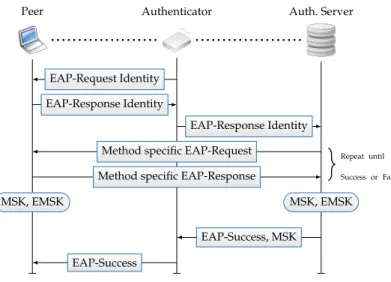
2.2 A generalized EAP message flow. . . 30
2.3 The format of RADIUS packets. . . 32
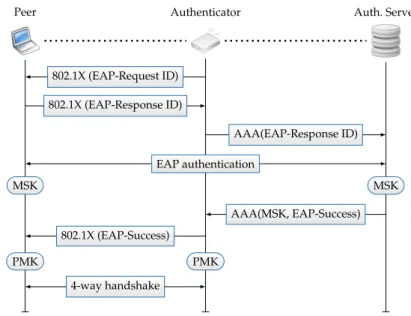
2.4 Message flow of the EAPOL protocol. . . 35
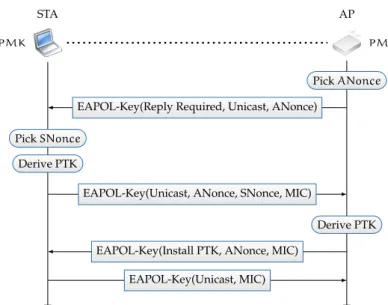
2.5 Message flow of the IEEE 802.11i 4-Way handshake. . . 36
2.6 Comparing the IPsec tunnel modes. . . 39
2.7 Comparing the IPsec transport modes. . . 39
3.1 An exemplary WMN architecture. . . 49
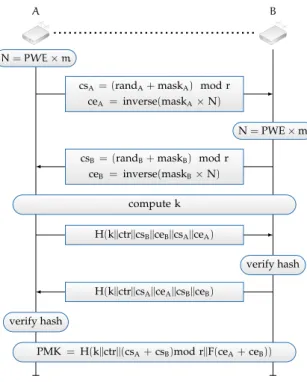
3.2 The message flow of the ECC-based SAE Protocol used in the IEEE 802.11s amendment. . . 61
4.1 The exemplary setup of the ITsec testbed. . . 77
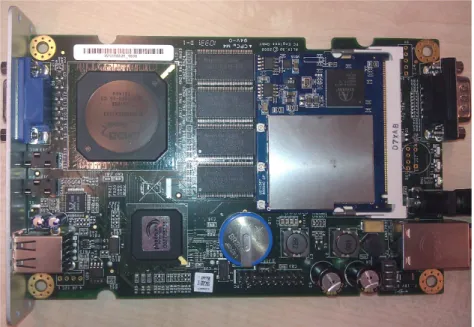
4.2 An exemplary view of the internals of an ALIX.3D3 board. . . 78
4.3 An overview on the architecture of the pwrmesh software. . . 80
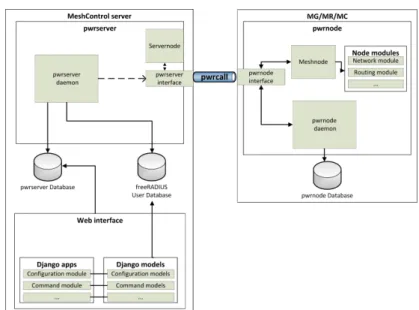
4.4 An excerpt of the node view of pwrmesh showing the details of meshrouter16along with a map. . . 81
4.5 An example of the deploy view of pwrmesh showing a selection of functionalities. . . 82
4.6 The packet loss ratio in the ITsec testbed . . . 83
4.7 The average round trip times in two different setups. . . 84
4.8 The average throughput of the ITsec testbed. . . 84
5.1 The messag flow of the 3PFH protocol. . . 97
5.2 The Framework for establishing Security Associations for Sequentially Deployed WMN (FSASD)key hiearchy derived from the EMSK. . . 100
5.3 The message flow of the 3PHSD protocol. . . 104
5.4 Dividing a WMN into logical FAU Sub-Domains using the AAA server as the top level controller. . . 108
5.5 The FSASD key hierarchy extended such that FAU support is enabled. 109 5.6 The security associations in a FAU-enabled WMN. The colors used correspond to Figure 5.5. . . 110
5.7 EAP-TTLS/PAP runtime with respect to wireless hops and IPsec usage between the MC and the AAA server. . . 116
5.8 3PHSD runtime using SCTP (red) and UDP (blue). . . 118
6.1 An abstraction of the multi-operator network model used in this thesis.127 6.2 The domain specific FSASD key hierarchy for the Operatorsπandψ. 129 6.3 Authentication ofMCψπ which is roaming in the FN of Operatorπ. . 131
6.4 Bootstrapping an IPsec SA between the roamingMCψπ andMGψψof the MC’s HN. . . 132
6.5 Bootstrapping an IPsec connection from the roamingMCψπ to an MG of the FN. . . 134
6.6 AuthenticatingMRψπ in the domain of Operatorπ. . . 135
6.7 Authenticating arbitrary devices in the domain of Operatorπ. . . 137
7.1 The general idea of the 3PHSH protocol. . . 149
7.2 The 3PHSH protocol message flow. . . 149
7.3 The general idea of the NPA protocol. . . 150
7.4 The NPA protocol message flow. . . 151
7.5 The general idea of the ENPA protocol. . . 152
7.6 The ENPA protocol message flow. . . 153
7.7 The attribute format used by the ENPA protocol. . . 153
7.8 The PMK format used by the ENPA protocol. . . 154
7.9 A snippet of the domain specific FSASD key hierarchy including keys used by the logical FAU domains. . . 156
7.10 The general purpose evaluation topology that is used for 3PHSH, NPA, and ENPA. . . 159
7.11 Runtime of 3PHSH comparing TCP and UDP over various distances. 160 7.12 The NPA evaluation topology allowing distance variations to the TMRs. . . 160
7.13 The NPA star topology focussing on the amount of requested TMRs. 161 7.14 This figure shows the duration after NPA message M2 containing the PMK is received at the TMRs for various distances using TCP and UDP. . . 161
7.15 This shows the runtime of NPA until the last TMR has received the PMK. . . 162
7.16 This figure shows the runtime of NPA with regards to the distance be-tween the TMR and the AAA server. Here onlyoneTMR is requested by the MC. . . 163
7.17 This figures shows the effect of including varying numbers of IP addresses in the ENPA messages received a theMesh Client (MC). . . 164
List of Figures 5 7.18 This figure shows the duration of scanning each channel using IEEE
List of Tables
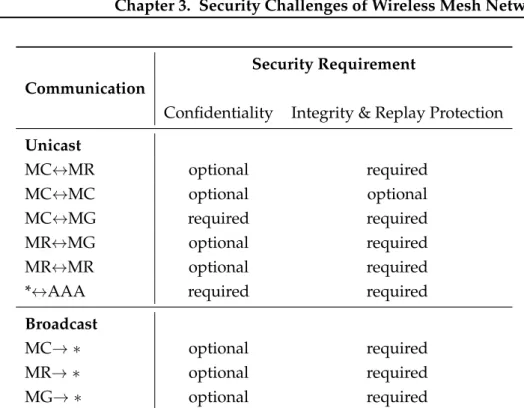
2.1 The IEEE 802.11 beacon frame body. [IEE99] . . . 37 2.2 The IEEE 802.11 Vendor-Specific Information Element format. . . 38 3.1 An overview on the security requirements for the differentcommu-nication patterns in WMNs. . . 56 3.2 A summary of the characteristics & the security requirements of the
compared architectures. . . 67 3.3 The mobility functionalities of the compared architectures. . . 68 4.1 This table compares different WMN testbeds on a general level. . . . 88 5.1 The various key types, key lengths & purposes used in FSASD. . . . 102 5.2 Protected communication patterns in a WMN secured by FSASD. . . 114 7.1 This table summarizes the protocol properties of 3PHSH, NPA, and
ENPA. . . 155 7.2 A comparison of the theoretical handover duration for
bootstrap-ping asinglehandover destination. Note that only NPA and ENPA are capable of bootstrapping multiple handover destinations in one protocol run. . . 159 7.3 This table summarizes the security analysis respective to RFC4962. . 167
C
H A P T E R1
Introduction
Nowadays, mobile telecommunication networks (e.g. 3G networks) andWireless LANs (WLANs)co-exist and compete to provide Internet access to mobile users. Over time the number of users with data subscription plans to mobile operators has constantly increased. This has already begun to spark business models aiming to off-load traffic to WLANs. The available bandwidth and speed of a 3G connections is often too slow to enable multimedia applications such as video streaming. This is mostly related to the varying coverage quality in such networks and the large user base in cells. On the one hand operators must heavily invest in expensive hardware to increase network quality. But on the other hand, the immediate Return of Investment (ROI) is far from being clearly defined. Thus, operators usually cap the tariffs in terms of amount of data, e.g., significant speed reduction after consuming 500MB.
IEEE 802.11 WLAN coverage on the other hand is widely available in many places: private individuals operate WLANAccess Points (APs)at their homes, uni-versities and companies provide wireless access to their students and employees, commercial operators provide access at hotels, airports, coffee shops, and other public places. Even to a point of WLAN pollution where the amount of APs de-creases the network quality for all users. Usually these networks are either operated by private individuals with a very limited user group, or they are operated by a commercial entity that requires user registration. This results in a collection of connectivity bubbles, each of different quality and administrative domain.
In order to address these issues many so-called community WLAN networks have been initiated, e.g., Freifunk or Fon1. The point being, a community offers their collective WLAN access to their members. Each member must contribute their private WLAN to be able to profit from access elsewhere. However, this approach has some downsides. Usually private individuals are responsible for the traffic that is transmitted from their network to other networks, e.g., the Internet. As such, they can also be held accountable in a legal sense for any illegitimate or malicious traffic generated by their users. Also, it is non-trivial to enable WLAN access to community members while protecting traffic from being eavesdropped on or manipulated by
IEEE Radio Communications • September 2005 S24
formed using one type of radios on devices. Thus, a Client WMNis actually the same as a conventional ad hoc network. However, the requirements on end-user devices is increased when compared to infrastructure meshing, since in Client WMNs the end-users must perform additional functions such as routing and self-configuration.
Hybrid WMNs.This architecture is the combination of infrastructure and client meshing, as shown in Fig. 2. Mesh clients can access the network through mesh routers as well as directly meshing with other mesh clients. While the infra-structure provides connectivity to other networks such as the Internet, Wi-Fi, WiMAX, cellular, and sensor networks, the routing capabilities of clients provide improved connectivity and coverage inside WMNs.
The characteristics of WMNs are outlined below, where the hybrid architecture is considered for WMNs, since it com-prises all the advantages of WMNs:
• WMNs support ad hoc networking, and have the capability of self-forming, self-healing, and self-organization. • WMNs are multi-hop wireless networks, but with a wireless
infrastructure/backbone provided by mesh routers. • Mesh routers have minimal mobility and perform dedicated
routing and configuration, which significantly decreases the load of mesh clients and other end nodes.
• Mobility of end nodes is supported easily through the wire-less infrastructure.
• Mesh routers integrate heterogeneous networks, including both wired and wireless. Thus, multiple types of network access exist in WMNs.
• Power-consumption constraints are different for mesh routers and mesh clients.
• WMNs are not stand-alone and need to be compatible and interoperable with other wireless networks.
Therefore, WMNs diversify the capabilities of ad-hoc net-works instead of simply being another type of ad hoc network. These additional capabilities necessitate new algorithms and design principles for the realization of WMNs.
Critical Design Factors
The critical factors influencing the performance of WMNs are summarized as follows.
Radio Techniques.Many approaches have been proposed to increase capacity and flexibility of wireless systems in recent years. Typical examples include directional and smart antennas, multiple input multiple output (MIMO) systems, and multi-radio/multi-channel systems.
To further improve the performance of a wireless radio and control by higher layer protocols, more advanced radio technologies, such as reconfigurable radios, frequency agile/cognitive radios, and even software radios, have been used for wireless communication. Although these radio tech-nologies are still in their infancy, they are expected to be the future platform for wireless networks due to their dynamic control capability. These advanced wireless radio technologies all require a revolutionary design in higher-layer protocols, especially MAC and routing protocols.
Scalability.Scalability is a critical requirement of WMNs. Without support of this feature, the network performance degrades significantly as the network size increases. For example, routing protocols may not be able to find a reliable routing path, transport protocols may loose connections, and MAC protocols may experience significant throughput reduction. To ensure the scalability in WMNs, all protocols from the MAC layer to the application layer need to be scal-able.
Mesh Connectivity.Many advantages of WMNs originate from mesh connectivity. To ensure reliable mesh connectivity, network self-organization and topology control algorithms are needed. Topology-aware MAC and routing protocols can sig-nificantly improve the performance of WMNs.
Broadband and QoS.Different from classical ad hoc net-works, most applications of WMNs are broadband services with heterogeneous QoS requirements. Thus, in addition to end-to-end transmission delay and fairness, more performance metrics, such as delay jitter, aggregate and per-node
through-FIGURE1. Infrastructure/backbone WMNs. Sensor networks Sensor Base station Base station Access point Wi-Fi networks WiMAX networks Cellular networks Sink node Internet Wireless mesh backbone Wired clients Wireless clients Mesh router with gateway Mesh router with gateway/bridge Mesh router with gateway/bridge Mesh router with gateway/bridge Mesh router with gateway/bridge Mesh router with gateway Mesh router
Figure 1.1:Wireless Mesh Network Architecture [AW05]
other community members. In consequence the acceptance of such approaches usually suffers.
In terms of commercial operators it is typically required for users to register sep-arately with each operator. Additionally, adding new infrastructure to a commercial WLAN can be quite cumbersome and expensive as a wired connection from the backbone to the new access point is required and communication protocols may not be standardized.
It would be straightforwardly beneficial for all involved entities to increase the connectivity by leveraging a greater coverage area. A flexible, easy, and on-demand extension of the infrastructure can be achieved by so-calledWireless Mesh Networks (WMNs). Parts of this technology have also been standardized by the IEEE based on WLAN [IEE99] and other networking technologies such as WiMAX [IEE12]. In general, a WMN consists of a hierarchy of nodes that are wirelessly connected with each other (see Figure 1.1). On top of the hierarchy,Mesh Gateways (MGs)provide access to other networks, typically the Internet, and route traffic from the mesh to the Internet and vice versa. On a second hierarchy level,Mesh Routers (MRs)route traffic within the wireless mesh. On a third level,Mesh Clients (MCs)are connected to the network via MRs that serve the clients as points of network attachment. Finally, in WMNs, some MCs are able to route traffic for other MCs and thus act as MCs and MRs simultaneously. Within a wireless mesh network different communication patterns exist. MCs communicate directly with MRs, and with MGs and other MCs; MRs communicate with each other and with MGs. All the communication patters originating from MCs, MRs, and MGs have to be authenticated and adequately
13 protected against eavesdropping and manipulation.
Today, WMNs are mostly considered to be operated by a single operator which is also reflected by standardization efforts. For the future, however, we do not only envision WMNs operated by different commercial operators to inter-operate, but also a convergence of commercial and community networks. In such a converged mesh network multiple commercial operators cooperate, such that MCs can obtain network access via MRs operated by any of the commercial operators and yet obtain a single bill (roaming). Private individuals contribute their access points to the converged WMN. In contrast to community networks individuals are compensated for the use of their access points by other participants. MCs can be configured to act as MR for other MC in the converged network and be compensated. Thus, in our envisioned converged mesh networks an oligarchy of operators ranging from commercial operators to private individuals with their mobile equipment will be supported. In addition, we envision such converged networks to support mobility of MCs (seamless handover) as well as mobility of infrastructure components. Seamless mobility for MCs is crucial for real-time applications such voice or video conferencing, and video streaming. Supporting MR mobility allows, e.g., for easy re-connection on relocation of a private individual contributing its WLAN AP, or on setup and tear-down of APs contributed by commercial or public entities in case of temporary events.
In order for all participants to accept and profit from the envisioned converged mesh, it is crucial to ensure that it does not lead to financial losses to the involved commercial and private entities, and that it meets the functional requirements even in the presence of malicious and selfish MCs, MRs or MGs. Within this thesis we develop new security mechanisms that address security for WMNs as whole. We propose mechanisms for bootstrapping security associations, multi-operator networks including infrastructure sharing, roaming, and handover services. Finally, to demonstrate their practicality, all developed mechanisms have been implemented and evaluated using current off-the-shelf hardware.
1.1. Contributions 15
1.1
Contributions
This thesis addresses the security issues of WMNs on a general level by proposing a comprehensive multi-operator enabled security architecture including bootstrap-ping, key management, and handover capabilities. In the following we summarize our main contributions.
At first, we contribute significantly to analyzing the security issues of WMNs on a general level in Chapter 3. While there is consensus on the importance of the main security challenges of WMNs, prior work has not yet led to generally accepted security requirements. In particular, existing proposals for security architectures for WMNs tend not to address WMNs as a whole, but rather concentrate on one or two specific characteristics and design security mechanisms that meet the se-curity requirements for these specific characteristics. We step back to classify and characterize WMNs as a whole. This high-level vantage point helps us to define general security requirements and identify unique challenges to meet these require-ments with respect to the characteristics of WMNs. We then use this framework of requirements and characteristics to evaluate state of the art proposals ranging from standardization efforts of the IEEE to results from academia.
André Egners and Ulrike Meyer:Wireless Mesh Network Security: State of Affairs, 35th IEEE LCN 2010, Denver, USA [EM10]
In recent years many testbeds for WMNs have been implemented to testing and evaluating different aspects of WMNs, however, none of these have been designed with testing and evaluating security mechanisms for WMNs in mind. In Chapter 4 we share from the experience of designing a testbed dedicated to test and evaluate security protocols in a realistic setting. We detail the hardware and software setup of our testbed, the management tools we developed to facilitate maintenance of our testbed, along with several pitfalls we encountered during the setup. This testbed is used in all subsequent chapters to evaluate the developed security mechanisms. The testbed is also continued to be used for further research activities. As such, our testbed significantly contributes to enabling practical research and feasibility evaluations.
From Security Research Using a Wireless Mesh Network Testbed, 38th IEEE LCN 2013, Sydney, Australia [EHJM13]
A number of security architectures have been proposed for WMNs, however, none is a comprehensive solution. We propose a comprehensive security framework based on open standards and well scrutinized security protocols in Chapter 5 solving the well knownbootstrapping problem. In particular, our framework allows for mutual authentication between any node and the AAA server based on any desired type of AAA credentials; supports the removal of any network node (e.g., a compromised MR); solves the problem of bootstrapping security associations required for the end-to-end protection of the different traffic types within a WMN in a highly efficient way; supports end-to-end protection with the help of standardized, well-scrutinized protocols, namely EAP for node authentication, 802.11i CCMP for link layer protection and IPsec ESP for network layer multi-hop traffic and supports secure proactive handovers of moving MCs (or MRs) from one point of network attachment to another. Additionally, we introduce a new component that allows to split an administrative WMN domain into logical sub-domains. This has the potential to significantly speed up handover protocols.
André Egners, Hendrik Fabelje and Ulrike Meyer:FSASD: A Framework for establishing Security Associations for Sequentially Deployed WMN, 13th IEEE
WoWMoM 2012, San Francisco, USA [EFM12]
While previous security research of WMNs mainly focused on single-operator networks, we propose an extension of our comprehensive security architecture for multi-operator WMNs. Our proposal (cf. Chapter 6) allows for a secure deploy-ment of infrastructure components (routers and gateways) as well as MCs. The multi-operator support of our architecture does not only cover MC roaming, but also the deployment of infrastructure components of one operator in the adminis-trative domain of the other operator. Our architecture is the first to support secure infrastructure sharing between operators. Additionally, our solution is based on open standards and protects traffic generated by mesh clients from insider attackers such as compromised MRs, MRs operated by malicious operators, and curious or malicious routing MCs.
André Egners and Ulrike Meyer:Secure Roaming and Infrastructure Sharing for Multi-Operator WMNs, 28th ACM SAC 2012, Coimbra, Portugal [EM13]
1.1. Contributions 17
The main contributions of Chapter 7 are three complementary secure and effi-cient handover protocols for WMNs that can be used by all devices, including the network infrastructure. One of these protocols allows to pro-actively supply candi-dateTarget Mesh Routers (TMRs)with keying material as part of the initialExtensible Authentication Protocol (EAP)authentication of a device joining the WMN. The other two protocols can be run at any point in time after successful authentication. The first of these protocols allows several TMRs to be pro-actively supplied with keying material, but the device requiring handover cannot be sure that these TMRs have already received the keying material at the end of the protocol run. The second protocol has the advantage that a device initiating the protocol can be certain that the TMR has received the keying material when the protocol finishes. Additionally, we extend the protocols to be usable in a multi-operator contexts. We implemented and evaluated our protocols using our testbed and integrated them into the de-facto standard WLAN software hostapd and wpa_supplicant.
André Egners, Patrick Herrmann and Ulrike Meyer:Secure and Efficient Handover Protocols for WMNs, 14th IEEE WoWMoM 2013, Madrid, Spain [EHM13]
Previous proposals on WMN security mainly focus on mesh networks operated by a single operator and rarely support mobility of MCs with the help of secure roaming and handover procedures. While these approaches protect the communi-cation of MCs against external attackers, they do not take internal attackers into account. In our previous publications we proposed a security architecture for single-operator WMNs, extended this architecture to the multi-single-operator case to support roaming between operators and secure infrastructure sharing and proposed secure handover procedures within the domain of a single operator. In this paper we merge the different aspects of our prior proposals together to form a comprehensive security architecture for multi-operator WMNs. Our solution is based on open standards and explicitly addresses internal attackers. In addition, we propose pro-active handover services between different operators and show how dedicated MRs can take over authentication services in time critical situations such as handover procedures.
André Egners, Patrick Herrmann, Ulrike Meyer:Multi-operator Wireless Mesh Networks secured by an all-encompassing Security Architecture, International Journal of
After summarizing the contributions of this thesis we continue with the roadmap stating how we detail the individual concepts.
1.2
Roadmap
This thesis continues with Chapter 2 which introduces basic concepts, building blocks and technologies that are of importance for this work. We start by detailing EAP as the standard mechanism for authentication in wireless networks, specifi-cally in IEEE 802.11 WLAN networks. EAP is an extensible protocol framework including authentication methods and message transport. We further discuss the EAP-Tunneled Transport Layer Security (EAP-TTLS) as the authentication method which is subsequently leveraged by our security architecture. EAP-TTLS tunnels an additionalinnerauthentication method inside of an end-to-end encryptedTransport Layer Security (TLS)tunnel from the EAP peer to the EAP server.
After discussing EAP, we continue with theRemote Dial-in User Service (RADIUS) protocol which encapsulates EAP on the network layer between theNetwork Access Server (NAS)and theAuthentication, Authorization and Accounting (AAA)server. The RADIUS/AAA/EAP server is responsible for authentication and authorization of network devices and users. It stores the necessary credentials, generates keys and transports them to the NAS a device is authenticating from. The originally intended setup uses a wired backbone, thus, the traffic between NAS and AAA server cannot be easily eavesdropped on. However, the key transport messages themselves are only barely secured.
We then introduce the IEEE 802.11 WLAN standard and how both, EAP and RADIUS are used to authenticate wireless devices. This also includes the discussion of the 4-way handshake which is used to establish a link layer security association between the Station (STA) and the AP. We also include a section on the IEEE 802.11u [IEE04b] amendment. It intends to improve interworking with external networks, such as the mobile communication networks. However, it also introduces very useful features for network discovery and AP selection. It allows to include so-called vendor specificInformation Elements (IEs)in the IEEE 802.11 wireless beacon. This is a particularly interesting feature which is used in this thesis during handover (cf. Chapter 7) and to announce node types used for optimizing the key distribution (cf. Section 5.3).
Chapter 2 closes by elaborating onInternet Protocol Security (IPsec), a mechanism to secure multi-hop communication on the network layer between two endpoints or networks. We detail the most important features of IPsec such as its tunneling and transport modes.
After having set the necessary technical foundations, this thesis continues by discussing the security challenges of wireless mesh networks in Chapter 3. We start
1.2. Roadmap 21 by introducing the general terms of WMNs such as the different architecture and node types. We then turn to the security challenges of WMNs.
Once we have briefly discussed the related work in researching the security challenges in WMNs, we follow by defining an attacker model for the works subse-quently presented in this thesis. Attackers are defined with respect to being external and internal, as well as to their respective capabilities.
Next, the security requirements of WMNs are defined by considering all pos-sible communication patterns, e.g., MC to MG communication. All patterns are analyzed with respect to the security requirements ranging from confidentiality to non-repudiation. Additionally, we broaden these requirements by considering specific challenges and scenarios in WMNs, e.g., single- and multi-operator WMNs, heterogeneity of wireless links and mobility of network clients as well as mobility of the network infrastructure.
Subsequent to having the security requirements and communication patterns for WMNs exemplified, we use them as a framework to evaluate a selection of prominent related work which claims to address security of WMNs in a compre-hensive way. This includes the IEEE 802.11s mesh networking amendment, as well as proposals from the research community.
In Chapter 4 we introduce a WMN testbed developed for the purpose of the security research put forth in this thesis. We discuss the requirements that we have towards the testbed and detail the overall architecture, the hardware, the software that we use and mechanism for node management. Additionally, we elaborate on pitfalls that we discovered during setting up the testbed and using it for evaluating our research. Besides shortly discussing other WMN testbeds, we also include a general performance evaluation of the testbed, i.e.,Round Trip Time (RTT), throughput, latency and also the performance impact of using cryptographic acceleration cards.
Chapter 5 proposes a framework to bootstrap security associations for WMNs. It represents the foundation of the architecture extensions detailed in the subsequent chapters and addresses all the requirements deduced in the previous chapters. By using EAP-based authentication of all nodes in the network, we are able to extend the EAP security framework by leveraging the presence of the Extended Master Session Key (EMSK). This key serves as the root in an extensible key hierarchy which both node and authentication server share after successful authentication. Based on this key hierarchy we bootstrap various security associations, e.g., for the purpose of secure key transport using EAP/RADIUS in a wireless multi-hop domain. Our framework also allows to split a WMN domain into multiple logical sub-domains for the purpose of speeding up key management protocols and handover (cf.
Chap-ter 7). This extension is similar to the multi-operator architecture we propose in Chapter 6. The key management framework is also thoroughly evaluated with respect to performance and is implemented using our WMN testbed.
After detailing our security architecture in a single-operator context, we extend our concept to a multi-operator scenario in Chapter 6. We use the notion of so called domain specific keys to extend our key hierarchy. By exporting a copy of the key hierarchy, which is specific to the respective domain, all the security associations that are valid in the single operator concept, can also be used in a multi-operator scenario. Additionally, we introduce the previously unknown notion of mixed networks, in which different operators contribute their devices collaboratively forming a single network.
In Chapter 7 we continue by extending our security architecture even further. The context of WMNs and oblivious network coverage implicates the capability of seamless handover from one wireless access point to the next. We propose three proactive handover protocols for WMNs that leverage the security architecture of Chapter 5 and the multi-operator extension presented in Chapter 6. Our protocols allow to bootstrap handover keys, i.e.,Pairwise Master Keys (PMKs)used during the IEEE 802.11i 4-way handshake. This allows us to reduce the overall handover delay to a minimal level as the keys are deployed before initiating the actual handover. We also evaluate the handover protocols using our WMN testbed described in Chapter 4.
Last, Chapter 8 and Chapter 9 conclude this thesis by summarizing the prior chapters and providing an outlook to future research in this area.
Part I
C
H A P T E R2
Ingredients
This chapter introduces the basics concepts and techniques that are required for this thesis. After generally introducing the operation of theExtensible Authentication Protocol (EAP)and specificallyEAP-Tunneled Transport Layer Security (EAP-TTLS), we continue with the Remote Dial-in User Service (RADIUS) protocol. Next, we detail how the former mechanisms are used with the IEEE 802.11 [IEE99]Wireless LAN (WLAN)standard to facilitate authentication, authorization, and accounting for WLAN devices. Also we shortly introduce the secureRemote Procedure Call (RPC) framework pwrcall. Last, we presentInternet Protocol Security (IPsec)as a general purpose mechanism to secure network layer traffic between two hosts or networks.
2.1
Extensible Authentication Protocol
EAP is specified in Request For Comments (RFC) 5247 [ASE08] as an extensible framework supporting multiple different authentication methods. It is specified to be network layer agnostic, thus, the RFC also defines the basic concept of the lower layer. Typically, data link layers such asIEEE (IEEE) 802 are used. EAP is used in IEEE 802.1X [IEE10] for Port-Based Network Access Control. As no transport protocol such asTransport Control Protocol (TCP)is used, the protocol itself must keep state of the ongoing sessions.
Figure 2.1 shows the EAP stack. The primary goal is to authenticate the peer to the authentication server. The peer and thepass-throughauthenticator, typically referred to as the authenticator, communicate using an EAP lower layer. In order to
EAP lower EAP layer EAP peer EAP method EAP lower EAP layer EAP peer/auth. AAA/IP EAP layer EAP auth. AAA/IP EAP layer EAP auth. EAP method Peer Pass-through Authenticator Auth. Server
Auth. Server Authenticator Peer EAP-Request Identity EAP-Response Identity EAP-Response Identity
Method specific EAP-Request
Method specific EAP-Response
Repeat until Success or Fail MSK, EMSK MSK, EMSK EAP-Success, MSK EAP-Success
Figure 2.2:A generalized EAP message flow.
send the EAP messages from the pass-through authenticator to the authentication server, the latter encapsulates the messages inAuthentication, Authorization and Ac-counting (AAA)messages. Communication between the pass-through authenticator and the authentication server is IP-based.
The basic message flow of EAP is depicted in Figure 2.2. First, the authenti-cator sends anEAP-Request-Identityframe to the peer which responds with an EAP-Response-Identitycontaining peer’s identity. The authenticator forwards this message to the authentication server. Next, the authentication server and the peer agree upon which EAP authentication method is to be used.
If the chosen EAP method iskey generating, two keys will be generated by the peer and the authentication server: theMaster Session Key (MSK)and the so-called Extended Master Session Key (EMSK). The MSK is sent by the authentication server in theEAP-Successmessage to the authenticator which may use it for further tasks. In the context of IEEE 802.11i the first 256 bits of the MSK are used as the input key for the 4-way handshake (cf. Section 2.3). This handshake is used to derive keys which are used to protect the communication on the data link layer between the Station (STA)(peer) and theAccess Point (AP)(authenticator).
The second key is the EMSK which must neither leave the peer nor the au-thentication server. It is reserved for future use as specified in RFC 5247 [ASE08]. If an EAP method is key generating it has to ensure that both the peer and the authentication server are mutually authenticated.
2.2. Remote Dial-in User Service 31
2.1.1 EAP-Tunneled-TLS
EAP-TTLS [PF08] is a key generating EAP authentication method which extends the Transport Layer Security (TLS)[DR08] protocol. It provides authentication of the AAA server using standard TLS procedures. As EAP-TTLS istunneled, it may encapsulate authentication protocols such as thePeer Authentication Protocol (PAP) or another EAP method, calledinnermethod for peer authentication. This is for instance important to protect password based authentication methods against eaves-dropping or man-in-the-middle attacks.
EAP-TTLS additionally allows to carry so calledAttribute Value Pairs (AVPs). Using such AVPs enables to send vendor specific information from the client to the EAP-TTLS server in an end-to-end secured manner. The AVP format of EAP-TTLS is equivalent to the AVPs used by Diameter [PJE+03] which is the logical succession
of the RADIUS protocol (cf. Section 2.2). However, while not using Diameter, it is possible to map these AVPs to RADIUS attributes.
2.2
Remote Dial-in User Service
RADIUS is specified in RFC 2865 [RRSW97]. It is a protocol that carries information to perform authentication, authorization, and accounting. In order to keep the protocol and the implementation simple, RADIUS uses theUser Datagram Protocol (UDP). This means that RADIUS must handle retransmission of packets itself. In case one server fails, the packet must be resent to another server.
Four types of packets are defined to be passed between RADIUS server and Network Access Server (NAS):Access-Request,Access-Accept,Access-Reject, and Access-Challenge. A NAS acts as the RADIUS client and communicates with the RADIUS server. The packet format is depicted in Figure 2.3 and includes transport attributes that provide specific information such as the NAS-IP-Address (typically an AP) and attributes that allow authentication and authorization, e.g., the User-Name and User-Password attributes. User information is transported within theAccess-Request. Multiple round trips for authentication are possible by having the server send anAccess-Challenge and the client answering with anAccess-Request. At the end of an authentication exchange, the RADIUS server replies with anAccess-Rejector Access-Acceptto the NAS. RADIUS server and NAS share a secret which essentially represents an ASCII string. Passwords in RADIUS packets are obfuscated using the shared secret and MD5 [Riv92].
RADIUS packets have an 128 bit authenticator, such that the NAS is able to verify whether it received the packet from the correct RADIUS server. For the Access-Requestthis value is randomly chosen by the NAS and the reply contains the
0 1 2 3 4 5 6 7 8 9 10 11 12 13 14 15 16 17 18 19 20 21 22 23 24 25 26 27 28 29 30 31
Code Identifier Length
Request/Response Authenticator Attributes hhh hhhhhh hhhhhh hhhhhh hhhhhh hhhh h h h h h h h h h h h h h h h h h h h h h h h h h h h h h h h
Figure 2.3:The format of RADIUS packets.
respective authenticator (cf. Equation2.1, “||“ denoting concatenation). TheRequest Authenticatorauthenticates the packet the server replies to while the other fields of the received packet (Code, ID, Length, and the Attributes) are protected in the same manner. The parameterSecretis shared between the RADIUS server and the client (NAS).
ResponseAuthenticator=MD5(Code||ID||Length
||RequestAuthenticator||Attributes||Secret) (2.1)
Encapsulation of EAP-Messages in RADIUS messages is based on RADIUS attributes (cf. Figure 2.3) [AC03]. In order to indicate the attribute type, the Type field is used. If the attribute encapsulates an EAP message, the Type field is set to 79. To indicate a vendor-specific attribute the type must be set to 26. The actual data is contained in the Value field following the one byte long Length field which indicates the size of the attribute. The length includes the Type, Length, and the Value field. Thus, the payload that can be stored in a Value field is bound to6253 bytes
2.2.1 Attacking RADIUS
As already identified in the original RFC on RADIUS [RRSW97], the protocol is vulnerable to a dictionary attack on the RADIUS secret. The vulnerability is of special relevance in multi-hop wireless networks such asWireless Mesh Networks (WMNs). Opposed to infrastructure WLAN where APs are connected by wire to the network’s backbone, WMNs have a wireless backbone. Therefore, RADIUS traffic
2.3. Wireless LAN 33 may be eavesdropped on every wireless hop in between the AP and the RADIUS server. In order to evaluate and demonstrate the practical relevance of this attack, we implemented it and measured the performance of our implementation. Our results corroborate the relevance of the dictionary attack on the RADIUS secret when the RADIUS traffic is not additionally secured.
There are two weaknesses in how the RADIUS secret is used to protect RADIUS communication. First, the same RADIUS secret is used to protect the confidential-ity of sentPairwise Master Keys (PMKs)in a RADIUSAccess-Accept, as well as for integrity protection, i.e., computing the Response-Authenticator of the RADIUS packets. Second, theResponse-Authenticator(Equation2.1) is computed by replacing the Authenticator Field with theRequest-Authenticator, which is the nonce from a RADIUS request, and appending the RADIUS secret, which is an ASCII passphrase to this packet. The Response-Authenticator is then computed by applying MD5. Dic-tionary attacks are possible by computing the Response-Authenticator by guessing RADIUS secrets and comparing the results to the expected Response-Authenticator. Since different possible passphrases can be tested in parallel, an offline distributed dictionary attack against the RADIUS secret is possible. Because the RADIUS secret is appended to this buffer and the beginning of the buffer containing the RADIUS packet does not change, it is not necessary to recompute MD5 blocks containing this data.
As MD5 operates on blocks of 64 bytes, the MD5 state can be computed once, and only the last block of MD5 containing the RADIUS secret and the necessary padding will have to be computed for each of the guessed passphrases. This construction of the MD5 authenticator allows to improve the speed of a dictionary attack. Using an Intel Core-i7 870 processor, the speedup of running this optimized attack in parallel against the sequential unoptimized algorithm has been evaluated. A single thread attack allowed a speedup of 3.42. Using two threads, a speedup of 6.92 has been achieved, a speedup of 12.34 using four threads, and a speedup of 15.43 using eight threads. The speed using eight threads is equivalent to testing 36, 428, 055 different RADIUS secrets per second. Therefore, a network allowing unprotected RADIUS traffic is potentially vulnerable to this attack. An attacker only needs to eavesdrop twopackets in order to allow the described attack.
2.3
Wireless LAN
The IEEE standard 802.11 [IEE99] specifies theMedium Access Control (MAC)and thePhysical Layer (PHY)for wirelessLocal Area Network (LAN). The standard adepts the MAC and the PHY to the special requirements of WLANs. For example, the
wireless medium is unprotected from other signals in the environment, so that interference with other signals is likely. Also all signals can easily be eavesdropped by an attacker in range. The latter is addressed by amendment 802.11i [IEE04a] which specifies authentication, key management, and the link layer security between client and access point.
The IEEE 802.11 allows for two operating modes, i.e., thead hocand the infras-tructuremode. In thead hoc mode two STAs recognize each other and establish a peer-to-peer association to form an Independent Basic Service Set (IBSS). In the infrastructuremode all STAs connect to a central entity, i.e., the AP. It is able to bridge data between all STAs associated to it. An AP and its associated STAs form a so calledBasic Service Set (BSS). Extending, a collection of APs form the so called Extended Service Set (ESS). An ESS uses the sameService Set ID (SSID)across all BSSs. Also, a so called Portal, usually co-located with an AP, may be present. It connects a BSS with other networks, e.g., to the Internet.
In order for a STA to connect to a BSS it has to discover available APs. This can either be achieved byactiveorpassivescanning. Active scanning involves the STA sending out sequential probe requests on each channel. The AP replies with a probe response frame which contains the SSID,Basic Service Set Identifier (BSSID), sup-ported rates, and its security capabilities. The SSID represent the human readable name of the BSS, whereas the BSSID typically relates to the AP’s MAC address.
Passively scanning results in the STA listening for beacons sent out by the APs. A beacon is typically sent every 100 ms.
To associate with the AP the STA needs to initiate the Open System authentica-tion [IEE04a]. The first of two messages is the Open System authenticaauthentica-tion request. The AP replies with an Open System authentication response which may already indicate success. Next, the STA issues an association request which includes the desired SSID and the supported rates. Finally, the AP confirms the supported data rates and the session ID.
802.11i Security. In pre-802.11i deployments the STA would now be able to fully access the network. While private networks typically use pre-shared key mech-anisms, enterprise network requires the STA to unlock the 802.1X [IEE10] port, mapped to the newly created association. In order to unlock the port, the STA has to perform an EAP authentication (cf. Section 2.1) usingEAP Transport Over LAN (EAPOL)which is a protocol that runs between STA and AP. EAP packets are encapsulated by EAPOL in Layer 2 frames. The message flow is shown in Figure 2.4.
2.3. Wireless LAN 35 Auth. Server Authenticator Peer 802.1X (EAP-Request ID) 802.1X (EAP-Response ID) AAA(EAP-Response ID) EAP authentication MSK MSK AAA(MSK, EAP-Success) 802.1X (EAP-Success) PMK PMK 4-way handshake
Figure 2.4:Message flow of the EAPOL protocol.
(peer). The STA replies with an EAPOL-Response frame which contains its identity. Now, the AAA server and the STA execute an EAP method. An EAP method which is key generating must be used to ensure that after its execution the STA and the AAA server are in possession of the MSK. The AAA server then delivers the MSK to the AP. Upon receipt of the AAA success message, the AP sends an EAPOL-Success frame to the STA.
Now, the STA and the AP are in possession of the so called PMK which consists of the first 256 bits of the MSK. It is subsequently used to create a link layer security association between STA and AP by running the 4-way handshake. The purpose of this handshake is to explicitly confirm that both parties are in possession of the PMK. Also, the PMK is used to derive freshPairwise Transient Keys (PTKs)to protect the communication between STA and AP on the link layer.
Figure 2.5 shows the message flow of the 4-way handshake. First, the AP picks a random nonceANonceand sends it to the STA. This frame is not yet protected by any security mechanism. Now the STA picks a nonce, calledSNonceand derives the PTK using thePseudo Random Function (PRF)shown in Equation2.2.
PTK=PRF(PMK, ANonce||SNonce||AP MAC-Addr||STA MAC-Addr) (2.2) First, the PRF is keyed with the PMK. The second parameter is a concatenation of the exchanged nonces and the MAC addresses of the AP and the STA. After generating the PTK, the STA sends its generated SNonce to the AP. This frame is already integrity protected by aMessage Integrity Code (MIC). Now, the AP derives
STA AP
PMK PMK
PickANonce
EAPOL-Key(Reply Required, Unicast, ANonce)
PickSNonce
Derive PTK
EAPOL-Key(Unicast, ANonce, SNonce, MIC)
Derive PTK
EAPOL-Key(Install PTK, ANonce, MIC)
EAPOL-Key(Unicast, MIC)
Figure 2.5:Message flow of the IEEE 802.11i 4-Way handshake.
the PTK and checks if the MIC of the received frame is correct. Afterwards, the AP instructs the STA toinstallthe PTK. Finally the STA confirms the installation of the PTK to the AP. Subsequent link layer traffic between the STA and the AP is now protected by using theTraffic Integrity Key (TIK)and theTraffic Encryption Key (TEK) which are derived from the PTK.
IEEE 802.11 Beacons. The IEEE 802.11 [IEE99] standard allows to define and transport so-calledvendor-specific Information Elements (IEs)which are transported inside of the wireless beacons broadcast by the APs.
Parts of the IEEE 802.11 beacon frame body are shown in Table 2.1. It contains the Robust Security Network (RSN)element which is used to provide information about security features of a device. Last the beacon frame specifies the vendor-specific IEs that are used to transport information that is not covered by the standard. The IE format is shown in Table 2.2.
The IE needs to contain theIdentification (ID)of the IE and is set to 221, identi-fying it as a Specific IE. A length field contains the length of the Vendor-/Specific content including theOrganizationally Unique Identifier (OUI). The OUI is defined by the vendor to specify the content. A single frame can contain multiple Vendor-Specific IEs which must have a different OUI to determine the subsequent content.
IEEE 802.11u. The IEEE 802.11u [IEE04b] has been amended to the IEEE 802.11 standard in 2012 and intends to improve interworking with external networks, such
2.3. Wireless LAN 37
Order Information Notes 1 Timestamp
2 Beacon interval 3 Capability 4 SSID
· · · ·
21 RSN RSN IE shall be present within Beacon frames gen-erated by STAs that gave dot11RSNAEnabled set to true.
· · · ·
Last Vendor/Specific
Table 2.1:The IEEE 802.11 beacon frame body. [IEE99]
as the mobile telecommunication networks. However, it also introduces interesting features for network discovery and AP selection. These new features are to be used in thepre-association phase, i.e., the STA is currently not connected, but scanning for available APs in its surrounding. The APs are supposed to be advertising their network type (private network, free public network, paid public network), roaming consortium (e.g. eduroam [WF05] and so-called venue information. They also provide aGeneric Advertisement Service (GAS), which should indicate the offered services using Layer 2 communication between the non-associated STA and the AP. Additionally, IEEE 802.11u introduced theAccess Network Query Protocol (ANQP). This protocol can be used to allow the STA to discover additional information about the network in its preassociation phase. They can for instance include:
. the name of the operator,
. available roaming partners at this AP,
. IP address (here the AP), including type and availability
and any other unspecified, but usefulmeta datawhich might be helpful to the STA. The above data is to be distributed using the IEEE 802.11 wireless beacons and vendor specific elements.
In the context of our handover protocols (cf. Chapter 7), we propose to use the IEEE 802.11u amendment to distribute this kind of useful meta information to the
1 1 3 Length−3 Element ID Length OUI Vendor/specific content
Table 2.2:The IEEE 802.11 Vendor-Specific Information Element format.
Mesh Clients (MCs). Additionally, the concept ofFSASD Authenticators (FAUs)(cf. Chapter 5) leverages this beacon functionality.
2.4
Internet Protocol Security
TheInternet Protocol Security (IPsec)suite has been originally proposed in 1995 in RFC 1825 [Atk95]. Since then, many subsequent RFCs have followed updating the standard [JLN11].
IPsec allows confidential, integrity protected, and authentic IP traffic between two endpoints. This can either benetwork-to-networkorhost-to-host. For instance, it is used to securely connect LANs at different branches of enterprises, secure remote access from Internet to Intranet (Virtual Private Network (VPN)), secure connections between individuals host, or routers.
Key security services provided by IPsec are:
. IP-packet-level origin authentication and integrity . Protection against replay attacks
. IP-packet-level encryption
. Limited traffic flow confidentiality
For this thesis the most relevant parts of IPsec are:
. Authentication Header (AH): authenticity and integrity of IP packets
. Encapsulating Security Payload (ESP): confidentiality, integrity, and authenticity of IP packets
. Security Association (SA): collection of key and cryptographic algorithms to be used with AH and ESP, SA establishment, e.g., usingInternet Key Exchange Protocol (IKE)
An IPsec SAs defines howInternet Protocol (IP)packets are to be secured between two endpoints. It consists of the destination IP, theSecurity Policy Identifier (SPI),
2.4. Internet Protocol Security 39 IP Header ESP Header IP Header IP Payload (TCP segment, UDP/ICMP message)
ESP Trailer
ESP Auth Trailer IP Packet
Encrypted with ESP Header
Authenticated by ESP Auth Trailer
(a)ESP-Tunnel mode.
IP Header AH Header IP Header IP Payload (TCP segment, UDP/ICMP message)
IP Packet
Authenticated by Authentication Header
(b)AH-Tunnel mode.
Figure 2.6:Comparing the IPsec tunnel modes.
IP Header
ESP Header
IP Payload (TCP segment, UDP/ICMP message)
ESP Trailer
ESP Auth Trailer IP Payload
Encrypted with ESP Header Authenticated by ESP Auth Trailer
(a)ESP-Transport mode.
IP Header
AH Header
IP Payload (TCP segment, UDP/ICMP message)
IP Payload
Authenticated by Authentication Header
(b)AH-Transport mode.
Figure 2.7:Comparing the IPsec transport modes.
e.g., AH or ESP, and a SPI number to identify the SA. As this is an unidirectional concept, an additional SA needs to be setup to secure bi-directional communication between two endpoints.
IPsec can be used intransportandtunnelmode. Transport mode only protects the IP packet payload. For example, AH in tunnel mode will encapsulate a packet using the authentication header and IP header. The packet is now authenticated and integrity protected. ESP in tunnel mode encapsulates the whole original packet in a new IP packet. Both, header and payload are secured. In any case, the unencrypted new tunnel headers are used to route packets from one endpoint to the other. The differences in encapsulation and which parts of the packet are secured in which manner are shown in Figure 2.6 and Figure 2.7.
AH can be used in both modes and is used to authenticate source and destination host of the communication. It protects the integrity of the IP packet payload and its headers by using a keyed hash function. ThisMessage Authentication Code (MAC)is included in the Authentication Header of the new packet.
ESP can also be used in both modes. It achieves source authentication, integrity and confidentiality, by adding a header, and a trailer including a MAC to the packet. The original IP payload is fully encrypted. In tunnel mode, also the IP header of the original packet is encrypted, thus, it provides some IP address privacy for traffic that is tunneled through an IPsec gateway.
Entity Authentication & Key Agreement. Since all mechanisms described above need cryptographic material, IPsec provides several key agreement and manage-ment protocols. For instance, one can install keys to be used with an SAs, i.e., inject a preshared key. In addition, there are protocols such as IKE,Internet Key Exchange Protocol v2 (IKEv2)[Kau10],Internet Security Association and Key Management Proto-col (ISAKMP)[MSST98] to allow automated key agreement and management for IPsec. The described protocols, message formats, and payloads for authenticated key exchange are used to establish full-fledged IPsec SAs.
An often voiced annoyance of IPsec is its complicated usage and key establish-ment which, additionally, is spread over multiple RFCs. This makes it particularly hard to use and implement, thus, likely inducing misconfiguration and defective implementations. For this purpose IKEv2 [Kau10] has been condensed into one single RFC. It has also reduced the overall protocol complexity by reducing the number of different phase one key exchanges. A directly usable SA is generated during the initial phase one exchange. Phase two exchanges are reduced to two messages with less complex parameters.
In this thesis, we use IPsec by injecting a shared secret key established during authentication or a subsequent authentication and key agreement protocol.
2.5
The pwrcall RPC Framework
In this section we shortly discusspwrcall, a framework for ”secure and lightweight distributed function calls’‘ [Sch11]. It is built onto the foundations of [MYS03] and [Spi07] using the simplicity of capabilities.
Capabilities Model
Capabilities have first been described in [DVH66] resembling an unforgeable token which is used to authorize access to an object. Since then the concept has made its way to operating systems and programming languages [Har85, SSF99, Mil06]. The object capability modelof [Mil06] does not differentiate between subjects and objects, but rather defines so-called non-primitive objects as a (code, state)-tuple. This state represents a set of references to certain other objects. Objects can send messages to each other and exhibit a certain behavior which is defined by their programming code. The messages between objects can carry references, thus, influence their computations. The design of [FN79] merges this notion with the functionality that objects know which type of access to it is allowed. This means that objects themselves can expose certain functions as capabilities to other objects to access. In
2.5. The pwrcall RPC Framework 41 order to access a certain resource it is required to possess the respective capability referencing the object.
Design Overview
In the following we describe the design of the pwrcall framework. The key features of the pwrcall framework are:
. using object-capability model,
. capability generation is based on symmetric encryption, . revocable capabilities,
. function calls to third-party objects via delegation.
Functionalities of pwrcall objects are exported as methods of the respective objects. To access them remotely, other objects need to posses a capability to do so. Pwrcall objects are registered withing the framework, making it possible that a capability can be passed on to other entities. They can be used to obtain connectivity by initial condition when passed out as so-called off-line URLs (below):
pwrcall://e7bcae69e9c79aad2f4b8fe1f14bcd52beb4faae@ 137.226.161.211:10000,192.168.1.4:10000
/8ed767d925d54a19d0b4a4c4633d0028751eab43
Pwrcall specifies a minimum set of parameters needed to enable a remote func-tion call. In oder to enable multiplexing the pwrcall messages use IDs. Addifunc-tionally, a function call must contain the capability designating the remote object, a function name specifying the object’s method call and function call parameters. The response carries an error description, or the function’s return value.
Pwrcall Capabilities
Pwrcall introduces a new way to define capabilities using symmetric encryption techniques, i.e., AES with an 128-bit key size.
Capability=AES-128(nodesecret, nonce||designator||options) (2.3) The capability itself is created as a cipher text of the parametersnonce, designator, andoptions(cf. Equation2.3). A designator is a reference use to look up the target object in the pwrcall framework. As the encryption of the parameters uses a per-node secret key the designator itself does not need to be unforgeable. A nonce enables to set a lifetime of the capability, effectively bound to the node. Theoptions structure allows for automatic revocation after a period of time.
Communication Design
Pwrcall exposes aNodeas its central component being responsible to host objects in-tended to be accessible from remote systems. It handles serialization, data structures, method-calls, and provides connectivity to other nodes and objects.
It is important to note that pwrcall allows method calls in a bi-directional way. There may not only be one server and several clients, but also multiple nodes communicating with each other’s functions, using their respective objects.
Security Design of pwrcall
Pwrcall allows authenticating nodes and providing access control to objects in a secure way. The TLS protocol is used to provide confidentiality and integrity of communication between nodes and also for authenticating peers. Each peer must present a certificate (in a generic sense) to its communication partner. It is possible to use a Public Key Infrastructure (PKI) to validate certificates, or enable mutual authentication by using known public key fingerprints. Although pwrcall is flexible in this regard, its default usage pattern is the Off-line-URL modus. As access control to objects is secured using object capabilities, access to functions of objects is only possible by using a legitimate reference.
Pwrcall’s security architecture protects against common attacks on network protocols. Using TLS can prevent man-in-the-middle attacks when at least one com-munication party is correctly authenticated. In pwrcall this is enabled by verification of peer certificates or the use of Off-line URLs verifying the node fingerprint.
In order to successfully forge function call requests, an attacker would need to break the symmetric encryption used to generate the capability. Choosing a strong scheme and large random numbers makes brute-force attacks infeasible as well. The nonces of capabilities hinder replay attacks aiming to use previously valid capabilities.
2.6
Summary
This chapter introduced the relevant technical means, protocols, and concepts which this thesis is based on. After first presenting the most important part, the EAP (cf. Section 2.1), we describe the backend technology, RADIUS (cf. Section 2.2), neces-sary to fully use the protocol framework. We also discussed the most significant security issues of RADIUS, i.e., the insufficiently strong cryptographic functions and the insecure use of RADIUS secrets and message parameters. These security challenges also motivate the subsequent attack on RADIUS traffic that can be
eaves-2.6. Summary 43 dropped if the attacker is located in the correct network segment. Next, we showed how both, EAP and RADIUS, are used in WLAN (cf. Section 2.3) today for entity authentication. This also entailed the discussion of derived keys which are sub-sequently used to secure the one-hop link layer connection between STA and AP. In Section 2.5 we shortly discussed pwrcall, a secure RPC framework based on the object-capability model. Last, we shortly introduced IPsec (cf. Section 2.4) as a general multifaceted concept of securing host-to-host and network-to-network traffic on the network layer.
All these techniques will play an important role on the comprehensive security architecture for WMNs proposed in this thesis.
Next, Chapter 3 presents the network model, its entities and the application scenarios this thesis assumes as well as the derived requirements a comprehensive security architecture has to fulfill.
C
H A P T E R3
Security Challenges of Wireless
Mesh Networks
Previous publications identified the most serious security challenges arising from WMNs to be secure multi-hop routing, detection of corrupted nodes, and fairness with respect to the distribution of network resources. While there is consensus on the importance of these challenges, prior work has not yet led to generally accepted security requirements. In particular, existing proposals forsecurity architecturesfor WMNs tend not to address them as a whole, but rather concentrate on one or two specific characteristics and design mechanisms that meet the security requirements for these specific characteristics (e.g. secure routing or client authentication).
In this chapter we introduce the necessary fundamentals which this thesis is based on. We introduce IEEE 802.11-based [IEE99] WMNs in a general sense, different scenarios and operator models, as well as the involved entities and node types. Additionally, we define the communication patterns of such networks and chara
![Figure 1.1: Wireless Mesh Network Architecture [AW05]](https://thumb-us.123doks.com/thumbv2/123dok_us/611751.2573300/26.892.169.703.172.489/figure-wireless-mesh-network-architecture-aw.webp)