Architectural Principles for Database
Systems on Storage-Class Memory
Dissertation
zur Erlangung des akademischen Grades
Doktoringenieur (Dr.-Ing.)
vorgelegt an der
Technischen Universität Dresden Fakultät Informatik
eingereicht von
Ismail Oukid, M.Sc.
geboren am 19. Mai 1989 in Blida, Algerien
Gutachter: Prof. Dr.-Ing. Wolfgang Lehner
Technische Universität Dresden
Prof. Dr. Stefan Manegold
Universiteit Leiden & Centrum voor Wiskunde en Informatica
Tag der Verteidigung: 5. Dezember 2017
ABSTRACT
Database systems have long been optimized to hide the higher latency of storage media, yielding complex persistence mechanisms. With the advent of large DRAM capacities, it became possible to keep a full copy of the data in DRAM. Systems that leverage this possibility, such as main-memory databases, keep two copies of the data in two different formats: one in main memory and the other one in storage. The two copies are kept synchronized using snapshotting and logging. This main-memory-centric architecture yields nearly two orders of magnitude faster analytical processing than traditional, disk-centric ones. The rise of Big Data emphasized the importance of such systems with an ever-increasing need for more main memory. However, DRAM is hitting its scalability limits: It is intrinsically hard to further increase its density.
Storage-Class Memory (SCM) is a group of novel memory technologies that promise to alleviate DRAM’s scalability limits. They combine the non-volatility, density, and economic characteristics of storage media with the byte-addressability and a latency close to that of DRAM. Therefore, SCM can serve aspersistent main memory, thereby bridging the gap between main memory and storage. In this dissertation, we explore the impact of SCM as persistent main memory on database systems. As-suming a hybrid SCM-DRAM hardware architecture, we propose a novel software architecture for database systems that places primary data in SCM and directly operates on it, eliminating the need for explicit I/O. This architecture yields many benefits: First, it obviates the need to reload data from storage to main memory during recovery, as data is discovered and accessed directly in SCM. Sec-ond, it allows replacing the traditional logging infrastructure by fine-grained, cheap micro-logging at data-structure level. Third, secondary data can be stored in DRAM and reconstructed during recov-ery. Fourth, system runtime information can be stored in SCM to improve recovery time. Finally, the system may retain and continue in-flight transactions in case of system failures.
However, SCM is no panacea as it raises unprecedented programming challenges. Given its byte-addressability and low latency, processors can access, read, modify, and persist data in SCM using load/store instructions at a CPU cache line granularity. The path from CPU registers to SCM is long and mostly volatile, including store buffers and CPU caches, leaving the programmer with little con-trol over when data is persisted. Therefore, there is a need to enforce the order and durability of SCM writes using persistence primitives, such as cache line flushing instructions. This in turn creates new failure scenarios, such as missing or misplaced persistence primitives.
We devise several building blocks to overcome these challenges. First, we identify the programming challenges of SCM and present a sound programming model that solves them. Then, we tackle me-mory management, as the first required building block to build a database system, by designing a highly scalable SCM allocator, named PAllocator, that fulfills the versatile needs of database systems. Thereafter, we propose the FPTree, a highly scalable hybrid SCM-DRAM persistent B+-Tree that bridges the gap between the performance of transient and persistent B+-Trees. Using these building blocks, we realize our envisioned database architecture in SOFORT, a hybrid SCM-DRAM columnar transactional engine. We propose an SCM-optimized MVCC scheme that eliminates write-ahead log-ging from the critical path of transactions. Since SCM-resident data is near-instantly available upon recovery, the new recovery bottleneck is rebuilding DRAM-based data. To alleviate this bottleneck, we propose a novel recovery technique that achieves nearly instant responsiveness of the database by accepting queries right after recovering SCM-based data, while rebuilding DRAM-based data in the background. Additionally, SCM brings new failure scenarios that existing testing tools cannot detect. Hence, we propose an online testing framework that is able to automatically simulate power failures and detect missing or misplaced persistence primitives. Finally, our proposed building blocks can serve to build more complex systems, paving the way for future database systems on SCM.
ACKNOWLEDGEMENTS
This thesis would not have been possible without the contributions, support, and companionship of many whom I would like to acknowledge.
First and foremost, I would like to express my deepest gratitude to my supervisor and mentor Prof. Wolfgang Lehner for his unconditional support throughout my thesis, bothpersonallyand profession-ally. Wolfgang has always been a positive presence. He had my back from day one until today and continuing, ensuring I was always in the best possible conditions to succeed, even beyond my thesis. By always offering constructive criticism and enthusiastically encouraging me to aim high, he gave me confidence and guided me to strive for excellence.
Furthermore, I would like to thank Prof. Stefan Manegold for taking on the role of co-examiner of my thesis, for his invaluable feedback, and for his hospitality during my visit at CWI.
Moreover, I would like to express my gratitude to the SAP HANA Campus team, where I had the privilege to conduct my thesis. I enjoyed my time as a PhD student in great part thanks to their companionship. First, there is Arne Schwarz, the heart and soul of the campus, who works hard so that we only need to worry about our research. Then there is my fellow PhD students and friends: Ingo Müller, Michael Rudolf, Marcus Paradies, Iraklis Psaroudakis, David Kernert, Elena Vasilyeva, Hannes Rauhe, Robert Brunel, Thomas Bach, Florian Wolf, Matthias Hauck, Lucas Lersch, Frank Tetzel, Robin Rehrmann, Stefan Noll, Georgios Psaropoulos, Jonathan Dees, Philipp Große, Martin Kaufmann, and Francesc Trull. Ingo influenced me the most as a researcher and as a person. I looked up to him as a mentor from day one; from him I learned scientific rigor, critical thinking, and that
quality needs time. I have been looking up to him as a big brother since and still strive to follow his footsteps. Michael’s willingness to help is unmatched; he came to the rescue countless times for technical and non-technical issues. My time in Germany surely would not have been as enjoyable without his help. I was lucky to travel with Marcus several times to conferences; he surely knows how to organize a trip – the Yosemite excursion is unforgettable. I had such an exciting time with Iraklis, Ingo, Frank, Matthias, and Thomas during the SIGMOD programming contests – I learned a lot from each one of them. Frank was the perfect night owl partner for the late evenings in the office, and Georgios made my social life a thing again during the last year of my PhD. Additionally, I would like to thank Robin, Frank, Lucas, Stefan, Michael, Marcus, Thomas, Matthias, and Ingo for reviewing parts of this dissertation. I am grateful to all of you guys!
Special thanks go to my SAP supervisors Daniel Booss, Anisoara Nica, and Peter Bumbulis, as well as my Intel supervisor Thomas Willhalm for their help and guidance throughout my thesis. Daniel’s technical expertise was key in jump starting the PAllocator. Peter was influential in laying out the vision for SOFORT during my visit to SAP Waterloo in April 2014. Ani supported me in several of my papers and was instrumental in devising the adaptive recovery mechanism of SOFORT. Thomas was always prompt to give me feedback and get me access to the latest and fanciest Intel hardware. More-over, I would like to thank Norman May, Alexander Boehm, Roman Dementiev, Otto Bruggeman, and Abelkader Sellami for their support and insightful input. A special appreciation goes to Oliver Rebholz, my manager in my new role at SAP, for allowing me to finish my dissertation by easing my load in the first few months of my employment.
During my thesis, I was blessed with talented students that were of great help in building my prototype SOFORT: Adrien Lespinasse worked on early versions of PAllocator and the testing framework, Johan Lasperas worked on the FPTree, Daniel Bossle worked on SCM-optimized concurrency control, and Grégoire Gomes worked on the defragmentation scheme of PAllocator.
I would also like to thank my colleagues at the TU Dresden Database Systems Group for their warm welcome whenever I visited: Lars Dannecker, Ulrike Fischer, Katrin Braunschweig, Julian Eberius, Tim Kiefer, Robert Ulbricht, Ines Funke, Ulrike Schöbel, Dirk Habich, Maik Thiele, Martin Hahmann, Hannes Voigt, Thomas Kissinger, Tobias Jäkel, Tomas Karnagel, Till Kolditz, Claudio Hartmann, Kai Herrmann, Kasun Perera, Rihan Hai, Ahmad Ahmadov, Johannes Luong, Annett Ungethüm, Patrick Damme, Lars Kegel, Juliana Hildebrandt, Alexander Krause, Mikhail Zarubin, Elvis Koci, Nusrat Lisa Jahan, Muhammad Idris, and Rana Faisal Munir. A special appreciation goes to Hannes, Kai, Till, and Maik for their help regarding the PhD administrative procedure, and to Thomas for his contribution to theinstant recoverypaper.
I warmly thank my long-time friends Hamza Rihani and Amine Bentaiba who have always been there for me and provided me with an outlet to escape my thesis whenever I needed to. Last but not least, I would like to thank my family, especially my parents, for believing in me more than anyone, for their unconditional support, constant encouragement, and for indulging my character in stressful periods. Ismail Oukid December 15, 2017
CONTENTS
ABSTRACT v
ACKNOWLEDGEMENTS vii
1 INTRODUCTION 5
2 LEVERAGINGSCMINDATABASESYSTEMS 11
2.1 Storage-Class Memory . . . 11 2.1.1 Architecting SCM . . . 12 2.1.2 SCM Performance Implications . . . 14 2.2 SCM Emulation Techniques . . . 15 2.2.1 NUMA-Based SCM Emulation . . . 16 2.2.2 Quartz . . . 17
2.2.3 Intel SCM Emulation Platform . . . 17
2.3 SCM and Databases: State-of-the-Art . . . 18
2.3.1 Storage and Recovery . . . 19
2.3.2 Query Optimization and Execution . . . 24
2.4 Overview of SOFORT . . . 27
2.4.1 Design Principles . . . 27
2.4.2 Architecture Overview . . . 27
2.4.3 Persistent Memory Management . . . 28
2.4.4 Data Layout . . . 28
2.4.5 Concurrency Control . . . 29
2.4.6 Recovery Mechanisms . . . 30
2.5 Conclusion . . . 31
3 PERSISTENTMEMORYMANAGEMENT 33 3.1 Persistent Memory Challenges . . . 34
3.1.1 Data consistency . . . 34
3.1.2 Data recovery . . . 35
3.1.3 Persistent memory leaks . . . 36
3.1.4 Partial writes . . . 36
3.1.5 Persistent memory fragmentation . . . 37
3.1.6 Address space fragmentation . . . 37
3.2.1 Recoverable Addressing Scheme . . . 38
3.2.2 Consistency Handling . . . 38
3.2.3 Persistent Memory Leak Prevention . . . 39
3.2.4 Related Work . . . 40
3.3 Persistent Memory Allocation . . . 42
3.3.1 Pool Structure . . . 42
3.3.2 Allocation Strategies . . . 42
3.3.3 Concurrency Handling . . . 43
3.3.4 Garbage Collection . . . 44
3.3.5 Related Work . . . 45
3.4 PAllocator Design and Implementation . . . 46
3.4.1 Design goals and decisions . . . 46
3.4.2 Programming Model . . . 49 3.4.3 PAllocator Architecture . . . 50 3.4.4 SmallPAllocator . . . 51 3.4.5 BigPAllocator . . . 52 3.4.6 Defragmentation . . . 54 3.4.7 Recovery . . . 55 3.5 Evaluation . . . 56
3.5.1 Standalone allocation and deallocation . . . 58
3.5.2 Random allocation and deallocation . . . 60
3.5.3 Larson benchmark . . . 61
3.5.4 Recovery time . . . 63
3.5.5 Defragmentation . . . 64
3.5.6 Allocator impact on a persistent B-Tree performance . . . 64
3.6 Summary . . . 65
4 PERSISTENTDATASTRUCTURES 67 4.1 Related Work. . . 68
4.1.1 CDDS B-Tree . . . 69
4.1.2 wBTree . . . 69
4.1.3 NV-Tree . . . 70
4.1.4 Discussion . . . 71
4.2 FPTree Design Principles . . . 73
4.2.1 Selective Persistence . . . 73
4.2.2 Fingerprints . . . 74
4.2.3 Amortized Persistent Memory Allocations . . . 76
4.2.4 Selective Concurrency . . . 76
4.3 FPTree Base Operations . . . 78
4.3.1 Fixed-Size Key Operations . . . 78
4.3.2 Variable-Size Key Operations . . . 84
4.4 Evaluation . . . 89 4.4.1 Experimental Setup . . . 90 4.4.2 Single-Threaded Microbenchmarks . . . 90 4.4.3 Concurrent Microbenchmarks . . . 93 4.4.4 End-to-End Evaluation . . . 97 4.5 Summary . . . 100
5 SOFORT: A HYBRIDSCM-DRAM TRANSACTIONALSTORAGEENGINE 101 5.1 Design Space Exploration . . . 102
5.1.1 Concurrency Control . . . 102 5.1.2 Version Storage . . . 105 5.1.3 Index Management . . . 106 5.1.4 Garbage Collection . . . 107 5.2 SOFORT Architecture . . . 108 5.2.1 Concurrency Control . . . 109 5.2.2 Version Storage . . . 109 5.2.3 Index Management . . . 111 5.2.4 Garbage Collection . . . 112 5.3 SOFORT Implementation . . . 113 5.3.1 MVCC Structures . . . 113 5.3.2 Start Transaction . . . 115 5.3.3 Select . . . 116 5.3.4 Insert . . . 117 5.3.5 Delete . . . 118 5.3.6 Update . . . 118 5.3.7 Commit Transaction . . . 119 5.3.8 Abort Transaction . . . 120 5.3.9 Recovery . . . 122 5.3.10 Garbage Collection . . . 124
5.4 Continuing Unfinished Transactions . . . 125
5.5 Evaluation . . . 126
5.5.1 Experimental Setup . . . 127
5.5.2 OLTP Performance . . . 127
5.5.3 Data Placement Impact on OLTP Performance . . . 128
5.5.4 Durability Cost . . . 130
5.5.5 Recovery Time . . . 131
5.6 Summary . . . 132
6 SOFORT RECOVERYTECHNIQUES 133 6.1 Recovery of Secondary Data Structures . . . 134
6.1.1 System Responsiveness . . . 135
6.1.3 Discussion . . . 136
6.2 Adaptive Recovery . . . 136
6.2.1 Characterization of Secondary Data Structures . . . 136
6.2.2 Benefit Functions for Secondary Data . . . 137
6.2.3 Benefit Functions Benefitdepand Benefitindep . . . 139
6.2.4 Recovery Manager . . . 141
6.3 Evaluation . . . 142
6.3.1 Experimental Details . . . 142
6.3.2 Secondary Data Placement Impact on Recovery Performance . . . 143
6.3.3 Recovery Strategies . . . 144
6.3.4 Adaptive Resource Allocation Algorithm . . . 146
6.3.5 Resilience to Workload Change . . . 148
6.3.6 Impact of SCM Latency . . . 148
6.3.7 Limits of Adaptive Recovery . . . 149
6.4 Related Work. . . 150
6.5 Summary . . . 151
7 TESTING OFSCM-BASEDSOFTWARE 153 7.1 Background . . . 154
7.1.1 Related Work . . . 155
7.1.2 Memory Model . . . 156
7.2 Testing of SCM-Based Software . . . 156
7.2.1 Crash Simulation . . . 156
7.2.2 Faster Testing with Copy-on-Write . . . 159
7.2.3 Faster Code Coverage with Call Stack Tracing . . . 159
7.2.4 Memory Reordering . . . 160
7.2.5 Crash Simulation During Recovery . . . 161
7.2.6 Crash Simulation in Multi-Threaded Programs . . . 163
7.2.7 Limitations and Complementarity with Yat . . . 163
7.3 Evaluation . . . 164
7.4 Summary and Future Work . . . 166
8 CONCLUSION 167 8.1 Summary of Contributions. . . 167 8.2 Future Work . . . 169 BIBLIOGRAPHY 173 LIST OFFIGURES 185 LIST OFTABLES 187 LIST OFALGORITHMS 188
1
INTRODUCTION
“The arrival of high-speed, non-volatile storage devices, typically referred to as storage class memories (SCM), is likely the most significant architectural change that datacenter and soft-ware designers will face in the foreseeable future.” Nanavati et al. “Non-Volatile Storage: Im-plications of the datacenter’s shifting center”. In Communications of the ACM. Jan, 2016.C
ompanies rely heavily on extracting insights from a continuous flow of new data for their busi-ness operations and strategic planning. Traditionally, they have used dedicated systems for in-gesting and analyzing their data. Incoming data is first ingested by several transactional systems. Then, the accumulated data is sent periodically, e.g., once a week, to a data warehouse that prepares it for analytical processing. Thereafter, the data warehouse is queried to extract relevant business insights. A major disadvantage of this approach is that business insights reflect the past rather than the present. With the rise of Big Data, businesses became eager to process their ever-growing data and extract business insights in real-time, a capability that traditional systems cannot provide.Hybrid Transactional and Analytical Processing (HTAP) database systems, such as SAP HANA [44] and IBM DB2 Blu [140], are a new type of database systems that provide the ability to ingest updates while providing real-time analytics at the same time [142]. As a result, they provide business insights that reflect the most recent data, which allows companies to discover and react to trends while they are happening, thereby giving them a competitive edge. These systems are made possible thanks to advancements in hardware. Indeed, the advent of large main-memory capacities and high core counts has spurred a shift in software design towards main-memory-centric architectures, which yield orders of magnitude faster access characteristics than traditional, disk-centric approaches. HTAP database systems are a salient example of this new class of main-memory-centric systems.
Scale-up (shared memory) is the preferred architecture of HTAP database systems because of the need to tightly integrate their transactional and analytical capabilities. In fact, some business applications cannot be efficiently scaled out. For instance, certain Enterprise Resource Planning (ERP) transac-tional workloads touch nearly the whole database, which renders efficient partitioning of the data for scale-out impractical. Furthermore, the rise of Big Data emphasized the importance of these systems with an ever-increasing need for larger main memory capacities. However, they have become con-strained by the scalability limits of DRAM: The largest available shared memory server for database systems can embed up to 48 terabytes of DRAM [61].
While the cost per bit of DRAM has steadily decreased over the years, the capacity and bandwidth per core have worsened [112]. As a matter of fact, it is intrinsically hard to further increase the density of
21 23 25 27 29 211 213 215 217 219 221 223
DRAM SCM Flash Hard Drive
LL Cache EDRAM L1 Cache
SRAM
Main Memory High Performance Disk
Access Latency in Cycles for a 4 GHz Processor
Figure 1.1: Comparison of access latency of different memory technologies. Adapted from [137]. DRAM [67]: The smaller the DRAM cell, the more it leaks energy which interferes with the state of neighboring cells, thereby exponentially increasing error rates. Another concern is that a significant share of the energy consumption in data centers can be attributed to DRAM [30], either directly or indirectly (e.g., through the cooling system). Consequently, DRAM can no longer satisfy the demand for ever growing main memory capacities.
Storage-Class Memory1(SCM) is a class of novel memory technologies that exhibit characteristics of both storage and main memory: They combine the non-volatility, density, and economic char-acteristics of storage (e.g., flash) with the byte-addressability and a latency close to that of DRAM (albeit higher), as illustrated in Figure 1.1. Examples of such memory technologies include Resistive RAM [50] (researched by Hynix, SanDisk, Crossbar, Nantero), Magnetic RAM [37] (researched by IBM, Samsung, Everspin), and Phase Change Memory [87] (researched by IBM, HGST, Micron/In-tel). In particular, Intel and Micron announced an SCM technology, called 3D XPoint [1], in the Dual Inline Memory Module (DIMM) form factor. SCM technologies are expected to exhibit asymmet-ric latencies, with writes being noticeably slower than reads, and limited write endurance (although SCM may be significantly more durable than flash memory, e.g., 3D XPoint [1] by three orders of mag-nitude). Moreover, SCM will be denser than DRAM, yielding larger memory capacities. Finally, in contrast to DRAM that constantly consumes energy to refresh its state, idle SCM does not consume energy – only active cells do. Hence, SCM has the potential to lift the scalability issues of DRAM, both in terms of capacity and energy consumption.
CPU
DRAM SCM
App/DBMS
Application Virtual Memory
Figure 1.2: SCM is mapped directly into the address space of the application, allowing direct access with load/store semantics.
Given its unique characteristics, SCM can serve as fast storage or as DRAM replacement. However, while SCM is projected to be cheaper than DRAM, it will be too expensive to replace flash. Addi-tionally, it is too slow to replace DRAM. Nevertheless, we foresee that SCM will be invaluable in extending main memory capacity in large scale-up systems. Additionally, it can serve as a cheaper DRAM alternative when performance is not paramount. We argue, however, that these use cases do not harness the full potential of SCM: They do not exploit its non-volatility. In this dissertation we make the case for a third option: using SCM aspersistent main memory, i.e., as memory and storage at
|
3
>
Diese Zeile ersetzt man über: Einfügen > Kopf- und Fußzeile NICHTim Master
Tr an si en t M ai n M em or y Pe rs ist en t St or ag e Log log buffer buffer pool … … runtime data
a) Traditional Architecture b) Envisioned SCM-enabled Architecture Transient Main Memory Non-Volatile Main Memory database runtime data Database moving the persistency bar
Figure 1.3: Towards a hybrid SCM-DRAM single-level database storage architecture.
the same time. Given its byte-addressability and low latency, processors will be able to access SCM di-rectly with load/store semantics. Current file systems, such as ext4 Direct Access (DAX) [35], already support this access method by offering zero-copy memory mapping that bypasses DRAM and offers the application layer direct access to SCM, as illustrated in Figure 1.2.
Two factors have traditionally spurred shifts in database architectures: new business needs, such as the need for high transaction rates following the advent of the Internet, and – maybe more importantly – advancements in hardware technology [151]. In fact, we often find in the literature decades-old research works that investigated database architectures that were reinvented decades later, mainly because hardware advancements empowered them. For instance, main-memory databases have been researched and recognized, as early as the 1980s, as superior in performance to disk-based counter-parts [34, 91, 47]. Nevertheless, it took until the late 2000s, and the advent of large main memory capacities, before main-memory databases took off. SCM databases are no exception: They have been investigated since the late 1980s [27, 2]. However, these works, as well as recent ones, leverage SCM to improve only the logging component as the main bottleneck for transaction processing. Neverthe-less, other components of the database do not benefit from SCM. In contrast, we argue that the two ingredients to trigger a rewrite of database systems are present: scaling up HTAP database systems represents the business need, and SCM represents the advancement in hardware. Therefore, we en-deavor in this dissertation to explore a novel database architecture that leverages SCM as persistent main memory.
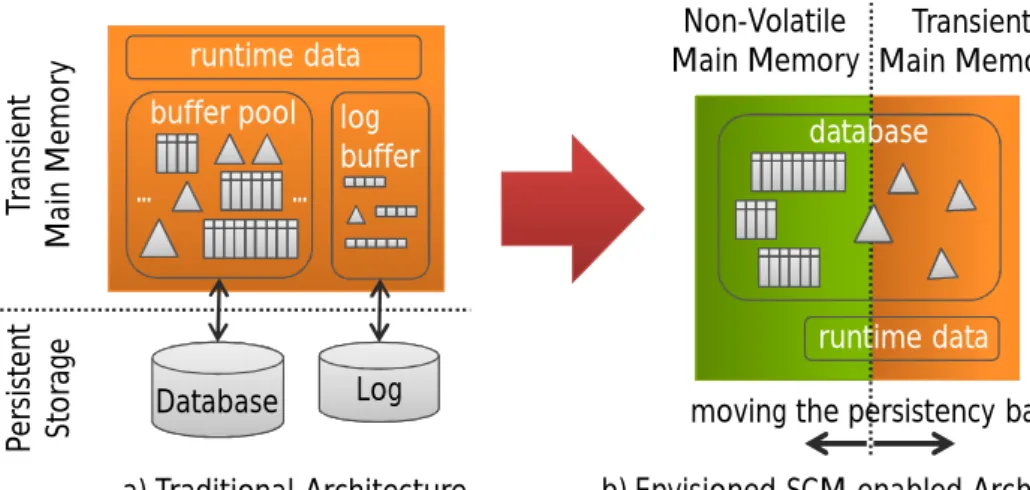
Figure 1.3 outlines the move from a traditional database architecture towards our envisioned system design. Due to the block-oriented nature of today’s non-volatile devices (e.g., hard disk or flash), both traditional disk-based and modern main-memory database systems rely on additional logging and snapshotting components to efficiently guarantee consistency and durability. The demarcation line between transient memory and persistent storage is explicit, as illustrated on the left-hand side of Figure 1.3. SCM, however, is byte-addressable and offers a latency close to that of DRAM. Thus, we envision a novel main-memory database architecture that directly operates on SCM, eliminating the need for explicit I/O. We anticipate that the performance gained by removing I/O will compensate for the performance lost because of the higher latency of SCM. Still, we see the need to keep DRAM next to SCM for performance-critical data structures, as illustrated on the right-hand side of Figure 1.3. Our envisioned hybrid SCM-DRAM architecture allows for a radical change in the database archi-tecture: First, it eliminates the traditional recovery bottleneck of main-memory database systems, namely reloading data from storage to main memory, as data is discovered and accessed directly in
SCM. Second, the use of SCM-based persistent data structures in combination with an adequate con-currency scheme (e.g., Multi-Version Concon-currency Control) allows for completely replacing the tradi-tional logging infrastructure by fine-grained, cheap micro-logging at data-structure level. Third, it can be dynamically decided where to store certain database objects as long as their loss can be tolerated, e.g., index structures may be stored in DRAM and reconstructed during recovery, potentially based on recent workload patterns. Fourth, system runtime information can easily be stored in SCM to improve recovery time. Finally, the system may retain and continue running transactions in case of system failures. For large main-memory database systems running in business-critical environments (e.g., e-commerce), this is a major advancement compared to traditional log-based systems.
While SCM brings unprecedented opportunities as a potential universal memory, it fulfills theno free lunchfolklore conjecture and raises unprecedented challenges as well. To store data, software has traditionally assumed block-addressable devices, managed by a file system and accessed through main memory. The programmer holds full control over when data is persisted and the file system takes care of handling partial writes, leakage problems, and storage fragmentation. As a consequence, database developers are used to ordering operations at the logical level, e.g., writing an undo log before updating the database. SCM invalidates these assumptions: It becomes possible to access, read, modify, and persist data in SCM using load and store instructions at a CPU cache line granularity. The journey from CPU registers to SCM is long and mostly volatile, including store buffers and CPU caches, leaving the programmer with little control over when data is persisted. Even worse, compilers and CPUs might speculatively reorder writes. Therefore, there is a need to enforce the order and durability of SCM writes at the system level (in contrast to the logical level) using persistence primitives, such as memory barriers and cache line flushing instructions, often in a synchronous way. This in turn creates new failure scenarios, such as missing or misplaced persistence primitives, which can lead to data corruption in case of software or power failure. As a consequence, leveraging SCM as persistent main memory requires devising a novel programming model.
Given the absence of a standard SCM programming model, SCM memory management, and SCM-based data structures, it is unclear how to achieve our envisioned architecture. Therefore, we set forth two main goals for this dissertation: (1) devising fundamental building blocks that can be used to build SCM-based database systems, and (2) using these building blocks to demonstrate how to achieve our envisioned database architecture. For the latter part, we target HTAP capabilities. Hence, we opt for a columnar data representation, as it is easier to tame a column-store for OLTP than to tame a row-store for OLAP (see Section 2.4.5 for a more detailed discussion). In fine, the work presented in this dissertation can be regarded as a pathfinding effort, or as technology scouting, for future SCM-based database systems.
Dissertation Outline and Contributions
Our extensive pathfinding work on SCM led us to devise several building blocks that are necessary for enabling our envisioned single-level architecture [127]. In the following we give an overview of our contributions:
• SCM Programming Model [124]. Exploring the implications of leveraging SCM as persistent main memory led us to identify several programming challenges. Examples of these challenges are data consistency, data recovery, persistent memory leaks, and partial writes. To address them, we survey state-of-the-art SCM programming models and make the case for the most suitable techniques for database systems. We assemble these techniques into a sound SCM programming model that forms the foundation of the work presented in this dissertation.
Ch ap te r7 Te st in g Fr am ew or k fo rS CM -Ba se d So ft w ar e Ch ap te r3 SC M Pr og ra m m in g M od el Chapter 3
Persistent Memory Management
Chapter 4
Persistent Data Structures
Chapter 5 SCM-Optimized Concurrency Control Chapter 6 Recovery Techniques
SOFORT
Figure 1.4: Organization of our contributions across the dissertation.
• Persistent Memory Management [124]. Memory management is the first building block needed to build a database system. We survey state-of-the-art transient memory and SCM alloca-tors and make the observation that they are designed for general-purpose applications. However, database systems have all but general-purpose needs. We identify the unique needs of database systems and use them as guidelines to design a highly scalable SCM allocator, named PAllocator. • Persistent Data Structures [126]. With SCM memory management, it becomes possible to build SCM-based data structures. While surveying state-of-the-art SCM-based data structures, we noticed that they are significantly slower than their DRAM-based counterparts because of the higher latency of SCM. To close this performance gap, we propose the FPTree, a highly scalable hybrid SCM-DRAM B+-Tree that places its inner nodes in DRAM and its leaf nodes in SCM. Upon recovery, inner nodes are rebuilt from leaf nodes. Furthermore, the FPTree implements a novel concurrency scheme that uses Hardware Transactional Memory (HTM) for the concurrency of inner nodes and fine-grained locking for that of leaf nodes.
• SOFORT [122, 128]. Equipped with efficient SCM memory management and SCM-based data structures, we realize our envisioned database architecture in SOFORT2, a hybrid SCM-DRAM columnar transactional engine. SOFORT is a single-level store, i.e., the working copy is the same as the durable copy of the data. We propose an adaptation of MVCC to SCM in a way that eliminates traditional write-ahead logging from the critical path of transactions. SOFORT al-lows placing secondary data either in SCM or in DRAM. Since SCM-based data is near-instantly available upon recovery, the new recovery bottleneck is rebuilding DRAM-based data.
• Recovery Techniques [129]. To tackle the new recovery bottleneck, namely rebuilding DRAM-based data, we propose two recovery techniques: instant recovery and adaptive recovery. In-stant recovery allows SOFORT to provide inIn-stant-responsiveness by accepting queries right after recovering SCM-based data, while DRAM-based data is rebuilt in the background. Adaptive re-covery improves upon instant rere-covery by ordering the rebuild of DRAM-based data structures according to their importance to the currently running workload.
• Testing Framework for SCM-Based Software [123]. SCM brings new failure scenarios that existing testing tools cannot detect. To tackle this issue, we propose an online testing framework that is able to automatically simulate power failures and detect missing or misplaced persistence primitives. Furthermore, our testing framework uses a set of optimizations, such as limiting duplicate testing by leveraging call stack information, to achieve fast crash simulation.
Figure 1.4 illustrates the organization of these contributions across the chapters of this dissertation. We motivate each contribution in detail at the beginning of its corresponding chapter. Furthermore, each chapter is concluded with a summary of its main insights. Moreover, we show the advantages of each of our devised building block through a thorough qualitative as well as experimental comparison
with state-of-the-art competitors. In brief, our proposed building blocks can be used to build more complex systems, such as SOFORT, thereby paving the way for future database systems on SCM. This dissertation is organized as follows: In Chapter 2 we elaborate on the characteristics of SCM, how to emulate it, and the performance implications of its higher latency. Then, we survey state-of-the-art database research on SCM [125]. We conclude Chapter 2 by giving an overview of SOFORT and its different components, while contrasting its design decisions with those of state of the art. Thereafter, Chapter 3 details the programming challenges of SCM and explores how to solve them. Then, we detail our SCM programming model and devise PAllocator, our highly scalable persistent memory allocator. Next, in Chapter 4 we survey existing SCM-based data structures. Then, we present the FPTree, our hybrid SCM-DRAM B+-Tree. Afterwards, Chapter 5 demonstrates how we assemble our devised building blocks to build SOFORT. In particular, we elaborate on how we adapt MVCC to SCM. Furthermore, Chapter 6 presents SOFORT’s recovery techniques, namely instant recovery and adap-tive recovery. Later, we showcase in Chapter 7 our online testing framework for SCM-based software. Finally, Chapter 8 summarizes the contributions of this dissertation and presents an extended view on promising future work directions. In particular, we present our vision on how to extend our work to account for hardware and media failures to achieve high availability by leveraging SCM and Remote Direct Memory Access (RDMA).
2
LEVERAGING SCM IN DATABASE SYSTEMS
S
CM is emerging as a viable alternative to lift DRAM’s capacity limits. Since it exhibits charac-teristics of both storage and main memory, SCM can be architected in different ways: as main memory extension, as disk-replacement, or as persistent main memory, i.e., as main memory and storage at the same time. These unique properties enable several optimizations and architectural enhancements for database systems. In this chapter we position our work with regards to state-of-the-art research on leveraging SCM in database systems. To do so, we first survey database optimization opportunities enabled by SCM that were explored in the literature, starting from the most straightfor-ward ones to completely revising database architectures. Then, we highlight the gaps in state-of-the-art that our work ambitions to fill. We show that placing all data in SCM compromises performance, and argue instead for a hybrid SCM-DRAM architecture. While related works have mostly focused on transactional row-store systems, we target hybrid analytical and transactional (HTAP) systems. In this context, we proposeSOFORT, a hybrid SCM-DRAM single-level columnar storage engine, designed from the ground up to explore the full potential of SCM.This chapter is organized as follows: In Section 2.1 we present SCM, discussing how it can be inte-grated in the memory hierarchy, and exploring its performance implications with microbenchmarks. Since SCM is not available yet, we elaborate in Section 2.2 on practical ways to emulate its perfor-mance characteristics. Thereafter, Section 2.3 surveys state-of-the-art research on the use of SCM in database systems, with an emphasis on works that enhance database logging and storage architectures. Then, Section 2.4 positions our work with regards to related work and gives an overview of SOFORT. Finally, Section 2.5 summarizes this chapter.
2.1
STORAGE-CLASS MEMORY
Leon Chua predicted in the early 1970s the existence of thememristor[23], a fundamental circuit element that is capable of storing and retaining a state variable. It the late 2000s, a team at HP Labs discovered the memristor in the form of Resistive RAM (RRAM) [50] [153]. It turned out that sev-eral works had already stumbled upon the memristor property, but they could not identify it as such and deemed it an anomaly. Since then, several other memory technology candidates that exhibit the memristor property have been identified, e.g., Phase Change Memory (PCM) [87] and Spin Trans-fer Torque Magnetic RAM (STT-MRAM) [59]. In the industry, these novel memory technologies are
Parameter NAND DRAM PCM STT-RAM Read Latency 25µs 50 ns 50 ns 10 ns
Write Latency 500µs 50 ns 500 ns 50 ns
Byte-addressable No Yes Yes Yes
Endurance 104–105 >1015 108–109 >1015
Table 2.1: Comparison of current memory technologies with SCM candidates [107].
grouped under the umbrella termStorage-Class Memory(SCM). SCM promises to combine the low la-tency and byte-addressability of DRAM, with the density, non-volatility, and economic characteristics of traditional storage media. Most SCM technologies exhibit asymmetric latencies, with writes being noticeably slower than reads. Table 2.1 summarizes current characteristics of two SCM candidates, PCM and STT-MRAM, and compares them with current memory technologies. Like flash memory, SCM supports a limited number of writes; yet, from a material perspective, some SCM candidates promise to be as enduring as DRAM. These candidates also promise to feature even lower latencies than DRAM. However, while its manufacturing technology matures, we expect the first few genera-tions of SCM to exhibit higher latencies than DRAM, especially for writes. Given its non-volatility, idle SCM memory cells do not consume energy, contrary to DRAM cells that constantly consume energy to refresh their state. Consequently, SCM has the potential to drastically reduce energy con-sumption, although except for embedded systems, this potential has yet to be shown. Given SCM’s byte-addressability and low latency, data in SCM can be accessed via load and store semantics through the CPU caches without buffering it in DRAM.
In this work, we assume that the issue of SCM’s limited write endurance will be addressed at the hard-ware level. In fact, works like [138, 98] already proposed wear-leveling techniques at the hardhard-ware level to increase the lifetime of SCM.
The advent of SCM seems to be imminent. Intel and Micron demonstrated large capacity DIMMS of a new byte-addressable non-volatile memory technology called 3DXPoint [1]. Furthermore, there has been recently a breakthrough in the industry efforts to standardize different Non-Volatile DIMMs (NVDIMMs) form factors [71]. Microsoft Server [162] and Linux [97] have both announced support for NVDIMMs. In the following section, we discuss different alternatives on how SCM can be inte-grated in the memory hierarchy.
2.1.1 Architecting SCM
SCM can be architected as main memory extension to alleviate DRAM’s scalability limits. In this sce-nario, the non-volatility of SCM is not leveraged. Several works have investigated this approach. For instance, Lee et al. [86] discussed how to use Phase Change Memory as a scalable DRAM alternative. We expect this architecture option to be rapidly adopted, especially in large main-memory systems where the cost of DRAM is a major factor in the total cost of ownership (TCO). Indeed, SCM is pro-jected to be cheaper than DRAM. We foresee that the first adopters will be cloud providers such as Google, Amazon, and Microsoft, as well as large-scale main-memory database systems such as SAP HANA.
Figure 2.1 depicts two options for architecting SCM astransientmain memory. The first one, illus-trated in Figure 2.1a, is to introduce SCM as a new memory tier on top of which DRAM serves as a hardware-managed cache (e.g., as a fully associative cache). Qureshi et al. [139] investigated this op-tion and showed that a buffer of 1GB of DRAM can efficiently hide the higher latency of up to 32GB
SCM DRAM Application application address space
Virtual memory subsystem
(a) DRAM as hardware-managed cache for SCM SCM DRAM Application application address space Virtual memory subsystem
(b) SCM next to DRAM
Figure 2.1: SCM as transient main memory extension.
of SCM. The second option, shown in Figure 2.1b is to have SCM next to DRAM, at the same hier-archical level, thereby introducing the notion of fast and slow memory and the corresponding data placement problem.
SCM can be alternatively used as persistent storage, hence leveraging its non-volatility. There are again two options, as depicted in Figure 2.2: The first one is to use SCM as a fast block device, man-aged by a traditional file system, and accessed through DRAM. Note that this use case does not lever-age the byte-addressability of SCM. We do not foresee this architecture option to be widely adopted, as SCM is projected to be much more expensive than flash memory. The second option is to use SCM as persistent main memory, i.e., as main memory and storage at the same time, hence leveraging the full potential of SCM– we assume this architecture in this work. We elaborate in the next paragraph on how SCM is managed as persistent main memory.
Application
SCM-optimized filesystem application
address space
Virtual memory subsystem mmap()
SCM
load/store
file API DRAM
Figure 2.2: SCM as disk replacement or as persistent main memory.
There seems to be a consensus that SCM will be managed by a special file system that provides zero-copy memory mapping – as recommended by the Storage Networking Industry Association (SNIA) [150] – bypassing the operat-ing system page cache and providoperat-ing the application layer with direct access to SCM, as illustrated in Figure 2.2. Sev-eral such file systems have already been proposed, such as BPFS [26], SCMFS [175], PMFS [39], NOVA [179], and HiNFS [121]. Additionally, Linux kernels 4.7 and higher al-ready embed such a functionality through the new Direct Access (DAX) feature [35], currently supported by the ext4 file system [42]. However, the Linux page table presents a major roadblock for the integration of SCM in large-scale systems: The Linux page table currently implements con-currency using a global lock, which makes memory recla-mation upon shutdown of a multi-terabyte main memory process very slow, although SCM pages do not need to be reclaimed as they do not correspond to any DRAM memory. Worse, both DRAM and SCM page entries are scanned to reclaim the memory of the DRAM ones. For example, our measurements, de-picted in Figure 2.31, show that it takes up to15minutes to reclaim10terabytes of main memory upon process termination. Moreover, memory mapping millions of files will stress the (lack) of scal-ability of the Linux page table and the file system indexing [29], significantly slowing down startup time of large-scale main memory systems. Most of these issues can addressed by using SCM-aware file systems – instead of building sub-optimal SCM support on top of existing ones – and by making the virtual memory component of operating systems SCM-aware.
0 5 10 15 20 25 1 2 3 4 5 6 7 8 9 10 11 12 13 14 15 To ta lt im e in m in ut es
TBytes of memory used
Figure 2.3: Measuring process termination duration. Experiment: memory map memory, touch it, then kill the process and measure termination duration. The experimental system has 32 E7-8890 v3 processors (1152 cores total) and 16 terabytes of DRAM.
2.1.2 SCM Performance Implications
To understand the performance implications of a hybrid SCM-DRAM hardware architecture, we de-signed three microbenchmarks:
Synthetic read.We evaluate the performance of pure sequential and random reads in DRAM and in SCM. The size of the dataset is 1 GB. Pure sequential read is implemented as a cache ping, i.e., one byte is read from every cache-line-sized piece of the dataset, making the whole dataset go through L1 cache. As for pure random read, one byte from the dataset is randomly read – which counts as a full cache line read – until the amount of read data is equal to the size of the dataset.
SIMD-Scan. As a real-world example of sequential reads, we evaluate theSIMD Range Scan[173], an OLAP scan operator over bit-packed integers usually representing dictionary-coded values in a columnar representation, in SCM and in DRAM. In this experiment, each integer value is represented with 11 bits, and the size of the dataset is set to200million values, i.e., 262 MB.
B+-Tree and Skip List. As a real-world example of random reads, we evaluate the read and write performance of a B+-Tree and a Skip List in DRAM and in SCM. In each experiment, we first populate the tested structure with 10 million tuples, then, we execute 5 million either read or write operations. Each tuple is a pair of 8-Byte integers.
In all experiments, we use the Intel SCM Emulation Platform, described in Section 2.2.3, to vary the latency of SCM from90 ns (i.e., the latency of DRAM) up to 700 ns. Figure 2.4 depicts the experimental results. The y-axis represents the slowdown incurred by using SCM over DRAM. For an SCM latency of200 ns, we notice that the slowdown for pure sequential read and SIMD-Scan is only1.05×and1.04×respectively, while for an SCM latency of700 nsthe slowdown increases but is limited to1.81×and1.65×, respectively. This is explained by hardware and OS-level prefetching that hide the higher latency of SCM when detecting a sequential memory access pattern. Additionally, we partially attribute the slowdown surge to the hardware prefetcher that fails to prefetch data at the right time. Indeed, the prefetcher has to prefetch datatimely; if the data is prefetched too early, then it might be evicted from the cache before it is used by the CPU; if the data is prefetched too late, then prefetching will not hide the whole memory latency. Since the hardware prefetcher is calibrated for DRAM’s latency, it prefetches data too late when SCM’s latency is too high. Hence, the prefetcher becomes unable to hide the whole memory latency. This is a limitation of the emulator and can be fixed in real hardware by calibrating the hardware prefetcher for SCM’s latency. We conclude that workloads with sequential memory access patterns hardly suffer from the higher latency of SCM.
Skip List read B+-Tree read Rand. read Skip List write B+-Tree write Seq. read
SIMD-scan 90 200 300 400 500 600 700 1 2 3 4 5 6 Latency[ns] Slowdown
Figure 2.4: Slowdown incurred by using SCM over DRAM in different microbenchmarks.
DRAM DRAM-NoPrefetch SCM SCM-NoPrefetch 0 8 16 24 32 0 20 40 60 80 100 Bit case Thr ough. [% over Scan-DR AM]
Figure 2.5: SIMD Scan performance on SCM relative to DRAM with and without hardware and software prefetching.
To validate our analysis, we fix the latency of SCM to200 nsand ran again the SIMD-Scan experiment for different bit-cases, with and without hardware and software prefetching. Figure 2.5 shows that the average performance penalty for the different bit cases is 8% compared with using DRAM. With hard-ware and softhard-ware prefetching disabled for both SCM and DRAM [36], we observe that the average performance penalty of using SCM rises to 41% compared with using DRAM. If we compare similar memory technologies, disabling prefetching incurs a slowdown of 34% for DRAM and 56% for SCM. On the side of random memory accesses, Figure 2.4 shows that the performance of pure random read, Skip List read/write, and B+-Tree read/write quickly and linearly deteriorates as we increase the la-tency of SCM: For an SCM lala-tency of200 ns, the slowdown is already1.61×, 1.98×/1.75×, and
1.59×/1.78×, respectively, and increases for an SCM latency of700 nsup to4.86×,5.47×/4.10×, and4.21×/4.40×, respectively. This is explained by the fact that Skip Lists and B+-Trees have a ran-dom access pattern that triggers several cache misses per read/write, amplifying the overhead of the higher access latency of SCM. We conclude that workloads with random access patterns significantly suffer from the higher latency of SCM.
This result motivates the need to keep DRAM to enable faster query execution, as keeping latency-sensitive data structures in SCM leads to a significant performance penalty.
2.2
SCM EMULATION TECHNIQUES
Researchers are often reluctant to dive into systems research on SCM due to the lack of real hardware. To a certain extent, their concerns are justified as several SCM performance characteristics and their interplay with modern CPU architectures are yet to be seen. One solution would be to use cycle-accurate simulators, such as PTLSim [183], a cycle-cycle-accurate out-of-order x86-64 simulator. However, these solutions are not attractive to systems developers because: (1) they are slow; (2) their simulated architecture does not reflect the latest CPUs, thereby limiting their accuracy; and (3) they often re-quire extensions to account for non-supported instructions. Nevertheless, if we assume the DIMM form factor and an access interface similar to that of DRAM, we can reliably emulate SCM latency and bandwidth in different ways, which we detail in the following.
Socket 1 C1 C2 C3 C4 Socket 2 C1 C2 C3 C4 Interconnect DRAM DRAM Bind application
to socket 1 Memory ofsocket 2 as
emulated SCM SCM
Higher latency, lower bandwidth
Figure 2.6: NUMA-based SCM emulation on a two-socket system. 2.2.1 NUMA-Based SCM Emulation
Non-Uniform Memory Access (NUMA) can be used to emulate a higher latency and a lower band-width. This can be achieved, as illustrated in Figure 2.6, by binding a program to the memory and computing resources of a socket (processor), and using the memory of another socket as emulated SCM, which will have the latency and throughput characteristics of remote memory accesses through socket interconnect links. While Figure 2.6 depicts a two-socket system, where only a single emulated latency and bandwidth configuration is possible, larger systems such as 4 or 8-socket systems can offer additional emulation configurations. In fact, the number of interconnect hops determines the latency and bandwidth metrics. Furthermore, some interconnect links can be switched off in the BIOS to force additional interconnect hops between two sockets. This is useful, for instance, when the sockets of a system are fully connected with each other.
The main advantage of NUMA-based SCM emulation is that it does not affect the micro-architectural behavior of the CPU such as speculative execution, memory parallelism, and prefetching, thereby ensuring a reliable and accurate performance evaluation of programs that use SCM. Additionally, as we explain below, it requires little effort. However, it offers limited latency and bandwidth settings and delivers a symmetric (instead of the expected asymmetric) SCM latency.
Binding a program to a socket can be done on Linux usinglibnumaor simply using thenumactl com-mand [115], among other widely available and simple-to-use possibilities. Using the memory of a socket as emulated SCM can be done in two ways. The first one is to mount a temporary file system, i.e.,tmpfs[158], on the memory of a specific socket, and use the resulting device as emulated SCM. This can be done in two steps:
1. create atmpfsdevice with, e.g., 1 GB size in/mnt/pmem: mount t tmpfs o size=1G tmpfs /mnt/pmem
2. remount the device to bind its memory to a specific socket (e.g., socket 1): mount -o remount,mpol=bind:1 /mnt/pmem
A drawback of this approach is that the operating system still manages the memory and allocates it to the device when needed at a page granularity.
The second way to use the memory of a socket as emulated SCM is to reserve a DRAM region upon boot time and mount an SCM-aware file system on it (e.g., ext4 DAX) [60]. This memory region will be invisible to the operating system and will be treated as an SCM device, which contrasts with the
tmpfsapproach where the operating system still manages the memory. This approach be carried in three steps:
• reserve a DRAM region using thememmapkernel boot parameter. For example, to reserve 32 GB starting from physical address 64 GB, the parameter is:
memmap=32G!64G
• format the resulting SCM device to a file system format that supports DAX, e.g., ext4: mkfs.ext4 /dev/pmem0
• mount the device with the DAX option: mount o dax /dev/pmem0 /mnt/pmem
In summary, NUMA-based SCM emulation is easy to use and requires little effort.
2.2.2 Quartz
Quartz [167] is a DRAM-based, software-based SCM performance emulator that leverages existing hardware features to emulate different latency and bandwidth characteristics. Instead of injecting de-lays to every single SCM access, which the authors argue is infeasible in software without a significant overhead, Quartz models the average application perceived latency by injecting delays at boundaries ofepochs. Anepochhas a fixed time duration upon which hardware performance counters are read. A delay is then introduced based on the number of stalled cycles induced by references to SCM. The delay is computed as follows:
Delay = (Stalled cycles / Average latency) X latency differential Time Delay
Epoch duration
Hence, Quartz can vary the emulated latency of SCM by changing the latency differential between DRAM and SCM in the formula above. The authors evaluated the emulation accuracy of Quartz by comparing it with NUMA-based emulation and reported an error rate no higher than 9%. Quartz can emulate either a system with only SCM, or a system with fast memory (DRAM) and slow memory (SCM). The latter is achieved by combining Quartz with NUMA-based emulation; Quartz would add delays that correspond to only remote memory accesses, which can be quantified by means of hard-ware performance counters.
Quartz consists of two parts: a user-mode dynamic library that managesepochs, and a kernel module that manages performance counters. Using Quartz is as easy as pre-loading the user-mode, which will register the threads of the program and manage delay injection. To sum up, Quartz has the advan-tage of relying counters available in commodity hardware and offering a wide range of latency and bandwidth setting. However, it might interfere with the micro-architectural behavior of the proces-sor, emulates a symmetric SCM latency, and is less accurate than NUMA-based emulation. HP has recently open-sourced Quartz [136], enabling its adoption by some works [90].
2.2.3 Intel SCM Emulation Platform
Intel has made available an SCM emulation platform [38] to several academic and industry partners, and many publications have already used it [39, 122, 6]. It is equipped with four Intel Xeon E5
Socket 0
DRAM SCM DRAM
CPU (8 cores) CPU (8 cores)
Socket 1 QPI
Memory Channels
Figure 2.7: Architecture overview of Intel’s SCM emulation platform.
processors, two of which are deactivated and their memory is interleaved at a cache line granularity to form an emulated SCM region. Each processor has 8 cores, running at 2.6GHz and featuring each 32 KB L1 data and 32 KB L1 instruction cache as well as 256 KB L2 cache. The 8 cores of one processor share a 20 MB last level cache. The two active processors have four DDR3 memory channels each, two of which are attached to local memory, and the other two are attached to the emulated SCM region, as illustrated in Figure 2.7. This contrasts with NUMA-based emulation and Quartz which rely on remote memory accesses via socket interconnect links. The emulated SCM region is managed by an SCM-aware file system, such as PMFS [39] or ext4 with DAX support [42, 35], that provides direct access to the memory region withmmap.
Similarly to Quartz, the memory bandwidth of emulated SCM can be changed utilizing the DRAM thermal control [58]. To emulate different latencies, the system relies on a special BIOS and mi-crocode which introduces delays upon accesses to the emulated SCM region. More precisely, the emulator relies on the fact that the number of cycles stalled for Last Level Cache (LLC) misses is proportional to memory latency. The emulator injects additional stall cycles using debug hooks and special microcode every 32 LLC miss – smaller windows lead to better emulation but incur tangible emulation overhead. The number of additional injected stall cycles is computed as follows:
Countadded stalls=Countstalled×
Latencyscm
Latencydram
whereCountstalledis provided by hardware counters and represents the number of stalled cycles due to LLC misses during a window. This is more accurate, yet more complex to implement, than the software-based average latency approach of Quartz.
In brief, the advantage of Intel’s SCM emulation platform is that it is a hardware-based emulation, yet it enables a wide range of bandwidth and latency settings. Moreover, tampering with the CPU’s micro-architectural behavior is limited since delays are introduced at a much narrower window granularity and independent of software logic. However, in addition to emulating symmetric SCM latencies, it has the drawback of not being widely available: (1) it is a special piece of hardware; (2) there exist only a few such systems; and (3) access to such a system can be granted only through Intel. In our work, Intel provided us with access to such a system which we used in our experiments.
2.3
SCM AND DATABASES: STATE-OF-THE-ART
SCM impacts all layers of database systems. First and foremost, the storage and recovery layer, which is the focus of this dissertation, can be completely re-architected. We present in Section 2.3.1 several works that leveraged this opportunity. The most advanced SCM-based architectures require novel data structures, which in turn require SCM allocation schemes. We elaborate on both topics in Chapters 3 and 4, respectively. Moreover, the asymmetry in SCM read/write latency and bandwidth calls for revising the cost models of query optimizers and the trade-offs of query execution operators. We present in Section 2.3.2 relevant works that investigated this challenge.
Transactions
DRAM
Data Cache Centra-lized
Log Buffer
HDDs/SSDs Data Files Log Files Secondary Data
Primary Data Data access
viaDRAM Log written todisk viaDRAM
Figure 2.8: Traditional database architecture. 2.3.1 Storage and Recovery
In this section we discuss optimization opportunities brought by SCM to database storage and recov-ery architecture. We classify related work into two categories: (1) works that focus solely on improv-ing the loggimprov-ing infrastructure usimprov-ing SCM; and (2) works that go further and propose to re-architect database storage and logging using SCM.
Traditional database architecture
In the traditional disk-based database architecture, shown in Figure 2.8, the data cache and log buffer are associated with storage devices for durability. All database objects in the data cache reflect a (potentially modified) copy of the database state. Runtime information is stored in main memory and re-built during system startup. The border line between transient memory and persistent storage is explicit and the database system manages cross-border traffic using an eviction policy, a log buffer, etc. The last decade has seen the emergence of main-memory database systems which assume that the whole database fits in main memory, enabling them to simplify away the data cache. Nevertheless, they still require a log buffer.
To ensure transaction durability, both disk-based and main-memory database systems rely on Write-Ahead Logging (WAL) [56] on traditional storage media (HDDs, SSDs), which constitutes a bottleneck for transactional workloads. To mitigate this bottleneck, database systems usually implement group commit [34]: log durability is enforced per batch of transactions to amortize disk access cost. Fur-thermore, WAL entries are usually coalesced in the log buffer to transform multiple random writes into amortized sequential disk writes [109]. This is achieved by keeping a centralized log buffer and employing page latches, which constitute a contention point for high-performance transactional sys-tems. Recovery is performed by replaying the log starting from the latest consistent durable database state (redo phase), then undoing the effects of in-flight transactions at failure time (undo phase). To shorten the redo phase, database systems employ checkpointing, which consists in periodically taking snapshots database state.
Improving the logging infrastructure using SCM
SCM-based database systems have been investigated as early as in the 1980s. For instance, Copeland et al. [27] made the observation that a system with battery-backed DRAM – an economically viable technology at the time – would allow to remove disk I/O from the critical path of transactions, thereby alleviating the need for group commit [34] and reducing transaction latencies. Agrawal et al. [2] inves-tigated database recovery algorithms assuming a back-then hypothetical non-volatile main-memory system. While using two-phase locking for concurrency control, they devised optimized recovery algorithms for both page locking and record locking schemes. While these works only look at how to optimize existing logging and recovery algorithms in presence of non-volatile main memory in a non-disruptive way, Copeland et al. [27] recognize the possibility of devising novel counterparts. The advent of SCM has spurred a renewed interest in non-volatile main memory database systems. Fang et al. [43] were the first to introduce SCM in the database architecture. They propose to place the database log, access it, and update it directly in SCM, which simplifies the log architecture since the log buffer is not required anymore. The log can be asynchronously written to disk for archival purposes. This architecture has two advantages: (1) As Copeland et al. [27] previously observed, group commit is not needed anymore, because SCM is several orders of magnitude faster than disks; and (2) transaction logs are traditionally grouped in contiguous pages to amortize disk access, which necessitates the use of page latches; being a random-access, byte-addressable memory, SCM alleviates this constraint, making log page latches unnecessary. These two advantages result in lower transaction latencies and higher transaction throughput.
Gao et al. [46] propose to use SCM as a new, persistent buffering layer between main memory and disks. They introduce PCMLogging, a new logging scheme that integrates implicit logs into modified pages. PCMLogging flushes the modified pages of a transaction from main memory to SCM upon commit, which ensures that the database state is always up-to-date. Therefore, checkpointing is not required anymore. However, undoing the effects of unfinished transactions during recovery is still needed. Indeed, a full main memory cache might need to flush modified pages to SCM. To handle this case, PCMLogging keeps in SCM a list of all running transactions and their respective modified pages that were flushed to SCM. To provide undo capabilities, PCMLogging writes flushed pages out-of-place in SCM. Recovery is performed by scanning the pages in SCM, retrieving their transaction ID, and rolling back the ones modified by in-flight transaction at failure time. We argue that, contrary to Fang et al. [43], PCMLogging introduces additional complexity in durability management and does not leverage the byte-addressability of SCM. Additionally, the authors compare PCMLogging only to a traditional database architecture with emulated PCM as main memory, which does not allow to draw compelling conclusions.
Wang et al. [170] make the observation that while distributed logging has been historically a no-go for single node systems because of I/O overheads, the characteristics of SCM make it relevant for multi-socket systems. Hence, they propose a distributed logging scheme that maintains one SCM log buffer per socket, thereby relieving log contention. A log object is considered durable as soon as it is written to the SCM log buffer. When the latter becomes full, it is flushed to disk. The authors investigate two flavors of distributed logging: page-level and transaction-level log space partitioning. In page-level log space partitioning, a transaction can write log records to any log partition, which might incur expensive remote memory accesses. Additionally, transactions lose access to the previous Log Sequence Number (LSN) of each log record, because LSNs are bound to a single log partition. This compromises the ability of a transaction to undo its changes when it aborts. To remedy this problem, the authors propose to keep a private DRAM undo buffer per transaction. In transaction-level log space partitioning, transactions write log records only to their local log partition. This poses an issue during recovery as the order of log records per page is lost, thereby compromising the redo and undo phases. To solve this issue, the authors propose to uniquely identify log records usingglobal
sequence numbers(GSNs) based on a logical clock [82] for each page, transaction, and log record. The order of log records can therefore be established during the log analysis phase of recovery.
SCM log buffers are marked as write-combining, meaning that read and write operations to SCM bypass the CPU cache. Writes are lazily drained from the write-combining buffers to SCM. Therefore, it is necessary to employ memory fences which (among other things) drain the contents of the write-combining buffers. Nevertheless, a memory fence drains the buffers of only its local core, which poses a challenge for transaction commit. Indeed, before committing, a transaction must ensure the persistence of all its log records, in addition to all log records that logically precede them. To solve this problem, the authors introducepassive group commit. The general idea is as follows: (1) every committing transaction issues a memory fence and updates a variable (dgsn) in its working thread to its GSN; (2) committing transactions are registered into a group commit queue; and (3) a daemon fetches the smallestdgsnacross working threads (i.e., the upper bound GSN of persisted log records) and dequeues any transaction that has a GSN smaller than this minimum. Following an empirical evaluation, the authors conclude that transaction-level log space partitioning is more promising that the page-level counterpart.
Huang et al. [62] focus on the most cost-effective use of SCM. Since SCM will be more expensive than disks, they propose to restrict the use of SCM to the database log, which is the main bottleneck for OLTP systems. Doing so shifts the logging bottleneck from I/O to software overheads, mainly incurred by contention on the centralized log buffer. Therefore, the authors proposeNV-logging, a per-transaction decentralized logging scheme. Basically, transactions keep private logs in the form of a linked-list of transaction objects. Log objects are first constructed in DRAM, then flushed to a global circular log index, which is truncated upon checkpointing. A global counter is used to generate LSNs. The internal structure of log objects is similar to that of ARIES [109], except that NV-logging keeps a backward pointer instead of keeping the LSN of the previous log object. The recovery procedure follows the ARIES protocol. While the authors claim that NV-logging is the mostcost-effectiveuse of SCM in OLTP systems, it misses out on the opportunity of introducing SCM in the main-memory layer, SCM being projected to be cheaper than DRAM.
Re-architecting database storage and logging using SCM
While the logging component might be a target of choice for SCM in the short term, SCM can spur a more radical change in database architecture. For instance, Pelley et al. [133] investigated three architecture alternatives for SCM in database systems. The first one is to use SCM as a drop-in disk replacement, which enables near-instantaneous recovery since dirty pages can be flushed at a high rate, significantly reducing the redo phase during recovery. However, this architecture retains all the software complexity introduced to amortize costly disk I/O. The second architecture option, denoted In-Place Updates and illustrated in Figure 2.9a, assumes that SCM reads are optionally performed through a software-managed DRAM cache, while writes are performed directly to SCM. The central-ized log that keeps a total order of updates is not needed anymore: Undo logs are distributed per transaction (i.e., each transaction keeps a private log), which is possible since in-flight transactions modify mutually exclusive sets of pages. In-Place Updates completely removes redo logging and page flushing, but it is highly sensitive to the latency of SCM writes.
To lift this shortcoming, the authors introduced a third architecture option, named NVRAM group commit. It executes transactions in batches, which are then either all committed or aborted. The changes of a transaction batch are buffered in a DRAM staging buffer and flushed to SCM upon com-mit, as depicted in Figure 2.9b. Aborting batches can undo their changes in the staging buffer by leveraging the transactions’ private undo logs. Note that, in contrast to in-place updates, these logs are
DRAM Transactions SCM Persistent Data TX-private undo log Secondary Data Primary Data Optional Data Cache Reads optionally directly from SCM Reads Writes directly to SCM
(a) In-Place Updates
DRAM Staging Buffer Transactions SCM Persistent Data TX-private undo log Secondary Data Primary Data Reads optionally directly from SCM
Writes staged until batch commit
(b) SCM-Group Commit
Figure 2.9: Database architecture with SCM as a primary data store.
not persisted. For failure recovery, NVRAM Group Commit relies on a database-wide undo log. When the staging buffer is not large enough, or in presence of long-running transaction, NVRAM Group Commit falls back to traditional, ARIES-style logging. The authors assume apersistbarrier primitive that ensures the durability of all pending SCM writes. They show that In-Place Updates, respectively NVRAM Group Commit, exhibits the highest transaction throughput when the latency of the persist barrier is lower, respectively greater, than1µs. Nevertheless, we argue that both suffer from the fact that updates are still done at a page granularity, which does not leverage SCM’s byte-addressability. Debradant et al. [31] showed that, when SCM is used as disk-replacement, the OLTP performances of disk-based and main-memory databases converge (in the absence of skew) and become bound by the logging overhead, suggesting that neither architecture is suitable for SCM. This result motivated Arulraj et al. [5] to conduct an empirical study of three storage architectures, namely namely In-Place Update (InP), Copy-on-Write (CoW), and Log-Structured Updates (Log), and their enhanced SCM counterparts. The authors assume an SCM-only system. The InP architecture is based on the VoltDB [169] main-memory database system. It keeps checkpoints on disk and uses the STX B+-Tree library for all its in-memory indexes. To ensure durability, InP employs WAL to record transaction changes between two checkpoints. Recovery consists in loading the latest checkpoint, replaying the log, then undoing the changes of in-flight transactions. The SCM-enhanced version of InP, denoted NVM-InP, uses persistent versions of the STX B+-Trees. It alleviates the need for checkpointing and the redo phase during recovery, since all committed transactions are guaranteed to have persisted their changes. WAL is still needed to undo the effects of in-flight transactions. However, instead of copying the previous state of a record, NVM-InP simply stores a non-volatile pointer in the log, thereby reducing data duplication.
The CoW architecture is based on LMDB’s CoW B+-Tree [22]. The SCM-optimized counterpart, namely NVM-CoW, modifies LMDB’s CoW B+-Tree to leverage the byte-addressability of SCM. For instance, only the nodes involved in an update are copied instead of the whole B+-Tree, thereby reduc-ing the storage footprint. Recovery in both variants does not involve any operation since the system is always guaranteed to be in a consistent state.
The Log architecture employs LevelDB’s Log-Structured Merge Tree (LSM) [48]. The LSM tree keeps amemtable(B+-Tree) in DRAM and ensures its durability using WAL. When amemtablereaches a certain size, it is compacted into a Sorted String Table (SST) and spilled to persistent storage. The WAL log is then truncated and a newmemtableis created. The LSM tree can have multiple layers of SSTs. A background process merges SSTs together to reclaim space and limit read amplification. The
SCM version of Log, namely NVM-Log, implements thememtableas a non-volatile B+-Tree. NVM-Log keeps the same structure of the LSM Tree, except that instead of compactingmemtablesinto SSTs, it keeps their structure intact and simply marks them as immutable. For recovery, WAL is not needed anymore for the redo phase, but similarly to NVM-InP, it is still needed for the undo phase.
Following an extensive empirical evaluation, the authors observe that in OLTP scenarios, the NVM-InP architecture performs the best out of the three evaluated architectures. However, this architecture is still tied to WAL, which we argue can be completely removed. Moreover, they conclude that SCM latency is the most significant factor in the performance of these SCM-enabled systems, which moti-vates the need to keep DRAM for latency-sensitive data structures, as already stated in Section 2.1.2. TohideWAL from the critical path of transactions, Arulraj et al. [6] propose