CEC Theses and Dissertations College of Engineering and Computing
2018
Database Streaming Compression on
Memory-Limited Machines
Damon F. Bruccoleri
Nova Southeastern University,[email protected]
This document is a product of extensive research conducted at the Nova Southeastern UniversityCollege of Engineering and Computing. For more information on research and degree programs at the NSU College of Engineering and Computing, please clickhere.
Follow this and additional works at:https://nsuworks.nova.edu/gscis_etd Part of theComputer Sciences Commons
All rights reserved. This publication is intended for use solely by faculty, students, and staff of Nova Southeastern University. No part of this publication may be reproduced, distributed, or transmitted in any form or by any means, now known or later developed, including but not limited to
photocopying, recording, or other electronic or mechanical methods, without the prior written permission of the author or the publisher.
This Dissertation is brought to you by the College of Engineering and Computing at NSUWorks. It has been accepted for inclusion in CEC Theses and Dissertations by an authorized administrator of NSUWorks. For more information, please [email protected].
NSUWorks Citation
Damon F. Bruccoleri. 2018.Database Streaming Compression on Memory-Limited Machines.Doctoral dissertation. Nova Southeastern University. Retrieved from NSUWorks, College of Engineering and Computing. (1031)
Database Streaming Compression on Memory-Limited Machines
by
Damon Bruccoleri
A dissertation submitted in partial fulfillment of the requirements for the degree of Doctor of Philosophy
in
Computer Science
College of Engineering and Computing Nova Southeastern University
An Abstract of a Dissertation Submitted to Nova Southeastern University In Partial Fulfillments of the Requirements for the Degree of Doctor of Philosophy
Database Streaming Compression on Memory-Limited Machines
byDamon Bruccoleri March 2018
Dynamic Huffman compression algorithms operate on data-streams with a bounded symbol list. With these algorithms, the complete list of symbols must be contained in main memory or secondary storage. A horizontal format transaction database that is streaming can have a very large item list. Many nodes tax both the processing hardware primary memory size, and the processing time to dynamically maintain the tree.
This research investigated Huffman compression of a transaction-streaming database with a very large symbol list, where each item in the transaction database schema’s item list is a symbol to compress. The constraint of a large symbol list is, in this research, equivalent to the constraint of a memory-limited machine. A large symbol set will result if each item in a large database item list is a symbol to compress in a database stream. In addition, database streams may have some temporal component spanning months or years. Finally, the horizontal format is the format most suited to a streaming transaction database because the transaction IDs are not known beforehand. This research prototypes an algorithm that will compresses a transaction database stream.
There are several advantages to the memory limited dynamic Huffman algorithm. Dynamic Huffman algorithms are single pass algorithms. In many instances a second pass over the data is not possible, such as with streaming databases. Previous dynamic Huffman algorithms are not memory limited, they are asymptotic to O(n), where n is the number of distinct item IDs. Memory is required to grow to fit the n items. The improvement of the new memory limited Dynamic Huffman algorithm is that it would have an O(k) asymptotic memory requirement; where k is the maximum number of nodes in the Huffman tree, k < n, and k is a user chosen constant. The new memory limited Dynamic Huffman algorithm compresses horizontally encoded transaction databases that do not contain long runs of 0’s or 1’s.
I would like to thank my dissertation committee, Dr. Junping Sun, Dr. Wei Li, and Dr. Jaime Raigoza, for their excellent guidance and help in editing and guiding this manuscript. Their input was significant on several levels, including the challenges they presented, feedback and direction. Finally, I would like to specifically thank Dr. Sun for his mentoring and guidance that started in his Database Management Systems class. His encouragement is greatly appreciated.
I would like to thank my family; my wife Olivia and my three children, Darian, Dalton and Jasmine. Thank you for all your patience, understanding and sacrifice while I conducted my research. It has been several difficult years for all of us while I pursued this degree.
I would like to thank the New York Transit Authority for their employee education program and encouragement while I pursue this degree.
v Abstract iii
Table of Contents v List of Tables vii List of Figures ix
Chapters
1. Introduction 1 Background 1
Problem Statement 10
Why Streaming? Why Huffman? 12 Dissertation Goal 13
Research Questions 16
Relevance and Significance (Benefit of Research) 17 Barriers and Issues 18
Measurement of Research Success 19 Definition of Terms 20
2. Review of the Literature 25 The Data Stream 25
Introduction to Compression 29
Two Pass Compression of a Transaction Database 35 Run Length Encoding (RLE) Compression. 36 Huffman Compression. 40
Canonical Huffman Codes 43 Prefix Codes 45
Adaptive (Dynamic) Compression 46 Dynamically Decreasing a Node Weight 65 Frequent Item Counting in Streams 67 Lossy Compression 73
Frequent Item-Set Stream Mining 76 Transaction Database Compression 78 Other Compression Algorithms 85
Initial Investigation (Prior Research Work) 88 Overview 88
Compression Algorithms Used to Achieve Results in the Initial Study 89 Conclusion From the prior research 96
3. Methodology 98 Approach 98
Discussion of the Proposed Memory Limited Dynamic Huffman Algorithm 98 Space and Time Asymptotic Complexity 110
Expansion of the Compressed File 113 Swap Maximum Bound Analysis 115
vi Swap Minimum Bound 119
Proposed Work 119 Resources 127
4. Results 128
Verification of Algorithm Coding 128 Performance 130
Optimization of Algorithm 136
Characteristics of Benchmark Transaction Data 140 Database Compression Results 146
Accidents Benchmark Transaction Database Summary 146 BMS1 Benchmark Transaction Database Summary 150 BMS-POS Benchmark Transaction Database Summary 153 BMS-Webview2 Benchmark Transaction Database Summary 155 Kosarak Benchmark Transaction Database Summary 159
Retail Benchmark Transaction Database Summary 161
T40I10D100K Benchmark Transaction Database Summary 165 T1014D100K Benchmark Transaction Database Summary 168 Discussion of Benchmark Compression Results 171
5. Conclusions, Implications, Recommendations 174 Conclusions 174
Implications 178 Recommendations 179 Appendix A Raw Data 181 References 188
vii Tables
Table 1 Benchmark Databases 15
Table 2 Transaction Database Formats 35 Table 3 Golomb Codes for m = 2 to 13 39
Table 4 Huffman and Canonical Huffman Codes 43 Table 5 Illustration of Three Possible Prefix Codes 46
Table 6 Final Huffman Codes After Input String 'Engineering' 59 Table 7 Vertical Versus Horizontal Formats 80
Table 8 Sample Database for Diff-Bits Algorithm 83
Table 9 Calculation of Transactional ID (TID) Differences 83 Table 10 Calculation of Diff-Bits in Bit Vector 84
Table 11 Comparison of Compression Ratio (c/u) Results from prior research 95 Table 12 Comparison of Asymptotic Encoding Time for Compression Schemes 96 Table 13 Comparison of Asymptotic Time/Memory Complexity 117
Table 14 Structure of Benchmark Databases 121
Table 15 Algorithm Verification to Knuth’s Original Grimm Fairy Tale Results 130 Table 16 Bits Produced “3 at a Time” 133
Table 17 Bits Produced “4 at a Time” 135 Table 18 Bits Produced “Word at a Time” 136
Table 19 Measured Data for Modified Frequent Item Identification Algorithm 140 Table 20 Description of Benchmark Transaction Database source data 141
Table 21 Accidents Produced Bits and Minimum Weighted Path Length 147 Table 22 BMS1 Produced Bits and Minimum Weighted Path Length 150
viii
Table 24 BMS-POS Produced Bits and Table Minimum Weighted Path Length 156 Table 25 Kosarak Produced Bits and Minimum Weighted Path Length 159
Table 26 Retail Produced Bits and Minimum Weighted Path Length 162
Table 27 T40I10D100K Produced Bits and Minimum Weighted Path Length 165 Table 28 T1014D100K Produced Bits and Minimum Weighted Path Length 168 Table 29 Comparison of Actual 20% Compression Results to Pareto 173
ix Figures
Figure 1. Elements of a data stream processing system. 4 Figure 2. Sibling property. 5
Figure 3. FPGA/CPU Architecture for database applications. 6 Figure 4. Glacier source code and circuitry examples. 8
Figure 5. An FPGA data mining architecture. 9
Figure 6. Streaming transactions horizontal format. 10 Figure 7. Two models of compression adaptation. 33 Figure 8. Huffman tree. 42
Figure 9. Pseudocode for static Huffman compression. 42 Figure 10. FGK algorithm tree update pseudocode. 49 Figure 11. Detailed update procedure. 50
Figure 12. Move q to the right of its block. 50 Figure 13. Exchange procedure. 51
Figure 14. Transfer q to the next block subroutine. 52 Figure 15. Encode procedure. 53
Figure 16. FGK algorithm example, 'e' input to tree. 54
Figure 17. FGK algorithm example, ‘n’ and ‘g’ input to tree. 55 Figure 18. FGK algorithm example, 'i' and second 'n' input to tree. 56
Figure 19. FGK algorithm example, input of the two e's in the string 'enginee.' 57 Figure 20. FGK algorithm example, adding the ‘r’ (a). and the final ‘ing’ (b). 57 Figure 21. Sibling property illustration. 60
x
Figure 23. Decreasing the symbol "e" weight by one, to 2. 66 Figure 24. Decreasing a node ‘e’ weight by one, to 1. 66 Figure 25. Decreasing a node ‘e’ weight by one, to 0. 67 Figure 26. 'e' is absorbed by NYT node. 67
Figure 27. Frequent-k algorithm. 69 Figure 28. SpaceSaving algorithm. 70
Figure 29. Frequent-k algorithm example, k = 5. 71 Figure 30. SpaceSaving algorithm example, k = 5. 72 Figure 31. Pseudocode for static Huffman compression. 91 Figure 32. Pseudocode to write Golomb RLE database. 93
Figure 33. Memory limited dynamic Huffman algorithm pseudocode. 101 Figure 34. Overview of the memory limited dynamic Huffman algorithm. 102 Figure 35. Memory limited dynamic Huffman algorithm cases. 103
Figure 36. Rebalancing the Huffman tree. 104
Figure 37. Original algorithm FGK modified to be memory limited. 105 Figure 38. Dynamic Huffman tree for string "enginee." 107
Figure 39. Huffman tree for string "engineer." 107
Figure 40. Huffman tree for string "engineeri," memory constrained. 109 Figure 41. Huffman tree for string "engineerin," memory constrained. 109 Figure 42. Comparison of the final Huffman trees for string "engineering.” 110 Figure 43. NYT node configuration. 113
xi
Figure 46. One- versus 2-at-a-time compression ratio comparison. 131 Figure 47. Two- versus 3-at-a-time compression ratio comparison. 133 Figure 48. Three- versus 4-at-a-time compression ratio comparison. 134 Figure 49. “4 at a time” versus “word at a time” comparison. 136 Figure 50. Frequent item identification pseudocode. 137
Figure 51. Frequent item identification pseudocode with “Option B.” 138 Figure 52. “Option B” performance. 139
Figure 53. Frequency of items in the accidents database. 141 Figure 54. Frequency of items in the BMS1 database. 142 Figure 55. Frequency of items in the BMS-POS database. 142 Figure 56. Frequency of items in the BMS-Webview2 database. 143 Figure 57. Frequency of items in the Kosarak database. 143
Figure 58. Frequency of items in the Retail database. 144
Figure 59. Frequency of items in the T40I10D100K database. 144 Figure 60. Frequency of items in the T1014D100K database. 145
Figure 61. Accidents static versus memory limited dynamic compression ratio. 148 Figure 62. Accidents actual versus calculated max swaps. 148
Figure 63. Accidents actual versus calculated max swaps (semi-log). 149 Figure 64. Accidents actual swaps versus the compression ratio (semi-log). 149 Figure 65. BMS1 static versus memory limited dynamic compression ratio. 151 Figure 66. BMS1 actual versus calculated max swaps. 151
xii
Figure 69. BMS-POS static versus memory limited dynamic compression ratio. 154 Figure 70. BMS-POS actual versus calculated max swaps. 154
Figure 71. BMS-POS actual versus calculated max swaps (semi-log). 155 Figure 72. BMS-POS actual swaps versus the compression ratio (semi-log). 155 Figure 73. BMS-Webview2 static versus memory limited compression ratio. 157 Figure 74. BMS-Webview2 actual versus calculated max swaps. 157
Figure 75. BMS-Webview2 actual versus calculated max swaps (semi-log). 158 Figure 76. BMS-Webview2 actual swaps versus compression ratio (semi-log). 158 Figure 77. Kosarak static vs. memory limited dynamic compression ratio 160 Figure 78. Kosarak actual versus calculated max swaps 160
Figure 79. Kosarak actual versus calculated max swaps (semi-log). 161 Figure 80. Kosarak actual swaps versus the compression ratio (semi-log). 161 Figure 81. Retail static versus memory limited dynamic compression ratio. 163 Figure 82. Retail actual versus calculated max swaps. 163
Figure 83. Retail actual versus calculated max swaps (semi-log). 164
Figure 84. Retail actual swaps versus the compression ratio (semi-log). 164
Figure 85. T40I10D100K static versus memory limited dynamic compression ratio. 166 Figure 86. T40I10D100K actual versus calculated max swaps. 166
Figure 87. T40I10D100K actual versus calculated max swaps (semi-log). 167
Figure 88. T40I10D100K actual swaps versus the compression ratio (semi-log). 167 Figure 89. T1014D100K static versus memory limited dynamic compression ratio. 169 Figure 90. T1014D100K actual versus calculated max swaps. 169
xiii
Chapter 1
Introduction
Background
Streaming databases provide data processing functions for banking, process control, reservation systems, web analytics, the stock market, and market-basket
transactions. A streaming database is a real-time demand. It contains data patterns in a data stream. Compression of the data stream is important for the efficient delivery of the stream over the communications channel, for possible storage of the database (or
bounded sections thereof), and for the subsequent processing of the database by
specialized hardware. Compression of the data-stream can provide pre-processing of the dataset by identifying frequent items and item-sets. Because it is a stream, multiple pass algorithms to process the streaming databases may not always be possible. In some instances, it may be necessary to obtain results in a single scan for various purposes.
In the streaming transaction, stream S consists of m transactions t1, …,tm, where t1
is the oldest transaction in the stream, and tm is the youngest transaction. Each
transaction is a set of items. The items in t are drawn from the set of n items I = {i1, …, in}. Each transaction also includes a transaction id, tid.
Prior research developed several compression algorithms for transaction databases including the run length encoding (RLE) compression techniques using a Golomb code. This is a single pass compression technique. RLE compression using Golomb codes does not require prior knowledge of the item probabilities to achieve good compression
developed a Huffman compression algorithm (Huffman, 1952) for a static database and dataset. The research applied the Huffman static compression to the item IDs in several benchmark transaction datasets. The benchmark datasets had a bounded item list. Multiple passes over the database were possible. In a first pass over the data item ID frequencies were determined. A second pass compressed the dataset. Several of the datasets had large sets of item IDs.
The proposed new research is a progression of the previous research to streams with a very large alphabet. The constraint of compressing a stream means the algorithm needs to be a single pass algorithm. The constraint of a large alphabet is identical to the constraint of compression using a memory-limited machine. Memory here refers to either primary memory or secondary storage. If a machine had enough memory then it would be able to contain the complete Huffman tree, or list, of all the symbols in the alphabet. Thus, the constraint of a large alphabet is identical to the constraint of a memory limited machine. Field programmable gate arrays (FPGAs) are an example of memory limited computing hardware capable of massive and high-speed parallel
operation. In the literature, the term alphabet is often interchanged with the terms symbol or character.
This new research proposes to extend the Huffman compression algorithm (Huffman, 1952) to achieve dynamic compression of database streams with a large alphabet on memory constrained hardware. Previous research compared the static two pass Huffman compression to the RLE compression. The static Huffman algorithm compressed a horizontally encoded transaction database. The RLE compression algorithm (using Golomb codes) was used to compress the same transaction databases,
but they were vertically encoded. The new proposed memory limited dynamic Huffman compression algorithm will be used to compress horizontally encoded transaction databases. A transaction data stream will be horizontally encoded since a vertically encoded data stream would require prior knowledge of all transactions. The horizontal encoded transaction databases are commonly structured as a transaction ID followed by one or more item IDs. The vertically encoded databases are commonly encoded as a bitmap. Each row of the bitmap represents an item. Each row is a sequence of 1s and 0s that represent the presence or absence of that item in a transaction. Thus, the complete list of items in a transaction would be assembled by noting the presence of a 1 bit in its column for each item row. Table 7 summarizes several common transaction database formats.
Because a transaction database stream may be responding to real time events, the horizontal format is most commonly used for these systems. The vertical format is more suited for a static transaction database. In the streaming format, as transactions are occurring in real time, each transaction ID and associated item IDs could appear in the stream. Typical elements of a stream processing system are depicted in Figure 1.
The stream processing systems may have several asynchronous input streams and one or more output streams. Because, by definition, the streams are unbounded, portions of the data, aggregations, or queries over the data would be stored. Not the complete dataset.
Figure 1. Elements of a data stream processing system.
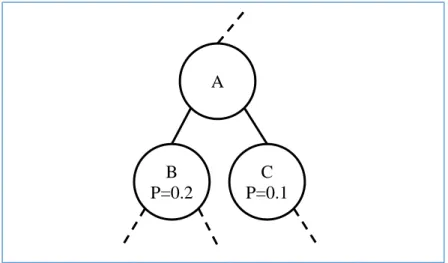
Dynamic Huffman Compression algorithms exist to compress data streams with bounded item (or token) list (Vitter, 1987; Knuth, 1985; Gallager, 1978; Faller, 1973). They incrementally calculate the Huffman tree from streaming data and compress them dynamically. A key to updating the Huffman tree is that the Huffman tree maintains the ‘sibling property.’ Although the static Huffman algorithm does not maintain the sibling property across all nodes, it is important to the dynamic algorithms of Knuth and Vitter to keep the all the nodes in order of weight (sibling property) to balance the tree. A binary tree has the sibling property “if each node (except the root) has a sibling and if the nodes can be listed in order of non-increasing probability with each node being adjacent in the list to its sibling” (Gallager, 1978). The sibling property is illustrated in Figure 2. Nodes A, B and C may be part of a larger tree. Nodes B and C are siblings. This tree is a
Huffman tree if all siblings in the tree can be listed in order of non-increasing probability. Nodes B and C meet that requirement.
Secondary Storage Database Stream(s) Stream Processor Fixed Queries Output Stream(s) On-the-fly Queries “Limited” Working Storage
Figure 2. Sibling property.
An algorithm for adaptive Huffman coding was conceived and proposed by Faller (1973), and Gallager (1978) independently. It was improved by Knuth (1985). Knuth described an efficient data structure for the tree nodes, and an efficient set of algorithms to process the dynamic tree to maintain the sibling property. In the literature this is known as algorithm Faller-Gallager-Knuth or the FGK algorithm (Knuth, 1985). This algorithm is similar to the original Huffman algorithm in that both sender and receiver build the same tree to compress and decompress the stream. The sender performs the compression function and the receiver performs the decompression function. There must be coordination between the sender and receiver to properly restore the data to its
uncompressed state.
The FGK algorithm builds the tree dynamically from the frequency of items in the stream. The algorithm will be illustrated and described later in this paper. The node frequencies change as new items arrive in the stream. Both sender and receiver need to update their tree synchronously and dynamically to maintain the sibling property. An aspect of the FGK algorithm is that a new node is added to the tree as each new item arrives, and in certain cases, nodes get exchanged. Nodes are never removed from the
A
B P=0.2
C P=0.1
tree. The space complexity of FGK (Knuth, 1985) is O(n), where n is the number of symbols in the alphabet to compress. Thus, one of the challenges of these compression algorithms is in memory-limited machines with many items, or a stream with no bound on the number of items.
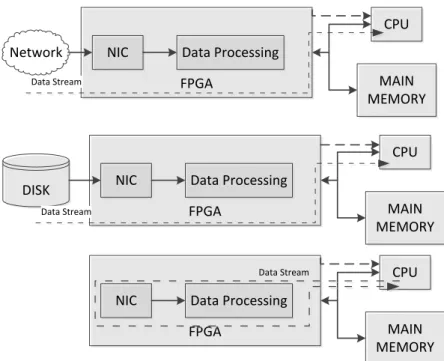
An example of a memory limited machine is the FPGA. FPGAs have been proposed for database processing (Mueller, Teubner & Alonzo, 2009a). In Figure 3, three possible architectures are presented. The researchers suggest that data tuples from a network connection could be streamed through the FPGA, and only the results of the query output to the CPU. Similarly, in Figure 3 (b), a stream from a secondary storage device could be processed. The advantages of these two architectures is that tuple processing on the order of hundreds of thousands of tuples per second could be achieved without applying that loading to the main CPU.
Network
FPGA
NIC Data Processing
CPU MAIN MEMORY
FPGA
NIC Data Processing
CPU MAIN MEMORY
FPGA
NIC Data Processing
CPU MAIN MEMORY DISK Data Stream Data Stream Data Stream
Figure 3. FPGA/CPU Architecture for database applications. Adapted from “Data Processing on FPGAs” by R. Mueller, J.
Teubner, and G. Alonso, 2009, Proceeding of the VLDB Endowment, 2(1), 910-921.
As an example of how the circuitry in Figure 3 could be applied, researchers (Mueller, Teubner & Alonso, 2010) have developed a cross compiler that inputs SQL statements and a database schema, and outputs the FPGA circuits. This is depicted in Figure 4. Here, in section (a), is a declared the schema for a database stream. The attributes, datatypes and order in the stream are defined. In Figure 4(b) a SQL statement is declared by a user to filter the database stream. The user is interested in tuple selection of stock transaction trades with a volume larger than 100,000 whose ticker symbol matches the symbol “USBN”. Finally, the user is interested in tuple projection of only the price and volume attributes.
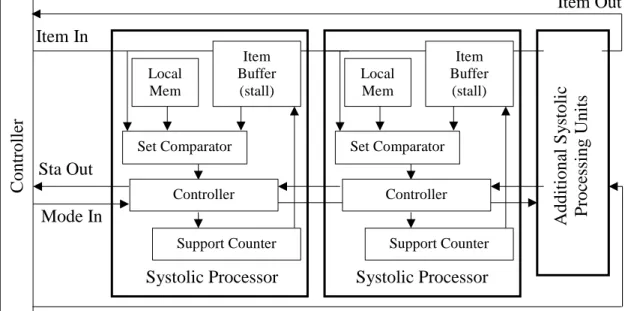
In Figure 5 an architecture for a data mining application is presented using FPGA (Baker & Prasanna, 2009). Here the researcher proposes implementing an FPGA
configured as a set of systolic processors to implement the Apriori algorithm for frequent item data mining. In their concept, the transaction database is streamed from some source through the systolic processors and the candidate item sets are built up. First the L2 item sets are generated. Next, the L2 candidate item sets need to be streamed through all the systolic processors to determine the L3 sets. As with the Apriori algorithm, the complete transaction database needs to be streamed (again) through all the systolic processors to prune the L3 candidate item sets. This operation continues until the maximal frequent itemset(s) is determined.
Figure 4. Glacier source code and circuitry examples. Adapted from “Glacier: A Query-to-Hardware Compiler,” by R. Mueller, J. Teubner, and G. Alonso, 2010, ACM SIGMOD International Conference on Management of Data, 1159-1162.
CREATE INPUT STREAM Trades (
Seqnr int, -- sequence number
Symbol string (4) -- stock symbol Price int, -- stock price
Volume int ) -- trade volume
(a) Stream Declaration
SELECT Price, Volume
FROM Trades
WHERE Symbol =” USBN” AND Volume > 100,000 INTO LargeUBSTrades (b) Textual Query Large UBSTrades | ΠPrice, Volume | σC | c:(a,b) | b:(Volume,100,000) | a:(Symbol,”USBN”) | Trades (c) Algebraic Plan
Figure 5. An FPGA data mining architecture. Adapted from “Efficient Hardware Data Mining With the Apriori Algorithm on FPGAs” by Z. Baker and V. Prasanna, 2009,
Proceedings of the 13th Annual IEEE Symposium on Field-Programmable Custom Computing Machines, 3-12.
The research in Figure 3, Figure 4, and Figure 5 are significant for three reasons. The first is it identifies the FPGA, a memory limited hardware element which is the object of database architecture research. Secondly, these architectures might benefit from compression of the data to enable higher speed processing. Finally, they all assume a horizontal encoding scheme of the database. The encoding scheme of a real-time
database will be the horizontal transaction format as depicted in Figure 6. In this figure a transaction is created in real time at a cashier. The transaction is inserted into the
transaction stream. A vertical format for the transaction database would not be a natural representation since the vertical format requires keying on the item IDs rather than the transaction IDs. The item IDs are a static list of all items in the store. Transaction IDs are created in real time. Keying on the Item IDs would require listing all the Transaction IDs in items list and this would not be possible since all the Transaction IDs may not
Item Out Sta In C ont rol le r Item Buffer (stall) Set Comparator Local Mem Controller Support Counter Item In Sta Out Mode In Item Buffer (stall) Set Comparator Local Mem Controller Support Counter A d d itio n al S y sto lic P roc es si ng U ni ts
have been created yet. Thus, the Horizontal transaction database format is a natural representation of a real-time streaming database.
Figure 6. Streaming transactions horizontal format.
An algorithm that is proposed to compress a horizontally encoded streaming transaction database on FPGAs is the dynamic Huffman compression algorithm (Knuth, 1985). In the case of item compression on FPGAs or specialized hardware using the FGK algorithm, the space complexity register requirements are O(n) since a node must exists for every item in I (the set of items). This proposal is for a new type of
compression algorithm, or variation of the FGK algorithm. This new algorithm could dynamically compute the Huffman tree of only the most k frequent items without needing memory capable of holding all n items, where k is defined as:
k < n
For instance, k can vary from 1 to n and might be chosen based on available memory on memory limited hardware.
Problem Statement
A problem related to compression of transaction database streams on memory-limited machines is identifying the frequent items in a data stream on memory-memory-limited
Transaction ID, Item ID 1, Item ID 2, …
Previous Transaction Next Transaction
time
Real Time Transaction stream
machines. This is the objective of several algorithms and research (Charikar, Chen, & Farach-Colton, 2002). For instance, the Frequent-k algorithm dynamically finds the k most frequent items in streaming data base S (Demaine, López-Ortiz, & Munro, 2002; Karp, Shenker, & Papadimitriou, 2003). A frequent item identification algorithm
(Metwally, Agrawal, & El Abbadi, 2005) is another algorithm used to find the list of most frequent items in streams. Their memory complexity is O(k), rather than O(n). Here k is chosen so that
k < n,
The number of different items, i, in the stream S is n (as previously defined). The number of items to be held in memory is k.
A transaction database data stream can be compressed by applying a dynamic Huffman compression on the resulting stream’s items. Algorithms exist for updating a dynamic Huffman tree as a single item arrives in a bounded stream with a bounded item list. The dynamic Huffman algorithms are not designed for memory-constrained
machines or to process streams with very large item lists. They expect the tree to grow to accommodate all items in the stream.
The dynamic Huffman compression algorithm as proposed by Knuth (1985) will be extended to accommodate operation on memory-limited machines or to compress database streams with a large set of items.
The new algorithm will be able to limit the required memory size of the dynamic Huffman algorithm. Dynamic Huffman algorithms are single pass algorithms.
Conventional, static, Huffman algorithms require two passes over the data to be
pass compresses the data. A single pass compression algorithm is applicable to streaming databases because a second pass may not be possible. The complete stream may not fit into available memory. Additionally, there may be many symbols to compress in the stream. For instance, assume that each item ID in a streaming transaction database is represented as a 32-bit word, and each item ID in the stream is considered a symbol to compress. A large Huffman tree would result if some method to moderate the Huffman tree is not employed.
The work proposed is different than the prior dynamic Huffman algorithms (Knuth, 1985) because the prior work assumes a bounded item list and that the dynamic Huffman tree will fit into memory. A new algorithm will build the Huffman tree, update the Huffman tree item frequencies as new items are added to the tree, or as they become old. It must maintain the sibling property of the Huffman tree and moderate the size of the Huffman tree. Node frequencies will be determined from the frequent item algorithm.
A recognized benefit of the prior dynamic Huffman compression algorithms use on a data stream is that the algorithm is adaptive to temporal changing statistical
frequencies of the symbols. Enhancing the algorithm to manage the maximum size of the stored data structure will benefit compression of transaction data streams with large symbol lists. This new algorithm to be researched is called the memory limited dynamic Huffman algorithm.
Why Streaming? Why Huffman?
Streaming implies single pass. Reading the database multiple time may not be possible, or may be slower.
Streaming is a real-time demand. A horizontal encoded transaction database may be more natural for a real-time stream. Existing compression schemes for vertically encoded bitmap or tidset transaction database schemas may not be applicable to a real-time stream because they require the transaction IDs to be known beforehand.
Several datamining algorithms exist for horizontal encoded transaction database formats. A Huffman compression algorithm could compress the frequently used item IDs in a transaction database stream.
Dissertation Goal
High speed and large throughput data stream mining will require specialized computing hardware to analyze, summarize, monitor and tabulate user queries, perform algorithmic trading, and secure networks. To this end reconfigurable hardware has been used to process the data stream using algorithms realized on a massively parallel scale. For instance, Muller, Teubner, and Alonzo (2009a, 2009b, 2009c, 2010, 2011a, 2011b) have published much research on mining streaming databases with algorithms
implemented on a highly parallel scale. In their research, they present a variety of algorithms for frequent item computation, stream queries, and stream joins using reconfigurable computing. Other researchers using reconfigurable computing to mine streaming databases are Baker and Prasanna (2005, 2006). Some of this research centers on computing frequent item-sets on transaction databases using systolic arrays. The systolic arrays are implemented using reconfigurable computing hardware. Other researchers are using the reconfigurable hardware to filter XML data streams (Mitra et al., 2009). Other previous work in this research project explored and implemented algorithms for association rule mining using reconfigurable computing. In this previous
research, the algorithms were designed to be massively parallel and fine grained. The algorithm was scalable.
Technology is enabling the implementation of the reconfigurable compute
function. Data compression techniques can increase the effective throughput of data that is transferred on a communications channel and the computer hardware. Compression of the data can potentially make use of memory more effectively. Typically, this would be secondary storage. It is also used to more efficiently use primary memory. Similarly, compression can be used to more effectively use the logic gates and interconnects in the reconfigurable computer hardware.
Effective use of the computing hardware can be achieved by compressing the data at the source, and keeping the data compressed during processing. For instance, Baker and Prasanna (2005) propose using an FPGA to implement the Apriori algorithm. They propose a systolic array architecture that might benefit from compression of the data stream between the individual systolic processors. The Viper algorithm (Shenoy, Haritsa & Sudarshan, 2000) proposes compression of the database stream.
This research work will develop a dynamic Huffman compression algorithm for memory-constrained machines. A memory-constrained machine is defined as one where the size of the database to be held in memory, approaches or exceeds the size of the memory. It will benchmark the algorithm using several popular benchmark databases as summarized in Table 1.
Table 1
Benchmark Databases
Database Database source
Accidents Traffic accident data b
BMS1 KDD CUP 2000: click-stream data from a webstore named Gazellea
Kosarak Click-stream data of a Hungarian on-line news portal b Retail Market basket data from an anonymous Belgian retail store b T10I4D100K Synthetic data from the IBM Almaden Quest research group c T40I10D100K Synthetic data from the IBM Almaden Quest research group c BMS-POS KDD CUP 2000: click-stream data from a webstore named Gazellea BMS-WebView2 KDD CUP 2000: click-stream data from a webstore named Gazellea aRetrieved from
http://www.sigkdd.org/kdd-cup-2000-online-retailer-website-clickstream-analysis. bRetrieved from http://fimi.ua.ac.be/data/ c Agrawal and Srikant (1994)
The dynamic compression results will be compared to the static database compression results that were obtained in the previous experiments (see Chapter 2, “Initial Investigation,” for results). The important metrics to collect are the compression ratio of prototyped algorithms compared to a two pass Huffman Compression (Huffman, 1952) and the RLE compression techniques (Golomb, 1966). The compression ratio will be calculated from the measurements of uncompressed and compressed file bit lengths. The performance of the Dynamic Huffman compression using limited memory algorithm developed in this research will depend on the amount of memory allocated to the
algorithm. The algorithm will be run multiple times on the benchmark databases to collect insight on how the allocated memory affects real world compression ratios. A complete list of metrics and measurements will be detailed in Chapter 3, Methodology.
The proposed work prototypes a compression algorithm using a frequent item algorithm to determine item frequencies. A frequent item identification algorithm
(Metwally, Agrawal, & El Abbadi, 2005) will be implemented and integrated into the FGK algorithm.
The overall goal of this research is to facilitate knowledge discovery in streaming databases using reconfigurable computing. This research will facilitate compression of the data stream with a large item list on memory limited devices.
Research Questions
A question this research will answer is how the frequent item identification algorithm affects the compression algorithms ability to compress different types of streaming data. The benchmark databases represent several varieties of transaction databases and are used to represent the streaming data. This research will compare the results of the streaming database algorithms with the static compression techniques previously developed and benchmarked.
Secondly, the benchmark databases results will provide insight on how the new algorithms compression ratio varies with the type of data compressed. For instance, it was determined in the initial study that artificial (computer generated) transaction databases compress poorly using the Huffman static compression. Huffman techniques compress well when the data has a probability distribution function that is not uniform. In probability theory, a uniform probability distribution, f(x), has a constant value
𝑓𝑓(𝑥𝑥) = 𝑎𝑎 − 𝑏𝑏1
over interval a ≤ x ≤ b and 𝑓𝑓(𝑥𝑥) = 0 otherwise (Mendenhall, Beaver, & Beaver, 2012). For example, when a single dice is rolled, there is a uniform probability of rolling any one of the six outcomes. It was determined that for synthetic datasets with a more nearly uniform probability distribution a bit map representation of the database with an
RLE compression technique might offer better compression results. It is expected that the memory limited dynamic Huffman compression will provide similar, poor,
compression results as was obtained with the static Huffman algorithm for a synthetic database. This will be verified using the benchmark datasets.
A question this research will answer is what should be the criteria for selecting k, the number of nodes to hold in memory. This question has not been found to be explored in the literature. Certainly, this should be related to the total number of symbols in the input stream, n. The metric used by most compression techniques to compare algorithms is the compression ratio. The compression ratio is defined as the compressed data length divided by the uncompressed data length. For streaming data, often the compression ratio is defined as the compressed data rate divided by the uncompressed data rate. Relevance and Significance (Benefit of Research)
Because of the explosion of data, stream mining has come to the forefront. In stream mining, the frequency of items t in T (as previously defined) may not be known beforehand and thus would require single pass compression. Additionally, there is a push to perform the mining and queries using specialized hardware and reconfigurable
computing (such as FPGAs) for high speed parallel processing to handle the high speed data streams. The challenge with FPGAs is to create massive parallel high speed
algorithms with the limited resources on chip. Although algorithms scalable to a number of FPGAs are possible, compression of the data will reduce the number of registers and logic necessary.
This research proposes to apply a single pass dynamic Huffman compression to the transaction database stream to compress the k most frequent items in the database, on
memory limited machines, where k is a user chosen constant chosen to limit the size of the Huffman tree. It will provide a basis to make the tradeoff between computing memory/time required and the resulting compression ratio.
This research may be beneficial to database storage. Successfully compressing streaming items, i, in T (as previously defined) could result in a reduction in required primary storage. Although a streaming database is not capable of being stored in primary memory, compression would allow larger sections, or windows, of the database to be stored than could be stored without compression.
This research will be beneficial to the dynamic Huffman compression of data with a large symbol list, or a symbol list where the memory structure is larger than can be fit into available memory.
Barriers and Issues
In frequent item stream mining an in-memory data structure holds a list of items and their frequencies. The data memory is limited and as it fills up, less frequent items are pushed out to make way for new items. Thus, the main issue is to update the dynamic Huffman tree using the results from the frequent item-set mining.
Specifically, incrementally updating the Huffman tree and keeping the sibling property using Vitter’s algorithm (Vitter, 1987), as the frequencies change poses
problems. Vitter provides a way to update the Huffman tree with a single new item and maintain the sibling property. Vitter does not provide a way to remove items from the tree and rebalance the tree to maintain the sibling property. Knuth (1985), in his
algorithm, discusses how to add and remove items from the tree and perhaps by studying Knuth’s method, Vitters algorithm (1989) can be extended. Another possible solution is a
brute force approach (Pigeon, 2003). The brute force approach recalculates the complete Huffman tree as new frequent items are found or removed. Pigeon also discusses using a fixed table as previously discussed in the “Questions” section. A fixed table provides some set of fixed Huffman prefix codes. These prefix codes are not calculated
dynamically. They are pre-calculated and fixed. In this approach the shortest prefix codes are simply assigned to the most frequent items.
Because of these issues, the method that will be prototyped in this research proposal is to use the FGK dynamic Huffman algorithm and prune the tree using a frequent item algorithm (Metwally, Agrawal, & El Abbadi, 2005). This algorithm will allow reuse of old tree nodes. The deletion of a tree’s node, or decrementing of a node’s weight, will not be required, although it is possible as discussed by Knuth (1985). Measurement of Research Success
There are several measurements that should be met to determine research success. The measurements should be quantitative rather than qualitative to avoid subjective
measurement. For instance, some metrics might be: Benefits, Value, Goals/milestones. Value may be a subjective measurement. For this research, the following framework should be used to determine final success:
o The coding of a memory limited dynamic Huffman algorithm that:
can compress/decompress a file and is verified against Knuth’s original results.
Consumes comparable memory and time as Knuth’s algorithm.
Compression ratio comparable to Knuth’s original algorithm when memory is not limited. If not, why?
o Verification of the ability to compress real life transaction database files formats.
o A method to predict or estimate the compression ratio/memory tradeoff for a database application, perhaps based on the distribution of items.
This last item is important because if this algorithm is to be included in a design, then some expectation of the results should be able to be determined in the design stage. Definition of Terms
Adaptive Compression – A type of single pass compression where the algorithm change based on the data being compressed. The algorithm may
automatically learn or adapt to the type of data with the goal of increasing the compression ratio, or other metric.
Apriori [algorithm] – A computer algorithm for knowledge discovery in databases. It finds association rules in the data based on a support and confidence. It does this by successively pruning larger supersets of data patterns based on the frequency of its subsets. This bottom up algorithm significantly reduces the number of item sets that are considered. Canonical [Huffman Code] –It means a ‘useful’ code, given the many different
Huffman Code sets that could result depending on the arrangement of the Huffman tree. Canonical Huffman codes are lexicographically ordered by length of the code.
Compression – the act of representing a larger set of data with a smaller set of data. Decompression would be the restoration of the larger set of data, or the approximate restoration of the data, from the smaller compressed set. Dynamic Compression – see Adaptive Compression
Entropy – Originally defined in the field of thermodynamics, it is a measure of the degree of randomized energy in the system and its ability to produce work. A system with higher entropy is more randomized and has less ability to do useful work. In information science, higher entropy refers to a more randomized signal. Shannon (1948b) reused the word and defined it to be negative the log of the expected value of the probability of an event. The event in this case would be the symbol or bit in a message.
Entropy coding – A lossless Compression technique which is accomplished by removing redundancy in the data.
FPGA – Field Programmable Gate Array. This is a chip that has I/O pins and an internal ‘sea of gates’ whose connections are programmable after
manufacture. The internal structure of the FPGA is determined by the manufacturer but can realize any logic function as determined by the users programming. Commonly, FPGA also contain ‘macro’ functions such as memory, phase lock loop clocking circuitry, non-volatile memory, analog conversion, and specialized I/O.
Lossy compression - a compression technique where the reconstituted data only approximates the original signal. The algorithm accomplishes this by partially discarding data. It may also match data as redundant that only
partially matches and then remove the redundancy. Typically used for applications that can tolerate inexactness in the reconstituted data such as digitized photos, video and sound.
Lossless compression – Any compression technique where the reconstituted data is identical to the original data for all data targeted by the algorithm. LUT – In the context here it refers to Look up Table for an FPGA. From Boolean
logic, it is well known that any logic function can be implemented using a NAND gate. FPGA manufacturers do not use the NAND gate as the basic building block of the logic that can be implemented on the FPGA. Rather, they use the LUT. Each LUT typically may have four input bits and a single output bit. Sixteen memory cells hold the logic mapping between input and output. Thus, any Boolean logic function is realizable. Rather than using LUTs to implement flip-flops and registers, manufacturers will include a few flip-flops with each LUT on the chip. Different
manufacturers may call these LE’s (logic elements), macrocells, or gates. Memory constrained – Any real computer system is memory constrained when
the application or algorithms requirement for data exceeds the memory limits. This could refer to either secondary storage or main memory constraints.
Mining – The term data mining is a misnomer. A more apt term, and the industry-accepted term, is Knowledge Discovery in Databases. The goal of Mining is the discovery of useful patterns and relationships in the data and not the data itself.
Prefix code – A prefix code can be uniquely (and instantaneously) decoded in the input stream. It is usually a variable length code. Unary coding is a type of prefix code.
Reconfigurable computing – This is the ability of the computing hardware to change its hardware connections either dynamically (at runtime), or more commonly, to adapt itself to the application after its manufacture.
Reconfigurable computing was made possible by the development of FPGAs with high density. Reconfigurable computing has the unique characteristic of being able to reconfigure itself during or before runtime to implement a variety of fine grained, massively parallel, algorithms. RLE – Run length encoding is a simple form of lossless data compression where
long sequences of identical symbols (or data patterns) are coded as a data count and symbol (or pattern). A familiar application that uses RLE compression is facsimile transmission. In this application, it is common to scan pages of text which have large sections of white space. If the pixels that represent the white space were encoded as a ‘0’, and the black text pixels as a ‘1’, the RLE model would be tuned to encode the large ‘runs’, or sequences of 0s as a count and a single 0 bit.
Streaming – In the context of this document, refers to an unbounded real-time data transmission.
Transaction database – a database whose records (or tuples) contain the presence, or absence, of items. Each tuple also has a key, also called the transaction id.
Truncated binary coding – a binary coding that is used because of its entropy efficiency. To encode n symbols requires between k and k+1 bits, where
𝑘𝑘= ⌊log2𝑛𝑛⌋, In this coding the first few symbols can be transmitted with k bits, while the remainder of the symbols require the full k+1 bits.
Unary coding – This is a type of prefix code. In this system the number n is represented by n 1s followed by a 0 (or the opposite). Note that the number of bits required to transmit this code increases with the number to transmit. Thus, it is an entropy encoding where the probability of each symbol is given by 𝑃𝑃(𝑛𝑛) = 2−𝑛𝑛. It is similar to tallying where a mark is drawn for each item to be represented.
XML – Extensible Markup Language is a set of rules for encoding documents. It is text based and designed to be readable by humans, but efficient for machine processing as well. It is the basis for many formats including RSS, SOAP and ATOM. XML formats have become the basis for many applications including Microsoft Office. Part of the format is textual data delimited by text tags.
Chapter 2
Review of the Literature
The Data Stream
Advances in computing have facilitated the collection of continuous data
(Aggarwal, 2007). Much of this type of data is generated from simple transactions, such as using a credit card on the telephone, browsing a website with a browser, a stock
transaction or the daily itinerary of commercial aircraft. Much of the data flows across IP networks. This data can be mined for interesting relationships for many different
applications. When the volume of data is large there are significant challenges:
1. Because of processing time cost constraints, it may no longer be possible to mine the data in multiple passes. A single pass of the data for its processing may be desirable. This will define the algorithm chosen to process the stream. Stream mining algorithms process the data in a single pass.
2. In many cases, there is a temporal component to the data. The data may change with some periodicity given the time of day, season, or perhaps it may evolve apparently randomly given the political situation of the time. Item frequencies may change over time. There is a need for stream mining algorithms to
accommodate this temporal or ‘time varying’ component.
This second bullet seems to corroborate this research. The author also notes that stream mining is often accomplished with distributed algorithms/hardware (Aggarwal, 2007).
S. Muthukrishnan (2011) presents some further thoughts on the progress and direction of stream computing. He presents an alternate view of stream computing. He notes that computing capacity, memory and communications have been growing steadily. With it the amount of generated data has also grown and it needs to be analyzed. The generated data streams are created in “massive” rates far higher than can be captured and stored. It arrives at a faster rate than can be sent to a central database without
overwhelming the communication’s channel and faster than can be computed. The assumption is that all data can be captured, processed, and stored. For instance, digital signal processing starts with the Nyquist theorem (Nyquist, 1928; Shannon, 1948) that states the sample rate should be twice the highest signal frequency for full reconstruction. Database theory leads to a relational algebra that is continuously applied to the data and is provable to be correct on its results. Communications theory incorporates the thought that there is a minimum number of bits required to transfer the information content. This is Shannon’s concept of self-information (Shannon, 1948). As a future direction of research, Muthukrishnan (2011) notes:
Streaming and compressed sensing brought two groups of researchers (computer science and signal processing) together on common problems of what is the minimal amount of data to be sensed or captured or stored, so data sources can be reconstructed, at least approximately. ...This is however just the beginning. We need to extend compressed sensing to functional sensing, where we sense only what is appropriate to compute different functions and SQL queries (rather than simply reconstructing the signal) and furthermore, extend the theory to massively
distributed and continual framework to be truly useful for new massive data applications above. (p. 319)
In “Data Streams: Algorithms and Applications” (Muthukrishnan, 2005), the concept of transmit, compute and store, or TCS, capacity is outlined to differentiate data stream processing from other ‘normal’ compute data flow. The data stream is data that occurs as an input to some program at a very high rate. At this rate it may be difficult for the computing hardware to transmit (T) the entire data to the program. The program may have limitations on its ability to compute (C) the algorithms and processing necessary on all the large chunks of data. The program may not be able to store (S) either temporarily or to archive the data.
This view defines data stream processing as relating to the stress on these resources.
Another interesting definition of a data stream, that is relevant to this research, comes from the Blog “Development Blog on compression Algorithms” (Collet, 2011). The author demonstrates quite a bit of knowledge and the writings do provide
confirmation of some basic concepts to understand a data stream. Here Collet (2011) says,
At its most basic level, a file satisfies the definition of a stream. These are ordered bytes, with a beginning and an end. File is in fact a special stream with added properties. A file size can to be known beforehand. And in most
circumstances, it is likely to be stored into a seek-able media, such as a hard disk drive. But a stream is not limited to a file. It can also be a bunch of files grouped
together (tar), or some dynamically generated data. It may be read from a streaming media, such as pipe, with no seek capability. (p. 1)
Babcock, Babu, Datar, Motwani, and Widom (2002) expound on the unique aspects of the data stream. They note that the database system cannot control the order in which the data arrives. Either between data streams, or within a stream. They note that data streams are unbounded in size and that once a data stream element has been
processed or discarded, it cannot be easily retrieved unless the element was stored. But typical storage is small compared to the size of the stream.
There are several real-world examples of stream processing database systems (Babcock et al., 2002). Traderbot is a web-based financial search engine that processes queries over streaming financial data. iPolicy Networks processes network packet streams in real time. It performs complex stream processing, table lookups, URL filtering, and correlates the data across multiple network flows. Large websites such as Yahoo may coordinate distributed clickstream analysis to track heavily accessed web pages. Finally, they cite sensor monitoring as a streaming database application. Large number of sensors may generate data that needs to be processed and analyzed by the database management system. An example query from a network management system is presented. This query will compute the averaged load over one minute on link B and to notify the operator when the load crosses some value t:
SELECT notifyoperator(sum(len)) FROM B
GROUP BY getminute(time) HAVING sum(len) > t
Introduction to Compression
Both RLE compression (Golomb, 1966) and Huffman Compression (Huffman, 1952) take advantage of a statistical modeling of the data stream to achieve a level of compression. Without some model of the data, its compression may not be possible (Nelson & Gailly, 1996). For instance, consider all possible 1000-bit messages (Blelloch, 2001). It should be obvious that all possible 1000-bit messages (there are 21000 of them)
cannot be represented by less than 1000-bits, unless some set of those messages are represented by more than 1000-bits. As a more concrete example, take for example an alphabet that consisted of only four symbols. It is impossible to represent 10 different values using only four symbols (unless multiple symbol combinations are used). The ten decimal digits cannot be compressed to only four symbols. Going back to the 1000-bit example, a model of the 1000-bit messages is required that identifies a subset of those messages and/or some redundancy in the representation of information contained in that message subset. It is reasonable to expect to compress only that subset of messages. For instance, identify a model of data that represents a color static picture, then identify redundancies in the structure of the data. From that model, develop an algorithm and code that compress that subset of messages. Data that falls outside of the model might not be effectively compressed. In fact, data that falls outside the model often result in a larger size when run though a compression algorithm not intended for its model.
Some common ways compression algorithms achieve results is to exploit the redundancies in the data (Salomon, 2004). Redundancies in the database can exist at many different levels; from the bit stream level (RLE), to the identification of repeated symbol patterns (Ziv & Lempel, 1977, 1978), up to the taxonomy of attributes/records as
identified by database normalization (Codd, 1970, 1972). Note that neither of these last two methods require a statistical model of the data. Non-random data has some sort of structure. Compression takes advantage of that structure to represent that data in a smaller version. Ideally, the smaller, compressed, version of the data would not have any noticeable format.
For instance, Huffman compression takes advantage of the statistical frequency of characters (or tokens) in the message. In this model of the data used by Huffman, there is a statistical non-uniformity in the frequency of characters. Messages that fall outside that model, i.e., do not have a non-uniformity in the frequencies of their data characters, when compressed, would likely result in ‘compressed’ messages that are larger than the original message.
As an example, assume a message to be compressed was composed of an alphabet that was 127 characters and these characters were encoded in 7-bit ASCII. Further
assume that all 127 characters appeared in the original message with equal probability. The proposed message might consist of 500 occurrences of each of the 127 characters in the symbol set. Further assume that the occurrence of each of the characters is random within the message. This message falls outside of the Huffman model. In the Huffman model there is a non-uniformity in the symbol probabilities. The resulting Huffman compressed message from this equal probability symbol set would consist of the same sized message as the original, also encoded in 7-bit characters. This can be confirmed by trying to build a Huffman tree of the 127 characters where each character has equal probability of 0.79%. The probability of any of the 127 characters occurring is 100%, then the probability of a single character, if all had equal probability, is 100%
Each character would be encoded by the Huffman tree using 7 bits, the same as the original ‘uncompressed’ coding. In addition, the compressed message would contain ‘overhead’. The overhead would at least need to contain some representation of the Huffman tree, or if canonical codes are used, a dictionary of the input characters. The result in this case would be a compressed message that is larger than the original message.
Arithmetic compression (Witten, Neal, & Cleary, 1987) builds on Huffman by taking advantage of inefficiencies in Huffman’s representation of the compressed data. This model recognizes that the ideal number of bits to represent the Huffman token is most often not an even integer.
Lempel-Ziv (Ziv & Lempel, 1977) does not look at individual character’s frequencies as in Huffman or arithmetic compression techniques. It looks for repeated sequential patterns of characters in streaming message. It is effective at compression long strings of repeated characters. The Lempel-Ziv model recognizes recurring patterns in streaming data.
A model of a streaming transaction database presents several features that can be exploited to code a compression scheme algorithm. This research is intended to explore and find that redundancy.
Streaming data has a sender, a receiver, and a communications channel. The sender compresses the data. In some literature, this is also called the coder. The receiver, on the other end of the communications channel, decompresses the data. In some
attention to this decompression algorithm as well. Both the sender and receiver need to stay synchronized over the data stream.
The model of compression may be fixed or adaptive. An example of a fixed compression algorithm might be one which compresses ASCII characters and the relative frequencies of the various ASCII character are determined beforehand. Both the sender and receiver require the same model of the data for successful compression to occur. With an adaptive model, both the sender and receiver would respond to changes in the frequencies of the characters as the data is processed.
Adaptive, often called dynamic, compression is a type of single pass compression. Single pass compression algorithms do not need to know the frequency of items to be compressed in advance. They may have ‘meta-information’ about the model of the data but not be tuned to specific probabilities of redundancies in the data. These techniques are applicable to streaming databases because the database may have a temporal component and the frequencies may vary over some period.
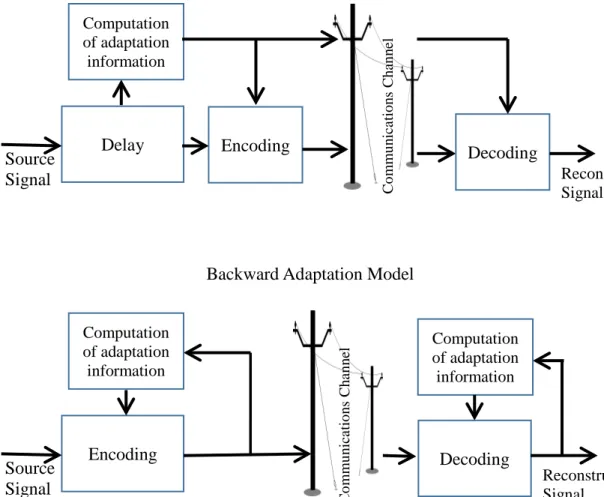
Figure 7 shows two models for adaptation. The forward model assembles a packet from the stream. Statistics on the item frequencies or other redundancies are computed over the packet. The compressed stream is transmitted along with the adaptation information. For instance, in the Huffman two pass compression the source transmits the table necessary to reconstruct the Huffman tree.
In the backward adaptation model, encoding is immediately performed using stored information from previous conversions. As new symbols enter the source stream, they are immediately transmitted into the compressed stream (since there is no adaptation
information on them yet). Both the source and destination sides compute the adaptation information synchronously.
Figure 7. Two models of compression adaptation.
Transaction databases occur in several applications. Finding association rules in
market basket analysis is introduced by Agrawal, Imieliński, and Swami (1993). The data typically consists of marketing and transaction information. This might include the date of purchase, a customer ID, a transaction ID, and most importantly the list of items and quantities. In this application, the data may come from a web store, or it may come
Computation of adaptation information Delay Encoding Source Signal Decoding Reconstructed Signal C o m m u n ic a tio n s C ha n ne l
Forward Adaptation Model
Computation of adaptation information Encoding Source Signal Decoding Reconstructed Signal C o m m u n ic a tio n s C ha n ne l Computation of adaptation information Backward Adaptation Model
from a supermarket. It may come from the register at the checkout counter. Association rules identify those items frequently purchased with other items at the checkout. For example, the association rule might state that 80% of customers who purchased a tablet computer also purchased a black carrying case and a mouse. This type of information may determine the advertisements that appear on a web store checkout page, product placement within a retail store, layout of a mailing flyer, target marketing…
Table 2 illustrates popular and proposed transaction database formats. In the horizontal format illustrated in (a), a transaction id (tid) is followed by a variable length list of item identifiers. The record, or tuple, is variable length. For the purposes of a compression algorithm, each of these ids would be considered a token in the input stream. The tid would be a unique identifier and would have a frequency of 1 in the stream. The item identifiers might not and items that are popular and sold frequently might would have a higher probability. Some algorithms for association rule mining, such as the popular Apriori algorithm, assume the horizontal format for the transaction database. This database format is also assumed by the MaxMiner (Bayardo, 1998) and
DepthProject (Agrawal, Aggarwal, & Prasad, 2000) algorithms.
In contrast is the vertical format as illustrated in Table 2 (c). In this format, each tuple is keyed to the item ID. Each tuple contains the item tidset. The tidset is the set of all tids in which the item occurs. Table 2(d) illustrates the vertical bitmap format. This format is used by the Mafia (Burdick, Calimlim & Gehrke, 2001), Viper (Shenoy et al., 2000), Eclat (Zaki, 2000), Charm (Zaki, 2000), and Partition (Savasere, Omiecinski, & Navathe, 1995) algorithms. Compressed vertical bit vectors are used in this format.
Table 2
Transaction Database Formats
(a) Horizontal format
ID Item 100 A, B 200 D, E 300 A, C 400 A, C, E 500 C 600 D, E
(b) Horizontal bitmap format Item ID A B C D E 100 1 1 0 0 0 200 0 0 0 1 1 300 1 0 1 0 0 400 1 0 1 0 1 500 0 0 1 0 0 600 0 0 0 1 1
(c) Vertical tidset format
Item Transaction ID A 100, 300, 400 B 100 C 300, 400, 500 D 200, 600 E 200, 400, 600
(d) Vertical bitmap format Transaction ID Item 100 200 300 400 500 600 A 1 0 1 1 0 0 B 1 0 0 0 0 0 C 0 0 1 1 1 0 D 0 1 0 0 0 1 E 0 1 0 1 0 1
Two Pass Compression of a Transaction Database
Data mining, or knowledge discovery in databases (KDD), attempts to find interesting relationships in a database. Association rule mining is a machine learning
algorithm used for KDD. Association Rule learning finds frequent item-sets in a transaction database, D (Agrawal, Imieliński, & Swami, 1993). Let the set of transactions in D be
T = {t1, t2,…, tj}, where t1 is the first transaction and tj is the last transaction in the database. Let the set of items in the database be
I = {i1, i2,…, in}
Thus, n is the number of different items in the database, and j the number of different transactions in the database. The transactions each have a TID, or transaction ID. An association rule is defined as
𝐴𝐴 ⟹ 𝐵𝐵; where 𝐴𝐴 ⊆ 𝐼𝐼,𝐵𝐵 ⊆ 𝐼𝐼 and 𝐴𝐴 ∩ 𝐵𝐵 ≠ ∅.
An example of an association rule is {𝐵𝐵𝐵𝐵𝐵𝐵𝑎𝑎𝐵𝐵,𝐸𝐸𝐸𝐸𝐸𝐸𝐸𝐸}⟹ 𝑀𝑀𝑀𝑀𝑀𝑀𝑘𝑘. The task is to find all the frequent association rules in the transaction database, T. A maximal frequent item-set, of length k. is defined as
{𝑀𝑀1,𝑀𝑀2,𝑀𝑀3, … ,𝑀𝑀𝑘𝑘}
A maximal frequent item-set is not a subset of a frequent item-set. Finally, a transaction ti in D will contain some of the items in I. Let the cardinality of items in a transaction ti in T be |ti|.
Run Length Encoding (RLE) Compression.
RLE compression notes that in sparse matrices, there will be long runs of 0 bits in each row. The probability of a 1 bit in the database will be the number of items in the transaction database D, divided by the total number of transactions times the number of different items in item list.
ℕ= �|𝑡𝑡𝑖𝑖| 𝑗𝑗 𝑖𝑖=1
ℕ is the total number of items in the database. The probability of a 1 bit becomes
𝑝𝑝= 𝑗𝑗 ∙ 𝑛𝑛ℕ
where j is the number of transactions in the database and n is the number of different items in the database.
The probability of a 0 bit will be 1 - p.
An RLE algorithm using Golomb prefix codes will compress a long string of 0 or 1 bits with a minimal entropy (Golomb, 1965). Golomb codes first require computation of a factor, m , based on the probability, p, of a 0 bit in the string to be encoded. This quantity is computed as 𝑝𝑝𝑚𝑚 ≈1 2 or, 𝑚𝑚 ≈−loglog102 10𝑝𝑝 = 1 −log2𝑝𝑝
Based on work by Gallager and van Voorhis (1975), Salomon (2007) refines this equation. Salomon more accurately obtains:
𝑚𝑚 =�−loglog2(1 +𝑝𝑝)
2𝑝𝑝 �
A larger m value means a higher probability of a long run of 0 bits. This will be used to calculate a Golomb prefix code whose length is shorter for runs of 0 bits around the ideal mean run length.