R E S E A R C H
Open Access
Closed-form approximations of the
peak-to-average power ratio distribution for
multi-carrier modulation and their applications
Marwa Chafii
1*, Jacques Palicot
1and Rémi Gribonval
2Abstract
The theoretical analysis of the peak-to-average power ratio (PAPR) distribution for an orthogonal frequency division multiplexing (OFDM) system, depends on the particular waveform considered in the modulation system. In this paper, we generalize this analysis by considering the generalized waveforms for multi-carrier (GWMC) modulation system based on any family of modulation functions, and we derive a general approximate expression for the cumulative distribution function (CDF) of its PAPR, for both finite and infinite integration time. These equations allow us to directly find the expressions of the PAPR distribution for any particular functions and characterize the behaviour of the PAPR distribution associated with different transmission and observation scenarios. In addition to that, a new approach to formulating the PAPR reduction problem as an optimization problem, is presented in this study.
Keywords: Distribution; Peak-to-average power ratio (PAPR); Generalized waveforms for multi-carrier (GWMC); Orthogonal frequency division multiplexing (OFDM); Multi-carrier modulation (MCM); Optimization
1 Introduction
Orthogonal frequency division multiplexing (OFDM) [1-3] is a technique used to send information over sev-eral orthogonal carriers in a parallel manner. Compared to the single-carrier modulation, this system shows a bet-ter behaviour with respect to frequency-selective channels and gives a better interference reduction. It allows an optimal use of the bandwidth, thanks to the orthogonal-ity of its carriers (compared to FDMA systems). These are among the reasons why this technique has been adopted in many standards such as the asymmetric digital subscriber line (ADSL) [4], the Digital Audio Broadcast-ing (DAB) [5], the Digital Video BroadcastBroadcast-ing-Terrestrial (DVB-T2) [6], HiperLAN/2 [7], Long Term Evolution (LTE) and WiMAX.
However, the OFDM signal features large amplitude variations compared to that of the single carrier’s signal, because it is the sum of many narrowband signals in the time domain, with different amplitudes. Based on this fact, in-band and out-of-band distortions occur during the
*Correspondence: [email protected] 1SUPELEC/IETR, Cesson-Sévigné Cedex 35576, France Full list of author information is available at the end of the article
introduction of the signal into a non-linear device, such as the high-power amplifier (HPA). In order to study these high amplitude fluctuations, the peak-to-average power ratio (PAPR) has been defined. The PAPR is a random variable, as the symbols arrive randomly at the modula-tion input. To study this measure, several researchers have analysed the distribution law for different particular mod-ulation bases: the Fourier basis [8], the wavelet basis [9], the wavelet packet basis [10] and the discrete cosine trans-form (DCT) [11]. Others have studied the PAPR based on the Fourier modulation basis, using different wave-forms, such as the square root raised cosine (SRRC) [12], the isotropic orthogonal transform algorithm (IOTA) [13], the extended Gaussian functions (EGF) and other pro-totype filters in the PHYDYAS project [14] for the filter bank multi-carrier (FBMC). For the wavelet modulation basis, we can also study the PAPR by using several types of wavelets, such as the Daubechies wavelets, the Haar wavelet and the biorthogonal wavelet [15]. To the best of our knowledge, this is the first work that generalizes the previously done studies, by considering any family of modulation functions, so as to derive an approximation of the PAPR distribution. The equations are applied to check the expressions of the PAPR distribution, which have been
Section 4, some applications of the PAPR approximation are explained. Finally, Section 5 concludes the paper.
2 System description
We consider in this section the most general theoretical case: transmitting infinite data in a continuous way over time. We first model the GWMC signal at the modulation output in Section 2.1. In Section 2.2, we define the condi-tions that our system must satisfy for the analysis of the PAPR distribution in Section 3.
2.1 GWMC system
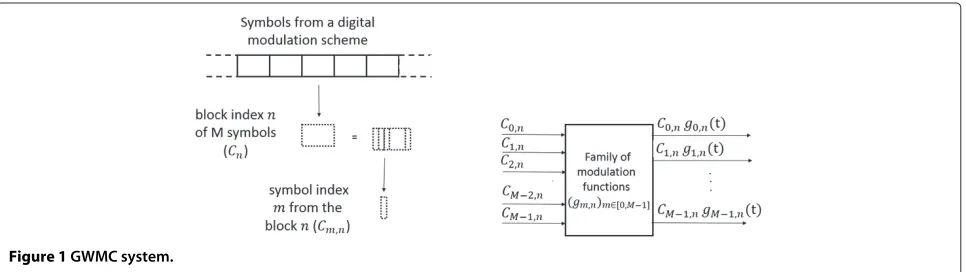
Information-bearing symbols, resulting from modulation performed by any type of constellation, are decomposed into several blocks. Each block of symbols is inserted in parallel into a modulation system as shown in Figure 1. At the output of the modulator, the GWMC signal can be expressed as [19]:
Definition 1. (GWMC signal)
X(t)= n∈Z
M−1
m=0
Cm,ngm(t−nT) gm,n(t)
. (1)
• T, duration of a block of input symbols
• M, number of carriers that we assume greater than 8. (This is an assumption made for the validity of
(G-CLT) in Section 3, our system must satisfy the follow-ing two assumptions:
Assumption 1.(Independence of input symbols)
• CmR,n(m∈[[0,M−1]],n∈Z)are pairwise independent, each with zero mean and a variance ofσc2
2.
• CmI,n(m∈[[0,M−1]],n∈Z)are also pairwise independent,
each with zero mean and a variance ofσc2
2.
• (∀m,p∈[[ 0,M−1]]),(∀n,q∈Z)CmR,nandCIp,qare independent.
As a consequence,
E CRm,nCpR,q
= σc2
2 δm,pδn,q, (2)
E CIm,nCpI,q= σ 2 c
2 δm,pδn,q, (3)
ECRm,n=ECmI,n=0, (4)
E CRm,nCpI,q=ECmR,nE CpI,q=0. (5) The symbols from constellation diagrams of the usual digital modulation schemes (quadrature amplitude modu-lation (QAM), quadrature phase shift keying (QPSK), etc.) satisfy these conditions.
Assumption 2.
As discussed in Appendix 2B, Assumption 2 is suffi-cient to ensure Lyapunov’s conditions, which ensures the validity of a variant of the CLT that considers independent random variables which are not necessarily identically dis-tributed [20]. The reader can refer to Appendices 1 and 2A for more details.
3 An analysis of the PAPR
3.1 General definition of the continuous-time PAPR
For a finite observation duration ofNT, we can define the PAPR for the GWMC signal expressed in Equation 1 as follows:
PAPRNc = maxt∈[0,NT]|X(t)|
2
Pc,mean
. (8)
The indexccorresponds to the continuous-time context and the exponentN is the number of GWMC’s symbols considered in our observation.
Lemma 1.(Mean power of GWMC signal)
Pc,mean= lim
The mean power Pc,meanis defined over an infinite inte-gration time, because our scenario assumes an infinite transmission time. The details of its derivation, in order to obtain Equation 9, are explained in Appendix 3.
For the discrete-time context, the PAPR can be defined as follows:
Definition 2.(Discrete-time PAPR of GWMC signal for a finite observation duration)
PAPRNd = maxk∈[[0,NP−1]]|X(k)|
The subscriptdcorresponds to the discrete-time con-text, andPis the number of samples in periodT.
In fact, the discrete mean power is defined as
Pd,mean= lim
Siclet has derived in his thesis [21] the mean power of a discrete BFDM/QAM (biorthogonal fre-quency division multiplexing) signal that is expressed as
X[k]=M−m=01n=−∞+∞ fm[k−nP], such that fm[k] is an analysis filter. His derivation does not use the exponen-tial property offm[k]. Then, in our case, we can follow the same method to get Equation 11.
To simplify the derivation of an approximation of the PAPR distribution, we will consider the discrete-time def-inition of the PAPR.
3.2 Approximation of the CDF of the PAPR
The CDF or its complementary function is usually used in the literature as a performance criterion of the PAPR. The CDF is the probability that a real-valued random variable (the PAPR here) featuring a given probability distribution will be found at a value less than or equal toγ, which can be expressed in our case as
PrPAPRNd ≤γ=Pr
Lemma 2.(Upper bound of the PAPR)
For a finite number of carriers M, and a family of functions (gm)m∈[[0,M−1]] that satisfies A2 = minm,t
n∈Z|gm(t − nT)|2 > 0 and B1 = maxm,t
n∈Z|gm(t−nT)| < +∞, we have for any observation duration I, and any input symbols,
PAPRc(I)≤CM:=PAPRc,bound, (14)
proof and a full demonstration, please refer to Appendix 4. Based on Lemma 2, there is a finite PAPRc,supsuch that,
for any γ > PAPRc,sup and any observation duration I,
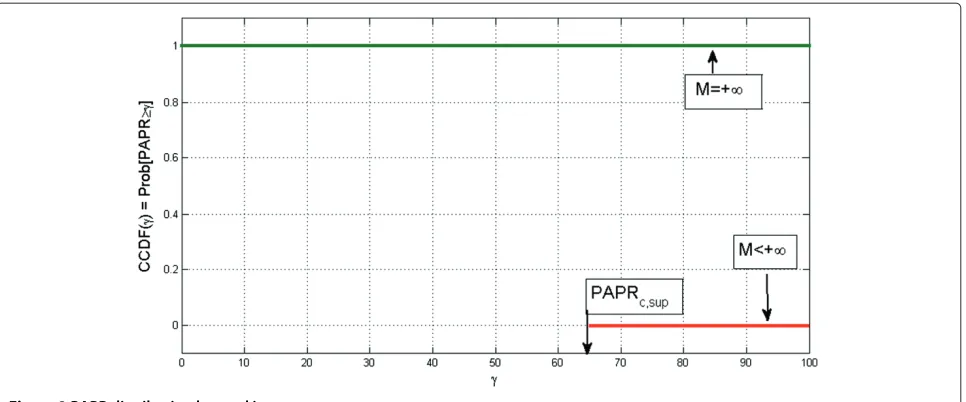
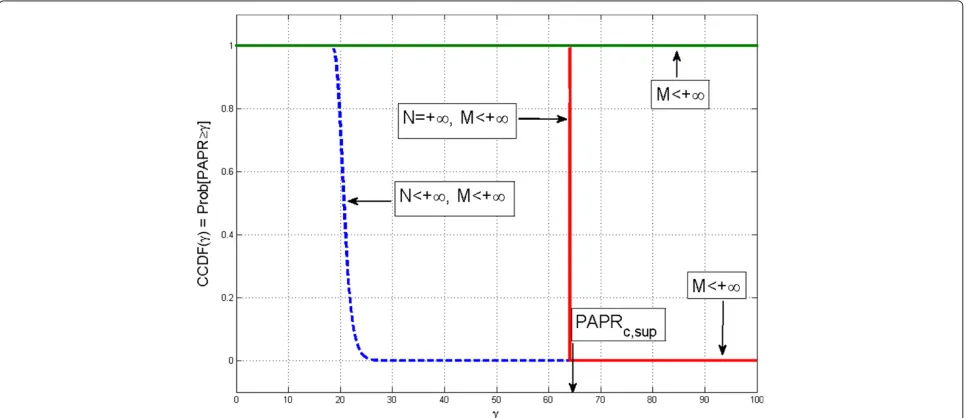
Pr(PAPRc(I) ≤ γ ) = 1, the CCDF is then equal to zero beyond the PAPRc,sup(see Figure 2). We can also mention
that the bound goes to infinity when the number of carri-ersMgoes to infinity, the CCDF is then equal to 1 for any sufficiently smallγ (see Figure 2).
In what follows, we give an approximation of the CDF of the PAPR for γ sufficiently small compared with PAPRc,sup. We leave to further work a mathematical
Figure 2PAPR distribution beyond its supremum.
By considering an observation duration limited to N
GWMC symbols ofP samples each, and by approximat-ing the samplesX(0),X(1),X(2),. . .,X(NP−1)as being independent (which is the approximation made in [8] in the absence of oversampling), the CDF of the PAPR for the GWMC signal can be expressed as follows:
PrPAPRNd ≤γ=Pr
max
k∈[[0,NP−1]]|X(k)| 2≤γP
d,mean
=Pr∀k∈[[ 0,NP−1]] |X(k)|2≤γPd,mean
≈
k∈[[0,NP−1]]
Pr|X(k)|2≤γPd,mean
.
(16)
We should now look for the distribution law of|X(k)|2.
We first find the distribution of the real part ofX(k)and, after that, do the same for the imaginary part.
Let us put
XRm(k)=
n∈Z
CmR,ngmR,n(k)−CIm,ngmI,n(k) XIm(k)=
n∈Z
CmR,ngmI,n(k)+CIm,ngmR,n(k),
such that XR(k)=
M−1
m=0
XRm(k)
XI(k)=
M−1
m=0
XIm(k).
We have the random variables XR0(k), X1R(k),X2R(k),. . .,
XR
M−1(k)that are independent with zero mean and satisfy Lyapunov’s condition by assuming Assumption 2. Thus,
for largeM, we can apply the G-CLT (see Appendix 2) and get
M−1
m=0
Xm(R k)∼N
0,σ
2
c 2
n∈Z M−1
m=0
|gm,n(k)|2
σ2
X(k)
2
(17)
XR(k)∼N
0,σ
2
X(k)
2
. (18)
Following the same steps, we get
XI(k)∼N
0,σ
2
X(k) 2
. (19)
Then X(k) follows a complex Gaussian process with zero mean and variance σX2(k) = σ2
c
n∈Z
M−1
m=0
|gm(k−nP)|2. Hence,
|X(k)|2∼χ2with two degrees of freedom.
Denoting x(k)= Pd,mean
σ2 X(k)
,
(20)
we obtain from Equations 16 and 20 the following result:
Theorem 1. (PAPR distribution of GWMC signal for a finite observation duration)
For large M, with the considered simplifying assump-tions, we have
PrPAPRNd ≤γ≈ k∈[[0,NP−1]]
1−e−x(k)γ
,
with x(k)=
M−1
m=0gm2 Pn∈Z
M−1
m=0|gm(k−nP)|2 .
Note that the approximate distribution of the PAPR depends not only on the family of modulation functions (gm)m∈[[0,M−1]]but also on the number of carriersMused.
In addition, it depends on the parameter N, the num-ber of GWMC symbols observed. Taking into account the simplifying assumption of our derivations, we can easily study the PAPR performance of any multi-carrier mod-ulation (MCM) system. The approximate expression of the CDF of the PAPR will be compared to the empirical CDF featured in Section 4.1. In Section 3.3, we deduce the behaviour of the PAPR distribution for an infinite observation period.
3.3 PAPR distribution for an infinite observation period
By considering an infinite number of GWMC symbols observed, we can define the PAPR as being
PrPAPR∞d ≤γ=Pr
maxk∈N|X(k)|2 Pd,mean ≤γ
. (22)
To get the PAPR distribution in this case, we can letN
go to infinity in Equation 21; then, we obtain the following formula:
Corollary 1.(PAPR distribution of GWMC signal for an infinite observation duration)
For large M, with the considered simplifying assumptions, we have
Pr(PAPR∞d ≤γ )=0. (23)
In fact, we have
Pr(PAPR∞d ≤γ )= k∈N
1−e−x(k)γ,
with x(k)=
M−1
m=0gm2 Pn∈Z
M−1
m=0|gm(k−nP)|2 .
(24)
And we have M−1
m=0
gm2= M−1
m=0
n∈Z P−1
k=0
|gm(k−nP)|2,
then A2MP< M−1
m=0
gm2<B2MP,
(25)
and 1
B2MP <
1
Mn∈ZM−m=01|gm,n(k)|2 < 1
A2MP
.
(26)
From Equations 25 and 26, we get
A2
B2 <x(k) < B2
A2, (27)
hence
1−e−x(k)γ<1−e− B2
A2γ <1. (28)
Thus, for an infinite observation duration, and for γ sufficiently small compared with PAPRc,sup, we have
Pr(PAPR∞
d ≤γ )=0. (29)
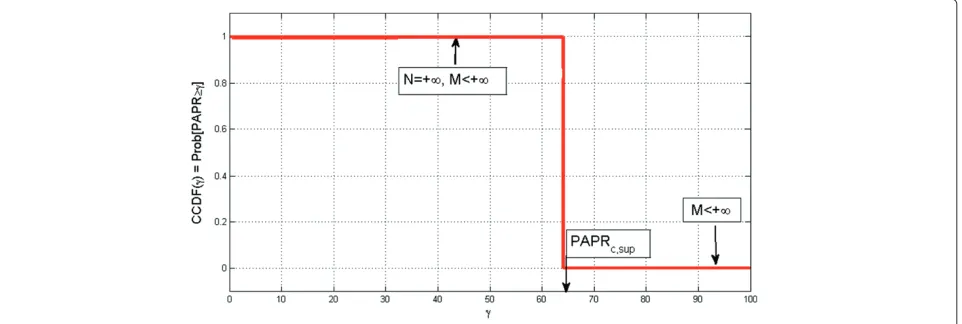
The CCDF is then equal to 1 for anyγ (see Figure 3). Equation 29 can be interpreted by the fact that we can-not control the PAPR for an infinite number of GWMC symbols, because we will inevitably have some GWMC symbols with large peaks. Thus, for M ≥ 8 and γ suf-ficiently small compared with PAPRc,sup and an infinite
observation duration, there is no family of modulation functions(gm)m∈[[0,M−1]] that can avoid the large peaks.
Based on this fact, we expect to optimize the PAPR within a finite number of GWMC symbols. As the num-ber of GWMC symbols decreases, PAPR optimization gets better.
4 Applications
The approximation of the PAPR distribution law for any modulation system provides a valuable contribution to the study of the PAPR problem in the case of MCM systems. In particular, it allows us a fast computation of the PAPR distribution for any family of modulation functions that satisfies our conditions. Based on developed equations, we are able to characterize the behaviour of the PAPR distribution for different transmission and observation scenarios and for any interval ofγ. In addition to that, we show how the PAPR reduction problem can be formulated as an optimization problem. We give more details in the following sections.
4.1 Simple computation of the PAPR for any family of modulation functions
We know that the PAPR is a random variable, that is why the derivation of its distribution law may be complex. Especially if you have to repeat the derivation each time the family of modulation functions changes. Equation 21 is a closed form approximation, so it allows us to directly find an approximate CDF of the PAPR without complex operations. To illustrate this, we consider the following examples.
4.1.1 Conventional OFDM
Figure 3CCDF of the PAPR for an infinite observation duration.
• The Fourier basis is used for the modulation, with a rectangular waveform:
gm(k)=e j2πmk
P [0,P](k)
with [0,P](k)=
1 if0≤k≤P
0 else .
• The observation is limited to one OFDM symbol, and the number of samples considered isMthenP=M.
The expression of the GWMC signal in Equation 1 becomesX(k)=n∈ZmM=−01Cm,ne
j2πm(k−nP)
P [0,P](k−nP). We apply Equation 21 of the PAPR distribution with
N=1. We then get
x(k)= MP
Pn∈ZM−m=01|ej2πm(Pk−nP)[0,P](k−nP)|2 =1,
and then
PrPAPR1d≤γ= 1−e−γM. (30) It is similar to the expression derived by Van Nee for the discrete case.
4.1.2 FBMC systems
We consider the OFDM/OQAM as being an example of the FBMC system, and we check the expression derived by Skrzypczak [22]. Then, let us consider the following:
• The modulation functions are
gm(k−nP)=hOQAM(k−nP) ej2πMm(k−D/2)ejθm,n, then |gm(k−nP)|2=h2OQAM(k−nP), wherehOQAMis the prototype filter (IOTA, SRRC, PHYDYAS...).
• The observation is limited to one block of symbols, and the number of samples considered in this block is
M, thenP=M.
• gm2=1.
The expression of the GWMC signal in Equation 1 becomes X(k)=n∈Zm=M−01Cm,nhOQAM
(k−nP)ej2πMm(k−D/2)ejθm,n.
We apply Eq. (21) of the discrete-time PAPR for a finite observation duration withN=1. Then, we get
x(k)= 1
Mn∈Zh2OQAM(k−nP)
and then
Pr(PAPR1d≤γ )= M−1
k=0
1−e
−γ
Mn∈Zh2
OQAM(k−nP)
.
(31)
This result is similar to the one obtained by Skrzypczak.
4.1.3 NOFDM systems
The family of modulation functions used in NOFDM sys-tems is not orthogonal, but it forms an incomplete Riesz basis. The choice of the non-orthogonal pulses is flexi-ble and can be adapted to the knowledge of the channel; therefore, NOFDM systems have a better bandwidth effi-ciency than OFDM systems and tends to be more robust against frequency-selective fading [16]. To provide an example of an NOFDM system, we consider Hamming windoww(t), which is a non-orthogonal pulse. Thus, the
waveform of the modulation is expressed as
gm(t)=e j2πmt
T w(t),
w(t)= ⎧ ⎪ ⎨ ⎪ ⎩
0.54−0.46 cos
2π t
T
if 0≤t≤T
0 else
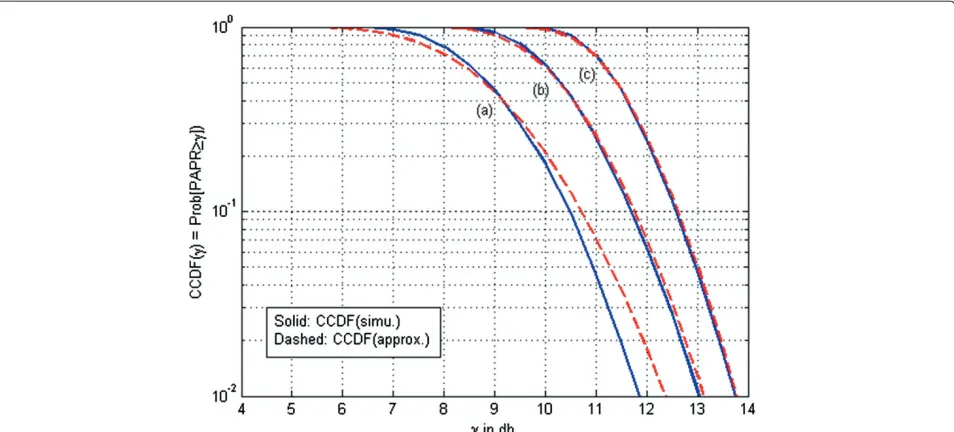
Figure 4Experimental and theoretical CCDF of PAPR for NOFDM system using Hamming window for different number of carriers.
(a)M=64, (b)M=256 and (c)M=1, 024.
the experimental CCDF simulated by generating 10,000 realizations of NOFDM symbols, for different number of carriers.
We observe that the larger the number of carriers gets, the more accurate the theoretical curve gets. And this is due to the fact that our derivations are based on the G-CLT which assumes a large number of carriers.
4.1.4 WH-MC systems
Instead of using the inverse discrete Fourier transform (IDFT) for the modulation, we can use the inverse Walsh-Hadamard transform (IWHT). Then, the family of the modulation functions is expressed as
gm(k)=W ALm(k)
(WALm)m∈[[0,M−1]] are the Walsh functions and are
columns of Hadamard matrix of dimension M = 2Q, which is defined by the recursive formula:
H21=
1 1 1 −1
(32)
H22=
⎛ ⎜ ⎜ ⎝
1 1 1 1
1 −1 1 −1 1 1 −1 −1 1 −1 −1 1
⎞ ⎟ ⎟
⎠, (33)
and for 2≤q≤Q,
H2q=
H2q−1H2q−1 H2q−1H2q−1
=H(2)⊗H2q−1,
(34)
where⊗denotes the Kronecker product.
Note that the Hadamard matrix consists only of +1 and−1 entries, that is why the implementation has a sim-ple structure featuring only additions and subtractions. In fact, the IWHT can be implemented using the radix-2 algorithm, which means that there are onlyMlog2M
complex additions required [23].
Figure 5 shows the theoretical CCDF of the PAPR based on Equation 21 withP = MandN = 1, and the experi-mental CCDF simulated by generating 10,000 realizations of WH-MC symbols, for different number of carriers.
We observe that we have a good approximation for
M≥64.
4.2 CCDF of the PAPR for different transmission and observation scenarios
The CCDF of the PAPR depends on the number of car-riersM, the observation durationNT and the parameter γ to which the PAPR is compared. For an infinite num-ber of carriers, the PAPR is always large and the CCDF is then equal to 1 for anyγ. If the number of carriersMis finite, the CCDF of the PAPR is equal to 0 forγ greater than PAPRc,sup. And forγ less than PAPRc,sup, the CCDF
depends on the observation duration: when we consider an infinite observation duration, the CCDF is equal to 1, but if we limit the observation duration to a finite number of symbols, the CCDF is defined by Equation 21. Figure 6 presents all the possible cases.
4.3 Optimization problem
Figure 5Experimental and theoretical CCDF values of PAPR for a WH-MC system for different number of carriers.(a)M=64, (b)M=256 and (c)M=1, 024.
place before and after the modulation. But as we can see in Equation 21, the distribution of the PAPR depends on the family of modulation functions used in the system. Thus, we can act also on the modulation system to reduce the PAPR. In fact, to confirm this idea, we can com-pare the PAPR performance of the OFDM/OQAM [13] to that of the wavelet OFDM [27]. The first variant uses the same modulation basis as the conventional OFDM (Fourier basis) and does not show any improvement on
the PAPR’s performance [22], unlike the second that uses the wavelet basis and shows an improvement of up to 2 dB [28].
Let us model the PAPR’s optimization problem. It con-sists in finding the optimal functionsgmthat maximize the CDF of the PAPR in Equation 21. By trying to do that, we notice that we should do the optimization at some par-ticular points of the functionsgm (the sampling points), while these points are not chosen in a particular way.
To adjust the optimization problem, we approximate the
is a Riemann sum, then
T
the quantity that we should maximize over the functions (gm)m∈[[0,M−1]]is
To express the optimization problem that can lead to a new modulation system featuring an optimally reduced PAPR, we have to express the constraints on the functions (gm)m∈[[0,M−1]]. Let us define the following constraints:
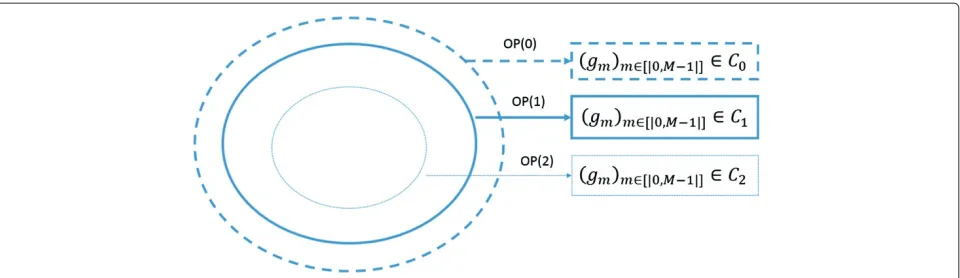
C0is the condition that we need to apply CLT. We considered Assumption 2 because the expression of
C0is not intuitive.
• C1=
that satisfy Assumption 2.C1is stronger thanC0.
• C2=
andC1but easy to manipulate.
These conditions define the choice of the functions (gm)m∈[[0,M−1]]. Figure 7 shows the inclusion relationship
between the different conditions.
Thus, the optimization problem can be expressed as follows:
The present study proposes to act on the modulation system to reduce the PAPR. Looking for the optimal fam-ily of modulation functions is a new approach to deal with the PAPR problem. Its advantage is that we can use, at the same time, one of the previous PAPR reduction techniques to get an even smaller PAPR.
5 Conclusions
In this paper, we make several derivations to achieve the more general CDF approximation of the PAPR in the sense that transmitted symbols can be carried by any family of functions. First, we define the GWMC system and derive a general approximation of its PAPR distri-bution for both finite and infinite integration time. We conclude that the PAPR distribution depends on the fam-ily of functions used in the modulation, but for an infinite observation duration, large peaks cannot be avoided, even if we change the family of modulation functions. To show the importance of developed expressions, we illustrate their applications: the simple computation of the PAPR distribution of any modulation system, the characteriza-tion of the CCDF of the PAPR for different transmission and observation scenarios, as well as the modelling of the PAPR reduction problem as a constrained optimization problem.
can lead to a new system of multi-carrier modulation featuring an optimal performance.
Appendix 1
Berry-Esseen theorem
In probability theory, the CLT states that, under cer-tain circumstances, the probability distribution of the scaled mean of a random sample converges to a nor-mal distribution as the sample size increases to infinity. Under stronger assumptions, the Berry-Esseen theorem, or Berry-Esseen inequality, specifies the rate at which this convergence takes place by giving a bound on the maximal error of approximation between the normal distribution and the true distribution of the scaled sample mean. In the case of independent samples, the convergence rate is
& 1 M. In general, we have a good approximation for the Gaussian curve forM>8.
In our case, we perform simulations by considering the number of carriers to be equal toM=64>8. Under this assumption, the following Lyapunov’s condition:
lim
dent random variables, each with finite expected valueμm and a varianceσm2. Let us define
and the third-order centred moments
r3M= If Lyapunov’s condition is satisfied, thenSM−mM
sM converges in distribution to a standard normal random variable, as
Mgoes to infinity:
SM−mM
sM ∼N( 0, 1).
B. Lyapunov’s condition for GWMC Property 1.(Lyapunov’s condition)
and
We want to prove the validity of Lyapunov’condition. We have
From Equations 44 and 45, we have
3
We can prove the second part of Lyapunov’s condition by proceeding similarly. Assumption 2 is then a sufficient condition of Lyapunov’s condition.
C. Application of Lyapunov CLT Let us putXR random variables (Assumption 1). And we have
• From Equation 4,∀m∈[[ 0,M−1]] E(XmR(t))=0. • Var(XmR(t))=n∈Zσc2
− m,n m,p m,n() m,p() Lyapunov’s condition is then satisfied. By means of Lyapunov’s CLT, we get for largeM
M−1
The average power is calculated as follows:
Pc,mean = lim
Upper bound of the PAPR [29]
LetMbe a finite number of carriers and(gm)m∈[[0,M−1]]
a family of modulation functions that satisfies
Ai=minm,tn∈Z|gm(t−nT)|i>0 and Bi=maxm,t
n∈Z|gm(t−nT)|i<+∞ for i∈ {1, 2}. For any
obser-vation duration I and any input symbols, we have
Abbreviations
ADSL: asymmetric digital subscriber line; BER: bit error rate; BFDM: biorthogonal frequency division multiplexing; CDF: cumulative distribution function; CCDF: complementary cumulative distribution function; CLT: central limit theorem; DAB: Digital Audio Broadcasting; DCT: discrete cosine transform; DVB-H: Digital Video Broadcasting-Handheld; DVB-T: Digital Video Broadcasting-Terrestrial; EGF: extended Gaussien function; FSK: frequency Shift Keying; GWMC: generalized waveforms for multi-carrier; GCLT: generalized central limit theorem; HiperLAN/2: high performance radio LAN; HPA: high-power amplifier; IOTA: isotropic orthogonal transform algorithm; LTE: Long Term Evolution; NOFDM: non-orthogonal frequency division multiplexing; OFDM: orthogonal frequency division multiplexing; OQAM: offset quadrature amplitude modulation; PAPR: peak-to-average power ratio; PSK: phase shift keying; QAM: quadrature amplitude modulation; QPSK: quadrature phase shift keying; SRRC: square root raised cosine; WH-HT: Walsh-Hadamard multi-carrier.
Competing interests
The authors declare that they have no competing interests.
Acknowledgements
This work has received a French state support granted to the CominLabs excellence laboratory and managed by the National Research Agency in the ‘Investing for the Future’ program under reference no. ANR-10-LABX-07-01. The authors would also like to thank the ‘Région Bretagne’, France for supporting this work.
Author details
1SUPELEC/IETR, Cesson-Sévigné Cedex 35576, France.2Inria, Bretagne
Atlantique, Campus de Beaulieu, Rennes Cedex 35042, France. Received: 1 December 2013 Accepted: 17 July 2014 Published: 30 July 2014
References
1. RW Chang, Synthesis of band-limited orthogonal signals for multichannel data transmission. Bell Sys. Tech. J.45, 1775–1796 (1966)
2. S Weinstein, P Ebert, Data transmission by frequency-division
multiplexing using the discrete Fourier transform. Commun. Technol. IEEE Trans.19(5), 628–634 (1971)
3. R Lassalle, M Alard, Principles of modulation and channel coding for digital broadcasting for mobile receivers. EBU Tech. Rev.224, 168–190 (1987) 4. ETSI TS 101 388 V1. 3.1 (2002–05), Asymmetric Digital Subscriber Line
(ADSL)-European specific requirements (2002)
5. Digital Audio Broadcasting (DAB); DAB to mobile, portable and fixed Receivers, Tech. Rep. ETSI ETS 300 401 (1995)
6. ETSI EN 302 755 v1. 2.1 (2010-10) Digital Video Broadcasting (DVB), Frame structure channel coding and modulation for a second generation digital terrestrial television broadcasting system (DVB-T2)
7. ETSI TS 101 475 V1. 3.1 (2001-12), Broadband radio access networks (BRAN); HIPERLAN type 2; physical (PHY) layer (2001)
8. R Van Nee, R Prasad,OFDM for Wireless Multimedia Communications. (Artech House Inc., Norwood, 2000)
9. M Hoch, S Heinrichs, JB Huber, Peak-to-average power ratio and its reduction in wavelet-OFDM, inInternational OFDM Workshop(Hamburg, Germany, 2011), pp. 56–60
10. M Gautier, C Lereau, M Arndt, J Lienard, PAPR analysis in wavelet packet modulation, in3rd International Symposium On Communications, Control and Signal Processing, 2008. ISCCSP 2008(IEEE St Julians, 2008), pp. 799–803 11. L Patidar, A Parikh, BER Comparison of DCT-based OFDM and FFT-based
OFDM using BPSK modulation over AWGN and multipath Rayleigh fading channel. Int. J. Comput. Appl.31(10), 38–41 (2011). New York, USA 12. P Chevillat, G UngerBoeck, Optimum FIR transmitter and receiver filters
for data transmission over band-limited channels. Commun. IEEE Trans.
30(8), 1909–1915 (1982)
13. B Le Floch, M Alard, C Berrou, Coded orthogonal frequency division multiplex. Proc. IEEE.83(6), 24–182 (1995)
14. A Viholainen, M Bellanger, M Huchard, Prototype filter and structure optimization. PHYDYAS project, January 2009
15. H Zhang, D Yuan, M Pätzold, Novel study on PAPRs reduction in wavelet-based multicarrier modulation systems. Digital Signal Process.
17(1), 272–279 (2007)
16. W Kozek, AF Molisch, Nonorthogonal pulseshapes for multicarrier communications in doubly dispersive channels. Selected Areas Commun. IEEE J.16(8), 1579–1589 (1998)
17. H Bogucka, AM Wyglinski, S Pagadarai, A Kliks, Spectrally agile multicarrier waveforms for opportunistic wireless access. Commun. Mag. IEEE.
49(6), 108–115 (2011)
18. A Aboltins, Comparison of orthogonal transforms for OFDM communication system. Electronics and Electrical Engineering.
111(5), 77–80 (2011)
19. M Chafii, J Palicot, R Gribonval,Closed-Form Approximations of the PAPR Distribution for Multi-Carrier Modulation Systems. (Lisbon, Eusipco, 2014) 20. B Knaeble,Variations on the projective central limit theorem. PhD thesis,
University of Utah, 2010
21. C Siclet, Application de la théorie des bancs de filtres à l’analyse et à la conception de modulations multiporteuses orthogonales et biorthogonales. PhD thesis, Rennes 1 University, France, 2002 22. A Skrzypczak, Contribution à l’étude des modulations multiporteuses
OFDM/OQAM et OFDM suréchantillonnées. PhD thesis, Rennes 1 University, France, 2007
23. BG Evans, G Bi, Hardware structure for Walsh-Hadamard transforms. Electron. Lett.34(21), 2005–2006 (1998)
24. L Wang, J Liu, PAPR reduction of OFDM signals by PTS with grouping and recursive phase weighting methods. Broadcast. IEEE Trans.57(2), 299–306 (2011)
25. C-P Li, S-H Wang, C-L Wang, Novel low-complexity SLM schemes for PAPR reduction in ofdm systems. Signal Process. IEEE Trans.58(5), 2916–2921 (2010)
26. D Guel, J Palicot,Transformation des techniques “ajout de signal” en techniques “tone reservation” pour la réduction du PAPR des signaux OFDM. (GRETSI, Dijon, 2009)
27. Rishabh K, K Nachiket, N Piyush. EE678 Wavelet Application Assignment, Wavelet OFDM
28. MHM Nerma, NS Kamel, V Jeoti, NA Baykara, NE Mastorakis,BER performance analysis of OFDM system based on dual-tree complex wavelet transform in AWGN channel. (Istanbul, Turkey, 2009)
29. M Chafii, J Palicot, R Gribonval, A PAPR upper bound of Generalized Waveforms for Multi-Carrier modulation systems, inISCCSP, 6th International Symposium on Communications, Control and Signal Processing(Athens, 2014)
doi:10.1186/1687-6180-2014-121
Cite this article as:Chafiiet al.:Closed-form approximations of the peak-to-average power ratio distribution for multi-carrier modulation and their applications.EURASIP Journal on Advances in Signal Processing20142014:121.
Submit your manuscript to a
journal and benefi t from:
7 Convenient online submission
7 Rigorous peer review
7 Immediate publication on acceptance
7 Open access: articles freely available online
7 High visibility within the fi eld
7 Retaining the copyright to your article