The PhD School of Economics and Management
PhD Series 6.2011
PhD Series 6.2011
Emplo
yee Stock Ownership: Effect on Str
ategic Management and P
erformance
copenhagen business school handelshøjskolen solbjerg plads 3 dk-2000 frederiksberg denmark www.cbs.dk ISSN 0906-6934 ISBN 978-87-593-8458-9 9 788759 384589
Employee Stock Ownership:
Effect on Strategic Management
and Performance
Employee Stock Ownership:
Simon S. Torp
Employee Stock Ownership: Effect on Strategic Management and Performance
1st edition 2011 PhD Series 6.2011
© The Author
ISBN: 978-87-593-8458-9 ISSN: 0906-6934
“The Doctoral School of Economics and Management is an active national and international research environment at CBS for research degree students who deal with economics and management at business, industry and country level in a theoretical and empirical manner”.
Employee Stock Ownership:
Effect on Strategic Management and
Performance
A PhD thesis
By
Simon S. Torp
Aarhus University, Institute of Business and Technology (AU-IBT) Birk Centerpark 15, DK-7400 Herning
and
Copenhagen Business School
Center for Strategic Management and Globalization (SMG) Porcelaenshaven 24, DK-2000 Frederiksberg
Executive summary
This dissertation creates a model that combines the literature on employee stock ownership (ESO), middle management involvement in strategy and the participative leadership style with the motivational literature on psychological ownership. The model is based on the recognition that despite a strong theoretical foundation of the first three concepts supporting a positive relationship with performance, the empirical evidence is inconclusive. Additionally, the literature on the three concepts finds that the performance effect of the concepts seems to be mediated by the creation of internalised extrinsic motivation in the form of psychological empowerment, organisational citizenship behaviour or psychological ownership. Based on the literature on psychological ownership, ESO, middle management involvement and a participative leadership style are argued to be determinants of psychological ownership. The model thereby argues that the three concepts must be seen as determinants of psychological ownership and that their potential positive effect on performance is triggered by their potential motivational effect. The three concepts can also be seen as interrelated and the model argues that a combination of the three would enhance the performance effect.
Based on the model, a number of hypotheses are empirically tested to investigate the relationships in the model. The tests are based on a cross-sectional survey of 300 top 500 Danish companies as measured by number of employees. The analysis found that different types of companies employ different kinds of ESO schemes ranging from covering only a few key employees to covering a majority of the employees. It can also be seen that the prevalence of ESO schemes is high in stable sectors with relatively low-educated and low-paid employees, e.g. construction, while the prevalence is low in dynamic sectors with highly educated and high-paid employees such as IT and telecommunication.
The test of ESO, middle management involvement and participative leadership style as determinants of psychological ownership supported the model arguing that the effect on performance is based on the concepts’ potential motivating effects and that no direct effect on performance can be found. The analysis found that while middle management participation in the strategy process was a significant determinant of psychological ownership, autonomy had no significant effect; this calls for a better understanding of the different effects of the two types of middle management involvement. It was also found that a participative leadership style was the most influential factor in the creation of psychological ownership and that ESO only had an indirect effect which was mediated by middle management participation in strategy. Psychological ownership had a significant positive effect on company performance.
The dissertation contributes to our knowledge by underpinning the importance of the creation of internalised extrinsic motivation in the form of psychological ownership. This means that both scholars and practitioners need to analyse how ESO, middle management involvement in strategy and participative leadership style can be combined in the pursuit of psychological ownership and that the three areas might be combined with other initiatives that enhance motivation. The findings also highlight the need for a better understanding of how different employees are motivated by the different initiatives at an individual level. It may be expected that employees at different organisational levels, in different job types in different sectors and with different job characteristics will be affected differently by the three factors and that the effect on the creation of psychological ownership and thus company performance will be affected by these individual factors.
Executive summary in Danish.
Denne afhandling udvikler en model, der kombinerer teori omkring medarbejder medejerskab, involvering af mellemledere i strategiprocessen og involverende ledelsesstil, med
motivationsteorierne om psykologisk ejerskab. Litteraturstudier af de tre områder afslører, at det er vanskeligt empirisk at påvise en effekt på virksomhedens resultater på trods af stærke teoretiske argumenter. Ligeledes viser det sig, at for alle tre områder er en evt. effekt på resultatet medieret af skabelsen af en følelse af medejerskab blandt medarbejderne. Denne følelse af medejerskab angives i litteraturen på forskellig vis i form af ”psychological empowerment”, ”organizational citizenship behaviour” eller ”psychological ownership”. Alle tre former for motivation angiver dog en tilstand, hvor medarbejderen opfatter virksomhedens mål og succes, som identisk med egne mål og egen succes. En analyse af motivationsteorien omkring psykologisk medejerskab afslører, at dette teoriområde ser medejerskab, involvering og involverende ledelsesstil som elementer eller forudsætninger for at skabe motivation. Forfatteren argumenterer derfor for i sin model, at medejerskab, involvering og involverende ledelsesstil udelukkende påvirker virksomhedens resultater via deres indflydelse på medarbejdernes motivation og at de tre områder må forventes at påvirke og forstærke hinanden.
Den udarbejdede model initierer en række hypoteser om de forventede sammenhænge i modellen, som bliver testet empirisk i afhandlingen. Den empiriske del er baseret på en
spørgeskemaundersøgelse blandt 300 af de 500 største virksomheder i Danmark målt på antal medarbejdere.
Det første empiriske afsnit finder, at forskellige typer af virksomheder anvender forskellige type at medarbejderaktie programmer. Det påvises, at andelen af virksomheder med medarbejderaktier er høj i en stabil sektor med relativt lavt uddannede medarbejde som bygge- og anlægssektoren, mens
andelen af virksomheder med medarbejderaktieprogrammer er lav i IT og telekommunikation, der er en dynamisk sektor med relativt højtuddannede og vellønnede medarbejdere. Ligeledes viser det sig at virksomheder, der har medarbejderaktieprogrammer, der omfatter mere end halvdelen af alle medarbejdere også i højere grad anvender gruppe baserede bonusordninger, mens virksomheder der har medarbejderaktieprogrammer, der kun omfatter nøglemedarbejdere i højere grad anvender individuelle bonusordninger. Dette resultat er i modstrid med den generelle opfattelse af, at brede aktieprogrammer bør komplementeres med individuelle bonusordninger for at understøtte både den langsigtede og den individuelle kortsigtede præstation.
Analysen af medarbejder medejerskab, involvering af mellemledere og involverende lederskab, som forudsætninger for at skabe en følelse af medejerskab understøttede den udviklede model. Ligeledes blev det påvist, at der ikke er en direkte effekt af de tre områder på virksomhedens resultater, men udelukkende via deres evne til at skabe motivation i form af en følelse af medejerskab blandt medarbejderne. Dette bidrag til vores viden omkring effekterne af medarbejder medejerskab, involvering af mellemledere og involverende ledelsesstil åbner op for helt nye forskningsområder. Vi bliver nødt til at ændre vores opfattelse af, at det at involvere medarbejderne, eller tilbyde dem aktier, i sig selv skaber bedre resultater. Vi er nødt til at se de forskellige tiltag i sammenhæng og fokusere på, hvordan de i den konkrete situation kan skabe motivation. Det betyder også, at vi skal kombinere de tre teoriområder med resultaterne fra motivationsteorien.
Motivationsteorien har bidraget med en lang række resultater der fremhæver at mennesker bliver motiveret af en række forskellige tiltag. Medarbejdere i forskellige jobfunktioner, på forskellige organisatoriske niveauer og i forskellige sektorer bliver motiveret på forskellig vis, og effekten på
Table of contents
0. Preface ... 2
1. Employee Stock Ownership: Effect on Strategic Management and Performance ... 7
2. Involvement, leadership style and formal ownership as determinants of psychological ownership among middle managers ... 32
3. The prevalence and antecedents of Employee Stock Ownership in Denmark ... 68
4. Determinants of psychological ownership – Leadership, involvement and formal ownership; new empirical evidence ... 110
5. Management attitudes to middle management involvement and formal ownership as determinants of psychological ownership ... 150
6. Conclusion ... 191
References ... 201
Preface
This dissertation consists of an introductory chapter followed by four papers addressing the topic of
middle managers in strategy from different angles. Each chapter is intended to be a contribution in its
own right and can be read individually as well as in the larger context of this dissertation.
The development of this thesis and the model included is the result of a journey through a number of
research areas and streams. Based on my interest in corporate finance, I initially wondered how
ownership structures could support company development and performance. I therefore started out
analyzing how employee stock ownership (ESO) among employees at different organizational layers
affected performance. This analysis concluded that despite a rich literature on ESO based on agency
theory explaining how the introduction of ESO would align the interest of the employee with the
interest of the company based on an economic incentive, the dissertation reveals that the effect is
mainly rooted in the potential motivational effect of the creation of psychological ownership feelings.
While the argument based on an economic incentive might be correct among top managers, who has
the organizational power to significantly influence the value of the firm, this influence becomes
insignificant at lower organizational levels. Claiming that ESO creates an economic incentive at lower
organizational levels thereby violates the general assumption that controllability is a prerequisite for
ESO to be effective. This conclusion is also in line with the diverse ESO effect findings which range
from neutral to marginally positive. The effect of ESO on performance was found to be mediated by
both top management’s willingness to involve middle managers in decisions and by the creation of a
psychological sense of ownership. If a sense of controllability of the development of the firm’s value is
processes seems to fulfill both needs. This conclusion motivated me to examine the strategy literature
with a focus on employee involvement. In this literature review, I especially looked at the involvement
of middle managers in strategy processes. The middle manager perspective seemed highly
underdeveloped yet very promising due to the theory strongly emphasizing the importance of middle
managers as creators of strategic responsiveness, innovations and facilitators of strategy processes.
When analyzing the middle manager perspective in strategy, I was puzzled by a number of questions:
Can it be assumed that middle managers are automatically motivated to participate, just by allowing
them to do so? If participating, are they then doing so in the best interest of the company? If
participation creates more innovations, better strategy implementation, more information sharing, better
decision-making, then why are the articles testing the performance effects so diverse in their findings?
Some scholars advocate that the leadership style conducted can both promote and restrain participation
despite a general wish from top management to involve employees in the strategy development. The
effect of involvement seems also to be mediated by the creation of engagement, commitment and
psychological ownership. Based on the realization that both the effect of ESO and the involvement of
middle managers in the strategy process seemed to be mediated by top management’s willingness to
involve and the leadership style conducted, led me to explore the participative leadership style research
stream.
The literature on participative leadership style analyzes how top management can support the
involvement of employees in organizational decisions. A participative leader creates a culture in the
context of which the employees are aware that their contribution is valuable, cared for and expected
and an organizational structure that clearly guides the employees in how new ideas, arguments and
participative leadership style, such as increased decision quality, motivation and commitment, the
performance effects are reported to be mediated by the creation of psychological empowerment.
This discovery of three research streams, ESO, involvement of middle managers in strategy and
participative leadership style, with strong theoretical and empirical support but all mediated by the
creation of psychological ownership, encouraged me to investigate the research stream of
psychological ownership. Psychological ownership is defined as the state in which individuals “feel as
though the target of ownership or a piece of that target is theirs” and is found to increase commitment,
stewardship and company performance. The creation of psychological ownership is also found to be
supported by involvement and task significance (i.e. involvement in strategy), feedback, trust and
autonomy (i.e. participative leadership style) and formal ownership (i.e. ESO). By exploring this fourth
research stream, the final piece of the jigsaw seemed to fall into place. There appeared to be a clear
interconnection between ESO, involvement of middle managers in strategy and participative leadership
style and they all supported the creation of psychological ownership. It also seemed clear that a gap
existed in our understanding of how these four areas are interrelated and that a combination of the areas
could create new insights into how to combine the areas in the pursuit of improved company
performance.
The objective of this thesis to theoretically and empirically contribute to the understanding of the
interrelation and performance effects of these four areas. The literature review of the four areas
revealed that a number of relationships between the four areas lacked a broad-based empirical
investigation, and that a contribution could be made by conducting an updated large-scale survey. To
ensure statistical validity and avoid common method bias, data needed to be collected from multiple
sources. This was achieved by collecting answers from two top managers and two middle managers in
collected from external sources. Based on the literature review combining the four areas and the data
collected, four articles were written, one conceptual article developing the model and three empirical
articles analyzing some of the relationships in the model. I am aware that a number of other
relationships could be explored and that a finer grained analysis could be conducted based on the model
and the data collected, but this task will hopefully be pursued in a future career in academia.
The process of completing this thesis has taught me that I cannot cover everything in one article. An
article needs to be focused and thoroughly present theory, method and conclusions in a manner that
allows colleagues to review the quality and contribution of the research conducted. Each article is
therefore an expression of my view on areas needing contributions and due to the above-mentioned
need for focus, they will be restrained by a number of limitations; finally, each article calls for future
research to improve and extend the findings.
Acknowledgements
The first page of each of the chapters in the dissertation mentions some of the many people who have
contributed with feedback and constructive criticism for that particular chapter. In addition to these
acknowledgements, I would like thank the many people who have helped me through the last five years
with encouragement, support and helpful comments. I would especially like to thank my supervisor,
Professor Torben Juul Andersen, for valuable and encouraging guidance and supervision in the arts and
crafts of academic scholarship. I would also like to thank him for persistently encouraging me to pursue
a career in academia in the future development of my career. I would also like to thank my PhD
colleague at CBS, Stefan Linder, for thorough comments on my papers, theoretical and methodological
discussions and cooperation on the conduction of the survey. I would like to thank participants at the
empirical papers and two anonymous reviewers at Economic and Industrial Democracy for valuable
feedback on the first empirical paper. I would also like to thank AU-IBT and “Research Foundation of
Ringkøbing Amt” for the financial support of my PhD and the support and feedback from colleagues at
AU-IBT, especially Professor Christian Koch, Professor Mogens Dilling-Hansen and Associate
Professor Ole Friis. Finally, I am grateful to friends and family and especially my wife Karin whose
support, encouragement and patience have made this dissertation possible.
Simon S. Torp
1. Employee Stock Ownership: Effect on Strategic
Management and Performance
INTRODUCTION
Within business studies, the point of interest has often been the intersections between ownership,
management and employees. Different traditions and interests have highlighted different aspects of the
interconnection between the areas, just like some have focused on the areas separately. The ownership
of companies has been addressed within political science, discussing who should own companies, how
profit should be distributed and if any political constraints should be put on the enforcement of
ownership rights. Ownership of companies has also been analysed within the context of corporate
finance, addressing the effects of different ownership structures. Some scholars have tested the effect of
venture capital ownership on company growth, stock listing vs private ownership and companies partly
or wholly owned by the employees (Bennedsen, 2001; Himmelberg et al., 1999; Jensen et al., 1976;
Zhou, 2002). None of the findings has been able to conclusively determine that specific ownership
structures are more efficient than others. Within management studies, a substantial body of work
addresses strategies and strategy development.
The diversity within the strategy literature reflects different perceptions of the process, the purpose and
the definition of strategy. While some scholars regard strategy as a normative or prescriptive process
primarily defined and conducted by top management (Ansoff and McDonell, 1990; Chandler, 1962;
Porter, 1980, 1985), other schools see it as a descriptive process only partly controllable which mainly
takes the form of interaction between employees at different organisational layers and which may be
Mintzberg et al., 1999; Penrose, 1957). While the first approach mainly focuses on the management
area, the latter tries to grasp the interaction between management and employees combining
management studies with the extensive literature on employees and organisational studies addressing
how people interact in organisations through formal and informal power structures and incentive and
motivational systems (Maslow, 1954; Mintzberg, 1984; Tayler, 1913; Weber, 1921). Similarly, other
research areas combine ownership and management or ownership and employees. Within agency
theory (Eisenhart, 1989), the problems of motivating the agent, initially mainly focusing on top
management, have been addressed through incentives like stocks, stock options, warrants or other
performance related bonuses. The key focus has been on aligning the interest of the utility maximising
agent (top management) with the interests of the firm. The recent financial crisis, however, has brought
to light some of the potential shortcomings of a short-term performance focus among top managers,
namely increased risk, greed and destabilisation of organisation and societies. Agency theory and the
alignment of interests have also formed the basis for a research area combing ownership and employees
by extending the motivational effects of stock ownership found within top management to all
employees. The interest was sparked by the fact that many western companies have developed from
being low tech industrial firms to more knowledge intensive service companies; a transformation
process during which the motivation of and initiatives from employees became crucial for creating of
competitive advantages. Founded in the agency theory, the argument behind employee stock ownership
(ESO) covering a larger part of the employees is to create an economic incentive to work in the key
interest of the company. While the effect of ESO was found to be significant among top management,
the effect of more general ESO programmes is more diverse (Kruse, 2002). Some scholars have
reported that the effect is mediated by the creation of psychological ownership, while others report that
1981); in fact, it may even have a negative effect on commitment (Pendleton, 2010). This suggests that
there is more to the effect of ESO at lower organisational levels than the mere economic incentive and
indicates that the motivational effect of being considered important and included in decisions might
offer a more plausible explanation for the effect of ESO than the economic incentive founded in agency
theory (McCarthy et al. 2010). This position is supported by findings indicating that the effect of ESO
is mediated by the creation of psychological ownership among employees and inclusion of employees
in the decision-making process. The sense of psychological ownership is enhanced when employees are
allowed to participate in strategic decisions due to the importance of the decisions. While all employees
could be involved in strategic decisions, interest has increasingly focused on the importance of
involving middle managers in the strategy process. The uniqueness of middle managers lies in their
access to both top and front end managers coupled with their operations knowledge. In a top-down
perspective, this central position allows middle managers to act as sources of change through strategy
implementation and by “selling” the strategy at lower organisational levels, hereby working as the
extended arm of top management. From a bottom-up perspective, middle managers are in a position to
influence the strategic debate at top management level by influencing the issues brought to the top
management’s attention (Dutton et al., 2001). Additionally, middle managers act as sources of
innovation on account of their close contact with front end managers and the market and their ability to
increase information sharing across the organisation, vertically as well as horizontally. In the literature,
the term middle manager is understood in a rather wide sense, including all managers below top
management and above first-level supervision (Dutton and Ashford, 1993; Uyterhoven, 1972). Despite
the rich literature on the middle management perspective (Wooldridge et al. 2008) and the theoretically
and empirically findings reporting a number of positive effects of middle management involvement in
2008), analyses of the effect on company performance are few and the findings are diverse (Andersen,
2004; Mair, 2005). This could suggest that middle managers are not automatically willing to become
involved even if invited to be so and if they get involved, they might not act in the best interest of the
company. Meyer (2006) reported how middle management involvement led to destructive interventions
by middle managers and Guth and MacMillan (1986) found that middle managers obstructed strategy
implementation through foot-dragging and sabotage. In their analysis of 12 organisations, Mantera and
Vaara (2008) found that the leadership style conducted by top management could both constrain and
support involvement despite an official policy of involvement.
This thesis will address a number of the gaps that exist in our understanding of how ESOPs,
involvement of middle managers in the strategy process and a participative leadership style can
increase company performance. While the agency theory based findings of ESOPs assume that the
economic incentive of the ESOP will automatically align the interest of the middle manager with the
interest of the firm, other findings suggest that it is the creation of motivation spurred by psychological
ownership that generates a positive effect. Similarly, the literature on involvement of middle managers
in strategy assumes that allowing middle managers to become involved in strategy by definition
motivates the middle managers to do so and automatically in the best interest of the company. The
findings of Meyer (2006) indicate that involvement in itself may support both supportive and
destructive middle management actions and that middle managers somehow need to be motivated to
participate and feel committed to act in the best interest of the company. This suggests that our
understanding of how middle managers become involved in strategy and how they are motivated is
incomplete and that more research in the field is called for.
The creation of intrinsic and extrinsic motivation is addressed in self-determinations theory (SDT)
extrinsic motivation are based on the need for competence, relatedness and autonomy. The thesis will
study the interaction between ESOPs, the involvement of middle managers in strategy and a
participative leadership style. Based on the theoretical assumption that middle management level
ESOPs only create a limited economic incentive due to the lack of controllability with the reward and
the (often) limited economic importance of the plan, the effect of the ESOP needs to be found in the
plan’s potential effect on the creation of motivation and psychological ownership. Similarly,
involvement of middle managers in strategy should be understood in the framework of motivation,
supported by both formal ownership and a participative leadership style. The SDT stresses the
importance of competence, relatedness and autonomy as human needs leading to motivation, personal
development and behavioural self-regulation (Ryan, Kuhl and Deci, 1997). This suggests that
involvement in strategy (competence, autonomy), ESOP (relatedness) and a participative leadership
style (relatedness, autonomy) combined would release the human potential to “be agentic and
inspired, striving to learn, extend themselves, master new skills, and apply their talents responsibly”
(Ryan and Deci, 2000); without motivation, employees become apathetic, alienated and irresponsible.
This introduction chapter reviews the fundamental literature within the areas of interest, sets the scene
for the gaps addressed in the succeeding four chapters and presents the methodological approach to
collecting the empirical data for the thesis.
MOTIVATION AND SELF-DETERMINATION THEORY
From early childhood, human beings are naturally curious, vital and self-motivated. They show
considerable effort, agency and commitment in their lives and this attitude seems to be more the rule
than the exception (Ryan and Deci, 2000). Despite this positive feature of human nature, the problem
organisational studies for decades. This paradox suggests that the work setting in itself seems to
restrain the nature of humans. The self-determination theory (SDT) “has focused on the
social-contextual conditions that facilitate versus forestall the natural processes of self-motivation and
healthy psychological development” (Ryan and Deci, 2000). Social contexts are found to both facilitate
and restrain motivation and personal growth and the effects vary among people. SDT is “an organic
metatheory that highlights the importance of humans’ evolved inner resources for personality
development and behavioral self-regulation” (Ryan, Kuhl and Deci, 1997). The theory has identified
three human needs that, if satisfied, facilitate the natural propensities for growth and integration, social
development and personal well-being (Ryan and Deci, 2000). The three needs are competence (Harter,
1978), relatedness (Baumeister and Leary, 1995; Reis, 1994) and autonomy (deCharms, 1968; Deci,
1975). Deci and Ryan (1985) have developed the cognitive evaluation theory (CET) as a subtheory of
SDT and find that social-contextual events, like feedback, communication and rewards support the
sense of competence and enhance intrinsic motivation. They also find that the sense of competence is
powerless to enhance intrinsic motivation if not accompanied by a sense of autonomy or, in other
words, self-determination. This underlines the need for contextual settings that support both autonomy
and a sense of competence. Despite the feeling of competence and autonomy, a sense of relatedness to
the task and the settings increases the likelihood of intrinsic motivation flourishing. This requires that
the employees are met with trust and respect from the company and their immediate manager(s) and
that management makes an effort to provide feedback and takes an interest in the employees. While
intrinsic motivation is defined as the inherent tendency to seek out novelty and challenges for the task’s
own sake, SDT underlines that people will only feel intrinsically motivated to undertake activities that
have the appeal of novelty, challenge and aesthetic value (Ryan and Deci, 2000). To understand the
Extrinsic motivation refers “to the performance of an activity in order to attain some separable
outcome” (Ryan and Deci, 2000). The tasks or the behaviour are defined by others and motivation can
range from amotivation or unwillingness, to passive compliance and to active personal commitment.
SDT defines five types of extrinsic motivation due to the level of internalisation and perceived locus of
causality. The amotivated person has an impersonal locus of causality and either does not act at all or
act without intent. External regulation is motivated by external rewards and externally regulated
individuals experience control and feel alienated from the task. There is an external locus of control
and the person does not perceive the task (or the job) to be a part of the person’s self (deCharms, 1968).
Although still externally driven, Introjected regulation is motivated by a wish to demonstrate ability
or to avoid guilt. The activities are based on self-control and a sense of duty but the task remains
isolated from the personal self (Deci and Ryan, 1995). Identified regulation is a more autonomous or
self-regulated form of extrinsic motivation where the activities are partly internal and accepted or
owned as personally important. The most autonomous and self-determined form of extrinsic motivation
is integrated regulation; locus of control is internal and the task is internalised and seen as part of the
personal self. The task has been valued and brought into congruence with one’s other values and needs.
Integrated regulation has many features in common with intrinsic motivation; however, it is still
considered extrinsically motivated since the task is performed for the purpose of achieving separable
outcomes rather than for the enjoyment of completing the task in itself.
A number of studies have found that well-internalised extrinsic motivation is associated with higher
engagement (Connell and Wellborn, 1991), higher quality learning (Grolnick and Ryan, 1987) and
better performance (Miserandino, 1996).
Extrinsic motivation is considered integrated if the task or behaviour is being prompted, modelled or
This implies that the feeling of relatedness is a strong facilitator of internalisation. To create a feeling
of relatedness, the task must be meaningful, the person must experience autonomy and
self-determination and an absence of control and finally, experience competence by fulfilling the task.
In the following sections, the literature on employee stock ownership, involvement of middle managers
in strategy processes, participative leadership style and psychological ownership will be presented and
related to the theoretical framework of motivation based on SDT. The research streams will be
synthesised in the model that is tested in the rest of the thesis. Before setting the scene for the rest of
the four chapters in the thesis, the methodology of the empirical part will be presented to frame the
articles both theoretically and empirically.
EMPLOYEE STOCK OWNERSHIP
In the literature, employee stock ownership (ESO) is commonly defined as ownership through an
employee stock ownership plan (ESOP) initiated by the company. The plan is either set up freely or
restricted by government laws “with the explicit intention of providing employees with an additional
source of income related to enterprise results” (Pendleton et al., 2001). The plan can either be
narrow-based covering less than 50% of the employees or broad-narrow-based covering more than 50% (Pendleton et
al., 2001; Robinson and Zhang, 2005). Narrow-based schemes are mainly introduced to present key
employees with an economic incentive and to retain them in the company, while broad-based schemes
may be introduced to create an incentive and/or as part of a political wish to share the ownership or as
part of a leadership style and company culture acknowledging all employees as key stakeholders in the
development of the company. The interest in and use of ESOPs increased during the 1980s and 1990s
due to government incentives and legislation as well as an increased emphasis on agency cost reduction
et al. (2008) reported that 21%-24% of all American workers were covered by an ESOP in the 1990s; a
substantial percentage when considering that ESOPs were virtually non-existing in 1978 when the 401k
plan was introduced (Blasi, Kruse, Sesil and Kroumova, 2003). As far as the EU is concerned, large
diversities exist among the individual EU members; for instance, 5% of Portuguese companies with
more than 100 employees employed an ESOP in 1999/2000 while the corresponding UK figure was
45% (Pendleton et al., 2001). Due to the financial crisis in the beginning of the 21st century, the USA
has experienced a decline in the use of ESO from 24% in 1999 to 18% in 2006 (Buchele et al., 2009;
Kruse et al., 2008; Rogers, 1999) and a similar decline in Ireland was reported by D’Art and Turner
(2006). This decline indicates that the incentive for participating in an ESOP is mainly financial and
that turbulence on the financial markets might increase employees’ risk aversion and perception of risk
(Markowitz et al., 2010), discouraging them from participating in the plan. The current prevalence of
ESO and the use of narrow and broad-based schemes, however, are yet to be explored for the purpose
of establishing if the use of ESOPs declines when financial markets are turbulent. If this is indeed the
case, it could indicate that companies, in periods of turbulence, tend to reduce the use of an incentive
system which has the potential to increase employee involvement and commitment and thus prove
essential for the survival of the company. The effects of introducing an ESOP have been found to be
increased commitment and job satisfaction (Beatty, 1994; Drago and Heywood, 1995, Kruse, 1996),
higher survival rates (Kruse, 2002), higher corporate productivity (Kim, 2009) and partly increased
company performance (Addison and Belfield, 2000, 2001; Jones et al., 2010; Kruse, 2002; Logue and
Yates, 2001). The effects, however, are mediated by participation in decisions and management’s
readiness to provide employees with access to company information and the opportunity to bring their
influence to bear in the decision-making process (Hambrick and Mason, 1984; Kruse, 2002; Long,
different results; some scholars’ report of a positive effect, others neutral effects, while no one have
found negative effects (Kruse, 2002). Despite the fact that the majority of research conducted on ESO
is based on agency theory, increasing the share of ownership and thereby the financial incentive has
failed to impact company performance. Especially wholly employee-owned companies have been
reported to have either insignificant effects on company performance when controlling for company
size (Kramer, 2010) or even a negative effect (Kim, 2009) due to degeneration or abuse of power
(Sauser, 2009). The findings also suggest that the effect is somehow influenced by the involvement of
employees in the decision-making process and the leadership style conducted. The next sections will
address the interface of these areas.
MIDDLE MANAGEMENT INVOLVEMENT IN STRATEGY
In the last decades, the middle management perspective in organisations has been the target of
increasing attention (Wooldridge, Schmid and Floyd, 2008) as a supplement to the traditional view on
top management as the prime source of change and initiatives. The middle management perspective
explores the role and importance of middle managers in corporate entrepreneurship (Burgelman, 1983),
innovation and organisational learning (Kanter, 1982; Nonaka, 1994), strategy implementation
(Balogun and Johnson, 2004; Huy, 2002) and strategy processes (Currie and Procter, 2005; Floyd and
Lane, 2000; Pappas and Wooldridge, 2007; Wooldridge and Floyd, 1990). The perspective addresses
the internal processes in the organisation and highlights the middle managers’ role as facilitators of
strategy implementation (Huy, 2002) or sources of innovations and change through issue-selling or
championing activities (Dutton, Asford, O’Neil and Lawrence, 2001; Ling, Floyd and Baldridge,
2005). The uniqueness of middle managers lies in their access to both top and front end managers
position in the middle allows middle managers to act as sources of change through strategy
implementation and by “selling” the strategy at lower organisational levels, hereby working as the
auxiliary arm of top management (Conway and Monks, 2010). From a bottom-up perspective, middle
managers are in a position to influence the strategic debate at top management level by influencing the
issues brought to the attention of top management (Dutton et al., 2001). Additionally, middle managers
act as sources of innovation on account of their close contact with front end managers and the market
and by increasing information sharing across the organisation, vertically as well as horizontally. Middle
management involvement in strategy development can be seen both as allowing middle managers to
participate in decisions, providing them with the possibility to advocate their ideas (Andersen, 2004),
or by distributing the strategic decision authority to middle managers, in the literature referred to as
autonomy (Burgelman, 1984). By allowing middle managers to participate in decision-making, their
knowledge of operations can be included in the decisions and/or they are in a position to perform
champion or issue-selling activities by bringing new ventures or innovations to the attention of top
management. Participation in the strategy process also increases the sense of ownership to and
responsibility for the strategy creating a culture in which middle managers function as agents of change
by selling and thus implementing the strategy in the organisation. Distributing decision authority to
middle managers allows organisations to react faster to changes in their environment in recognition of
the fact that complex geographically dispersed organisations cannot be managed by top management
alone but require a form of interactive leadership distributed to middle managers with decision
authority (Balugan and Johnson, 2004).
The effects of middle management involvement are multifaceted and address both individual and
organisational levels. Ketokivi and Casterñer (2004) reported how middle management involvement in
enhancing goal convergence and coordination both vertically and horizontally. Similar findings were
reported by Vilá and Canales (2008) who arrived at the conclusion that middle management
involvement enhanced the acceptance and appreciation of strategic actions and encouraged active
participation in the coordination and implementation of the strategy. Involvement of middle managers
in strategy has also been found to enhance organisational responsiveness and innovation by increasing
the speed at which information reaches top management and by bringing in its train faster
implementation of actions taken to address environmental changes (Westley, 1990). Laine and Vaara
(2006) added the perspective that without involving middle managers and thereby ensuring acceptance
of the strategy, middle managers were prone to create their own strategic conversation and obstruct the
implementation of the corporate strategy. The effect of middle management strategy involvement on
company performance has been tested by some scholars with varying results. Mair (2005) tested the
effect of involvement in a large service firm and found improved subunit performance while Andersen
in an analysis of 185 American companies (2004) found a significant effect of autonomy in dynamic
environments but no effect of participation. As a contrast to the expected positive effects of
involvement, Guth and MacMillan (1986) reported that involvement of middle managers led to
foot-dragging and sabotage hindering strategy implementation. In a more recent analysis, Meyer (2006)
observed that the pursuit of subunit goals by middle managers led to destructive interventions and the
failure of a top management initiated merger. Sillince and Mueller (2007) ascertained that without a
firm top management mandate, middle managers reframed responsibilities and pursued opportunism.
Wooldridge et al. (2008) conclude in their review of the middle management literature that even though
some evidence exists to suggest that middle management involvement can provide positive
organisational outcomes, other studies suggest that involvement may be associated with negative
understanding why some middle managers get more involved than others and how to motivate them to
become involved in the best interest of the company. Mantera and Vaara (2008) found that the
leadership style conducted could both obstruct and promote involvement despite an intention on
management’s part to involve in both situations. These findings suggest that middle managers need to
be motivated to become involved in the best interest of the company and top management needs to
conduct a leadership style that supports involvement; in the literature sometimes referred to as
participative leadership style (Chen and Tjosvold, 2006; Kaufman, 2001; Kim, 2002).
PARTICIPATIVE LEADERSHIP STYLE
A participative leadership style supports the involvement of employees in organisational decision
making (Kaufman, 2001; Kim, 2002). Participative leaders do so by consulting employees before
decisions are made, asking for their opinions and taking them into account. They create a culture in
which the employees are aware that their contribution is valuable, appreciated and expected, and
believe that they have the opportunity and right to discuss problems and influence organisational
decisions (Emery, 1995; Stanton, 1993). The distributed decision authority, in case of involvement of
middle managers referred to as autonomy, is in the leadership literature often referred to as
empowerment, defined as the delegation of decision authority to the lowest level in the organisation
capable of making a competent decision (Conger and Kanungo, 1988; Thomas and Velthouse, 1990;
Seibert, Silver and Randolph, 2004). The concept of empowerment is very similar to the concept of
autonomy in that it measures the degree of decision authority distribution. Two theoretical models are
often used to explain the effect of a participative leadership style. The motivational model focuses on
the motivation created by having the opportunity to participate in decisions which, in return, supports
exchange model describes how participation signals that superiors trust, respect and show concern for
the employee thereby inspiring confidence in the leader (Dirks and Ferrin, 2002). The trust intimated
by the leader and the organisation is reciprocated by the employees who exhibit a higher level of work
performance (Cohen, 1992; Zallars and Tepper, 2003). Huang et al. (2009) found that while the effect
of participative leadership on middle managers was mediated by psychological empowerment
(motivational model), the effect on non-managerial employees was mediated by trust-in-supervisor
(exchange-based model).
Despite its intention to involve employees in the strategy process, top management may still create
systems and a culture that constrain involvement. Mantere and Vaara (2008) found in an analysis of 12
Nordic organisations that mystification, disciplining and technologisation impeded involvement, while
self-actualisation, dialogisation and concretisation promoted involvement. This suggests that top
management needs to devise systems enabling employees to see how they can participate, it needs to
actively seek the opinions of the employees and to engage in constructive controversy involving
open-minded discussions of opposing positions (Tjosvold, 1998). To create such a culture, the employees
need to feel safe and top management needs to be curious and make an effort to understand the position
of the employee (Poon et al., 2001).
The effect of a participative leadership style is reported to be increased quality of decisions (Scully,
Kirkpatrick and Locke, 1995), increased employee motivation (Locke and Latham, 1990), commitment
(Armenakis, Harris and Mossholder, 1993), satisfaction (Smylie, Lazarus and Brownlee-Conyers,
1996) and psychological empowerment (Eby et al., 1999). The effect on performance has been reported
to be mediated by psychological empowerment (Careless, 2004; Seibert et al., 2004) suggesting that
creation of internalised extrinsic motivation of the employee. Especially middle managers have been
found to have a pressing need to be empowered to be able to perform effectively (Kanter, 2004).
OWNERSHIP, INVOLVEMENT AND LEADERSHIP – A MATTER OF MOTIVATION?
When analysing the three research streams presented above, it transpires that despite the extensive
literature on the subjects, they all seem to fall short when it comes to understanding the processes
related to the area at the individual level. It also becomes evident that all three areas are mediated by
the creation of internalised extrinsic motivation within the individual employee, manifesting itself as
commitment, loyalty, citizenship behaviour, psychological empowerment and psychological
ownership. All concepts are capturing a state of mind which facilitate the employee’s willingness to
participate in the development of the company, and to do so in the best interest of the company. While
commitment and loyalty can be seen as subsets or consequences of citizenship behaviour,
psychological empowerment and psychological ownership, the distinction between the three
last-mentioned is more complex and the concepts are partly overlapping. Organisational citizenship
behaviour (OCB) is defined as “individual behavior that is discretionary, not directly or explicitly
recognized by the formal reward system, and in the aggregate promotes the efficient and effective
functioning of the organization” (Organ, Podsakoff and MacKenzie, 2006, p. 3). Participation in job
tasks that are intrinsically motivating has been found to trigger the creation of OCB and motivate
employees to intensify their work effort (Bateman and Organ, 1983). OCB can, however, be directed
both towards organisations and individuals and mainly the first is seen to drive organisational
performance and be influenced by environmental and organisational factors, such as involvement in
decisions (Skarilicki and Latham, 1997; Williams and Anderson, 1991). The creation of OCB in terms
by positive interaction with the employee’s supervisor suggests that especially middle managers will
develop OCB towards the organisation through involvement in decisions (Huang et al., 2010).
Psychological empowerment is defined as “an individual’s experience of intrinsic motivation that is
based on cognitions about him- or herself in relation to his or her work role” (Spreitzer, 1995). The
construct is composed by four cognitions: meaning, competence, self-determination and impact
(Conger and Kanungo, 1988; Spreitzer, 1995). Meaning refers to the value of the work performed
based on the individual’s subjective evaluation and competence is the individual’s confidence in their
own ability to successfully perform a given task or activity. Self-determination is the individual’s sense
of having a say in how tasks are distributed and which methods should be employed and finally, impact
is the possibility to influence organisational outcomes (Spreitzer, 1995). The level of empowerment is
based on subjective evaluations of the match between individual values and the demands and
opportunities of his or her work task. The creation and enhancement of psychological empowerment
have been found to be mediated by the empowerment climate (Seibert, Silver and Randolph, 2004)
which refers to the organisational climate supporting empowerment. It is defined by a set of shared
perceptions regarding the policies, practices, and procedures that are rewarded, supported and expected
by an organisation (James, Joyce and Slocum, 1988; Schneider and Reichers, 1983). Thus, the
empowerment climate can be viewed as closely related to a participative leadership style made up of
systems, signals and procedures used by top management to support, encourage and expect
involvement and autonomy from middle managers. Pierce et al. (2003, p. 86) have defined
psychological ownership as “the state in which individuals feel as though the target of ownership or a
piece of that target is theirs”. Psychological ownership in organisations has been linked to increased
commitment (O’Driscoll et al., 2006; VandeWalle et al., 1995), stewardship (Pierce et al., 2003) and
of psychological ownership are found to be involvement and formal ownership (Pierce et al., 1991)
autonomy and feedback (Pierce et al., 2009) and investment of oneself in the target of ownership
(Pierce et al., 2001, 2003). The creation of psychological ownership is based on five human motives; a)
efficacy and effectance, b) self-identity, c) having a place, d) territoriality and e) accountability (Avey
et al., 2009; Pierce et al., 2003). Pierce et al. (2001, 2003) suggested that stewardship, personal
sacrifice and risk, promotion of organisational change and caring and protective behaviour towards the
company all are enhanced by the creation of psychological ownership.
As described above, the three concepts, OCB, psychological empowerment and psychological
ownership, all constitute different ways of defining organisational commitment and are all based on the
generation of internalised extrinsic motivation. Where OCB focuses on increasing the work effort
without involving formal incentives and psychological empowerment addresses identification with the
organisation, psychological ownership highlights the wish to develop and improve the company,
leaving personal interest out of account. As presented previously, ESO, involvement of middle
managers in strategy making and participative leadership style were all mediated by the creation of one
of these motivational concepts. This raises the question of whether ESO, involvement and leadership
style are the prime concepts to investigate in preparation for analysing how to improve company
performance, which is a hallmark of strategy management research (Rumelt, Schendel and Teece,
1991), or if the three concepts are antecedents of internalised extrinsic motivation in the form of i.e.
psychological ownership. If the latter is the case, research needs to spotlight the individual level of the
process of creating psychological ownership, analysing how ESO, involvement and leadership style
affect the creation of psychological ownership in a variety of different employees and how they
interact. This assumption raises a number of research questions to be answered of which some will be
empirical p of the thes leadership METHOD When cond combinatio paradigm o measured interpretati 1 The three qu part of the th
sis and their
style and ps DOLOGY A ducting emp on of the tw of the resea notwithstan ons. Due to uestionnaires c hesis will be r contributi sychologica AND EMPI pirical resea
wo. The choi
archer. Bein nding the i o the fact th can be found a e discussed on to our k l ownership IRICAL ME arch, the me ice of appro ng a neo-po interference
hat the indiv
as appendices followed b knowledge o p. ETHOD1 ethodology a oach depend ositivist, I b of contex vidual conce to the disserta by a presenta of the inter approach ca ds largely o elieve in th xtual matter epts in the m ation. ation of the raction betw an be qualita on the scope he existence rs and indi model have remaining ween ESO, ative or qua e of the rese e of a world ividual per been tested four chapte involvemen antitative or earch and th d that can b ceptions an d in a numb ers nt, r a he be nd er
of case studies within the different research streams and a desire to quantify the effect of ESO,
involvement of middle managers in strategy and a participative leadership style on the creation of
psychological ownership and ultimately, the effect of psychological ownership on company
performance, the choice of a broad-based quantitative survey seems most appropriate.
When preparing a questionnaire and performing a survey, the concepts of validity and reliability of the
responses need to be addressed. Validity is “concerned with whether a variable measures what it is
supposed to measure” (Bollen, 1989, p. 184), while reliability refers to the instrument’s capacity for
consistently and stably measuring what it is supposed to measure (Black and Champion, 1976; Winter,
2000). The concept of validity has been divided into a number of different subtypes of validity. Some
scholars have divided it into content-related, criterion-related and construct-related validity, while
others have divided the concept into internal and external validity.
To ensure content-related validity, all constructs and relationships were based on a theoretical
foundation and items were based on former studies where possible. To increase the content-related
validity, all questionnaires were pretested on a sample of 3 middle managers to test whether the items
were understandable, clear and precise; this led to small linguistic adjustments. After the initial pretest,
the questionnaire was pretested again on a group of 66 middle managers and 21 CFOs to test the
validity of the constructs. None of the respondents in this pretest formed part of the following main
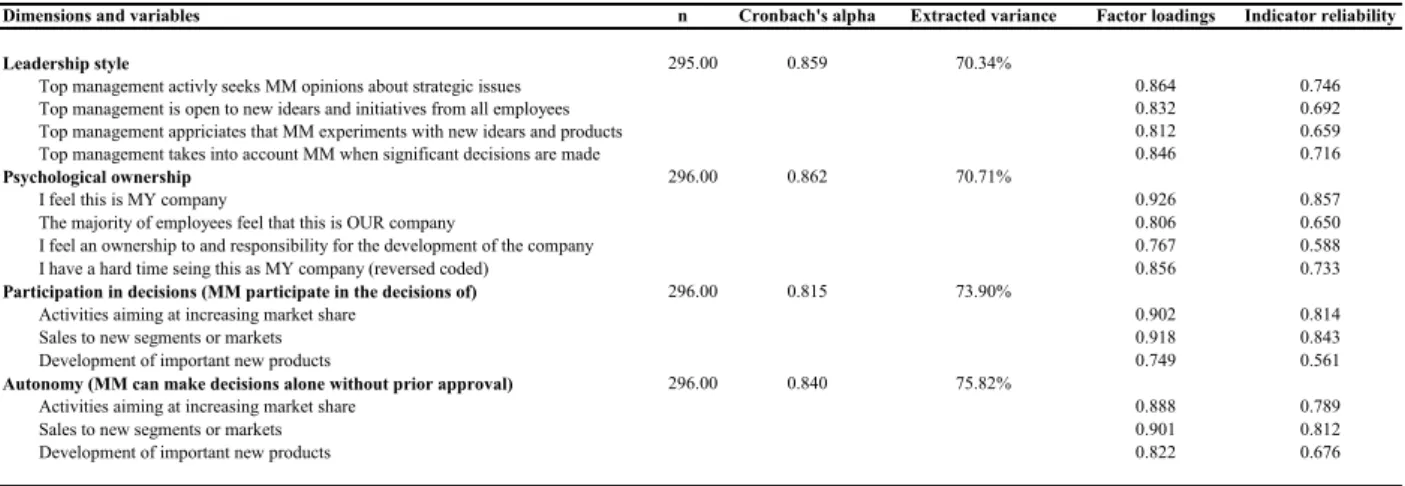
survey. To further test the content-related validity, all constructs were tested in an exploratory factor
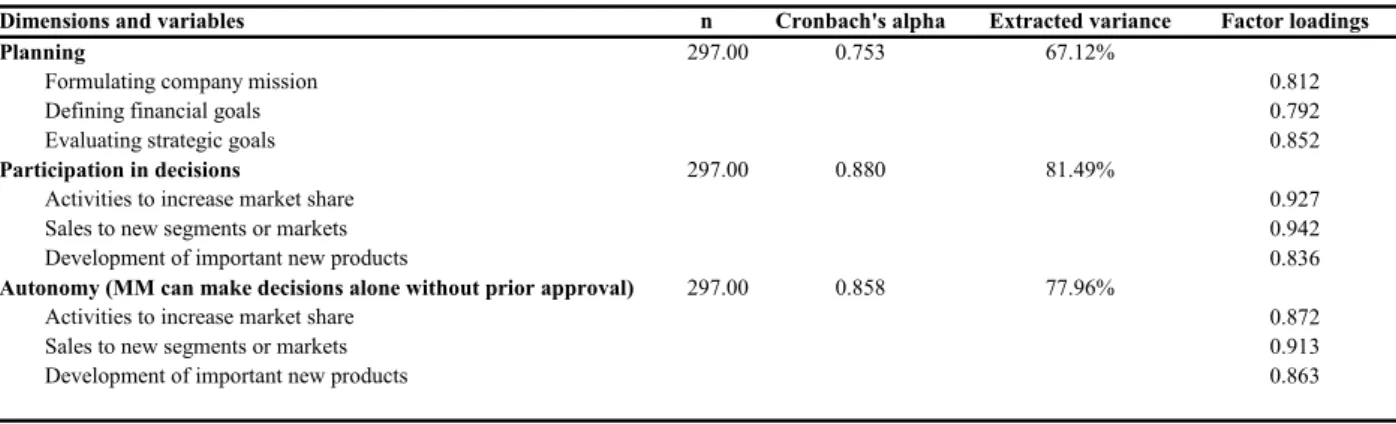
analysis to ensure a Cronbach’s alpha of at least 0.7 and factor loadings of at least 0.7 (Kline, 2005).
All tests supported a sufficient content-related validity.
Criterion-related validity was addressed by collecting performance measure data from official Danish
for non-response bias and collection method. The above actions gave no cause for concern in terms of
criterion-related validity problems.
Construct-related validity was ensured by using theoretically founded and formerly tested items,
constructs and relationships and by collecting data from multiple sources and from 3-4 respondents
from each company.
The questionnaires were developed in the autumn of 2009 and were based on a literature review; all
items were founded on theory and former surveys or case studies. To increase the possibility of a high
response rate, the questionnaires were limited to two pages plus an introduction letter. Despite the
limited space, the questionnaire included items addressing aspects of employee stock ownership,
involvement of middle managers in strategy, leadership style and psychological ownership relevant for
this thesis, but also other items to be used in future research.2
In the winter of 2009/spring of 2010, a list of the 500 largest Danish companies, measured in terms of
number of employees (a minimum of 225 full-time employees), was extracted from
“Kobmandsstandens Oplysningsbureau”. The 500 companies cover a broad set of industries. In
addition to number of employees and company contact information, the database also provided us with
2004-2009 financial data, industry code, stock market listing and founding year. In a first step, the CFO
was contacted by means of a personalised cover letter and the CFO questionnaire including questions
about the use of ESO. Due to their position in the finance department, the CFOs are most likely to have
access to information about who owns shares in the company and how many shares. Two weeks later,
the first letter was followed by a second letter directed to the CFOs who had failed to respond to the
initial letter. The two waves of letters produced a total of 149 answers from the CFOs. In a third step,
the remaining 351 CFOs were contacted by phone and asked to participate in the survey. This resulted
in additional 167 answers yielding a total of 316 answers from the CFOs. Careful inspection for
completeness and plausibility of the responses led to the elimination of nineteen answers (one firm had
actually received and answered the questionnaire twice, one firm was in the process of liquidation,
three firms had severely reduced the number of employees during the autumn of 2009, thus no longer
exhibiting the required number of employees, the other responses were severely incomplete or
implausible). Thus, a total of 297 answers were collected from a broad set of industries (i.e. a response
rate of 59.4%). The questionnaire was sent by mail to the head of marketing/sales in the 297 companies
in February 2010; a second letter was sent two weeks later to the non-respondents and finally, the
remaining companies were contacted by phone, resulting in a total of 207 answers (i.e. a response rate
of 69.7% of the initial 297 companies). A randomly chosen middle manager from each of the 297
companies was contacted by phone to collect answers to a reduced questionnaire. A total of 210 middle
managers answered the questionnaire (i.e. a response rate of 70.7% of the initial 297 companies). To be
able to test the validity of the answers, answers from two middle managers were collected from 57
companies as a subsample of the 210 companies.
General data on the companies of the entire population and the participating companies are available in
the appendix. The 297 companies have been tested for non-response bias and collection method; none
of the tests raised any concerns.
The problem of common-method bias has been addressed on the basis of the recommendations of
Podsakoff et al. (2003). The main approach for avoiding common-method bias is to use data from
multiple sources. This is accomplished by collecting data from multiple respondents in each company
and using external financial data collected from official databases as measures of performance.
Additionally, in each article, a Harman’s single factor test is conducted on all the items used in the
THE CONTENTS OF THE REST OF THE DISSERTATION
The rest of the dissertation is structured as follows: Chapter 2 develops a theoretical model that
demonstrates how ESO, involvement in strategy and a participative leadership style are antecedents of
psychological ownership among middle managers, and how they influence each other. The model
suggests that the creation of psychological ownership is moderated by worker and job characteristics,
which, in return, implies that the importance and effect of participative strategy processes among
middle managers differ between employees and between sectors. The effect of psychological
ownership on employee behaviour, employee attitudes and financial performance is also found to be
influenced by the sector’s knowledge intensity and environmental dynamism, suggesting that in sectors
with high knowledge intensity, the effect of creating psychological ownership among middle managers
is greater. This is due to the important role played by highly motivated knowledge intensive employees
in the creation of new ventures and difficulties of effective control and the risk of agency costs and
slack, caused by job characteristics and the variety of tasks traditionally assigned to knowledge
intensive workers. The contribution of the chapter lies in the development of a model combining the
areas of ESO, involvement and leadership style; a model which views the concepts not as sources of
increased performance, but as antecedents of psychological ownership. The model hereby combines the
literature in a new way, creates new insights and directs future research.
Chapter 3 tests the prevalence and antecedents of employee stock ownership in Denmark. As
developed in the model in chapter 2, ESO is one of the antecedents of psychological ownership and the
effect of psychological ownership on company performance is expected to be stronger in dynamic
environments. This indicates that the use of ESO among companies should grow more prevalent in
indicated that the prevalence of ESO has been reduced since the IT bubble burst in 2000. Similarly, the
effect of psychological ownership on company performance is expected to be higher in knowledge
intensive sectors indicating that the use of ESO would be expected to be higher in these sectors. The
model also indicates that the use of ESO is more prevalent in companies with high middle manager
involvement in strategy processes born out of the middle managers’ desire for some kind of profit
sharing as an incentive for engaging in participative strategic actions. The paper reports of an overall
increase in the prevalence of ESO in Danish companies but finds that only the prevalence of
narrow-based schemes (less than 50% of the employees covered by the scheme) has increased, while the use of
broad-based schemes (more than 50% of the employees covered by the scheme) has decreased. The
paper contributes to our knowledge be reporting that the antecedents of ESO are determined by the type
of ESOP.
Companies employing an ESOP covering only top management are mainly small companies with a
traditional view on strategy as a process controlled and executed by top management. In contravention
of theory-based recommendations, they combine the narrow-based scheme with individual bonuses.
According to a number of scholars, it is recommended to combine narrow-based incentives with
broad-based schemes to motivate employees to both contribute to the long-term development of the company
and to excel in their individual job functions. Companies employing broad-based schemes covering a
majority of the employees also seem to complement the broad-based ESO scheme with group-based
bonuses, also contradicting the recommendations from academia.
The general analysis of companies using ESOPs indicates that the prevalence of ESO is higher in listed
companies, which is in support of a number of similar findings (Pendleton et al., 2001). Adjusting for
stock listing, the prevalence seems to be higher in a stable sector like construction with relatively
relatively high-educated high-paid employees. This finding also conflicts with the expectation that the
prevalence would be high in dynamic industries with high-paid employees; an expectation borne out of
the fact that such industries should see a greater effect of and need for employee initiatives and the fact
that highly salaried employees would be more familiar with stock investments.
Chapter 4 tests ESO, involvement and participative leadership style as antecedents of psychological
ownership as well as their interrelations and interactions. Based on the model in chapter 2 and previous
literature reviews, it was expected that all three variables would be direct antecedents of psychological
ownership and that all interrelations would be significant and positive. The models were tested in
structural equation models (SEM) and the model with the best good fit reported both participative
leadership style and participation to be significant positive determinants of psychological ownership.
Especially a participative leadership style was reported to have a strong and highly significant impact
on the creation of psychological ownership. A participative leadership style was also found to be a
strong positive predictor of the level of involvement, implying that a top management which conducts a
leadership style that encourages, supports and expects involvement also experiences a high level of
involvement among middle managers. ESO had no direct effect on the creation of psychological
ownership, but was mediated by participation. This is in line with previous findings arguing that the
effect of ESO is mediated by allowing employees to exercise the formal ownership rights like
participation in decisions. A number of interactions between the three variables were tested but the tests
failed to improve the fits of the model. The chapter contributes to our understanding of the creation of
psychological ownership by testing the antecedents, interrelations and interactions of ESO,
involvement and leadership style. The findings reveal that especially the leadership style conducted is
arguments indicating involvement as an antecedent of psychological ownership, the present data find
that only participation, not autonomy, is a determinant.
Using the model tested in chapter 4, chapter 5 extends the model by testing the effect of psychological
ownership on company performance. The model tests if ESO, middle management involvement in
strategy and a participative leadership style have a direct effect on performance, if the effect is
mediated by psychological ownership or both. The model in SEM demonstrated good fits and
confirmed the findings in chapter 4 which indicated that participation and a participative leadership
style are antecedents of psychological ownership, while ESO is mediated by participation. No direct
effects of the three variables were found on company performance, signifying that ESO, middle
management involvement and leadership style are mediated by psychological ownership. These
findings provide the empirical support for the model in chapter 2, suggesting that the research areas of
ESO, involvement in strategy and leadership style need to focus on the effect of the variables on the
creation of internalised extrinsic motivation and especially psychological ownership. This finding also
suggests that more research should be conducted into how ESO, involvement and leadership style can
be combined with other activities which increase motivation and that the factors in themselves are not