Is Child Work Necessary?* by
Sonia Bhalotra
Department of Applied Economics, Cambridge University
The Suntory Centre
Suntory and Toyota International Centres for Economics and Related Disciplines
London School of Economics and Political Science Discussion Paper Houghton Street
No. DEDPS 26 London WC2A 2AE
August 2000 Tel.: 020-7955 6674
* This research was funded by research grants from the DFID (Labour Markets Programme)
and the ESRC (contract number R000237121). I am grateful to Catherine Porter for excellent research assistance, and to Steve Nickell, Manuel Arellano, John Cockburn, Nigel Duck, Jean Drèze and Chris Heady for useful discussions. The paper has also benfited from presentation at the Institute for Fiscal Studies in London, at the RES and ESEM meetings in 1999, and at the Universities of Bristol, Nottingham, Oxford, Princeton and Southampton.
Abstract
This paper investigates why children work by studying the wage elasticity of child labour supply. Incorporating subsistence constraints into a model of labour supply, we show that a negative wage elasticity favours the hypothesis that poverty compels work whereas a positive wage elasticity would favour the alternative view that children work because the relative returns to school are low. Distinguishing between these alternatives is important for policy. Existing studies have concentrated on the income elasticity, but this tells us nothing other than that leisure (or education) is a normal good. Using a large household survey for rural Pakistan, we estimate structural labour supply models for boys and girls in wage work, conditioning on full income and a range of demographic variables. Our estimates describe a forward falling labour supply curve for boys, consistent with the view that boys work on account of the compulsions of poverty. This is less clear in the case of girls. Therefore, raising the return to schooling for girls may draw them out of work, but eliminating boys' wage work requires alleviation of the poverty of their households. Trade sanctions or bans on child labour may have deleterious consequences for these households unless they are compensated for the loss of income.
Keywords: Child labour, education, poverty, gender, intertemporal labour supply.
JEL Nos. J22, J13, D12, O12.
© The authors. All rights reserved. Short sections of text, not to exceed two paragraphs, may be quoted without explicit permission provided that full credit, including notice, is given to the source.
Correspondence address: Dr Sonia Bhalotra, Department of Applied Economics, University of Cambridge, Sidgwick Avenue, Cambridge, CB3 9DE, UK: Email: [email protected]
Is Child Work Necessary?
1. Introduction
Why do children work? A common but not undisputed perception is that child participation in work is compelled by household poverty1
. Indeed, both the geographic distribution of child workers today and the economic history of specific regions demonstrate a clearly negative association of child work and aggregate income2. However, it is unclear
whether it was the rise in household incomes that eliminated child labour by dispelling the need for it, or whether the instrumental factor was the introduction of relevant legislation. This is because aggregate income may register an increase without any increase in the incomes of households supplying child labour. At the same time, economic growth or increases in aggregate income tend to be associated with the development of legal and political infrastructure, as well as with shifting and evolving social norms. In the last decade, microdata for developing countries have become available, which make it possible to disentangle household living standards (a microeconomic variable, which differs across households) from factors like new laws or changed norms, which apply equally across
1
See this view expressed, though not established, in Grootaert and Kanbur (1995) and Hamid (1994), for example. In much of the recent theoretical work on child labour (discussed in Section 2.1), it is axiomatic that households providing child labour are poor. However, it is only Basu and Van (1998) that use precisely the notion of how poor (close to subsistence) that is invoked in this paper.
2
households. Studies using these microdata have produced mixed results (see Section 2). While a number find that the work participation rates of children are uncorrelated with household income, some do establish a significant negative relation of household income with child work.
However, a negative impact of income on child labour does little more than affirm the plausible belief that child leisure (or child schooling)3
is a normal good. Given that leisure (or education) is a normal good, does child labour arise primarily as a result of household poverty or primarily because the relative returns to alternatives like school attendance are low? There is no rigorous evidence on this question and yet the policy implications of the two alternatives are dramatically different. If the objective of policy is to move working children in to school, should the extra unit of public money be spent on alleviating poverty in households supplying child labour (e.g., by giving them a subsidy to compensate the opportunity cost of attending school) or on improving the quality and relevance of education (e.g., direct spending on school infrastructure and organisation or on lowering the direct costs of school attendance)? The first strategy has been adopted by the Food-for-Education Program in Bangladesh (see Ravallion and Wodon, 1999) and the second underlies the Back-to-School Program in Indonesia (see Sayed, 2000).
This paper argues that estimates of the wage elasticity of child labour supply allow us to discriminate between these alternative hypotheses.
3
For adults, the alternative to work is defined as leisure but for children the choices include school.
Suppose that households are very poor in the specific sense that income without child earnings falls below subsistence requirements, or that child work is necessary. Then a decrease in the child wage must be compensated by an increase in child hours in order to meet the subsistence target. For a fixed target, the wage elasticity will be –1. More generally, the income effect of a change in the wage of an individual is more likely to dominate the substitution effect in poor households than in rich ones. We therefore define our poverty hypothesis to imply that the wage elasticity is negative. If we observe a positive wage elasticity, we can reject the poverty hypothesis and conclude that consumption is comfortably above subsistence for the sample households. In this case, the hours of child work are determined primarily by relative returns (that is, the substitution effect dominates). Section 4. formalises the hypothesis by incorporating subsistence constraints in to a labour supply model.
If we identify a negative wage elasticity, we may argue that improving returns to education is unlikely to have a substantial impact on child work. This is because the marginal utility of consumption increases very rapidly as people get close to subsistence4
and is so large in this region that creating matching increases in the marginal return to education may not be in the scope of policy5
. If, on the other hand, we observe a positive
4
This intuitive idea seems not to have exerted its power until recently. See, for example, Deaton (1998) in the context of the precautionary savings hypothesis.
5
This argument uses the standard result that investing in education or labour markets to increase the return to education will tend to alter the relative marginal utilities of consumption and schooling in a manner that will increase the demand for schooling.
wage elasticity, then investing in schools (or in improving labour market opportunities) will have a non-negligible impact on child work.
Using survey data for 2400 households, labour supply equations for boys and girls who work for wages in rural Pakistan are estimated. We condition on participation and exploit the substantial variation in hours of work to estimate the wage elasticity6
. The main result is that the wage elasticity is significantly negative for boys and insignificantly different from zero for girls (Section 6).
The paper is organised as follows. Section 2 surveys the literature, delineating the contributions of this paper. The data are described in Section 3, where relevant descriptive statistics are presented. A theoretical framework is outlined in Section 4. Section 5 sets out the empirical model and the estimation strategy. Section 6 presents the results and Section 7 investigates their robustness. Section 8 presents further analysis of the results and Section 9 discusses policy implications and concludes.
2. Existing Literature and Contributions of this Paper
Theory
Much of the small theoretical literature on child labour is premised on the idea that children work because their households are poor. In its extreme subsistence form, the poverty hypothesis is axiomatic in Basu and Van (1998). To the extent that the adult wage proxies poverty, as assumed
in Basu and Van, this paper may be seen as a test of their critical assumption7
. Lahiri and Jaffrey (1999) and Ranjan (1999) present models in which child labour arises as a result of imperfect credit markets. Clearly, credit constraints are more likely to bind for the rural poor, not only because their average incomes are low but also because their incomes are particularly volatile8
. Eswaran (1998) jointly models child labour and fertility, showing that a poverty trap is created when child mortality is high and child labour is socially acceptable.
The possibility that child labour is a rational response to relative returns in an adverse economic environment has also been modelled. In their pioneering work, Rosenzweig and Evenson (1977) find that high fertility and therefore child labour in India in the late 1950s was motivated by the relatively high ratio of child wages to school returns. Cigno and Rosati (2000) also model child labour jointly with fertility and child mortality, and the role of prices (the marginal cost of human capital, including the child wage) is explicit. Bhalotra and Heady (2000) model child farm labour in a two-period setting with credit and labour market imperfections and distinguish relative returns from wealth effects.
6
The wage elasticity of labour force participation will of course be positive. I have confirmed this for the data used in this paper.
7
Smoothing the discontinuous labour supply curve in Basu and Van gives a negative labour supply curve. However, as their paper is purely theoretical, they do not raise the hypothesis of the wage elasticity being negative.
8
In relation to the poverty hypothesis of this paper, note that finding that poverty compels child work is consistent with households either being chronically poor or else transiently poor and credit-constrained.
Cockburn (2000) proposes a related model of child work on the household farm in which assets reflect relative returns as well as wealth.
Empirical research on child labour
What is the evidence? It is mixed and it is not clear how robust it is. Motivations other than poverty
There is some evidence that children work for reasons other than poverty such as to gain economic independence from their parents (see Iversen (2000) for rural Karnataka, India), because school attendance affords the child a disutility that dominates the disutility from work (e.g. Delap (1998) on urban Bangladesh), or in order to acquire training (see Aragao-Lagergren, 1997). However, these results are difficult to generalise because they rest on isolated case-studies.
Using large representative household survey data, Bhalotra and Heady (2000), Cigno and Rosati (2000), and Cockburn (2000) all find evidence consistent with the view that imperfect labour markets can explain child work. In particular, when it is difficult to hire in farm labour, land owning households may employ their children on the household farm and the evidence is that child work is increasing in farm size. The children of the very poorest (landless) households may not work because there are limited opportunities for work. There is also some evidence that credit constraints explain child labour- rather than low permanent income or
wealth9. For example, Jacoby and Skoufias (1997) and Sawada (1999) find that children are taken out of school in response to household income shocks in rural South India and Pakistan respectively.
A further possible reason that children work, distinct from poverty, is that their parents are selfish. Historians have debated this question with regard to child labour in nineteenth century England (e.g. Nardinelli, 1990, p.94) against Anderson, 1971) and Brazil (Rizzini, 1999). Burra (1995) and Gupta (1998) present arguments to suggest parental callousness in contemporary India, and Bhalotra (2000) finds evidence consistent with parental selfishness using representative data for contemporary rural Pakistan.
All in all, as indicated in the first paragraph of Section 1, the poverty hypothesis is not trivially true- it deserves investigation.
The evidence on poverty and child labour
A number of studies find that working children contribute a fairly substantial fraction of household income10
. Our data produce figures in line with some of these studies: for children in wage work, the average contribution of boys is close to 30% and of girls, to 15%. This makes it plausible that households rely upon the child’s contribution. A number of
9
In a cross section, this distinction may be obscured. Bhalotra and Heady (2000) show that the presence of credit constraints will strengthen the negative effect of income on child work. The cited studies exploit panel data to look at the effects of exogenous income shocks on schooling and, by implication, child labour.
10
See Sharma and Mittar (1990) and Swaminathan (1998) for India, Cain (1977) for Bangladesh, Patrinos and Psacharapoulos (1994) and Myers (1989) for Paraguay, Kassouf (1998) for Brazil.
recent analyses of child labour by economists have used microdata for developing countries and found that the participation rates of children are uncorrelated with household income (e.g. Nielsen (1998), Canagarajah and Coulombe (1998), Sasaki and Temesgen (1999)), though some find the expected negative effect (e.g. Cigno and Rosati, 2000)11
.
Since most of these analyses are conducted as if household income (or poverty status) were exogenous and this will tend to create a positive bias in the OLS coefficient, it is possible that a negative income effect would be identified more systematically if appropriate instrumental variables were used12. Indeed, using community-level variables to
instrument income, Bhalotra and Heady (2000) find that the Smith-Blundell test rejects exogeneity of income and the OLS estimates have the expected upward bias. Nevertheless, they identify a negative income effect for only two of the four samples of children (girls and boys in rural Pakistan and Ghana). This may not be terribly surprising in the case of farm work since average hours in farm work are half-time or less, and it is often combined with school attendance. Most existing studies (cited above) combine the different types of child work (eg. wage work and work on household
11
A variety of direct income effects can be found in Grootaert (1998), Jensen (1999), Kassouf (1998), Patrinos and Psacharopoulos (1997), Patrinos and Psacharopoulos (1995), Psacharopoulos (1997)) and Ray (2000), amongst others.
12
Ray (2000) deducts child income (imputing a wage to non-wage workers) from household income. While this will ameliorate simultaneity bias it will not eliminate it if parent and child labour supply are simultaneously chosen. Grootaert (1998) acknowledges that income is likely to be endogenous and attempts to deal with this by replacing income with a dummy for whether or not the household falls into the lowest income quantile. However, discarding information on income does not solve the problem.
farms), thereby imposing a restrictive homogeneity of the income effect and possibly obscuring it13
. Wage elasticities
Estimates of the child wage elasticity allow us to discriminate between alternative hypotheses for why children work, which estimates of the income elasticity cannot do (see Sections 1 and 4). There appear to be no comparable estimates of child wage elasticities in the literature. Most econometric analyses of child labour estimate reduced form participation equations and do not include the wage as a regressor. In their studies of household production and time allocation, Levy (1985), Rosenzweig (1981) and Rosenzweig and Evenson (1977) find positive own-wage elasticities for children in the rural areas of Egypt and India respectively, but negative wage elasticities are ruled out by construction in their models14
. Ray (2000) estimates tobit models for Pakistan and Peru and finds a positive wage elasticity for children. However, since he merges rural and urban data and combines wage work with work on the household farm or enterprise, his estimates are not comparable with ours15
.
13
Bhalotra and Heady (2000) show that, under perfect capital markets, the negative effect of income on child labour which is expected when the choice is between leisure and work may not appear when the effective choice involves re-allocating an hour from school to work.
14
Estimates of wage elasticities of participation are expected to be positive. This is confirmed for our data.
15
It is very unlikely that the restrictions on the slope parameters of the labour supply function implied by Ray’s specification are valid. Also, Ray uses the tobit model and he sets the wage for all non-working children equal to the smallest wage amongst working children. The child wage is assumed exogenous.
Turning from work on child labour to the larger literature on labour supply, there is some evidence of negative wage elasticities for adult men (see, for instance, Rosenzweig (1980) for rural India, Attanasio and MaCurdy (1997) and Kneiser (1976) for the US, Kooreman and Kapteyn (1986) for the Netherlands), though these are typically found at high wage levels. Negative wage elasticities at low wages have been found for Mexico using data on adults (Hernandez-Licona, 1996). Looking at children sharpens the question: Since the earnings of adults provide non-labour income for children, we would expect forward falling labour supply curves to be less likely to be observed for children than for adults.
Contributions of this paper
This paper makes precise the common notion that children work because they come from subsistence-poor households and argues that this hypothesis can be tested against alternatives by estimating the wage elasticity of labour supply (Section 4). It emphasises the importance for policy purposes of distinguishing between the alternatives. An important advantage of this approach is that it avoids the problems of selecting a poverty line and assuming that there is a discrete jump in poverty status at that line. It differs from most existing work, which investigates the poverty hypothesis by studying the income elasticity of child work participation. It is argued in this paper that this does no more than establish that child leisure (or education) are normal goods.
Data on non-labour income is needed to obtain estimates of direct income effects. The data used contain information on household consumption and on the labour income of all household members. In the absence of a panel that records asset changes, this information is used to create a lifecycle-consistent definition of household income (see Blundell and Walker, 1986). In contrast, existing studies use reported income (a static definition). When there are lifecycle aspects to decision making, this yields wage elasticities that confound the effects of shifts in wage profiles with movements along them (see Blundell and MaCurdy, 1998). Unlike much of the existing work on child labour, this paper allows for the endogeneity of household income and the child wage. Careful attention is paid to identification and since weak instruments can generate inconsistent estimates (see Staiger and Stock (1994) and Bhargava and Sargan (1983)), tests are provided for the strength of the instruments used. Similarly, the final estimates of the wage elasticity are subject to a range of robustness checks.
Most available studies pool data on boys and girls and on rural and urban regions. They also tend to combine child wage labour with child labour supplied to the household farm or enterprise. On the basis that the implied pooling restrictions are unlikely to be valid, this paper estimates separate labour supply curves for boys and girls, and concentrates on rural areas, where child work and poverty are most prevalent. It focuses on wage work rather than on household employment because the data reveal
that wage work is the most demanding form of child work, and also because it is only for wage work that we have information on earnings. 3. The Data
The data are the rural observations from the Pakistan Integrated Household Survey (PIHS) for 1991, available from the Living Standards Measurement Survey unit of the World Bank. There are 2400 rural households. Households are large and complex, the mean household size being 7.63 (mode=7). We therefore have information on more than 18000 individuals. The survey collects detailed data on schooling and on economic activity.
3.1. Defining children
Children are commonly defined as persons under 15 years of age, for example by the ILO and the UNICEF (e.g., ILO, 1996), though the empirical literature has used a variety of definitions in the range 5-18 years. Since employment questions in our survey are only addressed to individuals ten years or older, we analyse the data for 10-14 year olds. Since we isolate
children in wage work, gender-specific sample sizes are small. In the interests
of robustness, results are also reported for wage working individuals aged 10-17. The employment of children on household farms in Pakistan (and
Ghana) is analysed in Bhalotra and Heady (2000). This paper is concerned with wage employment16
. 3.2. Descriptive Statistics
Prevalence of child work and gender differentials
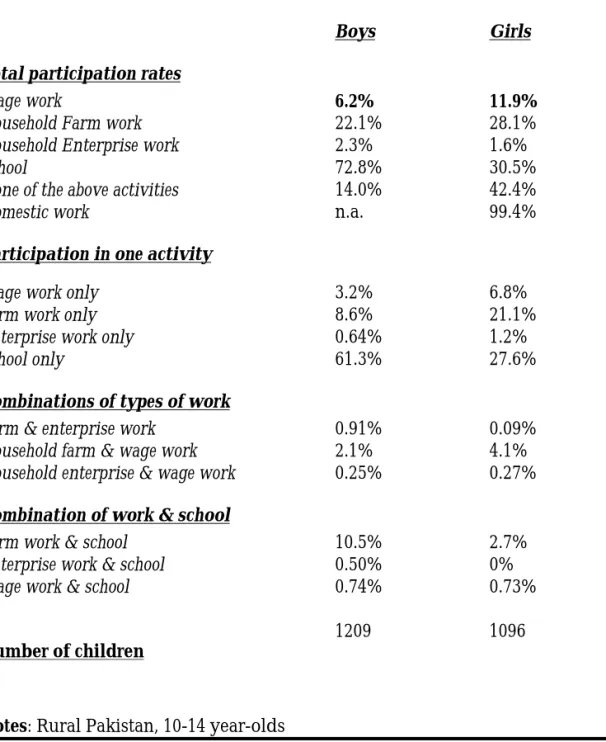
School enrollment is very low in Pakistan, even in comparison with other low income countries, and child participation rates are among the highest in the world (ILO, 1996). In comparison with sub-Saharan Africa or with neighbouring India, Pakistan also has a relatively large fraction of children in wage work. Table 1 presents a profile of child activity rates. Among 10-14 year olds, 6% of boys and 12% of girls are in wage employment. Comparing these figures with the participation rates for adults puts them in perspective. Amongst adults (18 years and older), only 36% of men and 15% of women are wage workers, the larger fraction are self-employed.
The participation rate of girls exceeds that of boys in both wage work and work on household farms and enterprises, but the gender differential in work participation is small compared to the enormous gap in school attendance. This is because a much larger fraction of girls, as compared with boys, report “no activity” (“none of the above activities” in Table 1), which may reflect engagement in domestic work. Where data on domestic
16
Children working for wages are classified as being in one of three activities: permanent agricultural employment, seasonal agricultural employment and non-agricultural employment.
work are unavailable, one needs to be careful about assuming that variables which release children from work will also put them in school. Work hours and competing child activities
The sample probabilities of combining activities are also in Table 1. In contrast to sub-Saharan Africa (see Bhalotra and Heady (2000), Canagarajah and Nielsen (1999), for example), it is uncommon for children in Pakistan to combine activities. Virtually no children combine wage work and school. It is thus clear that wage work competes with schooling17. Since
hours of wage work average 45 a week for boys and 31 a week for girls (Table 2), it is unsurprising that, for most children, it cannot be combined with school or other types of work. Around this high mean is considerable variation, which is exploited in estimating the wage elasticity. Kernel density plots for hours in Figure 2 show the distribution to be bi-modal. Child labour and household living standards
Simple tabulations show that, among boys and girls alike, average household income is lower for workers than for nonworkers. Since this is so even without deducting the child’s contribution to household income, it suggests that poverty is an important determinant of child work. Furthermore, average household income is lower in the sample of children
17
To assess whether children reporting wage work in the reference week are from households experiencing a rough patch, it is useful to look at the average completed school years of these children. These are 2.1 years for boys in wage work as compared with 4.6 for those who are not in wage work, even though workers are older on average. The corresponding figures for girls are 0.6 years as compared with 1.9 years.
working for wages as compared with the sample of children employed on the household farm/enterprise. Thus wage working children appear to be particularly impoverished.
Table 2 and Figure 1 present work and school participation rates by expenditure quartiles. Amongst the poorest 25% of rural households, a remarkable 19% of girls are in wage work as compared with only 8% of boys. In the richest 25% of households, the participation rate falls to 9.4% for girls and 5% for boys. These data indicate that the burden of household poverty is born disproportionately by girls. The gender differential is even more remarkable in the relation of household living standards and school attendance.
These data support the poverty hypothesis in that it is clear that the rates of school attendance increase and of child work decrease in moving from the lowest to the highest quartile18
. Notice, however, that child work participation in the upper quartile remains at a level high enough to merit investigation. The poverty hypothesis alone cannot explain this.
It is recognised that household expenditure levels may be endogenous to child employment rates (though not, of course, to school participation rates). However, if the income contribution of children is subtracted away, the poorest households, amongst whom child work is more prevalent, will
18
The poverty line is just above the mean expenditure per capita of the lowest quartile, so households challenged to meet subsistence requirements are expected to be in this group. Malik (1995) estimates the poverty line for 1990-1 for rural Pakistan to be Rs. 243 per capita, using calorie-expenditure functions estimated on the Household Income and Expenditure Survey which has a similar sampling frame to the survey that we use (the PIHS).
be even poorer. The pattern we observe across quartiles is therefore unlikely to be altered. Nevertheless, as a check, child activity rates were tabulated by quartiles of adult income19
and in the upper quartile 6% of children were in wage work and 20% in self employment. The persistence of child work among the richest 25% of the rural population is therefore not the result of the endogeneity of expenditure.
For the reasons discussed in Sections 1 and 2, we estimate hours equations conditional on participation. So, while the participation-poverty relations in Table 2 and Figure 1 are an important description of the work environment, it is also useful to look at hours of work (conditional on participation) by quartile. This information is also in Table 2 and the relation of work hours and poverty looks non-linear. Non-parametric estimates of this relation, obtained using a Gaussian kernel, are in Figure 3. Consistent with the participation data, and also with the results obtained in Section 6, after conditioning on a range of variables, the expected negative relation of household living standards and child work is clearer for girls.
19
Household income consists of wage income and income from the household farm and enterprise. The latter can only be assigned to individual household members by estimation of a production function for farm/enterprise work, and this is deferred. Adult income is defined here as the difference between total household income and child wage income. If the intra-household allocation of labour (leisure) is such that parents first set their own labour supply and then set child labour supply conditional on their income, then adult income will be exogenous to child work. A tabulation of child activity rates by adult income is available from the author on request.
Child labour and the child wage
A two-way scatter plot of hours and the wage rate for children in wage work is in Figure 4, where a cubic spline is fitted to the data. This reveals a negative tendency for boys and no relation of the two variables for girls. The plot is only indicative because non-labour income and other variables have, of course, not been held constant. It is nevertheless consistent with the results in Section 6.
4. A Theoretical Framework
This section sets out a model of labour supply which clarifies the role of the labour supply of household members other than the child and the definition of household income. By introducing subsistence constraints, it defines the poverty hypothesis that is investigated in this paper.
Household decision making
We assume that children under 15 do not bargain with their parents because they do not have a valid fallback option. The unitary specification used is consistent with the view that a “dictator” decides what labour, if any, the child will supply and also with the view that parents and children have common preferences. This is not nearly as unreasonable as the assumption of common preferences across spouses which has, in many contexts, been rejected in favour of the bargaining model. It may be important to allow the child labour decision to be influenced by the relative bargaining powers of the mother and the father of the child (e.g. Galasso, 1999) but our data do not have variables (“extra environmental
parameters”- see McElroy, 1990) that can be used to denote these relative powers in an empirical model. In view of this constraint, we specify a common utility function20. The empirical model is not nearly as restrictive as this may suggest. A dummy for female headship as well as the education and age of both parents are included as regressors. This allows for the possibility that mothers and fathers have different preferences over child labour and that relatively well educated mothers have greater power in decision making. The child hours equation also contains an indicator for whether the child is the child of the household head, and this allows for differential treatment of nephews, siblings, or other relations of the head. Labour supply conditional on lifecycle-income
Since it is unlikely that decisions about child work are made myopically, the labour supply decision is set in a multi-period framework. Assuming intertemporal separability, the problem can be decomposed into two stages. In the first stage, the agent allocates wealth (full income) across periods and, in the second stage, she conditions on full income and allocates consumption and leisure in view of their relative prices (see Blundell and Walker (1986), for instance)21
. The second stage problem yields
20
An advantage of the unitary model in the present context is that it is amenable to multi-period modelling and to allowing the non-separability of individual leisures in the household model (see Blundell and MaCurdy, 1998). In rural economies where household production is substantial, separability is a strong assumption.
21
These authors show that conditioning labour supply on the current period allocation out of lifecycle wealth is an alternative to the Frisch approach of Heckman and MaCurdy (1980) in which the conditioning variable that captures future anticipations and past decisions is λ, the
within-period marginal rate of substitution (MRS) conditions for the relative demands for consumption and leisure that are the same as in the static model but, as we shall see, household income, Y, is measured differently. Let subscript i denote the child in question and let j denote all other household members. Let instantaneous household utility be
(1) U=U(C, Li, Lj, X, ε) , C≥0, Li, Lj ≥0
where U is concave and defined over joint consumption (C), individual leisure (L) and a vector of individual and household characteristics, some of which are observable (X) and some of which are not (ε). These include determinants of school attendance as well as determinants of non-wage work (see Section 5). Leisure refers to non-market time and it therefore includes time spent at school or in activities other than wage work. The full income budget constraint is
(2) C + WiLi + ∑j WjLj = Y + WiTi + ∑j WjTj
where W are wage rates, T are time endowments (T≡L+H, where H is hours of work), Y is non-labour income, and the price of composite consumption, C, is the numeraire. All terms in (1) and (2) have the
marginal utility of wealth. It is a particularly attractive alternative when the data, as here, are limited to a cross section. This is because Y is observable in a cross section if consumption data are available, while λ is not (see (4) below).
subscript t for the current period but this is suppressed to avoid clutter. It is introduced in (3) and (4) where more than one period is involved.
To define non-labour income, consider the intertemporal budget constraint defining the time path of assets (A):
(3) At+1 =(1 + r)At + ΣkWtkHtk - Ct
where r is the interest rate and k=i,j. Using (2) and (3), we can see that non-labour income is given by
(4) Yt = Ct - ΣkWtk Htk = rAt - ∆At+1, where ∆At+1 = At+1 -At
So a lifecycle-consistent measure of Y counts in any asset accumulation or decumulation across periods (∆At), which is an important way of smoothing consumption. In contrast, nonlabour income in the static model is simply rAt, which is a valid measure only if agents are myopic or if there exist no capital markets so that it is impossible to save and dissave22. The
wage elasticity estimated from a static model will tend to confound shifts in wage profiles with movements along them (Blundell and MaCurdy, 1998). Since estimation of the wage elasticity is central to the current analysis, it is important to condition on lifecycle and not static income. The
22
While formal capital markets are underdeveloped in the rural areas of most low-income countries, there is considerable evidence of informal means of saving and dissaving (see Besley,
equality in (4) permits measurement of Y in a cross-section as the difference between household consumption and the labour earnings of all household members (C-ΣkWk Hk) 23
.
The first order conditions are obtained by maximising (1) subject to (4):
(5a) Uc - εc = λm (5b) ULi - εi ≥λm Wi (5c) ULj - εj≥λm Wj
where Uk denotes the marginal utility of k, λm is the marginal utility of money, and taste heterogeneity is introduced through the ε terms. The implied labour supply function for individual i (the child) in period t, given H=T-L, is
(6) Hi = Hi (Wi, Wj, Y, X, ε)≤ T
where the inequality is strict for an interior solution. So child labour depends on household income, the child wage, and the wage rates of other household members. We could equally transform the first order conditions
1996). The Pakistan data used in this paper reveal that between 43% and 50% of households reported borrowing or lending money in 1991.
23
This measure of Y is in fact net dissaving- a consumption based measure of nonlabour income. Note that Altonji (1983) uses food consumption as a proxy for the unobserved marginal utility of money in his analysis of multi-period labour supply decisions of American men.
to arrive at a conditional demand equation with child hours of work conditioned on parent hours of work (quantities) and non-labour income. Since parent work hours are likely to be endogenous, we prefer the form in (6) which conditions on parent wages (relative prices).
Subsistence and the wage elasticity of hours of work
Let’s introduce a subsistence constraint by defining C*≡C-Cs, where Cs is subsistence consumption and C*
is the excess of consumption over subsistence. Since U is not defined for consumption levels below subsistence24
, C is replaced by C*
everywhere.
Using (5) but suppressing the taste terms, we can write down the marginal rate of substitution between consumption and child leisure, f, as
(7) i i i W L C L C f = ∂ ∂ − ≡ * , * ) ( , C*>0, LI>0
Holding ΣjWjHj constant and taking total derivatives in (2) and (7) respectively yields (8) dC* + Wi dLi + Li dWi = dY, fC dC* + fL dLi = dWi 24
We can obtain partial derivatives with respect to Y by setting dWi = 0 and partial derivatives with respect to Wi by setting dY = 0. Using (7) and (8) now yields (9) Y Hi ∂ ∂ = L C C f ff f − − , Y H H f ff W H i i L C i i ∂ ∂ + − = ∂ ∂ 1
where fC and fL are the partial derivatives of f with respect to its arguments, the first term on the right hand side is the pure substitution effect (>0) and the second term is the income effect (<0 if leisure is normal). So we have the familiar result that the slope of the labour supply curve depends upon which of these effects is larger.
In order to derive conditions under which the relative strength of these effects can be assessed, we need to impose structure on the utility function. If f(C*, L) is restricted to be homothetic, so that f=g(C*/L) then (9) becomes (10) 1 * [ *( 1) ( s)] i i i i i C Y C WL C L W W H − + − + = ∂ ∂ σ
where σ is the elasticity of substitution between net consumption and
leisure, and σ=1 in the Cobb-Douglas case25
. Multiplying by (Wi/Hi) in (9) and substituting out Hi using Hi=[Ci*- (Y-Cs)]/Wi, got by rearranging (2a), we get an expression for the wage elasticity,
)] ( ][ [ )] ( ) 1 ( [ ) 11 ( s i i s i i i i i i w C Y C L W C C Y C L W H W W H − − + − + − = ∂ ∂ ≡ ∗ ∗ ∗ σ ε
It follows directly from (11) that when household consumption is at the subsistence level (C*
=0), then εw= -1. This is consistent with the intuitive notion of the child working towards a target income where the target is defined as the shortfall between subsistence requirements and other household income. Suppose that households are not exactly at subsistence but are nevertheless very poor. Then C* is not zero but close to zero and the first term in square brackets in (9) is close to zero for all values of σ. In this case, as long as the non-labour income of individual i (the child) falls below subsistence requirements (Y<Cs), εw<0. Thus, once subsistence constraints are incorporated into a model of labour supply, it is clear that the income effect of a wage change will tend to dominate the substitution effect for very poor households26
.
25
The derivation of (10) under homotheticity is detailed in the Appendix to Barzel and MacDonald (1973). .
26
It may be convenient to further assume that σ is constant. The MRS for the CES form is
(12) f(C* , Li) = σ α α * 1/ 1 − i L C
At C*=0, it follows from (12) that fC is infinite27 and we obtain from (7) and (9) that (13) i i i i W H W H − = ∂ ∂
from which it follows again that εw= -1. At C* close to zero, fc is very large and we can see from (9) that the wage elasticity for positive Hi will be negative.
We are now in a position to explicitly define the hypothesis and its testable implications. The strong form of our poverty hypothesis is that households are “subsistence poor” in the specific sense that income without child earnings falls below subsistence requirements. Its weaker form is that households are poor enough that the income effect of a change in the child wage dominates the substitution effect, other things being equal. We therefore estimate (6) using income defined in (4) and use
27
estimates of the wage elasticities for boys and girls (with reference to (11) or (13)) to test the poverty hypothesis28
.
Notice that the strong form of our poverty hypothesis is equivalent to the luxury axiom in the seminal paper by Basu and Van (1998). This paper presents a method for empirical verification of that axiom. Basu and Van denote household poverty by the adult wage rate in order to focus attention on an interesting configuration of labour market equilibria. We generalise this by characterising household poverty as dependent on adult earnings, non-labour income and any saving or dissaving performed by the household (see equation (6)). The generalisation is important because there is huge inequality in asset (especially land) distribution in low-income countries.
5. Estimation Strategy
5.1. Conditioning On Participation
We estimate hours of work conditional on participation because it is only on the intensive margin (continuous changes in hours of work) that the wage elasticity of labour supply can be negative29
. I have confirmed that the wage elasticity is positive in participation equations estimated on these
28
The poverty hypothesis is that if households are very poor then we will observe a negative wage elasticity. Conversely, finding a non-negative wage elasticity implies rejection of the poverty hypothesis. Note that we cannot and do not claim that a negative wage elasticity implies extreme poverty. [Ref.: If A⇒B then not-B⇒not-A. However, it does not follow that B implies A.]
29
While this greatly reduces the available data points, it is the only theoretically-consistent way to proceed.
data. If Ih is an indicator variable for participation in work, then observed hours, H, are given by H=H* if Ih=1 and H=0 otherwise. To control for selection bias, the inverse Mills ratio (λ) estimated from the work participation equation is included as a regressor in the hours equation (Heckman, 1974). To increase the robustness of this procedure to the assumed parametric distribution of the unobserved error terms, λ2 is also included in the model. This approach rests on the semiparametric series estimator principle of Newey, Powell and Walker (1990)30.
5.2. The Empirical Model
This section translates the theoretical model in to an estimable model, subject to constraints imposed by the data. The sensitivity of the results to some of the choices made here is investigated in Section 7. The variables in (6): Hi = Hi (Wi, Wj, Y, X, ε) are defined as follows. Two definitions of hours
of child wage work, Hi, can be constructed from the survey. One refers to the
week before the survey and the other to the annual average of weekly hours of work. Tables 1 and 2 use the first definition. The statistical analysis to follow reports results using both definitions. The child wage rate,
Wi, is measured as earnings divided by hours of work. This introduces a
30
Using US data, Newey, Powell and Walker (1990) investigate the robustness of estimates of women’s labour supply to the normality assumption. They find no statistical difference between the conventional 2-step Heckman estimates and semi-parametric estimates obtained using the series estimator. They also find that semiparametric estimates of the first stage participation equation are not significantly different from ML estimates. They conclude, in line with Mroz (1987), that the sensitivity of estimates of the hours of work model for women in the US depends more upon correct specification of the regression function and the choice of
potentially spurious negative correlation of W and H, to deal with which the wage is instrumented (see Section 5.4)31
. Measurement of earnings is complicated by the fact that some payments are in kind and also by the fact that earnings are reported for different payment frequencies and these have to be brought to a common denominator. We have performed this harmonisation and have incorporated payments in kind using cluster-level grain prices and information on quantities of grain received. (Clusters are the sampling units one level above households and they roughly correspond to rural communities)32
. The wage rates of other household members,
Wj, are calculated in an identical fashion. However it is not uncommon in these data that the child is in wage work but several of her household members –including her parents- are not. The parents may, for example, be in farm work. As a result, wj records many missing values33
. There are two
ways of dealing with this problem. One is to predict wj using the Heckman procedure. The other is to replace the wage rate of person j with the age instrumental variables than on specification of the error distribution. In this paper, particular care is taken to investigate the robustness of the specification for child labour supply (Section 7).
31
Note that the wage rate is specific to the individual child – it is not constrained to be the local market wage - which is available and used as an instrument.
32
The World Bank provides a file containing the components of household income and expenditure with the data. This includes computation of the earnings and work hours of every individual in the household. The adjustments mentioned are made in these files but we corrected some errors and altered some assumptions.
33
For boys in wage work, 52.5% of fathers and 75.4% of mothers do not report a wage. For girls in wage work, 70% of fathers and 26% of mothers do not report a wage. (Notice the strong suggestion of complementarity in mothers’ and daughters’ involvement in wage work). Is this because of specialisation within the household or does it suggest that children are only put in to wage employment when their parents cannot work, for example, on account of illness or disability? The data suggest specialisation: 73% of fathers and 55.3% of mothers of wage working children are engaged in work on the household farm or enterprise.
and educational level of person j. Both methods were implemented but the second is preferred because it is cleaner and because the impact of parents’ education and age on child labour is of independent interest (see Section 4.1). Since children in rural areas of low-income countries typically live in large integrated households, j goes up to 7 for the average household, In view of the small sample size available after conditioning on participation, we include only the Wj (age and education) of the child’s parents. The labour supply of other adults and siblings is “represented” in Y (see below). Formally, this amounts to assuming separability of the leisure of these individuals from the leisure of the child34. To investigate whether this
makes any significant difference, parents’ education and age was replaced by the average education and age of all adults in the household- this did not alter the wage and income elasticities. The omission of sibling terms as regressors is partially addressed by grouping siblings, a specification which is discussed in Section 7.2.
The lifecycle-consistent measure of non-labour income, Y is defined for
period t in (6) as (rAt-∆At+1)=(Ct-ΣkWtkHtk). This equality, which flows directly from the budget constraint, shows that information on asset changes is not necessary and that Y can be measured with cross-sectional data as long as they contain household consumption (C) and the labour income of all household members (ΣkWkHk)- which the survey we use does.
34
Many analyses of labour supply and certainly all analyses of child labour assume separability for all household members. We relax this assumption for parents, holding on to it for pragmatic reasons for other individuals. Even this degree of restriction is investigated.
Recall that the child may be engaged in any of the following activities: wage work, work on the household farm or enterprise, school, none of the above (see Table 1). Therefore, exogenous regressors, X, will include variables that determine the relative attractiveness of these activities. For example, we include a measure of land owned by the household which, at given household size, reflects the marginal productivity of farm/enterprise work35
, and dummy variables for the presence of different types of school in the village, which proxy the cost of school attendance36
.
To summarise, individual-level regressors other than the child wage are a quadratic in age and a dummy indicating whether the child was ill in the month preceding the survey. A full set of birth-order dummies and dummies describing the relation of the child to the household head (child, nephew, etc) were experimented with but these are not retained because they are insignificant and degrees of freedom are limited. Household-level variables other than a quadratic in income and parents’ education and age are
acres of land owned, household size, indicators of the age-gender composition of
the household, a dummy for whether the head is a female and religion. The
35
Rosenzweig (1980) presents formal models of labour supply in landholding and landless rural households. His analysis underlines the importance of conditioning on farm size when analysing wage labour, something that many existing empirical studies of child labour do not do.
36
This is equivalent to specifying a reduced form in a time allocation model. We have also estimated a model in which the completed school years of the child is included as a regressor (see Section 7).
proportion of household members in different age-groups capture the stage of the lifecycle at which the household is. Additional regressors measured at the village (or cluster) level are indicators for the presence of a
primary, middle and secondary school, and the unemployment rate (calculated
by aggregation of individual responses). The local unemployment rate allows for disequilibrium in the labour market and the common practice of excluding it from labour supply models results in mis-specification (see Ham 1986, Card, 1988). The equation also includes province dummies that will pick up more aggregate regional effects including demand effects.
5.3. Functional Form
A flexible functional form which permits negative curvature of the labour supply curve at low wages and low levels of household (nonlabour) income is
(14) Hi = α + βlnWi + γ1Yi + γ2Y2i + θ(lnWi)(Yi) + δXi + ei
where Xi incorporates all exogenous variables including Wj (that is measures of the wage rates of child i’s parents), and the interaction term between Yi and Wi allows the wage elasticity to vary with the level of household income. We expect θ>037
. The wage elasticity is ∂lnHi*/∂lnWi =
37
If we were interested in investigating the possibility that the adult labour supply curve bends backwards in a population where living standards are well above survival levels, we would include the square of the logarithm of the wage in the hours equation. This would allow the wage elasticity of hours of work to change sign with the level of the wage rate. In our context,
(1/Hi)[β + θYi]. Of course if θ=0, the poverty hypothesis in its weak form is simply β<0 and, in its strong form, it is β/Hi= -1. This semilog-linear form may be thought to provide a local linear approximation to a range of more complex functions.
Since Y (net dissavings) can take negative values, it cannot be logged. Amongst labour supply studies that use lifecycle models, some specify a Stone-Geary or CES utility function and this results in the term (Y/W) in the model, which provides a normalisation of Y (see Blundell, Duncan and Meghir (1994), for example). A difficulty with adopting this specification in this paper is that it restricts the wage elasticity to be more negative at higher levels of income, contrary to what we would expect in rural Pakistan38
. 5.4. Instrumental Variables
Endogeneity and Measurement Error
This section discusses the reasons why household income and the child wage may need to be instrumented, it describes the instruments used, and it then sets out the estimation method.
the parallel argument is that the wage elasticity may change sign with the level of household income (and therefore, possibly, with the adult wage rate). There is no similar reason to include a quadratic in the child wage rate.
38
This is consistent with the textbook case of backward bending labour supply where the income effect dominates the substitution effect at high wage rates (or high income). The poverty hypothesis proposed in Section 4 argues that the income effect may become very large at low wage rates (or low household income)- see preceding footnote as well. Let us re-specify (11) using the alternative functional form involving (Y/W) as, H= βlnW+λ(Y/W). Then the restriction that the wage elasticity is more likely to be negative at high income levels follows from the coefficients taking the plausible signs, β<0 and θ<0.
In a lifecycle model, income (Y) is endogenous by virtue of being defined by (past) consumption and leisure choices. Income is also notoriously difficult to measure accurately and this is especially true in rural economies. Our measure of income (see (6)) is obtained by taking the difference of consumption expenditures and household labour income, and differencing will tend to increase the noise-signal ratio39
. This strengthens the case for instrumenting household income. Available instruments for Y are the going agricultural wage rate for men obtained from questions put to village leaders, indicator variables for whether the cluster has a shop, a market, a bus running through it, a canal, electricity, and water supply, and the cluster-level average of Y (as in (6)). Tests of overidentifying restrictions reject some of these and we retain a smaller set (see Table 5). Having more than one instrument is very useful (Card (1994) highlights the problems that may arise when a single instrument is used).
If unobservables like laziness (tastes for work) are negatively correlated with both the wage and the hours of work of the child then the wage coefficient will be subject to endogeneity bias. Measurement error in the wage is also a potentially serious problem. Apart from any reporting errors, it is computed by dividing earnings by hours worked and, left
39
Let C*
denote true consumption and E*
denote true total labour earnings in the household and let these variables be measured with random errors denoted u and e with variances σu and σe. The measured variables are then C=C*+u and E=E*+e. The lifecycle measure of Y, net dissaving, is defined as (C-E) which equals (C*
-E*
)+(u-e), where var(u-e)=σu+σe-2cov(u,e), which we suspect is larger than σu, the variance of the measurement error when household living standards are measured simply by consumption, C, rather than net dissaving, Y. At the same
uncorrected, this procedure will induce a spurious negative correlation between work hours and the wage (which is bigger, the bigger the measurement error in hours). Finding a valid instrument for the wage in a labour supply equation is a difficult problem. What existing estimates of adult labour supply equations typically do is instrument the wage with education (for example, Kooreman and Kapteyn (1986), Hernandez-Licona (1996), Fortin and Lacroix (1997)) on the arguable assumption that education does not affect preferences for work (see the objection to this in Pencavel, 1986). This assumption may be especially strong when the data refer to children40. This paper therefore uses the going agricultural wage
rates for men and children at the cluster level as instruments. To increase the predictive power of the first-stage regression, we use the completed school years of the child as an additional instrument and, in contrast to most labour supply analyses, present tests of the overidentifying restriction. Since this test rejects education in the case of girls though not in the case of boys, it is dropped from the girls’ wage equation41
.
time, the signal in (C-E) is diminished to the extent that C and E tend to be close to each other. As a result, the noise-signal ratio is expected to be larger for Y than for C.
40
An equation with completed schooling included as an additional regressor was estimated and results are discussed in Section 7. This equation corresponds to a conditional demand equation. We prefer a more “reduced form” specification that includes the price of schooling (proxied in the empirical model by indicators for access to different levels of schooling in the village) rather than its quantity. See Section 5.2.
41
Method and Tests
The strategy for IV is set out below so as to make the interpretation of the tests on instruments clear. For simplicity let the main equation be written as
(15) H= Xα + Yβ + e
where X is exogenous, Y is endogenous so that cov(Y, e)≠0. Let the auxiliary equation describing Y in terms of exogenous variables be
(16) Y=Zγ+u
where Z includes X from (13) and instrumental variables Zk. If ue denotes the estimated value of u, then estimating
(17) H= Xα + Yβ + β0ue + e*
generates consistent estimates of β and the significance of β0 provides a test
of the exogeneity of Y (see Hausman (1978), Smith and Blundell (1986)). If
there are, say, k instruments (Z1,, Z2, .., Zk) for the endogenous variable, Y, then, conditional on the validity of Z1,..,Zk-1, a test of the overidentifying
restriction associated with Zk is obtained by testing the null that the coefficient on Zk is zero when it is inserted into equation (17). Alternatively, we may suppress Z1, if this is the instrument we are most confident of the a
as additional regressors in (17). This manner of testing overidentifying restrictions is in the spirit of the Sargan test. The strength of the instruments in the first-stage regression is given by an F test on the Zk in (16). Though it is still unusual for applied econometricians to investigate the strength of their instruments, it is important because weak instruments can yield biased estimates. Indeed, Bound, Jaeger and Baker (1995) show that the inverse of the F-statistic is proportional to the bias in the second stage. The results of tests on the instruments are presented in Table 5.
6. The Main Results
There is considerable variation in hours around the mean (see Figure 2), a good deal more than is typically observed for adult hours of work in industrialised nations. The specified model explains about 65% of the observed variation for boys and 10% for girls. The quadratic in the Mills ratio included to correct for selection of working children (see Section 5.1) is insignificant in both equations, taking a positive sign for boys and a negative sign for girls. Many of the control variables, while significant in the participation equation, are insignificant in the hours equation but, of interest, access to schooling reduces boys’ hours and farm size reduces girls’ hours42
. The preferred estimates are discussed in this Section and Section 7 investigates the robustness of these results by considering a range
42
As we shall see, this is consistent with our interpretation of the wage elasticities for boys and girls.
of alternative specifications (Tables 3 and 4) 43
. Table 5 presents tests of the instrumental variables.
At the sample means, the wage elasticity is estimated to be –0.33 for boys and this is significantly negative. Alternative specifications set the range as –0.3 to –0.6 (or as –0.3 to –1.4 if one is willing to accommodate imperfect instruments, see Section 7), so the preferred estimate of –0.33 is a conservative one. Girls exhibit a negative wage elasticity of –0.05 that is insignificantly different from zero. These results are robust to a range of specifications (see Section 7).
We cannot reject the weak form of the poverty hypothesis for boys (and the IV estimates support the strong form, that is, an elasticity not significantly different from –1)44
. The data are therefore consistent with the view that boys are in wage work because their labour income supports subsistence expenditures of the household. If a boy’s wage rate drops, he works harder to make up the loss in earnings. Conversely, if his wage rate increases, rather than exploit the higher marginal reward for effort on the wage labour market, he works less. The income effect of a change in his wage dominates the substitution effect.
Since the wage elasticity of girls’ work hours is insignificantly different from zero, we cannot strictly reject the hypothesis that it is negative. However, since it is not significantly negative, it is not clear that
43
This paper concentrates on the wage elasticity and, related, the income effect. The effects of other regressors are discussed in a companion paper where the determinants of participation are also presented.
44
households sending girls into wage work do this predominantly because the additional income is necessary to meet needs. This is because, for example, a wage elasticity of zero is also consistent with the hypothesis that parents are selfish. Selfishness can be implicitly defined as sending a child to work the maximum feasible hours, irrespective of the marginal return to an hour of work. What is clear from the gender differential in the wage elasticity is that household poverty is a stronger factor in determining boys’ labour market participation than in the case of girls. This is corroborated by the raw data presented in Table 6.
The wage elasticity estimate tells us that households that set boys to work on the wage labour market are living very close to subsistence. This implies that their marginal utility of consumption is so large that investing in increasing the marginal return to schooling is likely to be ineffective. This is less likely for girls. Using the Slutsky equation, it is clear that the pure substitution effect is much larger for girls than for boys. Thus, the labour supply of girls will be more sensitive to alteration of the relative returns to different activities. This reinforces the conclusion that improving returns to school for girls will impact negatively on their engagement in labour and that this impact will be larger than for boys for any given policy investment.
Household income has a significant negative impact on child work, of rather smaller magnitude than we may have expected. The elasticity for girls is twice as large as for boys. This is consistent with the data in Table 2 which show that girls’ participation rates drop more dramatically than
boys’ as income increases45
. The income elasticity for boys of –0.17 suggests that the fraction of increments in household income arising, say, from increases in parental income passed on to their sons is rather small. While the negative wage elasticity remains an important result, showing that boys need to try and maintain their earnings, the small income elasticity suggests that the implicit target may not be set by a shortfall in subsistence consumption. Instead, the target could, for example, be set to cover the boys’ own costs, or the costs of sending a sibling to school. In Section 7.3, we discuss estimates of a model that aggregates the work hours of siblings and this does yield a much larger income elasticity. Section 8 also contains further discussion of the poverty hypothesis.
In a companion paper, participation equations for boys and girls are presented and these establish the reduced-form determinants of participation in work. It is worth reiterating that estimation of hours equations conditional on participation in this paper is not motivated by an inherent interest in the variation in hours in the data (which is substantial enough to stimulate interest). Rather, it is a method of eliciting from the data the relative sizes of the income and substitution effects of a wage change which, as argued in Section 4, provides a useful separation of the two main economic arguments for why children work.
45
7. Investigating Robustness of the Results
How robust are our estimates? Estimates of labour supply equations for children are thin on the ground46
. Wage and income elasticities estimated from labour supply equations for men and women in industrialised countries have exhibited such great variation that this has stimulated research directed at identifying the important specification errors (see Mroz (1987) for example). Differing assumptions regarding selection bias (especially for women whose participation rate is relatively low), simultaneity or measurement error biases, and functional form have been shown to yield wildly differing estimates for the same population (e.g. Heckman, 1994). These issues are at least as pertinent for child labour supply in developing countries and, as we shall now see, both the child and the developing country aspect of this work raise a host of further specification issues. In the spirit of experimental science, a range of estimates from alternative specifications is reported. We first estimate alternatives designed to investigate whether the results may be spurious (Table 3). We then investigate robustness to definitions (Table 4). Tests of the instrumental variables are in Table 5. We refer to an equation which includes just the child wage, household income and selection correction factors as parsimonious. All other variables listed in Section 5.2 are then referred to as controls.
46
A handful of papers reporting positive wage elasticities for participation were cited in Section 2. I know of no estimates of the wage elasticity of child hours of work.
7.1. Occupational Rigidity
Is the negative wage elasticity simply a reflection of low wage jobs being associated with (packaged with) long hours? To control for this possibility, dummies for the type of work -seasonal agriculture, permanent agriculture and non-agricultural- are included as regressors. The seasonal work dummy is negative and very significant. The wage elasticity for boys falls from –0.33 to –0.25, remaining significant at 5%, and it is unchanged for girls.
7.2. Substitution Across Types of Work
Might a negative wage elasticity for wage work reflect an inferiority of wage work as compared with alternative types of work? Simple tabulations show that the average household income for the sample of wage working children is lower than for the sample of children engaged in work on the household farm or enterprise (“household work”). This is therefore a fair question. Now suppose that (market) wages for wage-work are positively correlated with marginal returns to work on the household farm and enterprise. This is entirely plausible especially when a fraction of wage work is on other people’s farms. In this case, an increase in the wage will reflect an increase in the return to both types of child work. If wage work is inferior to household farm/enterprise work then an increase in the child wage (and the resultant income effect) may create a shift of children from wage work to “household” work. This would show up as a negative wage elasticity in our estimates. An alternative reason that an increase in
the wage may cause a shift from wage to farm work is that parents may resort to using family labour on the farm when hiring in workers becomes more expensive.
To check whether this is what drives our estimate of a negative wage elasticity, the equation is re-estimated with the dependent variable defined as the sum of hours in the two types of work- that is, we now add hours on the household farm/enterprise to hours in wage labour. We find that the wage elasticity for boys, at –0.41, is still significantly negative and no smaller.
7.3. Instrumental Variables Estimates
See Section 5 for a discussion of the motivation and method for instrumenting Y and W and for an account of the tests performed. Test results are in Table 5. We are unable to reject the null of exogeneity of income for either boys (t=0.49) or girls (t=0.84). For girls, we cannot reject the exogeneity of the wage either (t=0.31). However, for boys, wage exogeneity is rejected (t=2.2) in the equation including the full set of control variables though it is not in a parsimonious version containing just the wage, income and the selection correction factor (t=0.66). The IV estimates are reported in Table 3. The wage elasticity for boys is now not significantly different from –1, which supports the strong version of the poverty hypothesis and the idea that they work towards a target income. However this result is interpreted with caution because tests of overidentifying restrictions reject the wage instruments for this case (and